
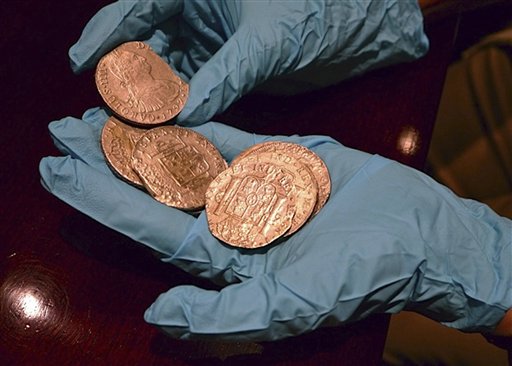
In this undated photo made available by Spain’s Culture Ministry, a member of the Ministry technical crew displays some of the 594,000 coins and other artifacts found in the Nuestra Senora de las Mercedes, a Spanish galleon sunk by British warships in the Atlantic while sailing back from South America in 1804, in a warehouse in Tampa, Fla. A 17-ton trove of silver coins recovered from the Spanish galleon was set to be flown February 24, 2012 from the United States to Spain, concluding a nearly five-year legal struggle with Odyssey Marine Exploration, the Florida deep-sea explorers who found and recovered it. (AP Photo/Spain’s Culture Ministry)
In another case of Europeans screwing over Indigenous Americans, a U.S. court has ruled that treasure from a Spanish vessel salvaged in 2007 should be returned to Spain. The Nuestra Señora de las Mercedes sunk in the Atlantic Ocean in 1804, about 100 miles west of the Strait of Gibraltar, after being attacked by a British war ship. The Mercedes had originated in Peru, which was a Spanish colony until 1821. Odyssey Marine Exploration of Tampa, Florida retrieved about 17 tons of gold and silver coins from the Mercedes, but its fate had been in limbo until a 3-judge U.S. appeals court ordered all of it returned to Spain.
Many Peruvians understandably feel robbed. The precious metals were mined and the coins were minted in the Andes region of Peru, most likely by countless Indians whose numbers already had been reduced due to disease and violence bestowed upon them by the Spanish invaders. Then, they were forced to toil in the mines, extracting the very ore they often used to make gold and silver ornaments for their own royalty in previous centuries.
“Spain’s progenitors were genocidal to our progenitors, the indigenous of Peru, thousands if not millions of whom died in underground mines going after that metal,” said Rodolfo Rojas Villanueva, an activist with the eco-cultural movement Patria Verde.
As in many such cases, it’s not the money that matters. It’s the issue of sovereignty and respect. “There existed an entity, a country that had not yet become independent but was a territory that later converted itself into an independent country, that is called Peru,” said Jose Antonio Garcia Belaunde, foreign minister in the 2006 – 2011 administration of President Alan Garcia. “The money belonged to that territory.”
Peru’s ambassador to the U.S., Harold Forsyth, put it more bluntly: “The ship departed from the port of Callao (near Lima) with a cargo of coins minted in Peru, extracted from Peruvian mines with arms and sweat of Peruvians.”
Peru has fought previously for its lost archaeological treasures. Under Garcia, it successfully persuaded Yale University to return hundreds of items taken from the Inca city of Machu Picchu a century ago by the U.S. explorer Hiram Bingham.
Just like when President Obama didn’t bow to Britain’s Queen Elizabeth II a couple of years ago (a move some White conservatives here in the U.S. considered a sign of disrespect, when in fact, our president should bow to no European royal), the people and governments of Europe often have to be reminded forcefully that the people and nations of the Western Hemisphere are no longer their colonial entities. They can’t just do to us as they please and expect us to tolerate it anymore. The sun set on their empires decades ago, and – as with many White southerners who keep reliving the Civil War – they just can’t seem to let that all go.
Both Peru and Odyssey have appeals pending before the U.S. Supreme Court whose right-wing bent in recent years should prove to be interesting in this case.
 Chief Writing Wolf