October is “National Breast Cancer Awareness Month.” Like many people, I knew someone who suffered from breast cancer. She was my Aunt Margo who died in 1989 at the age of 59. She was my mother’s older sister, and Margo’s death still impacts us today. Cancer of any kind doesn’t just affect the individual who develops it – it affects everyone who loves that person. Fortunately, our society has made great strides in the decades since this issue first came to prominence. It’s no longer a taboo subject, and its victims no longer have to live and suffer in the shadows.
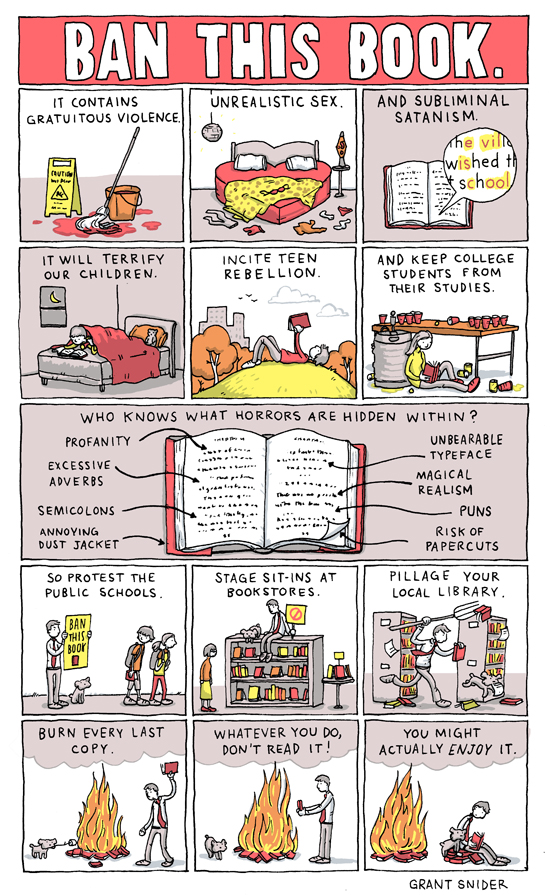
Yesterday, October 6, marked the official end of Banned Books Week. This shouldn’t be just a single annual event; it should be a daily, ongoing ritual. There will always be people who feel they know what’s best for the rest of us to read and see, and it’s up to us writers, poets, artists and bloggers to combat that arrogance. Thanks to fellow bloggers “Laith’s Ramblings” and “Travel Between the Pages” for highlighting this critical issue. As I’ve said before, no society is truly free unless they have the right to vote, to speak openly and to read whatever they please.
Nowhere are education and literacy needed than in developing nations. This year El Salvador, which endured many years of civil conflict, commenced its first annual “Literacy Brigade” as part of its National Literacy Program. For the first time in El Salvador’s history, the government is providing children with school uniforms, school materials and daily meals, while at the same time combating illiteracy among adults. It’s a daunting task, but it’s already showing results. Salvador Sanchez Cerén, the Minister of Education, notes that since 2010, illiteracy has been eliminated in 6 of the country’s municipalities and hopes to declared El Salvador’s illiteracy rate to be less than 4% within 2 years.
For three weeks this past summer, 28 university students, teachers, workers, mothers and retirees participated in this literacy brigade, bringing hundreds of donated notebooks, pencils and eyeglasses to dozens of communities. The first step in the NLP is to identify candidates with a door-to-door census conducted by NLP staff and community volunteers. The program’s paid promoters work to build local literacy circles in communities by convincing people who cannot read or write – many of whom are women over age 60 – to participate in this free literacy program, while simultaneously organizing community members and young students to share their knowledge and time as literacy teachers. Promoters often have to walk for hours to visit communities beyond the reach of public transportation or roads; often enduring harsh weather conditions, to follow the progress of the literacy circles that they helped build.
The effort obviously is starting to pay off. And, I think it’s well worth the struggle for the educators. In a tiny nation racked by so much violence, education can be a bridge towards a peaceful future. It’s necessity. People reading and writing can produce so much more than people shooting and killing.
“We must not believe the many, who say that only free people ought to be educated, but we should rather believe the philosophers who say that only the educated are free.” – Epictetus.
I should have mentioned this sooner, but this week is officially “Banned Books Week.” It’s a celebration of the freedom to read whatever you want, whenever you want. “Banned Books Week” started in 1982 in response to several challenges to textbooks and other literary pieces in schools across the U.S. The sudden surge of conservative ideology at that time was a beleaguered backlash against the supposed threat of liberalism. Some people – mostly of the religious bent – suddenly felt they knew what was proper for the rest of society to read. But, no society is truly free and democratic unless all people can read and write and all eligible citizens can vote. Here in Texas, even moderates have had a hell of a time striking back against the archaic conservatives of the state school board, which unknowingly made Texas the laughing stock of the nation and the world.
According the American Library Association, there 326 challenges reported to the Office of Intellectual Freedom in 2011; many others may have gone unreported.
Here are the 10 most challenged titles of 2011:
ttyl; ttfn; l8r, g8r (series), by Lauren Myracle
Reasons: offensive language; religious viewpoint; sexually explicit; unsuited to age group
The Color of Earth (series), by Kim Dong Hwa
Reasons: nudity; sex education; sexually explicit; unsuited to age group
The Hunger Games trilogy, by Suzanne Collins
Reasons: anti-ethnic; anti-family; insensitivity; offensive language; occult/satanic; violence
My Mom’s Having A Baby! A Kid’s Month-by-Month Guide to Pregnancy, by Dori Hillestad Butler
Reasons: nudity; sex education; sexually explicit; unsuited to age group
The Absolutely True Diary of a Part-Time Indian, by Sherman Alexie
Reasons: offensive language; racism; religious viewpoint; sexually explicit; unsuited to age group
Alice (series), by Phyllis Reynolds Naylor
Reasons: nudity; offensive language; religious viewpoint
Brave New World, by Aldous Huxley
Reasons: insensitivity; nudity; racism; religious viewpoint; sexually explicit
What My Mother Doesn’t Know, by Sonya Sones
Reasons: nudity; offensive language; sexually explicit
Gossip Girl (series), by Cecily Von Ziegesar
Reasons: drugs; offensive language; sexually explicit
To Kill a Mockingbird, by Harper Lee
Reasons: offensive language; racism
I still find it amazing – actually appalling – that, in the U.S., nudity and sexuality are considered obscene, while violence – even in the extreme – is viewed with flippant disregard. Other countries have it right in that they regard violence as the true obscenity.
Please also check out the Literary Freedom Project, which has the same goal. While this officially only lasts until October 6, we can never let down our guard for the sake of literary freedom.
Singer Andy Williamsdied at his home in Branson, Missouri, Tuesday night after a year-long battle with bladder cancer, his family announced today. He was 84. Born on December 3, 1927, in Wall Lake, Iowa, Williams began his career as a child, singing in a quartet with his brothers. As an adult, Williams embarked on his career, which spanned six decades and produced several hit songs – including the omnipresent “Moon River” – and 17 gold or platinum albums.
In 1962, “The Andy Williams Show” debuted on NBC and ran for nine seasons. He also appeared in a dozen other TV specials between 1959 and 1987. He was perhaps best known for his Christmas specials. By the early 1990’s, however, he found his brand of crooning had lost appeal among the rock and hip-hop generation. He then opened the Moon River Theatre in Branson and performed regularly on its stage. It was the first non-country music venue in the area.
In November 2011, Williams announced that he’d been diagnosed with bladder cancer.
“The entertainment industry has lost a giant piece of its living history today, but Williams’ legacy will forever be enshrined in the annals of music and television,” said Neil Portnow, the president of the National Academy of Recording Arts and Sciences. “Our deepest condolences go out to his family, friends, and all who will miss this American treasure.”
This is Williams performing “Moon River” on his show. The song was written and composed by Johnny Mercer and Henry Mancini for the 1961 movie “Breakfast at Tiffany’s.”
Here’s another one of my favorite songs, “Girl from Ipanema,” that Williams performed with Antonio Carlos Jobim in 1965.