Tag Archives: Native Americans

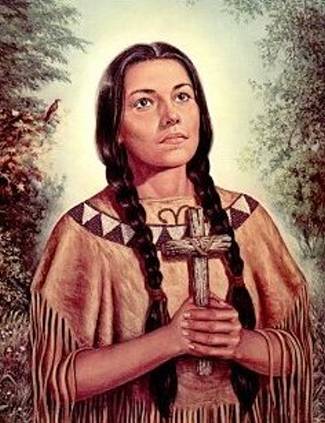
Kateri Tekakwitha – First Native American Catholic Saint

In a historic move, Pope Benedict XVI canonized the first Indigenous American into sainthood on Saturday, October 20.  Kateri Tekakwitha was born in 1656 to an Algonquin mother and a Mohawk father in what is now central New York State.  She was baptized into the Roman Catholic Church at age 20.  After being rejected by her family, she moved to a Jesuit mission near Montreal, Canada, where she taught children until her death four years later.

American Indians have been appealing for Kateri to be canonized for more than a century.  She was given the special status of venerable in 1942, the first step towards sainthood, and was beatified in 1980.

A person must be deceased for at least 5 years, even before he or she can be considered for sainthood in the Roman Catholic Church.  Afterwards, there are 4 steps in the process.

  1. When the subject arises that a person should be considered for Sainthood, a Bishop is placed in charge of the initial investigation of that person’s life.  If it is determined that the candidate is deemed worthy of further consideration, the Vatican grants a “Nihil Obstat,” a Latin phrase meaning “nothing hinders.”  Henceforth, the candidate is called a “Servant of God.”
  2. The Church Official, a Postulator, who coordinates the process and serves as an advocate, must prove that the candidate lived heroic virtues.  This is achieved through the collection of documents and testimonies that are collected and presented to the Congregation for the Causes of Saints in Rome.  When a candidate is approved, he/she earns the title of “Venerable.”
  3. To be beatified and recognized as a “Blessed,” one miracle acquired through the candidate’s intercession is required in addition to recognition of heroic virtue (or martyrdom in the case of a martyr).
  4. Canonization requires a second miracle after beatification, though a Pope may waive these requirements.  (A miracle is not required prior to a martyr’s beatification, but one is required before his/her canonization.)  Once this second miracle has been received through the candidate’s intercession, the Pope declares the person a “Saint.”

More than 700 Native Americans, many in full regalia, took part in the ceremony in St. Peter’s Square honoring the woman known as the “Lily of the Mohawks.”  A choir singing an Indian hymn was among the participants.  At a Mass on Monday, the 22nd, inside St. Peter’s Basilica, Native Americans will conduct a “smudge” ceremony by burning sage, according to an American church official.

Among those in attendance was a delegation from the Archdiocese of Seattle that included Jake Finkbonner, a 12-year-old boy whose recovery six years ago from necrotizing fasciitis, a rare flesh-eating disease, was accorded the status of a miracle by the church.

His survival was anything but certain when his parish and Native Americans around the U.S. and Canada began praying to Kateri.  His recovery was the key in the decision to canonize Kateri, said the Rev. Wayne Paysse, executive director of the bureau of Catholic Indian Missions.

Finkbonner’s family, who are members of the Lummi tribe, live in Bellingham, Washington.

Anyone who knows me personally, or follows this blog, is fully aware of my harsh views of the Roman Catholic Church.  The Church’s relationship with the Western Hemisphere’s native peoples is written in blood.  It’s the longest and most widespread chronicle of genocide in world history.  Of course, that’s pretty much the case with any branch of Christianity.  Early Spanish conquerors viewed Indigenous Americans with contempt and tried to destroy them.  Spain’s Queen Isabella I put a stop to the bloodshed, however, demanding that her representatives in what are now México and the United States baptize the Indians into Roman Catholicism.  Many Indians conceded; more I think as a matter of survival than acceptance of the strange, new religion.  Nothing can ever compensate for such brutality.  But, the canonization of Kateri is still a measure of goodwill.

1 Comment

Filed under News

Columbus Day – Whatever!

The Christopher Columbus monument in Barcelona, Spain

Today is Columbus Day in the United States where narrow-minded Americans perpetuate the myth that Christopher Columbus discovered this country.  It remains a popular fallacy despite obvious proof that the Western Hemisphere was not devoid of humans when Columbus and his fellow seafarers arrived.  As someone who is part Indian (Mexican), this is a particularly vexing situation.  But, as someone who is also Caucasian (Spaniard and German), I know I can be critical.  For one thing, historical references can’t confirm exactly where Columbus landed.  Some say present-day Hispaniola; others state Cuba.  But, it’s pretty well understood that he didn’t make it to the American mainland.

We also have to understand some other facts that slip by the history texts, which have always had a Euro-Christian slant.  Italian-Americans celebrate Columbus as one of their own.  Evidence has surfaced in recent years, however, that the intrepid explorer was not actually a humble Italian weaver, but a Polish immigrant.  Manuel Rosa, a professor at Duke University, claims that Columbus was the son of Vladislav III, an exiled king from Poland.

More importantly, though, Columbus had to seek help from Spain to finance his voyage.  In the late 15th century, Italy was not actually a country, but a collection of city-states; fractured and in constant conflict.  Apparently, no member of Italian royalty saw the value in Columbus’ grand scheme.  Thus, he turned to Spain and received approval from Queen Isabella – one of my paternal ancestors.

Another myth is that Columbus had deliberately set out to discover the Americas, or traveled as a result of some divinely inspired vision.  In reality, he wanted to find a westward route to India’s east coast and thus gain an advantage in the lucrative spice trade.  Spices were as valuable as gold and silver at the time.  Columbus believed Asia was where the Americas are and initially thought he’d arrived somewhere off the coast of China.  Then, he thought he’d actually made it to India and thus, called the Taíno peoples of the Caribbean “Indians.”

Yet another major fact that goes unreported is that Columbus was not the first European to arrive in the Western Hemisphere.  As Jared Diamond points out in his seminal book Collapse How Societies Choose to Fail or Succeed, scientists now realize that Norse Vikings arrived in North America nearly 500 years earlier.  In the 1960’s, archaeologists unearthed remnants of a village in present-day Newfoundland known as “L’Anse Aux Meadows.”  Norse literature also points to a land the Vikings called “Vinland.”  The Norse had begun their march across the North Atlantic around A.D. 800; first populating the Orkney, Shetland and Faeroe islands, then moving onto Iceland and Greenland.  There’s even some evidence that they’d made as far down North America’s eastern coastline as present-day Florida.  But, that remains to be proven.  By the time they landed in Newfoundland, however, they’d depleted much of their own energy and resources; thus any permanent settlement was unlikely.

But, here’s something even more important: people first arrived in the Americas between 15,000 and 25,000 years ago, if not sooner.  They’d branched out across the entire Western Hemisphere, even reaching the southernmost tip of South America, long before Columbus started thinking about his trip.  They built complex, intricate and highly-advanced societies – without firearms and without horses or cattle – and lived as best they could for all those millennia.

I’ve seen colorful illustrations of European men adorned in velvet and silk arriving on virgin American shores; their majestic ships moored in the distant background, carrying oversized crucifixes to which the scantily-clad Indians responded by dropping to their knees in automatic subjugation.  But, it’s just not true.  Columbus’ venture was a matter of commerce, not faith.  The concept of spreading Christianity came later, as Spaniards began settling into México and then, as the English and the French began moving westward across North America.  Some Indians allowed themselves to be converted to Christianity; more as a matter of survival, though, than some sort of mystical divine intervention.  Others, however, strongly resisted and were subsequently beaten down by White settlers who used their religiosity more as a tool of oppression than benevolence.

Investigations into the history of the Americas are ongoing, but in recent years, research has gradually proven the Siberian migration hypothesis to be true.  One study found “a unique genetic mutation” that exists only in both the indigenous peoples of Siberia and Native Americans.  Other recent data suggests that Japanese seafarers made it to South America’s Pacific coast around 3000 B.C.  Scientists have found similarities in pottery among Japan’s Jomon culture and coastal Ecuadorian Indians.  They also noticed that “the nautical capability of Chinese sea-going rafts” were identical to those of indigenous Peruvian and Ecuadorian peoples.  Moreover, archaeologists have found early specimens of the peanut – which is native to South America – in China.  That humans populated just about every corner of the Western Hemisphere is testament to overall human ingenuity and determination.  That they – we – have survived 500 years of disease, exploitation and genocide is even more impressive.

None of this is historical revisionism, as some staid elitists might claim.  The facts are now coming forward and being revealed, whether the old-timers like it or not.  It’s a mixed heritage.  I’m glad, for the most part, that Europeans made it over here.  But, what they did to the indigenous peoples cannot be underestimated or dismissed.  While nothing can be done about it now, it’s futile to ignore historical facts – even if it puts a damper on all those Columbus Day picnics and yard sales at Wal-Mart.

2 Comments

Filed under Essays

Crossroads of Development

From left, Tricia Bear Eagle, Helen Red Feather, Rudell Bear Shirt and Edward Jealous of Him, wait for tourists near the site of the Wounded Knee Massacre on the Pine Ridge Indian Reservation at a self-made visitor’s center.

The Pine Ridge Reservation in South Dakota is one of the most impoverished communities in the nation.  Unemployment hovers around 80%, and most residents subsist on government handouts.  Home to the Oglala Sioux, Pine Ridge sits near Mount Rushmore and the Dakota Badlands; both prime tourist destinations.  Most visitors, however, simply bypass Pine Ridge.  There are no hotels, museums, gift shops or restaurants; there aren’t even many public restrooms.

The 2.7 million-acre reservation, however, is ripe for development, and tourism could dramatically alter the economic future for the Oglala Sioux.  But, like most Native Americans, the Sioux are suspicious of outsiders.  Their land is sacred, and – after years of broken treaties and experiencing painfully racist marginalization – they’re naturally reluctant about the prospect of other people arriving with promises of financial security.  It’s not difficult to understand why.

“When you take a community of people where at one point our language was outlawed and parts of our culture were outlawed, it’s hard for us to, I guess, open up to the idea of sharing that in a way to make money off of it,” said Nick Tilsen, executive director of Thunder Valley, a nonprofit on Pine Ridge set up to keep traditional Lakota culture alive among young people.

Other Indian nations have opened their land to tourism and development.  The Navajo in the Southwest, for example, welcomes some 600,000 visitors annually who spent $113 million in 2011 alone.  In Oklahoma, nearly 45,000 people visited the Cherokee Nation’s Heritage Center museum last year.

But, the Oglala Sioux have just one tribally run casino-and-hotel complex, the Prairie Wind, on the western side of the reservation.  They recently opened a smaller casino in Martin, a town near the reservation’s eastern edge.

The community, Tilsen said, is not “totally against” development.  “I think we’re at the stage of, ‘What parts do we want to protect and what parts are we willing to share and what does that look like?’”

Pine Ridge is the site of the Wounded Knee Massacre, where more than 250 adults and children were killed by the 7th Cavalry in 1890.  Many residents, especially community elders, simply feel the area shouldn’t be turned into a tourist attraction with a museum.  Such development would be disrespectful to the dead in their view.

A museum commemorating the massacre was ransacked and its contents lost in 1972.  Another museum dedicated to the massacre draws thousands of people annually, but it’s 100 miles north of the reservation in Wall, South Dakota.  The tribal and federal governments are the two biggest employers, but many residents travel outside to find work or sell hand-made goods and trinkets for a few dollars.  In June, the National Park Service and the Oglala Sioux reached a new agreement that calls for creation of the nation’s first tribal national park at Badlands National Park – an endeavor that might also attract tourists and jobs.  Congress still must approve the idea.

But, the Oglala Sioux have relied too much on the federal government anyway with housing and food subsidies.  They could allow outside investment, but still retain control over any development on the reservation.  They don’t have to relinquish absolute authority to the federal or even state governments.  Establishing a museum and library highlighting the Wounded Knee Massacre wouldn’t be disrespectful, if the Oglala Sioux managed them.  I feel it would have just the opposite effect – it would make people aware of exactly what happened that winter day in 1890.  Tribal residents could tell the real story and not the John Wayne-style version that most Americans see and read about.  They have to do more for their children’s future than just selling pretty baskets and wind chimes on the side of the road.  They have to take their lives back from the clutches of a bitter history.

1 Comment

Filed under News

Fiercely Savage Stereotyping

Earlier today I visited my local barbershop in suburban Dallas.  It’s literally the quintessential small-town barbershop with a candy-stripe barber’s pole out front and an ancient Coca Cola vending machine inside.  The two full-time barbers are as folksy as they are friendly; subdued and quietly professional.  But, I prefer it to an overpriced salon any day.  A television sits atop the vending machine, and the barbers frequently have it turned on to old programs.  I often wonder if they can’t get anything except TV Land.  Today I saw the end of a “Have Gun, Will Travel” episode.  That was even before my time!  I busied myself with a magazine, however, and didn’t pay attention to it.  I forgot the title of the next show that came on – although it may have been another episode of the same series – but I distinctly remember a line from one of the characters; a blonde Caucasian woman screaming something about “all Indians are savages.”  I could forgive the label, considering the time in which that show was produced; just like I could forgive Theodore Roosevelt (one of my favorite presidents) for his Eurocentric views.  He was a product of his time.  We all are.

Yesterday, however, I was cruising through my slew of emails and noticed one with the word “Comanche” in the title; a post someone had made on one of the many Linked In groups to which I belong.  He was publicizing his recently-published book about a Civil War veteran returning home in the immediate aftermath of the conflict.  What does the Comanche Indian nation have to do with that?  I have no idea.  But, the blurb stated upfront that the Comanches were “fierce and savage fighters.”  There’s that word again – “savage.”  Savage as in “noble savage,” as in A Man Called Horse savage, but not Dances with Wolves savage.  I had to look at the email date again – July 9, 2012.  If I could somehow earn a dollar every time I read about Indians who were “fierce” and “savage,” I could pay off my student loans.

“Savage,” along with “fierce,” always finds its way into characterizations of Indigenous Americans.  It’s like you can’t describe the Pacific Ocean without using the word “deep” at some point in the verbiage.  Rarely, I’ve noticed, do I see such terms as “advanced,” “agrarian,” or “intellectual” in conjunction with Native Americans.  They’re always “fierce,” “wild” and, of course, “savage.”  Even contemporary writers can’t seem to get away from those words.  It’s part of the vernacular; like a separate dictionary was composed by the Euro-Christian scribes a century ago to describe Indians when writing about them.  I reach for a 30-something-year-old thesaurus when I want to find different adjectives.  Some writers of the western genre clearly reach for that stock encyclopedia of stereotypical definitions.

In the “Old West,” Native Americans are never “people;” they’re “Indians,” or “natives.”  They’re grouped into “tribes,” instead of “nations,” or “communities.”  They still live in “tipis,” not “houses,” or any kind of stable structures.  They wear “animals skins,” not “clothes.”  They have “medicine men,” not “doctors,” or “physicians.”  They tell “stories,” but they don’t relay facts.  They worship the sun and the moon, but they don’t seem to understand their machinations.  The older ones can offer sage advice about life’s little mysteries, but overall, none of them comprehend the greater purpose of humanity.

I shouldn’t be surprised.  What can we expect from non-Indian writers?  I posted a comment to that one writer’s statement, remarking about such stereotypes.  He came back saying his book had nothing to do with Native Americans.  Huh?  Then, why the Comanche Indian correlation?  Oh, I get it!  The White Civil War soldier returning home had become as “fierce” and “savage” as an Indian because the Negro people were now free.  I guess.  It still doesn’t make sense.  It’s almost not worth the trouble even to discuss it – almost.

Believe me when I say I can forgive the stereotypes of 1950’s era television.  They didn’t know better back then.  But now?  We still have that now?  In the 21st century?  That only makes me savagely and fiercely angry!  Oh, God!  Now, I owe myself two dollars.

1 Comment

Filed under Essays