Tag Archives: texas politics

Why Have the Democrats Abandoned Texas?

Immediately after he signed the Voting Rights Act into law on August 6, 1965, President Lyndon Johnson turned to his staff and said, “I’m afraid we’ve just handed the South over to the Republican Party.”  He didn’t realize how prescient a statement that was.  Many White southerners and their elected officials were appalled.  How dare Johnson, a fellow southerner, wreak such havoc on a system that – in their minds – had worked just fine for nearly 200 years.  After the tumultuous 1964 election season, in which people were beaten and sometimes killed for helping people register to vote or marching in favor of comprehensive voting rights, the 1965 Voting Rights Act ensured that every eligible U.S. citizen could cast a ballot, as promised by the U.S. Constitution.  It struck down two key stumbling blocks: the poll tax and the so-called “grandfather clause.”  It’s tough to imagine now, but until 1965, people actually had to pay a special tax to vote.  In the Southeast, the “grandfather clause” was designed by Whites primarily to keep non-Whites from voting; if a person’s grandfather could vote, it declared, then that person could vote as well.  But, since many people – mostly Blacks, Hispanics and Indians – were forbidden to vote in years past, their grandchildren couldn’t vote.  It was a deliberately vicious cycle that prevented the most oppressed members of society from having an impact on elections.

Southern Democrats weren’t quite like their New England and West coast counterparts.  The southerners referred to themselves as “Dixiecrats,” once the name of an actual political party.  They associated the Republican Party with those pesky northerners who had destroyed southern society and trampled on their precious “state’s rights.”  But, as the Democratic Party became more progressive in the 1960’s and 1970’s, many southerners found it distasteful.  It mostly centered on race; some older Whites simply didn’t consider Blacks and other non-Whites as equals and couldn’t stand the thought of an integrated society.  It went against their cultural values and how they viewed America.  The Democratic Party had lost its way, as far as they were concerned.  And, the Voting Rights Act pushed many over the edge and into the Republican camp.

Slowly but surely, however, southern Democrats began abandoning the Democratic Party.  Some of the most famous Republican leaders actually had started out as Democrats: Strom Thurmond, Jesse Helms and even Ronald Reagan.  Current Texas Governor Rick Perry first ran for public office in 1984 as a Democrat, but switched to the Republican Party in the 1990’s.  The great southern Democratic exodus actually didn’t begin, however, until after Reagan won the 1980 presidential election.  Reagan had surprised the nation when he won the 1966 California governor’s race.  California already had become a bastion of liberalism and progressive ideology, so it was shocking that a conservative Republican – even if he was a former actor – could actually take the mantle of the state’s highest office.  Reagan won reelection four years later and sought the Republican Party’s presidential nomination in 1976.  But, incumbent President Gerald Ford wouldn’t relinquish the helm of the GOP to Reagan.  The Republican Party fractured over that trite battle and lost the presidency to Jimmy Carter, a Democrat.  Besides, after the disastrous Watergate affair, political pundits declared the GOP practically dead; claiming it wouldn’t recover any time soon.  When Richard Nixon departed the White House in 1974, he didn’t just leave his career in tatters; he left the entire GOP in the same state.  Or, so it seemed.

The Carter administration proved disappointing.  Even with Democrats controlling both houses of Congress, Carter couldn’t seem to get a grasp on national issues.  The various energy predicaments, coupled with the Iranian hostage crisis that erupted in 1979, only solidified Carter’s ineptness in the minds of many Americans.  In fact, the entire decade of the 1970’s seemed like an utter and dismal failure; a massive stain on our nation’s history.

But, Ronald Reagan almost single-handedly changed the national mood.  He brought a sense of renewed optimism and an infectious degree of patriotism.  Using his charm and personal wit, he made Americans feel proud; a sentiment that had been absent for years.  But, Reagan also reinvigorated faith in the Republican Party – a faith that spread like the evangelical fervor to which it was often linked.  Reagan often told southern Democrats they were really Republicans at heart; “they just hadn’t figured it out yet.”  Thus, commenced that mass pilgrimage into Republican arms, especially in the Southeast.  And, just as Lyndon Johnson had insinuated, much of it was due to race.

In January of 1999, when George W. Bush was sworn in to his second term as Texas governor, Senator Kay Bailey Hutchison said that the state was becoming “increasingly conservative.”  I looked at my TV screen and asked, ‘When was it ever liberal?’  But, as I muse over Texas politics, I have to ask an even more important question: why has the Democratic Party abandoned us?

When he first ran for president in 2000, George W. Bush took 59% of the Texas vote; not surprising since he was then governor and had a somewhat stable management record in the state.  Four years later, he took 61.1% of the Texas vote; again not necessarily surprising.  Bush was so certain he’d take Texas, he didn’t even campaign here in 2004.  By then, the Texas political landscape had turned crimson red.  Yes, pockets of blue stubbornly persist, mainly in the far southern and far western regions.  But, without a doubt, the Republican Party dominates.

Yet, while Johnson felt that signing the 1965 Voting Rights Act practically handed the South over to the Republican Party, it looks now like the Democrats have done much the same thing with Texas.  It seems they’ve practically ceded the state to the GOP.  People like me who’ve voted mostly Democrat our entire lives feel equally forsaken.  Recent events, though, might explain why.

When he sought the Texas governorship two years ago, Bill White, the former mayor of Houston, not only failed to invite President Obama to campaign for him here, he refused to accept an offer from the White House for the President to visit the state on his behalf.  White didn’t even want Joe Biden to drop by – which, in some ways, I can actually understand.  But then, White criticized Governor Rick Perry for referring to President Obama as only “Barack Obama” in a campaign ad, noting that the term “President of the United States” was a special designation and commanded the proper respect.  So, while White openly respected the Office of the President of the United States, he still didn’t want President Obama down here.  Therefore, Obama stayed away.  White lost with 42% to Perry’s 55%.  Not that Obama’s presence would have helped White.  But, it’s always the thought that counts.

Texas has always played a pivotal role in presidential elections.  For every election from 1872 to 1924, and from 1928 to 1948, Texas voted mostly for the Democratic candidate.  Dwight D. Eisenhower won Texas during his two presidential runs, but that may have been, in part, because he was a native son and a World War II hero.  Texas returned to its Democratic obsession throughout the 1960’s.  But, in 1976, Carter became the last Democrat to win Texas in a presidential race.

When he became chairman of the Democratic National Party in 2005, Howard Dean, the former governor of Vermont, launched his “50 State Strategy” to get more Democrats elected to office, starting with the 2006 mid-term elections.  Critics dismissed Dean – whose 2004 presidential run was known for a primal scream amidst a speech following the Iowa caucuses – and denounced his plan as crazy.  But, it worked; the Democrats gained control of both houses of Congress in 2006 and, of course, the White House two years later.  But, the premise of the “50 State Strategy” was to broaden the DNC’s reach across the nation, instead of concentrating its resources and energy on the East and West coasts.  It was a noble and ambitious effort to rebuild the party that had let itself be defined by the more radical voices of their Republican counterparts.  The DNC had gone too far to the left; even shutting out moderates and alienating independents.  Now, just the opposite is happening with the Republicans; they’ve moved so far to the right that the “Party of Lincoln” has made compromise a proverbial four-letter word.

But, as I – a technical writer, not a political scientist – analyze both the Democratic and Republican parties, I understand that ideology is the principal factor.  Galvanized by George W. Bush’s defeat of Ann Richards in the 1994 governor’s race, Republicans in Texas launched concerted efforts to inject more of their ilk into the state legislature.  With a reconfiguration of district lines in 2001, they succeeded; the 2002 elections allowed Republicans to take command of the state legislature for the first time in 130 years.  Texas Republicans now like to proclaim they booted out the Democrats after decades of quasi-authoritarian rule.  They make it sound as if Texas had been in the vice grip of extremist liberals; a barren wasteland where feminists, homosexuals, abortion doctors and other miscreants ruled fearlessly and ruthlessly, until a handful of brave Reagan disciples dared to stand up to them.  But, when I look at those ancient “Dixiecrats,” I realize the Republicans of today are the Democrats of yesterday.  There’s no real difference.  The name has changed, but the conservative dogma remains.  And, remember: it all goes back to race, or more importantly, the Democrats’ philosophy that race or ethnicity shouldn’t matter in a person’s success in this country.  It’s really as simple as that; race is the central element of that change.  And, from that, extends other issues, such as gender and religion.

Amidst the chaos, I ask again: why has the Democratic Party abandoned Texas?  Several years ago, a cousin of mine noted that many Hispanics had forsaken their Roman Catholic roots and turned to Protestant denominations for spiritual guidance.  Some had even switched to Baptist or Pentecostal churches, which – if you knew Roman Catholics, especially Hispanics – you’d understand how heretical that is.  But, my cousin pointed out that the Roman Catholic Church apparently hadn’t addressed the needs of the Hispanic community, particularly its immigrant members.  She claimed the Church just wanted their money and unmitigated loyalty.  That, of course, is true of most any religious outfit.  But, in reflecting how passionate people can feel about politics, the same scenario applies to Democrats and their glaring willingness to accept that Texas is a Republican stronghold.  The late former House Speaker Thomas “Tip” O’Neill, a Democrat, once said that “all politics is local.”  That’s certainly true.  But, when your national leaders don’t pay attention to the locals, they shouldn’t get upset when those votes end up holding hands with the opposition.

1 Comment

Filed under Essays

Quote of the Day

“Confederate apologists have spent almost 150 years trying to change the Civil War into something that it was not.  Here’s what it was: an insurrection against the United States government with the main goal of maintaining the institution of African slavery.”

– A group of 12 Texas lawmakers, in a letter opposing a proposed marker on the Texas Capitol campus recognizing the Confederacy.

Leave a comment

Filed under News

Quote of the Day

“I really feel quite hypocritical about hairy-legged males who will never be pregnant and never have that life-altering decision to make being the ones writing the rules for the opposite gender as though we had nothing to do with their condition.”

– Texas state Sen. Jeff Wentworth, R-San Antonio, not shying away from his pro-choice stance in a heated primary.

Leave a comment

Filed under News

Second Quote of the Day

“He’s like a bad TV sitcom that’s just run too long.”

Glenn Smith, a Democratic operative who was an adviser to Gov. Ann Richards, on the speculation that Gov. Rick Perry is laying the groundwork to run for another term as Texas governor.

Leave a comment

Filed under News

Rick Perry Slinks Back to Texas

As the battle for the Republican Party’s presidential nomination drags on like a serial horror flick – with Mitt Romney trying to convince voters he’s “severely conservative;” Rick Santorum proclaiming how badly he hates queers and birth control; Newt Gingrich hoping there are enough angry old White men out there to put him in the Oval Office; and Ron Paul just sticking around – Rick Perry has returned to the Texas governor’s mansion and melts back into his previous life.  Governor “Good Hair” had hoped his Southern – or rather, uniquely Texas charm – would sway conservative voters across the nation like it did in the Lone Star state.  Since entering public office as a Democrat in 1984, Perry had never lost a political race; not even a primary – until now.  He earned a mere 10% in Iowa’s January 3 primary and skipped campaigning in New Hampshire to focus on South Carolina where I’m sure he thought he could win easily.  But, initial polls in one of the most scarlet of Republican states showed he was not the golden favorite.  So he bowed out before South Carolinians even headed to the polls and threw his support behind Gingrich.

Now, after the shock and awe of national politics, he’s back home.  I must have blinked and missed news of his return flight to Austin.  Regardless, Perry might have wished he’d never jumped into this year’s presidential race.  Politics at any level has become a blood sport in this nation.  Ever since the Watergate debacle, when Richard Nixon’s gross ambitions compelled him to flaunt the law and abuse his authority, the American people have come to expect the worst from their elected officials – and from those who aspire to join them.  But, like his predecessor, George W. Bush, Perry hoped he could turn his successful Texas governorship into an equally successful presidency.  Success, in this case, is relative.

Either way, it didn’t work, and now Perry struggles to recoup his tattered reputation even from fellow Texans.  An Associated Press poll shortly after he left the race showed that 42% of registered Texas voters approved of the job he’s doing as governor – a 10-point drop from just a year earlier – and 45% believed his failed presidential campaign hurt Texas’ image.  This latter fact is surprising, given Texans’ sense of independence.  We’re not prone to show concern for how others view us.  Californians and New Englanders often find this out the hard way.

Now, the Texas Democratic Party – which often looks like a Navajo family living amidst Nazis – is demanding more accountability from a governor who spent 6 months on the road trying to win the GOP nomination.  The state’s security tab for Perry’s run stood close to $800,000 at the end of January, but rose as invoices for things like airfare and rental cars came due.  It now stands in excess of $1 million, with many of those expenses for overtime pay for law enforcement personnel who protected Perry and his family while on the campaign trail.  Texas Democrats want Perry to reimburse the state.

“What a waste of money,” lamented Rep. Jessica Farrar (D-Houston), leader of the Texas House Democrats.  “Why can’t his private donors pay for it?”

But, Perry’s camp balks at the prospect, repeatedly claiming that the Texas Department of Public Safety is charged with protecting the governor and his family no matter the circumstances.

“Governor Perry is governor no matter where he goes, and DPS has a policy of providing security for governors and their families everywhere they travel — as they have back several administrations — just as many other states do, and as the federal government does for the president through the Secret Service,” Perry spokeswoman Lucy Nashed told the Texas Tribune last month.

Last year New Jersey Governor Chris Christie encountered a similar problem with personal security expenses, when he took a helicopter to travel to his son’s basketball game; a tab for which he reimbursed the state.  Granted, a kid’s sporting event doesn’t command quite the scrutiny as a presidential campaign race.  But, there’s a significant principal at stake.  Most Texans didn’t ask for Perry to run for president.  Even moderate Republicans were satisfied to see him remain as governor and deal with the state’s growing home foreclosure crisis, unemployment and border issues.

There’s another figure I find interesting.  In a poll the Dallas Morning News took of its readership last month, 53% of respondents stated Perry should not seek another term in office.  He’s already the longest-serving governor in the state’s history; having served since December 2000, when the U.S. Supreme Court decided to stop the Florida recount and declared Bush the winner.  Perry won overwhelmingly in 2002 against Democratic challenger Tony Sanchez, taking 58% of the vote.  That didn’t surprise anyone.  In the aftermath of the 09/11 terrorist attacks, the surge of national pride assured any Republican from the South an election victory.  But, Perry – with the sewage mentality that’s become part of political machinations – had maligned Sanchez with “suitcase ads;” alleging the latter had ties to a Texas savings and loan collapse in the late 1980’s (which, if anyone remembers correctly, was a Republican-inspired mess) and vicariously to Mexican drug dealers who had laundered money through the institution.  That Sanchez had no direct connection to that particular S&L and absolutely none to Mexican drug dealers was irrelevant to some Texas voters.  It seemed even a fair-skinned, blue-eyed, Texas-born, millionaire businessman who speaks perfect English couldn’t beat Perry because the former is surnamed Sanchez.

The 2006 governor’s race proved a bit more challenging for Perry.  The national GOP was on the defensive, following the government’s pathetic response to Hurricane Katrina and growing anger with the Iraq War.  Perry faced 4 rivals: Democrat Chris Bell, an attorney; Libertarian James Werner; independent Carole Keeton Strayhorn, the state Comptroller who billed herself as “one tough grandma;” and independent Richard “Kinky” Friedman who wanted to become Texas’ “first Jewish – cowboy – poet.”  I voted for Friedman because I was still angry with the Democratic Party’s pansy attempt to unseat Bush 2 years earlier, despite the mud-slinging and name-calling dished out by the GOP.  When I told some friends about my decision, they looked at me like I’d said I was joining the “Ronald Reagan Glee Club.”  Perry won, but with only 39% of the vote.  Bell garnered nearly 30% and Keeton Strayhorn and Friedman each got more than 10%; tallies that made the state’s Republican and Democratic parties take notice.

The 2010 Texas governor’s race turned out less dramatic and quirky.  It was a seemingly straight Republican – Democrat ticket, with former Houston mayor Bill White being Perry’s only real adversary.  It’s only highlight came when Sen. Kay Bailey Hutchison tried to snatch the governorship from Perry.  But, Perry succeeded in painting Bailey Hutchison as a true Washington insider; a curious proclamation coming from one staunchly conservative Texas Republican against another.  Perry trounced Bailey Hutchison in the March primary and won with 55% of the vote; in part because White couldn’t seem to form a cohesive campaign, but also because of the growing influence of the “Tea Party.”  Perry seemed to be more self-assured, however, as he didn’t agree to debate White and the other 2 candidates.  Perry appeared to view his role as divinely-inspired; that he somehow had been ordained to be Texas governor – and would hold onto the job like a pope.  The day after his 2010 win, the Dallas Morning News declared that Perry was set for the “national stage,” which many of us feared.  But, Perry would have none of it and repeatedly claimed that he wouldn’t seek the presidency.  Then, he went back on his word and, in an August 13 speech to some 700 conservative activists in South Carolina, announced he would run for president.  Again, I’m sure he felt divinely-inspired – until all hell broke loose around him.  He ended up making an absolute fool of both himself and – to some extent – the entire state of Texas and can’t find anything good to salvage from it.

If there’s a ‘lessons learned’ type of scenario here, it’s rather simple – don’t get too full of yourself.  George W. Bush, for example, was accustomed to Texas Democrats in the Austin state house; people who were often just “DINO’s”: Democrats in Name Only.  The southern Democrats of yesteryear are the Republicans of today; remember, Ronald Reagan and Strom Thurmond had begun their political careers as Democrats.  But, when Bush got to Washington, he faced the Kennedy and Pelosi type of Democrats; the east and west coast liberals who didn’t take kindly to his southern-style patriotism.  Perry, in a way, experienced the same kind of sanguineous bathwater; there’s another world outside of Texas, and not everyone will love you!

Now, Perry sinks back into his duties as governor of the 2nd largest state in the union – perhaps trying to be as obscure as a public official can be – and faces a constituency that isn’t as adoring as before; a constituency that questions his motives and ambitions.  As a life-long Democrat who’s voted Republican only once (and still regrets it), I’m naturally not fond of Perry – but not just from a party affiliation standpoint.  Texans like their characters – especially in politics – and Perry certainly delivered.  But, he may have delivered too much of stereotypical Texas to the nation during his presidential jaunt.  After the dismal presidency of George W. Bush, I’m certain the American populace isn’t eager to see another Texas governor in the Oval Office – at least not for a while.  But, they definitely don’t want someone like Perry who couldn’t remember the legal voting age, the date of this year’s presidential elections and – gosh, there was something else.  Oops!  There’s an old country song with the refrain, “God bless Texas.”  After living through more than a decade of Perry’s leadership, I have to pleadingly paraphrase, “God, please bless Texas!”

Leave a comment

Filed under Essays

2nd Quote of the Day

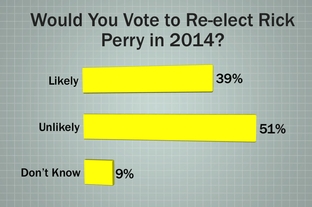
“He’s both as popular and as unpopular as he’s ever been.”

– Jim Henson, co-director of a University of Texas/Texas Tribune poll, about a question with 51% of respondents saying they would not vote for Perry again


39% should be a familiar number for him

Courtesy Charles Kuffner, Houston Chronicle

Leave a comment

Filed under News