
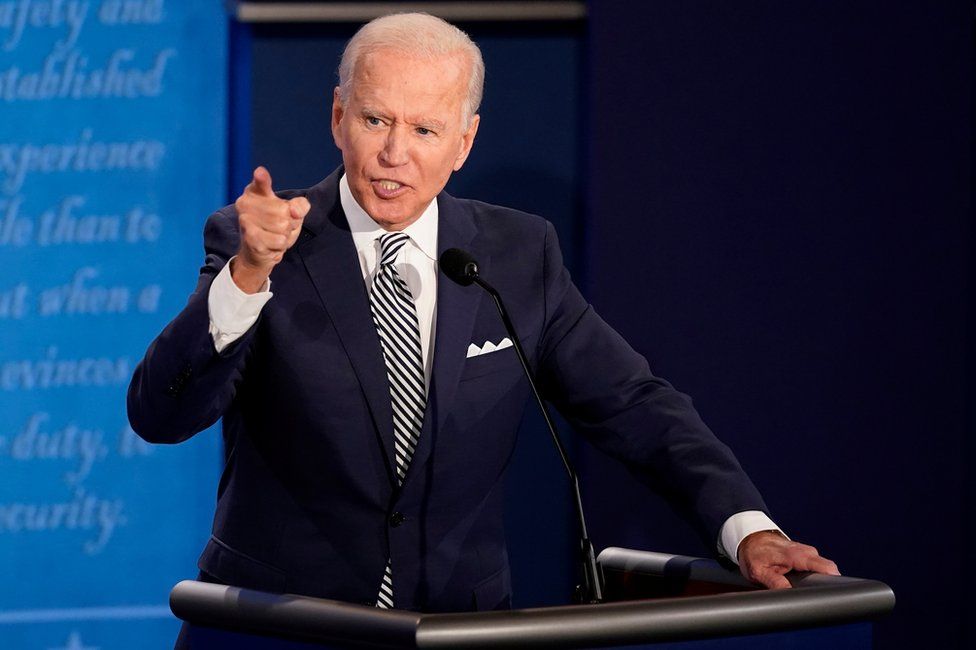
“Will you shut up, man.”
– Joe Biden, to President Donald Trump during the first presidential debate
“Will you shut up, man.”
– Joe Biden, to President Donald Trump during the first presidential debate
Filed under News

“That was a shit show.” – Dana Bash, CNN, Tuesday, September 29
Be careful what you do and say, as someone may be watching and listening. When one lives a public life, such…say, politicians, caution must always be front and center. For some people like Donald Trump, caution is a folly. Last Tuesday night’s debate between Trump and Joe Biden was the most raucous and incoherent political event I’ve ever seen in my adult life. I’ve never witnessed such discord and antagonism among political figures. Trump and Biden sounded less like political opponents and more like two cranky old neighbors arguing about leaves being blown into one another’s yards.
But, after the feud in which absolutely nothing was accomplished, I pondered the viewpoints of our allies and certainly our adversaries. While many Americans don’t care what other nations think of us, I am concerned how our standing as the beacon of democracy across the globe is after that mess.
Here are just a few.
“Most Canadians are going to feel grateful that they live in this country.” – Don Abelson, an expert in Canada-U.S. relations at St. Francis Xavier University in Antigonish, Nova Scotia.
“Chaotic, childish, grueling.” – Libération, France.
“The clearest loser from the first presidential debate between Donald Trump and Joe Biden was America.” – The Times, U.K.
“Never had American politics sunk so low.” – La Repubblica, Italy, which also described the debate as “chaotic, rowdy, and based on mutual contempt.”
“The US embarrassed itself before the world for 100 minutes.”– AajTak, Hindi-language news channel.
“The rivals kept interrupting each other and instead of a balanced discussion they chose the path of mutual insults.” – NTV, Russia.
“[Trump and Biden] “obviously did not show an exemplary role to American people on how to engage in debates.” – Hu Xijin, editor of China’s Global Times. Xijin added: “Such a chaos at the top of U.S. politics reflects division, anxiety of U.S. society and the accelerating loss of advantages of the U.S. political system.”
“Debate? What debate? The event was not intended to change minds or elucidate issues. It was only a form of entertainment which did credit to neither the incumbent nor the challenger. It encapsulates all that has gone wrong with American politics.” – Bilahari Kausikan, a former ambassador in Singapore.
“If the president says that, everyone takes it as natural. But for a decent man like Biden to say that is a bit of a surprise.” – Ichiro Fujisaki, a former Japanese ambassador to the U.S., regarding Joe Biden’s “shut up, man” comment to Trump.
“It was very depressing.” – Marietje Schaake, a Dutch former member of the European Parliament who now serves as international policy director at Stanford University’s Cyber Policy Center. She also warned: “The U.S. can go down a lot further, even if people think it’s already intense.”
“The comments I’ve seen from various European press (outlets) is basically: ‘I’m happy I’m not an American voter this year.’ It’s just a mess.” – Jussi Hanhimaki, a Finnish-Swiss professor of International History at the Graduate Institute in Geneva.
“This debate would be sheer comedy if it wasn’t such a pitiful and tragic advertisement for U.S. dysfunction.” – Kenyan commentator Patrick Gathara on Twitter
In the Middle East, the largely domestic debate drew raised eyebrows when Biden at one point said “inshallah” as Trump hedged on saying when he would release his tax returns. “Inshallah” in Arabic means “God willing.” It also can be used in a way to suggest something won’t ever happen. Both Al-Arabiya, a Saudi-owned satellite channel based in Dubai, and The National, a newspaper in Abu Dhabi, published articles noting Biden’s use of the word.
“How did America reach this level of political decline?” – Abdulkhaleq Abdulla, Emirati political scientist, on Twitter, adding that he saw the debate as a “tumultuous verbal battle.”
“Interruptions and arguments were allowed to fill way too much time.” – Danish Prime Minister Mette Frederiksen on Facebook. She also asked for feedback from voters about how to soften public debate, and stated, “Fortunately, it’s not like that in Denmark.”
“The first debate between would-be leaders of the free world was better suited to the Colosseum of ancient Rome or a cage fight in Las Vegas.” – The Australian.
Filed under News

“Kennedy deserved to be shot because he was a Catholic!”
My father looked at the old man with the hottest level of anger he could muster in a split second. All of 30 with a newborn son, my father blurted back at his coworker, “He was our president, you son-of-a-bitch! No one deserves to get shot!”
It was November 22, 1963, and the news of President John F. Kennedy’s assassination had just spread around the print shop in downtown Dallas where my father worked. Emotions were already raw, and my father didn’t care that he – a young Hispanic man – was yelling and cursing at a much older White male; in Texas; in 1963.
The antagonism towards Kennedy and the Democratic Party in Dallas and Texas – and throughout much of the Southeastern U.S., for that matter – couldn’t be more palpable on that tragic day. Even decades later I’ve heard some conservatives say November 22, 1963 was one of the best days in modern American history. One was a former friend – an openly-gay Jewish man – in 2003. The rest of us seated with him at a restaurant table after a Toastmasters meeting were stunned.
“Yeah,” I casually responded. “Just like the day Hitler escorted the first rabbi into a gas oven.”
No one in their right mind celebrates the death or illness of a national leader. Even as much as I dislike Donald Trump, I’m not happy to know that he’s come down with the dreaded COVID-19 virus. Late on Thursday night, October 1, news broke here in the U.S. that Trump and his wife have tested positive with the virus. Earlier this evening, Friday, the 2nd, Trump was escorted to the hospital. While I’m sure some leftist extremists are thrilled with this development, I see it for the national implication it has. This poses a serious threat to our national security.
In 1918 President Woodrow Wilson was concerned with the “Great War” (now known as World War I), which was consuming Europe and now involved the U.S., when a mysterious influenza began rampaging across the globe. Now known simply as the “Spanish flu”, the scourge afflicted some 500 million people and killed an estimated 50 million. Understand this occurred long before the jet age. According to historians, Wilson ignored the severity of the health crisis, even as it began taking lives here in the U.S., and vigorously pursued the end of the war. In April of 1919, he arrived in Paris for peace talks – and left sick with the very flu he never publicly acknowledged.
Once back home, Wilson was quickly sequestered, and White House press reports simply indicated that overworking had caused the president to come down with a cold and a fever. The Associated Press emphasized Wilson was “not stricken with influenza.” In the aftermath of the greatest conflict the world had known, the mere thought of the president contracting the dreaded flu surely would have sent the nation into a panic. So the true nature of his illness was stifled.
Six months later matters worsened for Wilson when he suffered a debilitating stroke. It’s plausible the flu exacerbated the onset of the stroke. Wilson never really recovered and would die in 1924. During the 18 months he had left in his presidential tenure, Vice-President Thomas Marshall should have taken his place. But, at the time, the vice-president was little more than a figurehead. In fact, throughout Wilson’s presidency, Marshall later claimed he performed “nameless, unremembered jobs” that had been created solely to prevent him from doing any harm to the nation as a whole. But, as history eventually revealed, First Lady Edith Wilson served as de facto Commander-in-Chief. She literally presided over cabinet meetings and other presidential duties; all while hiding her husband’s grave condition.

Just less than four years after Wilson endured his stroke, President Warren Harding suffered a similar event – but with fatal consequences. Harding and his wife, Florence, had just arrived in San Francisco after touring the Alaskan territory when he experienced a heart attack. Vice-President Calvin Coolidge was at his father’s home in Vermont; a dwelling without electricity or a telephone – not uncommon in rural abodes even by the 1920s. When word reached Washington of Harding’s death, two Secret Service agents got in a car and drove all night to Vermont to rouse Coolidge.
It’s difficult to imagine that now: a house with no phone and Secret Service agents having to drive to scoop up a sleeping vice-president. It’s equally unimaginable what allegedly happened in the days following Harding’s demise. First Lady Florence Harding charged into the Oval Office upon returning to the White House and cleaned out her husband’s desk; apparently removing a number of documents along with personal effects.
Secrecy has always been a part of any presidential administration. It has to be. And sometimes it’s mixed with basic respect for an individual’s privacy. Not until after Franklin D. Roosevelt died, for example, did many Americans learn he had been stricken with polio in the 1920s and was all but bound to a wheelchair. At the 1940 Democratic National Convention in Chicago, Roosevelt fell as walked to the podium. Film footage of the event wasn’t released until a few years ago, and most convention-goers remained quiet about the incident. Footage of Roosevelt being wheeled onto the deck of a military vessel almost remained hidden for decades.
Most Americans weren’t aware of the severity of Dwight D. Eisenhower’s heart attack in the fall of 1955; the White House press initially disguised it as a cardiac event. As with Roosevelt, the American public bestowed respect for medical privacy upon the president. But when Eisenhower experienced a mild stroke two years later, some questioned his fitness for office. By the time he left the White House, he truly looked like the 70-year-old man he was.
Therefore, most Americans were thrilled when John F. Kennedy – the first president born in the 20th century – arrived. He wasn’t just handsome and charming; he was vibrant and energetic. Yet not until long after his death did the public learn that Kennedy had become addicted to a variety of pain pills to help him cope with both a back injury he’d suffered in World War II and the effects of Addison’s disease.
Kennedy’s assassination was the first since William McKinley in 1901 and his death the first in nearly 20 years. It had been a given that the vice-president would succeed the president, if something detrimental happened to the latter. But, what if something happens to the vice-president? McKinley’s first vice-president, Garret Hobart, died of heart disease in November 1899. McKinley didn’t replace him, even though he selected Theodore Roosevelt as his running mate during his 1900 reelection campaign.
The question of succession became urgently relevant on November 22, 1963. Many people forget that Vice-President Lyndon Johnson was in the same motorcade as Kennedy; a few cars away. When shots rang out, a Secret Service agent shoved Johnson to the floorboard where the vice-president began complaining of chest pains. That was kept secret from the public, as a horrified nation needed no further bad news.
Thus, the 25th Amendment to the U.S. Constitution was created. It established a definite line of succession to the office of the president, beyond just the vice-president. And it received its first real test on March 30, 1981 when President Ronald Reagan was shot just outside a hotel in Washington, D.C. Vice-President George H.W. Bush was aboard Air Force Two, returning to the nation’s capital, when a Secret Service agent informed him of the shooting. Back in Washington chaos rocked the White House, as the country felt the nightmarish echoes of Kennedy’s death.

A junior in high school at the time, I vividly remember the confusion. While most of my classmates seemed oblivious to the fact the president of the United States had just been shot, I was worried. The Soviet Union had invaded Afghanistan more than a year earlier and were poised to invade Poland to squelch a labor uprising. As with rumors about the Kennedy assassination, was this a Soviet plot? I knew Bush was vice-president, but I didn’t know he’d been in Texas.
I remember Secretary of State Alexander Haig stepping into the White House Press room and announcing, “I’m in control here.” Haig was criticized later for inserting himself as the interim authoritarian. But, in a morass of hysteria, someone had to take command!
I also recall my mother sitting before the TV upon returning home from work that evening – and tearing up as news of the shooting spilled out. It took her back to that tragic autumn day in 1963, as she sat down to watch “As the World Turns” while nursing me, and Walter Cronkite suddenly interrupted to tell of Kennedy’s shooting.
The magnitude of the Reagan shooting didn’t come into full view immediately as news figures couldn’t determine if Reagan had, indeed, been shot. (It turned out a fragment of a bullet that had hit a car had struck Reagan.) The White House later concealed the seriousness of Reagan’s health in the aftermath. Days after the incident, Reagan posed for a photograph; clad in his robe and smiling. No one knew at the time he was running a high fever and almost collapsed once the picture was taken.
Reports of Donald Trump’s condition continue to flood our news feeds. We’re now learning that several people within the President’s inner circle have tested positive for the novel coronavirus and that the outdoor ceremony on Saturday, September 26, announcing Judge Amy Coney Barrett to the U.S. Supreme Court, may have been the “super spreader” event.
Trump is now in isolation and being treated for the ailment. I don’t bemoan that he’s being treated with the most potent medicines available and has a complete medical staff around him. Whether anyone likes it or not, he IS president of the United States, and his health is extremely important. I don’t care much for Donald Trump, but I don’t want to see him get sick and die. I only wish the best for him in this crisis.
Filed under Essays
 Chief Writing Wolf