
Courtesy Brusspup.

Ferguson and “El Albanil” in Corpus Christi this past August.
Okay, maybe I shouldn’t call it a “hand me down,” but a Diego Rivera painting Rue Ferguson inherited from his mother really has been appraised at $1 million. Ferguson’s great-grandparents had bought it in the 1920s. He took it to a broadcast of PBS’s Antiques Roadshow in Corpus Christi this past August to be evaluated.
The lost Diego Rivera painting “El Albañil (The Bricklayer)” was appraised at between $800,000 and $1 million. It was the highest appraisal of the show’s latest season.
“I was dumbfounded,” Ferguson said. “I didn’t know what to say. “I thought it might be worth a tenth of what they said. I had no idea.”
Mariel A. MacNaughton, account executive of Antiques Roadshow, said it’s an exciting moment for all of the staff when they encounter something as unique and valuable as this.
“It’s very rare to see works of Rivera’s that old,” MacNaughton said. “It’s not a painting that was sitting in museum for people to see every day.”
Ferguson’s great-grandparents had kept the painting behind a door in their home until it was passed on to Ferguson’s parents. His parents thought the painting was a fake and kept it in a storage room inside the home. In the early 1980s, his father found out the painting was real, and he had it restored, still unaware of its value.
The family then donated it to the McNay Art Museum in San Antonio for several years, but when Ferguson found out the museum wasn’t displaying it anymore he asked for it back, he said.
Rivera – one of México’s most famous artists who is also known as the philandering husband of fellow artist Frida Kahlo – created “El Albañil” in 1904, when he was just a teenager. After his death in 1957, his family didn’t know the location of the painting.
I’m sure the McNay would do just about anything to have that painting now. But, Ferguson hopes to have it displayed in a museum that features Diego’s work. Currently, though, it’s safely ensconced in a bank vault.
Filed under Art Working
As they do every year, the Dallas Arboretum is holding a pumpkin festival, “Pumpkin Village,” which makes artistic use of perhaps the most maligned and abused of American vegetables. Through November 21, 2012, these unique displays of the mighty gourd prove they’re not just for Halloween jack-o-lanterns or medieval cannon fodder.







Filed under Art Working
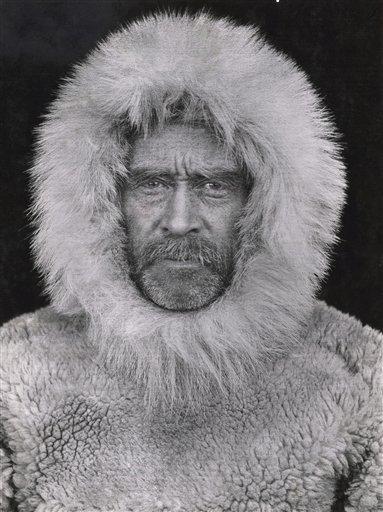
This 1908 photo of Arctic explorer Adm. Robert E. Peary, taken by an unknown photographer in Cape Sheridan, Canada, is among a small selection of the images the National Geographic Society will auction next month. (AP Photo/National Geographic via Christie’s Auction House.)
The National Geographic Society plans to auction 240 photographs and pieces of art from its vast collection this December at Christie’s. Since 1888, National Geographic has amassed millions of images and artworks from across the globe. The auction could garner upwards of $3 million. It’s the first time the institution will sell anything from its archives.
They are being auctioned “to celebrate our legacy …. and to give people a chance to buy a little part of this great institution’s history,” said Maura Mulvihill, senior vice president of National Geographic’s image and video archives.
“We think of ourselves as the unsung fathers of modern photojournalism,” she added. “I don’t think people are aware of what a massive instructive archive this is.”
Proceeds from the auction will serve to promote and preserve the archive, as well as “the nurturing of young photographers, artists and explorers … who are the future of the organization,” Mulvihill said.
National Geographic sponsors and funds scientific research and exploration through its signature publication, National Geographic Magazine, which reaches 8.8 million people worldwide in 36 countries and in 27 languages. The society reaches millions more through its National Geographic Channel, books and other sources.
Among the photos is a 1908 shot of Arctic explorer Adm. Robert E. Peary; the artwork includes an oil painting by Tom Lovell of Gen. Robert E. Lee’s Civil War surrender at Appomattox. While National Geographic is known for its extraordinary photography, early editions were filled with artwork.
National Geographic is my single favorite periodical, and – I believe – one of the most significant in the world. It transcends politics and religion and makes us realize how interconnected we are on this tiny, but otherwise fascinating planet.
Filed under Art Working

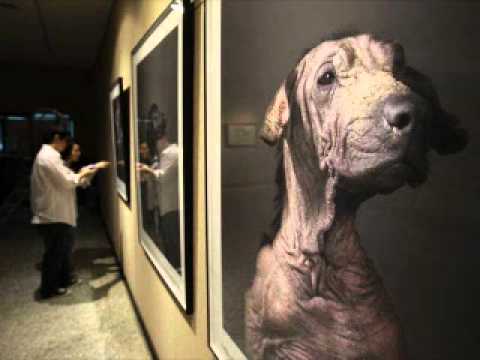
Like any animal photographer, Tou Chih-kang likes to capture expressions and personality. He creates the kind of pictures any pet owner would love. But, the dogs in his photos aren’t pets, and no one will ever see the animals again. The canines in Tou’s works are among the thousands of homeless shelter dogs in Taiwan – and they’re all on death row. After he photographs them, the animals are taken away to be euthanized.
“I believe something should not be told but should be felt,” says Tou, 37. “And I hope these images will arouse the viewers to contemplate and feel for these unfortunate lives, and understand the inhumanity we the society are putting them through.”
His photographs are like formal portraits, designed to bestow dignity and prestige upon the subject. In many of the dog portraits, the animals are placed at angles that make them look almost human.
This year Taiwanese authorities will euthanize an estimated 80,000 stray dogs. Animal welfare advocates say the widespread nature of the problem – Taiwan’s human population is only 23 million – reflects the still immature nature of the island’s dog-owning culture and the belief among some of its majority Buddhist population that dogs are reincarnated humans who behaved badly in a previous life. Many Taiwanese care for their animals, but others abandon pets to the streets once their initial enthusiasm cools.
“Animals are seen just as playthings, not to be taken seriously,” says Grace Gabriel, Asia regional director of the Massachusetts-based International Fund for Animal Welfare.
The dogs who wind up in the Taoyuan Animal Shelter are picked up by roving patrols, funded by local governments, of workers equipped with large nets.
After Tou photographs them, veterinary workers take them for a brief turn around a grassy courtyard before leading them into a small, clinical-looking room where they are killed by lethal injection. Tou, who uses the professional name Tou Yun-fei, says he began his project because the Taiwanese media were not paying enough attention to the dogs’ plight. He says he doesn’t believe in having pets, but the problem had long plagued his conscience. He says that while some of his friends refuse to even look at his photographs, others say the images taught them to take pet ownership more seriously.
A few photos already are on display at Taoyuan city hall, part of a bid to raise citizens’ awareness of the responsibilities that come with raising a pet.
“I am a medium that through my photography, more people will be aware of this issue,” he says. “I think that’s my role.”
Filed under Art Working
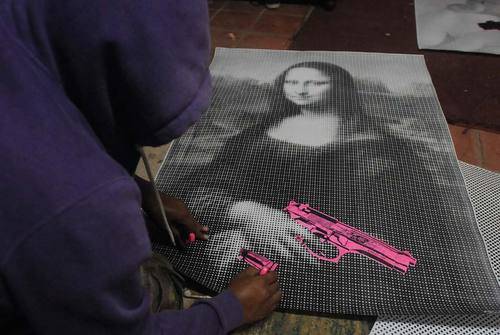
The “Urban Maeztro” at work.
When you think of masked crusaders, you don’t generally think of spirited souls galloping around under the cover of darkness, plastering the walls of the city with impromptu works of art. But, that’s exactly what’s happening in Tegucigalpa, Honduras. A man known only as “Urban Maeztro,” or “Urban Master,” takes only minutes to plaster his message onto a wall and then, he’s gone. In one location, he plastered a giant black-and-white reproduction of Leonardo da Vinci’s “Mona Lisa” wielding a pink pistol. In another, he slapped an image of Rene Magritte’s “Son of Man,” onto a wall of one of the city’s most elegant hotels, substituting a grenade for the apple covering the face of the suited subject in a bowler hat. There’s meaning in the mayhem.
Tegucigalpa is the most violent city in the entire Western Hemisphere – with 1,149 murders in 2011, or 87 for every 100,000 – and one of the most violent in the world. It’s a sadly ironic situation; considering Honduras – like most of Central America – was in the grip of so much civil unrest throughout much of the past 50 years. That terror has become embedded in the city’s fabric. The population of 1.2 million lives in a perpetual state of fear; burdened even further by poverty and a fragile government.
The Urban Maeztro is actually a 26-year-old former advertising agency employee. “The level of how common guns have become in this country has passed what is rationally admissible,” he said recently. “It doesn’t seem to surprise anyone, but for me it continues to be madness.”
He attracts the attention of passing viewers by defacing posters of artistic masterpieces with guns, grenades and other tools of violence. He also employs more traditional graffiti, such as painting sections of metal light poles to look like bullets.
“There is a parallel between the brutal violation of a work so beautiful by adding a firearm and the violence and guns in Tegucigalpa, which could also be a beautiful city without them,” he says.
He said the catalyst for his mission came when he entered a UNESCO poster contest on cultural diversity. When he lost the contest, he decided that the institutional doors for supporting his idea were closed.
“The natural place for art is the street, forget the middleman,” he says.
Since then he’s created a dynamic that includes making his own glue by boiling wheat and water, which he said is “the best adhesive and cheap,” and roaming the city on Sunday afternoons seeking vacant walls and inspiration. His accomplice, the documentarian Junior Alvarez, keeps watch while he works, then photographs the final piece.
“At first I had anxiety when I went into the streets,” notes the artist, “but now I’m used to the adrenaline.”
His work his danger and illegal, especially in a country that experienced yet another coup just three years and where many citizens believe the police and the military work in concert to foment the violence and keep the populace in check with fear.
During another artistic assault, a security guard watched as the Urban Maeztro plastered Grant Wood’s “American Gothic” on a wall in front of the National University.
“Who pays you to do that?” the guard asked.
“No one,” the artist answered.
“Then why do it?”
“To help you think.” And then, he was gone.
Sometimes, that’s what people need to do – think about their environment and their world and how they can change it for the better.
Filed under Art Working

“Odalisque in Red Pants”
Almost a decade after Henri Matisse’s “Odalisque in Red Pants” was stolen from a Venezuelan museum, the U.S. Federal Bureau of Investigation (FBI) recovered it from a Miami Beach Loews Hotel. They also arrested two people, Pedro Antonio Marcuello Guzman, 46, of Miami, and Maria Martha Elisa Ornelas Lazo, 50, of México City, who had tried to sell it for $740,000.
In 1981, the Caracas Contemporary Art Museum paid more than $400,000 for the Matisse painting of a bare-chested woman lounging in red pants.
Matisse is known for his vibrant use of color. Odalisques – oriental-themed paintings of partially clothed women reclining, standing or sitting, usually on beds – were a popular theme for the French artist in the 1920’s.
In 1997, the painting was lent to a Spanish exhibition, according to The Associated Press. After that, it remained in Caracas until it was stolen.
In 2002, the museum staff’s realized that what they thought was a multimillion-dollar painting hanging on a wall was actually a fake. That made museum and law enforcement officials believe the theft was an inside job.
The FBI offered few details about the recovery operation. But, they said Ornelas Lazo flew into Miami International Airport from México City on July 16, carrying a tube with the painting rolled up inside. She and Marcuello Guzman later met with two undercover agents posing as buyers at the hotel.
Filed under Art Working
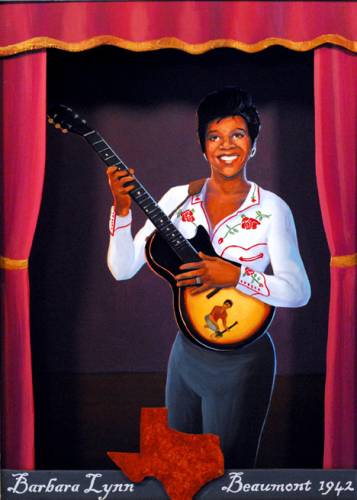
Barbara Lynn, from Beaumont, Texas. Her song “You’ll Lose a Good Thing” topped the charts in 1962, and the Rolling Stones covered her song, “We’ve Got A Good Thing Goin’ On” in 1964.
Cathey Miller is a Dallas-based artist who creates custom paintings, backdrops and murals for both residential and commercial clients. But, her personal work, which emphasizes portraiture and the female form in various imaginary settings, is also starting to gain recognition. Today, Miller’s exhibition of female songstresses, “Texas Lady Singers,” opens at the Kessler Theatre in Dallas’ Oak Cliff area.
Filed under Art Working
Russ Aikins stands with his carving of Jesus delivering his Sermon on the Mount. Photo by Kelsey Kruzich / Plano Star-Courier News.
Like most artists, Russ Aikins doesn’t consider his work a mere hobby; it’s a passion. That’s why it took him more than 20 years to create a wooden relief carving of Jesus’ “Sermon on the Mount.” Aikins unveiled his piece on July 1 at First United Methodist Church in Plano, TX.
“I don’t know how many thousands of hours it has taken,” Aikins said, adding he had no idea what he was in for when he began working on the carving. “I quit counting at 1,000 hours when I finally just said enough is enough. In the last four years I have been working out of a violin shop in downtown Plano because I was having a hard time focusing and freeing up time to work when I was at home. Since then, I have spent about four hours each afternoon when I have been in town.”
Now 70, Aikins began his wood work in 1988. For the complicated, specialized carving, he used about 170 carving tools, including some he made by hand when store-bought tools wouldn’t allow him to complete a necessary step in the process. The carving features 54 individual figures, which are carved out of 4-inch thick basswood. Aikins said the first step was drawing the outline of the people onto the wood, and then clearing away large amounts of wood to get a rough outline of the subjects. Then, it was countless hours of detail work using progressively finer carving tools to get to the finished project. He said all of the work was done by hand, and no sanding was involved in getting the people to have a smooth finish.
The result is simply spectacular. Also check out this video about Aikins’ project.
Filed under Art Working
Turba by Chris Panatier
As a child, artist Chris Panatier was labeled a kleptomaniac and a charlatan by his school officials. Such is the fate of us artistic types – writers, painters, musicians, poets, dancers – the self-righteous guardians of staid academia just don’t understand us. Pity them for they have no imaginations. If I could meet Chris, I’d probably give him a hug and tell him I feel his pain. But, like many artists, Chris never gave up his passion and is having the last word, as his work gains notoriety. His “Stranger Companions” show is currently on exhibition at the Rising Gallery in Dallas and will run through the end of July. His heavy oil abstracts literally leap out at the observer; engaging images that grab people’s attention and make them reconsider their view of the human form and other objects. Even a cursory examination of his artwork will prove that he’s different – beautifully, wonderfully different.
Filed under Art Working
 Chief Writing Wolf