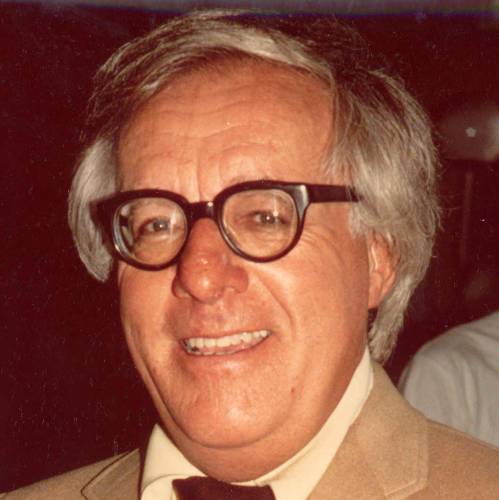
Ray Bradbury, the wildly imaginative science fiction writer who gave us Fahrenheit 451, The Martian Chronicles and Something Wicked This Way Comes, has died. He passed away last night at his home in Los Angeles, after a lengthy illness, according a statement released by his publisher Harper Collins. He was 91. During an incredible career that spanned 7 decades, Bradbury wrote as much about the perils of the unknown future as much as he did the possibilities. He predicted the usage of ATM’s and artificial intelligence.
Ray Douglas Bradbury was born August 22, 1920 in Waukegan, Illinois, the third son of Leonard Spaulding Bradbury and Esther Marie Moberg Bradbury. In 1934, the Bradbury family moved to Los Angeles, California where young Ray befriended a number of talented and creative people, like special effects maestro Ray Harryhausen and radio star George Burns. Burns gave Bradbury his first pay as a writer – for contributing a joke to the Burns & Allen Show. Bradbury attended Los Angeles High School and became active in the drama club. He planned to become an actor. But, two of his teachers recognized Bradbury’s writing talent and encouraged him to pursue that avenue instead.
As his high school years progressed, Bradbury grew serious about becoming a writer. Outside of class, he contributed to fan publications and joined the Los Angeles Science Fiction League. At school, he improved his grades and joined the Poetry Club.
Bradbury’s formal education ended with his high school graduation in 1938, but he continued to educate himself. He sold newspapers on Los Angeles street corners and spent his nights in the library. In between, he spent his time writing.
His first published short story, “Hollerbochen’s Dilemma,” was published in 1938 in Imagination!, an amateur fan magazine. In 1939, Bradbury published four issues of his own fan magazine, Futuria Fantasia, writing much of the content himself. His first paid publication, a short story titled “Pendulum,” appeared in Super Science Stories in 1941.
As he honed his writing skills, Bradbury often looked to established writers for guidance. During those early years, his mentors included Henry Kuttner, Leigh Brackett, Robert Heinlein and Henry Hasse.
In 1942, Bradbury wrote “The Lake,” the story in which he discovered his distinctive writing style. He gave up selling newspapers the following year and began to write full-time. In 1945 his short story “The Big Black and White Game” was selected for Best American Short Stories.
Bradbury’s reputation as a leading science fiction writer was finally established with the publication of The Martian Chronicles in 1950. The book describes man’s attempt to colonize Mars, the effects of colonization on the Martians, and the colonists’ reaction to a massive nuclear war on Earth. As much a work of social criticism as of science fiction, The Martian Chronicles reflects America’s anxieties in the early 1950’s: the threat of nuclear war, the longing for a simpler life, reactions against racism and censorship, and the fear of foreign political powers.
In 1953, Bradbury published Fahrenheit 451, a book that would become perhaps his best known work. It is set in a future in which a totalitarian government has banned the written word. The central character, Montag, enjoys his job as a professional book-burner. But he begins to question his duties the when he learns of a time when books were legal and people did not live in fear. Montag begins stealing books marked for destruction and meets a professor who agrees to educate him. When his pilfering is discovered, he must run for his life.
Bradbury’s work has won innumerable honors and awards, including the O. Henry Memorial Award, the Benjamin Franklin Award (1954), the Aviation-Space Writer’s Association Award for Best Space Article in an American Magazine (1967), the World Fantasy Award for Lifetime Achievement, and the Grand Master Award from the Science Fiction Writers of America.
He is survived by his four daughters, Susan Nixon, Ramona Ostergren, Bettina Karapetian and Alexandra Bradbury, and eight grandchildren. His wife of 57 years, Marguerite, died in 2003.










 Chief Writing Wolf
Quote of the Day
“Wouldn’t it be interesting to do a study between those that are on welfare and see how much and how often they read the Bible. You know, if Booker T. Washington is right that Christianity and reading the Bible increases your desires and therefore your ability for hard work; if we take that as an axiom, does that mean that the people who are getting government assistance spend nearly no time in the Bible, therefore have no desire, and therefore no ability for hard work? I could go a lot of places with this. I would love to see this proven out in some kind of sociological study, but it makes perfect sense.”
– David Barton, about a supposed connection linking welfare to failure to read the Bible.
Barton sits on the Texas State Board of Education as an alleged “expert” for the state’s social studies curriculum. That’s like saying Rick Santorum is an expert on birth control.
1 Comment
Filed under News
Tagged as David Barton, revisionist history, stupid comments, Texas State Board of Education