Kennedy’s Presidential Limousine – The Lincoln X-100

ym24048

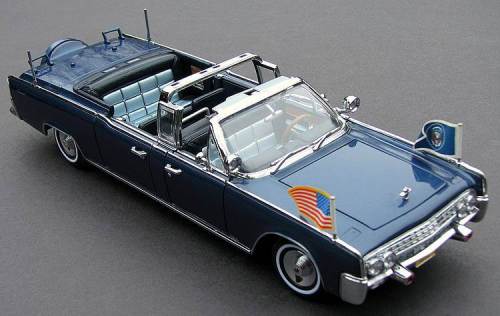
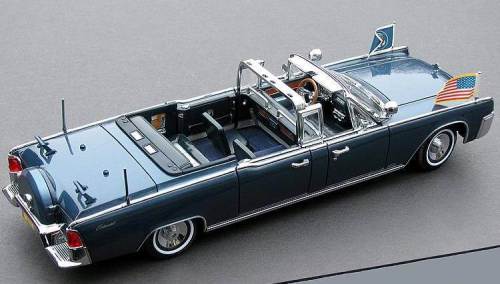
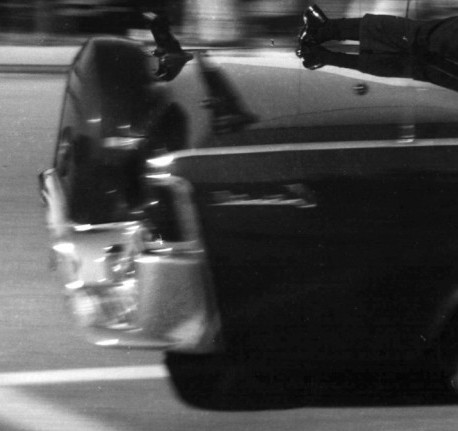
I mentioned this last year, on the 49th anniversary of Kennedy’s death, but I wanted to bring it up again on this special occasion.  My car fetish knows few bounds, even though it’s limited to most anything pre-1980.  That includes the vehicle Kennedy was riding in that fateful day: a 1961 Lincoln Continental X-100.  It was a 4-door convertible, and X-100 was its Secret Service code name.

Ford Motor Company assembled the car at its Lincoln plant in Wixom, Michigan in January 1961.  Hess & Eisenhardt of Cincinnati, Ohio customized the vehicle to function as a presidential parade limousine; literally cutting it in half, reinforcing it, extending it 3½ feet in length and making numerous other modifications.  Ford Motor Company and Hess & Eisenhardt collaborated on engineering and styling.  It debuted at the White House in June 1961.  The car remained the property of the Ford Motor Company, which leased it to the Secret Service for $500 per year.

The car, equipped at the Lincoln plant, would have retailed for $7,347.  Custom built, it cost nearly $200,000.

ym24048_11

Special features on the limousine included:

  • Removable steel and transparent plastic roof panels
  • Hydraulic rear seat that could be raised 10½ ” to elevate the president
  • Massive heating and air conditioning system with auxiliary blowers and 2 control panels
  • Dark blue broadcloth lap robes with gray plush lining and hand-embroidered presidential seals in special door pockets
  • Four retractable steps for Secret Service agents
  • Two steps on rear bumper for additional agents
  • Flashing red lights, siren
  • Blue Mouton rug in rear
  • Indicator lights when door was ajar or steps out
  • Two flagstaffs, two spotlights
  • Auxiliary jump seats for extra passengers
  • Two radio telephones
  • Interior floodlights

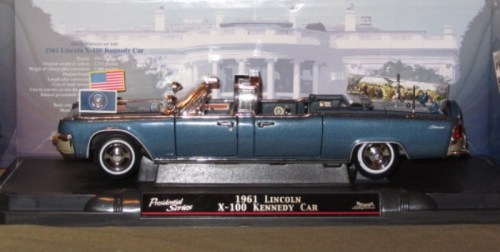
I have a replica of this car by Yat Ming, which is part of its “Presidential Limousines” collection.  Yes, it’s made in China, but I love it anyway.  And, I know owning such a thing sounds macabre, yet the vehicle is an indelible, albeit tragic, part of our nation’s history.

My replica of the 1961 Lincoln X-100.

My replica of the 1961 Lincoln X-100.

The Strange Saga of the JFK Assassination Car.”

Leave a comment

Filed under Classics

Through a Tiny Window

On November 22, 1963, I was just less than 3 weeks old.  At the time, my parents and I lived in an apartment above a garage owned by father’s oldest sister and her husband on the northern edge of downtown Dallas.  Through the small bathroom window, my mother caught a glimpse of President Kennedy’s motorcade, as it raced towards Parkland Hospital.  She had no idea at that moment what tragedy had just unfolded.

1122_rush-hospital-2

That siren; that God-awful siren!  It came from down the hall, and I had no idea why.  I had just turned on the TV to watch my show, “As the World Turns.”  My older sister got me hooked on it while I was on “maternity leave.”  Actually, in those days, there was no such thing.  Women just had to quit work and hope they had a job later, if they wanted it.  That’s fine, I’d told myself.  At that moment, with my new baby boy, I didn’t care about going back to a desk to argue insurance claims.

I’d almost died having him.  I wasn’t supposed to have him.  The doctors told me I just couldn’t have a baby.  But, my husband and I didn’t listen.  We turned our hopes to a higher authority.  I was almost 31, when he was born; so old to be a new mother back then.  I cuddled him close, as he quietly nursed; a diaper over his head.

It had been so hot – since summer!  Advice to future mothers: don’t get pregnant until summer passes.  Just a thought.  I had to sleep sitting up; otherwise, I’d choke to death.  We had a floor fan blowing all night to keep me cool.  My husband wore pajamas to bed that summer; the fan would make the room so cold for him.

But, why were those sirens so loud?  So many of them.  I scooted towards the bathroom window and looked to my right.  Through the trees in the back yard and the neighbors’ back yards I saw a flash of red lights and black cars.  Just a blur; a long streak of red and black.  For a second, I thought I also saw a flash of pink.  But, I think now it was just my imagination.

I knew President and Mrs. Kennedy were in town.  It would have been nice to go downtown to see them, but I couldn’t with the baby.  And, my husband had to go to work.

I went back into the front room, and the show had already started.  “Nancy” (Helen Wagner) was speaking to her father.  I don’t remember what they were talking about.  Then, without warning – in one of those moments that sears into your mind – Walter Cronkite interrupted the show.

And, said President Kennedy had been shot.

But, he was just here!

In Dallas.

The motorcade – that flash of red and black.  That’s what it was.

But, it was just there!

I’d just seen it.

I rushed back to the bathroom window.  I could see more traffic on Harry Hines.  I went back into the front room.

Walter Cronkite looked as if he was about to cry.  How do you announced something like that to millions of people and not break down?

I suddenly became terrified.  I had to call my husband.  Still cradling the baby, I dialed the phone from the bedroom.

The assistant manager – the owner’s brother-in-law – answered.

“I just saw on the news,” I told him.  “President Kennedy’s been shot!”

He was silent for a second.  “Is this a joke?”

“No!”  Why would he even ask that?  We didn’t joke about those things back then.

“Cathy, turn on the radio!” he said.

I looked at my baby, still nursing, oblivious to the world around him.  Is this the world he would inherit?  Where the president of the United States gets shot in broad daylight?

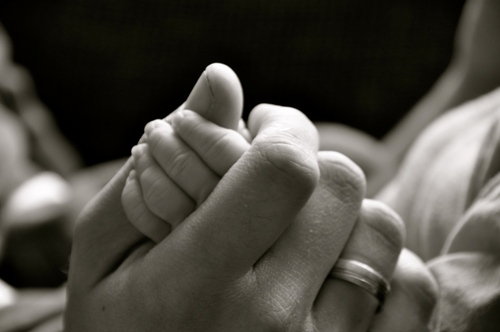
baby_hands

My husband came home early.  His boss had closed down the shop.  He was happy to see me and the baby.  But, he was as shocked as me – and angry.  “What’s wrong?”

“Some dumb son-of-a-bitch at work said he was glad Kennedy had been shot!”

Who would be happy about that?

That whole weekend – that entire, awful weekend – all we saw on TV was about Kennedy.  None of us could believe it.  My husband’s family gathered at his parents’ home to watch the funeral.  The black horse that wouldn’t cooperate; the long procession; the masses of people.  When John-John saluted his father, we all just about lost it.  This wasn’t really happening, was it?  I couldn’t say it out loud.  This couldn’t be happening – right?

Then, amidst the sadness and completely out of nowhere, one of my husband’s sisters-in-law asked, “Why are the flags only halfway up the poles?”

We all thought for a second or so and then, just looked at her.  Here she was, a hair dresser at an upscale salon, earning thousands of dollars every month when most people in those days only got by on a couple of hundred dollars, and she asks that.

My husband, sitting next to me, said, “Because they ran out of string.”

And, if I say we all felt guilty when we laughed, I’m not lying.  We literally burst out laughing.  Only my husband could say something like that and get away with it.  He then picked up a box of tissue and began offering some to everybody.

If I think about it now, it really hurts.  How could that happen?  Here!  Why did that happen?  That baby I held is now a half-century old, and the world is a much more violent place.

I close my eyes and think for a moment.

And can hear those sirens.

And see that flash of red and black.

And Nancy’s face.

And Walter Cronkite’s twisted mouth.

All from that tiny window.

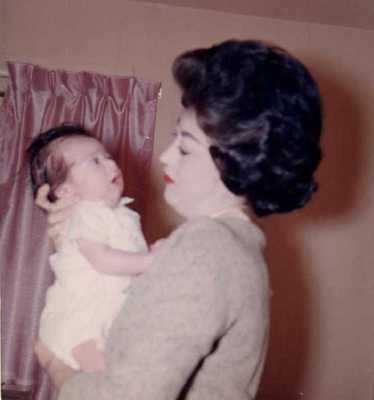
My mother and I on December 1, 1963.

My mother and I on December 1, 1963.

© 2013

1 Comment

Filed under Wolf Tales

Now Dallas, You Can Move Forward

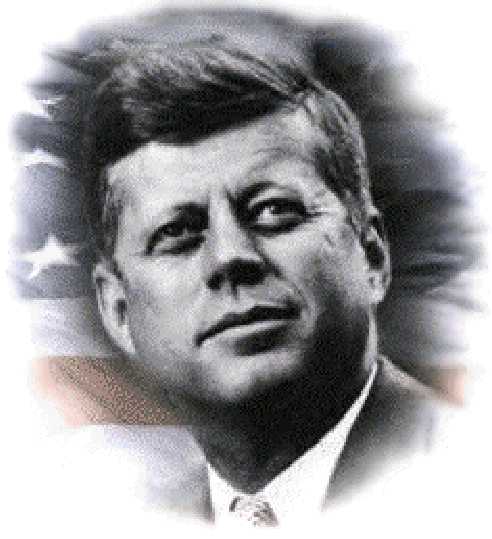
john_kennedy

For the past half century, the city of Dallas, Texas has been defined by three elements: the Dallas Cowboys, the television show “Dallas” and the assassination of the country’s 35th president, John F. Kennedy.  I’ve always admired Kennedy.  He was a true military hero who barely survived World War II.  He was witty and charming with a strong vision for America’s future.  In his inaugural address, he uttered the most inspirational words I’ve ever heard: “And so, my fellow, Americans, ask not what your country can do for you; ask what you can do for your country.”  It was a challenge for a country that – although already accustomed to them – to do more.  It’s certainly something this nation, filled with self-righteous individuals, needs today.  It’s why I vote regularly and speak out when I see injustice.  If you want your society to work for you properly, you have to be willing to do something right for it.

Several years ago, while working my first job as a package clerk at a nearby grocery store, a woman from California asked me how I felt about the city of Dallas.  It was a curious question.  But, it was her first trip to Texas, and she just wanted to know.  She mentioned that, in her native California in 1963, her fellow citizens immediately came to loathe the city of my birth and the entire state of Texas.  She saw people hurtle rocks and bottles at a couple of cars that bore Texas license plates.  Then, I told her I was only 17 days old on the day Kennedy died and that my mother had seen the presidential motorcade race by the garage apartment where we lived on its way to Parkland Hospital – though at the time, she had no idea what had just transpired.  She was nursing me and had sat down to watch “As the World Turns” – a program she’d become addicted to while on maternity leave – and just happened to hear the sirens in the distance; blaring through the open bathroom window.  Not until she returned to the front room to resume watching her show and Walter Cronkite interrupted did everything change.

The California woman – a blonde in her early 40s – froze.  The event became personal again.

It’s a good thing for a city to be associated with a great sports team.  After the horror of the Kennedy assassination, the Dallas Cowboys had the burden of transforming the city into “America’s team.”  Its image as a real estate and oil metropolis were certified in “Dallas,” one of the cheesiest programs the American entertainment community has ever produced.  Fortunately, I know the real Dallas, and I’m happy to announce it’s not that bad.  This place of nearly 2 million people is a blue enclave in a red state.  The city boasts a non-White majority population that still trends Democratic in presidential elections.  In 1995, Dallas elected Ron Kirk as mayor, the first Black to hold that office.  In 2004, Dallas County elected Lupe Valdez as its first Hispanic, female and openly gay or lesbian sheriff.  Two years later it elected Craig Watkins as its first Black district attorney.  There are two schools named after Kennedy here: Kennedy-Curry Middle School and John F. Kennedy Learning Center.  It’s a city with a diverse population and an international reach.  Yes, it boasts its share of crackpots.  Show me a city this size that doesn’t and I’ll show you a pile of rocks.

When word about Kennedy’s death spread throughout my father’s workplace, a printing company on the edge of downtown, an older man groused that Kennedy deserved to be shot because he was Catholic.  My father, then in his early 30s and unafraid to speak his mind, snapped back, “You son of a bitch!  He was our president!”

Several years ago, while working as a contractor for a government agency, my company’s liaison – a hard-right Republican who almost got teary-eyed whenever he mentioned Ronald Reagan’s name – unexpectedly commented that the Kennedy assassination was “one of the best days in this country’s history.”  The three of us standing there with him – my supervisor, a coworker and me – were literally startled.  The statement had come out of nowhere.

Even I who despised Ronald Reagan got scared when he was shot in 1981.  “No!” I announced to the man, while standing beside my supervisor.  “The day Kennedy was shot was one of the worst days this country has ever experienced!”  I reiterated how, on the day Reagan fell victim to a crazed gunman, I was glued to the television.  My mother arrived home from work and sat down to watch a local broadcast – and began to cry.  It had only been a little more than 17 years since Kennedy’s death, and the nightmare had been rejuvenated.

I stormed out of my supervisor’s office, genuinely pissed off, and returned to my desk.  The man, twice my size with an equally imposing voice, followed me and meekly apologized.

Every major metropolitan area has its extremists; its cache of lunatics who are filled with vile against anyone and anything they don’t like.  There were certainly plenty of them in Dallas in the early 1960s.  But, the nation was at the start of a cultural tumult, and such types filled a lot of cities, especially in the Deep South.  It had been a century since the start of the Civil War, and many White Southerners didn’t like the thought of Negroes gaining equality.  When Lyndon Johnson and his wife, Claudia (whom Lyndon affectionately dubbed “Lady Bird”), visited Dallas in September of 1960, they were met, in part, by a hostile crowd.  Although a native Texan and then-Senate majority leader, Johnson was vilified by some folks as duplicitous in a liberal Yankee agenda (e.g. civil rights for Negroes) by agreeing to run on the Kennedy ticket.  As the Johnsons exited a downtown theatre, a young woman lunged forward and snatched Mrs. Johnson’s white gloves from her dainty hands.  Lady Bird’s face turned as white as the gloves that ended up in a sewer.  The senator hustled his wife into a waiting car and hurtled an invective back towards the angry crowd.

When Kennedy died, it had been 13 years since someone made a concerted attempt to assassinate a sitting U.S. president; 18 years since one had died in office; and 62 years since one had been killed.  At age 43, Kennedy was the youngest man ever elected to the U.S. presidency, the first born in the 20th century – and the last to die in office.  His death shocked the nation – and the world – into a new, more brutal reality.  Few could fathom such evil in those days.  Kennedy’s vision for a better nation held so much hope.  That a lone gunman with a Napoleonic complex could possibly destroy the beautiful stones of Camelot with three bolts of lead hadn’t entered the public conscious.

When I was a senior in high school, an English teacher told me everything that erupted in the 1960s had been brewing the previous decade; a time many still view through a delicate stained glass window.  Historians and various cultural observers now agree that Kennedy’s assassination is when the 1960s actually began.  The moment a bullet pulverized the skull of the handsome, young president and compelled his beautiful, glamorous wife to clamber onto the back of the limousine to gather the bloody fragments – like a tomboy collecting rocks – is when that stained glass window shattered.  The patriotism of the 1940s and the economic security of the 1950s collapsed into the reality of a cold, dispassionate universe.  As a whole, Americans realized the nation hadn’t lived up to its ideals of equality and freedom for all.  The Watergate scandal then seemed to confirm things aren’t always how they seem, and we needed to start questioning authority.

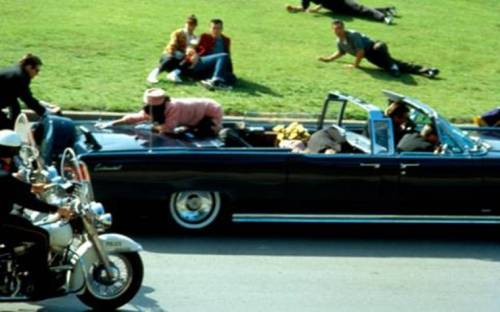
The exact moment when everything changed in America.

The exact moment when everything changed in America.

What’s often ignored about Kennedy’s visit to Texas is the overwhelming joy with which he and his wife, Jacqueline, were greeted.  When the couple arrived in neighboring Fort Worth late on November 21, a large, enthusiastic group had gathered in the rain to see them.  As the motorcade cruised through downtown Dallas on that bright, sunny Friday afternoon, hundreds of people lined the streets; waving and cheering.  At one point, Nellie Connally, the wife of Texas governor John Connally, turned to the president and gleefully pointed out that Dallas enjoyed the First Couple’s presence.  They did; they really did.

Several years ago someone painted a white X in the middle of Elm Street, identifying the exact spot where Kennedy was hit.  Somehow that dubious insignia withstood rain, sleet, triple-digit temperatures and Dallas drivers.  Recently, however, the city paved over it as part of a concerted infrastructure improvement plan.  But, it was also a symbolic move.  No, Dallas can’t just get over what happened here on this day five decades ago; pretending it was nothing more than a rough afternoon.  Yes, we grieve today about one of the most tragic events of the 20th century.  That’s the honorable thing to do.  But, we also need to consider Kennedy’s view of a better world – and then move forward.  We have no other choice.

aUYtZ1cxTTNkb0Ux_o_tx-wx-20120721---texas-weather-share---sunrise

John F. Kennedy Presidential Museum and Library

1 Comment

Filed under Essays

In Memoriam – John F. Kennedy: May 29, 1917 – November 22, 1963

????????????????????????????????????????????????????????????????????????????????????????????????????????????????????????????????????????????????????????????????

“Freedom lies in being bold.”

–  Robert Frost


John F. Kennedy Presidential Museum and Library

Leave a comment

Filed under News

Haiyan and the Resilience of a Community

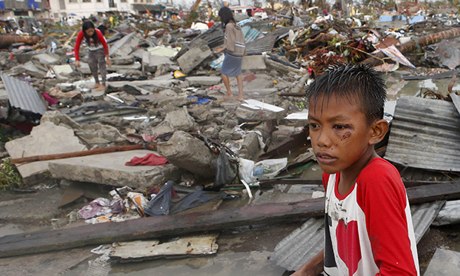
Typhoon Haiyan: residents of Tacloban city

It’s been a little more than a week now since Typhoon Haiyan plowed into the Philippines.  With maximum sustained winds of 195 mph, Haiyan – also known as Yolanda – is the most powerful tropical storm system in recorded meteorological history to make landfall anywhere in the world.  The previous record had been held by Hurricane Camille, which packed 190 mph winds when it slammed into the U.S. Gulf Coast in 1969.

The Philippines are no stranger to typhoons.  Strategically situated just north of Indonesia, between the South China Sea and the Philippine Sea, this country of 96.7 million has to brace itself every year for tropical events.  But, this time things are much worst.  As far as storms go, Haiyan couldn’t have hit a more vulnerable location.

Barely a quarter century removed from the brutal, 20-year dictatorship of Ferdinand Marcos, the Philippines still rank as a developing nation, even though it’s a relatively fully-functioning democracy.  Geographically classified as an archipelago, the Philippines are comprised of 7,107 islands.  But, it’s actually part of the overall Malay Archipelago, the world’s largest such areaHumans have occupied the Malay region for at least 30,000 years.  For centuries, though, the Philippines often served as a crossing point between mainland Asia and the larger islands of Borneo and New Guinea.  The arrival of Islam in the latter part of the 14th century changed much of the Philippines’ culture; a fact that remains even now, as the nation battles more radical Islamic elements.  In 1521, Spanish explorer Ferdinand Magellan became the first documented European to arrive in the Philippines.  He didn’t last long.  Barely a month later, local warriors killed him and several others who were part of his expedition during an intense battle.  But, the Spanish government, in its own bitter rivalry with Great Britain for world domination, persisted and launched more expeditions to the Malay area.  More battles ensued and more blood was spilled, but in 1565, King Phillip II succeeded in making the islands a Spanish colony.  It is him for whom the Philippines are named.  The Philippines remained a Spanish outpost until the 1898 Spanish-American War.  In 1935, the islands became a self-governing entity.

The “self-governing” part is always tricky for any nation that tries to set itself apart.  It’s especially difficult for those where democracy is an alien concept – which is pretty much most of the developing world.  After centuries of Spanish domination and Roman Catholic indoctrination, the Philippines weren’t a good candidate for automatic conversion to the democratic process.  I recall how a contingency of average Filipinos known as EDSA 1 toppled the Marcos regime in 1986, sending him and his family fleeing for their lives.  Even if his wife, Imelda, couldn’t haul her cache of designer shoes out of the imperial palace, the Marcos family had managed to siphon billions from national coffers before exiling themselves to Hawaii.  As the haggard clan disembarked from a plane, one Marcos relative clutched a bag of diapers, as if it was her only possession.  Then again, it’s quite possible fine jewelry and blocks of cash were hidden inside, so why wouldn’t she keep a tight grip on it?  In an attempt to make peace with the Philippines, the U.S. government indicted Ferdinand and Imelda Marcos on a series of racketeering and money laundering charges.  After Marcos died of cancer in 1989, the U.S. dropped all charges against Imelda.  She may have never got her shoes back, but at least she’s living in paradise.  Who says crime and corruption don’t pay?

When EDSA 1 finally rid the Philippines of Marcos, it installed Corazon Aquino as president.  Her husband, Benigno, had been a vocal critic of Marcos and was exiled in 1980 for his views.  When he dared to return to the land of his birth three years later, Marcos had him assassinated.  Thus began the torturous battle for freedom and the long slog towards a democratic state.  When international pressure compelled Marcos to call for elections in February 1986, Corazon Aquino was chosen as the opposition leader.

But, as foreign observers feared, everything that could have gone wrong with the Philippine election process did.  Results eventually proved Aquino as the victor, but not before scores had died in rioting.  When the Marcos family fled, Aquino took her rightful place as president of the burgeoning democracy and spent her single, six-year term fending criticisms of ineptness and coup attempts by Marcos supporters.

With a labor rate that is about 52% services and 32% agrarian, it’s no surprise the Philippines continues to struggle against the tide of wealth inequality.  Roughly 26% of the population lives at or below the poverty line.  Thus, Haiyan’s arrival added to the misery.  But, that happens wherever communities subsist in states of financial insecurity.  When Hurricane Katrina struck the U.S. Gulf Coast in 2005, President George W. Bush received staunch criticism for his inaction.  True, as a lackluster president, Bush didn’t have the mindset to respond to a natural catastrophe.  No one in his administration did.  But, for years, scientists had been warning the state of Louisiana that its southern enclaves were vulnerable to devastation, notably low-lying New Orleans.  But, the Crescent City itself was already in a state of decay.  Most of its citizenry relied upon government assistance and menial cash jobs just to survive.  The people were ill-equipped to help themselves get out of harm’s way; e.g. rent a car or buy a plane ticket.  The endemic corruption in both the city of New Orleans and the state of Louisiana set everyone up for disaster.

As of now, the death toll in the Philippines from Haiyan stands at 3,631 – the “official” estimate.  With so many rural areas still cut off due to lack of electricity and telecommunications, the number of victims may be higher.  I see reports of how bodies were left to rot on city streets and I’m glad chances of that happening here in the U.S. are rare.  People were upset that so many damaged vehicles were left on the streets of New Orleans almost a year after Katrina.  But, human bodies and animal carcasses?

Every one of those bodies was once a person; an individual who had a family and friends; someone who had hopes for a better future.  When death occurs on so massive a scale, it’s often difficult to think of the deceased as individuals.  It personalizes the disaster for us, so it’s easier to think of the dead masses and just shake our heads at the horror of it all.

Governments can’t address each one of them, so it has to consider the entire calamity and do what it can.  But, it’s really up to the survivors and their communities to cope with the aftermath.  They have to deal with the destruction; they have to clean out their homes; they have to gather what food and water they can find; they have to tend to the injured; they have to defend what’s left of their world.  In other words, they have to care for themselves.  That sounds brutal, but in a brutal situation, who best to take care of you and your loved ones except you, if you’re able-bodied?

I do know this: despite the mess, people will survive.  Someone will always get through such disasters and continue with their lives by rebuilding their neighborhoods and therefore, their countries.  After the initial shock, they stand up and just keep going.  It’s hard and it hurts; nothing like that is ever easy.  They may never recover emotionally or even physically from the upheaval, but they go on for as long as they can.  It’s just human nature.

This post from fellow blogger, Donna Amis Davis, a long-time resident of the Philippines, provides more personal insight into the disaster.

International Red Cross.

Doctors Without Borders.

Project Hope.

International Fund for Animal Welfare.

1 Comment

Filed under Essays

“Steamboat Willie” Goes for a Ride

Steamboat-willie

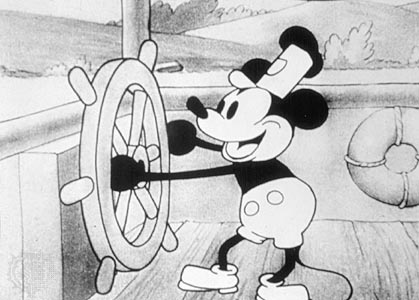
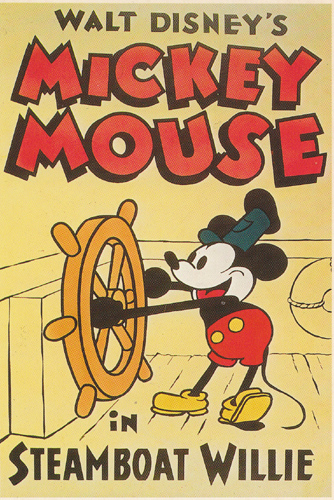
On this day in 1928, Walt Disney premiered the first cartoon with synchronized sound, “Steamboat Willie.”  Crude by today’s standards, it was innovative for its time.  Walt Disney himself performed all the voices, although the dialogue is often hard to understand.  The cartoon was a parody of the Buster Keaton film, “Steamboat Bill, Jr.,” which was a reference to a 1911 song, “Steamboat Bill,” performed by Arthur Francis Collins.  The film lasts all of 7 minutes and 23 seconds and came out as the film industry was making the inevitable and sometimes difficult transition to sound.  “Steamboat Willie” also marks the first appearance of that Disney icon, Mickey Mouse.  With an estimated budget of $4,986, there were some initial concerns about the believability of cartoon characters producing their own sound.  Thus, Disney arranged for a preview of the film even before the sound track was produced.  The audience responded positively to it and subsequent audiences liked it even better with the sound.  The film would later become the subject of controversy because of perceived animal cruelty, including one scene where Willie swings a cat around by its tale.  But, it was just a product of its time.  Regardless, it remains a landmark of early sound cinema and a true pioneer in both animation and overall filmmaking.

A poster produced for the film’s 50th anniversary.

A poster produced for the film’s 50th anniversary.

1 Comment

Filed under History

Veterans Day 2013

Veterans day_Page_2

Thank you to all who have served and are serving in the U.S. Armed Forces.  You did your best to make this country and this world a better place by exhibiting the utmost in personal responsibility.  Your sacrifices sometimes go unnoticed or ignored.  But, the majority of your fellow citizens will always respect and honor your contributions.

“May the stars carry your sadness away.

May the flowers fill your heart with beauty.

May hope forever wipe away your tears.

And, above all, may silence make you strong.”

Chief Dan George

1 Comment

Filed under News

The Chief Turns 50!

number-50-800x450_1741199

Well, I’ve finally reached that critical milestone: the half century mark.  I honestly can’t believe it.  And, I’ll be damned if I still don’t look a day over 47!

I probably have about as many years ahead of me as behind me.  But, despite a lifetime of worrying about the small details, I wouldn’t trade it in for anything.  I could easily reflect on what I haven’t achieved by now: I never got married; never had kids; didn’t join the U.S. Navy like I’d wanted 25 or so years ago; still haven’t gotten my novel published; haven’t visited Yosemite; didn’t invest in that turbo penis pump.

But, I’d rather reflect on what I have achieved: I did finish that novel; I earned my college degree; I’ve become closer to my family; I got hold of my alcohol problems; I learned not to let stupid crap bother me all the time; I didn’t waste money on that turbo penis pump.

I consider the alternative to turning 50 – never getting there!  In September, I wrote about the 20th anniversary of the death of one of my best friends.  He was just a month shy of his 32nd birthday.  I look at the casualty lists of the Afghanistan and Iraq wars and almost cry at the ages of the young victims.  I don’t want to get sentimental on you folks, but it makes me thankful for this birthday and every birthday.  Thanks to all of you for your visits and comments!

Image courtesy of Planet Minecraft.

8 Comments

Filed under Birthdays

Raymond

Man-glass-window-back-silhouette-900x1600

This is based on a true story.  In September of 1997, a close friend of mine was shot six times in an attempted robbery / carjacking – and survived.  He’s still alive, albeit with a tiny bullet fragment lodged in his body.  I’ve changed the names of everyone involved, along with a handful of other personal facts.

You know how they say you’ll always make one really stupid mistake in life that you’ll regret forever?  Well, mine had to do with my driver’s license.  I know those things are important.  But, at three in the morning?

I didn’t think twice about it after getting home from work.  I’d walked into my apartment, pulled off my work shirt and started settling in for the night, when I realized my license was missing.  I dropped my wallet onto the dresser and it fell open.  My old license was there – I could see it through the plastic sheath or thing or whatever you call it – but the new one was gone.

I looked all over the damn place for it.  I couldn’t make too much noise.  My roommate, Jake, was asleep and waking him up was like waking up a grizzly bear.  I mean, he would literally get that mad!  I kept telling him he just needed to get laid.  That sort of pissed him off even more.

But, I started to worry that I’d lost the new license.  I had just turned 35 and drove around for a month with an expired license.  It was a grocery store clerk who reminded me it was expired.

Damn!  Now, it was gone.  I stood in the middle of the front room, scratching my head.  It was almost 3:00 A.M.  Then, I thought it’s probably somewhere in my truck.  So, I made my way back down to it, making sure I locked the door behind me.  The neighborhood was starting to go to hell.  It seemed fights were breaking out every weekend.  People had been throwing shit into the bed of my truck.  I caught one guy doing that and jumped his ass.  I actually grabbed him by his little finger and walked the bitch back to my truck.  I made him crawl into the bed, pick up the soda can and toss it into a trash can that sat just a few feet away.

“My truck ain’t your fucking trash can!” I yelled at him.  “There’s this fucking trash can over here!  Are you too fucking lazy to walk over here?”

He and his two buddies walked away, making racist comments: ‘White bitch,’ ‘White boy,’ ‘honkee.’

‘Honkee?!’  I hadn’t heard that since I was in grade school!  Didn’t that word go out of style with bell bottoms?  I guess I should’ve pointed out that I’m Hispanic, but I was tired that night.  I’d argued with more than a few people in that dump and didn’t want to get into it with three teenaged assholes who were probably too stupid to read their own fucking names.

But, that’s the kind of shit we had to deal with, almost every day.  The lease was up for renewal in three months, and I’d already told Jake I needed to move.  I couldn’t stand the place anymore.  He wasn’t too happy about that, but I didn’t care.

So, there I was, sitting in the passenger side of my truck; looking through a large brown envelope for my fucking license at three in the morning.  I’d already searched the glove compartment and under both seats.  I remember stopping for a minute, wondering why the place was so quiet.  Usually there were a group of guys on the other side of the parking lot, drinking beer and staying stupid shit to every female who walked by.

But, it was quiet, really quiet that night.  And, just when I turned back to the envelope, I heard a noise.  I looked up and saw the black barrel of a gun pointing at from between the truck and the door frame.

“Don’t move, muthafucka!” said the guy.

I could tell he was Black, before I noticed another Black guy standing directly in front of the truck; that one had his hands on the hood.  And, I had just realized he didn’t have on gloves, when I bolted towards the rear of the truck.  I really didn’t think about it.  I just started running.

And, the guy with the gun started shooting.  I could hear those tiny pops.  You know how they say gunshots actually sound like firecrackers?  Well, that’s exactly what they sound like.  There was no booming sound.  Just those tiny pops – ten of them, I found out later.

Six of them found me; two in my back, one in my left leg; two in my right leg; and one in my right shoulder.

I felt them, but then again, I didn’t really feel them.  Does that make sense?  I don’t know why, but I didn’t realize I’d been shot that many times until later that day.  Or, maybe the next.

I don’t know how, but I managed to make it back to the apartment.  For some reason, I thought I’d dropped my keys and began banging on the door; shouting for Jake to let me in.

When he finally came to the door, he was – well, pissed.

But, I don’t really remember what he said to me, except something like, “Goddamnit!”

It wasn’t until I got into the apartment that I realized I had my keys in my left hand.

I think Jake asked me what happened, and I just said something like, “I’ve been shot!”

When the paramedics hauled me out of the place, I noticed lights on in almost every unit around there.  And, there was all this noise.  I guess people talking.  I heard a couple of dogs barking, too.

That’s all I remember before everything blurred.  And, I felt for a minute like everything and everyone was in black and white.  That’s how they looked; everyone in black and white.

Then, I heard a swishing sound, and everything was solid white.  That hurt my eyes.  But, it was the light coming from the hospital room window to my right.  I didn’t know what hospital.  Everything finally darkened a little, but it was blurred.  Something was stuck in my nose.  I felt like I was handcuffed – no, strapped.  My whole body hurt.  Something told me my moustache and goatee were missing.

A large object leaned over me; a big darkness – with gold, wire-rimmed glasses.  How the hell did I notice that?

“Well, you’re awake.”

I opened my mouth – at least that’s what I thought I was doing – but I felt like someone had poured sand down my throat.

“My name is Therese.”

Therese?  I don’t know any Therese.  Who the hell are you?!  Damn that fucking sand!

“Don’t try to talk.  Just rest, love.  You’ve been through a bad situation.”

She sounded funny.  Everything was already blurry.  But, it got blurrier.  And then, it darkened.

I heard that swishing sound again.  My throat still felt like it was filled with sand.  I could focus a little more.  The room was still bright, but I could make out more details.  Where was I?

Then, I heard a shuffling sound, like someone walking; someone trying to creep up on me.

“Hello.”

It was that same voice – the funny-sounding one.  Accented, really.

I rolled my head to the left.

“You feeling any better?”

I guess.  Damn sand!

“Just nod your head,” she said.  It was Therese.

How did I remember her name?

“You have a tube down your throat.”  She was a big woman; a big Black woman with gold, wire-rimmed glasses.  Jamaican?  Haitian?

I couldn’t tell.  Then, she smiled.  The prettiest smile I think I’ve ever seen.

Things got blurry again.  I think I started to cry.

“You’ve been through a lot, love.”

I felt a slight tap on my left hand – and I realized she was caressing it.

I’m not the emotional type.  I’m really not.  But, for some reason, Therese brought out the sensitive side in me.  She was from Nigeria, she told me later.  She’d been here for a few years.

Where am I?

“Parkland,” said Therese.  “You’re in ICU right now.”

I couldn’t hear myself talk.  What happened?  I felt warm and started to tremble.

“I really can’t say, love.”  Then, she seemed to disappear, and I guess I fell asleep again.

But, she came back and smiled so pretty again.  She removed the tube from my throat.  “You’ll be alright,” she said, caressing my hand.  “You’re already getting better.”  Then, she was gone again – and I really felt scared.  I didn’t pay much attention to the other nurses.  I’m sure they were nice, too.  I just don’t remember them.

I took back everything bad I’d ever said about Black people.

A doctor came in around that same time – I think – to talk to me.

But, even with that tube removed – and after several cups of water – I really couldn’t say anything.  What happened, I mouthed.

“I really can’t say,” the doctor told me.  She was a skinny, blonde who looked sexually anemic.  “I think the police will try to come by later – now that you’re awake.  But, you’ll be fine.”

Gosh, thanks.  That means a lot.  I didn’t hear or see her leave.  I just noticed after a moment – or maybe a hundred moments – that she was gone.  So was Therese.  I missed her.

The light from the window had gone away.  It was so much darker now.  Evening had settled in.

I could still tell my facial hair was gone.

“Raymond?”

“Yea.”  I looked up.

It was Jake.  He had a strange look on his face – one I’d never seen before.  He looked – scared.  This from a guy who’s mastered the bar fight and liked to drive his Harley in the triple digit speeds.

“I came by earlier,” he said.  “But, you were asleep.”  He cleared his throat.

“Okay.”  I felt warm.

“You’ll be alright, man.”

“What the fuck happened?”

“I think someone tried to steal your truck.  They shot you six fucking times, man!”

Goddamn!  I spent four years in the Army and saw a little bit of action – nothing to get me invited to the White House.  And, I get shot six times as a fucking civilian?

“But, you’ll be alright,” said Jake.

“I guess.”

“No, I mean it.  You’ll be alright.  They’ll find out who did this.”

“Yea.”

“I called your mom and told her what happened.”

“Okay.”

“She’s trying to get a flight down here.”

“She – she’s never been to Texas.”  I’d been back to Montana a few times.  But, no one in my family had been down here.

“She has my cell number and my work number.  I told her to call me when she gets in.  I’ll go pick her up at the airport.”

“Okay – yea.”  It hurt just to take one measly breath.  “She’s never been down here.”

“Well – I need to go.”

“Alright.”

He left.  Funny, though – how he looked.  Like he was really concerned.

I noticed a phone on the table to my left.  I guess I should call my own mother.  Or, maybe my brother, Alan.  Or, my sister, Amanda.  Or, James.  Or, Diana.  Or, Michael.  Or, maybe they should just stay up there in Montana and not worry about me.  It was so goddamn long before any of them called me once I moved to Texas.  Alan actually tracked me down about ten years ago.  Dad wanted to make amends, he said.

“For what?” I asked.

“For everything,” said Alan.  “Things are different now.  They’ve kind of softened up a little.”

“Define ‘softened up’.”

“Come on, man!  Don’t be such a hard ass.  Things really are different now.”

I could hear him thinking.

“We miss you man.”

That shocked me.  I mean, literally!  No one in my family had ever missed me.  Not when I joined the Army and wrote all of two times during that four-year hitch.  Not when I took off for Yellowstone after getting out and was gone for almost two weeks.  (Nothing can settle your troubled mind like Yellowstone!)  None of them seemed to miss me, when that teenage girl ran a red light and slammed into my car.  I was 17 and was in the hospital for a day, before anyone came out to see me.  That one incident is why I joined the Army on my 18th birthday.  And, no one gave a shit when I left Montana…what – fourteen years ago?  Something like that.  I guess being the youngest of six has its down side.

Dad wanted to make amends?  Okay.  I’ll bite.  Amanda sent me an airline ticket for Christmas that same year.  Okay, I’ll see how it goes.  It actually went pretty well.  But, I still didn’t feel ‘missed.’

Now, Dad was gone.

I picked up the phone – and called one of my closest buddies, Lance.

“I was running for my life,” I told him.  He later said I was breathing hard – like I was at an obscene phone caller’s convention.

“I’ll be there as soon as I can,” he said.  “Just hang tight, bro!”

I looked at the tubes.  Yea, I think I’ll just hang out here for a while.

I didn’t hear Lance come into the room.  “What day is it?”

“Saturday,” he answered.

The window was dark.

“Let me close these,” he said, walking around to the draw the drapes.  “Have you talked to your mom or anyone back home?”

“No, not yet.  Jake said he called my mother.”  It still hurt to breathe.  “She’s never been down here.  None of them have.”

Lance is one of the few really good friends I have have – a true friend; the type who comes around even when all sorts of shit lands in your face.  We’re about the same age, but from two totally different backgrounds.  He’s a native Texan and has only one sibling: an older brother.  He’s really close to his family.  And, so am I.  They’re the best people you could ever know.  I don’t know what time he left, but he vowed to be back the next day.

He kept his promise – like he always did – but, that next day is when my mother finally showed up.  I’d never called her.  She hadn’t called me.  Jake escorted her into my room.

“Oh, my God!” she hollered.  I forgot how loud she could be.  “What happened?!”

“Hell if I know,” I said.  I can tell you why the sky is blue, but I can’t tell you why some dumb fuck decided to shoot my ass!

I think I can honestly vouch for most men and say that a hospital is the last place you want your mother to see you.  But, here was mine – looking as disorganized as I felt.  I was more lucid by then, so I could counteract anything embarrassing she said about me.  But, she didn’t say anything that made me cringe – except that she wanted to return home.

I guess Jake and I thought she would just go back to the apartment with him.  But, she didn’t want that.  She was too scared.  And, the hospital wouldn’t let her stay in the room with me.  It was ICU – even if it did have a window – and they had to keep the room clear.  The head nurse – who looked like a gym teacher gone wrong – told us so.

“Just take me back to the airport,” my mother told Jake.

“Oh, Jesus,” I remember saying.  I was so warm and almost nauseous.

“That’s probably the morphine,” Lance told me.

“I don’t need this right now.”

The gym nurse told my mother that she could spend the night in the waiting room; security patrolled the area hourly.  She, Jake and Lance checked it out and returned to my room.

“I’m not staying there!” my mother announced.  “Just take me back to the airport.”

Then, Lance said something that surprised even me.  “Why don’t you come home with me?  It’s Sunday, so I can just bring you back here on my way to work in the morning.”

My mother looked at him kind of strangely; wondering, I guess, if he was sincere.  Jake looked at him funny, too.

I finally spoke up.  “I know him!  I trust him.  He has a spare bedroom; he has food; you’ll be safe there.”

“Okay,” she said.  She relented.

They all left at 9:00 P.M.

Lance brought my mother back down, as promised, the following morning and then headed on to work.  At some point, before that, though, I managed to call my boss, David.

“What the fuck?!” he said.  The ‘f’ word was one of his favorites.  What do you expect from someone who’s worked his entire life at a muffler plant?

I stayed in the hospital four more days.  My mother stayed at my apartment, sleeping in my bed.  She stayed two more days after I got out.  Jake drove us to the airport to see her off.  For the first time in I don’t know how long, I missed having her around.

“Are you alright?” Jake asked me on the way back to the apartment.

“Yea.”

It was a while before I could return to work.  Building mufflers is tougher than it sounds.  But, working around a bunch of guys who railed my ass about getting shot made up for it.  Even Lance joked – in front of mother, no less – that the gunman should’ve aimed for my head.  “That way the bullets would have just bounced off!”

hands-silhouette-behind-the-window-photography-hd-wallpaper-1920x1200-3468

I regrew my goatee right away, which I hoped – like working again – would bring some type of normalcy back to my life.  Even if I had a memento from the shooting: a tiny bullet fragment in my shoulder.

And, that’s when things started to happen very fast.  I moved out of the apartment with Jake and into the home of another buddy whose girlfriend suddenly decided she wanted to be single again.  That arrangement lasted for all of three months.

Then, I found a place closer to North Dallas, but further away from work.  When I heard a popping sound late one night, I left that joint – even when I found out the popping sound was a guy beating up his girlfriend in the parking lot.

I found another place closer to work.  That seemed okay for a couple of months – until the couple upstairs started a screaming match at five almost every morning.

“Why don’t you just move back up here?” Alan asked me one Saturday night.

I was already drunk on Coors.  “I can’t.”

“Why not?”

I couldn’t say.  “Well – I can’t afford it right now.  Not all the way up there.”

He grumbled.

I just couldn’t bring myself to say I didn’t want to be so close to them.  When I joined the Army, I vowed never to return.  I did, of course, but for all of four months.  My dad still wasn’t satisfied with me.  I could never please that man.  I don’t know why.  That youngest child thing, I guess.

But, I really couldn’t afford to pack up and move.  I was tied down to that apartment – and those screamers – for eighteen months.  When that ended, I moved yet again; this time just south of Dallas.  It was actually a nice little one-bedroom apartment.  And, the area was quiet.

It was amidst that quiet when I first gave serious thought to that tiny bullet fragment.  By the time I’d moved to Southern Dallas it had migrated down to my elbow, just above it actually.  If I pressed down on the area, I could feel it.  If I drank enough Coors, I couldn’t even tell it was there.  In fact, I forgot about it.  Then, I’d forget about the license – and the truck – and the gun – and the firecracker sounds.

It’s so nice to forget those things.  It really is.  It means everything in the world to me.  Just forgetting.

I still don’t know who shot me.  The police dusted my entire truck for fingerprints.  There was so much fucking fingerprint dust it almost looked black instead of blue.  I don’t remember talking to the police in the hospital.  But, I remember saying bye to Therese the day I left.  She had the prettiest smile.

I’ve lost touch with Jake, but I hear from Lance all the time.  Lance is one of the few friends who actually remembers what happened – but doesn’t hassle me about it.  He just has a different way of asking.

If I stand naked in front of the mirror, I’m glad all those fucking surgical scars have disappeared.  I’m not conceited.  I just didn’t like looking as if I was a rag doll patched together and sold at the Salvation Army.

So, I look at my new truck and the now ten-year-old license and try not to drink too many Coors – even if it means I’ll feel that bullet fragment.  Even if it means I’ll sit up at three in the morning and see the barrel of that gun.  Even if it means – even if it means I finally understand I’m not stupid.

It means there’s a lot more to me than just that once incident.

8 Comments

Filed under Wolf Tales

Sometimes People Do Deserve to Die Like That

homicide

One of my favorite television shows is “The First 48” on the A&E Network.  Camera crews follow homicide detectives around major metropolitan areas as they try to solve murders.  The show’s title is based on the concept that police must try to solve a killing within 48 hours of its occurrence, or the chances of finding the culprits decreases exponentially.  People who know me may find it’s a strange choice, considering I’m suspicious of law enforcement.  The few times I’ve needed the help of a police officer none are around.  But, if I should exceed the speed limit by 5 miles, or have an expired inspection sticker, suddenly they’re on the scene.  Still, I admire the tenacity of the homicide detectives I’ve seen on “The First 48.”  I also admire their tendency to remain neutral in the face of such tragedies; the worst that humanity has to offer.

While consoling the victim’s relatives, the detectives almost always declare that the person “didn’t deserve to die like that.”  True, no one really deserves to be murdered.  The adage about playing with fire and getting burned applies just as well to criminal activity.

In one of the “The First 48” episodes, a Miami homicide detective stood in the middle of a street in a particularly crime-riddled neighborhood and announced that it was “haunted by the ghosts of young Black men.”  Indeed, it seems so many of the crime victims and perpetrators are either Black or Hispanic.  I’m honestly surprised when a White person shows up as either a victim or a suspect.  That feeds into the mythology, though, that Blacks and Hispanics are more crime-prone than their White and Asian counterparts.

But, I’ve also noticed many of the homicide detectives – at least half – are either Black or Hispanic also.  So are many of the regular police officers.  They somehow go unnoticed in discussions of race and crime.

It’s not so much, however, that non-Whites are more likely to commit crimes.  Civil rights activists have long accused the criminal justice system in the U.S. as being skewered against non-Whites, especially non-White men.  The U.S. also maintains the highest number of incarcerated individuals in the world: roughly 2.3 million people, or 25% of the global prison population.  When one realizes that the U.S.’s 300 million residents comprise only 5% of the people on planet Earth, it should make folks stop and think.  While Blacks and Hispanics each represent less than a quarter of the U.S. population, together they make up 58% of the U.S. prison population.

People may scoff at these statistics and proclaim the U.S. just has a better legal system.  If that’s the case, then why do we boast the highest violent crime rate in the world?  As of 2011, the U.S. experienced 1.2 million violent criminal acts.  One would think we’re akin to Somalia: a completely lawless state with no functioning government.

I’m neither a criminologist nor a psychologist, so I have to rely on whatever statistics I can find and verify, instead of on personal or professional knowledge.  But, in viewing “The First 48,” I’ve noticed something critical: whenever police enter a crime-ridden neighborhood and seek help, they’re often met with a wall of silence.  No one saw anything; no one heard anything; no one knows anything.  It’s as if the victim abruptly turned up with a bullet in their brain, while nearby residents were sleeping, watching TV, or talking on the phone and ‘didn’t hear anything,’ or ‘don’t know nothing.’  At times, it seems such neighborhoods are group homes for the mentally retarded.

In one of the show’s episodes here in Dallas, officials arrived to investigate a shooting death in an apartment complex.  When one of the detectives approached a group of young men sitting on the hood of a car, the latter jumped off the vehicle and walked away.  They didn’t say anything, but their actions spoke for them: ‘we don’t want to talk to you.’  But, if you’re upset about crime in your neighborhood, then why don’t you talk to the police and tell them what you know?  Of course, that’s always easier said than done.  The police don’t have to live there.  People are often mired in poverty and can’t afford just to get up and move to a safer place.

In one episode of “The First 48,” a resident of a Miami housing complex complained to a detective that police only come around to issue tickets for cars parked in front of the trash dumpsters.  I can understand her point.  Police get frustrated when people won’t communicate with them.  But, why should they, if all police officers are going to do is write up parking tickets?  I can see both sides of this issue.  Criminals don’t just hurt one person; they terrorize the entire community.  People become scared and lose hope that law enforcement will help them.

There are no easy answers to these complex social issues where race, gender and socio-economic circumstances often factor into the discomforting mix.  People have noted that, when a White female goes missing or turns up dead, police not only move Heaven and Earth to find out what happened, the story goes national.  Think Jon Benet Ramsey; think Natalee Holloway.

Still, things really are different when you compare a child who is kidnapped from their own home in the middle of the night to a 20-something in an impoverished neighborhood who’s trying to get into the drug trade because of the easy money.

Consider the case of Gary Leon Ridgeway, known colloquially as the “Green River Killer.”  From 1982 to 1998, Ridgeway murdered as many as 66 women and teenage girls in the state of Washington.  He dumped the bodies in wooded areas near the Green River.  Most, if not all, of his known victims were prostitutes.  The teenaged ones were most likely runaways.  Ridgeway had become a suspect in 1983, a year after he’d been arrested in Seattle for patronizing a prostitute.  He took and passed a polygraph in 1984, when police again questioned him about the string of murders.  Thus, he remained on police radar for nearly two decades, before being arrested in 2001.  In 2003, a judge sentenced him to life in prison; a shocking outcome to one of this nation’s worst serial murderers.  But, prosecutors took the death penalty off the legal bargaining table to coax Ridgeway into confessing to other slayings; including some in the state of Oregon.  How he managed to escape a massive police dragnet for so long confounds even the most seasoned homicide detectives.

But, the families of many of the victims say they know why: Ridgeway murdered prostitutes, not choir girls.  That many of his victims were Black or Native American added the ubiquitous and disturbing racial component.  Except for Ridgeway’s teenaged victims – naïve girls who may have fled broken homes – I think it’s fair to say the adult women knew what they were doing.  Yes, prostitution is illegal.  But, don’t expect police to stand by and ignore the interactions between hooker and client, unless the latter turns violent.  Police can only do so much to protect average citizens.

It’s tough for me to have empathy for someone who consumes alcohol for half a century and then complains when they develop cirrhosis.  As a former alcoholic, I can see where my life was headed and got hold of the problem years ago.  And, it’s equally tough for me to have sympathy for a drug dealer who ends up in a dark alley with scores of bullet holes in his or her body.  I’m not being judgmental.  I’m just pointing out the obvious.

In yet another episode of “The First 48,” homicide detectives in Memphis looked strangely at a suspect when he told them that murder is just how some people die.

“Do you realize how serious this is?” responded one of the detectives.

Obviously he didn’t, as he sat in the interrogation room with a sour expression.  He was young, but already emotionally hardened by a community that seemingly had accepted its dire fate as a crime pit.

Most people don’t deserve to be murdered.  But, when individuals deliberately engage in criminal activity and end up on a mortician’s table, what did you expect?

1 Comment

Filed under Essays