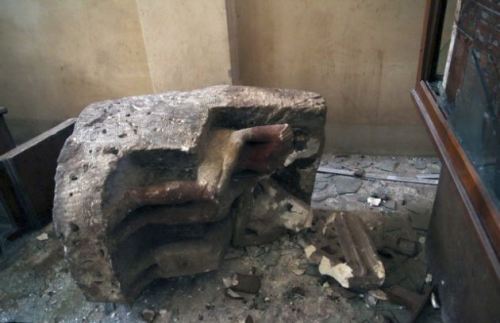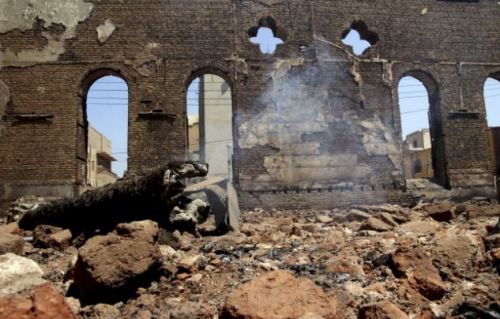
The above photo is from fellow blogger Penny Howe who sat on a bench overlooking the Columbia River, near her home, during this past spring’s winter snow melt. I shared it with several friends who expressed concern for Penny’s mental health. I assured them she’s a writer like me, so they immediately understood.
But, the picture made me think of the real threat soil erosion poses to major urban areas located near large bodies of water. It’s a genuine concern with climate change and rising sea levels. Half of the world’s population – roughly 3 billion people – lives in urban areas; a sharp rise from 13% in 1900. At the start of the 20th century, only 12 cities across the globe had populations of 1 million or more; now there are 336. More alarmingly has been the rise of “mega-cities,” urban areas with populations of at least 10 million. In 1950, New York was the only city in the world with that distinction; now, there are a total of 17 such metropolitan areas. Those people have to live and work somewhere, and that has increasingly come to mean larger edifices – gargantuan structures of concrete, steel and glass. All of those individuals and all of those buildings weigh several tons, which – along with food and water consumption – has an impact on the overall environment.
People will probably be debating the pros and cons of global warming until…well, until they drown. But, here in alphabetical order, is an informal list of some of the world’s fastest sinking cities.
Amsterdam – The Dutch capital is also the Netherlands’ largest city with about 820,654 people crammed into 84.56 square miles (219 km²); the greater metropolitan area has over 2.3 million residents. More importantly, Amsterdam is at constant threat from the water that surrounds it on 3 sides. In February of 1953, a series of calamitous floods from the North Sea killed over 1,800 people in the Netherlands alone and prompted Dutch engineers to rethink defenses for all of the nation’s cities. A large series of dikes and canals mostly keep the waters under control, but Amsterdam – built on sand and clay – is still sinking at roughly .078 inches (2 mm) per year.
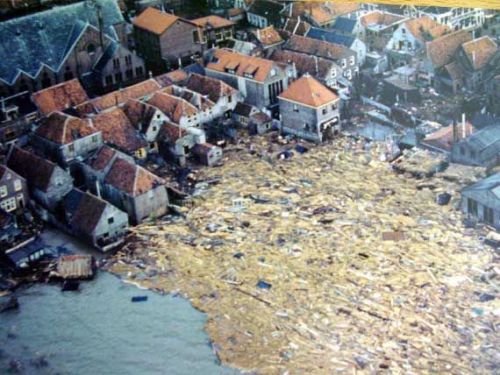
Winter floods in 1953 forced the Dutch to re-think their urban defenses.
Bangkok – The capital of Thailand boasts a population of some 8.281 million people, crowded into 606 square miles (1,569 km²), with over 14 million living in the general metropolitan area. Located on the Chao Phraya River delta, Bangkok has experienced a major economic boom in recent years. Like Amsterdam, Bangkok residents used intricate waterways to navigate the city for centuries. But, constructed on soft marine material known as Bangkok clay, the growing metropolis is sinking some 4.7 inches (120 mm) annually. Some engineers have warned about the dilemma for decades; mainly due, of course, to soil erosion and groundwater removal. Only recently, however, has Thailand undertaken measures to protect Bangkok by building dykes and retrofitting flood gates. But, for a city considered a “climate change hot spot,” that may not be enough.
Houston – The fourth largest city in the United States has some 3 million residents in its 627 square miles (1,625 km²) and practically sits right on the Gulf of México. In June of 2001, Tropical Storm Allison devastated parts of the Texas Gulf Coast, but Houston experienced the worst flooding. Allison dropped 6 – 10 inches (152 – 254 mm) of rain in less than 5 hours. That made Houstonians realize how vulnerable they are to nature’s elements. But, in 2010, University of Houston geologist Shuhab Khan announced that much of Houston (and overall Harris County) is sinking at approximately 2 inches per year. Like so many other coastal cities, Houston continues to build and drain groundwater to accommodate the expansion.
Jakarta – Located on the northwest corner of the island of Java, Indonesia’s capital has nearly 11 million people residing in 285.8 square miles (740.3 km²) and over 28 million inhabitants in the greater area known as Jabodetabek. About 40% of Jakarta’s land area sits at or below sea level. A 2010 report by the Bandung Institute of Technology noted that Jakarta is sinking at a rate of 3 – 4 inches (10 – 12 cm) per year; most of it due to the usual culprits: groundwater extraction and rapid infrastructure development. But, they act in concert with soil compaction and plate tectonics. A massive 9.1 earthquake off the coast of nearby Sumatra in December 2004 proved that seismic activity makes the entire Indian Ocean region vulnerable. Analyses done from 1974 to 2010 show that large portions of Jakarta sank anywhere from 9 – 27 inches (25 and 70 cm). A massive seawall built to prevent the Java Sea from inundating the city is also sinking. The Indonesian Forum for Environment has gone so far to claim that Jakarta will sink completely into the Indian Ocean by 2030, if construction and groundwater extraction aren’t limited.
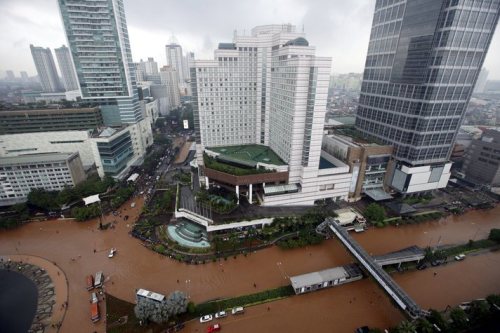
Flooding earlier this year almost paralyzed Jakarta.
London – As the provincial capital of the United Kingdom and the official capital of England, London is unique its dual role. And, contrary to popular American mythology, not everyone in England lives here – even with 8.174 million residents in its 607 square miles (1,572 km²). People have lived in the area for millennia, but the Roman Empire began building the former Londinium at the mouth of the Thames River in the first century A.D.; thus, making it one of the oldest continuously-occupied cities in Europe. In 2002, however, satellite photos showed that London had sunk about 2 cm between 1996 and 2001. Recent observations have noted that the legendary “Big Ben” at Britain’s Palace of Westminster is tilting at a somewhat precarious angle and that the entire parliamentary structure is gradually sliding towards the Thames. The growing subsidence may be due partly to development of the “Jubilee Line Extension” and the new “London Power Tunnels;” all constructed to meet the demands of a growing population. But, much of London’s descent could be traced to Britain’s overall recovery from the last Great Ice Age, when a massive ice sheet blanketed most of the island and depressed the entire land area downward. With the retreat of the ice, Britain is showing signs of a colossal rebound: Scotland is actually rising, while Wales and eastern England are technically sinking. Still, with a series of walls, dykes and the “Thames Barrier” – the world’s second-largest movable flood barrier – London hopes at least to delay any pending deluge.
México City – The Mexican capital is the largest city in the Western Hemisphere – in both population and land area – with some 8.851 million residents in 573 square miles (1,485km²) and roughly 21.2 million people in the overall metropolitan area of 761,601 square miles. It’s the only city on this list not located by an ocean or a sea, but its continuing subsidence is very real. Both can be attributed to the ancient Aztecs who began building Tenochtitlan, the center of their vast empire, nearly 1,000 years ago on a marshy island amidst 5 lakes that formed the base of the Valley of México. They dredged water to create an extensive series of canals and bridges, as the city grew. Spanish explorers were awed by the sight of it upon their arrival in 1519; at the time, Tenochtitlan had about 200,000 residents, larger than any city in Europe. After gaining control of the region, the Spaniards merely continued the expansion. Today, a small portion of one of those bodies of water, Lake Texcoco, remains. But, this giant metropolis, which was plunging at an astonishing 19 inches annually in the middle of the 20th century, is still sinking 2 inches per year into the soft bedrock. Many streets have sharp drop-offs from their sidewalks, while water and electricity lines are in constant danger of snapping or bursting.
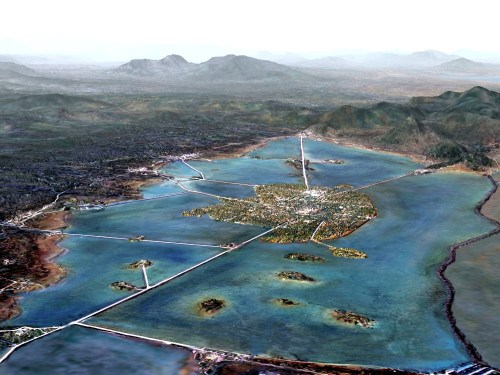
An artist’s conception of what Tenochtitlan may have looked like when Spanish explorers arrived.
New Orleans – Like Amsterdam, New Orleans is surrounded by water on 3 sides: Lake Pontchartrain to the north and the Mississippi River to the west and south. With about 343,800 people in 350.2 square miles (907 km²), it also has the dubious distinction of being the fastest-sinking city in the U.S. – roughly 1 inch (2.5 cm) per year. In fact, after the devastation of Hurricane Katrina, scientists took a closer look at New Orleans’ geological state and realized it was sinking into the Gulf of México much faster than previously thought. That may explain why the city’s complex levee system failed during Katrina and allowed some 80% of it to be flooded. As of 2006, scientists estimate, some of those levees had sunk up to 3 feet in the previous 40 years.
New York City – Composed of 5 individual, self-governing boroughs, New York City has about 8.245 million people in a total land area of 468 square miles (1,213 km²); altogether, about 19.3 million people reside in the New York metropolitan area. Last year’s Hurricane Sandy made all New Englanders realize the extent of their vulnerability to nature’s wrath; even toughened New Yorkers trembled. Sandy flooded parts of 4 of the city’s boroughs, but scientists have noted for years that densely-packed Manhattan Island, in particular, is slowly sinking into the Atlantic.
Shanghai – Founded around A.D. 1291, the most-populous city in the world boasts some 23.47 million residents. Located on the Yangtze River, Shanghai (which means “Above the Sea”) is sinking as much as 4 inches (101 mm) per year. Groundwater extraction has added to the problem, but so has the city’s rapid infrastructure growth. One report by the Shanghai Geological Research Institute claims that the physical weight of the city’s skyscrapers account for as much as 30% of Shanghai’s subsidence. In response, city officials have begun pumping roughly 60,000 tons of water per year back into wells; built hundreds of levees along the Yangtze; and are planning an emergency floodgate on the river’s estuary.
Venice – One of the oldest and most ornate cities in the world, Venice long ago ceded its fate to the sea; they’re just partying in advance of the grand finale. Some 264,000 people live in its 160.1 square miles (414.6 km²), which scientists believe is dropping between .04 and .08 inches (1 – 2 mm) annually – more than previously thought. Built against the Adriatic Sea, Venice is actually a cluster of islands that has always had a classic love / hate relationship with the water. Moreover, it’s tilting to the south at .12 – .16 inches (3 – 4 mm) per year. In just under the past 300 years, scientists believe Venice has dropped 2 feet (60 cm). That may not seem like much, but Venetians are experiencing more floods – about 4 or 5 times a year. Canals and bridges are part of the city’s landscapes, along with floodgates designed to close when high tides reach a level of 43.30 inches (110 cm). Street lamps linked to flood gauges automatically shine brighter as the water begins to rise; thus warning pedestrians to seek higher ground – or at least jump into a boat.
While sunken cities feel like the products of wild imaginations, recent advances in submarine archeology have proven the existence of submerged metropolises across the globe. Take Helike, for example, an ancient Greek port city that once thrived on the southwestern shores of the Gulf of Corinth. For centuries, its existence and demise were dismissed as purely mythical. But, in 2001, scientists found remnants of Helike buried further inland and have since confirmed that a massive earthquake and tsunami devastated the region in 373 B.C.; subsequently leading to the city’s destruction. It’s possible the catastrophe spawned the legend of Atlantis. Karen Mutton’s “Sunken Realms” provides an extensive and fascinating list of many other submerged cities, along with theories of what may have happened to them.
Nothing lasts forever – certainly nothing made by humans. Quakes and tsunamis may have once posed the greatest threat to archaic urban areas. But, in our infinite arrogance and bloated self-assurance, modern people don’t realize how little control we often have over our own fates.
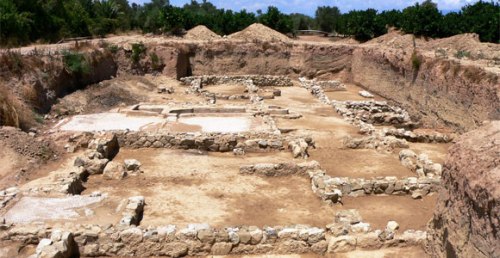
Proven true – Helike really did exist.