Where was the outrage?
Last year the Centers for Disease Control and Prevention (CDCP) reported that, between November of 2000 and December of 2011, eleven infant boys in the New York City area developed herpes infections following orthodox Jewish circumcision rituals. In keeping with religious tradition, every infant male born into the Jewish faith undergoes a bris, or brit milah, on the 8th day of life, during which the foreskin of his penis is removed. The cleric, a mohel, often dabs the infant’s lips with a drop of wine supposedly to numb the pain before performing the ritual. In the rare cases when the baby is born without a foreskin – a condition called aposthia – or if he was circumcised outside of the standard bris ceremony, the mohel performs a symbolic circumcision called a hatafat dam brit in which he pricks the head of the infant’s penis to draw a drop of blood. All of this is done in accordance with Jewish scripture, Genesis 17:10-14 and Leviticus 12:3, which Abraham, the founder of Judaism, allegedly wrote. Orthodox Jews, like many staunchly religious people, view their faith as an unmitigated commandment that should not be questioned.
No one knows if Abraham considered the possibility of herpes infections. But, during some of these ultra-orthodox rituals, the mohel often performs metzitzah b’peh, or oral suction, to minimize blood loss. In other words, he sucks on the baby’s penis, while family members and others stand around in quiet observation. I believe, in keeping with contemporary federal law, that’s called pedophilia and – regardless of one’s religious affiliations – it’s a felonious criminal offense.
Health officials have known for years that herpes infections can be detrimental to newborns. Because of their undeveloped immune systems, babies born to women infected with genital herpes (herpes simplex type 2) can develop fevers, seizures and / or blindness. Death is not uncommon among these infants. Herpes simplex type 1 usually causes blisters on the mouth, lips or eyes; otherwise known as cold sores. Of the 11 aforementioned New York cases, 10 of the babies were hospitalized; at least 2 developed brain damage, and 2 others died.
In December of 2005, New York Mayor Michael Bloomberg – tiptoeing through the minefield of religious sensibilities – issued a letter to the local Jewish community warning of the health risks of metzitzah b’peh and politely asked rabbis to cease the practice. Religious leaders scoffed at the notion, insisting that the ritual was perfectly safe. As usual, they claimed religious freedom and vowed to fight any attempts to ban it.
Such cases may be rare, but I noticed no demands were made of New York’s Jewish community to stop putting their infants at risk; no threats of prosecution; no criminal charges – nothing but courteous requests to think about what they were doing. Had those infants been girls, I realized, Bloomberg himself would have rounded up every religious leader and every parent and thrown them in jail. But, since male circumcision has become such an insidious element of pediatric care in the U.S. and since violence against males – even infant males – is socially acceptable here, no one seemed to notice.
Religious freedom – like free speech and voting – is one of the hallmarks of American society. It’s a critical feature of any civilized state. But, I have to wonder how the public would react to infant females contracting genital herpes following some archaic religious ceremony. Would the local mayor merely ask religious leaders to stop and just hope for the best? Where, in fact, was the media outrage over the 2012 CDCP report? Why is that people seem to think it’s okay that baby boys aren’t just being cut up in the name of religion, but dying because of it?
Male circumcision is primarily associated with Judaism, but it’s also a sacred rite among Muslims. Unlike Jews, however, Muslims wait until their sons are older to perform the ritual – usually between the ages of 6 and 11. But, its origins in the Islamic faith, however, are unclear. It’s mentioned in the hadith (sayings from the profit Mohammed), but not in the Quran. Circumcision is not considered a religious rite among Christians, even though the “Gospel of Luke” states that Jesus was circumcised on the eighth day after his birth. Circumcision was also considered a rite of passage among some African and Indigenous Australian groups where it was viewed as a pathway to manhood for boys.
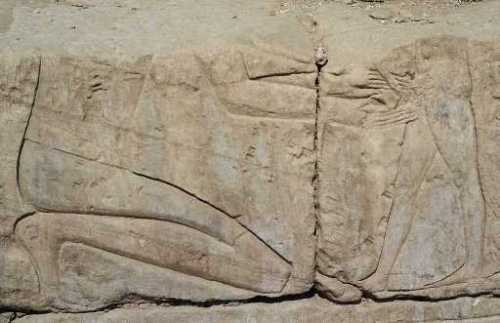
A purported circumcision from the Temple of Khonspekhrod in Luxor, Egypt, c. 1360 B.C.
Male circumcision was once virtually unknown in the United States. Early proponents were doctors who believed it would prevent male sexual deviants from committing further crimes, such as rape and pedophilia; others included homosexuality in that evil repertoire. Circumcision was even recommended for men charged with adultery and to stop boys from masturbating. This was during a time when physicians believed human sexuality (and its various perversions) were strictly tied to genitalia. In 1858, for example, the European medical community urged clitoridectomies to overcome frigidity and hysteria in women. In 1891, England’s Royal College of Surgeons published On Circumcision as Preventative of Masturbation. Around the same time, John Harvey Kellogg, a nutritionist and self-proclaimed sexual advisor, developed his corn flakes cereal as a means to prevent children from masturbating. Kellogg believed masturbation – then often called onanism or self-pollution – caused insanity and, if left unchecked, could be fatal. He even suggested threading silver wire through the foreskins of young boys to prevent them from getting erections and therefore, stamp out their sexual urges. He also came up with the idea of injecting some of his patients with yogurt enemas to cleanse their intestinal tracts. Fortunately, neither of these latter two practices caught on with the American public.
Neither did circumcision. That began to change, however, after World War II. Much of it has been credited to the rapid influx of Jewish immigrants fleeing Nazi-riddled Europe. But, a growing body of medical practitioners had already begun to urge circumcision of newborn boys as a means of preventing penile cancer later in life. In 1932, Abraham Leo Wolbarst, [Circumcision and penile cancer. Lancet 1932; 1: 150-153], published a review of 1,103 cases of penile cancer in the U.S. and noted that none occurred among Jews. He cited similar figures from Europe and pointed out that Muslim men who had been circumcised as pre-teen boys were less likely to develop penile cancer. A 1935 report entitled “Epithelioma of the Penis,” published in the Journal of Urology, [Dean AL Jr. Epithelioma of the penis. J Urol 1935; 33: 252-283], seemed to confirm those findings with an analysis of a mere 120 penile cancer victims at New York’s Memorial Hospital: none were Jews. Circumcision among adult males began to increase throughout the 1930s.
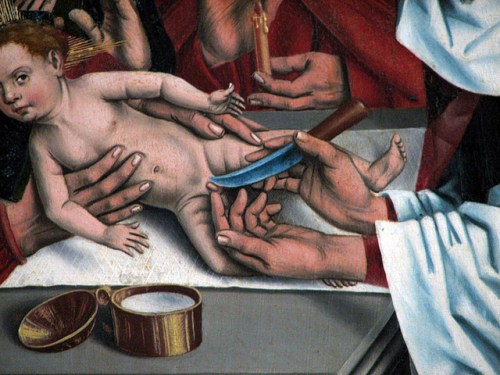
Detail of Friedrich Herlin’s 1466 depiction of the circumcision of Jesus, “Twelve Apostles Altar.”
Then, in 1946, various reports started coming out in the U.S. claiming that men returning home from World War II, especially those who’d served in North Africa, were suffering from penile cancer. These men, some medical professionals supposedly observed, had gone for long periods without bathing and, for the uncircumcised ones, this culminated in a build-up of smegma; which in turn, developed into penile cancer. It is true that many of those servicemen were uncircumcised and had gone without bathing for lengthy stretches. But, they weren’t suddenly afflicted with penile cancer. Instead, many of them were suffering from venereal diseases, mainly syphilis. It’s quite plausible to assume many of them, happy that the relentless war had finally ended, celebrated by patronizing local brothels before returning home. Yet, the unsubstantiated claims of a sudden outbreak of penile cancer nonetheless launched a movement and circumcisions of newborn males began occurring at a rapid pace. By the mid-1950s, up to 90% of newborn American boys were circumcised; thus making it the most common surgical practice in the country. By the early 1960s, some health insurance companies began reimbursing doctors for circumcisions, thus invoking a profit motive. Some hospitals started performing circumcisions without the parents’ knowledge or consent – and then charging them for it. In the early 1980s, the rate of newborn male circumcisions began to drop; albeit slowly, and continued dropping. By 2010, the rate stood at roughly 40% in the U.S. – the first time it was below 50% in over half a century.
Preventing penile cancer is perhaps the top myth related to male circumcision. As with anything, the truth often gets lost amidst the rancor of popular opinion and uncertain medical advice. Tell a lie often enough, as the saying goes, and people start to believe it. But, here are the facts, starting with that number one lie:
Myth: It prevents penile cancer.
Fact: Penile cancer is one of the rarest forms of carcinoma known to humanity. Worldwide penile cancer accounts for about 0.2% of all cancers in men. In the U.S., it accounts for some 0.1% of all cancers in men, or about 1 man in 100,000. Men are actually more likely to die from a rare form of male breast cancer than penile cancer. Even in other developed nations, such as England and Japan, where male circumcision is uncommon, penile cancer is actually more rare.
After years of intense medical analyses with various groups of men, no doctor has been able to prove conclusively that intact foreskins are linked directly to penile cancer. Doctors do know that the number one cause of penile cancer is the human papilloma virus (HPV), which is spread through unprotected and often frequent sex. Poor diet, obesity and nicotine consumption are other contributing factors.
Myth: It prevents cervical cancer in men’s female partners. This is another top reason provided for male circumcision.
Fact: As with penile cancer, HPV is the leading cause of cervical cancer, with poor diet, obesity and nicotine consumption listed as other risk factors. Up until the mid-1950s, cervical cancer was one of the leading causes of cancer deaths among women in the U.S. But, physicians don’t credit the increase in male circumcisions for the decline; rather, they point to the increased prevalence of pre-cancerous screenings (Pap smears) and greater attention to women’s overall gynecological health.
Circumcising males to protect females may be politically correct, but it’s morally unethical and medically impractical. You don’t safeguard one group of people by violating the basic human rights of another. Even if all men are circumcised, venereal diseases can still be spread through unprotected sex. As with the number of pregnancies and births, the rates of venereal disease infections drop when women are empowered with information. Women in developed countries, for example, have on average 2 children; while women in developing nations have as many as 5 children.
Myth: It minimizes the risk of venereal disease transmissions.
Fact: The term “minimize” is often substituted for the term “prevent,” but the misunderstanding can be dangerous. Even though most males born in the U.S. from the 1950s to the 1970s were circumcised, the rates of sexually transmitted diseases increased exponentially during that same time period. Gonorrhea was one of the biggest culprits, with 193 reported cases per 100,000 individuals in 1950; and 442 reported cases per 100,000 individuals in 1980. Syphilis actually experienced a dramatic decrease: 642 reported cases per 100,000 individuals in 1950; and 60 reported cases per 100,000 individuals in 1980. The key term, of course is “reported.” Even now, though, both those ailments remain the most commonly-transmitted venereal diseases. (Health, United States, 2010, U.S. Health and Human Services, Trend Tables: Table 44, p. 212.)
Genital herpes exploded from an average annual 5% infection rate in the late 1960s to about 30% by 1980. Chlamydia, which was rare before 1990, saw 1.4 million cases in the U.S. in 2011. Hepatitis B has also been tenuously linked to male circumcision. Scientists identified Hepatitis B as a separate strain in 1955 and discovered it could be sexually transmitted in 1975; the same year they identified Hepatitis C, which they initially called “non-A, non-B.” Until the 1970s, Hepatitis B had been dubbed the “druggies’ disease” because it primarily infected intravenous drug users. In the 1980s, Hepatitis B became linked with another growing epidemic, another consequence of the sexual revolution: AIDS. And, that in turn, has now metamorphosed into yet another ruse for circumcision.
In recent years, some epidemiologists have claimed that circumcision minimizes the spread of HIV (human immunodeficiency virus) infections. Much of this is based on a controlled study of 5,534 uncircumcised, HIV-positive Ugandan men, beginning in 2002. Doctors convinced the men (all of whom identified as heterosexual) to get circumcised. None of the physicians believed the men would be cured of HIV, but they wanted to see if the men developed higher T-cell counts once their foreskins were removed. As often happens, things looked great on paper, but didn’t go as planned once put into action. Many of the men – believing they’d been cured of HIV – began having unprotected sex; others disappeared from the control group, so doctors couldn’t track their activities. Still, the doctors insisted the study showed promise; claiming that circumcision reduced a man’s risk of acquiring HIV by as much as 60%. But, to me, the concept of a bunch of mostly White, mostly female European and American physicians urging a cluster of uneducated, basically illiterate Black men to have their penises mutilated seems as racist and sexist as it does immoral.
Myth: It prevents urinary tract infections (UTI), especially in male children.
Fact: The medical community can’t seem to make up its mind on this one. On average, about 5% of girls and 2% of boys will develop a UTI. Between 1971 and 1999, the American Academy of Pediatrics published 5 policy statements on the circumcision of boys in relation to UTIs and could find no credible evidence of a direct correlation. In other words, circumcision didn’t prevent UTIs in boys. In 1986, however, they still noted the procedure “has potential medical benefits.” Then, in 1999, they reversed course and didn’t recommend it.
An analysis of 136,086 boys born at U.S. Army hospitals from 1980 to 1985 showed that 100,157 were circumcised. Of those, 193 experienced complications related to the procedure; that apparently included UTIs. Of the 35,929 uncircumcised infants, 88 (or .24%) developed UTIs. It’s obvious infants develop UTIs because they can’t control their bladder and therefore, can’t clean themselves.
There is only one legitimate medical reason for circumcision: phimosis, which is the inability of the foreskin to be retracted. The condition can lead to inflammation of the penile glans and urinary tract infections. Occasionally, topical ointments such as hydrocortisone can relieve the tightness of the skin and subsequent inflammation. But, more practically, removal or loosening of the foreskin is appropriate. Still, on average, only about 1% of boys are born with or develop this condition.
Another medical reason often given for circumcision is prevention of balanitis, which is inflammation of the penile glans. This usually occurs in uncircumcised men, but is traced to one primary cause: poor hygiene. Severe balanitis requires more aggressive treatments, such as antibiotic pills or steroid creams. But, it’s amazing what regular hygienic habits can accomplish. Simple hand-washing, for example, can reduce the risk of respiratory-associated infections by up to 16% and reduce the risk of diarrheal disease-associated deaths by up to 50%.
Yet another explanation often given to justify circumcision is purely aesthetic: it allegedly makes the penis look better. That, of course, is a personal opinion, but not enough to warrant mandatory foreskin removal. I’ve entered into a number of debates about this one in particular; often with women who would scream if I suggested they have a surgical procedure done to meet what I think is my own definition of beauty. Any woman who thinks the uncircumcised penis looks ugly needs to hold a mirror up to her own crotch; the female genitalia isn’t exactly a work of art either. Human genitalia altogether isn’t built for appearance; it’s built for function. You don’t look at it; you work with it.
Then, there’s the presence of smegma – the nasty buildup of dead skin cells beneath the foreskin. It’s primary cause? Once again, poor hygiene. For most uncircumcised men, hygiene is a simple matter, like breathing – we retract the foreskin and clean ourselves. Any uncircumcised man who doesn’t engage in this most basic of behavior has far more problems than the inability to reach for soap and water.
If circumcision truly prevented penile or cervical cancers, then perhaps we should mandate, or at least strongly recommend, that women have double mastectomies once they pass their child-bearing years to avoid breast cancer. Despite recent medical advances and awareness, breast cancer remains the number one killer of women in the U.S. For that matter, we should mandate adult males have prostatectomies to avoid prostate cancer, which is the third greatest cause of carcinoma-related deaths of men in the U.S. (Lung cancer is the top killer, but I don’t think mandatory thoracotomies would be practical.)
Appendicitis is much more common than penile cancer, and since the appendix serves absolutely no purpose in the human body, appendectomies could save valuable time and money. Tonsillitis is a common affliction in children, but doctors still don’t perform tonsillectomies as a preemptive measure. Wisdom teeth often become impacted and necessitate removal, but again, doctors don’t seem to automatically mandate it.
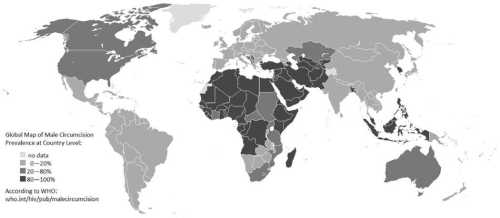
Unlike so-called female circumcision, calls to ban male circumcision have been met with hostility from people who suddenly develop an affection for religious freedom. The loudest voices have come from the Jewish community; many of whom will use any excuse to play the victim. When a handful of Muslim groups protested that banning female circumcision violated their religious freedoms, human rights activists paid no attention. In that regard, protecting the health and safety of infant and toddler females trumped the religious ideologies of their parents. A number of countries rightfully passed laws outlawing the practice, including the U.S. When it comes to males, however, that religious freedom issue abruptly rears its ugly head and suddenly takes precedence over the rights of the child.
In 1996, then Congresswoman Pat Schroeder of Colorado proposed the Female Genital Mutilation Prevention Act (FGMPA) to outlaw female circumcision in the U.S. It didn’t seem to matter that the ritual never had been practiced here, or most anywhere in the developed world. The FGMPA passed unanimously, and then-President Bill Clinton signed it into law. I’d never even heard of female circumcision until the early 1990’s, when human rights advocates started complaining about the thousands of girls suffering and dying in isolated parts of Africa and Asia. For a much longer period, however, others had been complaining about the savagery of male circumcision and the fact that boys are suffering and dying as well. The same devout Muslims who practice female circumcision in Africa and Asia also practice male circumcision – with the same level of barbarity; no anesthesia, no sterilization and no post-operative medical care. With each child – female or male – they just cut off part of the flesh. But, as in the developed world, the deaths and injuries suffered by males are ignored. It is truly a gender-bias abomination. But, in the politically correct universe of 1990’s America, that didn’t seem to matter; thus, the FGMPA became law without question and remains law, even though female circumcision was never practiced in the U.S. or any other developed nation.
In 2011, two California cities – San Francisco and Santa Monica – proposed to ban male circumcision. In both cases, the issue reached the state legislature where Assemblyman Mike Gatto reacted by introducing a bill that would prevent any municipality in California from outlawing the procedure. Ultimately, supporters of the ban in both cities experienced disenfranchisement. In San Francisco, voters defeated the measure at the ballot box in November of 2011. In Santa Monica, those who had proposed the anti-circumcision measure merely withdrew it from consideration.
In July of 2012, the German government backed away from its sweeping proposal to ban male circumcision. Chancellor Angela Merkel announced that Jewish and Muslim groups will be allowed to circumcise their sons in accordance with their respective religious beliefs.
The 11 cases highlighted in the 2012 CDCP report aren’t really anomalies. Every year in the U.S., about 100 infant and toddler boys die due to botched circumcision procedures, which include complications from administration of anesthesia. Some say the number sometimes reaches 300, but actual statistics are difficult to ascertain. I’m quite certain if 100 to 300 infant or toddler girls were dying from botched medical procedures, the practice would have been outlawed without question, no matter whose religion was offended. If 100 to 300 adult females died annually from a botched cosmetic procedure, it definitely would have been outlawed!
It’s shocking to think that infant male circumcision is the most common surgical practice performed in the United States, but it has been for over six decades. Even with the rash of weight reduction surgeries and face lifts in recent years, removing the foreskins of baby boys still ranks number one among cosmetic procedures. But, the adverse effects of those circumcisions are conveniently left out of the debate.
Almost every year for nearly three decades, a bill simply titled the “Male Genital Mutilation Bill” has been presented to the U.S. Congress. And, every year it never comes up for discussion. It goes back to the cloak of religious freedom, and the grip it has on society.
When people make medical decisions based on religious ideology, other people – usually infants and children – often die. In medieval Europe, the Roman Catholic Church often punished as heretics any medical practitioner who tried to ease the difficulties of pregnancy and childbirth; the Church believed women had to suffer for the sins of “Eve.” Even now, the Fundamentalist Church of Jesus Christ of Latter Day Saints (FLDS) forces women and girls to endure the agony of childbirth because of Eve’s alleged transgressions. When the “Black Death” struck 14th century Europe, the Roman Catholic Church pointed to Jews as the culprits. As we now know, of course, the “Black Death” was the bubonic plague, which is a virus transmitted by fleas that live on rats and other animals. The lack of hygiene among medieval Europeans and the fact they often slept in the same quarters as their animals contributed to the virus’ spread. Jews were saved mostly because they often washed their hands before preparing food and engaged in other such ghastly habits like bathing more than once a year.
Just recently, a measles outbreak in Fort Worth, Texas has been traced to an evangelical Christian church where members refused vaccinations of any kind. When some in the congregation returned from overseas proselytizing trips infected with the highly contagious disease, leaders prescribed prayer instead of medicine. Now, 21 people in two counties have been diagnosed with measles.
I realize it’s difficult to alter religious ardor. People tell me Jews and Muslims should be allowed to circumcise their sons because they’ve been doing it for centuries. Well, for centuries, slavery was considered perfectly acceptable. Blatant racism was a factor of American life from its beginning; something that changed only in recent decades. That, in and of itself, ties into the enslavement of the first African-Americans; their contemporary European counterparts believed slavery was mandated by the Bible. In the 19th century, White Americans concocted the philosophy of “Manifest Destiny” to forge westward across North America, which obligated them to destroy any darkness and savagery they encountered; meaning, of course, God commanded them to kill any heathenous Indians who got in their way.
As a former Roman Catholic devotee – an altar boy at that! – I once believed in the concept of “original sin” and the story of creationism. Then, I saw the light and divorced myself from such ludicrous ideology – a sacrilege unto itself in the Church. The Church’s disrespectful treatment of women was the real catalyst for my departure from its ranks of the blind faithful. Roman Catholicism – and all branches of Christianity – has always taught that women were second-class citizens; another by-product of Eve’s wickedness. Even now, the Church forbids birth control; believing everyone should procreate whether they like it or not. The Church naturally doesn’t feel obligated to provide financing for those procreative results.
When human rights clashes with religious freedom, religion needs to take a back seat – always and forever, no exceptions. I don’t care about anyone’s religious affiliation – Jew, Christian, Muslim, whatever – infants have more of a right to have their bodies left intact than their parents or their communities have to practice a certain philosophy. If all of Judaism or Islam collapse because parents won’t be able to carve up their sons’ penises, then that would be a good thing. Religion has been a great oppressor throughout human history. Judaism, Christianity and Islam, in particular, have been the worst offenders; more people have been maimed and murdered because of those three religions than any other human construct. It’s still happening even now.
And again, with 11 newborn babies infected with herpes, I ask – where was the outrage?
Attorneys for the Rights of the Child
International Coalition for Genital Integrity
MGMbill.org
Jews Against Circumcision
Mothers Against Circumcision
Nurses for the Rights of the Child