
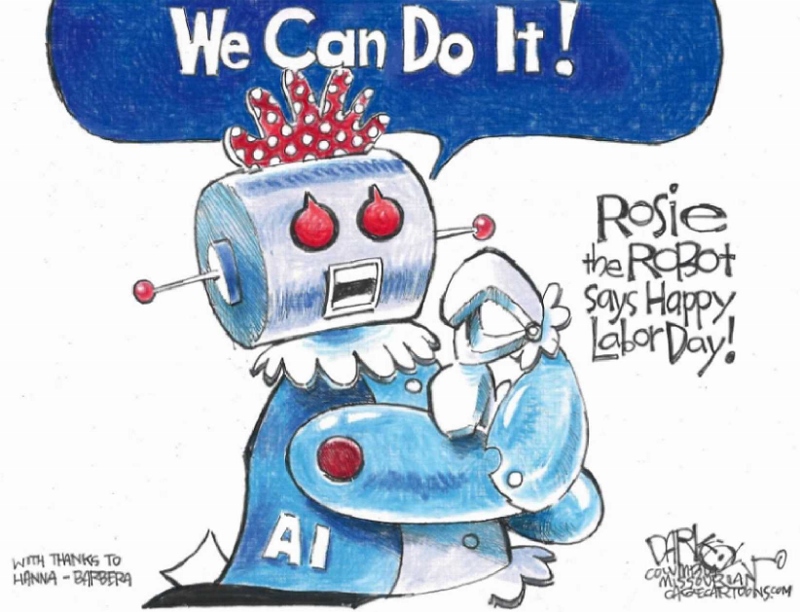
“Action and reaction, ebb and flow, trial and error, change – this is the rhythm of living. Out of our over-confidence, fear; out of our fear, clearer vision, fresh hope. And out of hope, progress.”
Image: John Darkow
“Action and reaction, ebb and flow, trial and error, change – this is the rhythm of living. Out of our over-confidence, fear; out of our fear, clearer vision, fresh hope. And out of hope, progress.”
Image: John Darkow
Filed under News
“It takes less time to do a thing right, than it does to explain why you did it wrong.”
Filed under News
Filed under News

As Labor Day fast approaches here in the U.S., I’m happy to point out that I recently started a new job; a full-time position with a firm that does a great deal of government contract work. And, if you know anything about the U.S. federal government, there’s a lot of work to be done! It’s similar to the kind of work I did with an engineering company more than a decade ago.
Yes, that’s me in the scary unretouched photo above – slaving away over a hot keyboard and fighting spreadsheet eyes. Although my company has a local office, they switched to remote work at the start of the COVID-19 pandemic three years ago and have found that it seems to be the best functional model for everyone. So I get to sit at a desk in my home bare-chested and in gym shorts shuffling through a myriad of digital documents. As a devout introvert, it’s a utopian environment for me.
It’s especially ironic in that I’ll be 60 in some two months – and finding a job at this point in life is challenging for anyone. I’d been doing contract and freelance work since 2010, so it’s quite a change. But welcome nonetheless. Yes, it’d be great if my debut novel (or any future novel) could be sold to a motion picture company for X amount – preferably in the seven figure range – that would be extraordinary. But I know how unlikely that is. I’m not naïve.
I listen carefully to close friends and fellow bloggers as they vent about their own struggles to get from one point to another in the working world. One friend lives in the Los Angeles area and works for a major television network. He studied filmmaking and screenwriting at New York University in the 1990s and is witnessing – and feeling – the impact of the ongoing writers’ and actors’ strikes firsthand. I commented a while back about his education. “A lot of good that did me!” he replied. I often felt the same, as I struggled over the past decade to find work. I kept relying upon that degree in English I finally earned. What good has it done? I asked myself more than a few times. But I’m still proud of it.
My father was essentially forced to retire shortly after turning 62 in 1995. When he called the local Social Security office to apply for his benefits, the clerk stated (almost sarcastically), “I guess you want your money now.” My father answered, “You’re damn right I do!” In the middle of one day several years ago he decided on a whim to have a glass of wine. One of my uncles lives alone in a neighboring suburb with a cat and once told me, “I’m happy to sit around on my fat ass and watch TV all day!” Aside from a brief stint in the U.S. Army in the 1960s, he worked in warehouses most of his life. Like my father, he did hard labor – donkey-type work; the kind that wears out people quickly.
Other people, like my mother, did white-collar work – the kind that wears on the mind. I don’t know what’s worse – mental or physical exhaustion. I suppose they’re equally stressful.
Regardless I’m back in the swing of things with the labor force. I actually enjoy what I’m doing – mainly because I’m doing it from home and can sit around bare-chested while listening to music such as this. It helps fight those spreadsheet eyes.
Filed under Essays
Filed under News
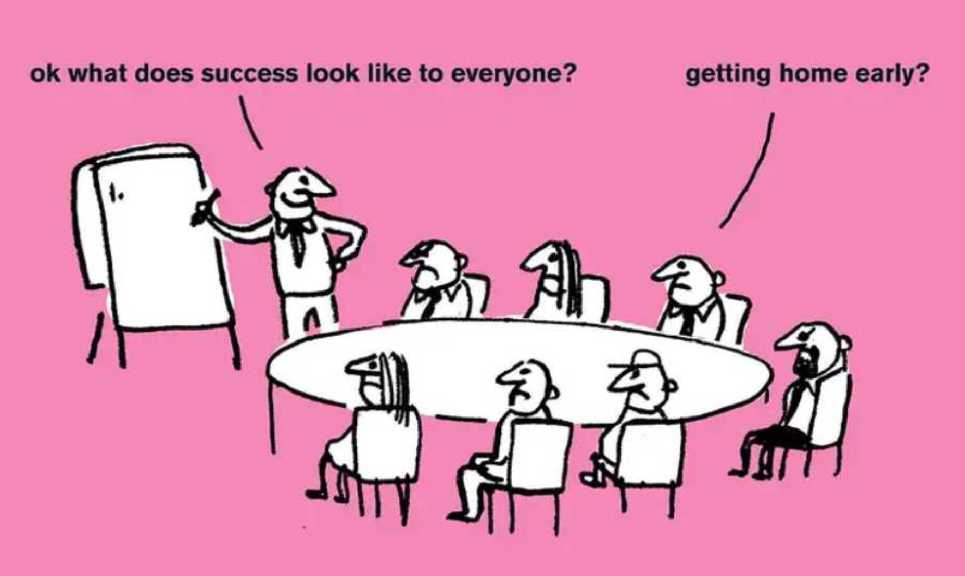
“Nothing is really work unless you would rather be doing something else.”
Image: Modern Toss, New Scientist
Filed under News

“Nothing ever comes to one that is worth having except as a result of hard work.”
– Booker T. Washington
“Dare to be honest and fear no labour.”
– Robert Burns
“Nothing will work unless you do.”
– Maya Angelou
“No human masterpiece has been created without great labour.”
– Andre Gide
“If all the cars in the United States were placed end-to-end, it would probably be Labor Day weekend.”
– Doug Larson
“Genius begins great works; labor alone finishes them.”
– Joseph Joubert
“It is only through labor and painful effort, by grim energy and resolute courage, that we move on to better things.”
– Theodore Roosevelt
“All labor that uplifts humanity has dignity and importance and should be undertaken with painstaking excellence.”
– Martin Luther King, Jr.
“Labor Day is devoted to no man, living or dead, to no sect, race or nation.”
– Samuel Gompers
“I believe that summer is our time, a time for the people, and no politician should be allowed to speak to us during the summer. They can start again after Labor Day.”
– Lewis Black
“Before the reward, there must be labor. You plant before harvest. You sow in tears before you reap joy.”
– Ralph Ransom
“The best way to find yourself is to lose yourself in the service of others.”
– Mahatma Gandhi
“A hundred times every day, I remind myself that my inner and outer life depend on the labors of other men, living and dead, and that I must exert myself in order to give in the same measure as I have received and am still receiving.”
– Albert Einstein
“Work is no disgrace; the disgrace is idleness.”
– Greek Proverb
“Without ambition one starts nothing. Without work one finishes nothing. The prize will not be sent to you. You have to win it.”
– Ralph Waldo Emerson
“A man is not paid for having a head and hands, but for using them.”
– Elbert Hubbard
“The supreme accomplishment is to blur the lines between work and play.”
– Arnold J. Toynbee
“It is labor indeed that puts the difference on everything.”
– John Locke
“As we celebrate Labor Day, we honor the men and women who fought tirelessly for workers’ rights, which are so critical to our strong and successful labor force.”
– Elizabeth Esty
“I’ve heard of nothing coming from nothing, but I’ve never heard of absolutely nothing coming from hard work.”
– Uzo Aduba
“Just try new things. Don’t be afraid. Step out of your comfort zones and soar, all right?”
– Michelle Obama
“The price of success is hard work, dedication to the job at hand, and the determination that whether we win or lose, we have applied the best of ourselves to the task at hand.”
– Vince Lombardi
“Though you can love what you do not master, you cannot master what you do not love.”
– Mokokoma Mokhonoana
“Work isn’t to make money; you work to justify life.”
– Marc Chagall
“Follow your passion, be prepared to work hard and sacrifice, and – above all – don’t let anyone limit your dreams.”
– Donovan Bailey
Filed under News

Finally – some good news!
A few years ago – about a year after I got laid off from an engineering company and while I struggled to find even a temporary job while trying to launch my freelance writing career – I told a close friend of mine via email that, when the economy improves, people will start switching jobs without giving much, if any, notice to their employers.
“True,” he replied.
It’s starting to happen. The recent economic crisis – the worst in this nation’s history since the Great Depression – almost completely destroyed our financial stability. Multiple factors were responsible for it: broad-based tax cuts for the wealthiest citizens and largest corporations; further deregulation of banking and housing; and the wars in Afghanistan and Iraq. Between December 2007 (when the recession officially commenced) and June 2009 (when it officially ended), the U.S. economy shed roughly 8.7 million jobs. Employers began to add jobs in 2010. Only recently, however, have we regained all those lost jobs.
There’s no real cause for celebration. The after effects of such a prolonged economic debacle are as varied as the causes. People lost accumulated personal wealth; state and local economies suffered decreased tax revenue; and home values dropped. Wages, however, remain stagnant, despite increased productivity. People have always worked too damn hard for their money. Of course, everyone feels they’re overworked and underpaid. But now, we have statistical proof. But, according to Ben Bernanke, chairman of the U.S. Federal Reserve System, the “Great Recession” actually was worse than the Great Depression. In a statement filed on August 22 with the U.S. Court of Federal Claims, as part of a response to a lawsuit over the 2008 bailout of insurance giant American International Group (AIG), Bernanke said:
“September and October of 2008 was the worst financial crisis in global history, including the Great Depression.” Of the 13 “most important financial institutions in the United States, 12 were at risk of failure within a period of a week or two.”
When asked why he thought it was critical for the U.S. government to rescue AIG, Bernanke replied:
“AIG’s demise would be a catastrophe” and “could have resulted in a 1930s-style global financial and economic meltdown, with catastrophic implications for production, income, and jobs.”
Obviously, too-big-to-fail truly has become too big to fail! The Great Depression was exacerbated by the fact the Federal Reserve System didn’t take command of the banks. Billionaire financier Andrew Mellon was the U.S. Treasury Secretary during the Hoover Administration and – like a typical conservative Republican – believed the nation’s banks had gotten themselves into trouble and needed to get themselves out of it, even if that meant they failed and took their customers’ money with them. Which they did, of course, in very large numbers. At the time, though, we didn’t have a Federal Deposit Insurance Corporation (FDIC) to safeguard people’s financial assets. The federal government’s lackadaisical attitude at the onset of the Great Depression forced Republicans to lose both houses of Congress during the 1930 midterm elections and shoved Hoover out of the White House two years later. That same kind of ineptitude is probably what caused them to lose both houses of Congress in 2006.
Yet, as the economy continues to recover and employers continue adding jobs, I see my aforementioned prediction materializing. During sluggish markets, employers can afford to be picky on who they hire and can freeze wages and salaries at will. It’s almost cruel and inhumane the way some can behave. And, what’s the average worker to do? With children, mortgages, car payments and other debts, they’re often stuck. They have little power.
But, from January to June of this year, more than 14 million people quit their jobs. I would like to think they left for better jobs. And, I’d like to believe they gave little notice to their employers. After all, companies don’t have to give employees any real notice when they plan to let someone go; albeit, quite often, people can feel it. In 2009, there were approximately seven people for every job opening. As of June 2014, the ratio had dropped to 2-to-1. Overall, the number of unemployed has dropped by 5 million, while the number of new jobs has grown by 2.5 million. Now, there’s talk of a problem we haven’t seen in a while: labor shortage. Companies are starting to feel one of the adverse effects of an improving economy; there aren’t enough people, or at least not enough qualified people, to fill certain positions. Thus, it’s employees and jobseekers who can be picky.
And, that’s a good thing. It’s really the way it should be. Only once in my life have I had the pleasure of quitting a job I hate; in January 1989, I left a retail position, which I’d held for nearly three years. I just walked into the place and gave my immediate supervisor a typewritten note announcing my resignation. But, I’ve known a few people who, in recent years, essentially gave their boss the middle finger and walked out of a company. They recounted their experiences with glee. We spend a great deal of time at work; often more than with our own families. Work gives people personal value and a sense of accomplishment, and everyone who makes an effort to complete a job should be respected. Whether that person answers the phones in a call center; digs ditches for sewer lines; programs a voice mail system; or rings up items at a cash register, they should be considered important. They pay taxes and insurance and they put the rest of their money back into the economy as consumers.
Last week, an executive in the company where I’m working as a contract technical writer staged an impromptu meeting to announce a major organizational change. After presenting a variety of business details, he said something that I’d never heard from someone at his level: “Family is more important than work.” He emphasized that everyone needs to place greater value on their loved ones than on their careers; noting that he hadn’t done that and almost paid the price for it. I’ve heard some executives tell people on an individual basis the same thing – but never in such a large setting. He’s right. A company won’t collapse because you can’t make it to a business conference. You won’t necessarily recall that training seminar. But, you most likely will remember a child’s sports event. And, you’ll cherish it forever.
Filed under Essays
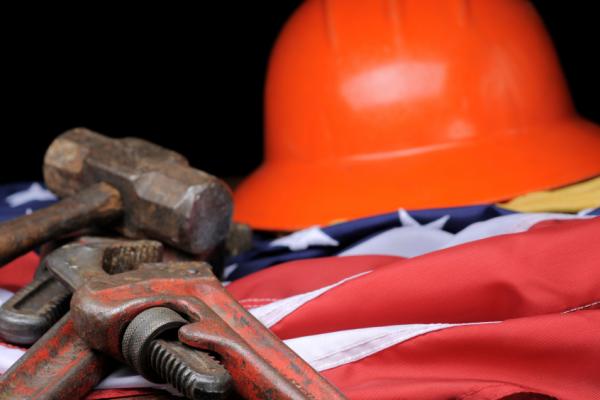
“All labor that uplifts humanity has dignity and importance and should be undertaken with painstaking excellence.”
Filed under News

 Chief Writing Wolf