
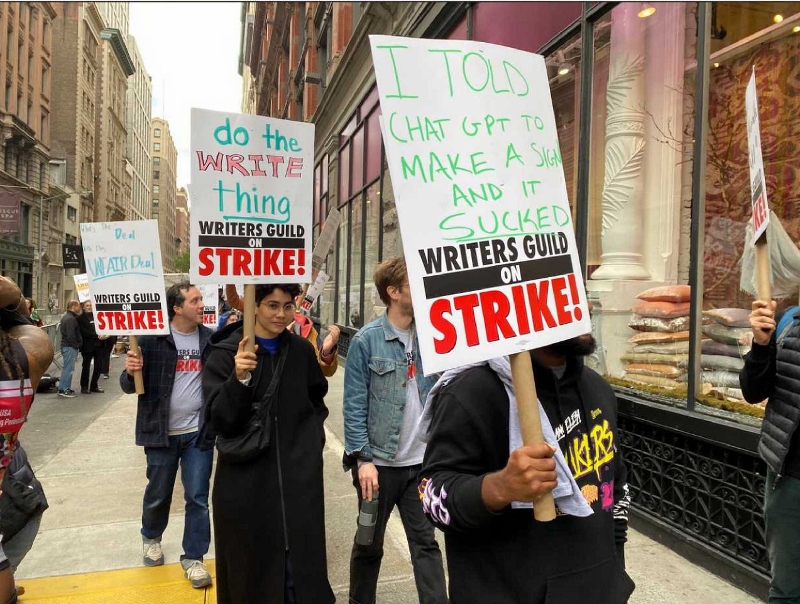
Protesters outside Netflix’s headquarters on May 3 demand better pay and no AI in the writers’ room. Photo: Maya Pontone/Hyperallergic)
On Monday, May 1, the Writers Guild of America went on strike. It’s the first time professional television and film writers have revolted against the entertainment industry since 2007. That particular walkout last more than three months and alone cost the state of California $2.1 billion. Back then the dispute centered on the growing internet market and material being downloaded for very little, if not for free. The entertainment world’s corporate elites had, of course, remained profitable.
The WGA is still fighting for the usual claims: higher wages, better healthcare benefits and pensions, and – as in 2007 – more compensation when their work shows up on streaming platforms, such as Amazon and Netflix. According to an industry bulletin, writer pay has fallen, as corporate profits have risen. Production companies are also hiring fewer writers to do more work. (Sound familiar?)
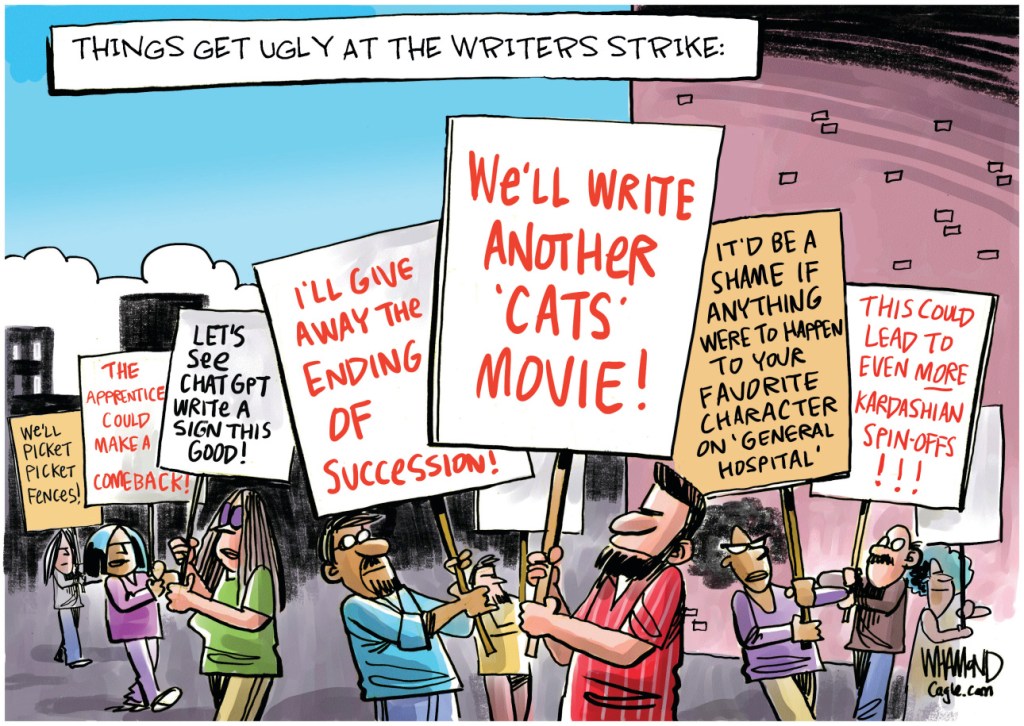
But now the writers are also targeting a new entity: artificial intelligence (AI) and in particular the ChatGPT program, which has emerged as a writing tool. Launched in November 2022 by OpenAI, ChatGPT is still in its development phase, but has curious (threatening?) implications for writing, computer programming and even every day conversations. In recent years AI has been used to create realistic fake photos and videos.
Didn’t Isaac Asimov warn about things like this?
Dr. Geoffrey Hinton certainly has. Considered the ‘Godfather of AI’, Hinton has expressed concerns about AI’s rapid expansion across the globe, dubbing it an “existential risk” to true human intelligence and ingenuity. A decade ago Google brought Hinton on board to help develop its AI platform, and his endeavors ultimately led to the creation of ChatGPT. Now, perhaps channeling Victor Frankenstein, Hinton declares, “I’ve come to the conclusion that the kind of intelligence we’re developing is very different from the intelligence we have. So it’s as if you had 10,000 people and whenever one person learned something, everybody automatically knew it. And that’s how these chatbots can know so much more than any one person.”
Television and film writers still struggle for respect and profitability. Britanni Nichols, who writes for the popular ABC show “Abbott Elementary”, noted that she could live comfortably off the residuals she’d receive from the network between seasons, since she’d get half her original writing fee. But now, when those episodes are sold to streaming services, she earns a paltry 5.5% of that fee.
“You’re getting checks for $3, $7, $10,” she explains. “It’s not enough to put together any sort of consistent lifestyle. It can really be a real shock. … sometimes you get a stack of checks for $0.07.”
Music artists experienced similar woes with the Spotify streaming service several years ago. Singers and songwriters found they were earning, on average, less than one cent per day, as the site’s patronage downloaded a vast array of songs. The animosity grew so intense that singer Taylor Swift pulled her entire song catalog in 2014. Other artists followed suit, thus setting the stage for a major overhaul of the music streaming concept and business model. It was dramatic and controversial, but it had to be done.
Other creatives found themselves expressing similar anxieties. In 2021 artist Jens Haaning caused a stir when the Kunsten Museum of Modern Art in Aalborg, Denmark paid him the equivalent of USD 84,000 to create a modern art piece. He responded with two blank canvases collectively titled “Take the Money and Run”. It was his homage to (and protest of) the poor wages painters often receive for commissioned works. “The work is that I have taken their money,” he said. Like writing, painting and sculpting aren’t so easy to do.
Author Amy Joy once stated, “Anyone who says writing is easy isn’t doing it right.” And I often recollect an old story involving the late actress Anne Bancroft and her husband, writer and filmmaker Mel Brooks. After landing a movie role, Bancroft allegedly held up the script and lamented the amount of dialogue she had to memorize!” – whereupon Brooks replied by a holding up a blank sheet of paper and asked her to imagine putting all that dialogue down on it.
Several years ago, when LinkedIn was still somewhat relevant, I belonged to various writing and art groups. In one the issue of financial compensation arose, and a handful of misguided souls had the audacity to question why writers – or any artists, for that matter – felt they had the right to be paid for their work. “No one asked you to be a writer,” declared one visitor. I pointed out that no one is asked to enter into any kind of profession, not including family and close friends. (My parents wanted me to go into computer science, which I did when I started college, and quickly discovered how inept I was at it.) The public doesn’t ask anyone to go into the creative arts – not directly. But the average accountant, lawyer, architect, cashier or FedEx driver wants to be entertained in one way or another; try as they may, though, they don’t have the talent or discipline to create their own stories or compose their own songs. Thus, in a subtle manner, they do ask for someone somewhere to do these things for them. People like to read stories, listen to music and look at beautiful paintings. Somebody is always ready to respond and create those pleasures. Thus, they should be respected and be compensated for their endeavors.
All I can say to the WGA folks is to keep writing and keep fighting! It’s worth the battle. You and your work are worth the battle!
 Chief Writing Wolf