

“Inspiring kids to love to read became my mission. In the beginning, my hope was simply to inspire the children in my home county but here we are today with a worldwide program that gives a book a month to well over 3 million children.”
“Inspiring kids to love to read became my mission. In the beginning, my hope was simply to inspire the children in my home county but here we are today with a worldwide program that gives a book a month to well over 3 million children.”
Filed under News

“Sometimes you’ve got to let everything go – purge yourself. If you are unhappy with anything… whatever is bringing you down, get rid of it. Because you’ll find that when you’re free, your true creativity, your true self comes out.”
I have a personal – albeit tenuous – connection to Tina Turner. My father worked for a printing shop in downtown Dallas for most of his adult life. In the early 1960s, before I was born, he met Turner and her then husband, Ike, when they came to town ahead of a series of shows they had scheduled. The couple was just getting started in their career together, and the shop where my father worked landed the contract to print up tickets and various promotional materials for the Turners. My father had never heard of them, but recounted they were polite and professional, arriving in business attire as was customary at the time. Ike, he said, did most of the talking. He never saved any of the stuff he printed for them, so he had only his recollection of the meeting to relay in the following years.
Filed under News
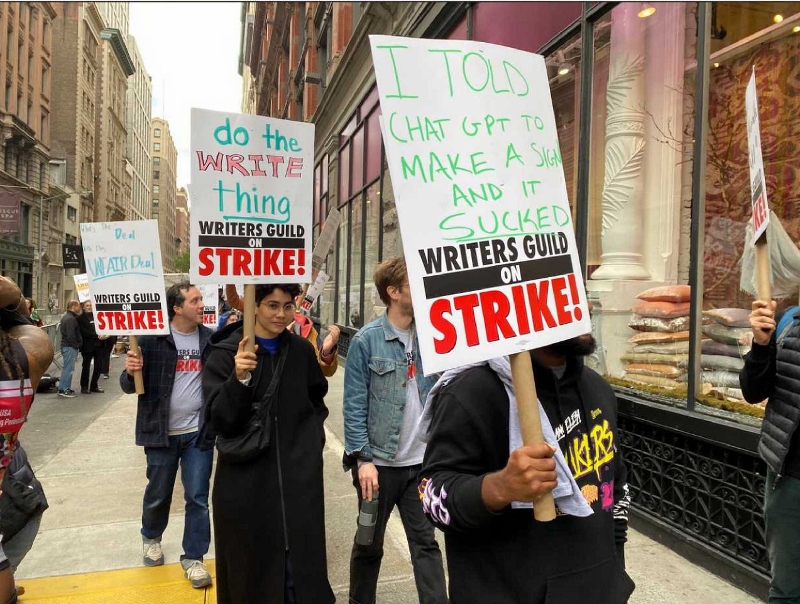
Protesters outside Netflix’s headquarters on May 3 demand better pay and no AI in the writers’ room. Photo: Maya Pontone/Hyperallergic)
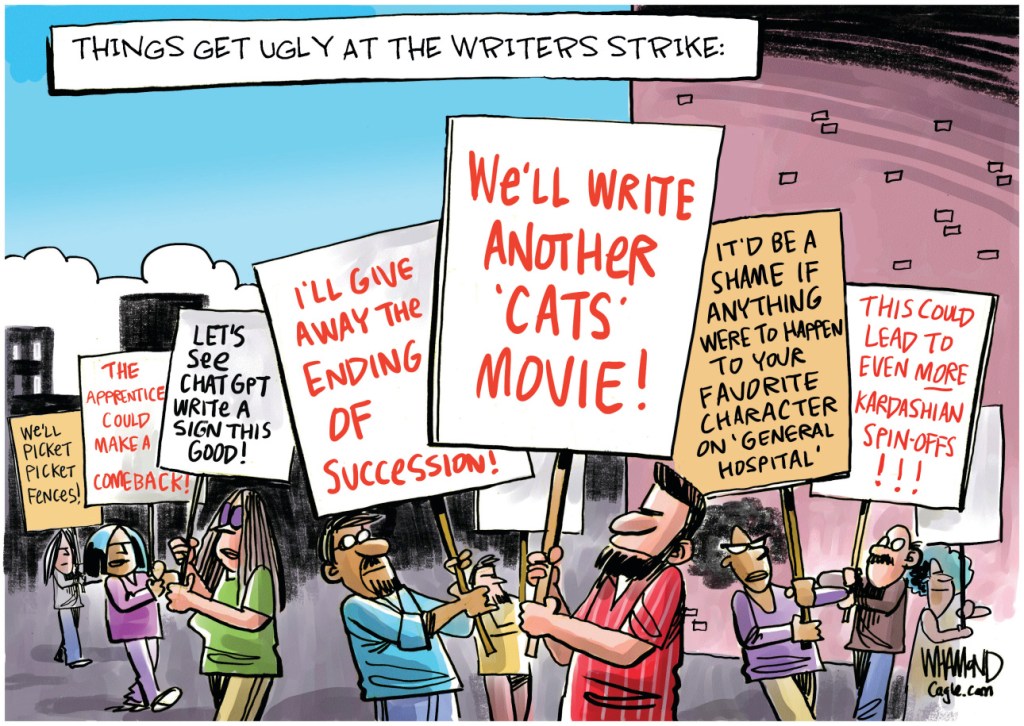
On Monday, May 1, the Writers Guild of America went on strike. It’s the first time professional television and film writers have revolted against the entertainment industry since 2007. That particular walkout last more than three months and alone cost the state of California $2.1 billion. Back then the dispute centered on the growing internet market and material being downloaded for very little, if not for free. The entertainment world’s corporate elites had, of course, remained profitable.
The WGA is still fighting for the usual claims: higher wages, better healthcare benefits and pensions, and – as in 2007 – more compensation when their work shows up on streaming platforms, such as Amazon and Netflix. According to an industry bulletin, writer pay has fallen, as corporate profits have risen. Production companies are also hiring fewer writers to do more work. (Sound familiar?)
But now the writers are also targeting a new entity: artificial intelligence (AI) and in particular the ChatGPT program, which has emerged as a writing tool. Launched in November 2022 by OpenAI, ChatGPT is still in its development phase, but has curious (threatening?) implications for writing, computer programming and even every day conversations. In recent years AI has been used to create realistic fake photos and videos.
Didn’t Isaac Asimov warn about things like this?
Dr. Geoffrey Hinton certainly has. Considered the ‘Godfather of AI’, Hinton has expressed concerns about AI’s rapid expansion across the globe, dubbing it an “existential risk” to true human intelligence and ingenuity. A decade ago Google brought Hinton on board to help develop its AI platform, and his endeavors ultimately led to the creation of ChatGPT. Now, perhaps channeling Victor Frankenstein, Hinton declares, “I’ve come to the conclusion that the kind of intelligence we’re developing is very different from the intelligence we have. So it’s as if you had 10,000 people and whenever one person learned something, everybody automatically knew it. And that’s how these chatbots can know so much more than any one person.”
Television and film writers still struggle for respect and profitability. Britanni Nichols, who writes for the popular ABC show “Abbott Elementary”, noted that she could live comfortably off the residuals she’d receive from the network between seasons, since she’d get half her original writing fee. But now, when those episodes are sold to streaming services, she earns a paltry 5.5% of that fee.
“You’re getting checks for $3, $7, $10,” she explains. “It’s not enough to put together any sort of consistent lifestyle. It can really be a real shock. … sometimes you get a stack of checks for $0.07.”
Music artists experienced similar woes with the Spotify streaming service several years ago. Singers and songwriters found they were earning, on average, less than one cent per day, as the site’s patronage downloaded a vast array of songs. The animosity grew so intense that singer Taylor Swift pulled her entire song catalog in 2014. Other artists followed suit, thus setting the stage for a major overhaul of the music streaming concept and business model. It was dramatic and controversial, but it had to be done.
Other creatives found themselves expressing similar anxieties. In 2021 artist Jens Haaning caused a stir when the Kunsten Museum of Modern Art in Aalborg, Denmark paid him the equivalent of USD 84,000 to create a modern art piece. He responded with two blank canvases collectively titled “Take the Money and Run”. It was his homage to (and protest of) the poor wages painters often receive for commissioned works. “The work is that I have taken their money,” he said. Like writing, painting and sculpting aren’t so easy to do.
Author Amy Joy once stated, “Anyone who says writing is easy isn’t doing it right.” And I often recollect an old story involving the late actress Anne Bancroft and her husband, writer and filmmaker Mel Brooks. After landing a movie role, Bancroft allegedly held up the script and lamented the amount of dialogue she had to memorize!” – whereupon Brooks replied by a holding up a blank sheet of paper and asked her to imagine putting all that dialogue down on it.
Several years ago, when LinkedIn was still somewhat relevant, I belonged to various writing and art groups. In one the issue of financial compensation arose, and a handful of misguided souls had the audacity to question why writers – or any artists, for that matter – felt they had the right to be paid for their work. “No one asked you to be a writer,” declared one visitor. I pointed out that no one is asked to enter into any kind of profession, not including family and close friends. (My parents wanted me to go into computer science, which I did when I started college, and quickly discovered how inept I was at it.) The public doesn’t ask anyone to go into the creative arts – not directly. But the average accountant, lawyer, architect, cashier or FedEx driver wants to be entertained in one way or another; try as they may, though, they don’t have the talent or discipline to create their own stories or compose their own songs. Thus, in a subtle manner, they do ask for someone somewhere to do these things for them. People like to read stories, listen to music and look at beautiful paintings. Somebody is always ready to respond and create those pleasures. Thus, they should be respected and be compensated for their endeavors.
All I can say to the WGA folks is to keep writing and keep fighting! It’s worth the battle. You and your work are worth the battle!
Filed under Essays
“It wasn’t about writing songs to dance to. It was about recording music that felt right. I wanted to make it palatable. There are no guarantees.”

“Listen,” I said to my father, “you hear that?”
He didn’t know what I meant.
“Nothing.”
It was December 1972, and my 9-year-old self had never heard such quiet in a neighborhood. This week marks 50 years since my parents and I moved into this home in suburban Dallas. The area was newly-developed; former farm and ranch territory that comprised the hinterlands of a growing metropolis. Family and friends wondered how my parents had managed to find the place.
We had been living in a two-bedroom apartment above a garage in the back of a house owned by my father’s oldest sister and her husband. Located just north of downtown Dallas, it sat very near Harry Hines Boulevard – a lengthy industrial stretch of road that would later become more infamous as a haven for prostitutes and adult book stores.
My mother was in that apartment with a 17-day-old me on November 22, 1963, when she heard a cacophony of sirens and rushed to a window. She saw the tail of President Kennedy’s motorcade rushing down Harry Hines, unaware of what had just happened moments earlier.
On the day we began moving into our new home, my aunt made herself scarce. She had grown so accustomed to having us there that she couldn’t bear the sight of us packing up to leave.
It’s hard to imagine now, but not until we moved here did we get our first color television set. A month later we finally got our phone. I still have that number connected. In 1972, Richard Nixon won a second term in the White House; Watergate reared its contemptuous head; violence marred the Summer Olympics in Munich; HBO launched; Polaroid introduced the SX-70 one-step instant camera; and three of my favorite films – “Cabaret”, “The Godfather”, and “The Poseidon Adventure” – came out.
My parents were excited because they were now living the American dream of home ownership. My father was particularly enthusiastic to follow his mother’s tradition of gardening and quickly found paradise in the front and back yards. I was thrilled with the prospect of getting a dog. It was a promise my parents had made to me upon moving into the house. They fulfilled it the following summer when they bought a German shepherd puppy I named Josh. My mother had to swallow her phobia of large canines; having witnessed a man ravaged by a Doberman in the late 1930s.
My parents made friends with many of the neighbors, and I maintain a few of those friendships today. They each had that type of personality, especially my father – they seemed to make friends with most anyone. I, on the other hand, seemed naturally reticent to meet new people. Regardless, our home became a refuge for most everyone we knew. We often held parties and other gatherings; if for no other reason except to have a party or a gathering. Family, friends and neighbors relished visiting. This was a place where all good souls were welcome; where people could feel happy and safe. We had food (real food – not just chips and dips!), music, beverages, laughter and plenty of love. No one left here sad or dejected. Drunk and tired, maybe – but never glum.
When my father lay in a hospital bed in May of 2016, he reiterated that he wanted to die here – in this house. It was a wish I was able to grant him. My mother also passed away here in 2020.
A few years ago I told an old friend, Paul, that I suspected I will die here, too, albeit alone.
“What’s wrong with that?” he asked.
“Nothing!” I replied. It was more a statement than an omen.
So I’m alone now. This house is quiet. At a half century it’s showing its age. But it’s mine; it’s where I grew up and where my parents drew their last breath. It’s where so many people came to enjoy life.
It’s a house at 50, but it’s always been a home.
Filed under Essays

“I try to say I love you in a million different ways. That’s what I aspire to do. That’s what I do best.”
“Everywhere”
“Go Your Own Way”
“Hold Me”
“Little Lies”
Filed under Classics

In 1995, the British pop duo Everything But the Girl released “Missing”, a song that would become their greatest hit. Tracey Thorn and Ben Watt paired up 40 years ago to create EBTG. They found their title in the slogan of a store in their home town of Hull that promised to sell shoppers “everything but the girl”. I feel they’re one of the most underrated musical acts of recent decades. There was once a time – before the internet – when people could vanish from our lives and we relied on music like this to fill the void. Music always seems to fill the void of whatever or whomever we’re missing.
My old friend, Paul Landin, had discovered EBTG in the late 1980s and became instantly fascinated with them. He was especially enamored with Thorn. I know he traveled to England at least twice in the 1980s, but I don’t know if he ever saw EBTG in concert there or anywhere. Paul died in April after a year-long battle with liver cancer. Shortly after his death, a mutual friend, Mike*, sent a Tweet to Tracey Thorn advising her that “one of her biggest fans” had passed away. Paul and Mike had met at New York University in the early 1990s where they both studied filmmaking and found they had a mutual love of EBTG. They couldn’t have been more different: Paul, a Mexican-American born and raised in Texas and Mike, a traditional “WASP” from upstate New York.
A few days after Paul’s death Mike told me he’d dreamed of our old friend. “It might have been the edible I had last night,” he said via text, “but I felt his presence sitting across from me in the living room. He was smiling and he said don’t worry, everything is going to be okay.” Still, Mike lamented, he feels Paul had been cheated out of fulfilling his dreams of being a successful filmmaker/screenwriter.
Paul and I had a strange friendship; almost a love/hate type of interaction. I supposed that was because we were so much alike in many respects. Our fathers grew up together in East Dallas. Paul and I even attended the same parochial grade school in the 1970s (I vaguely remember him) and were altar boys at the accompanying Catholic church. We shared a love of good food and good cinema. As fraught as our friendship could be at times, I still miss him and his quirky nature.

Tracey Thorn’s reply to Mike* back in April
I miss a lot of aspects of my life. But isn’t that what happens to us as we get older? With more years behind than ahead of us, we sort through the intricacies and chaos of our lives and wonder how we managed to make it this far.
I miss the gatherings my parents and I used to have at this house. There often wasn’t a particular reason. Third Saturday of the month? Good enough! Family, friends and neighbors would convene upon this simple home and have the best time imaginable. We had food – real food! Not just chips and dips. People often brought dishes out of courtesy, but everyone knew they could actually have a meal. Ours became the fun house; where people could gather and always feel they were loved and appreciated.
I miss Sunday lunches with my parents. It was always a special occasion – even when I moved back here in 2007. We talked about anything and everything. Like music, food helps people bond.
I miss the 1990s and the excitement of heading into a new century and a new millennium. In some ways I miss the apartment I moved into in May of 1991; a relatively small one bedroom/one bath abode. For the first time in my life, I was truly on my own. I miss happy hours with colleagues at the bank where I worked in Dallas at the time. I still relish the period from 1996 to the spring of 2001, when most everything in my life seemed to go right. I know I can never go back (past perfect is only possible in grammar), but I wish I could recapture that feeling of freedom and happiness. I miss my blue and white lava lamp.
I miss the German shepherd, Josh, my parents and I had from 1973 to 1985. When we moved to this house in suburban Dallas in 1972, my parents had promised they’d get me a dog. Somehow I’d become enamored with German shepherds. My mother had a phobia of big dogs. As a child in México City, she’d seen a man attacked by a Doberman. But she swallowed her fears for my sake. Early on I noticed his eyes seemed to be tri-colored: mostly yellow-gold, but also green and blue. We didn’t realize how big he was, until we brought him inside the house. We would bring him in during the torrid Texas summers and (in his later years) during the occasional harsh winters. Putting him to sleep on Easter Saturday 1985 was one of the most traumatic experiences we ever endured. It’s not that we expected him to live forever, of course; we just never prepared ourselves for the end.
I miss my last dog, a miniature schnauzer I adopted from a former friend and roommate and named Wolfgang. I loved the sound of his breathing at night, as he slept. It remains one of the most soothing sounds I’ve ever heard in my life. My parents also fell in love with him, after I moved back here in 2007. My father especially developed a deeply personal relationship with Wolfgang. I realized how strong that connection was on the day my father died in June of 2016, when the lights flickered, and Wolfgang ambled down the hall. He stood before my parents’ closed bedroom door and turned to me. I knew my father was gone. Wolfgang died less than five months after my father did. I still maintain my father returned and got him.
I miss my father, George De La Garza, Sr. I love and miss my mother and everyone I’ve ever known and lost, but I miss my father the most. We had a unique bond that couldn’t be matched by anything or anyone. In my worst moments, I often wish he’d come back to get me. But then, all the plans I’ve made for myself wouldn’t come to fruition. And when I call to him and get no response, I realize it’s just not my time. I know. We could communicate without words.
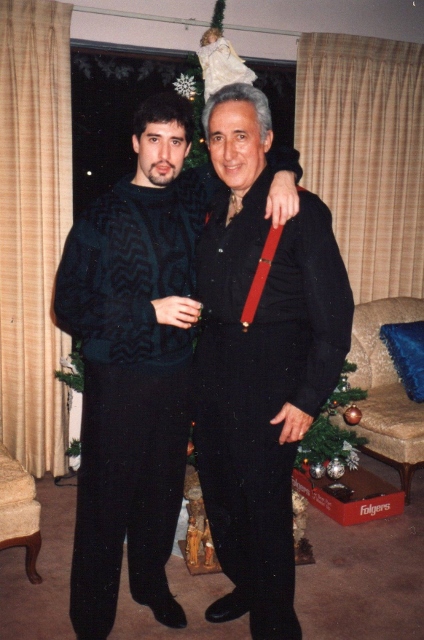
So I continue and recollect the best moments of my past years and look forward to what I have left. Still, I’m always missing someone or something.
We all miss someone or something from our lives. Who or what do you miss?
*Name changed.
Image: Aeviternitas
Filed under Essays
It’s been 30 years since the group SNAP! released their signature song “Rhythm is a Dancer”. It remains one of my favorite tunes and was a favorite of one of my closest friends, Daniel, who died of AIDS in 1993. Another close friend, Paul (who died this past April), also liked it. It’s so emblematic of the 1990s.
Looking back – as I have the tendency to do – things were pretty good for me in 1992; a time before cell phones and personal computers were common and when the future seemed wide open, as the world moved closer to the new millennium.
My sentimentality may be getting the best of me now, as I’ve been going through some times these past few months. Still, music always has a way of soothing the troubled mind.
Filed under Classics

“I shall not today attempt further to define the kinds of material I understand to be embraced within that shorthand description [‘hard-core pornography’], and perhaps I could never succeed in intelligibly doing so. But I know it when I see it, and the motion picture involved in this case is not that.”
U.S. Supreme Court Justice Potter Stewart, opinion in Jacobellis v. Ohio, 1964
You know the old puzzle: if a tree falls in the forest, and no one is around, does it make a sound? Using that logic, if a book is published, and no one finds its content offensive, is it obscene?
Obscenity seems to be subjective. Right-wing extremists certainly feel that way, as they have (once again) assumed the role of moral overseer and decided they have the authority to determine what books are and are not appropriate for others to read. To we writers and other artists, the term censorship is like holy water to a devil worshiper: it’s terrifying! Whenever we learn that some people are challenging the presence of certain materials in a public venue, such as a library, we bristle. But, instead of running and hiding, we’ve been known to stand and fight.
In the latest battle, the school board in McMinn County, Tennessee decided to ban the 1986 Art Spiegelman book “Maus: A Survivor’s Tale” from its library. The illustrated tome is Spiegelman’s recounting of his parents’ experiences as prisoners of the Auschwitz Nazi death camp. It won Spiegelman a Pulitzer Prize and, in 1992, the Museum of Modern Art mounted an exhibition displaying his original panels for the story. “Maus” had been party of the school district’s lessons on the Nazi Holocaust. The McMinn school board’s complaints about “Maus” are the usual gripes: language and nudity (animal nudity in this case).
It’s worth noting McMinn County, Tennessee is near the location of the infamous Scopes Monkey Trial, where the concept of evolution became intensely controversial. In 1925 the state of Tennessee passed the Butler Act, a bill banning the teaching of evolution in its schools. Evolution, declared legislators, contradicted the Christian Bible as the single standard of truth in public arenas, such as schools. The move astonished – and frightened – many across the country.
The American Civil Liberties Union (ACLU) responded immediately by vowing to support any educator in the U.S. who dared to teach evolution. A popular young high school teacher in – of all places, Tennessee – named John Scopes offered to be the defendant, if the state decided to make good on its promise. They did. On May 7, 1925, Tennessee authorities arrested Scopes and charged him with violating the Butler Act.
The ensuing legal battle made headlines across the country and the world. The judge in the case showed his deference to the state by opening each session with a prayer and refusing to let Scopes’ defense call any scientific witnesses. Ultimately Scopes was found guilty and fined $100. The ACLU hoped the case would make its way to the U.S. Supreme Court, but the Tennessee State Supreme Court reversed the decision on a technicality. Still, the repercussions were widespread. The Butler Act was never enforced in Tennessee again, and similar measures in other parts of the U.S. met with failure. But progressives realized they could never relax in the face of extremist ideology.
So, here we are in the third decade of the 21st century, where the U.S. has come out of two brutal Middle East wars and is now facing an onslaught of urban violence. We experienced 36 mass shootings in the month of January, resulting in 101 injuries and 42 deaths. That’s just in the month of January 2022 alone!
But, as usual, social and religious conservatives are more upset with books. In October of 2021, Texas State Representative Matt Krause asked the Texas Education Agency for information about 850 books in school libraries. He wanted to know how many copies of these books were in each library. It didn’t surprise observers that the majority of the books are by women, non-Whites and/or LGBT authors. The imperial Krause is concerned that taxpayers are funding the presence of these books in school libraries. Yet, my tax dollars are wasted if those books are removed because he and other like-minded folks find them unacceptable.
Some disputes have become hostile. Police in Leander, Texas got involved in a controversy over one book, “Lawn Boy” in 2021. Author Jonathan Evison says he received death threats because of it. Texas – where any restrictions on guns is considered anathema – isn’t the only state under siege by moral zealots. Similar attempts at censorship and assaults on free speech have played out in Missouri, Pennsylvania and Virginia.
“If I had a statement, it would be ‘Read the book or sit down,’” says Evison. “I feel like these people are frightened because they’re losing the culture wars.”
Yeah! Sit down and read – more than the Bible or the TV guide.
I will concede parents have the right to be concerned by what their children view and read. But I feel banning books from a school library is just one step away from banning books in any library or elsewhere. It’s truly not an unrealistic stretch to envision such a scenario. The world has witnessed such activities in totalitarian societies, and the results are often sanguineous.
Once again, though, what is obscene?
The 1920s was a decade of both progress and excess, particularly for the growing film industry. Although silent and in black-and-white, movies had begun to show a variety of mature content – mainly heavy alcohol consumption and sexual behavior. Concern over the material became so intense that, in 1934, Will H. Hays – then head of the Motion Picture Association of America (MPAA) – introduced his personally developed “Hays Code”, a standard production guide for what is and what is not acceptable content for motion pictures. The code remained until 1968, when the MPAA introduced its film rating system: G (General Audiences), PG (Parental Guidance recommended), R (Restricted) and X (mainly for sex, but also for violence).
By the 1960s, films were presenting increasingly controversial subject matter – and headaches for the MPAA. The 1966 film “Who’s Afraid of Virginia Woolf?” shocked audiences with its blatant use of foul language and served as one catalyst for the rating system. The 1968 film “Vixen” became the first movie branded with an X rating. The following year John Schlesinger released “Midnight Cowboy” with Jon Voight in the titular role. It, too, was branded with an X rating. Despite that, it went on to win the 1969 Academy Award for Best Picture – the first and (to date) the only X-rated film to win such an honor. Viewing both “Vixen” and “Midnight Cowboy” now might make somebody wonder what the fuss was all about.
The film rating system took an odd turn in 1983 when a remake of the classic film “Scarface” came out. The MPAA initially granted the movie an X rating because of its excessive violence. Director Brian DePalma reluctantly trimmed some of the footage, and the film was rebranded with an R. If it had gone out with the X label, “Scarface” would have been the first movie released as such because of violence.
Another X controversy arose six years later with “The Cook, the Thief, His Wife & Her Lover”. The film’s gratuitous sexual content garnered an X rating from the MPAA. As with DePalma and “Scarface”, director Peter Greenaway reluctantly agreed to edit out a small portion of the sexual matter – small as in some 5 minutes – and the film was upgraded to R. The fiasco upset many in the entertainment community – not just in the U.S. but across the globe. If the difference between an R and an X rating is a paltry 5 minutes, then how valid is a film rating system?
What is obscene?
In the 1950s, the Hays Code was applied to a growing new medium: television. In motion pictures, the code, for example, dictated that people of the opposite sex could not be filmed in bed together, unless one of the duo (usually the man) had at least one foot on the floor. In TV, however, even married couples couldn’t be shown in the same bed. The rule went into effect after a 1947 episode of “Mary Kay and Johnny” showed the title characters hopping into the same bed. But that taboo dissolved completely in 1969 with “The Brady Bunch”. Bathrooms also were generally off-limits in television. One exceptional first was a 1957 episode of “Leave It to Beaver”, when the boys tried to hide a pet alligator in the tank of a toilet. An early episode of “All in the Family” produced another first: the sound of a toilet being flushed.
As mundane as all of these events are today, they each sparked a ruckus at the time.
Personally, I find excessive violence offensive. I never laughed when I saw men and boys get struck in the groin in slap-stick comedy scenes in films and on television. I grimace at bloody acts in similar venues, while others react as if nothing more than a sharp wind blew past them. Conversely, many of these same individuals are horrified by the sight of blatant nudity, especially if the nudeness is that of a male. It’s difficult to imagine now, but even as recently as the late 1960s words like pregnant and diarrhea were forbidden on television.
The word “bitch” is used frequently on TV today. But, in 1983, a musical group called Laid Back released a song entitled “White Horse”, which features the line: ‘If you wanna be rich, you got to be a bitch.’ MTV played the video, but bleeped out the term “bitch”. In 1994, Tom Petty released “You Don’t Know How It Feels”, which contains the line: ‘But let me get to the point, let’s roll another joint.’ Music video networks deemed the ‘roll another joint’ verbiage unacceptable and bleeped it out whenever they played the video.
In 1989, rap group 2 Live Crew released two versions of their song “Me So Horny”: what they dubbed the G-rated version and the R-rated version. Radio stations played the G-rated version frequently, but the R-rated version generated the most strife. At the start of 1990 a federal judge in the state of Florida considered the group and their music obscene and in violation of community standards – whatever that’s supposed to mean – and forbid local radio stations from playing any of their music. Consequently, 2 Live Crew’s reputation and music sales skyrocketed.
I remember the controversy that erupted with the video to Madonna’s 1990 song “Justify My Love”. Once again, music video networks assumed the role of moral protectorate and either refused to play the video or played it late at night, when children and other fragile souls – such as moral crusaders – were asleep. Undeterred by the skirmish, Madonna packaged the video and sold it independently.
In 1965, The Rolling Stones made their debut appearance on “The Ed Sullivan Show”, during which they performed a sanitized version of “Let’s Spend the Night Together”. Producers convinced the group to sing ‘Let’s spend some time together’ instead. Lead singer Mick Jagger leered at the camera – in the way only Mick Jagger can – when he spat out the words.
Two years later The Doors were presented with a similar option when they made their appearance on the show and performed their already popular and now seminal hit “Light My Fire”. Sullivan’s son-in-law, Robert Precht, suggested they alter the line ‘Girl, we couldn’t get much higher’ to ‘Girl, we couldn’t get much better’. The group refused and performed the song as it was. Their act of defiance resulted in their permanent ban from the show – a move I know upset them to no end.
I’ve noticed social conservatives haven’t raised concerns about inappropriate material in books like “The Anarchist Cookbook” and “The Turner Diaries”. The latter served as a blueprint for Oklahoma City bomber (domestic terrorist) Timothy McVeigh. If conservatives really want to ban books with sexual references and violence, they should start with the Christian Bible, which is rife with salacious and unsavory behavior.
Meanwhile, “Maus” has experienced a surge in sales as a result of the squabble surrounding it. If there’s one way to ensure something’s popularity or success, it’s to try to ban it. In other words, censorship always backfires.
Yet, censorship will always remain a threat to freedom of speech, expression and the press. The war will never be won – by either side. But those of us on the side of true freedom can win individual battles by standing up to self-righteous demagogues.
Filed under Essays

“I mean one of the most chilling phrases in the English language is: ‘Surprise, it’s Rudy Giuliani.’ Just ask the crew of ‘Borat.’”
Stephen Colbert, commenting on Rudy Giuliani’s unexpected appearance on ‘The Masked Singer’
The episode has yet to air.
Filed under News

