Tag Archives: Spain

Back Strokes

“The normal cycle in the life and death of great nations has been first a powerful tyranny broken by revolt, the enjoyment of liberty, the abuse of liberty – and back to tyranny again. As I see it, in this country – a land of the most persistent idealism and the blandest cynicism – the race is on between its decadence and its vitality.”

Alistair Cooke

Now that 2025 has ended, we must realize that we’re officially more than a quarter of the way into the 21st century.  And, in the United States, we have a totalitarian despot as our President.  I never would have thought we’d be in this position – the self-proclaimed “Beacon of Democracy” has a self-righteous moron as its leader.

Reminder: we’re in the 21st century – C.E.!

Last November marked the 50th anniversary of the death of Francisco Franco, who came to power during Spain’s Civil War and ruled for more than three decades.  Western Europe’s last true dictator, Franco persecuted his political opponents, suppressed certain cultural aspects, manipulated the media, and just generally wielded absolute control over the country.  His death brought democratic relief to Spain.

It’s a familiar pattern that’s occurred across the globe and throughout human history.  Certain individuals promise – and initially bring – freedom to the people and then mutate into a brutal autocrat.  The masses get sucked into the chasm of false promises and righteous dreams…then are horrified when the truth comes out.

Sometimes it appears humanity will never learn.  I feel that way now about the United States.  In 2000 we all stood on the precipice of a new century and a new millennium.  The future was ours.  Then, here in the U.S., we regressed and inadvertently chose a leader who turned out to be ill-equipped for the role of “Leader of the Free World”.  And the first decade of the 21st century – C.E. – became lost to war and the morass of class divisions.  We should have been preparing to build a colony on the moon and sending humans to Mars.  Instead Americans were trying to figure out whether to pay for utilities or buy groceries.

And we’ve reached that point again.

In June of 2022, the U.S. Supreme Court overturned the right to abortion in this country.  It accompanied ongoing attacks on our literary culture, as book bans rampaged across the land.  Looking at all of it, I wondered how and why we were moving backwards.  Societies, in general theory, are supposed to move forward – much like time.  Conservatism may sound like a grand ideology, but it can be detrimental.

In November of 1979, I was a high school student and in San Antonio, Texas for a speech and drama contest, when we heard news that a band of rebels had stormed the U.S. embassy in Tehran, Iran.  Some of my fellow students had no idea where Iran was, much less why it had become a target for protesters.  But we’d soon learn exactly why.  From then until January of 1981, a number of Americans were held hostage in Tehran as retribution for the U.S. support of their former national leader, Reza Shah Pahlavi.  Pahlavi had been forced from power earlier in 1979 by a populace who had grown weary of his tortuous rule.  Now Iran is in the grips of social unrest once more, and ironically, Pahlavi’s son is seeking to return to his homeland and lead his people into a new universe.

Again, the world has seen this happen before: Russia, China, France…the list is almost endless.  The citizenry gets tired of how their universe is functioning and decides to take action.  The result is often violent.

This year, 2026, officially marks the semiquincentennial of the United States – our 250th anniversary of existence.  I was twelve years old in the summer of 1976, when we marked our bicentennial, and I felt an extraordinary sense of pride and excitement.  The nation was still recovering from the brutal cultural upheaval of the 1960s, but at that moment, we all seemed to bond and become – as our founders intended – a truly united people.  I’m certain I’ll never live to see our tricenntenial, but it’s a pleasant dream.

It’s even more inspirational to know our nation will move beyond the likes of our current leaders who have no real sense of a future.  We’ll never be a utopia.  No community can ever achieve that.

Denounce me as naïve, if you want – I’ve often called myself cynical at this point in my life.  but I still hope for the best.
4 Comments

Filed under Essays

Glamor Tyranny

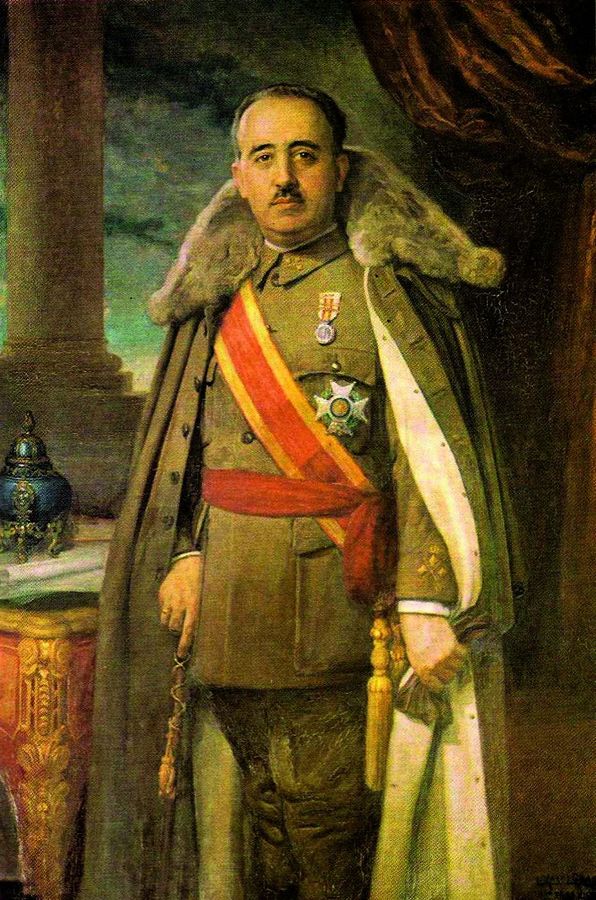
Portrait of Francisco Franco

“When I feed the poor, they call me a saint.  But when I ask why the poor are hungry, they call me a communist.”

– Brazilian Archbishop Hélder Câmara

Last month marked the 45th anniversary of the death of Francisco Franco, Western Europe’s last dictator.  Afterwards Spain finally transitioned into a democratic state; something it had tried when it elected a new government in 1931.  During the “Second Republic”, Spaniards deposed King Alfonso XIII and reduced the powers of the military, the Roman Catholic Church and property-owning elites.  But, just two years later, a center-right coalition won a majority in the elections and they brought in Franco.  Franco had gained some notoriety for fighting against an insurgency in Spanish-controlled Morocco amidst World War I.  In 1926, at the age of 33, he became the youngest general in all of Europe.  But, as the “Second Republic” proceeded, Franco grew critical of the new government and was subsequently banned to a military outpost in the Canary Islands.  By 1936 right-wing extremists had fomented plans for a military coup.  Apparently Franco was initially opposed, but joined the effort as it took shape.

The 1936-39 Spanish Civil War actually began in Morocco, as right-wing activists launched concerted efforts to regain control.  By 1939 they had won – at the cost of 1 million lives – and Franco became Spain’s eminent ruler.  Spain’s “White Terror” induced a culture of repression and execution; a persecution of democratic supporters of a truly tolerant government.  Civil wars in any country are brutal and destructive, and Spain’s conflict was no different.  During Franco’s reign, an estimated 150,000 people were executed or mysteriously vanished.  That’s a modest assessment.  Personally, as with the Nazi Holocaust or the Cambodian massacre, I believe the official estimates are politically polite.

Early last month a friend posted a photo (a formal portrait) of Franco on his Facebook page.  One of his friends replied by declaring that Franco would have never let Spain become the socialist state it is now.  I responded by noting that Franco was a dictator who opposed free speech and freedom of religion.  Franco imprisoned and executed thousands of political opponents, while thousands more disappeared.  Like Argentina, Guatemala and other Latin American nations, Spain emerged as a totalitarian state, where anyone who dared criticize the leadership was deemed a rebel and summarily prosecuted.  No one among the Spanish populace ostensibly was brave enough to stand up to such totalitarian shenanigans, until Franco died.  But it is what it is.  Calls for revolution are always easier than actually revolting.

I don’t believe either my friend or his friend responded to my comment.  I guess I should have been shocked by the aforementioned Facebook posts.  But ultimately it didn’t surprise me, since my friend is a devotee of Donald Trump.  He once posted photos of himself and Spanish dignitaries at a diplomatic function in Houston.  But seeing his post about Franco angered me.

I’ve noticed some conservatives hold a certain degree of sentimentality for dictators and autocrats.  Hence Trump’s conciliatory behavior towards the likes of Russia’s Vladimir Putin or North Korea’s Kim Jong Un.  Both Putin and Jong Un live in relative luxury, while essentially holding an iron grip on power.  North Korea is particularly egregious in this dichotomy.  They still won’t acknowledge the brutal severity of a 1990s-era famine in which up to 3.5 million people perished.

Trump is also in line with Brazil’s Jair Bolsarano who openly longed for the period of the nation’s military rule; a time when – like many other nations in Latin America – thousands disappeared, were imprisoned or turned up dead.  Bolsarano has often been dubbed as “Trump of the Tropics”.

I’m sure the analogy flattered Bolsarano, and it sounds appropriate.  Like Trump Bolsarano denounced COVID-19 as a “little flu” and downplayed it, even when he contracted the virus.  As with any European-style colonialist, Bolsarano lamented that Brazil didn’t succeed in eliminating the nation’s indigenous populations.  He doesn’t seem to realize North America’s indigenous peoples were NOT completely obliterated from the continent.  Yet, Bolsarano ultimately will go to his grave knowing his sanguineous ideals failed.  And I couldn’t be happier.

I also couldn’t be happier knowing Donald Trump will NOT be President of the United States after noon (EST) on January 20, 2021.  Fortunately, our beloved democratic process functioned as designed last month.  The United States isn’t like Franco’s Spain or Latin America of the past; where military dictatorships commanded every aspect of people’s lives, or like Putin’s Russia where one person can hold the reins of power for infinite years, or Kim Jong-Un’s North Korea where a single clan of dynastic brutes can cripple the minds and bodies of their subjects.

I feel Donald Trump came as close to an autocrat as we’ve ever had.  It was a frightening prospect, especially knowing he actually wanted to delay the November 3 elections.

But American democracy prevailed over Trump’s fascist tendencies.  That’s how all civilized societies should operate.

Leave a comment

Filed under Essays

Coloring In

We’ve heard it so many times before.  History has always been written by the victors.  It’s a sad reality, yet very true.  It means that much of the history of Africa and the Western Hemisphere has been recounted with a decidedly European viewpoint.  As someone of mixed European and Indigenous American extraction, I always felt conflicted about this disparity.  While trying to find information about Native American Texans in an encyclopedia during my grade school years, for example, I noticed that references to pre-Columbian peoples were treated dismissively.  It wasn’t just archaic history in standard academic circles.  It was irrelevant.  Even mention of the state’s Spanish colonizers – the first permanent European settlers – was dubbed “pre-history.”  It seemed Texas history didn’t actually begin until the likes of Stephen F. Austin and Sam Houston arrived.  And it didn’t matter that these men weren’t even born and raised in the state.

Only within the past half-century has the truth about various indigenous societies been revealed with advances in archaeological research and detailed forensic analysis.  Lidar, for example, has taken the concept of neon lighting from the banal presence of liquor store signs to the jungles of Central America where long-abandoned Mayan structures remain shrouded by the foliage.  As a devotee of Archeology magazine, I’m constantly amazed by discoveries of ancient settlements across the globe.  Areas once thought to be occupied by nomadic hunter-gatherer types at best are revealing the ghosts of thriving population centers.

Yes, history has always been dictated and composed by those who somehow managed to overcome the locals – usually through the casualties of disease and pestilence or the sanguineous nature of war and violence.  But the blood of history’s victims seeps into the ground and eventually fertilizes the crops that feed the newly-minted empires.  That blood eventually metabolizes into the truth of what really happened – albeit many centuries or millennia later.  Still at that point, it can no longer be ignored.

Here in the U.S. we’re now seeing statues and other emblems of the American Civil War come down by government decree.  Supporters of that conflict have maintained its genesis was the battle for states’ rights, while truth-tellers insist it was a battle over slavery.  They’re both correct, in some ways.  It was a battle over the right of some states to keep an entire race of people enslaved.  I certainly feel removal of these statues is appropriate.  Those who fought for the Confederacy wanted to rip the nation in half over that slavery issue and therefore, should not be venerated as military heroes.  They’re traitors.

The debate has now shifted to renaming many U.S. military bases.  In my native Texas, one military base is named after John Bell Hood, a Confederate general who – like so many other Texas “heroes” – wasn’t even born and raised in the state.  Hood also wasn’t an especially adept military commander; having lost a number of individual conflicts.  And yet, a military base is named after this treasonous fool?

The U.S. Pentagon has expressed some willingness to rename military bases that reference those ill-fated Civil War characters.  Naturally, it’s upset many White southerners who annually reenact various Civil War conflicts; not realizing how ridiculous they look in their antebellum garb.  I can’t help but laugh at them.  They’ve been fighting the war for over 150 years and STILL haven’t won!

In his usual brusque and toddler-esque manner, President Trump announced last month he would veto a USD 740 billion defense bill if it included an amendment that would rename many of those military bases.  He declared, “These Monumental and very Powerful Bases have become part of a Great American Heritage, and a history of Winning, Victory, and Freedom.”

Remember, the Confederacy lost that war.  A million reenactments won’t change that reality.

Some 30 years ago my father discovered that Spain’s Queen Isabella (who funded Christopher Columbus’ voyage) was an ancestor of his mother.  According to documentation my father found, Isabella learned of the atrocities Spain’s military officials were committing against the indigenous peoples of the “New World” and ordered them to stop.  That’s one reason why Latin America has a stronger connection to its native peoples than the United States and even Canada.

It should be worth noting that, while Italians celebrate Columbus as a national hero, he probably wasn’t even a native son.  For centuries he was considered a Genoese sailor with grand visions of finding a westward route to India and subsequently gain an edge in the then-contentious spice trade.  Contemporary research, however, has declared he was actually the son of Polish King Władysław III; often dubbed the twelve-toed king because allegedly had 6 toes on each foot.  And I have to emphasize that Columbus couldn’t get Italian leaders to finance his ventures, so he turned to Spain.  In the 15th century C.E., Italy was actually a conglomeration of city-states.

In one of my earliest essays on this blog, I lamented the term “redskin”; a derogatory moniker for Native Americans that has figured prominently into the names of many sports teams, from grade school to professional.  Just this week the Washington Redskins football team announced what many previously considered unthinkable: they might change their name.  Team owner Daniel Snyder conceded he’s bowing to pressure from its largest corporate sponsors (big money always has the loudest voice in the corporate world), as well a growing cacophony of socially-conscious voices demanding change.  Snyder said the team has begun a “review” of both the name and the team’s mascot.  Detractors, of course, moan this is political correctness at its worst.  But, just like Civil War reenactors still haven’t won, Eurocentrics still won’t admit they didn’t obliterate North America’s indigenous populations.

Change on such a grand scale is always slow and painful.  But, as with time itself, change will happen; it can’t be stopped.

We can never correct or fix what happened in the past.  Nothing can ever atone for the loss of millions of people and the destruction of the societies they built.  But we can acknowledge the truth that is buried.  It’s not rewriting history; it’s writing the actual history that remained entombed in that bloodied soil for so long.  It’s adding the needed and long-absent color to reality.

4 Comments

Filed under Essays