
Tag Archives: U.S. Constitution

Queers on the Altar

final

Last week’s ruling by the U.S. Supreme Court, in Obergefell v. Hodges, legalizing same-gender marriage across the country has resulted in the usual mix of joy and condemnation. A little more than a decade ago the same court ruled, in Lawrence v. Texas, that anti-sodomy laws are not constitutionally enforceable. That decision came less than two decades after the High Court ruled in Bowers v. Hardwick that states can declare same-gender sexual activity illegal.

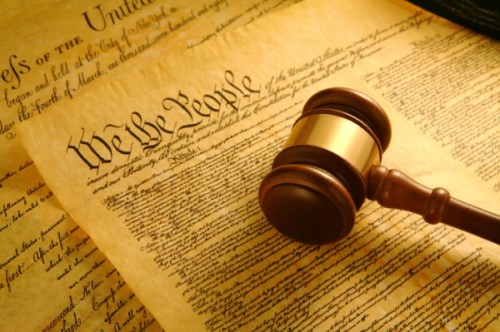
Writing for the majority in the narrow 5 – 4 ruling, Justice Anthony Kennedy stated that “couples of the same sex may not be deprived of that right and liberty,” according to the U.S. Constitution’s 14th Amendment. That amendment was designed initially to grant former Negro slaves the dignity of a human life; that is, they would be considered as equals to Whites. But, the nearly 150 years since, it has come to mean everyone in the United States is considered equal.

In the minority opinion, Chief Justice John Roberts wrote the Court had taken an “extraordinary step” in deciding not to allow states to decide the issue for themselves, noting that the Constitution doesn’t define marriage. No, it doesn’t. And it shouldn’t. But that’s the curious thing about human rights: they’re not to be voted upon; hence the term “rights.”

Reading and listening to the plethora of responses from religious leaders and social conservatives is almost laughable. Even before the gavel fell, former Arkansas Governor Mike Huckabee called on fellow Christians to engage in a “biblical disobedience” campaign against the “false god of judicial supremacy.” After the ruling, Huckabee told Fox News’ Megyn Kelly, “I will not acquiesce to an imperial court any more than our Founders acquiesced to an imperial British monarch. We must resist and reject judicial tyranny, not retreat.”

East Texas Congressman Louie Gohmert warned that the Obergefell decision ensures God’s wrath upon the nation. “I will do all I can to prevent such harm,” he said, “but I am gravely fearful that the stage has now been set.” He went on to recommend fleeing the U.S., lest we all get obliterated by a massive hurricane or earthquake or a toenail fungus epidemic.

One of the best reactions came from Texas Senator Ted Cruz who bemoaned, “Today is some of the darkest 24 hours in our nation’s history. Yesterday and today were both naked and shameless judicial activism.”

Aside from the fact Cruz doesn’t understand proper verb-subject agreement, I’d like to take this opportunity to point out some of the darkest periods in American history:

December 29, 1890 – Wounded Knee massacre;

October 28, 1929 – “Black Monday” stock market crash;

December 7, 1941 – Pearl Harbor attack;

November 22, 1963 – assassination of John F. Kennedy;

March 30, 1981 – attempted assassination of Ronald Reagan;

April 19, 1995 – Oklahoma City bombing;

September 11, 2001 – Al Qaeda terrorist attacks.

Of course, Cruz may not even be aware of these catastrophic events, since…you know, he’s not from this country and probably hasn’t studied American history too much.

In advance of the SCOTUS ruling, Texas Governor Greg Abbott signed the “Pastor Protection Act,” which would allow religious figures in the Lone Star State the right to refuse to conduct same-gender marriages, calling it a move to protect free speech. But, as soon as the decision was made public, same-sex couples in Texas began flocking to county offices to obtain marriage licenses. Many county officials wouldn’t issue them; claiming they had to await proper instructions from Abbott’s office. Others simply refused for obvious reasons: they don’t like queer folks and felt their religious beliefs were under attack. And we thought Ebola was scary!

Texas Attorney General Ken Paxton proclaimed that “no court, no law, no rule and no words will change the simple truth that marriage is the union of one man and one woman.” He also falls in line with the right-wing mantra that traditional Christian family values are under attack – again – by stating, “This ruling will likely only embolden those who seek to punish people who take personal, moral stands based upon their conscience and the teachings of their religion.”

Hey, Ken! Take it easy, man! No one’s trying to circumvent your religion. But I know that religion – any religion – doesn’t trump human rights. Whenever they clash, human rights takes precedence – always and forever. Or, it should. Plenty of people feel differently. They equate the two; seeing them as symbiotic. Yet more than a few use their religion as a tool of obstruction and division.

Here’s something else though: for more than a thousand years both the Roman Catholic and Eastern Orthodox Churches conducted and sanctified same-gender marriages. Yes, the very same people who burned Joan of Arc to death and blamed Jews for the 14th century’s “Black Plague” may not have had many qualms letting queer people get married. In his groundbreaking 1994 book, “Same-Sex Unions in Premodern Europe,” the late religious historian John Boswell found evidence that some clerics oversaw these types of ceremonies as far back as the 4th century A.D.

One manuscript preserved in the Vatican and dating to 1147 bears this prayer:

“Send down, most kind Lord, the grace of Thy Holy Spirit upon these Thy servants, whom Thou hast found worthy to be united not by nature but by faith and a holy spirit. Grant unto them Thy grace to love each other in joy without injury or hatred all the days of their lives.”

According to Boswell, it’s more than just a prayer; it’s an affirmation of marriage between two men. His extensive research produced more than 60 texts from Paris to St. Petersburg that talked of “spiritual brotherhood” or “adoptive brotherhood.” Boswell, of course, had to translate scores of documents written in antiquitous languages. And, given the difficulty in properly conveying what someone wrote, it’s not fully certain if same-sex marriages actually were allowed in the Byzantine Empire anywhere during the Middle Ages. Some scholars accused Boswell of rewriting history. These “ceremonies” were not rites of marriage, they say, but rather brotherhood-type bonds between men entering the cloistered life.  But the thought is intriguing nonetheless.
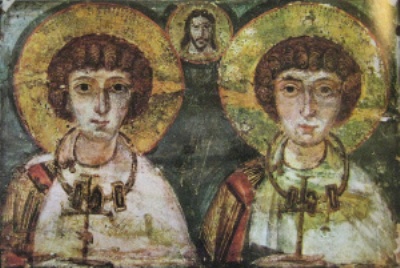
Illustration of Saints Serge and Bacchus allegedly united in a same-sex union. Source: Annalee Newitz, “Gay marriage in the year 100 AD,” io9.com, July 29, 2013.

Illustration of Saints Serge and Bacchus allegedly united in a same-sex union. Source: Annalee Newitz, “Gay marriage in the year 100 AD,” io9.com, July 29, 2013.

Among North America’s indigenous peoples, homosexuality and bisexuality were widely accepted and, many cases, revered. Interpretations of various Indian languages have produced the term “two-spirit people.” While some communities clearly mocked such people, others viewed them as uniquely deserving of respect and consideration. There’s no verifiable documentation that actual same-sex marriage ceremonies were performed among Native Americans. But, with the intrusion of Christianity ideology, “two-spirit people” were relegated to obscurity and treated with disdain. Regardless, same-gender unions may not be a just a 20th century concept.

Right-wing claims that same-sex unions pose a danger to traditional marriage, but it’s a dubious argument. Divorce rates in the U.S. had reached near 50% by the 1980s, but then began dropping. Marriage rates, however, have also been dropping. Moreover the greatest threats to marriage should be obvious: poverty and other financial difficulties; unemployment and underemployment; domestic violence; and drug and alcohol abuse.

Once as taboo as homosexuality itself, divorce became more acceptable, beginning in 1969, when California became the first state to enact no-fault divorce. Ironically the law was signed by then-California Governor Ronald Reagan, an icon of conservative family values who became the nation’s first and – to date – only divorced president.

The late actress Elizabeth Taylor was married eight times. Former radio personality Larry King was also married eight times, twice to the same woman. Faux singer Britney Spears once married a childhood friend as a joke. Kim Kardashian’s 2010 marriage to Kris Humphries lasted 72 days.

Former Congressman Newt Gingrich (who tried to impeach President Bill Clinton in 1998 for lying about an affair with an intern) is married to his third wife. His first two marriages ended in divorced after he was caught having affairs with younger women. He delivered divorce papers to his second wife, while she was recuperating in a hospital from cancer surgery.

I want to point out something more personal. The day after the Obergefell decision, my parents marked their 56th wedding anniversary. They’ve lasted this long, not because they’ve just become stuck to each other, like parasites on a cow, but because they took their marriage vows seriously. They respect one another, have a great sense of humor, and occasionally spend quality time apart. It hasn’t always been easy. Like any married couple, they had their share of arguments and disagreements. But nothing was ever so bad that they had to separate. More importantly, they never felt threatened by any gay or lesbian person. The Obergefell case isn’t going to bring an end to their nearly 60-year union. In their twilight years, they’re more concerned with their own physical health and financial well-being.

In other words, they’re minding their own damn business. I recommend all the malcontents pissed off over the Obergefell case do the same.
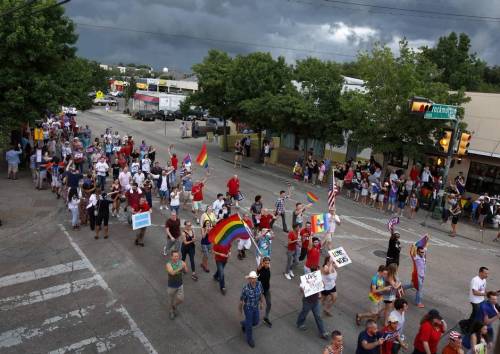
Despite a looming rainstorm, gay couples and their families and friends marched down Cedar Springs Road in Dallas to celebrate the same-sex marriage ruling on Friday, June 26.
Despite a looming rainstorm, gay couples and their families and friends marched down Cedar Springs Road in Dallas to celebrate the same-sex marriage ruling on Friday, June 26.

6 Comments

Filed under Essays

Civil Righting

the-constitution

Back in 2002, my then-roommate, Tom,* and I got into a discussion about racial and gender equality.  I stated that all of the various civil rights movements of the 19th and 20th centuries, starting with the abolitionist movement, were necessary to instigate change and make America live up to its declaration as a truly free and inclusive nation.  Tom merely shook his head no in a condescending fashion and said, “Nah,” later adding that eventually people would have “come around” and realize discrimination was wrong.

I looked at him like the fool he was and asked him if he sincerely believed that.  He said he did.  I then recounted the story of my father’s return from Korea in the mid-1950s.  He had been drafted into the U.S. Army and sent to the front lines in the midst of the Korean War.  Among the many friends he made were a large contingent of Black soldiers.  By then, the U.S. armed forces had been forcibly integrated, so a mix of ethnic groups comprised all the various military units.  My father didn’t serve his full two-year stint, as the war ended sooner than most anyone had expected.  He and several of his fellow soldiers arrived in Seattle via ship and then boarded a train to head to their various home cities.  My father was confused when his Black team mates started walking away from.  He called out to them, asking where they were going.  One told him they were headed towards the rear caboose – where Black people had to sit.  As he watched his friends, his brothers-in-arms, saunter down the platform, my father said to himself, “Oh yea, we’re back in America – land of the free.”

Tom just sort of looked at me, not knowing what to say.  He conceded it was wrong, even then, to force Blacks to sit at the back of a bus or a train.  But, he snapped out of his brief foray into actual reasoning and reiterated that eventually White people would have realized how unfair that was.  In other words, we didn’t bus strikes or protests of any kind.  People should have just waited around, hoping for the better.

No one should have to wait for justice and fairness.  Nobody should be straddled to the rocks of oppression and brutality – hoping, praying and begging for those in positions of power and influence to see the light.  Disenfranchised groups in the U.S. had waited for centuries to be treated with dignity and respect and to be given an equal chance to succeed.

I told someone else around the same time as my conversation with Tom that the 1960s exploded with anger and rage because patience had finally run out.  They’d done everything that had been asked of them: they served in the military; they worked hard; they cleaned homes and streets; they obeyed the laws (no matter how discriminatory they were); they tried as best to keep to themselves – everything.  And, they still weren’t given a fair chance.  Blacks still had to sit at the back of the bus; women still had to change their last names when they got married and still had to have children; Indians still had to live in squalor on reservations; gays and lesbians still had to suppress their true identities.

And so, by the 1960s, everything just sort of erupted at once.  If change didn’t come through peace and hard work, then it had to be forced.  America was compelled to fulfill its proclamation as a nation of freedom and opportunity.  It no longer had a choice in the matter.  The time had come to change – whether some folks liked it or not.

It was curious to hear Tom speak of racial and gender equality and inequality.  He was a mix of German and Cherokee; from a small, nondescript community in far northeast Texas.  We discussed the plight of Indigenous Americans more than once.  He felt that Indians could have fought back against European encroachers because they also had men.  I noted that Europeans had two primary advantages: guns and horses.  Moreover, they’d adopted both gunpowder and horse-riding skills from the Chinese.  Tom wasn’t moved.  And, I told him he now had the distinction of falling into two unique groups: those who aren’t educated about a subject and those who don’t want to be educated.  That’s actually a rarity, but one that persists even now; in this second decade of the 21st century with a biracial U.S. president and a shrinking White majority.

Attitudes really are hard to change.

*Name changed.

4 Comments

Filed under Essays

A Magna Carta in Houston

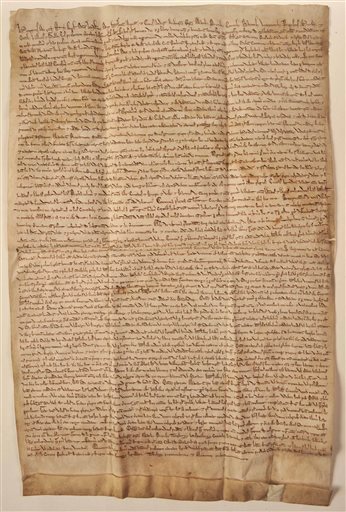
A copy of the original “Magna Carta.”

A copy of the original “Magna Carta.”

For the first time in its known history, the legendary “Magna Cartawill leave its birth place of England and arrive in the United States.  Originally issued on June 15, 1215, in a field at Runnymeade by King John, the revered document is a considered a hallmark of democracy with its multiple declarations of various freedoms; including an acknowledgement that taxes cannot be arbitrary, free men cannot be imprisoned without first being judged by their peers, and that justice cannot be delayed or denied.  King John was just trying to avert a civil war, when confronted by scores of rebellious land barons; a clash that erupted anyway, when Pope Innocent III nullified it 10 weeks later.  Somehow, though, the item itself survived.  Copies of the original made in 1217 are kept at the Hereford Cathedral Perpetual Trust.

Now, one of those versions will go on display at the Houston Museum of Natural Science.

“These are truly rare and ancient documents,” said Catherine F. Patterson, a British historian at the University of Houston.  “They are national treasures that have been guarded for centuries and don’t typically leave England’s shores.”

The “Magna Carta” later formed the basis for English common law and is often cited as a cornerstone of the U.S. Constitution.  It’s ironic, though, since the medieval treatise applied only to wealthy landowners.  Nonetheless, it remains a historic item.

The exhibit is scheduled to open in February and last for 6 months.  Hopefully, it’ll make people focus on the realities of democracy’s foundations and the struggles for true freedoms.

“People in their minds have the Disney version where the king wakes up one day and says, ‘I have a great idea,’” said Joel Bartsch, the museum’s president and CEO.  “When they come to the museum, they get the real version.”

1 Comment

Filed under Art Working

Six Years and That’s It!

There’s an old saying in Washington, D.C., that presidents spend their first four years in the Oval Office running for reelection and the second four building their legacy.  The ratification of the 22nd Amendment to the U.S. Constitution in 1951 limits the president to two four-year terms.  Its genesis was the tenure of Franklin D. Roosevelt who won a remarkable four consecutive elections and, as the beleaguered Archie Bunker once said, “[held] onto the job like the Pope.”

Currently, there are twenty-seven amendments to the U.S. Constitution; the last one, proposed in 1789 and not ratified until 1992, preventing laws affecting Congressional salary from taking effect until the beginning of the next session of Congress.

After struggling to watch and digest both the Republican and Democratic National Conventions, I propose a twenty-ninth amendment: a U.S. president’s term shall be limited to one six-year stint.  Six years and that’s it!  You’re done; finished; complete.  You can start writing your biography and building your library.  If it’s good enough for México, it’s good enough for the United States.

Every incumbent president since Richard Nixon has spent way too much time and energy during their fourth full year in office hoping to keep the position.  Ronald Reagan almost dropped dead during his reelection campaign because he was so old and feeble, and apparently Bill Clinton got so sexually frustrated during his that he ended up feeding an intern the hard way.  Okay, those are just my opinions, but seriously folks!  As the symbolic leader of the free world, in a nation with the oldest constitution on Earth, our president needs to be focused on the tasks at hand.

President Obama, for example, keeps trying to explain why the U.S. economy is still so bad, while still trying to fix it.  He’s squeezing campaign stops in between deciding whether to drop a bomb on Syria, or send in the Marines.  If we had that one six-year term deal in effect and Obama had been elected, say in 2006, he’d already be scheduling sessions with his ghost writer and consulting with the Chinese architects for his library in downtown Chicago.  Then, he could say to hell with it and drop that bomb on Syria and not worry if it’s going to piss off the coveted Syrian-American vote.

If anything, our presidents won’t leave office looking so old and frazzled.  They could actually get more sleep during that fourth year in office because they won’t be up for reelection.  They could still build a grand legacy during six whole years in office.  Of course, they usually spend the remainder of their lives trying to defend it.

I’m not a political scientist, or even a journalist.  I’m just an average American citizen who’s grown tired of the sludge fests that have accompanied our national elections over the past twenty years or so.  But, I’d still like to get some feedback on this proposal.  What do you think?

Leave a comment

Filed under Essays