Tag Archives: Writers Guild of America

Right This

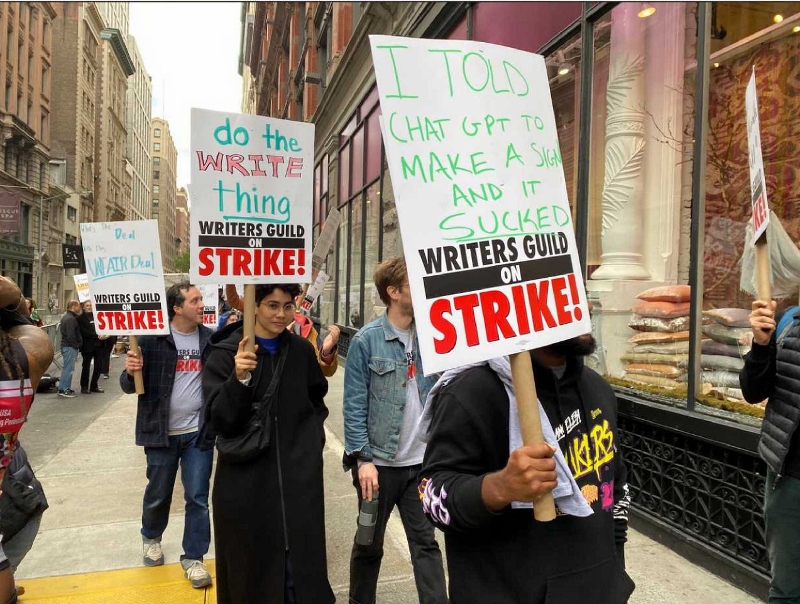
Protesters outside Netflix’s headquarters on May 3 demand better pay and no AI in the writers’ room. Photo: Maya Pontone/Hyperallergic)

On Monday, May 1, the Writers Guild of America went on strike.  It’s the first time professional television and film writers have revolted against the entertainment industry since 2007.  That particular walkout last more than three months and alone cost the state of California $2.1 billion.  Back then the dispute centered on the growing internet market and material being downloaded for very little, if not for free.  The entertainment world’s corporate elites had, of course, remained profitable.

The WGA is still fighting for the usual claims: higher wages, better healthcare benefits and pensions, and – as in 2007 – more compensation when their work shows up on streaming platforms, such as Amazon and Netflix.  According to an industry bulletin, writer pay has fallen, as corporate profits have risen.  Production companies are also hiring fewer writers to do more work.  (Sound familiar?)

But now the writers are also targeting a new entity: artificial intelligence (AI) and in particular the ChatGPT program, which has emerged as a writing tool.  Launched in November 2022 by OpenAI, ChatGPT is still in its development phase, but has curious (threatening?) implications for writing, computer programming and even every day conversations.  In recent years AI has been used to create realistic fake photos and videos.

Didn’t Isaac Asimov warn about things like this?

Dr. Geoffrey Hinton certainly has.  Considered the ‘Godfather of AI’, Hinton has expressed concerns about AI’s rapid expansion across the globe, dubbing it an “existential risk” to true human intelligence and ingenuity.  A decade ago Google brought Hinton on board to help develop its AI platform, and his endeavors ultimately led to the creation of ChatGPT.  Now, perhaps channeling Victor Frankenstein, Hinton declares, “I’ve come to the conclusion that the kind of intelligence we’re developing is very different from the intelligence we have.  So it’s as if you had 10,000 people and whenever one person learned something, everybody automatically knew it.  And that’s how these chatbots can know so much more than any one person.”

Television and film writers still struggle for respect and profitability.  Britanni Nichols, who writes for the popular ABC show “Abbott Elementary”, noted that she could live comfortably off the residuals she’d receive from the network between seasons, since she’d get half her original writing fee.  But now, when those episodes are sold to streaming services, she earns a paltry 5.5% of that fee.

“You’re getting checks for $3, $7, $10,” she explains.  “It’s not enough to put together any sort of consistent lifestyle.  It can really be a real shock. … sometimes you get a stack of checks for $0.07.”

Music artists experienced similar woes with the Spotify streaming service several years ago.  Singers and songwriters found they were earning, on average, less than one cent per day, as the site’s patronage downloaded a vast array of songs.  The animosity grew so intense that singer Taylor Swift pulled her entire song catalog in 2014.  Other artists followed suit, thus setting the stage for a major overhaul of the music streaming concept and business model.  It was dramatic and controversial, but it had to be done.

Other creatives found themselves expressing similar anxieties.  In 2021 artist Jens Haaning caused a stir when the Kunsten Museum of Modern Art in Aalborg, Denmark paid him the equivalent of USD 84,000 to create a modern art piece.  He responded with two blank canvases collectively titled “Take the Money and Run”.  It was his homage to (and protest of) the poor wages painters often receive for commissioned works.  “The work is that I have taken their money,” he said.  Like writing, painting and sculpting aren’t so easy to do.

Author Amy Joy once stated, “Anyone who says writing is easy isn’t doing it right.”  And I often recollect an old story involving the late actress Anne Bancroft and her husband, writer and filmmaker Mel Brooks.  After landing a movie role, Bancroft allegedly held up the script and lamented the amount of dialogue she had to memorize!” – whereupon Brooks replied by a holding up a blank sheet of paper and asked her to imagine putting all that dialogue down on it.

Several years ago, when LinkedIn was still somewhat relevant, I belonged to various writing and art groups.  In one the issue of financial compensation arose, and a handful of misguided souls had the audacity to question why writers – or any artists, for that matter – felt they had the right to be paid for their work.  “No one asked you to be a writer,” declared one visitor.  I pointed out that no one is asked to enter into any kind of profession, not including family and close friends.  (My parents wanted me to go into computer science, which I did when I started college, and quickly discovered how inept I was at it.)  The public doesn’t ask anyone to go into the creative arts – not directly.  But the average accountant, lawyer, architect, cashier or FedEx driver wants to be entertained in one way or another; try as they may, though, they don’t have the talent or discipline to create their own stories or compose their own songs.  Thus, in a subtle manner, they do ask for someone somewhere to do these things for them.  People like to read stories, listen to music and look at beautiful paintings.  Somebody is always ready to respond and create those pleasures.  Thus, they should be respected and be compensated for their endeavors.

All I can say to the WGA folks is to keep writing and keep fighting!  It’s worth the battle.  You and your work are worth the battle!
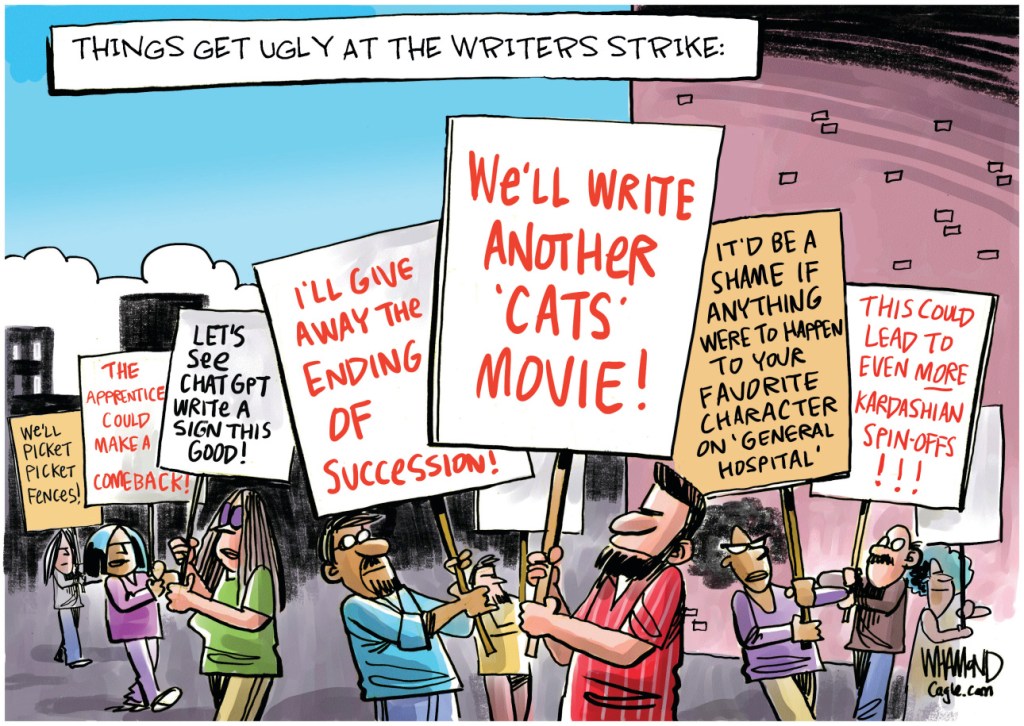
Bottom image: Dave Whamond

2 Comments

Filed under Essays

Worthy Words

Writer-at-work

Last month writer Wil Wheaton received a request from the Huffington Post to publish an essay, “Seven Things I Did to Reboot My Life,” that he’d just published on his own blog. Until his follow-up essay, I wasn’t aware contributors to HP aren’t paid for their work – except in that most traditional of literary reimbursements: exposure. I believe most every freelance writer has encountered the ubiquitous “we-can’t-pay-you-but-you’ll-get-tremendous-exposure” line. It’s supposed to make us feel comfortable, hopeful maybe, that – in lieu of much-needed financial resources – an untold number of readers will see our work and that someone in that vast crowd will be awestruck enough to offer us a paid job that, in turn, will lead to our long-held dream of being a successful (affluent) scribe. But I’m surprised at this revelation, considering HP founder Arianna Huffington is a proud progressive who champions free speech and worker rights.

Wheaton didn’t fall for HP’s offer and declined it faster than a Hollywood celebrity dropping a gluten-filled sandwich. Meaning he politely told them to stick their “exposure” ruse up their ass. I couldn’t stop laughing out loud when I read that. My dog surely thought I’d finally gone over the edge, as he grabbed his rawhide bone and scurried into the den.

Good for you, Wil!

Myths about writers persist. It’s not a profession; it’s more of a hobby. We like to suffer for our art. We’re so desperate for notoriety we’ll give it away whenever we can – like drug addicts needing a fix. As with any tall tale, there’s some measure of truth to it. But most of us writers take our work seriously. It’s more of a calling than a profession; a passion for the written word and a desire to spread our thoughts and ideas in the best way we know how. Yet we also like to get paid for our time and effort.

Writing isn’t like a sneeze; building up quickly, before exploding forth. It takes time and energy. Ideas may pop into our heads during the most unlikely of literary activities – eating, showering, having sex, stalking the last publisher who called your writing crappy – but turning those sparks into full-fledged and long-lasting flames is cumbersome. Some scribes can pound out a story in a matter of weeks, while others take years to write an award-winning tome. Whatever the length of time, it’s not an easy task.

But what is it that makes some people think writers don’t mind working for free? What is it that compels some publishers to believe “exposure” is a sufficient replacement for monetary compensation? But, then again, how much is a single word worth? If a rap singer can spit out a foul-mouthed, yet otherwise incomprehensible “song” and earn millions, why should a freelance writer have to produce 500 words for fifty bucks? I can see the insanity in such questions, but I know too many others just don’t get it.

In 1988 the Writers Guild of America – composed of West and East branches – drove home the importance of writer compensation with a strike that practically brought the U.S. entertainment industry to a halt and almost bankrupted the state of California. The WGA started as the Authors League of America in 1912; an entity devoted to protecting the financial and creative rights of writers. Its first president was Winston Churchill – not the famed British prime minister – but a former member of the New Hampshire State Legislature and a novelist and playwright. President Theodore Roosevelt, who signed the Copyright Act of 1909 on his last day in office, served as the Guild’s first vice-president.

The ALA’s mission was simple and straightforward: “to protect the rights of all authors, whether engaged in literary, dramatic, artistic, or musical competition, and to advise and assist all such authors.” In 1921, it metamorphosed into the Authors Guild, when playwrights, composers, and lyricists left to form the Dramatists Guild of America. In 1933 the Screenwriters Guild formed in Hollywood.

The 1988 strike wasn’t the WGA’s first, but tellingly, each protest arose in response to cultural and technological changes in the entertainment industry. In 1960 the WGA launched a 21-week strike against film studios seeking compensation for movies shown on television. In 1973 they struck in favor of increased wages and health benefits. The 1981 strike was for cable and home video revenue. And, just three years before the 1988 event, the WGA protested over royalties from videocassette sales. The 1988 strike actually began late the previous year, when movie and TV producers demanded that writers accept sliding-scale payments on residuals from works that are re-broadcast after their original air dates. The producers claimed that syndication prices drop, so writers shouldn’t expect compensation identical to their original payments. The writers didn’t dispute the concept of syndication; the matter concerned the amount. Negotiations commenced, but stalled. And the result was the longest-lasting writers’ strike in U.S. history; costing the entertainment conglomerate roughly $500 million.

The 2007 WGA strike was, as before, a response to emerging technology. This time, it was a digital issue, and, as before, producers tried to utilize the new gadgetry to get around paying writers a decent share. The increased presence of the Internet and other devices, such as I-phones, allowed for greater dissemination of content. Recalling the 1988 mess, movie and TV producers listened two decades later and worked quickly to end the drought.

The angst of writers resounds clearly with other artists. In 1999 two teenagers, Shawn Fanning and Sean Parker, launched an online company called Napster, where people could download and share songs – for free. Using a then-innovative technology called file-sharing, users simply had to log onto their computers and – for lack of a better term, but calling it what it is – pirate their favorite tunes for personal usage. From a technological perspective, it was ingenious. From an artistic viewpoint, it was flat-out theft. The music industry quickly took notice, and – after much legal wrangling – Napster was forced to shut down in 2002.

The same issue arose again with musical streaming. It exploded into controversy last year when singer Taylor Swift pulled her entire music catalog from Spotify, one of the largest musical streaming companies in the U.S. Spotify and others offer users a desktop application for a nominal fee through which they can download whatever songs they want. The companies earn a hefty profit through ads and other sources. And the artists earn…a few dollars. Literally. Singer and songwriter Rosanne Cash dubbed musical streaming “dressed-up piracy.”

My paternal grandfather was a carpenter. One day, in the 1930s, a local woman called him to help get a window in her house unstuck. He examined the window briefly, before taking a hammer and lightly tapping on either side of the frame, thus dislodging it. When he charged her $10, she balked; asking why she should pay him for “tapping a little bit here and a little bit there.” He promptly told her the fee wasn’t for “tapping a little bit here and a little bit there,” but for knowing to “tap a little bit here and a little bit there.” Knowledge is worth something. So are words.

How much someone’s talents are worth will always be a matter of debate and is often subjective. On an episode of “The People’s Court” a while back, a performance artist sued a student videographer she’d hired to capture one of her stage shows; she wasn’t satisfied with the quality of the final product. Apparently she could only afford one camera, so the young man could only focus on a limited area of the stage; instead of videotaping the entire panorama. He could have brought in an assistant to work another camera, but the artist said her budget wouldn’t allow it. When Judge Marilyn Milian asked why she was so upset, she pointed out she was frustrated with the limited scope of the videotape. There were several people on stage, but the videographer only managed to catch one or two at a time. Milian reminded the plaintiff she’d hired a student videographer, not a professional, and queried why the woman just didn’t pay to have a second camera. Her budget wouldn’t permit it, she reiterated – whereupon she answered her own question. Case dismissed.

Anyone who thinks writers must accept the “exposure” concept at face value should consider this scenario. Imagine you’ve spent the bulk of your professional life in the food service industry. You’ve worked for a variety of outfits – restaurants, hotels, country clubs – before you finally decide you’re tired of slaving over other people’s hot ovens and decide to open your own catering business. You encounter a couple who wants to hire you to cater their daughter’s wedding reception. They want a certain amount and variety of food for a large number of people on a particular day and at a particular time. They then tell you it’s not in their budget to pay you up front for all the food and your time and energy in preparing it and setting it up, but emphasize that with so many people expected to attend the reception, you’ll get great culinary exposure; which means that someone will surely find it so delicious they’ll want to hire you for something else at a later date. Do you think a caterer would go for that? Why should a writer?

Last year I finally decided I needed to hire a professional editor to review my novel manuscript. I selected Leslie Silton, a Los Angeles-based editor who has worked with a variety of writers. After going through my novel, she found a number of minor things that I’d missed; elements that ultimately would have made me look unprofessional. It really does pay to get an outsider to review your work. At no time, however, did I expect Leslie to work for free. I never dreamed of telling her, “Look, I can’t pay you, but I have about 200 followers on my blog, 300 Facebook friends, and 250 Linked In contacts. I intend to publicize my novel on all those sites, and when they see what a great job I did, they’ll also see your name.” I would have gotten a dial tone the second I finished that sentence. As a Bostonian, though, I’m certain Leslie would have provided some colorful verbiage to go with it. If you produce work for one site, just for the “exposure,” what makes you think someone who sees it and – given that they like it – won’t expect you to be satisfied with the same type of “payment”?

In one of my Linked In groups a while back, this very subject came up. A freelance writer mentioned that she was frightened when a client expressed dissatisfaction with her work; therefore, she lowered her fees to avoid any impending damage to her professional reputation. I told her that she shouldn’t have felt bad enough to lower her fees, just because one particular client didn’t like her final output. “Your work is worth something,” I emphasized.

Wheaton offered a logical response to the Huffington Post “exposure” offer: they earn a considerable amount in advertising revenue. More importantly, HP itself is valued at something around $50 million. Too many writers fall for that “exposure” bit – and suffer the blatant disrespect that surreptitiously goes with it.

As writers we’re worth something. And exposure doesn’t quite cover it.

Image: Cullen Communications.

11 Comments

Filed under Essays