Around 1990 I met a woman who once worked for the now-defunct Braniff Airlines. She was the aunt of a close friend, and somehow we got to discussing business practices and how things function in the corporate world. I was already working for a major bank in Dallas. She noted how the former president of Braniff refused to accept the reality of bad news. Anyone who dared to step into his office and present him with less-than-stellar information about the company’s dire finances was promptly terminated. On the day in 1982 the company filed for bankruptcy, she mentioned that employees didn’t get paid and, in some clerical settings, they literally went ballistic and destroyed many pieces of equipment and office furnishings as retribution. I was shocked, but said I didn’t blame them.
In the summer of 2011 I landed a contract technical writing position with an IT firm in Dallas. One of the senior technical writers had worked for Braniff as a flight attendant until they went bankrupt. She confirmed what that other woman had told me two decades earlier. Braniff employees didn’t receive their last paycheck and lost their patience.
You don’t have to be a business owner to understand that bad news is an inevitable burr in daily operations. It comes with territory, but some people handle it better than others. The same goes for comedy. Cultural shifts can make individuals more or even less sensitive to certain aspects of their surrounding environments.
The U.S. currently has a president, however, who has no problem calling people names and making fun of them, but suddenly draws the line at people mocking him. “You’re a horrible person” is how he often prefaces a response to someone who asks him a question he finds intolerable. But, as I wrote in a previous essay, it appears the demonic world of American politics has become riddled with the emotionally fragile.
Last week conservative activist Charlie Kirk was shot and killed by a young man while holding an outdoor question-and-answer session at Utah Valley University. The 31-year-old Kirk left behind a wife and two young children. Right-wingers immediately jumped into the chaos and started pointing fingers at liberals and the entire Democratic Party.
“Democrats own what happened today,” South Carolina Republican Nancy Mace groused to reporters the day after Kirk’s death. “I am devastated. My kids have called, panicking. All the kids of conservatives are panicking.”
President Trump ordered flags flown at half-mast in honor of Kirk; something he didn’t do in the bloody aftermath of the January 6, 2021 riots on Capitol Hill.
It’s ironic, though, because Kirk once said that gun-related deaths were merely a price to pay for Americans’ right to own firearms. “It’s worth it to have a cost of, unfortunately, some gun deaths every single year so that we can have the Second Amendment,” he stated matter-of-factly in 2023. Now he’s being lionized as a martyr to conservative ideology.
Kirk also believed firmly in free speech, declaring that saying even “contrarian things” is acceptable. I have to agree with that statement. But, as the adage goes, be careful what you wish for…
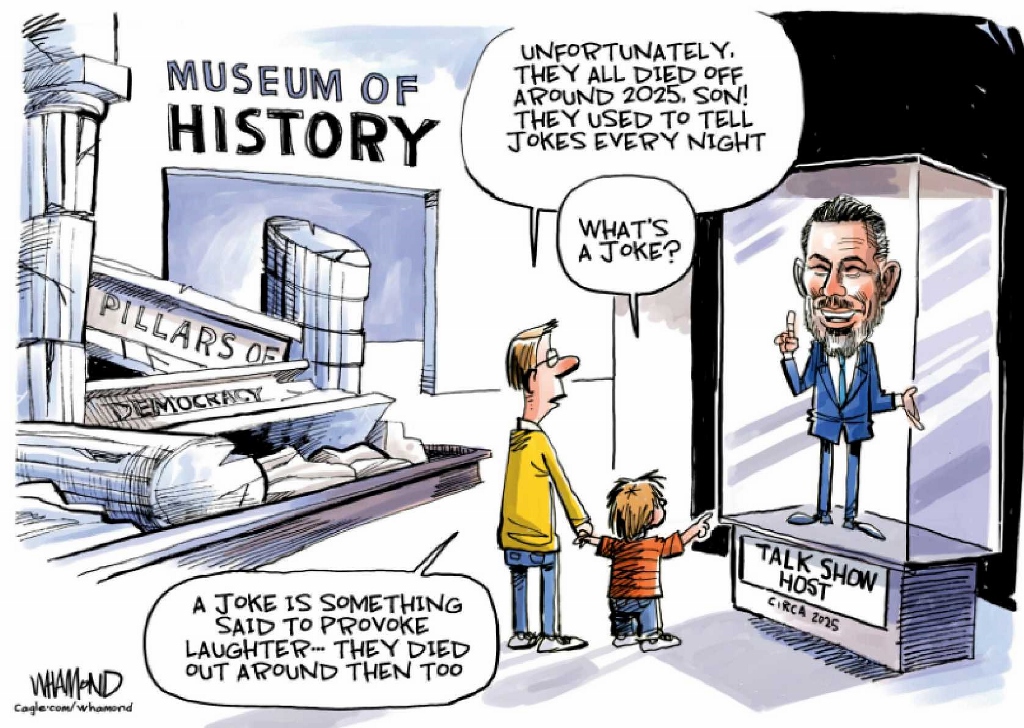
The general concept of free speech is now under attack, as it always has been with Trump and his MAGA mafia. Recently the Federal Communications Commission ordered the ABC network to cancel or at least suspend Jimmy Kimmel’s nightly talk show, after he commented on Kirk’s murder. Kimmel didn’t gloat over the assassination; he simply pointed out that Trump supporters are using it to enhance their own anger.
For some folks, free speech only seems to have consequences or responsibilities when someone says something they don’t like. How free should someone be with their own words? You can’t threaten to kill someone or you can’t call them a rapist without tangible proof. Slander and threats of violence aren’t covered by the First Amendment to the U.S. Constitution.
Banned Books Week 2025 is coming up soon, and I recollect a news piece I saw back around 1986 – the centennial anniversary of the Statue of Liberty. Several foreign-born and newly-minted American citizens discussed the oppression they escaped. One woman, a Russian, noted that she was a reading a book at an outdoor café, when said she suddenly got the feeling someone was watching her. But she remembered she was now in the United States – and she could read just about anything she wanted, even in public, without fear that someone would report her to authorities for being a traitor or disruptive; merely because of what she was reading.
Is that where we’re headed? People need to watch what they read, as well as what they say? Or is the First Amendment now subject to political interpretation?
Do any of us want someone else to determine what we say and read? I’m not willing to give up that type of freedom. No one should.
Image: Dave Whamond

 Chief Writing Wolf