Category Archives: Art Working

Cities in the Night

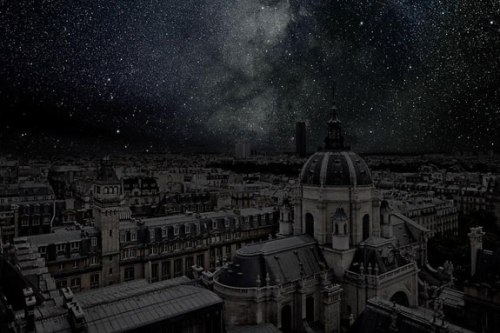
What would the world’s largest metropolitan areas look like if illuminated only by the light of the stars?  That’s difficult to imagine, given the unyielding relationship between cities and their plethora of lights.  But, French photographer Thierry Cohen has done just that.  Cohen worries that intense urbanization has spawned generations of people who are too detached from the natural world.  He feels a city-bred individual “forgets and no longer understands nature.”

Light pollution has become a serious concern in recent years.  Before, no one really gave much thought to the ill effects of so many artificial sources of light.  City skies have become virtually empty of stars.  The International Dark-Sky Association, founded in 1988, works to preserve the integrity of the night sky by advocating for fewer lights and more practical usage of those that are necessary.  Their efforts are paying off.  In 2002, the Czech Republic became the first country to enact legislation to eliminate light pollution.

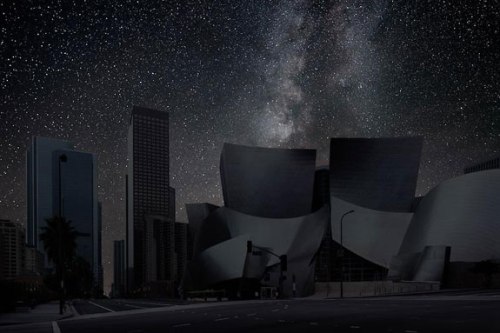
Three years ago Cohen embarked on an ambitious project to help city dwellers realize what they’re missing.  He traveled to some of the world’s largest cities and photographed them during the day; meticulously recording the time, angle, latitude and longitude of the shot.  Then, he journeyed to remote deserts and plains at corresponding latitudes and pointed his lens to the night sky.  New York City, for example, parallels with the Black Rock Desert in Nevada; for Hong Kong, it’s the Western Sahara in Africa; for São Paulo, it’s the Atacama Desert in Chile; and for Cohen’s native Paris, it’s the prairies of northern Montana.  Cohen then manipulated the photographs to create composites of the cities and their skyscapes.

The results are magnificent.  Observers don’t see a skyline as in a fantasy or a dream, but rather as it should be seen.  And, in the end, hopefully they’ll begin to think about more their environment.

Hong Kong
Hong Kong

Los Angeles

Los Angeles

New York City

New York City

Paris

Paris

Rio de Janeiro

Rio de Janeiro

San Francisco

San Francisco

São Paulo

São Paulo

Shanghai

Shanghai

Tokyo

Tokyo

4 Comments

Filed under Art Working

Timbuktu Under Siege

Mali---Travel---Tradition-010

The deaths of innocent civilians are always the anticipated casualties of any conflict.  But, historical artifacts are often the silent victims of war.  We’re seeing that now in the West African nation of Mali, as Al-Qaeda-backed rebels try to seize power.  Late last month, as rebel forces retreated from the city of Timbuktu, they torched two buildings that held a number of antiquitous manuscripts; some dating to the 13th century A.D.  Situated on the far southern edge of the Sahara, Timbuktu is one of the oldest, most continuously-occupied cities on the African continent.  Founded by Tuarag nomads around 1100 B.C., it rose to become a critical trading post and center of Islamic culture in the region.  Three of western Africa’s oldest mosques –Djinguereber (Djingareyber), Sankore, and Sidi Yahia – were constructed in Timbuktu in the 14th and 15th centuries A.D.  In 1988, UNESCO added Timbuktu to its “List of World Heritage Sites in Danger.”

With such an extraordinary history, you’d think even Islamic rebels would do everything to maintain Timbuktu’s dignity.  But, the hostilities racking Mali prove nothing is immune.  If warring factions don’t care about innocent people, why would they care about a batch of aged texts?

The impacted manuscripts were retained in two separate facilities: an old library and a new South African-funded research center, the Ahmad Babu Institute.  Completed in 2009 and named after a 17th century Timbuktu scholar, the latter structure utilized modern science and technology to preserve the deteriorating papers, which had been hidden in wooden trunks and boxes and found buried in caves and beneath sand.  Most of the texts were written in Arabic, while a few were composed in African languages, such as Songhai, Tamashek and Bambara.  There was even one in Hebrew.  They covered a range of topics, such as astronomy, poetry, music, medicine and women’s rights.  The oldest dated to A.D. 1204.

One long-time Ahmad Babu Institute employee, Seydou Traoré, said only a small number of the documents had been converted to digital images.   “They cover geography, history and religion,” he said.  “We had one in Turkish.  We don’t know what it said.”  The manuscripts were important, not just because of their age, but because they exploded the myth that “black Africa” had only an oral history.  Typically, the manuscripts were not numbered, Traoré said.  But, the last word of a previous page was repeated on each new one.  Scholars had painstakingly numbered several of the manuscripts under the direction of an international team of experts.

Essop Pahad, chairman of the Timbuktu manuscripts project for the South African government, said, “I’m absolutely devastated, as everybody else should be.  I can’t imagine how anybody, whatever their political or ideological leanings, could destroy some of the most precious heritage of our continent.  They could not be in their right minds.  The manuscripts gave you such a fantastic feeling of the history of this continent.  They made you proud to be African.  Especially in a context where you’re told that Africa has no history because of colonialism and all that.  Some are in private hands but the fact is these have been destroyed and it’s an absolute tragedy.”

3 Comments

Filed under Art Working

Cloud Capture

cumulusklein-Berndnaut-Smilde

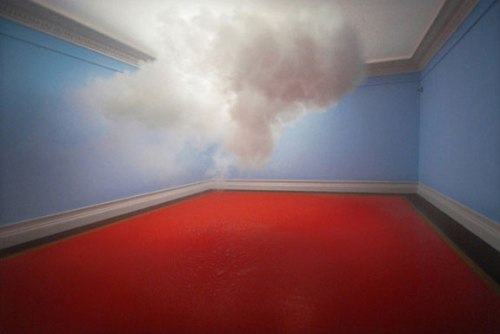
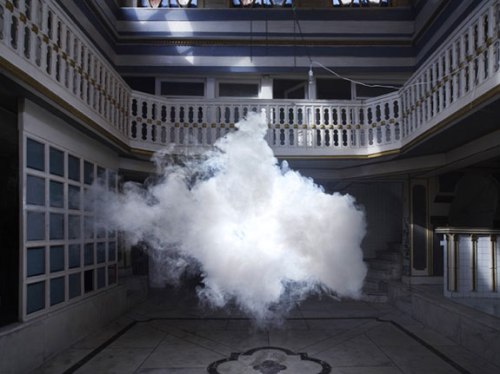
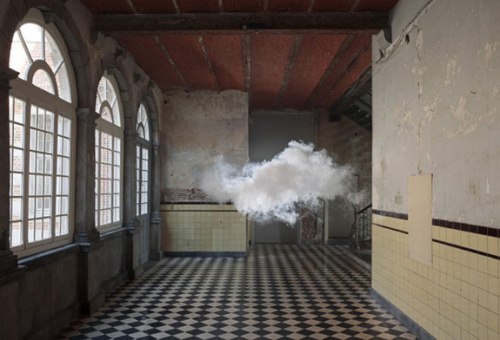
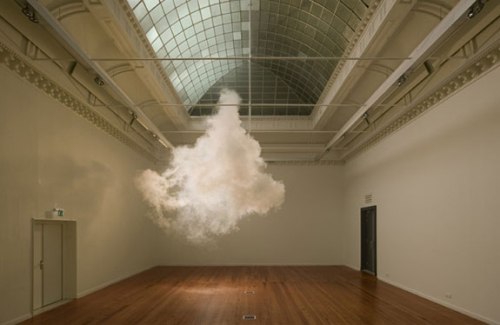
This is one of the most intriguing displays of art in motion I’ve ever seen.  Dutch photographer Berndnaudt Smilde creates nimbus clouds indoors and then quickly snaps pictures of them.  Characterized by their low altitude and heavy volume, nimbus clouds are the type that produces precipitation.  The clouds Smilde creates hang low, but fortunately, don’t bear any rain or snow.

Smiled began displaying his work in a small gallery in Arnheim, the Netherlands in 2010, but last year moved into much larger spaces, including a castle and a 15th century church.

“Some things you just want to question for yourself and see if they can be done,” says Smilde.  “I imagined walking in a museum hall with just empty walls.  There was nothing to see except for a rain cloud hanging around in the room.”

Nimbus-Berndnaut-Smilde

nimbus-cukurcuma2-berndnaut-smilde

Perhaps it’s only natural that Smilde would be fascinated with clouds.  Holland is beset with heavy cloud cover and frequent precipitation.  Moreover, Dutch art masters such as Rembrandt van Rijn and Aelbert Cuyp, created some spectacular cloud-covered landscapes in their paintings.

“My grandparents had one with really threatening-looking clouds,” says Smilde.  “I remember I was intrigued by the power of it.  I couldn’t really grasp what it was, but there was something big, magical and dark about to happen in that painting.  I wanted to create the idea of a typical Dutch rain cloud inside a space.”

That took some ingenuity and plenty of research.  He encountered a substance called aerogel, also known as “frozen smoke,” which is 99.8% air.  It’s the lightest solid material on Earth.  Fascinated with its resemblance to clouds, Smilde began experimenting with it.  Using various temperature controls, moisture and backlighting, he eventually achieved a true nimbus cloud effect.  Since the cloud creations don’t last long, Smilde can’t display them except in photographs.  He has only conducted three live demonstrations.

nimbusDAspremont-Berndnaut-Smilde

Nimbus-Minerva-Berndnaut-Smilde

Like many visual artists, Smilde views his work through its transitory nature.  “It’s there for a brief moment and the clouds fall apart.”

The Ronchini Gallery in London will open a month-long show of Smilde’s work on January 16.  The SFAC Gallery in San Francisco will feature an exhibition of his photographs from February 15 through April 27, 2013.

1 Comment

Filed under Art Working

Suspect in Picasso Vandalism Arrested

I reported last June about a man who inexplicably vandalized a painting by Pablo Picasso at a museum in Houston.  Another visitor used a cell phone to capture video of the man later identified as 22-year-old Uriel Landeros.  He spray-painted an image of a bullfighter and the word “conquista” (conquered) over Picasso’s 1929 “Woman in Red,” before fleeing.

Landeros turned himself in to authorities at the international bridge near McAllen, Texas last week and now has confessed to the crime.  He is charged him with criminal mischief and felony graffiti.  His attorney, Emily Detoto, admits that his confession will make it difficult to defend him.  She added that Landeros is an accomplished graffiti artist, which I’m sure doesn’t make museum officials feel any better about the desecration to the painting.  It was part of the Menil Collection and is valued at several million dollars.

Leave a comment

Filed under Art Working

Tolkien Goes to School

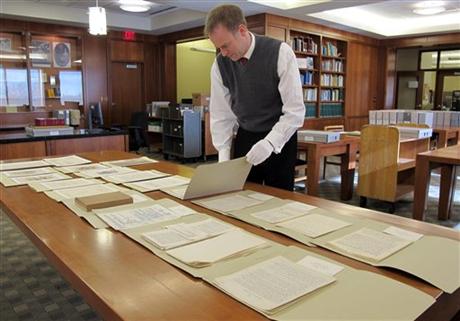
Marquette University Archivist Bill Fliss arranges some of the 11,000 J.R.R. Tolkien papers the university owns in the library of the Milwaukee school; home to the largest Tolkien collection in the world.  Photo courtesy Carrie Antlfinger, Associated Press.

Marquette University Archivist Bill Fliss arranges some of the 11,000 J.R.R. Tolkien papers the university owns in the library of the Milwaukee school; home to the largest Tolkien collection in the world. Photo courtesy Carrie Antlfinger, Associated Press.

We J.R.R. Tolkien fans will rejoice that Marquette University in Milwaukee, Wisconsin has created a class devoted exclusively to the writer’s works.  Tolkien is best known, of course, for The Hobbit and The Lord of the Rings – both of which set the standard for literary fantasies – but he composed a number of other pieces.  Marquette implemented the Tolkien course this past fall, in celebration of the 75th anniversary of The Hobbit’s publication.  Thirty-two students enrolled and studied Tolkien as a whole; not just from the viewpoint of his two most popular works.

Marquette is one of the main repositories of Tolkien drawings, writings and various drafts – more than 11,000.  It has the original manuscripts for The Hobbit and The Lord of the Rings, along with lesser-known Farmer Giles of Ham and Mr. Bliss, a children’s book.  Marquette was the first institution to ask Tolkien for the manuscripts in 1956 and paid him about $5,000.  The university had acquired the collection after it hired William Ready to build its literary collection.  Ready hired Bertram Rota, a London rare book dealer, to serve as the agent for Marquette.  Rota wrote to Tolkien and asked for his original manuscripts.  Tolkien was concerned about his retirement finances and agreed to the sale.  He died in 1973.

Marquette isn’t the first university in the U.S. to offer a class on Tolkien.  But, in this case, Marquette students can actually view Tolkien’s detailed drawings, notes and other items on site at the school’s archive.

“One of the things we wanted to impress upon the students was the fact that Tolkien was a fanatical reviser,” said Bill Fliss, Marquette’s archivist.  “He never really did anything once and was finished with it.”

Tolkien was a true writer’s writer and not just for the fantasy set.  He took complete control of his works, designing even the book cover for the first edition of The Hobbit.  His detailed art work helps the reader envision the world of “Middle Earth” as he saw it.  Few others can match is creative prowess.

A sketch of “Middle Earth” from Tolkien’s “The Art of the Hobbit.”

A sketch of “Middle Earth” from Tolkien’s “The Art of the Hobbit.”

Leave a comment

Filed under Art Working

A Very Cirque Christmas

Leave it to the vivid imagination of the Cirque du Soleil artists to create a different version of the traditional Christmas tale.  Their “Cirque Dreams Holidaze,” on tour now, features the usual displays acrobatic extravagance and colorful showmanship Cirque aficionados have come to expect and which so many other entertainers have tried to duplicate.  An original music score, accompanied by well-known holiday songs, complement this incredible show.  I saw my first Cirque performance in 1998 and have never been more amazed.

Leave a comment

Filed under Art Working

Early Andersen Fairy Tale Discovered

andersen

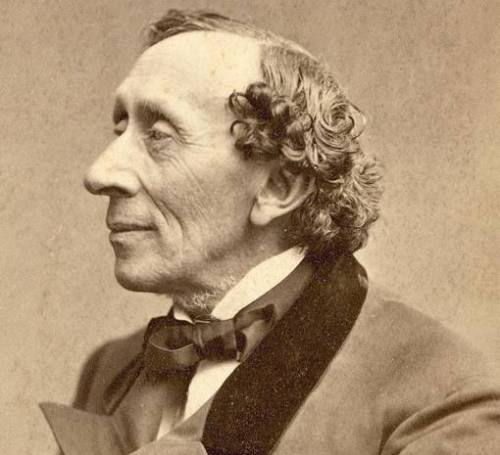
A Danish historian may have discovered the first fairy tale written by Hans Christian Andersen.  This past October Esben Brage found the ink-written manuscript at the bottom of a box in the historical archive on the island of Funen, where the Danish author was born.  Now, authorities have confirmed that Andersen wrote the 6-page story entitled “Tællelyset” (The Tallow Candle).  They’ve dated it to the 1820s, when the author was in his teens.

“I am in no doubt that it has been written by Andersen,” Ejnar Stig Askgaard of the Odense City Museum told the Danish daily Politiken.  The paper has published an English-language translation of the story.

The story is about a neglected and dirty tallow candle which finds happiness when a tinder box sees its true beauty and lights its wick.

The front page of the manuscript reads “To Madam Bunkeflod, from her devoted, H.C. Andersen.”  A vicar’s widow, Mme Bunkeflod lived opposite Andersen’s childhood home. Historians know that the writer visited her often as a child, borrowing her books.

“The fairy tale was a present.  A present of thanks to a woman whose home had been very important to him,” Askgaard said.

Experts believe the manuscript is a copy of the original.  Andersen’s first fairy tales were published in 1835.  He wrote some 160 stories, including classics like “The Ugly Duckling,” “The Little Mermaid,” “The Emperor’s New Clothes” and “The Little Match Girl,” that have been translated into more than 100 languages.

Leave a comment

Filed under Art Working

The Ai Way

aiweiwei2

Ai Weiwei (pronounced eye way-way) has become one of the most influential contemporary artists on the international circuit – in both politics and art.  Born in China, Weiwei spent some of his early years in New York in the 1980s where he apparently developed is acumen for merging art with social consciousness.  He’ll use any medium or genre – sculpture, photography, performance, architecture, and now tweets and blogs – to deliver his messages.  Weiwei has become something of a living martyr in China’s ongoing battles with democracy; he has openly criticized the Chinese government and been harassed and jailed.  His antics rival those of Salvador Dali and Andy Warhol: he once dropped an ancient Chinese vase and took a photograph of himself giving the White House the finger.

Weiwei has already been the subject of two shows in Washington, D.C.  This past spring, “Perspectives: Ai Weiwei,” opened at the Arthur M. Sackler Gallery with an installation of “Fragments.”  Working with a team of skilled carpenters, Ai turned ironwood salvaged from dismantled Qing-era temples into a handsomely constructed structure that appears chaotic on the ground but, if seen from above, coalesces into a map of China.  “Fragments embodies a dilemma Weiwei often proposes: can the timber of the past, foolishly discarded by the present, be re-crafted into a different, better China; a China we cannot yet discern?)  Since October 7, the Hirshhorn Museum and Sculpture Garden has been presenting a wide-ranging survey of Weiwei’s work, in a display scheduled to run through February 2013.  The exhibition title, “According to What?,” was borrowed from a Jasper Johns painting.

Authorities keep hounding him – now for alleged tax evasion.  Practically imprisoned in his non-descript home, he keeps a camera and an iPhone ready at all times.  He seems to recognize his significance in both the art and political communities.  In centuries past, Weiwei says, Chinese society had something of a “total condition, with philosophy, aesthetics, moral understanding and craftsmanship.”   Art was a powerful force, integral to China’s culture.  “It’s not just a decoration or one idea,” he notes, “but rather a total high model which art can carry out.”

Leave a comment

Filed under Art Working

2013 Rock and Roll Hall of Fame Inductees Announced

Quincy Jones

Quincy Jones

The Rock and Roll Hall of Fame has announced their 2013 inducteesHeart, the late Albert King, Randy Newman, Public Enemy, Rush and the late Donna Summer will receive performance inductions.  Record producer Lou Adler and record producer, conductor and arranger Quincy Jones each will receive the Ahmet Ertegun Award, which is given to non-performers.  The ceremony will take place on April 18, 2013 at the Nokia Theatre in Los Angeles, the first time it’ll be held on the West Coast.

Leave a comment

Filed under Art Working

Fly Guy

39573_10150304104960352_5514861_n

Arian Levanael, who goes by “The Amazing Ari,” certainly lives up to his stage moniker; performing some incredible aerial acrobatics with various fabrics.  His most recent performances include the London Tattoo Convention, The Champagne Circus Finland, Oxegen Festival Ireland, European Beardrop France, The Box London, Salon Rouge Cambridge, Tokyo Bradford, The Nightingale Birmingham, The Wright Venue Dublin and The Hong Kong Convention Centre for the Mass Mutual Awards.  His popularity is just now reaching beyond the nightclub circuit.  The makeup and attire are certainly outrageous, but it all fits well with the dynamics of his onstage persona.

Leave a comment

Filed under Art Working