A glacial torrent pours over a 40-foot-high ledge at Gođafoss, “waterfall of the gods,” in Iceland. After the Icelandic assembly adopted Christianity in A.D. 1000, its leader threw his pagan idols into the falls. The mossy island in the foreground, notes geographer Guđrún Gísladóttir, “is protected from sheep.” Photograph by Orsolya and Erlend Haarberg, National Geographic.
Category Archives: News
“Breivik Is No Knight Templar”
Fellow blogger The Templar Knight takes umbrage with a claim by Norwegian mass murderer Andres Behring Breivik that he’s part of the “Knights Templar,” the legendary religious crusaders of medieval Europe. Giving a Hitleresque salute in court the other day, Breivik admits he set off a bomb that killed 8 people and then shot 77 more to death last summer as part of his personal crusade against Norway’s Muslim population. It was the worst political attack in Europe since World War II and shattered the calm demeanor usually associated with Norwegian society.
The original “Knights Templar” first appeared in France in the 12th century. Hugues de Payens, a French nobleman, gathered 8 of his knight relatives and began what he called the “Knights of the Temple of King Solomon.” Their mission was simple but direct: protect pilgrims on their journey to visit “The Holy Places,” mainly Jerusalem. They became an elite fighting force; highly-trained, highly-motivated and well-equipped. Even their horses were trained specifically for battle and shielded by protective armor. One of the Templars’ earliest and most noteworthy battles took place in 1177. The famed Muslim military leader Saladin was attempting to invade Jerusalem from the south with a force of 26,000 soldiers. With only 500 men, the Knights Templar ambushed Saladin and forced him to retreat.
Breivik first described the Knights Templar in his 1,500-page manifesto “2083: A European Declaration of Independence,” in which he called the group “a nationalist military order and military/criminal tribunal.” He designed and modeled uniforms, badges and other insignia for the military. In his proclamation, which was distributed to about 1,000 people immediately before Breivik detonated a car bomb in Oslo, he also tried to recruit “Justiciar Knights” for the crusade. “As a Justiciar Knight you will go into history as one of the most influential individuals of your time,” Breivik wrote in “2083.”
As horrific as Breivik’s crimes are, his views are nothing new. Europe has seen a wave of anti-Muslim sentiment in recent years. A 2010 survey in the United Kingdom found that 52% of respondents believe Britain is divided sharply along religious lines. In Malmö, Sweden, in November 2010, a man was arrested in connection with a dozen unsolved shootings of immigrants, including 1 fatality. Even German Chancellor Angela Merkel told fellow Christian Democrats in October 2010 that multiculturalism “has failed, utterly failed.”
Officials haven’t determined whether Breivik acted alone, as he claims. But, this case is destined to be the subject of much attention and scrutiny in both Europe and the Muslim world.
Read the rest of The Templar Knight’s blog post here.
Filed under News
Quote of the Day
“I acknowledge the acts, but I don’t plead guilty, as I claim I was doing it in self-defense.”
– Anders Behring Breivik, responding to a judge in an Oslo courtroom on April 16. The 33-year-old Breivik is charged with killing 77 people last July at a Labor Party youth camp on the island of Utøya. Breivik also has denied being insane and has dubbed himself a contemporary “Knight Templar.”
Filed under News
Picture of the Day

Straddling the borders between Rwanda, Uganda, and the Democratic Republic of the Congo, Virunga Volcanoes Massif is an 8-volcano chain of one of Earth’s most active volcanic regions and a veritable salad bowl for mountain gorillas, chimpanzees, elephants, and other wildlife. Photograph by Robert Harding World Imagery/Corbis.
Filed under News
Quote of the Day
“I believe there are about 78 or 81 members of the Democrat Party that are members of the Communist Party. It’s called the Congressional Progressive Caucus.”
– Rep. Allen West (R-FL), during a town hall meeting with constituents last week.
Filed under News
The Battle of Book Discovery
For any writer, getting a book published is the first hurdle in the business end of the overall writing journey. Marketing is the second – and perhaps toughest – hurdle. If you’re like me, your mind spits a slew of creative plot lines and story ideas. But, actually marketing the final product is worst than a job interview. Obviously, no one outside of your close circle of family and friends will read your book if they can’t find it. Whether it’s traditional publishing or e-publishing, getting your name out there is critical to your success.
Otis Chandler, founder and CEO of Goodreads, uses the title of the classic Jacqueline Susann book, Once Is Not Enough, to describe the need for readers to take interest in a particular tome. Unless you’re simply a compulsive person, he states in this article, you need to run across a title multiple times before it will stick and motivate you to buy it. Today, amidst heated discussions about the future of bricks-and-mortar bookstores, retailers must realize, when it comes to books, “rediscovery trumps discovery.”
Goodreads is a privately run “social cataloguing” web site Chandler, a former software engineer, started in December 2006. Individuals sign up to create a personal library of their favorite books. It also allows them to discuss books they’ve read and suggest them to fellow readers. Just like when people walk into a traditional brick and mortar bookstore, determined to find one particular book, they often walk out with even more.
When shopping online, people are faced with a number of options – to buy, save it to a wish list for later, share it through social media. Everything they might want is available through a mouse-click. At the same time, though, there’s no urgency to buy.
If enough people become interested in a particular author, the writer develops a following, or what Chandler simply dubs a “tribe.” I think in rock n’ roll terminology, it’s a groupie. Whatever the verbiage, every writer hopes to gain a following. We write for the joy of it, yes, but we also want to become recognized.
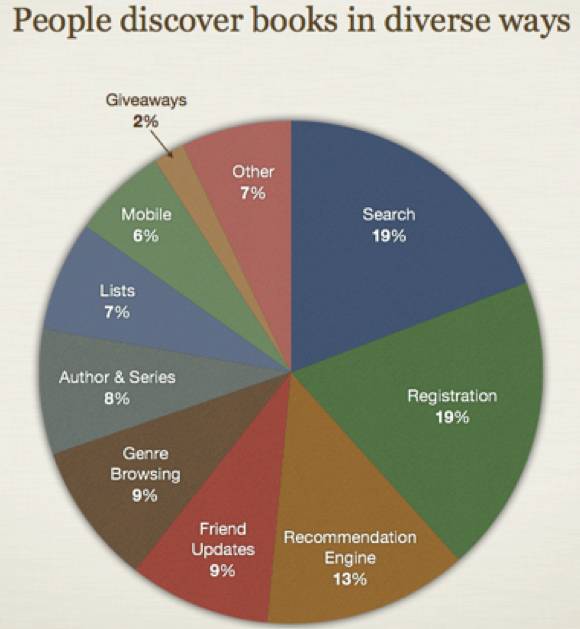
This pie graph displays the 10 primary means people discover books on Goodreads:
Social networking has become invaluable for writers, as the publishing industry evolves and gravitates towards the electronic format. Nothing can replace the often difficult creative process. And, nothing can replace the equally great challenge of marketing.
Filed under News
Indigenous Peoples at Forefront of Climate Change

The practices of Yanesha, left, and Tibetan farmers offer new insights into climate change and agricultural diversity.
Humans have always been subject to changes in their environment. They’ve struggled to adapt to a variety of extremes. The “Little Ice Age” in the 16th and 17th centuries killed livestock and crops, particularly in Europe. Prolonged droughts in what is now the Southwestern United States, beginning in the 11th century A.D., forced many of the region’s inhabitants to abandon their city-states. Only in recent years, however, have scientists begun to realize that humans also can have a negative impact on their environment. Unsanitary living conditions in medieval Europe allowed the spread of the bubonic plague in the 14th century. Overpopulation on tiny Easter Island led to almost complete deforestation.
Yet, there are examples of people whose cultural beliefs imbue them with a sense of personal responsibility towards their surroundings. The Yanesha of the upper Peruvian Amazon and the Tibetans of the Himalayas are among them. Over the last 40 years, Dr. Jan Salick, senior curator and ethnobotanist with the William L. Brown Center of the Missouri Botanical Garden has worked with both cultures. She explains how their traditional knowledge and practices hold the key to conserving and managing biodiversity in a paper entitled, “Biodiversity in Agriculture: Domestication, Evolution, and Sustainability,” published by Cambridge University Press.
The Yanesha and Tibetans are two different groups living in radically dissimilar environments, but both cultures utilize and value plant biodiversity for their food, shelters, clothing and medicines.
“Both cultures use traditional knowledge to create, manage and conserve this biodiversity, and both are learning to adapt to and mitigate the effects of climate change,” said Salick. “They have much to teach and to offer the world if we can successfully learn to integrate science and traditional knowledge.”
The Yanesha live a few hundred meters above sea level at the headwaters of the Amazon basin in central Peru. They possess traditional knowledge about one of the most diverse tropical rainforests in the world. Salick studied the cocona, a nutritionally important fruit native to the upper Amazon. She found the Yanesha have increased the genetic diversity of the species over time through preferential selection of oddly sized and shaped fruits.
The Yanesha also rely on species richness and diversity in indigenous agriculture and forestry management. They plant more than 75 species of crops in home gardens and more than 125 species in swidden fields (an ecological and sustainable system of traditional agriculture) to protect against potential crop destruction from pests, disease or weather. This biodiversity includes species rarely grown outside of indigenous agriculture. Studies have concluded that the species diversity in indigenous agriculture is unparalleled in modern agriculture and forestry, which often reduces natural diversity rather than enhancing it.
In contrast, the Tibetans dwell on the slopes of sacred Mt. Khawa Karpo and the upper Mekong River. Tibetan traditional knowledge, like that of the Yanesha of the Amazon, has long emphasized adaptation and biodiversity, and is now challenged by climate change.
Tibetans depend on biodiversity and entire landscapes for their livelihoods. Salick’s team measured the biodiversity on Mt. Khawa Karpo by sampling vegetation along vertical transects up the mountain. They found tremendously high variation of plant species at different elevations. These diverse alpine mountain ranges are also among those most likely to suffer critical species losses as the result of global climate change. Contemporary photos of the Himalayas show exceptional glacial retreat and tree line and shrub advance, more so than other alpine areas around the globe. Some of the most threatened, slow-growing plants such as the endemic snow lotus, used to treat blood pressure and hemorrhaging, could become extinct while more common “weedy” species take over and lessen the region’s biodiversity. But, Tibetans are adapting. They now grow grapes, which previously could never survive the severity of Himalayan winters, to make wine – ice wine is their specialty. They are mitigating climate change by incorporating large quantities of organic matter into soil, conserving forests that are expanding (afforestation) and preserving sacred areas with high biodiversity and old-growth forests.
As the U.S. and other developed nations debate the merits of climate change and other controversial subjects, I feel it’s important we pay attention to so-called primitive culture like the Yanesha and the Tibetans. They’ve apparently been doing something right. Otherwise, they wouldn’t have been able to survive all these centuries.
Filed under News
“We have to do something to stop this train…”
In this speech, Ben Nuvasma, former Tribal Chairman of the Hopi Nation, discusses the repercussions of Senate Bill 2109, proposed in February by Sens. John McCain and Jon Kyl, both Republicans representing Arizona. It’s amazing that, in the 21st century, the native peoples of the Americas are still dealing with this kind of blatant bigotry under the guise of state’s rights. Thanks to fellow blogger Matthew Sakiestewa Gilbert for this.
Filed under News