“There is no end in sight. For Republicans who thought that maybe Mitt Romney could come South and make this race look like it was coming to an end, this race is going on and on and on.”
– Ari Fleischer, former White House press secretary

“There is no end in sight. For Republicans who thought that maybe Mitt Romney could come South and make this race look like it was coming to an end, this race is going on and on and on.”
– Ari Fleischer, former White House press secretary
Filed under News

After 244 years, Encyclopedia Britannica will cease production of its iconic multi-volume book sets. Britannica usually prints a new set every 2 years, but 2010’s 32-volume group will be its last. The culprit is the usual suspect – the Internet. Like some newspapers and magazines, Britannica is converting to a completely digital format. President Jorge Cauz said the move is necessary. “Everyone will want to call this the end of an era, and I understand that,” he noted. “But, there’s no sad moment for us. I think outsiders are more nostalgic about the books than I am.”
Those “outsiders,” of course, are people who remain locked in the printed paper age. I guess I could count myself as one of them, since I still love the feel of a good book in my hands. But, even I know this transition is necessary for Britannica to survive. The oldest English-language encyclopedia in the world, it’s still a preeminent source of information and research. It came long before Google and Wikipedia and is a much more reliable bastion of knowledge than either of those two put together.
Britannica entered the digital age in 1994, when the first online version of its encyclopedia appeared. The encyclopedia still represents only 15% of its total revenue; the other 85% comes from online learning tools, academic products and more. The print set formed less than 1% of the company’s total sales; therefore, it’s time to let it go.
With a strong online presence and its impeccable reputation for accuracy and ethics, Britannica can easily regain its status as the premier source of information. Other search engines seem susceptible to innuendo and rumor; that is, subject to the whims of a few self-appointed “experts.”
Britannica is taking on Wikipedia and others by re-launching its own site in 3 weeks with more social connections and other interactive features. Britannica threw itself a party today with a cake in the shape of a print set. “Is that morbid?” Cauz asked jokingly.
I don’t believe so. It’s just practical.
Filed under News

Zach Thibodeaux, 9, cuddles with Natura at his father’s home in Addison, TX. Zach is slowly losing his sight – the result of cone-rod dystrophy, a disease that’s destroying the cells of his retina and for which there is no cure. Natura, a yellow Labrador retriever trained to be Zach’s guide, arrived from California this past January.
Filed under News

“Jerusalem is an insane place in some ways. It overwhelms people, and it has for centuries. The city is seductive, and people who are highly suggestible can succumb to this seduction. I’m always envious of people who live in San Diego, where history barely exists.”
— Yoram Bilu, an Israeli psychological anthropologist at the University of Chicago Divinity School, discussing “Jerusalem Syndrome,” where visitors to the city begin to believe they are the Messiah.
Like a typical foreigner – whether from Europe or the Middle East – Bilu shows what a historical idiot he is about the Western Hemisphere. Hell, a lot of Americans are that way! Even a cursory examination of San Diego will prove it has an extensive past – dating back some 20,000 years. But, who am I to try to reason with a psychologist?
Filed under News
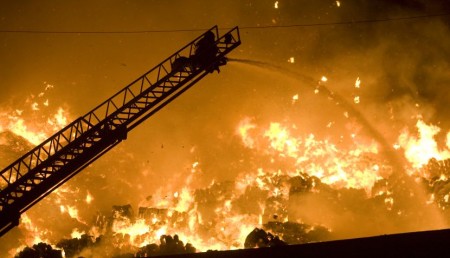
The blaze at its peak the night of March 8. Photo courtesy One Laptop per Child.
This is incredibly heart-breaking. A fire at Peru’s main state educational materials warehouse last week destroyed roughly half a million textbooks, 61,000 laptop computers and 6,000 solar panels that had been destined for schools in the nation’s poor rural communities. Education Minister Patricia Salas estimated the loss at $103 million. The blaze comes just as Peru’s school year begins. Salas told reporters that the overnight blaze “affects prospects for thousands of Peruvian children to begin classes with the materials and services the state had for them.”
Officials are still investigating the blaze, which broke out around 9 P.M. local time last Thursday, March 8, and took 11 hours to control.
The destroyed computers were purchased from the U.S.-based nonprofit One Laptop per Child Association, which has provided low-cost computers to the world’s most isolated and poorest children for the past five years. Peru is the program’s largest recipient in Latin America. The computers are rugged, low-power, white-and-green XO laptops.
Many of the destroyed books were in indigenous languages, such as Quechua and Ashaninka. They had been written for children ages 3 – 5 living in Peru’s eastern regions where the majority of the country’s native languages speakers are concentrated. Peru has about 9 million students in a public education system ranked among the poorest in the Western Hemisphere.

The warehouse was unrecognizable afterwards. Photo courtesy One Laptop per Child.
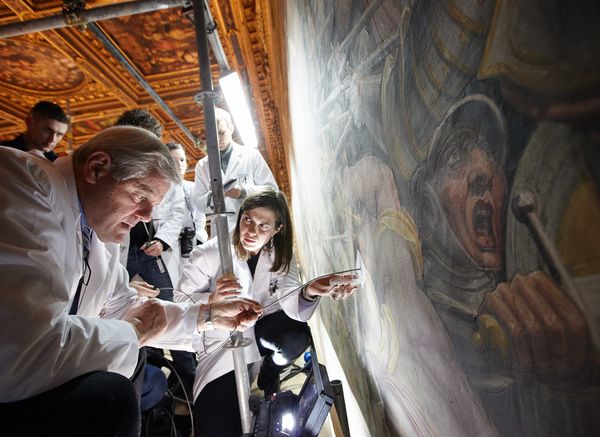
Researcher Maurizio Seracini (foreground) views video from behind a Giorgio Vasari mural in Florence. Art researchers are wondering if an undiscovered painting by Leonardo da Vinci is hidden behind a 16th century mural by fellow artist Giorgio Vasari. Photo courtesy of National Geographic.
Filed under News

“I am trying to say y’all and I like grits and things. Strange things are happening to me.”
— Mitt Romney joking to a Mississippi audience last week and apparently trying in vain to appeal to Republican voters there and in neighboring Alabama.
It’s bad enough the Republican Party has a virtual stranglehold on the Southeastern U.S. – mainly because of the 1965 Voting Rights Act that dared to guarantee Negroes and Indians the right to vote – but then politicians have to prove their insincerity with this kind of goofiness.
Filed under News

Chris Faraone starts off with a great piece of business advice from his father: “develop a compelling product, sling it like your kid is starving, and never trust distributors.” I couldn’t offer better wisdom to any kind of business entrepreneur – especially to us writers. Self-publishing – once the bastion of desperation for writers – has become more than fashionable; it’s become competitive. It’s now a viable alternative to any scribe who’s tired of trying to appeal to the right book agent or publisher with just the right proposal at just the right time. Self-publishing is a leech on traditional book publishing – but it’s the proverbial “Holy Grail” for the independent writer. It puts the power of publishing in the hands of the right people – the writers themselves. It doesn’t make the actual task of writing any easier; nor does it simplify the equally difficult job of marketing. But with self-publishing, writers at least have complete control over their work. Faraone learned about the business from his father who, ironically, operated his own book publishing company. And, although the younger Faraone concentrates a good deal of his editorial on the “Occupy Wall Street” movement, I see a perfect analogy. If you don’t like the way something is, work to change it! That’s how progress is made.
Filed under News