

“A man who was completely innocent, offered himself as a sacrifice for the good of others, including his enemies, and became the ransom of the world. It was a perfect act.”
“Easter says you can put truth in a grave, but it won’t stay there.”
“A man who was completely innocent, offered himself as a sacrifice for the good of others, including his enemies, and became the ransom of the world. It was a perfect act.”
“Easter says you can put truth in a grave, but it won’t stay there.”
Filed under News

“The uncertain old man whose real existence was the simplest of his enigmas.” – Gabriel García Márquez.

Today marks the 50th anniversary of the introduction of the Ford Mustang – the iconic vehicle that ushered in the modern age of the muscle car. Apparently, owning a Mustang is like chocolate, orchids, fine wine and back massages: once is never enough.
Admittedly, I’m not a Mustang fan, even though I have a model replica of the 1968 Steve McQueen “Bullitt” car. Few vehicles have been so heavily marketed in advance of their official introduction, or have created such an enduring mystique. It’s hard to imagine now, but at the time, the car cost $2,500. But, the advertising paid off: Ford sold 22,000 Mustangs the first day. By the end of 1964, they had sold 263,434.
Available in only two models – the coupe and the convertible – it had a 210-horsepower (no pun intended, 6-cylinder, V-8 engine, wall-to-wall carpeting, bucket front seats, a floor-mounted gear shift – all in about 180 inches in length. It’s definitely an icon, and even though, it’s endured a number of metamorphoses over the past half century, the Mustang is still – well – running strong.

A Mustang Prototype from 1962.

The sun rose over Boston on April 16, 2013, as it has every day since.
Today marks the first anniversary of the Boston bombing; a trite terrorist attack that killed three bystanders and injured more than 200 others. I say trite because the two foreign-born brothers who targeted unsuspecting runners and observers at Boston’s annual marathon – held every year on Patriot’s Day – didn’t achieve their intended goal: to bring down a large metropolitan area. Like London in 2005, Madrid in 2004, New York City and Washington, D.C., in 2001 and Oklahoma City in 1995, it just couldn’t be done.
Tamerlan and Dzhokhar Tsarnaev had just about everything they wanted, when their family brought them here in 2002 from Dagestan. They grew up in a middle class environment in one of America’s oldest and most revered cities. Tamerlan was training to be an Olympic boxer, and Dzhokhar was an ordinary college boy. Then, something happened with them. The older brother, in particular, suddenly realized he didn’t like the American military’s treatment of Muslims overseas. Thus, he decided to take action: bomb his adopted home city. Now, he’s dead, and his brother is in federal custody after barely surviving a battle with police last year.
I understand that people don’t like U.S. foreign policy. Our attempts at colonialism and, later, with democratic influence has always led to anger and resentment. Yes, I get that. I really do. But, people who become enraged with a nation’s outrageous behavior abroad always forget one thing: it’s not the fault of the common citizen. The Iraqi government, for example, committed genocide in Kurdistan – not the average Iraqi.
Terrorists also underestimate the goodness and resilience of humanity. Did the Tsarnaev brothers really think Boston would collapse after they attacked the marathon? There are only a handful of things that can take out such a large city; earthquakes and meteors being the most likely candidates. But, two punks who turn on their neighbors? Hell, no! Hitler almost inadvertently destroyed his beloved Germany during World War II. Mussolini practically did the same with Italy. Both ended up dying alongside their mistresses; Hitler in his underground bunker, and Mussolini hanged and burned.
People die and get hurt in terrorist acts. They scream, cry and vow revenge. But, as a society, we always manage to gather ourselves together and move forward. So, all the hate and anger goes for nothing. It wrecks some lives and burns a few cars. Then – people move on with their lives. What’s it worth then? Why the desire to destroy someone and something that may have absolutely nothing to do with the hostilities?
When Europeans first began populating the Western Hemisphere, they viewed the indigenous people as little more than two-legged forms of the local wildlife. The Europeans brought their guns, diseases and self-righteous determination and subsequently tried to decimate entire masses of individuals who had occupied this region for millennia. They did wipe out large communities and deliberately killed thousands of people, often at once. But, they didn’t win. They couldn’t destroy everyone. Indian people survived.
It’s a little like the Boston bombing case. All the fury and holy indignation just didn’t succeed. It never does. That’s not the way humanity works.
Filed under Essays

The ongoing search for Malaysian Airlines Flight MH 370 covers most of each news day across the globe. As sad and frustrating as it is, it’s still better than coverage of the British royal family and their newest addition. People keep asking how such a large aircraft with so many people aboard could simply vanish. Well, there’s a relatively logical explanation – we just haven’t found out yet. But, astute readers, especially those with a fetish for the mysterious, have noted somewhat ominous similarities between the real nightmare of MH 370 and James Hilton’s classic novel “Lost Horizon.” Originally published in the United Kingdom in 1933 by MacMillan, the story involves a group of travelers whose plane crash-lands in the Himalayas. As they struggle to survive, they encounter a Tibetan monastery called “Shangri-La” and become enamored with its wonderfully philosophical residents. The interaction between the two groups makes the foreigners realize life contains more than material wealth and petty arguments.
One Shangri-La native opines, “We rule with moderate strictness, and in return we are satisfied with moderate obedience. And, I think I can claim that our people are moderately sober, moderately chaste, and moderately honest.”
That doesn’t describe most Americans, including the Chief, but it’s a good conviction to follow. Whatever becomes of Flight MH 370, one thing remains eternal in the minds of dreamers: while getting lost may be frightening, there’ll always be that deep-seated desire to get lost on purpose and put the past behind us.
A small clip from the 1937 film version of “Lost Horizon.”
Filed under Classics

On March 19, Fred Phelps, the patriarch and founder of the Westboro Baptist Church in Topeka, Kansas passed away at age 84. Goodbye and good riddance. I’m glad the old bastard is dead. It would be even better if the rest of his family could join him, but their time will come, too.
Westboro gained notoriety in the early 1990s as a rabidly anti-abortion and homophobic clan. They tested the limits of free speech with the simple act of protesting – a test that would take them to the U.S. Supreme Court. Westboro’s roots date back to 1931, when it originated as a branch of Topeka’s East Side Baptist Church. In 1955, however, Phelps broke ties with East Side and established Westboro.
As a biblical literalist, Fred Phelps held a very narrow view of the world and believed anyone who strayed from it was hell-bound. But, he wasn’t just some cantankerous loudmouth who adored media attention. He was a convicted criminal. In 1947, Phelps was a student at Bob Jones University, when he and some fellow pupils traveled to Vernal, Utah to try converting people from Mormonism. After Phelps gave a speech condemning the Mormon religion, a young man in the audience asked him a theological question. Phelps apparently didn’t know the answer and – as idiots are often wont to do – physically attacked the man. The scuffle almost incited a riot. In 1951, Phelps found himself in Pasadena, California, where he led a protest to make kissing in public a criminal felony. When a police officer told him he didn’t have permission to protest, the then-21-year-old assaulted him.
Phelps actually had a good start in life. He was a Boy Scout who earned the coveted Eagle Scout Award. He graduated from high school at age 16 and was admitted to the United State Military Academy in West Point New York. While there, however, he attended a Methodist revival meeting and decided to become a minister instead of attending West Point.
Phelps and his wife, Margie, met at the Arizona Bible Institute in 1951 and married the following year. They eventually had 13 children. Phelps went on to earn a law degree from Washburn University in 1962 and, ironically, developed a reputation as a civil rights lawyer. He even won an award from the NAACP for his work on civil rights cases. But, his career began to disintegrate in 1979, when he was disbarred in the state of Kansas for perjury. He spiraled further out of control with complaints of harassment, witness intimidation and more false testimonies, until 1987, when he was permanently forbidden from practicing law.
In 1991, WBC began its notorious and never-ending anti-gay crusade by protesting at Topeka’s Gage Park; claiming it was a hotbed of homosexual activity. Phelps and his gang seemed to cross a fragile line, however, when they began picketing at the funerals of AIDS victims around the same time. They bought into the right-wing evangelical mantra that AIDS was God’s condemnation of the homosexual lifestyle. Even those who staunchly opposed homosexuality found funeral protests a bit much. WBC harassed gay-oriented businesses, women’s clinics and other institutions they despised by repeatedly faxing – and later emailing – them obscenity-laced messages. Every time someone complained, WBC cited the First Amendment to the U.S. Constitution, which guarantees – among other things – the right to free speech.
For some free speech advocates, the WBC tactics raised troubling questions. Free speech is a critical element of a truly democratic society. The U.S. and other developed nations pride themselves on the right of their citizens to speak out; no matter how offensive the verbiage may be. The late comic Lenny Bruce pushed the bounds of free speech with racially-tinged topics and foul language during his live standup routines in the 1950s. He was arrested and fined on occasion.
In 1977, free speech took a darker turn, when a neo-Nazi group planned a march in Skokie, Illinois. Skokie wasn’t a random selection. After World War II, the Chicago suburb had become home to several survivors of Europe’s Nazi death camps. At the time, about 40,500 of the city’s estimated 70,000 residents were Jewish. To them, the sight of people proudly waving the Nazi swastika was a painful reminder of one of the 20th century’s worst periods. Led by Frank Collin, the neo-Nazi group, the National Socialist Party of America, applied for a permit to march on May 1, 1977. Concerned about the antagonism such an event would generate, the Skokie Board of Commissioners passed an ordinance requiring marchers to post a $350,000 insurance bond. NSPA sued, stating that the ordinance violated the Constitution’s First Amendment. The case made it to the Illinois Supreme Court, which upheld the Skokie bond resolution. NSPA pursued the matter to the U.S. Supreme Court, which overturned it, noting that free speech covered even hate speech.
Free speech came under review again in 1984, when Gregory Lee Johnson burned an American flag outside the Republican National Convention in Dallas. He was protesting the policies of President Ronald Reagan, which subsequently led to his arrest on charges that he violated a Texas statute preventing the desecration of venerable objects, such as the U.S. flag. Johnson sued, claiming the Texas law violated his free speech rights. The case landed at the U.S. Supreme Court in 1989, which ruled in his favor. At the time, I worked for a bank in downtown Dallas and, on my way to lunch one afternoon, encountered a group of patriotic young men who were, oddly enough, protesting the Supreme Court’s decision. They were some kind of ROTC-type group; attired in suits and banging drums to the tune of the “Star-Spangled Banner.” They were also gathering signatures for a petition to the Supreme Court, hoping somehow to get the decision reversed. I signed it, but thought about it later. Can free speech be so limited?
Fred Phelps, his family and their supporters were always on a mission. They hated everyone and protested everywhere. They believed strongly that the United States had a one-way ticket to the “Dark Side” because of its tolerance of abortion, adultery, homosexuality, non-Christian theologies and other vices. In their view, each natural- or human-made catastrophe was a sign of God’s wrath upon America. From such horrors as the terrorist attacks of September 11, 2001 to seemingly random events, like the 2003 nightclub fire in Warwick, Rhode Island, Westboro claimed God was sending an omen.
Their hatred reached a putrid climax when they began picketing at the funerals of military personnel killed in the Afghanistan and Iraq conflicts. Along with carrying their regular “God Hates Fags” signs (that’s actually the name of their web site), they also bore placards with such terms as “Thank God for I.E.D.s (improved explosive devices)” and “Thank God for Dead Soldiers.” Singing “God Damn America,” while dragging the U.S. flag on the ground, Westboro touched nerves of raw pain for the families of the dead. In 2006, Westboro made their way to Maryland to picket at the funeral of Marine Lance Corporal Matthew Snyder who had been killed in Iraq. Snyder’s father, Albert, stated he couldn’t tell what was emblazoned on the group’s placards, but learned about it from later news reports. Albert Snyder sued, claiming Westboro’s actions caused him great emotional distress. Phelps countered naturally that his church was merely exercising its free speech rights. But, a Maryland court agreed with Snyder and granted him a $10.9 million judgment against Phelps. Phelps appealed and got the decision reversed. Snyder pursued the case to the U.S. Supreme Court, which sided with Westboro.
I see one major problem with the Snyder case. The family sued for emotional distress, which is immeasurable. The case, as I saw it, centered on harassment, slander and stalking. WBC placed Matthew Snyder’s Marine Corps portrait on its web site juxtapositioned alongside various slurs like “fag” and “murderer.” They also traveled all the way to Maryland from Kansas for the sole purpose of picketing his funeral. But, the Snyder family focused on the emotional distress issue, instead of stalking and slander, which aren’t protected by free speech. Therefore, I can actually understand why the Supreme Court ruled in favor of Westboro.
“Let me put this in more common vernacular,” Shirley Phelps-Roper, one of Fred’s daughters, told a TV reporter during another picket. “He (Albert Snyder) got his feelings hurt.” She went on to explain that Westboro had no regard for the Snyder family’s “feelings.” I’m sure it’s mutual.
Six of Fred’s children, including Shirley, are lawyers. In fact, Shirley Phelps-Roper argued their case before the Supreme Court, which is highly unusual. Generally, litigants before the Court don’t present their own cases.
Four of Fred’s children, including his oldest son Nate, abandoned their family, which essentially prompted their excommunication from Westboro. I’m quite certain that didn’t hurt their feelings. When the Snyder case arose, Nate Phelps, an atheist, went public and denounced his family’s antics, calling the funeral protests “evil.” But, in a television interview, he also made a stunning accusation: his father had often beaten his mother, as well as him and his siblings. No one at Westboro validated his claims. But, that should surprise no one. Some of the most devoutly religious people are also among the most physically abusive. They use their religion to justify the violence.
I’ve always wondered if someone would put a bullet through the heads of Phelps or one his brood. People have slung rocks at them, and Phelps even got sprayed with mace during one protest at a gay rights march. WBC maintains a hefty travel account to support their activities; money that would be better spent, for example, funding education or feeding homeless people. But, just as you can’t tell people what to do with their money, you really can’t tell them how to practice free speech.
I sincerely hope Fred Phelps suffered a long and painful demise. I’m not religious – in the traditional sense – but I am spiritual and believe in an afterlife of some sort. I envision Phelps encountering the souls of all the people whose funerals he protested at or whose tragic deaths he celebrated on his voyage into the netherworld. I can see them waving with gentle smiles, as he descends into the darkness. The right to free speech is sacred to most freedom-loving people. But, it doesn’t guarantee a place on the lap of whatever god you worship.
Westboro gets run out of Moore, Oklahoma.
Filed under Essays

“I almost lost you before you were born – twice.” How do you respond to something like that from your own mother? Especially when you’re only 9 or 10 years old? I don’t recall what started the conversation. My parents never held back when it came to subjects like babies and sex. I don’t know what brought us into that discussion, but my parents were incredibly forthright about such things. They figured I should find out from them, rather than from kids at school, television, or anywhere else. I certainly wouldn’t learn the truth about babies and sex from the Catholic parochial school I attended in the 1970s. Deep down inside the Catholic hierarchy knows that sex is pretty much how humans have reproduced for millennia, but openly hates it.
Once, when I was about 10 or 11, I asked my parents what happened in X-rated movies, and they told me “people run around naked” and use dirty words. Which, if you think about it, pretty much sums up an X-rated film. At some point, I’d asked my dad what an orgasm meant, and he flat out told me. He’d even told me – before my teens – what a condom was and how to put on one.
So it only made sense that my mother would point out bluntly that she’d come close to losing me in utero. The first episode occurred in August of 1963, when she was about seven months pregnant and was at the funeral of her beloved maternal grandmother. My mother had become faint as she stood at the grave site, beneath the scorching Texas sun. At the time my parents lived in a two-bedroom, one-bath apartment above the garage behind the house owned my father’s oldest sister, Amparo, and her husband – a place where we’d stay until my parents bought a house in suburban Dallas in 1972. Amparo had told my father that my mother didn’t look good and decided to accompany them to the funeral. Already expecting her own child, my aunt sat waiting in the limousine with a jar of cold water. After returning home, my mother began bleeding profusely. My father rushed her to the hospital where they saved her – saved both of us.
The second episode happened just two months later. One fall afternoon, my mother developed a fever, and inexplicably wondered outside into a rainstorm. Amparo was startled to see her and ordered her husband to retrieve my mother from their driveway. He brought her inside, and my aunt put her into a bed and watched over her until my father returned home from work.
Perhaps it’s because what my mother told – describing every excruciating moment of her pregnancy and my birth – that I understood, from a very young age, how fragile life is. Aside from my seemingly inborn shyness, it may explain why I wasn’t aggressive like my parents; why I never liked to fight; why I always tried to negotiate and compromise instead. It’s why I appreciate the smaller things in life – like the sound of rain or my dog’s breathing when he’s sleeping.
In the mid-1990s, when I worked at a major bank in downtown Dallas, one of my female colleagues, Felicia*, often lamented how her two younger sons seemed to take her for granted. Her older son was the model child: married with children and an active duty member of the U.S. Navy. But, her other sons, both teens at the time, were always doing something stupid. One day, at lunch, Felicia* mentioned that she’d almost miscarried her second son in a women’s room of that very building some seventeen years earlier. She’d become light-headed, she recalled, as I and a few others sat with rapt attention. Another woman escorted her to the ladies’ room where Felicia dropped onto a toilet and was certain she was about to lose that pregnancy; she was only about six or seven weeks along. The other woman ran out to tell their male supervisor about the dilemma. He called paramedics who rushed Felicia to a nearby hospital. Somehow, she and her unborn child – that second son who would later metamorphose into a conceited teenage brat – survived.
I asked Felicia if she’d ever told him about that. She said no; that she didn’t want to upset him with something so traumatic. I scoffed at the notion. “You need to tell him about that,” I implored. Describe how she’d collapsed in pain and managed to stagger into the women’s room; tell him that he almost ended up in the toilet of a downtown Dallas building. That, I assured her, would put his life into perspective.
A few weeks later, she pulled me aside to say she’d done just that recently; she told her son everything that happened that one afternoon; that she’d almost lost him in a women’s room of the bank – lost him before she even knew his gender, or had given him a name. She reveled in the sight of the light bulbs going off in his eyes.
And, that’s when life comes into perspective. That’s when you understand how delicate everything is.
*Name changed.
Filed under Wolf Tales

Not for scrap – this Faberge Egg is worth a few million and some change.
I don’t know what it is about Faberge Eggs that fascinate people – people, like viewers of “American Idol” and patrons of Botox parties, who have too much damn time on their hands. To me, eggs are something that comes out of a bird’s ass and ultimately ends up in pancake batter or an omelet. I mean, Faberge Eggs have to be the gayest things since “Star Trek” (come on – go-go boots; bell bottoms; perfectly-coiffed hair; phasers instead of real guns). But, I find even this particular story intriguing.
Last week – and just in time for spring – a scrap metal enthusiast walked into the London shop of antique dealer Kiernan McCarthy and bought a Faberge egg for about $14,000 (EUR 10,1200); hoping to profit from its gold content. But, a closer examination of the item made the customer think he was a rare Russian artifact. As luck and good fortune often shines upon those not looking for them, the egg turned out to be an imperial Faberge Easter egg made for Russian royalty that’s worth millions.
The egg contains a Vacheron Constantin watch and sits on a jeweled gold stand. It was given by Tsar Alexander III to his wife Empress Maria Feodorovna for Easter 1887. Faberge made 50 of the imperial eggs for the Russian royal family, and eight remained missing until now. Only three of those, however, are known to have survived the 1917 Russian Revolution.
This particular egg will be on display at London’s Wartski Antique Dealers, which specializes in Russian artifacts and Faberge Eggs.
Filed under Art Working

The usual victims: a worker tries to save a bird after the Exxon Valdez disaster.
On this day in 1989, the Exxon Valdez oil tanker ran aground at Bligh Reef in Prince William Sound, Alaska and spilled 10.8 million gallons of crude oil. The oil spread along 1,300 miles of otherwise pristine coastline. It remains one of the worst peacetime oil spills in world history, second only to the 1979 Ixtoc I disaster, and its effects linger to this day. One of those effects is that Exxon never fully accepted responsibility, and the people whose lives were impacted the most never received the financial compensation they were due. We can expect that from a multinational conglomerate with trillion-dollar reserves.
In an age before the Internet and Twitter, news of the calamity still spread fast. At first, many thought it was just a technical issue. The crew of a gigantic oil tanker, traveling at night, misjudged the topography of the area and slammed into some rocks. It wasn’t that simple. Valdez captain Joseph Hazelwood had left the navigation bridge around 11 P.M. local time the night before the accident and returned to his stateroom. He left two subordinates in charge of commandeering the vessel. When the accident occurred, U.S. Coast Guard officials immediately took Hazelwood into custody and began questioning him. They also detected the odor of alcohol on his breath and compelled him to undergo a Breathalyzer exam. His blood alcohol level registered .061, and Hazelwood later admitted to consuming “two to three vodkas” in the hours before the ship slammed into the shoreline. In 1990, however, a jury in Anchorage found Hazelwood not guilty of public intoxication and two other charges, but convicted him of “misdemeanor oil discharge;” whatever the hell that’s supposed to mean. Hazelwood did lose his job, and the Coast Guard stripped him of his maritime master’s license.
But, the reaction from Exxon’s then-CEO, Lawrence G. Rawls, only intensified the anger and showed the disconnect corporate executives often have from their own company’s daily operations. Rawls remained aloof for nearly a week after the disaster and then spoke publicly only out of seeming reluctance. He refused to visit the site of the accident and even meet with then-Alaska Governor Steve Cowper who had just taken office four months earlier.
In some ways, Exxon paid the price for its almost-flippant response. Cleanup efforts alone cost the company $2.5 billion, and it paid out an additional $1.1 billion in various settlements. But, when asked how Exxon intended to pay for the mess, one executive merely said it would raise gas prices.
Aside from the livelihoods of coastal residents who depended on fishing to survive, Alaskan wildlife suffered the greatest impact. Responders estimated that as many as 3,000 otters perished within the first year after the spill and have only now seen their numbers replenished to pre-Valdez times. The population of herring also suffered, but their numbers haven’t recovered. Another species that hasn’t recovered is the pigeon guillemot. Their numbers were already in decline before the spill, but the disaster pushed them even further to the brink of extinction. The sight of a large brown bear stumbling along the rocky shoreline, trying to lick its paws clean of the sticky oil, is one particular image that remains with me. Oil-saturated birds struggling for air is another.
Exxon’s reputation suffered as well, but not nearly as much. In 1999, the company merged with Mobil; an $81 billion deal that made it one of the large oil monopolies in the world. In 1994, complicated litigation to make Exxon pay financially for the spill was settled in four phases for a total of $2.5 billion. But, the company, of course, prolonged its appeals, and in 2008, the U.S. Supreme Court reduced the punitive damage award to $500 million. In the interim, Exxon (now Exxon Mobil) has reaped extraordinary profits. It hasn’t really suffered. Big corporations never really do. The effects still linger.
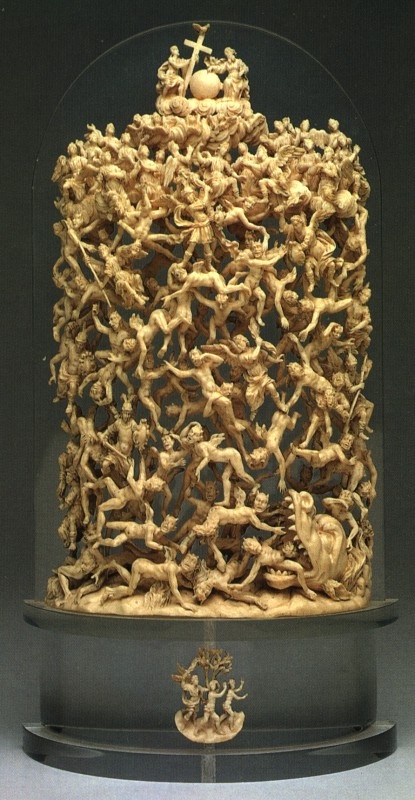
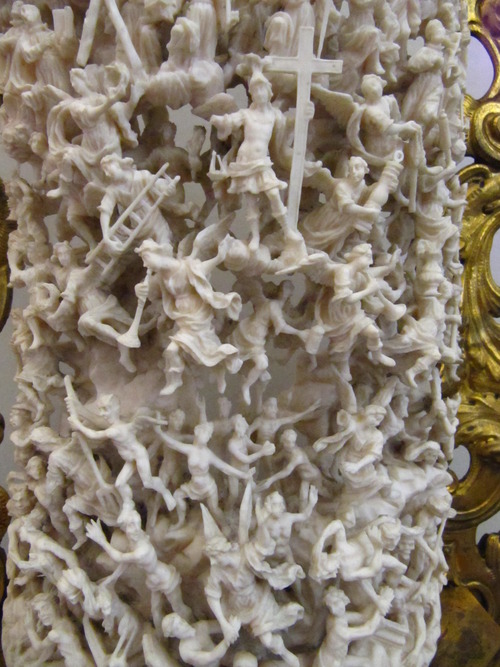
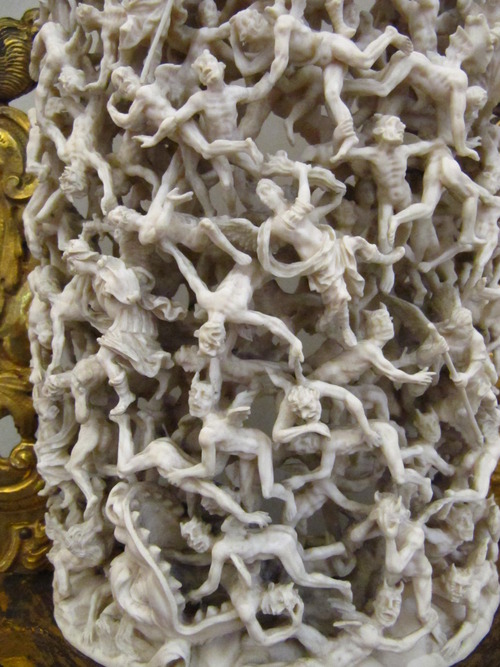
This is one of the most extraordinary sculptures I’ve ever seen. “The Fall of the Rebel Angels” is carved from a single piece of ivory. Made in Italy in the early 1700s by an unknown artist, it stands nearly a foot tall and depicts the demise of Heaven’s rebellious angels into the depths of the netherworld. Notice Adam and Eve clinging to the “Tree of Knowledge” at the bottom. The item is currently on display at the Nelson Atkins Museum of Art in Kansas City, Missouri.

Filed under Classics
 Chief Writing Wolf