Tag Archives: Argentina

Self-Inflicted

“When fascism comes to America, it will be wrapped in the flag and carrying a cross.”

Sinclair Lewis, 1935

I had a certain sensation deep inside of me; the same kind of feeling when I know something dramatic – either good or bad – is about to happen.  This time it was bad, and I almost felt sick.  Donald Trump has been reelected to the U.S. presidency.  He becomes only the second president in U.S. history to win a second term that didn’t immediately follow the first.  He also has the dubious distinction of being the first indicted criminal to be elected.  Little could be stranger or sadder for the American people.  I suppose, though, that too many people drank that proverbial Kool-Aid offered by the Republican despot; a man who openly admires the likes of Vladimir Putin and Kim Jong-Un; who has advocated violence against others; who has threatened to imprison anyone who disagrees with him; who incited a riot nearly four years ago; and who has demonstrated no true respect for average, working Americans.

I am embarrassed by and disgusted with many of my fellow Americans who helped put Trump into office.  The Democratic Party, however, really has no one but themselves to blame for this chaos.  Their leadership stood by as Joe Biden and Bernie Sanders ran for president in 2020.  With all due respect to those two gentlemen, their time had come and gone.  The window to run for and win the U.S. presidency is small.  I felt Biden and Sanders would have better served the country by giving speeches and writing books about the value and importance of democracy and how people like Trump pose the worst threat to our constitutional freedoms.

For the Democrats, the 2020 presidential race began with the most diverse slate of candidates – and ended with the same tired old figures that traditionally represented both parties: old White men.  Now understand I’m a mostly White male and have no qualms about it.  But this nation boasts too varied a population to rely upon the same types of people to lead us.

And it’s not that the U.S. isn’t ready for a female president.  We’re way past ready.  It’s just that the Democrats (and the Republicans for that matter) have never chosen the right women to lead them.  I’ve always said Hillary Clinton was too divisive a figure.  While I loved Bill “Who’s Your Daddy” Clinton, I personally never cared for Hillary.  And, although Kamala Harris made history by becoming the first female vice-president in U.S. history, she didn’t do enough to separate herself from Biden.

In 1993 Canada elected its first female prime minister, Kim Campbell, and highly patriarchal and staunchly Roman Catholic México just elected its first female (and Jewish) president, Claudia Scheinbaum.  Thus far, eighteen other women either have been elected or ascended to the highest office in their respective countries in the Western Hemisphere:

Jeanine Áñez, Bolivia, 2019-20

Rosalía Arteaga, Ecuador, 1997

Michelle Bachelet, Chile, 2006-10 and 2014-18

Dina Boluarte, Peru, since 2022

Sylvanie Burton, Dominica, since 2023

Xiomara Castro, Honduras, since 2022

Violeta Chamorro, Nicaragua, 1990-97

Eugenia Charles, Dominican Republic, 1980-95

Laura Chinchilla, Costa Rica, 2010-14

Cristina Fernández de Kirchner, Argentina, 2007-15

Lidia Gueiler Tejadam, Bolivia, 1979-80

Mireya Moscoso, Panama, 1999-2004

Mia Mottley, Barbados, since 2018

Ertha Pascal-Trouillot, Haiti, 1990-91 (acting president)

Michèle Pierre-Louis, Haiti, 2008-09

Dilma Rousseff, Brazil, 2014-16

Portia Simpson-Miller, Jamaica, 2006-07 and 2012-16

Claudette Werleigh, Haiti, 1995-96

Trump does not represent me – never has and never will.  He has proclaimed total disrespect for people who aren’t exactly like him.  And I’m certainly not like him.  I’m not a wealthy, full-blooded Caucasian womanizer who cheated on his taxes and has disdain for the American military.  I feel that he’s a genuine threat to free speech and the right to vote, but – like most conservatives – has the full support of gun rights advocates.  This latter band of extremists has always placed the value of firearms above free speech and the right to vote – and certainly above the lives of human beings.

One of my concerns with Trump’s return to the White House is that he will implement the so-called Project 2025 – a federal policy agenda created by the Heritage Foundation, a far-right conservative outfit that is a borderline hate group.  Many officials in Trump’s first administration took part in the project’s creation, which demands a complete overhaul of the government based on staunchly conservative ideology.  That philosophy features opposition to the usual causes: abortion and reproductive freedom and queer rights, but also immigration and racial equity.  Moreover, Project 2025 calls for unwarranted surveillance on specific individuals; using force to quell protestors; and targeting journalists who they deem enemies of the state.  This might sound familiar to those schooled in global political history.  They’re the same kind of tactics the Nazis and the former Soviet Union used on its own civilians.  Argentina pursued the same agenda during its “Dirty War”, and North Korea is doing it now.

I don’t know what’s next for America, but I see nothing good on the horizon.  I’m certain my conservative friends and relatives will assume I’m being paranoid, even hysterical.  Yet I felt similar sensations of foreboding when George W. Bush became president in 2000.  And I was right.  The U.S. ended up both in war and a recession.

I’m almost certain it will happen again.

2 Comments

Filed under Essays

England Didn’t Get the Memo – the Sun Set on Your Empire Years Ago!

mapofthefalklandislands2

Tensions have risen again between Argentina and the United Kingdom over the Falkland Islands, a tiny cluster of barely-habitable rocks in the far Southwestern Atlantic, about 300 miles east of the South American mainland.  Those of us who are old enough to remember the ill-fated 1982 battle between the nations over these islands probably also remember it was the first time we’d ever heard of them.  At the time I was surprised to realize that England still had a colonial outpost that far away; some 8,000 miles from London and therefore, closer to Antarctica than Buckingham Palace is to 10 Downing Street.  I knew the U.K. still held Northern Ireland in its grasp, but the Falklands?  And, it’s not like they’re “across the pond,” as the British are fond of saying about the U.S. in their infinitely arrogant demeanor.  The Falklands are clear over on the other side of the globe!  In another hemisphere!

The Falklands are comprised of two large islands (West and East) and more than 700 hundred islets.  They are to the Southern Atlantic what the ABC Islands (Aruba, Bonaire and Curacao) are to the Caribbean: clumps of rock jutting above the water.  If you sit on an Aruban beach, staring into the sunset, you could be blasted with sandy pebbles carried by powerful breezes.  It’s probably why people often visit the ABC Islands to scuba dive and get drunk.  If you sit on a Falkland beach (taking for granted that you can actually find a spot there that qualifies as a beach), you could have a similar experience, except the winds are much colder.  While tropical storms don’t terrorize the Falklands, arctic ones pose a similar threat, as they creep up from the south and assault the archipelago with frigid gusts and heavy precipitation.  They’re not exactly the Galapagos or the Seychelles.  Penguins and seals have populated them for thousands of years, but humans have only been there for the better part of the past four centuries.

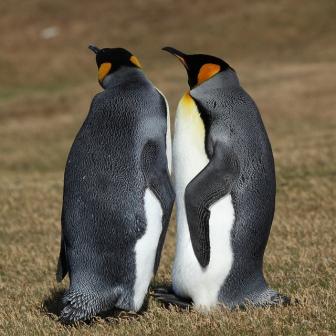
Gentoo penguins on the Falklands.

Gentoo penguins on the Falklands.

Argentina refers to the Falklands as Las Islas Malvinas (The Malvinas) and has laid claim to them for the last two hundred years.  I think it’s just a matter of pride and proximity – and animosity towards Great Britain.  What else could it be?

English navigator John Davis may have been the first European to sight the islands, while cruising through the area in 1592.  But, Dutchman Sebald de Weerdt made the first definite and recorded sighting in 1600.  Another Englishman, John Strong, made the first recorded landing, however, in 1690.  He named the sound between the two main islands after Viscount Falkland, a British naval officer.  In 1764, French navigator Louis Antoine de Bougainville established the islands’ first settlement, on East Falkland, and named the islands Les Malovines.  A year later the British established a settlement on what is now West Falkland.  In 1767, the Spanish bought the French settlement and, in 1770, drove out the British.

The British returned to West Falkland a year later, but left again, for economic reasons, in 1774.  Although the British never renounced their claim to the rocky outcroppings, Spain maintained their settlement on East Falkland until 1811.

In 1816, Argentina declared its independence from Spain and, in 1820, proclaimed sovereignty over the Malvinas and began occupying them.  But, in 1833, Britain returned and forcibly expelled the handful of Argentine military officers who remained.  By the end of the 19th century, the Malvinas had a self-supporting colony of Britons who swore allegiance to the British crown.  They ignored frequent Argentine protests over U.K.’s occupation of the islands.

In 1965, the United Nations approved a resolution inviting Argentina and Great Britain to discuss a peaceful resolution to the dispute.  Argentina simply wanted the islands turned back over to them.  Great Britain simply balked.  The relentless head-butting culminated in Argentina’s surprise invasion of the Falklands on April 2, 1982.  Within a few weeks, 10,000 Argentine troops occupied the islands.  Falkland residents couldn’t do much to resist.  But, Argentina was in no position to attack England.  Aside from an inferior military, they were just coming out of their infamous “Dirty War;” a frightening period during which the military dictatorship engaged in a brutal campaign against suspected left-wing political opponents.  People accused of treason disappeared; others turned up dead.  Many of those who vanished remain missing to this day.  The Falkland invasion was really just a political move to unite the Argentine people behind a government whose human rights abuses and financial mismanagement were gaining international attention.

The British response to the invasion was swift and deadly.  They launched a cavalry of battle ships, one commandeered by Prince Andrew.  The conflict was brutal, resulting in the loss of more than 900 lives.  After 74 days, Argentina surrendered and admitted defeat.  It was a serious blow to the morale of the Argentine people and their dubious government.  But, it was bound to happen.  And, more importantly, it still doesn’t mean Great Britain is right.

Long before the Falklands debacle, though, England’s empire had begun to disintegrate.  After the United States broke away from the British crown, England then lost such large territories as Canada and Australia.  The 20th century saw Great Britain experience the greatest number of colonial losses, due mainly to fighting two world wars within a generation.  In 1947, a fatigued and embattled U.K. watched as India gain independence.  Then, England’s colonies in Africa began to clamor for their own freedom.  Both Afghanistan and China had managed to thwart British imperialism in the 1800s.  And, in 1997, another British colonial jewel, Hong Kong, fell under Chinese control.

So, I have to wonder why England insists on retaining the Falklands.  Don’t they realize they’re no longer an imperialist superpower?  Other European nations – mainly Spain and France – conceded losing their own overseas territories.  But, Great Britain won’t let go.  I suppose it’s a Napoleonic complex.  Barely the size of the U.S. state of Alabama, England has to assert itself loudly and – sometimes – viciously.

Argentina is no better suited militarily to take on the British now than they were in 1982.  But, they have become democratized and revamped their financial infrastructure.  Its latest move seems to be isolationism.  Argentina President Cristina Fernandez de Kirchner has politely asked for the Falklands’ return, but British Prime Minister David Cameron scoffed at the likelihood and said he would “fight militarily” to keep the islands.  Such is the air of British self-righteousness: take what’s not theirs and kill anyone who tries to resist.  Their predecessors did that to the native peoples of North America; a sentiment that persists today in their dismissive behavior and attitude.

Falkland residents are scheduled to vote this March whether or not they want to remain as part of the United Kingdom.  I suspect they will choose to stay with Britain.  I also feel that – whatever occurs – the U.S. should stay out of it.  Regardless, England is starting to learn that the world is no longer its open treasure chest.

Leave a comment

Filed under Essays