Tag Archives: Iraq War

Iraq Again! Oh, Hell No!

Zombie hand

“It’s alive! It’s alive! It’s alive! It’s alive! It’s alive!”

Colin Clive in “Frankenstein


As the United States slowly recuperates from the wars in Afghanistan and Iraq, Americans are suddenly beset with a very real horror show: the rise of militants in Iraq, as well as the collapse of the Iraqi government. Most of us keep smacking ourselves across the face; trying to wake up from what can only be deemed a nightmare. No – a night terror. This can’t be happening. There must be some kind of misunderstanding. The media has it all wrong.

No, they don’t. It is happening. And, we’re all wide awake.

I wish that the brewing fiasco is – at best – a really cruel, heartless joke. But, it’s simply not. The blatant reality is that radical Iraqi insurgents have risen from the crypt of hate and anger to launch an assault on that nation’s fragile government and hapless military. They’ve already taken over Mosul, Iraq’s second-largest city. It’s surely only a matter of time before they attack Baghdad.

President Obama, who campaigned in 2008 partly on the promise to end the war in Iraq, says another round of military intervention is not likely. But, almost in the same breath, he added, “We have enormous interests there.”

What happened to the good old days, when a president would say stupid crap, but still really believe it with all his heart? Many of us disagreed with George W. Bush, but at least we knew where he stood on an issue. Along with Dick Cheney, Donald Rumsfeld, Condoleezza Rice and Colin Powell, Bush hoodwinked much of the nation into believing Iraq had a role in the September 11, 2001 terrorist attacks and was secretly building a nuclear arsenal. In the twisted logic that only a draft-dodging right-wing lunatic could manufacture, Bush forced the U.S. to switch its attention abruptly from Afghanistan to Iraq. Most of us level-headed folks saw the ruse clearly and still didn’t mind being labeled terrorists. We knew it was a lie. But, Bush was a puppet president for corporate oil interests (in much the same way Warren G. Harding was), so I don’t blame him completely.

But, with nearly 4,500 U.S. dead in Iraq alone – not to forget those who died from their injuries or suicide once back home – we’re faced with a bizarre quandary: sending troops back into Iraq to thwart what observers have ominously deemed the “threshold of civil war.”

Trick question: what’s the difference between the threshold of civil war in Iraq and a total conflict?

Answer: nothing!

The difference is in terminology only. Hearing military and political “experts” trying to define the two concepts is like saying there’s a difference between azure and blue. I knew a guy in college who got upset when people said he was Italian. He preferred the term “Sicilian.” Oh, of course! Silly me! And, just so you’ll know, I’m not Latino. I’m Hispanic! ¿Entiendes?

The U.S. put itself into a quixotic situation with Iraq more than three decades ago when it began funding its war with Iran. That came to an abrupt end in 1988, when Saddam Hussein launched a genocidal chemical attack on Kurdistan. The U.S. also placed itself in a quagmire with Afghanistan when it supported mujahideen rebels in their valiant fight against the former Soviet Union – and then forgot about the Afghan people. One nation doesn’t make a promise of that magnitude to another nation without owning up to it.

If, by some wretched chance, we do send our military back into Iraq, here’s what I’d like to see happen:

  • Initiate a military draft. Every 18-25 able bodied person (including women, Jews, Mormons, conservative Republicans and rich kids) will have to serve in some kind of capacity. No exceptions!
  • Raise taxes on the wealthiest 5% of American citizens. Since many of them are the ones who propagated the war in Iraq and subsequently benefited from it, we need half of their income to go into Pentagon coffers.
  • Cease all foreign aid. This includes Israel. Unquestionable financial and political support for Israel by the U.S. is another reason for the 09/11 attacks.

It’s only fair all of the above should occur, as the U.S. roars back into Iraq like a repo man going after a late-model BMW for the third time. But, I also think it’s only fair I should be rich and famous without working too hard for it. After all, I’m attractive (in the right black light) and intelligent. Why should I struggle so hard?

Will the U.S. boomerang its troops back into Iraq? I can only hope not. But, you know how that goes.

6 Comments

Filed under Essays

Shut Up and Draw

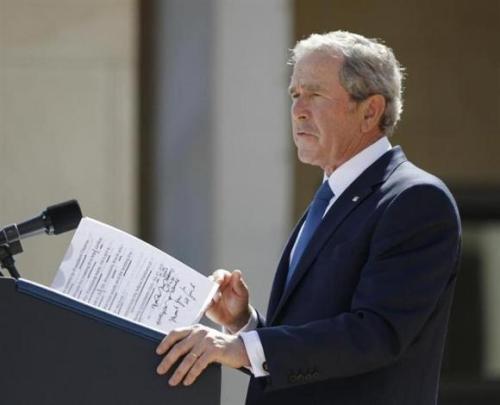
George W. Bush delivers remarks at the opening of his library in Dallas on April 25, 2013.

George W. Bush delivers remarks at the opening of his library in Dallas on April 25, 2013.

“I no longer feel that great sense of responsibility that I had when I was in the Oval Office.  And frankly, it’s a liberating feeling.” – President George W.Bush, to a high school graduating class in Roswell, New México, May 2009.

Countless numbers of Americans, especially several military families, wish we could liberate ourselves from the dismal legacy of the Bush Administration.  Unfortunately, we’re stuck with it.  But, survivors of military personnel killed in the Afghanistan and Iraq Wars bear relentless pain and anguish.  Anyone who enters the military has to accept the fact that they could be called to war and therefore, prepares as best they can for it.  Their parents, spouses, children and other relatives try to prepare themselves, too.  But, it’s still not easy losing a loved one to a foreign conflict.

Recently, Bush launched an initiative to help our military veterans transition back into civilian life as smoothly as possible.  My own conversations with past veterans made me realize how difficult this can be.  Through his Bush Institute, the 43rd president is imploring companies to recruit and retain military veterans, believing their tendency towards self-discipline and teamwork makes them among the best employees.

“We’ve got a problem, too many vets are unemployed,” said Bush.  “There’s what we call a military-civilian divide.”

He just figured this out?  It’s a noble cause, though.  The unemployment rate for military veterans remains around 10% as of 2013, compared to 7% for the general population.  A few times in recent years military veterans working for staffing agencies have contacted me about various technical writing positions.  The moment I hear them say they were in the military, I stop the conversation and tell them how much I appreciate their service.  It usually catches them off-guard.  But, in turn, they appreciate just hearing someone tell them that.

However, Bush has gone further and also issued a challenge to the medical community to drop the word “disorder” from the term “post-traumatic stress disorder.”  PTSD is a relatively recent term in the lexicon of psychological afflictions.  It used to be called “shell shock” or “battle fatigue.”  Many thought it was just a phase; almost an imaginary disorder.  But, it’s real and it’s painful for its sufferers and the people closest to them.

Bush, nonetheless, believes the “disorder” word stigmatizes the affected individual and makes them sound defective, or unable to be rehabilitated; therefore, he states, they may have trouble finding work in an already-fragile job market from employers who are weary of difficult people.

Gosh, how thoughtful.  It’s also hypocritical.  Like his Vice-President, Dick Cheney, Bush used just about every excuse to avoid military service when his country called upon him more than four decades ago.  An average high school student and occasional troublemaker, Bush managed to enter Yale University in 1964 and graduate four years later with a business degree.  Upon his graduation, his draft deferment ended.  The nation was mired in the depths of the Vietnam War, with public sentiment against the conflict (and the men who served there) becoming more vehement.  Still, Bush managed to secure a relatively cushy spot in the Texas Air National Guard.  Large numbers of young men were trying to do the same, and – according to some records – all of the spots in the Guard were taken.  I guess it didn’t hurt that his father was a U.S. congressman at the time.  Bush reenlisted in 1972 and was honorably discharged from the Guard two years later.  Questions remain about his level of attendance and whether or not he even completed his service.  His military records mysteriously vanished, and the Pentagon later claimed they were inadvertently destroyed.

I’ve always found that to be a rather convenient explanation.  A friend who served in the U.S. Air Force for twenty years, including several tours of duty in Vietnam, still has his military records.  All military personnel, he told me and several others more than a decade ago, are legally allowed to keep copies of them.

Dick Cheney, on the other hand, never did even that much.  He garnered five military draft deferments around the same time: four educational and one because he was a new father.  “I had other priorities in the 60s than military service,” Cheney said in 1989.

Words and actions always come back to haunt people.  I understand that no one wants to go into battle.  War is ugly and dirty; it is one of the most vile of human interactions.  But, hearing Bush trying to make nice with the people he sent to war is revolting.

The Iraq War is the crux of my anger.  It’s a conflict based solely on lies and innuendoes.  Abusing the international support brought on by the September 11, 2001 terrorist attacks, the Bush Administration created a tenuous link between Al-Qaeda and Iraqi dictator Saddam Hussein.  I believe the sole purpose was to gain access to the vast reserves of oil beneath Iraqi soil.  Proof comes in the fact that Halliburton (the energy conglomerate that Cheney headed before resigning in 2000) received a slew of no-bid government contracts.  For example, almost as soon as the U.S. invaded Iraq in March of 2003, the Army awarded Halliburton a no-bid contract to rebuild Iraq’s infrastructure.  Boots had just hit the sand and blood was still dripping while gilded corporate executives were salivating over big payouts.  While not necessarily illegal, no-bid contracts are certainly unethical and, in this case, highly suspicious.

War is fought by the grunts on the ground, but it’s waged by well-dressed power brokers in far-away skyscraper office suites whose idea of pain and agony is a paper cut.  It’s pretty much been that way for the past century.

As part of his retirement from public life, Bush has taken to painting.  He took up the hobby almost as soon as he departed the White House.  While his works may not earn him a spot in “International Artist” magazine, they’re being prominently displayed – (where else?) – in his presidential library.

In the spring of 2005, my-then supervisor at an engineering company, a coworker and I lived and worked in northeastern Oklahoma on a special project for the government agency where our firm had a contract.  We’d fly into Tulsa, rent a car and drive to the hotel in the far northeastern quadrant of the “Sooner State.”  One morning, as we prepared to board a flight in Dallas, I noticed a large group of people in military fatigues gathered nearby.  After a few moments of observing them, I approached the group and personally thanked each of them for their service.  They all seemed genuinely surprised that I – a total stranger – would do something like that.  But, it meant a lot to me that they were making such personal sacrifices.  In retrospect, I wonder how many returned alive, or at least undamaged.  I guess I’ll never know.

I’ll keep thinking about them, though, and I hope Bush just keeps painting.  He and the other clowns in his administration have done enough damage.

2 Comments

Filed under Essays

Marionette Presidency

Jester-vk028

In his 1979 novel, Shibumi, author Trevanian (Rodney William Whitaker) told the tale of the fictitious Nicholai Hel, a Shanghai-born spy of Russian – German heritage who is the world’s most accomplished assassin.  After surviving the carnage of the Hiroshima bombing, Hel retreats to a lavish and isolated mountain citadel with his beautiful Eurasian mistress.  Everything is grand and everyone is gorgeous in this story!  But, Hel is coaxed back into the netherworld of international espionage by an attractive young woman.  Hel soon learns, however, that he’s being tracked by a mysterious and omnipotent global entity known simply as the “Mother Company.”  The “Company” is a composite of corporate giants that installs leaders in key nations – even those in the developed world – manipulates the markets for such necessities as food and oil and incites wars whenever it deems appropriate.  The conflict between Hel and the “Mother Company” becomes something akin to a board game, where millions of lives are used as toys for the benefit of a few powerful elitists.  I first read Shibumi about a year after its publication and still find it one of the most fascinating works of fiction I’ve ever encountered.  I’m surprised – and disappointed – that it hasn’t been made into a film yet.

The recent opening of the George W. Bush Presidential Center in Dallas made me think about the novel.  No, I don’t believe Bush is an American version of Nicholai Hel.  Hel is a polyglot and a skilled chess player.  Bush can barely pronounce such complicated words as ‘nuclear’ and looks more comfortable holding a chain saw.  It’s the notion of a “Mother Company” – a massive and ruthless international organization – that captures my attention.  It’s easy to criticize Bush, or any president, for his domestic and foreign policies.  But, in a true democracy, that one person isn’t completely in charge of the nation’s affairs.  He simply represents the totality of the country’s population, as well as the nation’s successes and failures.  And in the face of that reality, I don’t feel George W. Bush really wanted to be in that position.

I honestly believe Bush would have been content to serve two, perhaps three, terms as Texas governor and be done with public life.  But, after gaining control of both houses of the U.S. Congress in 1994, the Republican National Party was determined to take back the Oval Office, too.  They didn’t seem to have many viable candidates, so they zeroed in on Bush and – in my analytical opinion – virtually forced him into running.  He formally announced his candidacy in June of 1999, well after all of the others.  But, I surmise it was Dick Cheney – who had served as Chief of Staff for Gerald R. Ford and as Secretary of Defense under George H.W. Bush – who wanted to be president, or more importantly, wanted to have the kind of power that comes with it.  Yet, with a personality less fluid than a chessboard, Cheney wouldn’t have stood a chance.

The fiasco that was the 2000 presidential elections certainly caught the nation off guard.  But, its roots go back a mere three years; when Cheney, Donald Rumsfeld (Secretary of Defense under Bush, Jr.), Paul Wolfowitz (Deputy Secretary of Defense, 2001 – 2005, and President of the World Bank, 2005 – 2007) and several others formed the Project for the New American Century.  PNAC had a simple mission: the United States needed to reassert itself as a global superpower, especially after the collapse of the Soviet Union and the end of the Cold War.

In its “Statement of Principles,” PNAC declared:

“As the 20th century draws to a close, the United States stands as the world’s most preeminent power.  Having led the West to victory in the Cold War, America faces an opportunity and a challenge: Does the United States have the vision to build upon the achievement of past decades?  Does the United States have the resolve to shape a new century favorable to American principles and interests?

“[What we require is] a military that is strong and ready to meet both present and future challenges; a foreign policy that boldly and purposefully promotes American principles abroad; and national leadership that accepts the United States’ global responsibilities.”

It’s obvious PNAC wanted the world to look and behave like the United States.  The U.S. is often viewed as the beacon of democracy, and its president labeled “Leader of the Free World.”  But, in this case, that noble brand of leadership was twisted to conform to a narrow viewpoint.  For me, proof comes in the Iraq War and the oil gleaned from the bloody aftermath.

In February 1998, Kenneth Derr, then CEO of Chevron, said, “Iraq possesses huge reserves of oil and gas-reserves I’d love Chevron to have access to.”  In May of 2000, Dick Cheney abruptly resigned his position as CEO of Halliburton and moved from Dallas with his wife back to his native Wyoming.  There, the couple registered to vote, and just a few months later, Bush selected Dick Cheney as his running mate.  Federal law prohibits presidential and vice-presidential candidates from having residencies in the same state.  In 2001, Derr became CEO of Halliburton.  Halliburton was among a handful of companies that were awarded no-bid contracts to assist with rebuilding Iraq.  The U.S. Army awarded the first no-bid contract to Halliburton in March of 2003 (the same month the U.S. invaded Iraq) to rebuild Iraq’s oil infrastructure.  The move generated enough outrage that the Pentagon cancelled that particular contract and opened up bidding to other companies.  But, Halliburton was never shoved out of the loop and eventually earned $39.5 billion from the Iraq War.

Everyone has moments of self-doubt in their chosen profession; those sad times when the pressure of doing the job right makes you question everything.  But, Bush always looked like he didn’t want to be there.  Some say his facial expressions bestowed his arrogance, while others claim it was merely self-confidence.  I think it was just frustration and – to some extent – cluelessness.  Liberals and even some moderates joked that Cheney was the real power in the Oval Office and that Bush was just a figurehead – a puppet.  But, there’s nothing mirthful about it – especially when you consider misinformation about the Iraq War was fed to the media and the American public.  The results are 4,488 U.S. military personnel casualties and 1.5 million Iraqi dead.

After leaving Washington in January 2009, Bush moved to Dallas and has pretty much stayed out of the limelight; an unusual reaction upon vacating the highest office in the land.  In contrast, Jimmy Carter made up for his dismal tenure in the Oval Office by working with Habitat for Humanity and overseeing elections in countries striving for the same brand of democracy Americans enjoy.  Bill Clinton stayed front and center of the public eye.  The Clinton Foundation works to improve global welfare through education and individual health.  Clinton even joined with his predecessor, George H.W. Bush, to provide aid to nations affected by the 2004 Indian Ocean tsunamiRonald Reagan probably would have done more after his presidency, had he not become hobbled by Alzheimer’s.

But, Bush, Jr.?  He’s virtually been incognito.  Even after publishing his memoir, Decision Points, it’s like he slipped into the Witness Protection Program.  In a May 2009 speech to students graduating from a high school in Roswell, New México, Bush said, “I no longer feel that great sense of responsibility that I had when I was in the Oval Office.  And frankly, it’s a liberating feeling.”

I don’t fault him for that!  There’s no job like President of the United States.  As with any national leadership role, the individual is president every hour of every day during his time in office.  His movements and his words are tightly controlled and meticulously documented.  He doesn’t really get weekends off, and vacations aren’t real vacations where he could get away and relax without a care in the world.  It’s just the nature of the job; it’s impossible for the President of the United States to rest completely while in office.  It is, without a doubt, one of the most prestigious roles in the world, but also one of the most dangerous.  Presidents have to be self-confident – even a little arrogant – for sure, but it comes at great personal costs.  I recall Jimmy Carter saying several years ago that he wouldn’t take the presidency again if it was given to him.

I’m not a conspiracy addict.  I don’t see evil machinations lurking around every street corner.  I believe Lee Harvey Oswald acted alone when he shot President John F. Kennedy and I don’t think Elvis Presley is living on a remote South Pacific island next door to Jim Morrison.  But, I do believe the integrity of the 2000 presidential elections was subverted and George W. Bush was placed (forced) into office at the hands of a few corrupt, but very powerful individuals and corporations.

Usually the brightest and most ambitious of individuals lead nations and form policies that impact the global population.  That’s just the way it is; the way it has to be.  Those things can’t be left to chance.  They don’t happen by coincidence.

But, if there is a “Mother Company” running this nation – or this planet – what is it?  The aforementioned World Bank?  The United Nations?  The International Monetary Fund?  All of them?  Or, something else.  Former professional wrestler Jesse Ventura has speculated it’s the Bilderberg Group, a Dutch-based organization formed in 1954 to encourage collaboration between the world’s great democracies.  People have debated this matter for years.

History is often written by the victors.  But, the history of George W. Bush’s presidency isn’t carved into stone.

Leave a comment

Filed under Essays

In Memoriam – The Iraq War

g-cvr-090217-dover-coffins-3a.grid-6x2

Today marks the 10th anniversary of the U.S. invasion of Iraq.  It’s tough to believe an entire decade has actually passed.  Any war is a sad, catastrophic affair.  But, this conflict is made even worst when we realize it was not only completely unnecessary; it was based on a pack of lies.

The nexus of the invasion was that former Iraqi dictator Saddam Hussein had “weapons of mass destruction,” or yellow-cake uranium from Nigeria, or something that could wreak havoc on our world.  I knew almost from the moment that President George W. Bush stood before the United Nations in September 2002 that he was lying about Hussein’s nuclear weapons capabilities.

It’s equally sad that the U.S. media followed suit with the Bush Administration’s lies, and – to make matters worse – so did much of the American public.

The Iraq War did have one clear winner: the American oil conglomerate.  Before the invasion, Iraqi oil reserves were closed to Western oil companies.  Now, it is largely privatized and almost completely dominated by foreign entities.

“Of course it’s about oil; we can’t really deny that,” said Gen. John Abizaid, former head of U.S. Central Command and Military Operations in Iraq, in 2007.

Then Senator and now Defense Secretary Chuck Hagel pretty much agreed, when he said also in 2007, “People say we’re not fighting for oil.  Of course we are.”

The Iraq War was a long time in the making.  You only have to look back to 1998, when Kenneth Derr, then CEO of Chevron said, “Iraq possesses huge reserves of oil and gas-reserves I’d love Chevron to have access to.”  Derr later became CEO of Halliburton – the same company Vice-President Dick Cheney lead until May of 2000, when he abruptly resigned and moved from Texas back to his native Wyoming.

In 2000, Chevron, Exxon, BP and Shell dumped millions into the Bush presidential campaign; more than any other presidential race.  Their efforts seem to have paid off.  Less than two weeks after Bush took office, Cheney chaired the newly-formed National Energy Policy Development Group whose entire purpose was to lay out the course for America’s energy future.  In March 2001, the group outlined Iraq’s oil production capacity and produced a final report two months later.

In 2004, Bush’s first Treasury secretary, Paul O’Neill, said, “Already by February (2001), the talk was mostly about logistics.  Not the why (to invade Iraq), but the how and how quickly.”

They found a way: the September 11, 2011 attacks on New York and Washington.  Dancing on the graves of the nearly 3,000 people killed in those attacks, the Bush Administration shifted attention to Iraq; accusing it of complicity in the calamity.  But, even before our troops landed in Baghdad, Cheney’s group was already making plans for Iraq’s postwar oil and energy industries.  Now, Chevron, Halliburton and several others have full access to Iraqi oil.  They must be happy – and proud.

It’s easy for draft dodgers like Bush and Cheney to wrap themselves in the American flag and cry freedom, before sending others into battle.  Like most wars, this one was commandeered by old men lounging safely ensconced in their leather chairs and fought by young people who often had no other opportunities in life, except to join the military.

Here’s what we have to show for the Iraq War:

Social conservatives always seem to find money for war – but never enough for education or health care.  Aside from the tangible costs, there are the emotional and psychological effects endured by military personnel and their families.  Nothing can replace the loss of a loved one – even if that person willingly joined the military, knowing they may never return alive.  The level of arrogance in the Bush Administration extended to the display of flag-draped coffins returning to the U.S.  In an effort to hide the true impact of war, photos of these coffins were banned from publication by the White House; a move you’d expect from the military dictatorships of Myanmar or Uganda.

Making matters worse, President Bush’s own mother, Barbara Bush, appeared on “Good Morning America” just a day before the Iraq invasion and said, “But why should we hear about body bags and deaths, and how many, what day it’s gonna happen, and how many this or that or what do you suppose?  Or, I mean, it’s not relevant.  So, why should I waste my beautiful mind on something like that, and watch him (her husband, former president George H. W. Bush) suffer?”

God forbid if Barbara Bush’s quaint little tea parties should be disrupted by the sight of body bags on television!  I mean, that would be wrong, wouldn’t it?  I remember Bush, Jr., saying that he still listened to his mother.  Now, we know why he’s such an arrogant bastard.

A few years ago my local ABC News affiliate showed a young man returning to his home in a small East Texas town on Mother’s Day weekend and surprising his mother who worked at a Dairy Queen.  Only his father knew he was coming back, but kept it a secret, so the kid could surprise his mother.  I thought, ‘That’s who’s fighting this war: kids from small towns whose mothers work at Dairy Queen.’  Not Ivy League lawyers and Harvard graduates; not the sons and daughters of hedge fund CEOs – kids with few options in life.  Many of them are dead now; their promising futures squashed so cowards like George W. Bush and Dick Cheney can look good in the eyes of their blind supporters and large oil companies can earn extraordinary profits.

I know that the Great Creator will damn the likes of Bush, Cheney, Donald Rumsfeld and Condoleezza Rice for fabricating this mess and trying to sugar-coat it with layers of patriotic fervor.  Until then, I pray for the welfare of those who actually did the dirty work of fighting this war.

A family tries to leave the besieged Iraqi city of Basra March 31, 2003 in the back of a truck near a British manned bridge that had become a demarcation line. Photo by Spencer Platt/Getty Images.

A family tries to leave the besieged Iraqi city of Basra March 31, 2003 in the back of a truck near a British manned bridge that had become a demarcation line. Photo by Spencer Platt/Getty Images.

3 Comments

Filed under Essays

Dreams Bigger Than Ourselves

Watching the debate between President Obama and Mitt Romney the other night invoked a number of emotions in me; mainly nausea.  Obama looked half-asleep, while Romney displayed yet another side of his plastic persona.  Romney contradicted himself more times than someone with schizophrenia, and Obama simply didn’t show any backbone.  Considering that Romney announced he would take down “Sesame Street” and Obama expressed joy last week that the National Football League’s referee strike had ended peacefully, I haven’t been this disillusioned about politics since January 20, 2001, when George W. Bush first took office.

It’s come to this?  PBS and football referees are that utterly important in the overall scheme of America’s ongoing economic crisis?  Well, at least PBS serves a purpose.  But, even before the Obama – Romney debate, I pondered why America has let itself stoop to such lowly aspirations.  This is a country that built the world’s first transcontinental railroad system in the mid-1800’s and, less than a century later, constructed the world’s largest highway system.  Following World War II, this same nation created the strongest middle class the world has ever seen.  We were the first to take flight into the air and the first to place men on the moon.  We helped to develop automobiles, telephones, radio, televisions and computers.  Now, we’re talking about creationism in schools and gay marriage.  Are we serious?  How did the national dialogue become so pathetic?

A half century ago, President John F. Kennedy issued a challenge to the nation; he wanted us “to go to the moon in this decade and do the other things; not because they are easy, but because they are hard.”  And, we did just that!  Less than seven years later, Neil Armstrong became the first human to set foot on the lunar surface.

I’m somewhat of a dreamer.  In fact, I’m a big dreamer.  My quiet, sometimes introverted personality conjures up the most fantastic of stories.  But, it also envisions the seemingly impossible of events.  Thus, while some people worry what Vice President Joe Biden might say in his debate with Congressman Paul Ryan next week and others sit on the edge of their seats, wondering who will take first place on “Dancing with the Stars,” I propose the following challenges to my fellow Americans.

Energy Independent – Every American president since Richard Nixon has called for the U.S. to be completely and totally energy independent.  The oil embargoes of the 1970’s first made us realize how badly our nation is beholden to the Saudi royal family who – just a few decades earlier – were still living a nomadic lifestyle.  Our technology helped them move into the 20th century almost overnight.  Currently, though, the U.S. obtains most of its oil from Latin America, mainly Venezuela.  We actually buy more oil from Canada than from OPEC nations.  But, we’re still reliant upon foreign nations for a good chunk of our fuel.  And, we’re still too dependent upon coal and natural gas.  The fact is that those resources are finite.  They’re also dirty and dangerous to extract from the Earth.  I’d like to see the U.S. develop cleaner and safer means of energy by 2030.  Yes, that’s less than 20 years from now, but I know we can do it.  And, we need to do it.  We can’t continue to pollute our environment and put our citizens at risk just to keep the lights on in the house.

Subterranean Power and Telecommunication Lines – In August of 1992, Hurricane Andrew plowed into Florida as a borderline category 5 storm, before marching across the Gulf of México and slamming into Louisiana.  It was the most expensive natural disaster in U.S. history at the time; costing an estimated $26 billion.  For weeks afterward, residents in the impact zones lived without power.  Andrew had knocked down and / or destroyed thousands of yards of power and telecommunication lines.  In the richest, most powerful country on Earth, people found themselves struggling from day to day in a third world-style environment in the heat of summer.  Twenty years later Hurricane Isaac gently rolled over southeastern Louisiana and did virtually the same thing to all those power and telecommunication lines.  Tropical storm systems aren’t the only harbinger of disaster.  Almost every winter, people in the northeastern U.S. brace for mighty arctic hurricanes that send them back into those third world type living conditions.  The same happens after floods, tornadoes, wildfires and earthquakes.  We can never control what the planet’s natural elements will do.  Every time humans have tried to fight nature, they almost always get smacked back into reality.  But, we can mitigate the impact of these calamities by burying as many of our power and telecommunication lines underground as possible.  This is not a new idea.  Many people – from energy analysts to, yes, politicians – have pushed for this to be done on a massive scale.  But, there have been plenty of detractors.  While we already have a large number of subterranean power and telecommunication lines, opponents claim they’re not necessarily more reliable than overhead lines.  While overhead lines experience more outages and are more vulnerable to every piece of aerial debris from disoriented birds to tree branches, subterranean lines are generally more difficult to access and repair when problems with them do arise.  Another obstacle, of course, is money.  There are greater costs associated with the installation of subterranean lines, and – as you might have guessed – those costs must be passed onto consumers, either in the form of higher utility rates or increased taxes.  But, I think it’s well worth the financial burden.  Ultimately, it costs people more to go without power; food is spoiled and lives can be endangered in extreme heat or cold.  The expenses incurred with the initial installations and ongoing maintenance will more than pay for themselves in the ensuing years.

Humans on Mars – For eons, our ancestors wondered what it was like on the surface of the moon.  When the U.S. finally made it there in July of 1969, our fanciful images of otherworldly beings gave way to the bland reality of rocks and dust.  But, we made it!  We’d successfully landed humans on the surface of another celestial body and brought them back to Earth.  Almost immediately, people began contemplating a trip to Mars.  The U.S. has come close; first with the Viking I and II voyages, and most recently, with the Curiosity mission.  These have been unstaffed journeys, but they’re important.  The U.S. space program of the 1960’s helped to advance technological developments; mainly with telecommunications, such as facsimile machines and cordless phones, but also with engineering and robotics.  As with any grand adventure, however, there are detractors who look primarily (or only) at the money factor.  The Viking missions alone cost $1 billion – in 1970’s-era figures – and, as of now, the Curiosity budget has exceeded $2.5 billion.  But so far, the U.S. has spent nearly $807 trillion in Iraq and almost $572 trillion in Afghanistan.  If we can afford that kind of cash to kill people and destroy entire towns and villages, we definitely can expend a fraction of that money on a staffed trip to Mars.  I don’t believe we’re alone in this universe.  And, it’s in our nature as humans to explore and discover.  I feel we should make a concerted effort to send a craft with humans to Mars by 2030.

100% Literacy Rate – This is the most ambitious of my goals.  Literacy and education are paramount to the success of any society.  But, they’re also the most personal and the most difficult.  As of 2012, the U.S. literacy rate stands at roughly 80%.  While this means that more than three-quarters of the U.S. population can read and write to some degree, we’re still far behind such countries as Denmark, Japan and Norway where literacy rates hover close to 100%.  Why is the U.S. at a dismal 80%?  I think much of it has to do with our elected officials and their reluctance to consider education as equally important as military prowess and individual financial wealth.  Moreover, the United States boasts the largest rate of incarceration than any other nation; some 1.8 million people are imprisoned here, or about 1 of every 100 adults.  Of those individuals, roughly 70% are illiterate.  While rates vary among states, it costs roughly $23,000 per year to house one person in a prison.  However, it costs about $1,000 to educate a child each year at the elementary level and about $3,000 per year at the high school level.  College educations also vary widely among states and differ between private and public universities.  But, the average cost per year is about $15,000.  Once someone graduates from college, or even a vocational training program, however, they can enter the work force and start paying back those costs in earnings and taxes, as well as consumer spending.  Somehow, though, our political elite thinks it’s more feasible to imprison someone than to educate them.  Every year across this nation, states balance their school budgets on the backs of its most vulnerable citizens: elderly, disabled and children.  Just like with the costs of the Afghanistan and Iraq conflicts, it’s beyond me to understand why this nation always has enough money for war, but never enough for education.  I feel it’s the conservative mindset working against us.  Earlier this year former senator and Republican presidential candidate Rick Santorum denounced President Obama as a “snob” for wanting everyone in the U.S. to have a college education.  Ignoring such stupidity, though, I think it’s plausible for the U.S. to have a 100% literacy rate by 2050, if not sooner.  It’s well worth the expense, as we’ll see our prison rates decrease, while consumer spending rates increase.  Educated people generally make better decisions and think first before they act.  It’s easier to give a child and book and deal with their barrage of questions once they finish reading it than to let a kid drop out of school and deal with their bad attitude once they’re in jail.

I know naysayers will read this and scoff at my lofty ambitions; perhaps accusing me of arrogance in imposing such goals upon others.  I’m not forcing anyone to believe as I do.  But, the wealthiest nation on Earth should have much greater objectives than ensuring tax cuts for the wealthiest 1% of its citizens or constructing a wall along the southern border.  Our grand ethnic and cultural diversity will allow for it.  Our future depends on it.  It’s in our nature as humans to wonder and explore – and to dream big.

4 Comments

Filed under Essays

A Memorial Day “First:” Lori Ann Piestewa

In honor of Memorial Day, I wanted to highlight this editorial by fellow writer and blogger K.B. Schaller, author of Gray Rainbow Journey and Journey by the Sackcloth Moon.  While we often think of the war dead as casualties of conflicts from long ago, this piece discusses Lori Ann Piestewa, a member of the Navajo Nation who was the first female troop casualty in the Iraq War.  Despite the oppression and degradation suffered by Indigenous Americans, they have been loyal to the United States and served in all branches of the armed forces with a higher percentage – given their small population – in comparison to other ethnic groups.  They’re certainly braver than the sorry-ass draft dodgers who got our nation into the Iraq War in the first place.  For better or worse, this is the country we have and it’s still a work in progress.  We should all realize that freedom truly isn’t that free.

3 Comments

Filed under News

Quote of the Day

“It’s pretty cool to see our country doing things like this.” 

– Army Sgt. Shawn Hudson, upon returning to Fort Bragg via Dallas / Ft. Worth International Airport

After 8 years, the “Welcome Home a Hero” program ended last week, as the last troops returning from Iraq passed through DFW.  During that time, some 10,000 volunteers greeted thousands of soldiers, sailors, airmen, marines and coast guardsmen.  Many of the volunteers were military veterans, including Vietnam combatants who never received such a greeting.

Tom Downey, 71, who volunteers with the organization 'Welcome Home a Hero' greets a soldier with a rose on March 14, 2012 at the at the Dallas-Fort Worth International Airport.

Leave a comment

Filed under News