Tag Archives: Korean War

Home Somewhat Free

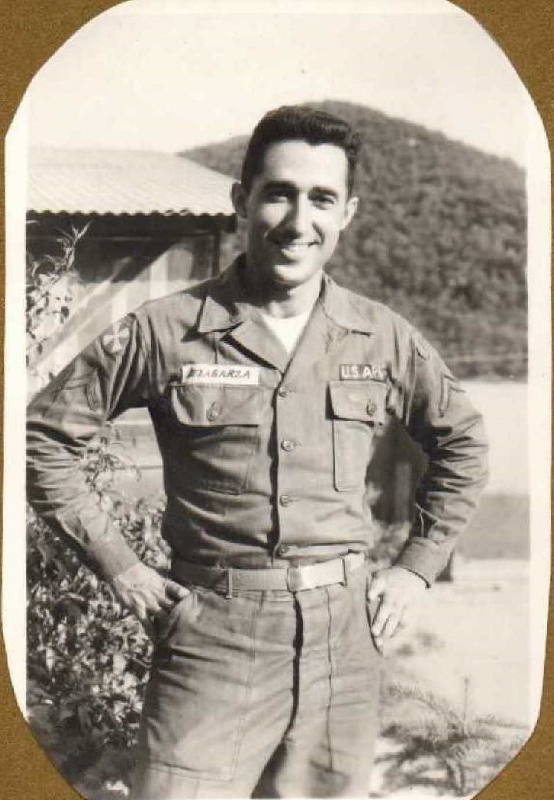
My father, George De La Garza, Sr., in South Korea in 1954

This is my father’s recollection of returning home from military service in Korea.

I had thought of joining the military when I got older.  My older brother, Jesse, did.  He was 17 and failing out of school when he enlisted in the U.S. Army in the summer of 1942.  They shipped him out to the Pacific region.  He was stationed on some remote island, when he killed his first person.  He said it was at night, and Jesse and his commanding officer were hidden in some thick foliage – looking for…whatever.  Then they spotted a Japanese solider approaching.  Jesse’s CO ordered him to kill the guy…“or I’ll kill you first and then him.”  He was still 17 and had no choice.  Jesse saw other casualties – adults and children; soldiers and civilians – in the wicked and bloody chaos of World War II’s Pacific theatre.  He caught malaria, before returning home.

Jesse received a slew of awards, including a Purple Heart by Gen. Douglas MacArthur himself.  He got an honorable discharge and quickly came back to Dallas.  One Saturday morning me and Jesse, our younger brother, and some other friends visited a local barbershop.  As sat conversing in Spanish and English, the shop’s owner approached and – in his heavy Scottish brogue – ordered us to leave.  “We don’t cut Mexicans’ hair.”

Here we all were – born and raised in the Dallas area, not causing any ruckus – and a foreign-born man tells us to leave.  At some point over the next couple of days, a massive rock found its way through the large glass window of that shop.  I swear I don’t know how that happened!

That experience kind of left me bitter about this great country and the freedom it was supposed to have.  I no longer had any desire to join the military.

Then came Korea – and I had no choice.

I had just turned 21 in January 1954, when my father drove me to the Greyhound bus station in downtown Dallas – just like he’d done with Jesse more than a decade earlier.  I had rarely been outside of Dallas and never outside of Texas.  I arrived at Fort Bliss in El Paso, a little scared and not knowing what to think.  After basic training, they put me on another bus to Los Angeles, then a train to Seattle, and finally a ship to Korea.

From what I understood later, Korea wasn’t nearly as bad as World War II, but when is there ever a pleasant war?  More importantly I understood why Jesse never wanted to talk about his own experiences.

By then the U.S. armed forces had been (forcibly) integrated, so men of all shapes, sizes and colors served together.  I developed close friendships with many of my Black comrades.  I could envision these connections lasting a lifetime.

It was only two years, but it felt like decades.  We left Korea on a ship for Seattle.  Once there we had to take a train down to Los Angeles.  I stood with my Black buddies on the platform, before we had to board.  My friends started walking away from me.

“Hey, guys, where are you going?” I asked, still innocent – naïve actually.

“We have to go to the rear of the train,” one of them called back to me.

The rear of the train – where the Negroes had to go.

Oh yeah, I told myself.  We’re back in America – the land of the free.

3 Comments

Filed under Wolf Tales

Wait? We have.

I looked at Tom* with what he later described as a scowl.  “Are you serious?” I asked.

“Um…yeah,” was his only reply.  He then looked embarrassed – almost as if he realized he’d just said the wrong thing.  Or, in this case, just pissed me off.

It was the fall of 2002, and we’d known each other for a few years and been roommates since May.  Things weren’t turning out as well as I’d hoped.  Pooling resources is supposed to help people get through tough time.  So far, the only thing that had turned out well was the new puppy he got in August, after the death of his last dog.

I like Tom – for the most part.  You never really know someone unless you either spend the night with or move in with them.  Tom and I had never spent the night.  I do have standards!  But Tom was smart and highly-educated; something of a wild man with few bounds.

He was a little like me: a native Texan of mixed ethnicity (in his case, German and Indian) who graduated high school in 1982 and attended the University of North Texas (although I didn’t arrive there until 1984).  But he was more conservative, and our political discussions on race and gender often went sideways with his right-wing logic.

This evening’s conversation was a perfect example.  I can’t remember what set it off, but I had mentioned that the modern civil rights movement “had to occur”; that it had to take place.  He refuted that claim; calmly stating that it had been completely unnecessary; that eventually society would “come around” and realize it was only fair to give all people a chance; that folks just “needed to wait”.

Thus, my…scowl.

“Wait?”  People had already waited – more than 400 years, from the arrival of the first Europeans to the 1950s, when Martin Luther Kind launched his quiet revolution.

People had waited through the American Revolution, the U.S. Civil War, World Wars I and II, Korea and Vietnam.  People had waited through every major political and social event since the Salem Witch Trials for an equal place in American society.  People had waited through the name-calling, beatings, shootings, stabbings, lynchings and relocations.

People had waited.  Long enough.  And that’s why everything finally exploded in the 1960s.  I believe the catalyst was the assassination of John F. Kennedy.  Just a few years into the decade, the first U.S. president born in the 20th century was cut down by a delusional madman (or a cavalcade of them, depending on who you ask); thus squelching a promising future to an American that was moving irreversibly forward.  But the centennial of the Civil War – a conflict about one group of humans owning another group, not property – helped fuel the embers of dissatisfaction.  People had finally said, ‘I’ve had it.  This is it.  We’ve done everything possible to make ourselves valuable and worthy of a seat at that great American banquet table.’

And, in the midst of the mayhem, old White fools like Richard Nixon and Ronald Reagan stood around saying, ‘I don’t know why they’re so upset.  They live in a free country.’

Define free.

A high school English teacher once said all that happened in the 1960s was boiling in the 1950s.  The Korean War – the sadly “forgotten war” – was a blight in an otherwise great decade.  It was marked by the creation of the grandest economy at the time and included the seminal Brown v. Topeka Board of Education.

Tom didn’t know what to say to me after my rant.  It was more of a lecture.  I can get emotional with those sensitive issues, but I’d maintained my decorum – each of us standing there in boxer shorts chugging beers.  He was truly speechless – a rarity for him.  But alas… he had to concede I was right.  Or more, that he could see my point.

Wait…no longer.

*Name changed

Leave a comment

Filed under Essays

Korean War Ends

????????????????????????????????????????????????????????????????????????????????????????????????????????????????????????????????????????????????????????????????????????????????????????????????????????????????????????????????

On this day in 1953, an armistice was signed in Panmunjon, Korea, ending the Korean War.  The conflict lasted all of three years and thirty-two days, but it took the lives of some 5 million people – civilians and military – and split the Korean Peninsula between the democratic Republic of Korea (South Korea) and the oppressive Democratic People’s Republic of Korea (North Korea).

Often called the “Forgotten War,” the conflagration had its beginnings with the conclusion of another bloody conflict.  As the world celebrated the end of World War II in 1945, the Korean Peninsula split along the 38th parallel; essentially becoming two nations.  In 1948, the United Nations General Assembly approved of open elections for the establishment of a provisional government.  Communist forces opposed the elections, but they were held in the southern half in May of 1948.  The elections created a national assembly, which in turn, established the Republic of Korea (ROK).  In response, residents in the north created the Democratic People’s Republic of Korea – an ironic name considering the nation’s current reputation for brutality.  The U.S. removed its last troops from Korea in 1949, and the DPRK saw an opportunity to invade its southern neighbors.

The war known for its battles amidst wretched winters actually began in summer.  On June 25, 1950, the North Korean People’s Army (NKPA) attacked the ROK with the backing of the Soviet Union.  The U.S. quickly returned to back the ROK.

It’s a shame – an extreme disservice – that the Korean War is occasionally referred to as the “Forgotten War.”  My father served in the U.S. Army during that mess and, like anyone involved, he hasn’t forgotten a single thing about it.  Certainly, there’s nothing to forget about 5 million deaths.

Korean War Project.

90678919_e27203ebd7_z

1 Comment

Filed under History