
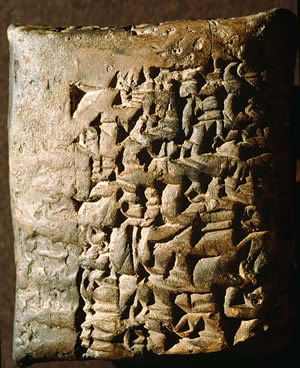
Think about what it takes to create a writing system from scratch. Imagine the intellectual aptitude of someone who draws an image on a rock, in the sand, or anywhere and declares that it represents something – a word, an action, a single sound. What is required of somebody to actually sit down and do that?
Not long after I began walking and talking around the age of 9 months, my parents started teaching me to read. The books were those simply-worded “See Spot Run” types, but I took to them with an uncannily inborn sense of ease. Whenever my folks became engaged with some task around the tiny two-bedroom apartment where we lived, they made sure I was either asleep or sitting on the couch with one of those books. Many of those colorful little pre-school tomes were “Golden Books,” the classics of childhood literature that helped to educate the young masses. I still have scores of them stored away neatly in boxes; surely they’d be collector’s items by now.
By the age of 5 – even before entering kindergarten – I was writing stories. Although I could speak in complete sentences and use seemingly grown-up words (my parents never “baby-talked” to me), putting those thoughts into written form became my primary means of communication. I’ve been reading and writing ever since.
My precociousness wasn’t always viewed with admiration. As a first-grader at a Catholic parochial school in Dallas, me and my fellow students were required to look at our name plates before carefully copying our names onto sheets of paper. I looked at mine once and, upon the second time I had to write it, I simply did so from memory. Proud of my accomplishment, I displayed the sheet of notebook paper to the nun teaching the class.
Her reaction was harsh. “Don’t ever do that again!” she chided.
It didn’t seem to matter that – all of 6 or 7 years of age – I successfully reprinted my name after having looked at the plate once. So I sauntered back to my desk, feeling humiliated and dejected.
Bitch!
I recounted the incident to my parents that evening at dinner, and they beamed with pride. My father reassured me I did nothing wrong and told me, from that point onward, just “pretend” to look at my name plate. I followed his advice, confident in my new-found ability. I never again looked at that stupid name plate; neither did I try to impress that decrepit nun. I surmised some time later that a vow of poverty, coupled with a life of celibacy and a cardboard headdress, must have a nasty impact on a woman’s cerebral capacity.
Another incident at that same school a few years later, however, made me question everyone in the education field. A lay teacher arrived at the school in the fall of 1976 to teach English. She and I got along nicely at first. But my impulsive audacity to question certain things apparently made her head hurt, and she’d stare at me from behind those gigantic 1970s-era glasses (the kind that now would qualify as motorcycle windshields) and seethe with frustration.
Other students in the class loved when her and I got into those “fights,” as one boy described them. That teacher certainly didn’t enjoy it and used every opportunity she could scrounge up to humiliate me in front of my classmates. Then, one morning, things came to a head between us over a single word: llama.
Because it’s a Spanish-language adaptation of an Indian term for the only draft animal to evolve in the Western Hemisphere, I knew it was pronounced “yama.” In Spanish, a double “L” bears a “Y” sound. The teacher shook her head no and insisted it was pronounced “lah-mah,” with the “L” clearly enunciated. I didn’t budge. I knew I was right.
Yet our constant linguistic tennis match finally made a few of her precious brain synapses explode, and she literally yelled at me to shut up and pronounce the word the way she saw fit – with that Anglicized “L” sound.
A near-deadly pall enveloped the room like a tsunami accosting a beachfront. Everyone fell silent, and the teacher ordered me to remain after class. My heart sank, and my stomach felt hollow.
After my fellow students departed, the teacher stuck a well-manicured fingernail into my quivering face and told me never to question her authority again. “Do you understand me?” she growled.
A weak “Yes, ma’am” tumbled from my lips. That evening at dinner I recounted the entire episode to my parents. This time they didn’t offer any coy suggestions for me to remain quiet. Arriving at school the next morning, both of them promptly entered the building with me and demanded to speak with that teacher.
The principal, a feisty and intimidating nun named Jean, told them they either had to make an appointment or wait until an upcoming parent-teacher conference.
My father, who was growing increasingly disillusioned with Roman Catholicism altogether, leaned forward onto the paper-cluttered desk and said, “Jean, get her in here now, or I’ll go find her and drag her ass in here myself.”
Sister Jean’s eyes widened, and her self-righteous demeanor crumbled faster than a Ku Klux Klansman accidentally entering the Pine Ridge Indian Reservation with a suitcase full of Christian bibles. The lay teacher arrived, and, as I waited outside by the secretary’s desk, she tried to explain her side of the story. My parents had always been renegades, but they were also fair. I don’t know what all was said amongst them, but my father made it clear that she was never to yell at or humiliate me in front of the class. He and my mother also made that teacher realize my pronunciation of the word “llama” was correct. Technically, everything was settled, but she still gave me a “B” for that spring semester. It didn’t matter. I graduated from the school shortly thereafter and was more than glad to get the hell out of there.
Neither of those situations diminished my love and passion for the written word. I’ve remained an avid reader and writer. And, just like I resisted the demands of those two teachers to think and behave differently, I’ve resisted any attempts to downgrade my intellect or circumvent my literary aspirations. As we stand on the threshold of this pioneering electronic medium called blogging, I think of the countless writers and poets who simply wouldn’t give up on their dreams to describe the world as they see it, or to tell the truth as they know it. I’m a strong advocate of the First Amendment to the U.S. Constitution, which guarantees free speech. But the power of the written word transcends that.
Writers have always been at the forefront of social and political changes. Powerful elites have tried to silence us; lest the truth gets out to the otherwise loyal masses who then should dare to forget their places in a carefully-structured society – places designated by those same powerful elites. Education and literacy are the best tools against tyranny and oppression. Once someone learns how to read and write, they start to think for themselves. And, while that’s good for society as a whole; for some, it forebodes danger. It’s why, for centuries, the Catholic Church tried to keep books out of the hands of commoners, especially women. It’s why, in the aftermath of the American Civil War, some Whites tried to do the same with the freed Negro slaves.
In more recent years, a number of journalists have been murdered in México, as they covered that nation’s ongoing war against the drug cartels and linked some of that violence to government and law enforcement officials.
Of course, composing short stories for my blog or recounting skirmishes with haughty nuns and teachers doesn’t constitute a battle against repression. But, from the moment some six millennia ago, when an unknown individual in the Sumerian desert carved the emblem of a human head in conjunction with a fish to indicate eating, writing has been an essential and inescapable attribute of our existence. I observe, from the comfort of my suburban home, the battles between police and drug lords in México and wonder if any of them are aware that a form of writing arose in the central part of that country around 600 B.C. Do they even realize how significant that is, not just in México’s history, but the history of the world?
I swing my attention to the mountains of landlocked Afghanistan and question if any of the men training to attack Europe and the U.S. in the name of Islam realize their ancestors corresponded frequently about such matters as the possibility of an afterlife and how birds stay aloft. How did that area reach the 16th century and become stuck there?
I remain passionate about literature and education, even in this increasingly digital world where cell phone text messages have become the norm. I have no less than 400 books crammed into my home, placed neatly on shelves or stacked atop one another. They cover everything from art to political science. Moreover, I have scores of magazines: “National Geographic,” “International Artist,” “The Sun,” “Indian” and the “Smithsonian.” And I keep adding to my repertoire. My only hope is that I get to read them all before I die, and even then, maybe carry them with me into the afterlife.
Regardless of what happens anywhere in the world, I know we writers will win the ongoing battles against ignorance and arrogance. Whether we have to stay after class for daring to question a teacher over the pronunciation of a single word, or stand before a hostile government that only wants so much of the truth to get out into the world, writers will always win. Even if we have to die for it.
Image: Mr. Dowling.


 Chief Writing Wolf