
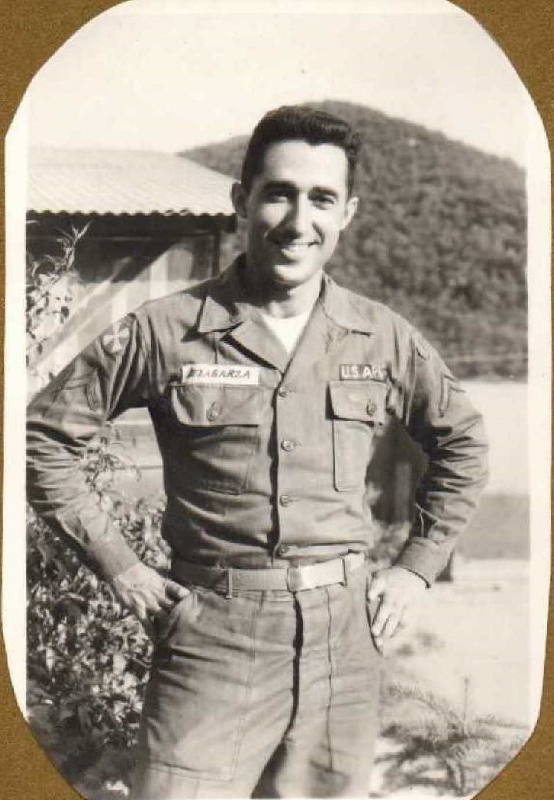
This is my father’s recollection of returning home from military service in Korea.
I had thought of joining the military when I got older. My older brother, Jesse, did. He was 17 and failing out of school when he enlisted in the U.S. Army in the summer of 1942. They shipped him out to the Pacific region. He was stationed on some remote island, when he killed his first person. He said it was at night, and Jesse and his commanding officer were hidden in some thick foliage – looking for…whatever. Then they spotted a Japanese solider approaching. Jesse’s CO ordered him to kill the guy…“or I’ll kill you first and then him.” He was still 17 and had no choice. Jesse saw other casualties – adults and children; soldiers and civilians – in the wicked and bloody chaos of World War II’s Pacific theatre. He caught malaria, before returning home.
Jesse received a slew of awards, including a Purple Heart by Gen. Douglas MacArthur himself. He got an honorable discharge and quickly came back to Dallas. One Saturday morning me and Jesse, our younger brother, and some other friends visited a local barbershop. As sat conversing in Spanish and English, the shop’s owner approached and – in his heavy Scottish brogue – ordered us to leave. “We don’t cut Mexicans’ hair.”
Here we all were – born and raised in the Dallas area, not causing any ruckus – and a foreign-born man tells us to leave. At some point over the next couple of days, a massive rock found its way through the large glass window of that shop. I swear I don’t know how that happened!
That experience kind of left me bitter about this great country and the freedom it was supposed to have. I no longer had any desire to join the military.
Then came Korea – and I had no choice.
I had just turned 21 in January 1954, when my father drove me to the Greyhound bus station in downtown Dallas – just like he’d done with Jesse more than a decade earlier. I had rarely been outside of Dallas and never outside of Texas. I arrived at Fort Bliss in El Paso, a little scared and not knowing what to think. After basic training, they put me on another bus to Los Angeles, then a train to Seattle, and finally a ship to Korea.
From what I understood later, Korea wasn’t nearly as bad as World War II, but when is there ever a pleasant war? More importantly I understood why Jesse never wanted to talk about his own experiences.
By then the U.S. armed forces had been (forcibly) integrated, so men of all shapes, sizes and colors served together. I developed close friendships with many of my Black comrades. I could envision these connections lasting a lifetime.
It was only two years, but it felt like decades. We left Korea on a ship for Seattle. Once there we had to take a train down to Los Angeles. I stood with my Black buddies on the platform, before we had to board. My friends started walking away from me.
“Hey, guys, where are you going?” I asked, still innocent – naïve actually.
“We have to go to the rear of the train,” one of them called back to me.
The rear of the train – where the Negroes had to go.
Oh yeah, I told myself. We’re back in America – the land of the free.

 Chief Writing Wolf