Tag Archives: South Korea

Home Somewhat Free

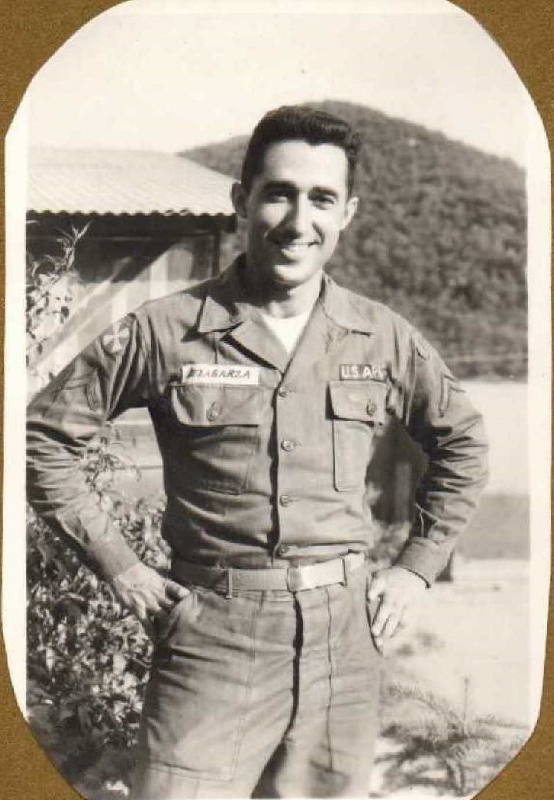
My father, George De La Garza, Sr., in South Korea in 1954

This is my father’s recollection of returning home from military service in Korea.

I had thought of joining the military when I got older.  My older brother, Jesse, did.  He was 17 and failing out of school when he enlisted in the U.S. Army in the summer of 1942.  They shipped him out to the Pacific region.  He was stationed on some remote island, when he killed his first person.  He said it was at night, and Jesse and his commanding officer were hidden in some thick foliage – looking for…whatever.  Then they spotted a Japanese solider approaching.  Jesse’s CO ordered him to kill the guy…“or I’ll kill you first and then him.”  He was still 17 and had no choice.  Jesse saw other casualties – adults and children; soldiers and civilians – in the wicked and bloody chaos of World War II’s Pacific theatre.  He caught malaria, before returning home.

Jesse received a slew of awards, including a Purple Heart by Gen. Douglas MacArthur himself.  He got an honorable discharge and quickly came back to Dallas.  One Saturday morning me and Jesse, our younger brother, and some other friends visited a local barbershop.  As sat conversing in Spanish and English, the shop’s owner approached and – in his heavy Scottish brogue – ordered us to leave.  “We don’t cut Mexicans’ hair.”

Here we all were – born and raised in the Dallas area, not causing any ruckus – and a foreign-born man tells us to leave.  At some point over the next couple of days, a massive rock found its way through the large glass window of that shop.  I swear I don’t know how that happened!

That experience kind of left me bitter about this great country and the freedom it was supposed to have.  I no longer had any desire to join the military.

Then came Korea – and I had no choice.

I had just turned 21 in January 1954, when my father drove me to the Greyhound bus station in downtown Dallas – just like he’d done with Jesse more than a decade earlier.  I had rarely been outside of Dallas and never outside of Texas.  I arrived at Fort Bliss in El Paso, a little scared and not knowing what to think.  After basic training, they put me on another bus to Los Angeles, then a train to Seattle, and finally a ship to Korea.

From what I understood later, Korea wasn’t nearly as bad as World War II, but when is there ever a pleasant war?  More importantly I understood why Jesse never wanted to talk about his own experiences.

By then the U.S. armed forces had been (forcibly) integrated, so men of all shapes, sizes and colors served together.  I developed close friendships with many of my Black comrades.  I could envision these connections lasting a lifetime.

It was only two years, but it felt like decades.  We left Korea on a ship for Seattle.  Once there we had to take a train down to Los Angeles.  I stood with my Black buddies on the platform, before we had to board.  My friends started walking away from me.

“Hey, guys, where are you going?” I asked, still innocent – naïve actually.

“We have to go to the rear of the train,” one of them called back to me.

The rear of the train – where the Negroes had to go.

Oh yeah, I told myself.  We’re back in America – the land of the free.
3 Comments

Filed under Wolf Tales

Waving

Water is fascinating.  Essential, indeed, yet compelling in how it moves and how we humans interact with it.  Artists, therefore, can never conjure enough means to display water, but each attempt is mind-boggling.

Recently, Design You Trust, a digital media company, installed a massive anamorphic illusion entitled “Wave” above a South Korean urban area.  Spanning 80.1 x 20.1 meters, the display appears to be an aquarium with water sloshing repeatedly against its “sides”.

Staring at it for any length of time may make some people queasy.  But, in the midst of the current political and health crises rampaging across the globe, I feel it invokes a sense of calm and humility; akin to waves crash against a shoreline, rain falling gently in the night, or a river tumbling over rocks.  You know – water.

Leave a comment

Filed under Art Working

Empire of Pages

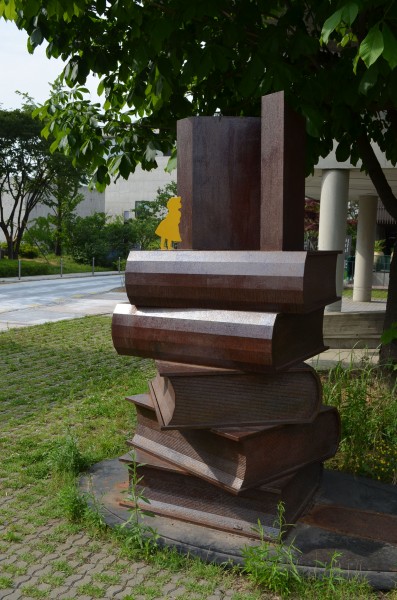
A giant book sculpture in Paju Bookcity.

A giant book sculpture in Paju Bookcity.

Imagine a city where every business is directly related to books.  As a writer and unrepentant bibliophile, that’s my idea of utopia; a slice of heaven on Earth.  But, in South Korea, it’s a reality.  Paju Bookcity was designed and built exclusively around the publishing industry.  Originally conceived in 1989 by a group of publishers who envisioned a village devoted to books, the town literally has books and book production as its centerpiece.  Here, residents place the “common good” above “ruthless self-interest” and work in buildings where architecture exists in harmony with the environment.

The concept finally came to fruition in 2001; today, Paju boasts 150 buildings and is home to some 200 publishing companies.  It goes beyond just a collection of chic book stores lined up on cobblestoned streets competing to see who can sell the best over-priced coffee with the latest romance novel or murder mystery.  Everything about Paju, which sits about 20 miles north of Seoul, is related to books.  Publishers even pay for buses to bring their staff to work.  Among the unique structures is the “Moveable Type Workshop,” which sports racks of leaded letters and ancient typesetting machines.

A writing system arose in China around 1,300 B.C., and the world’s first printing system appeared in the same region between the 4th and 7th centuries A.D.  But, the Koreans didn’t adopt a formal writing system until the 15th century A.D. with the creation of an alphabet that suited their own linguistic needs.

Understand that Paju is not a residential locale; it’s a business complex of sorts where about 10,000 people work.  It’s divided into 3 sections: a Publishing District, a Printing District and a Support District.  The overall area is owned by the Ministry of Culture, Sports and Tourism.

Not surprisingly, Paju also stages its own annual book festival call “booksori.”  On average some 450,000 people visit and about 200 author events take place over a 9-day period.

“There was no festival before and I wanted to lengthen the life of books, and have an intellectual gathering,” said Sang Lee, the festival’s founder and a spokesman for Paju.  “We held our third booksori this year and since 2003 we’ve also held a children’s book festival every May.”

It’s ironic that Paju is a short distance from the country’s border with North Korea; a staunchly communist nation not exactly known for free speech and free press.  The presence of the “demilitarized zone” spawns enough tension for anyone living nearby.  But, the idea of a community dedicated solely to the written word generates more peaceful aspirations and serves as a proverbial olive branch for distrustful enemies.  After all, literacy makes people think before they act.

For me, Paju Bookcity truly sounds like paradise.

//

Leave a comment

Filed under News

Korean War Ends

????????????????????????????????????????????????????????????????????????????????????????????????????????????????????????????????????????????????????????????????????????????????????????????????????????????????????????????????

On this day in 1953, an armistice was signed in Panmunjon, Korea, ending the Korean War.  The conflict lasted all of three years and thirty-two days, but it took the lives of some 5 million people – civilians and military – and split the Korean Peninsula between the democratic Republic of Korea (South Korea) and the oppressive Democratic People’s Republic of Korea (North Korea).

Often called the “Forgotten War,” the conflagration had its beginnings with the conclusion of another bloody conflict.  As the world celebrated the end of World War II in 1945, the Korean Peninsula split along the 38th parallel; essentially becoming two nations.  In 1948, the United Nations General Assembly approved of open elections for the establishment of a provisional government.  Communist forces opposed the elections, but they were held in the southern half in May of 1948.  The elections created a national assembly, which in turn, established the Republic of Korea (ROK).  In response, residents in the north created the Democratic People’s Republic of Korea – an ironic name considering the nation’s current reputation for brutality.  The U.S. removed its last troops from Korea in 1949, and the DPRK saw an opportunity to invade its southern neighbors.

The war known for its battles amidst wretched winters actually began in summer.  On June 25, 1950, the North Korean People’s Army (NKPA) attacked the ROK with the backing of the Soviet Union.  The U.S. quickly returned to back the ROK.

It’s a shame – an extreme disservice – that the Korean War is occasionally referred to as the “Forgotten War.”  My father served in the U.S. Army during that mess and, like anyone involved, he hasn’t forgotten a single thing about it.  Certainly, there’s nothing to forget about 5 million deaths.

Korean War Project.

90678919_e27203ebd7_z

1 Comment

Filed under History

Picture of the Day

South Korea’s mountainous Yeosu peninsula’s contains 300-plus jagged islands, two protected national marine parks and a rich maritime heritage.  Photograph by Topic Photo Agency.


Leave a comment

Filed under News