Tag Archives: writing

National Banned Books Week 2015

Old Covered Books on Table HD Wallpaper

Today is the official start of “Banned Books Week” here in the U.S.; the annual counter-assault against the angry and the self-righteous who dare to tell the rest of us independent thinkers what we can and cannot read. It’s a relentless battle.

This year the theme is “Young Adult” fiction. YA fiction, as it’s more commonly known, is the newest fad among adventurous scribes who want to help teenagers cross the troubled bridge into full-blown adulthood; the period of life where people learn the hard way that they aren’t the center of the universe. Suzanne Collins’ “The Hunger Games” trilogy is one highly successful example. Despite its popularity, it has garnered its own share of conservative protestors. I really can’t understand that. Within the context of American mythology, “The Hunger Games” has everything: violence, racial exceptionalism and plenty of bad luck. I mean, people getting shot down like wild animals. What’s more American than that?

One of the more curious books being challenged is Rebecca Skloot’s “The Immortal Life of Henrietta Lacks.” Henrietta Lacks was an African-American woman, born Loretta Pleasant in Virginia in 1920, who died of cervical cancer in Baltimore in 1951. It’s not her brief life or tragic death that is necessarily so compelling. It’s not even the fact she died of cervical cancer. It’s what resulted from her death, and the variety of ethical challenges her situation posed. The type of cervical cancer she developed was unique; something oncologists at the time had never seen. Shortly before Lacks’ death, doctors at Johns Hopkins Hospital removed two samples of the cancer – without her knowledge or permission. They ended up in the laboratory of researcher Dr. George Otto Gey who noticed the cells were unusually durable. Gey isolated and multiplied some of the cells, producing a line he dubbed “HeLa.” The HeLa line would go on to assist cancer researchers in the ensuing decades.

Perhaps the most famous outcome was the cure for one of humanity’s greatest scourges. Jonas Salk used the HeLa line to develop the polio vaccine, which was approved for general use in 1955, after only three years of testing. Immediately thereafter, other scientists began cloning the HeLa cell line; since then, over 10,000 patents involving the HeLa cells have been granted.

The Lacks Family didn’t learn of these advances until 1973, when a scientist contacted them, wanting blood samples and other genetic materials. For them and many African-Americans, this scenario reminded them of the infamous “Tuskegee syphilis study;” perhaps the most egregious and blatant example of medical racism in the U.S. The tale of Henrietta Lacks is nonetheless a compelling study of medical research and medical ethics. But one idiot in Knoxville, Tennessee has a different view: she calls it pornography. Parent Jackie Sims found Skloot’s book inappropriate for students at L&N STEM Academy in Knoxville. The term “inappropriate,” of course, means: ‘I don’t like it, so no one else should have access to it.’ Sims apparently equates gynecology with pornography. The term “cervical” surely sent her frail mind into a tizzy. Her precious on was given an alternate text (maybe something along the lines of a Disney coloring book), but Sims – like the typical self-righteous curmudgeon – wants Skloot’s tome to be banished from the entire school district. Fortunately, district authorities haven’t backed down, and – as of this writing – the matter is still under consideration.

For a complete selection of this year’s frequently-challenged books, check out this list. Then go out and buy, or download, one of them and read it, if you haven’t already. Remember, true freedom begins with the written word.

Banned Books Week on Twitter.

Banned Books Weeks is partnered with the Center for the Book in the Library of Congress.

2 Comments

Filed under News

Writing Lives

603cuneiform

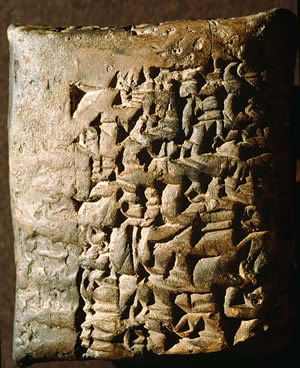
Think about what it takes to create a writing system from scratch. Imagine the intellectual aptitude of someone who draws an image on a rock, in the sand, or anywhere and declares that it represents something – a word, an action, a single sound. What is required of somebody to actually sit down and do that?

Not long after I began walking and talking around the age of 9 months, my parents started teaching me to read. The books were those simply-worded “See Spot Run” types, but I took to them with an uncannily inborn sense of ease. Whenever my folks became engaged with some task around the tiny two-bedroom apartment where we lived, they made sure I was either asleep or sitting on the couch with one of those books. Many of those colorful little pre-school tomes were “Golden Books,” the classics of childhood literature that helped to educate the young masses. I still have scores of them stored away neatly in boxes; surely they’d be collector’s items by now.

By the age of 5 – even before entering kindergarten – I was writing stories. Although I could speak in complete sentences and use seemingly grown-up words (my parents never “baby-talked” to me), putting those thoughts into written form became my primary means of communication. I’ve been reading and writing ever since.

My precociousness wasn’t always viewed with admiration. As a first-grader at a Catholic parochial school in Dallas, me and my fellow students were required to look at our name plates before carefully copying our names onto sheets of paper. I looked at mine once and, upon the second time I had to write it, I simply did so from memory. Proud of my accomplishment, I displayed the sheet of notebook paper to the nun teaching the class.

Her reaction was harsh. “Don’t ever do that again!” she chided.

It didn’t seem to matter that – all of 6 or 7 years of age – I successfully reprinted my name after having looked at the plate once. So I sauntered back to my desk, feeling humiliated and dejected.

Bitch!

I recounted the incident to my parents that evening at dinner, and they beamed with pride. My father reassured me I did nothing wrong and told me, from that point onward, just “pretend” to look at my name plate. I followed his advice, confident in my new-found ability. I never again looked at that stupid name plate; neither did I try to impress that decrepit nun. I surmised some time later that a vow of poverty, coupled with a life of celibacy and a cardboard headdress, must have a nasty impact on a woman’s cerebral capacity.

Another incident at that same school a few years later, however, made me question everyone in the education field. A lay teacher arrived at the school in the fall of 1976 to teach English. She and I got along nicely at first. But my impulsive audacity to question certain things apparently made her head hurt, and she’d stare at me from behind those gigantic 1970s-era glasses (the kind that now would qualify as motorcycle windshields) and seethe with frustration.

Other students in the class loved when her and I got into those “fights,” as one boy described them. That teacher certainly didn’t enjoy it and used every opportunity she could scrounge up to humiliate me in front of my classmates. Then, one morning, things came to a head between us over a single word: llama.

Because it’s a Spanish-language adaptation of an Indian term for the only draft animal to evolve in the Western Hemisphere, I knew it was pronounced “yama.” In Spanish, a double “L” bears a “Y” sound. The teacher shook her head no and insisted it was pronounced “lah-mah,” with the “L” clearly enunciated. I didn’t budge. I knew I was right.

Yet our constant linguistic tennis match finally made a few of her precious brain synapses explode, and she literally yelled at me to shut up and pronounce the word the way she saw fit – with that Anglicized “L” sound.

A near-deadly pall enveloped the room like a tsunami accosting a beachfront. Everyone fell silent, and the teacher ordered me to remain after class. My heart sank, and my stomach felt hollow.

After my fellow students departed, the teacher stuck a well-manicured fingernail into my quivering face and told me never to question her authority again. “Do you understand me?” she growled.

A weak “Yes, ma’am” tumbled from my lips. That evening at dinner I recounted the entire episode to my parents. This time they didn’t offer any coy suggestions for me to remain quiet. Arriving at school the next morning, both of them promptly entered the building with me and demanded to speak with that teacher.

The principal, a feisty and intimidating nun named Jean, told them they either had to make an appointment or wait until an upcoming parent-teacher conference.

My father, who was growing increasingly disillusioned with Roman Catholicism altogether, leaned forward onto the paper-cluttered desk and said, “Jean, get her in here now, or I’ll go find her and drag her ass in here myself.”

Sister Jean’s eyes widened, and her self-righteous demeanor crumbled faster than a Ku Klux Klansman accidentally entering the Pine Ridge Indian Reservation with a suitcase full of Christian bibles. The lay teacher arrived, and, as I waited outside by the secretary’s desk, she tried to explain her side of the story. My parents had always been renegades, but they were also fair. I don’t know what all was said amongst them, but my father made it clear that she was never to yell at or humiliate me in front of the class. He and my mother also made that teacher realize my pronunciation of the word “llama” was correct. Technically, everything was settled, but she still gave me a “B” for that spring semester. It didn’t matter. I graduated from the school shortly thereafter and was more than glad to get the hell out of there.

Neither of those situations diminished my love and passion for the written word. I’ve remained an avid reader and writer. And, just like I resisted the demands of those two teachers to think and behave differently, I’ve resisted any attempts to downgrade my intellect or circumvent my literary aspirations. As we stand on the threshold of this pioneering electronic medium called blogging, I think of the countless writers and poets who simply wouldn’t give up on their dreams to describe the world as they see it, or to tell the truth as they know it. I’m a strong advocate of the First Amendment to the U.S. Constitution, which guarantees free speech. But the power of the written word transcends that.

Writers have always been at the forefront of social and political changes. Powerful elites have tried to silence us; lest the truth gets out to the otherwise loyal masses who then should dare to forget their places in a carefully-structured society – places designated by those same powerful elites. Education and literacy are the best tools against tyranny and oppression. Once someone learns how to read and write, they start to think for themselves. And, while that’s good for society as a whole; for some, it forebodes danger. It’s why, for centuries, the Catholic Church tried to keep books out of the hands of commoners, especially women. It’s why, in the aftermath of the American Civil War, some Whites tried to do the same with the freed Negro slaves.

In more recent years, a number of journalists have been murdered in México, as they covered that nation’s ongoing war against the drug cartels and linked some of that violence to government and law enforcement officials.

Of course, composing short stories for my blog or recounting skirmishes with haughty nuns and teachers doesn’t constitute a battle against repression. But, from the moment some six millennia ago, when an unknown individual in the Sumerian desert carved the emblem of a human head in conjunction with a fish to indicate eating, writing has been an essential and inescapable attribute of our existence. I observe, from the comfort of my suburban home, the battles between police and drug lords in México and wonder if any of them are aware that a form of writing arose in the central part of that country around 600 B.C. Do they even realize how significant that is, not just in México’s history, but the history of the world?

I swing my attention to the mountains of landlocked Afghanistan and question if any of the men training to attack Europe and the U.S. in the name of Islam realize their ancestors corresponded frequently about such matters as the possibility of an afterlife and how birds stay aloft. How did that area reach the 16th century and become stuck there?

I remain passionate about literature and education, even in this increasingly digital world where cell phone text messages have become the norm. I have no less than 400 books crammed into my home, placed neatly on shelves or stacked atop one another. They cover everything from art to political science. Moreover, I have scores of magazines: “National Geographic,” “International Artist,” “The Sun,” “Indian” and the “Smithsonian.” And I keep adding to my repertoire. My only hope is that I get to read them all before I die, and even then, maybe carry them with me into the afterlife.

Regardless of what happens anywhere in the world, I know we writers will win the ongoing battles against ignorance and arrogance. Whether we have to stay after class for daring to question a teacher over the pronunciation of a single word, or stand before a hostile government that only wants so much of the truth to get out into the world, writers will always win. Even if we have to die for it.

Image: Mr. Dowling.

5 Comments

Filed under Essays

Writer Philip Roth Is Frustrated – and Retires

After more than 6 decades of writing, Philip Roth has become weary of the frustrations and decided to stop.  “The struggle with writing is over,” he scribbled onto a Post-It note that he affixed to his computer.  Roth, who will turn 80 in March 2013, has penned some 31 books since 1959, when he published Goodbye, Columbus and Five Short Stories.  Apparently, he’s had enough – whatever that’s supposed to mean to a writer.

Roth actually made the decision to retire 2 years ago, after completing Nemesis, about a polio epidemic that struck his hometown of Newark, New Jersey in 1944.

“I didn’t say anything about it because I wanted to be sure it was true,” he told The New York Times last week.  “I thought, ‘Wait a minute, don’t announce your retirement and then come out of it.’  I’m not Frank Sinatra.  So I didn’t say anything to anyone, just to see if it was so.”

As with many people, though, his health is an issue.  He had back surgery this past April continues to heal with regular exercise.  But, he apparently feels that could have a negative impact on his writing.  “I know I’m not going to write as well as I used to.  I no longer have the stamina to endure the frustration.  Writing is frustration — it’s daily frustration, not to mention humiliation. It’s just like baseball: you fail two-thirds of the time.”

“I can’t face any more days when I write five pages and throw them away,” he added.  “I can’t do that anymore.”

Perhaps I shouldn’t be critical, since I haven’t published anything outside of this blog yet.  But, I can’t imagine retiring from writing.  Like politics, it seems to be something people can do forever.  Writing, of course, actually has a purpose.  My mother retired at age 70 from a half century in the insurance business.  My father was forcibly retired in 1994 from a printing company where he’d worked for more than 30 years.  Neither misses their jobs, even though it left both with bitter memories.  I don’t miss the engineering company that laid me off 2 years ago, in part because of the crap I had to put up with there at the end.  I don’t know anyone who’d miss, say, working at a sewage plant or a coal mine.  People may miss their coworkers or the camaraderie that comes from the friendships they develop.  But, no one really longs for the work itself.  The writing life is ideal for me.  Enjoying something while making money at it?  That’s not working!

But, Roth wants to clarify one thing.  “I do not believe the novel is dying.  I said the readership is dying out.  That’s a fact, and I’ve been saying it for 15 years.  I said the screen will kill the reader, and it has.  The movie screen in the beginning, the television screen and now the coup de grâce, the computer screen.”

In that regard, I couldn’t agree with him more.

Leave a comment

Filed under News

Write Off

For the scriptually-challenged – yes, that’s a real term – the month of November has been designated by “Saint Literature” as “National Novel Writing Month,” a month to challenge prospective writers to produce a complete novel in 30 days.  The technical goal is 50,000 words, which is about 1,700 words, or 6 double-spaced manuscript pages per day.  “NaNoWriMo” began in July 1999, when a group of San Francisco writers decided to see what they could do with the written word in a month’s time.  As with any artistic endeavor, the purpose was merely to make a statement – whatever that’s supposed to mean.  In 2000, they moved the challenge to November.  Last year 256,618 people took part in the event, and 36,843 succeeded in writing a complete novel.

Some have criticized it as a waste of time and energy.  Who, after all, produces a quality literary piece in 30 days?  As with any art work, though, it’s all a matter of perception.  Some people may read my stuff and think it’s crap.  I respect their decision, as I light a curse candle at midnight on their behalf.  Make of it what you will, but we writers are the voices of our respective communities.  If we didn’t put words to paper or computer screen, children would go blind from masturbating too much and more people would vote Republican.

Image courtesy of “NaNoWriMo.”

Leave a comment

Filed under News

Pause

I wanted to let my followers know that I plan to take a brief hiatus from this blog.  I need to ready my novel for publication.  It just got rejected by another mainstream publisher, so I’m leaning towards self-publication.  I truly enjoy blogging, but it takes considerable time and effort.  I’ve been struggling to balance that with other writings and my new full-time work life.  I haven’t had much time to exercise either.  I’d vowed never to let my health be compromised by anything.  But, I’ve noticed that, as I push 50, life gets busier and more hectic.  It can also become increasingly disappointing.  Still, writing is my first passion; my first and only true love in life.  So, that’s where my heart will be for the next couple of weeks at least.

I feel it’s way past time to get this thing done.  I first had the idea in the early 1990’s, jotted down a few notes and some semblance of a synopsis, before putting aside to deal with other stuff going on at the time.  Yes, life does get in the way; then again, I sort of let it get in the way.  I began working on the novel again in 2000 and – once again – let other crap interfere.  I’ve just put it off for too long.  Thank you to everyone for subscribing to my blog.  I’m not disappearing altogether.  If something really significant arises, I’ll jump back into it.  But for now, I need to get this novel done.  I’m tired of working for other people and corporate entities.  Writing is – and always has been – the only true career path for me.

Leave a comment

Filed under Essays

Why Be a Writer?

This is a great opinion piece on the “Indies Unlimited” site from writer and fellow blogger J.D. Mader who asks quite simply, “What’s a writer for?”  It’s certainly a query I’ve made to myself.  Why am I doing this?  What purpose does this serve?  I could drop dead in the middle of this great story, and the world will not stop rotating.  So, why go through all that trouble of writing, editing and researching?  Well, I do it mainly for the love of it.  I’ve always loved to write; to create stories and characters, or in many cases, reconfigure what’s happened to me and the people I’ve met.  Of course, I change the names to protect myself.  But, for all of us creative types, we always find ourselves asking what purpose does it all serve.

4 Comments

Filed under News

What Comes First, the Platform or the Book?

Should anyone who wants to write a book already have a published collection of, say, short stories or essays?  It’s like learning to walk before you can run, and it’s a question Edward Nawotka proposes in this brief editorial.  As someone who’s still trying to get his first novel published – without having so much as a short story in print – this piqued my curiosity.  Some people are fortunate in that they write a book that catches a publisher’s fancy, which in turn, catches the public’s attention and launches a successful career.  Others write a book based on a lifetime of personal adventures; pulling together years of true experiences in teaching, law enforcement, or whatever.  But, Nawotka asks if someone can write a book and then “develop a platform to go along with it.”  Is it too conceited for someone to conjure up a magnificent tale and then seek an audience for it?  It’s an interesting hypothesis, and I know a lot of people are that confident in themselves to do it.  But, it seems to go against one of the first tenets of writing: know your audience and target your work for them.  It’s also akin to composing an outline, or synopsis, before actually writing.  I’ve never done an outline, except for high school and college essays.  But, I’ve found synopses work well for me.  I can understand the urge of some writers just to get something down.  Often, I have strange ideas and visions germinate in my brain, ultimately forcing me to put them down into a tangible form without concern for any prospective audience.  But, that’s just how I am.  We writers are a curious lot anyway; often very introverted and introspective.  No single formula for getting our stories out works for everybody.

1 Comment

Filed under News