Category Archives: Essays

Life Managing

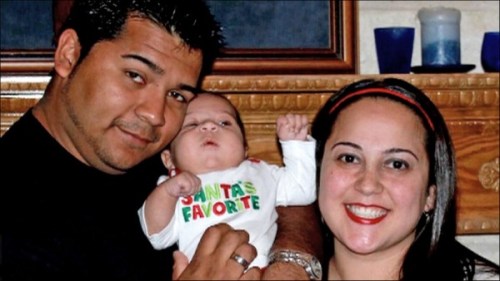
The Muñoz family in happier times.

The Muñoz family in happier times.

In June of 1997, the Southern Baptist Convention held its annual conference in Dallas, Texas.  Aside from preaching the gospel of Jesus Christ and proselytizing against the evil Bill Clinton, the organization had one other item on its agenda: boycott the Walt Disney Company because of its new policy to offer benefits to the same-sex partners of its some of its employees

The day after convention-goers officially voted on the Disney boycott, the “Dallas Morning News” placed the story on its front page – complete with a color photograph of the assemblage holding up placards; their smug, arrogant expression displaying their true contempt for the company.

In the fall of 1995, Disney had joined a growing number of companies that took the bold step of instituting non-discrimination policies for its gay and lesbian associates.  That included offering identical benefits to the same-gender partners of these employees.  Because Disney catered so much to families, the move triggered a more vociferous response from right-wing politicians and their evangelical puppet masters.  It prompted some to malign Disney as the “tragic kingdom.”

Meanwhile, buried on page 3 of the ‘Metropolitan’ section of that same “Dallas Morning News” issue was a brief story on something I found even more alarming: approximately 40% of children in Texas at the time had no health insurance.  I literally stopped when I read that.  I presumed, in my naiveté about the human condition, that all infants and children were automatically covered by some type of health insurance.  The piece – all of half a page – highlighted a family who lived in a trailer park just outside Dallas.  I can’t remember the details, but both parents worked and had two kids.  The family was just one of hundreds across the state.  I looked again at the SBC gang on the front page and wondered if they were even aware of the trailer park family; a family that could barely take care of itself, much less go on a Disney cruise with untold numbers of homosexuals allegedly lurking behind the lounge chairs.

I thought about that situation again when the bizarre case of Marlise Muñoz arose.  Last November Muñoz, a 33-year-old paramedic, suffered an apparent pulmonary embolism at her home in Haltom City, a Fort Worth suburb.  Her husband, Erick, found her on the kitchen floor after she’d gotten up in the pre-dawn hours to prepare a bottle for their toddler son.  Two days later officials at John Peter Smith hospital declared Marlise brain dead.  Her husband and parents asked that she be removed from life support.  But, the hospital refused.  Marlise was about 14 weeks pregnant at the time, and the hospital cited a little-known state law, the Texas Advance Directives Act, that forbids the cessation of life-saving measures on a pregnant woman.  Passed in 1989, “Texas Statutes – Section 166.049: Pregnant Patients” is supposedly meant to protect the lives of the unborn.  It’s an adjunct to “Texas Statutes – Section 166.046: Procedure If Not Effectuating a Directive or Treatment Decision,” which addresses life support for individuals in comatose or vegetative states.

The usual cacophony of pro-life voices raised themselves in self-righteous indignation in support of the unborn Muñoz child.  Muñoz supporters reacted by pointing to a simple fact: the woman was brain dead.  If someone’s heart stops, it can be resuscitated with electric shocks; if the lungs collapse, air can be pumped back into them; if the kidneys cease functioning, the individual can be hooked up to a dialysis machine.  But, you can’t perform CPR on a person’s brain.  Once a person’s brain dies, that’s it!  There’s no coming back.  It’s why the brain stem is the first part of the human embryo to form.

People often joke about brain death.  I point out that it’s a symptom of many politicians and entertainment celebrities.  In fact, it’s almost a requirement among reality TV stars.  But, brain death is a seriously finite condition.

Yet, pro-life activists lined up outside John Peter Smith demanding the hospital do everything it could to save the life of Marlise Muñoz’s unborn baby.  And, the hospital was trying to do just that – pumping oxygen into the dead woman’s corpse.  Her flesh was beginning to rot, however, and her body was developing both external and internal sores.  Moreover, examinations of the fetus showed its lower extremities were so badly deformed no one could determine its gender.

Erick Muñoz finally resorted to legal action against JPS.  On January 24, State District Judge R.H. Wallace concurred and ordered the hospital to let Marlise go.  “Mrs. Muñoz is dead,” he wrote.  “Defendants are ordered to pronounce Mrs. Muñoz dead and remove the ventilator and all other ‘life-sustaining’ treatment from the body.”

JPS chose not to fight the order and removed Marlise from life support on the 26th; what was left of her body died five minutes later.  As a token of love and affection, Erick named the unborn baby Nicole, his wife’s middle name.  No longer held captive to a ghoulish medical experiment, Marlise’s family can now bury her and moved forward with their lives as best as possible.  Erick still has a toddler son to raise.

This entire imbroglio comes less than a year after Texas State Senator Wendy Davis launched an 11-hour filibuster against a law that imposed heavy restrictions on abortion providers in Texas.  It was a move that garnered international attention and propelled Davis to launch a bid for the governorship.  The Muñoz case and the Texas abortion law are related, albeit tangentially, because of that pro-life label so many ideological conservatives here and around the nation like to claim.

Pro-life advocates really aren’t pro-life – that is, in the truest sense of the term – they’re pro-birth.  For some perverted reason, they want to control human reproduction.  They declare that it’s for the good of humanity; a desire to give all babies a chance at life.  I suppose, however, they really just want more bodies to work in the fields and the factories, or to go to war so oil and energy companies can earn more profits.  If pro-lifers truly are in favor of life, they wouldn’t stand idly by as literally millions of people, including infants and children, go to bed hungry in this country every night.  While the evangelical crowd thinks they’re doing society a favor by protesting the perceived horrors of homosexuality, they ignore the real tragedy of the uninsured, which has grown exponentially since 1997.  Conservative Republicans in the U.S. Congress were eager to invade Iraq in 2003, but have been slow in providing pay increases to military personnel.  We can expect that from a pack of old lawyers whose own pay and benefits are secure.

And, we can expect pro-lifers to holler in contempt that people like Judge R.H. Wallace don’t value human life.  Some are already publicly shaming Wallace and demanding his impeachment.  But, if the U.S. values human life so much, it wouldn’t boast one of the highest homicide rates among developed countries.  It wouldn’t tolerate 49 million Americans living with food insecurity (as of 2012).  Pro-life doesn’t mean a society fights like hell to allow (or force) a pregnant woman to give birth.  It means it fights for the welfare of all its citizens.  Life may begin at conception, but it doesn’t end when the umbilical cord is cut.

1 Comment

Filed under Essays

Civil Righting

the-constitution

Back in 2002, my then-roommate, Tom,* and I got into a discussion about racial and gender equality.  I stated that all of the various civil rights movements of the 19th and 20th centuries, starting with the abolitionist movement, were necessary to instigate change and make America live up to its declaration as a truly free and inclusive nation.  Tom merely shook his head no in a condescending fashion and said, “Nah,” later adding that eventually people would have “come around” and realize discrimination was wrong.

I looked at him like the fool he was and asked him if he sincerely believed that.  He said he did.  I then recounted the story of my father’s return from Korea in the mid-1950s.  He had been drafted into the U.S. Army and sent to the front lines in the midst of the Korean War.  Among the many friends he made were a large contingent of Black soldiers.  By then, the U.S. armed forces had been forcibly integrated, so a mix of ethnic groups comprised all the various military units.  My father didn’t serve his full two-year stint, as the war ended sooner than most anyone had expected.  He and several of his fellow soldiers arrived in Seattle via ship and then boarded a train to head to their various home cities.  My father was confused when his Black team mates started walking away from.  He called out to them, asking where they were going.  One told him they were headed towards the rear caboose – where Black people had to sit.  As he watched his friends, his brothers-in-arms, saunter down the platform, my father said to himself, “Oh yea, we’re back in America – land of the free.”

Tom just sort of looked at me, not knowing what to say.  He conceded it was wrong, even then, to force Blacks to sit at the back of a bus or a train.  But, he snapped out of his brief foray into actual reasoning and reiterated that eventually White people would have realized how unfair that was.  In other words, we didn’t bus strikes or protests of any kind.  People should have just waited around, hoping for the better.

No one should have to wait for justice and fairness.  Nobody should be straddled to the rocks of oppression and brutality – hoping, praying and begging for those in positions of power and influence to see the light.  Disenfranchised groups in the U.S. had waited for centuries to be treated with dignity and respect and to be given an equal chance to succeed.

I told someone else around the same time as my conversation with Tom that the 1960s exploded with anger and rage because patience had finally run out.  They’d done everything that had been asked of them: they served in the military; they worked hard; they cleaned homes and streets; they obeyed the laws (no matter how discriminatory they were); they tried as best to keep to themselves – everything.  And, they still weren’t given a fair chance.  Blacks still had to sit at the back of the bus; women still had to change their last names when they got married and still had to have children; Indians still had to live in squalor on reservations; gays and lesbians still had to suppress their true identities.

And so, by the 1960s, everything just sort of erupted at once.  If change didn’t come through peace and hard work, then it had to be forced.  America was compelled to fulfill its proclamation as a nation of freedom and opportunity.  It no longer had a choice in the matter.  The time had come to change – whether some folks liked it or not.

It was curious to hear Tom speak of racial and gender equality and inequality.  He was a mix of German and Cherokee; from a small, nondescript community in far northeast Texas.  We discussed the plight of Indigenous Americans more than once.  He felt that Indians could have fought back against European encroachers because they also had men.  I noted that Europeans had two primary advantages: guns and horses.  Moreover, they’d adopted both gunpowder and horse-riding skills from the Chinese.  Tom wasn’t moved.  And, I told him he now had the distinction of falling into two unique groups: those who aren’t educated about a subject and those who don’t want to be educated.  That’s actually a rarity, but one that persists even now; in this second decade of the 21st century with a biracial U.S. president and a shrinking White majority.

Attitudes really are hard to change.

*Name changed.

4 Comments

Filed under Essays

Free Speaking

free-speech-hand-mouth

“I disapprove of what you say, but I will defend to the death your right to say it.”

Voltaire

On the night before the United States was set to invade Iraq in March of 2003, the Dixie Chicks, a Texas-born country music trio, took to a London stage.  Lead singer Natalie Maines suddenly blurted out, “Just so you know, we’re on the good side with y’all.  We do not want this war, this violence.  And, we’re ashamed the President of the United States is from Texas.”

The audience cheered, and Maines laughed loudly, as if she had just been joking.  But, the repercussions here at home were swift and vitriolic.  Country music radio stations quickly pulled the band’s music from their play lists; fans turned on the group and began destroying their records and CD’s; others threatened violence; someone even made a bomb threat to the band’s record company.  The group has recovered in the ensuing decade, but hasn’t really attained the same level of popularity they enjoyed before “The Incident.”  I’m not a country music fan, so I don’t follow the band.  But, I’m certainly not a fan of former President George W. Bush.  Indeed, he is an embarrassment to the state of Texas.

Maines’ 2003 pronouncement came to light again recently with the uproar over comments made by another southerner: Phil Robertson of “Duck Dynasty” fame.  Robertson’s family created an empire making and selling products for duck hunters from their Duck Commander Company in West Monroe, Louisiana, which has been in operation since 1973.  The show debuted on the A&E Network in March of 2012 and became an instant success.  The family is devoutly Christian and proudly redneck.  They seem to celebrate both, and each episode ends with the family gathered around the dinner table reciting a prayer.

Now, the show’s future is threatened after Robertson granted an interview to GQ Magazine during which he equated homosexuality with bestiality and claimed African-Americans were better off in pre-civil rights America.  It’s the homophobic part of his rant that has garnered the most attention.

“Start with homosexual behavior and just morph out from there,” Robertson told GQ.  “Bestiality, sleeping around with this woman and that woman and that woman and those men.  Don’t be deceived.  Neither the adulterers, the idolaters, the male prostitutes, the homosexual offenders, the greedy, the drunkards, the slanderers, the swindlers – they won’t inherit the kingdom of God.  Don’t deceive yourself.  It’s not right.”

After I got past the difficult concept of someone like Phil Robertson actually speaking with GQ Magazine, I just sort of yawned.  I’ve heard this crap before.  Evangelical Christians here in the U.S. have long compared homosexuality (especially male homosexuality) to bestiality and always seem to know what’s right for everyone else.  If anyone should dare criticize them, they then claim they’re merely quoting biblical scripture.  I’ve heard that crap before, too.  I’ve known plenty of people who often said, ‘Hey, don’t get mad at me.  I’m just doing what it says in the Bible,’ – not understanding how stupid they sound.  That’s almost like a man claiming he couldn’t help but sexually assault a woman because she was wearing a mini-skirt.

That Robertson assumes Black-Americans would have done well to forgo the efforts of the civil rights struggles of the last two centuries and accept their lowly place in society is equally unsurprising.  Many older White conservatives, particularly in the southeastern U.S., bristle at the thought of non-Whites achieving any kind of equality.  Robertson and his ilk remain indignant about the Civil War and continually reenact key battles in the vain hope they’ll attain victory and the Negroes and Indians will retreat into the fields where they belong.

When A&E announced “Duck Dynasty” would be suspended, many Robertson fans came to his defense.  Among them are the usual right-wing squawkers: Rush Limbaugh, Sarah Palin and Louisiana Governor Bobby Jindal.  Yet another, Ian Bayne, an Illinois Republican congressional candidate, produced the most laughable response by comparing Robertson to Rosa Parks.  “In December 1955, Rosa Parks took a stand against an unjust societal persecution of black people,” stated Bayne, “and in December 2013, Robertson took a stand against persecution of Christians. What Parks did was courageous… What Robertson did was courageous too.”

I’d love to see the look on Robertson’s face when he heard that one!  Ironically, Rosa Parks’ actions were an early cannon shot in the brewing civil rights movement.

Several Robertson defenders are denouncing the apparent hypocrisy of his critics.  “Free speech is an endangered species,” said Palin.  Perhaps it is, but then again, you have to consider who’s speaking and what they’re saying.  When Natalie Maines criticized President Bush, her detractors suddenly warned that free speech has its responsibilities, which is a polite way of saying if you don’t agree with them, then you’re dead wrong.

Indeed, free speech has its limits.  You can’t yell ‘Fire!’ in a crowded theater (a common comparison); you can’t phone in a bomb threat; and you can’t falsely accuse someone of committing a criminal act, such as…oh, bestiality.  As a writer, I know that free speech is sacrosanct; an undeniable tenet of democracy.  It’s a precious right; one born of blood and more valuable than gold or diamonds.  I’ve known people who grew up in the former Soviet Union or communist East Germany and listening to their tales of living under such oppressive regimes where dissent was regarded as a scourge makes me understand how fortunate I am to have grown up in the U.S.  I’ve seen a few episodes of “Duck Dynasty” and think it’s rather funny.  Only in America can someone make a fortune from building duck calls.  As much as I detest people like Phil Robertson, I can’t let what he says bother me too much.  If he doesn’t like gay people, then that’s his right.  No one should try to force him to march in the next gay pride parade, while holding hands with a drag queen.  If he feels Black folks had it better in America pre-1970, I feel he’s an idiot.  Ask any older Black person, especially those who grew up in the southeastern U.S., what life was like for them under Jim Crow laws, and I’m sure they’ll tell you that – aside from gatherings with family and friends – it was pretty hard and scary.  But, if Phil Robertson believes otherwise, what are you going to do?  Try to drown him in the swamp behind his mansion?

There is one unique irony about Robertson’s pathetic analogy between homosexuality and bestiality.  A hunter’s duck call is actually a ruse; the device mimics the sound of a duck’s mating wail.  In other words, the hunter masquerades as an amorous waterfowl to ensnare an unsuspecting bird into a trap.  Not that Robertson has ever sought to get busy with a duck, of course!  But, just words for thought.

Image: Albany NY a.k.a. Smalbany.

4 Comments

Filed under Essays

Thanks for This?

???????????????????????????????

In April of 2010, Sarah Palin, the former (part-time) Alaska governor and 2008 Republican Party vice-presidential nominee, told the Women of Joy conference in Louisville, Kentucky, “God truly has shed His grace on thee – on this country.  He’s blessed us, and we better not blow it.”  She was criticizing the notion of separation of church and state; a tenet essential to the establishment of the United States.  She insisted, as right-wing evangelicals do, that this is a Christian nation; founded on biblical principals.  If that’s the case, then her oldest daughter, Bristol, should be stoned to death for getting drunk, having sex out-of-wedlock and giving birth to an illegitimate child.  That Bristol went on to condemn gay marriage – even though she and her baby’s father never could set a wedding date – is typical of conservative hypocrisy.

If Palin, or anyone else in her camp, were so concerned about the application of Christian ideology, then they should look at the startling rise in both poverty and food insecurity in the U.S.  Food banks have been running low on supplies and are working (even more than ever) on shoestring budgets.  To worsen matters, President and Obama and the U.S. Congress made cuts to Supplemental Nutrition Assistance Program (SNAP).  A family of 4 could lose on average $36 monthly in food assistance.  It’s even more astounding when you consider that many of these families are not welfare brats, but among the “working poor” – a new class of individuals created almost involuntarily in the past decade.  These are the people who haven’t benefited from “trickle-down economics.”  Capitalism hasn’t functioned quite so well for them.  In the late 1990s, more people moved up out of poverty than ever before in this nation’s history.  But, thanks to the incompetence and corruption of the Bush Administration, practically all those gains have been lost.

It’s, of course, the skewered tax policies the Bush Administration instituted, beginning in 2001; a financial structure retrofitted to favor the wealthiest individuals and largest corporations.  Coupled with the wars in Afghanistan and Iraq and the almost complete deregulation of the financial and housing industries, and it shouldn’t be too surprising that the U.S. is still in the grips of the worst economic downturn in 80 years.

While conservative extremists are obsessed with injecting creationism into science curriculums in schools and stopping queers from getting married, my biggest worry is the number of people who struggle daily with food insecurity.  As much of the U.S. winds down the Thanksgiving holiday with bloated meals, hectic travel schedules and “Black Friday” shopping excursions, here are some sobering statistics, as of 2012, about the state of many kitchens across the land.

Food Insecurity and Very Low Food Security:

  • In 2012, 49.0 million Americans lived in food insecure households, 33.1 million adults and 15.9 million children.
  • In 2012, 14.5% of households (17.6 million households) were food insecure.
  • In 2012, 5.7% of households (7.0 million households) experienced very low food security.
  • In 2012, households with children reported food insecurity at a significantly higher rate than those without children, 20.0% compared to 11.9%.
  • In 2012, households that had higher rates of food insecurity than the national average included households with children (20.0%), especially households with children headed by single women (35.4%) or single men (23.6%), Black non-Hispanic households (24.6%) and Hispanic households (23.3%).
  • In 2011, 4.8 million seniors (over age 60), or 8.4% of all seniors were food insecure. [1]
  • Food insecurity exists in every county in America, ranging from a low of 2.4% in Slope County, ND to a high of 35.2% in Holmes County, MS.[2]

Overall, the U.S. sported a rate of 14.7% for households with food insecurity.  Following are the top 10 states that exhibited statistically significant higher household food insecurity rates than the U.S. national average, which is from 2000 – 2012 in this study: [3]

Mississippi                 20.9%

Arkansas                     19.7%

Texas                          18.4%

Alabama                     17.9%

North Carolina          17.0%

Georgia                       16.9%

Missouri                     16.7%

Nevada                        16.6%

Ohio                            16.1%

California                   15.6%

Use of Emergency Food Assistance and Federal Food Assistance Programs:

  • In 2012, 5.1 percent of all U.S. households (6.2 million households) accessed emergency food from a food pantry or soup kitchen one or more times. [4] 
  • In 2012, 59.4 percent of food-insecure households participated in at least one of the three major federal food assistance programs – Supplemental Nutrition Assistance Program (SNAP; formerly Food Stamp Program), The National School Lunch Program, and the Special Supplemental Nutrition Program for Women, Infants, and Children (WIC). [5] 
  • Feeding America provides emergency food assistance to an estimated 37 million low-income people annually, a 46% increase from 25 million since Hunger in America 2006.[6]
  • Among members of Feeding America, 74% of pantries, 65% of kitchens, and 54% of shelters reported that there had been an increase since 2006 in the number of clients who come to their emergency food program sites. [7]

If the U.S. and all other democratic societies are serious about strengthening themselves, they’ll spend less money on wars against foreign nations and homosexuals and more on the real threats to stability: hunger and poverty.  Otherwise, “The Hunger Games” won’t be as much a movie as a way of life.

Sources:

  1. Ziliak, J.P. & Gundersen, C. (2013.) Spotlight on Food Insecurity among Senior Americans: 2011. National Foundation to End Senior Hunger (NFESH).
  2. Gundersen, C., Waxman, E., Engelhard, E., Satoh, A., & Chawla, N. (2013). Map the Meal Gap 2013, Feeding America.
  3. Coleman-Jensen, A., Nord, M., & Singh, A. (2013). Household Food Security in the United States in 2012. USDA ERS.
  4. Ibid.
  5. Ibid.
  6. Cohen, R., J. Mabli,, F. Potter & Z. Zhao. (2010). Hunger in America 2010. Mathematica Policy Research, Feeding America.
  7. Ibid.
  8. U.S. Department of Labor.Bureau of Labor Statistics. 2012 Annual Average Unemployment Rates.

2 Comments

Filed under Essays

Now Dallas, You Can Move Forward

john_kennedy

For the past half century, the city of Dallas, Texas has been defined by three elements: the Dallas Cowboys, the television show “Dallas” and the assassination of the country’s 35th president, John F. Kennedy.  I’ve always admired Kennedy.  He was a true military hero who barely survived World War II.  He was witty and charming with a strong vision for America’s future.  In his inaugural address, he uttered the most inspirational words I’ve ever heard: “And so, my fellow, Americans, ask not what your country can do for you; ask what you can do for your country.”  It was a challenge for a country that – although already accustomed to them – to do more.  It’s certainly something this nation, filled with self-righteous individuals, needs today.  It’s why I vote regularly and speak out when I see injustice.  If you want your society to work for you properly, you have to be willing to do something right for it.

Several years ago, while working my first job as a package clerk at a nearby grocery store, a woman from California asked me how I felt about the city of Dallas.  It was a curious question.  But, it was her first trip to Texas, and she just wanted to know.  She mentioned that, in her native California in 1963, her fellow citizens immediately came to loathe the city of my birth and the entire state of Texas.  She saw people hurtle rocks and bottles at a couple of cars that bore Texas license plates.  Then, I told her I was only 17 days old on the day Kennedy died and that my mother had seen the presidential motorcade race by the garage apartment where we lived on its way to Parkland Hospital – though at the time, she had no idea what had just transpired.  She was nursing me and had sat down to watch “As the World Turns” – a program she’d become addicted to while on maternity leave – and just happened to hear the sirens in the distance; blaring through the open bathroom window.  Not until she returned to the front room to resume watching her show and Walter Cronkite interrupted did everything change.

The California woman – a blonde in her early 40s – froze.  The event became personal again.

It’s a good thing for a city to be associated with a great sports team.  After the horror of the Kennedy assassination, the Dallas Cowboys had the burden of transforming the city into “America’s team.”  Its image as a real estate and oil metropolis were certified in “Dallas,” one of the cheesiest programs the American entertainment community has ever produced.  Fortunately, I know the real Dallas, and I’m happy to announce it’s not that bad.  This place of nearly 2 million people is a blue enclave in a red state.  The city boasts a non-White majority population that still trends Democratic in presidential elections.  In 1995, Dallas elected Ron Kirk as mayor, the first Black to hold that office.  In 2004, Dallas County elected Lupe Valdez as its first Hispanic, female and openly gay or lesbian sheriff.  Two years later it elected Craig Watkins as its first Black district attorney.  There are two schools named after Kennedy here: Kennedy-Curry Middle School and John F. Kennedy Learning Center.  It’s a city with a diverse population and an international reach.  Yes, it boasts its share of crackpots.  Show me a city this size that doesn’t and I’ll show you a pile of rocks.

When word about Kennedy’s death spread throughout my father’s workplace, a printing company on the edge of downtown, an older man groused that Kennedy deserved to be shot because he was Catholic.  My father, then in his early 30s and unafraid to speak his mind, snapped back, “You son of a bitch!  He was our president!”

Several years ago, while working as a contractor for a government agency, my company’s liaison – a hard-right Republican who almost got teary-eyed whenever he mentioned Ronald Reagan’s name – unexpectedly commented that the Kennedy assassination was “one of the best days in this country’s history.”  The three of us standing there with him – my supervisor, a coworker and me – were literally startled.  The statement had come out of nowhere.

Even I who despised Ronald Reagan got scared when he was shot in 1981.  “No!” I announced to the man, while standing beside my supervisor.  “The day Kennedy was shot was one of the worst days this country has ever experienced!”  I reiterated how, on the day Reagan fell victim to a crazed gunman, I was glued to the television.  My mother arrived home from work and sat down to watch a local broadcast – and began to cry.  It had only been a little more than 17 years since Kennedy’s death, and the nightmare had been rejuvenated.

I stormed out of my supervisor’s office, genuinely pissed off, and returned to my desk.  The man, twice my size with an equally imposing voice, followed me and meekly apologized.

Every major metropolitan area has its extremists; its cache of lunatics who are filled with vile against anyone and anything they don’t like.  There were certainly plenty of them in Dallas in the early 1960s.  But, the nation was at the start of a cultural tumult, and such types filled a lot of cities, especially in the Deep South.  It had been a century since the start of the Civil War, and many White Southerners didn’t like the thought of Negroes gaining equality.  When Lyndon Johnson and his wife, Claudia (whom Lyndon affectionately dubbed “Lady Bird”), visited Dallas in September of 1960, they were met, in part, by a hostile crowd.  Although a native Texan and then-Senate majority leader, Johnson was vilified by some folks as duplicitous in a liberal Yankee agenda (e.g. civil rights for Negroes) by agreeing to run on the Kennedy ticket.  As the Johnsons exited a downtown theatre, a young woman lunged forward and snatched Mrs. Johnson’s white gloves from her dainty hands.  Lady Bird’s face turned as white as the gloves that ended up in a sewer.  The senator hustled his wife into a waiting car and hurtled an invective back towards the angry crowd.

When Kennedy died, it had been 13 years since someone made a concerted attempt to assassinate a sitting U.S. president; 18 years since one had died in office; and 62 years since one had been killed.  At age 43, Kennedy was the youngest man ever elected to the U.S. presidency, the first born in the 20th century – and the last to die in office.  His death shocked the nation – and the world – into a new, more brutal reality.  Few could fathom such evil in those days.  Kennedy’s vision for a better nation held so much hope.  That a lone gunman with a Napoleonic complex could possibly destroy the beautiful stones of Camelot with three bolts of lead hadn’t entered the public conscious.

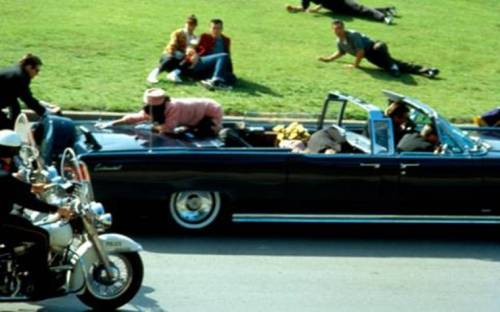
When I was a senior in high school, an English teacher told me everything that erupted in the 1960s had been brewing the previous decade; a time many still view through a delicate stained glass window.  Historians and various cultural observers now agree that Kennedy’s assassination is when the 1960s actually began.  The moment a bullet pulverized the skull of the handsome, young president and compelled his beautiful, glamorous wife to clamber onto the back of the limousine to gather the bloody fragments – like a tomboy collecting rocks – is when that stained glass window shattered.  The patriotism of the 1940s and the economic security of the 1950s collapsed into the reality of a cold, dispassionate universe.  As a whole, Americans realized the nation hadn’t lived up to its ideals of equality and freedom for all.  The Watergate scandal then seemed to confirm things aren’t always how they seem, and we needed to start questioning authority.

The exact moment when everything changed in America.

The exact moment when everything changed in America.

What’s often ignored about Kennedy’s visit to Texas is the overwhelming joy with which he and his wife, Jacqueline, were greeted.  When the couple arrived in neighboring Fort Worth late on November 21, a large, enthusiastic group had gathered in the rain to see them.  As the motorcade cruised through downtown Dallas on that bright, sunny Friday afternoon, hundreds of people lined the streets; waving and cheering.  At one point, Nellie Connally, the wife of Texas governor John Connally, turned to the president and gleefully pointed out that Dallas enjoyed the First Couple’s presence.  They did; they really did.

Several years ago someone painted a white X in the middle of Elm Street, identifying the exact spot where Kennedy was hit.  Somehow that dubious insignia withstood rain, sleet, triple-digit temperatures and Dallas drivers.  Recently, however, the city paved over it as part of a concerted infrastructure improvement plan.  But, it was also a symbolic move.  No, Dallas can’t just get over what happened here on this day five decades ago; pretending it was nothing more than a rough afternoon.  Yes, we grieve today about one of the most tragic events of the 20th century.  That’s the honorable thing to do.  But, we also need to consider Kennedy’s view of a better world – and then move forward.  We have no other choice.

aUYtZ1cxTTNkb0Ux_o_tx-wx-20120721---texas-weather-share---sunrise

John F. Kennedy Presidential Museum and Library

1 Comment

Filed under Essays

Haiyan and the Resilience of a Community

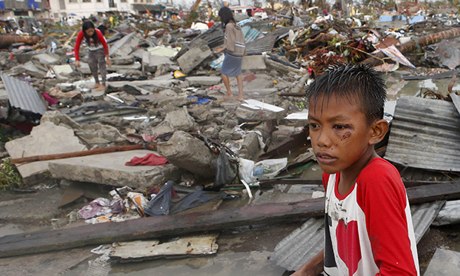
Typhoon Haiyan: residents of Tacloban city

It’s been a little more than a week now since Typhoon Haiyan plowed into the Philippines.  With maximum sustained winds of 195 mph, Haiyan – also known as Yolanda – is the most powerful tropical storm system in recorded meteorological history to make landfall anywhere in the world.  The previous record had been held by Hurricane Camille, which packed 190 mph winds when it slammed into the U.S. Gulf Coast in 1969.

The Philippines are no stranger to typhoons.  Strategically situated just north of Indonesia, between the South China Sea and the Philippine Sea, this country of 96.7 million has to brace itself every year for tropical events.  But, this time things are much worst.  As far as storms go, Haiyan couldn’t have hit a more vulnerable location.

Barely a quarter century removed from the brutal, 20-year dictatorship of Ferdinand Marcos, the Philippines still rank as a developing nation, even though it’s a relatively fully-functioning democracy.  Geographically classified as an archipelago, the Philippines are comprised of 7,107 islands.  But, it’s actually part of the overall Malay Archipelago, the world’s largest such areaHumans have occupied the Malay region for at least 30,000 years.  For centuries, though, the Philippines often served as a crossing point between mainland Asia and the larger islands of Borneo and New Guinea.  The arrival of Islam in the latter part of the 14th century changed much of the Philippines’ culture; a fact that remains even now, as the nation battles more radical Islamic elements.  In 1521, Spanish explorer Ferdinand Magellan became the first documented European to arrive in the Philippines.  He didn’t last long.  Barely a month later, local warriors killed him and several others who were part of his expedition during an intense battle.  But, the Spanish government, in its own bitter rivalry with Great Britain for world domination, persisted and launched more expeditions to the Malay area.  More battles ensued and more blood was spilled, but in 1565, King Phillip II succeeded in making the islands a Spanish colony.  It is him for whom the Philippines are named.  The Philippines remained a Spanish outpost until the 1898 Spanish-American War.  In 1935, the islands became a self-governing entity.

The “self-governing” part is always tricky for any nation that tries to set itself apart.  It’s especially difficult for those where democracy is an alien concept – which is pretty much most of the developing world.  After centuries of Spanish domination and Roman Catholic indoctrination, the Philippines weren’t a good candidate for automatic conversion to the democratic process.  I recall how a contingency of average Filipinos known as EDSA 1 toppled the Marcos regime in 1986, sending him and his family fleeing for their lives.  Even if his wife, Imelda, couldn’t haul her cache of designer shoes out of the imperial palace, the Marcos family had managed to siphon billions from national coffers before exiling themselves to Hawaii.  As the haggard clan disembarked from a plane, one Marcos relative clutched a bag of diapers, as if it was her only possession.  Then again, it’s quite possible fine jewelry and blocks of cash were hidden inside, so why wouldn’t she keep a tight grip on it?  In an attempt to make peace with the Philippines, the U.S. government indicted Ferdinand and Imelda Marcos on a series of racketeering and money laundering charges.  After Marcos died of cancer in 1989, the U.S. dropped all charges against Imelda.  She may have never got her shoes back, but at least she’s living in paradise.  Who says crime and corruption don’t pay?

When EDSA 1 finally rid the Philippines of Marcos, it installed Corazon Aquino as president.  Her husband, Benigno, had been a vocal critic of Marcos and was exiled in 1980 for his views.  When he dared to return to the land of his birth three years later, Marcos had him assassinated.  Thus began the torturous battle for freedom and the long slog towards a democratic state.  When international pressure compelled Marcos to call for elections in February 1986, Corazon Aquino was chosen as the opposition leader.

But, as foreign observers feared, everything that could have gone wrong with the Philippine election process did.  Results eventually proved Aquino as the victor, but not before scores had died in rioting.  When the Marcos family fled, Aquino took her rightful place as president of the burgeoning democracy and spent her single, six-year term fending criticisms of ineptness and coup attempts by Marcos supporters.

With a labor rate that is about 52% services and 32% agrarian, it’s no surprise the Philippines continues to struggle against the tide of wealth inequality.  Roughly 26% of the population lives at or below the poverty line.  Thus, Haiyan’s arrival added to the misery.  But, that happens wherever communities subsist in states of financial insecurity.  When Hurricane Katrina struck the U.S. Gulf Coast in 2005, President George W. Bush received staunch criticism for his inaction.  True, as a lackluster president, Bush didn’t have the mindset to respond to a natural catastrophe.  No one in his administration did.  But, for years, scientists had been warning the state of Louisiana that its southern enclaves were vulnerable to devastation, notably low-lying New Orleans.  But, the Crescent City itself was already in a state of decay.  Most of its citizenry relied upon government assistance and menial cash jobs just to survive.  The people were ill-equipped to help themselves get out of harm’s way; e.g. rent a car or buy a plane ticket.  The endemic corruption in both the city of New Orleans and the state of Louisiana set everyone up for disaster.

As of now, the death toll in the Philippines from Haiyan stands at 3,631 – the “official” estimate.  With so many rural areas still cut off due to lack of electricity and telecommunications, the number of victims may be higher.  I see reports of how bodies were left to rot on city streets and I’m glad chances of that happening here in the U.S. are rare.  People were upset that so many damaged vehicles were left on the streets of New Orleans almost a year after Katrina.  But, human bodies and animal carcasses?

Every one of those bodies was once a person; an individual who had a family and friends; someone who had hopes for a better future.  When death occurs on so massive a scale, it’s often difficult to think of the deceased as individuals.  It personalizes the disaster for us, so it’s easier to think of the dead masses and just shake our heads at the horror of it all.

Governments can’t address each one of them, so it has to consider the entire calamity and do what it can.  But, it’s really up to the survivors and their communities to cope with the aftermath.  They have to deal with the destruction; they have to clean out their homes; they have to gather what food and water they can find; they have to tend to the injured; they have to defend what’s left of their world.  In other words, they have to care for themselves.  That sounds brutal, but in a brutal situation, who best to take care of you and your loved ones except you, if you’re able-bodied?

I do know this: despite the mess, people will survive.  Someone will always get through such disasters and continue with their lives by rebuilding their neighborhoods and therefore, their countries.  After the initial shock, they stand up and just keep going.  It’s hard and it hurts; nothing like that is ever easy.  They may never recover emotionally or even physically from the upheaval, but they go on for as long as they can.  It’s just human nature.

This post from fellow blogger, Donna Amis Davis, a long-time resident of the Philippines, provides more personal insight into the disaster.

International Red Cross.

Doctors Without Borders.

Project Hope.

International Fund for Animal Welfare.

1 Comment

Filed under Essays

Sometimes People Do Deserve to Die Like That

homicide

One of my favorite television shows is “The First 48” on the A&E Network.  Camera crews follow homicide detectives around major metropolitan areas as they try to solve murders.  The show’s title is based on the concept that police must try to solve a killing within 48 hours of its occurrence, or the chances of finding the culprits decreases exponentially.  People who know me may find it’s a strange choice, considering I’m suspicious of law enforcement.  The few times I’ve needed the help of a police officer none are around.  But, if I should exceed the speed limit by 5 miles, or have an expired inspection sticker, suddenly they’re on the scene.  Still, I admire the tenacity of the homicide detectives I’ve seen on “The First 48.”  I also admire their tendency to remain neutral in the face of such tragedies; the worst that humanity has to offer.

While consoling the victim’s relatives, the detectives almost always declare that the person “didn’t deserve to die like that.”  True, no one really deserves to be murdered.  The adage about playing with fire and getting burned applies just as well to criminal activity.

In one of the “The First 48” episodes, a Miami homicide detective stood in the middle of a street in a particularly crime-riddled neighborhood and announced that it was “haunted by the ghosts of young Black men.”  Indeed, it seems so many of the crime victims and perpetrators are either Black or Hispanic.  I’m honestly surprised when a White person shows up as either a victim or a suspect.  That feeds into the mythology, though, that Blacks and Hispanics are more crime-prone than their White and Asian counterparts.

But, I’ve also noticed many of the homicide detectives – at least half – are either Black or Hispanic also.  So are many of the regular police officers.  They somehow go unnoticed in discussions of race and crime.

It’s not so much, however, that non-Whites are more likely to commit crimes.  Civil rights activists have long accused the criminal justice system in the U.S. as being skewered against non-Whites, especially non-White men.  The U.S. also maintains the highest number of incarcerated individuals in the world: roughly 2.3 million people, or 25% of the global prison population.  When one realizes that the U.S.’s 300 million residents comprise only 5% of the people on planet Earth, it should make folks stop and think.  While Blacks and Hispanics each represent less than a quarter of the U.S. population, together they make up 58% of the U.S. prison population.

People may scoff at these statistics and proclaim the U.S. just has a better legal system.  If that’s the case, then why do we boast the highest violent crime rate in the world?  As of 2011, the U.S. experienced 1.2 million violent criminal acts.  One would think we’re akin to Somalia: a completely lawless state with no functioning government.

I’m neither a criminologist nor a psychologist, so I have to rely on whatever statistics I can find and verify, instead of on personal or professional knowledge.  But, in viewing “The First 48,” I’ve noticed something critical: whenever police enter a crime-ridden neighborhood and seek help, they’re often met with a wall of silence.  No one saw anything; no one heard anything; no one knows anything.  It’s as if the victim abruptly turned up with a bullet in their brain, while nearby residents were sleeping, watching TV, or talking on the phone and ‘didn’t hear anything,’ or ‘don’t know nothing.’  At times, it seems such neighborhoods are group homes for the mentally retarded.

In one of the show’s episodes here in Dallas, officials arrived to investigate a shooting death in an apartment complex.  When one of the detectives approached a group of young men sitting on the hood of a car, the latter jumped off the vehicle and walked away.  They didn’t say anything, but their actions spoke for them: ‘we don’t want to talk to you.’  But, if you’re upset about crime in your neighborhood, then why don’t you talk to the police and tell them what you know?  Of course, that’s always easier said than done.  The police don’t have to live there.  People are often mired in poverty and can’t afford just to get up and move to a safer place.

In one episode of “The First 48,” a resident of a Miami housing complex complained to a detective that police only come around to issue tickets for cars parked in front of the trash dumpsters.  I can understand her point.  Police get frustrated when people won’t communicate with them.  But, why should they, if all police officers are going to do is write up parking tickets?  I can see both sides of this issue.  Criminals don’t just hurt one person; they terrorize the entire community.  People become scared and lose hope that law enforcement will help them.

There are no easy answers to these complex social issues where race, gender and socio-economic circumstances often factor into the discomforting mix.  People have noted that, when a White female goes missing or turns up dead, police not only move Heaven and Earth to find out what happened, the story goes national.  Think Jon Benet Ramsey; think Natalee Holloway.

Still, things really are different when you compare a child who is kidnapped from their own home in the middle of the night to a 20-something in an impoverished neighborhood who’s trying to get into the drug trade because of the easy money.

Consider the case of Gary Leon Ridgeway, known colloquially as the “Green River Killer.”  From 1982 to 1998, Ridgeway murdered as many as 66 women and teenage girls in the state of Washington.  He dumped the bodies in wooded areas near the Green River.  Most, if not all, of his known victims were prostitutes.  The teenaged ones were most likely runaways.  Ridgeway had become a suspect in 1983, a year after he’d been arrested in Seattle for patronizing a prostitute.  He took and passed a polygraph in 1984, when police again questioned him about the string of murders.  Thus, he remained on police radar for nearly two decades, before being arrested in 2001.  In 2003, a judge sentenced him to life in prison; a shocking outcome to one of this nation’s worst serial murderers.  But, prosecutors took the death penalty off the legal bargaining table to coax Ridgeway into confessing to other slayings; including some in the state of Oregon.  How he managed to escape a massive police dragnet for so long confounds even the most seasoned homicide detectives.

But, the families of many of the victims say they know why: Ridgeway murdered prostitutes, not choir girls.  That many of his victims were Black or Native American added the ubiquitous and disturbing racial component.  Except for Ridgeway’s teenaged victims – naïve girls who may have fled broken homes – I think it’s fair to say the adult women knew what they were doing.  Yes, prostitution is illegal.  But, don’t expect police to stand by and ignore the interactions between hooker and client, unless the latter turns violent.  Police can only do so much to protect average citizens.

It’s tough for me to have empathy for someone who consumes alcohol for half a century and then complains when they develop cirrhosis.  As a former alcoholic, I can see where my life was headed and got hold of the problem years ago.  And, it’s equally tough for me to have sympathy for a drug dealer who ends up in a dark alley with scores of bullet holes in his or her body.  I’m not being judgmental.  I’m just pointing out the obvious.

In yet another episode of “The First 48,” homicide detectives in Memphis looked strangely at a suspect when he told them that murder is just how some people die.

“Do you realize how serious this is?” responded one of the detectives.

Obviously he didn’t, as he sat in the interrogation room with a sour expression.  He was young, but already emotionally hardened by a community that seemingly had accepted its dire fate as a crime pit.

Most people don’t deserve to be murdered.  But, when individuals deliberately engage in criminal activity and end up on a mortician’s table, what did you expect?

1 Comment

Filed under Essays

And Me?

hands-of-elderly-man-hold-006

In September of 2012, I was at my parents’ house when my father was getting ready to go have his car inspected, and my mother decided she needed to take out the trash.  I had come in following an earlier and somewhat stressful job interview.  I had brought my dog with me to the house – not the interview.  I suddenly thought that I needed to check on my mother.  I don’t know why; it just suddenly occurred to me.  Good thing, though.  As I entered the garage, my mother was returning from the recycle bin, when one of her slippers got caught on the cracked driveway.  She slammed hard onto the concrete and immediately started screaming.  I rushed to pick her up; her left arm looked broken.  With my help, she hobbled back into the house.

My father came down the hallway, horrified.  “What the hell happened?” he bellowed.  He already has a loud voice, so with any extra effort, he could wake the dead.

I quickly explained the situation, which only made him mad.

It wasn’t the first time my mother had tripped while wearing those slippers.  They were cheap, rubber footwear with a two-inch heel; what I called high-heeled slippers.  A few months earlier I was again at their house with my dog, when he indicated he needed to visit the back yard.  My father decided to take him out; my mother decided to join them.  She leapt up from the couch and tripped on those same slippers; slamming hard onto the tile floor.  In fact, she came out of them.  They literally seemed to get stuck to the floor.  She ended up with a severe bruise up the right side of her leg.  A visit to their orthopedic doctor the following week confirmed nothing was broken, or even fractured.

When she fell in the driveway, my father hurriedly called that same orthopedic doctor.  He told them to come in immediately.  I drove them to his office; the receptionist could sense my frustration, as I signed them into the log book.

“Be patient, hon,” she drawled.

My mother’s arm wasn’t broken, but her shoulder was dislocated.  The doctor and two of his assistants tried to pop it back into place, as she lay on the X-ray table, but the muscles and ligaments around it had swollen too much.  They had to admit her to the neighboring hospital and put her to sleep.  It turned out to be an all-day affair.  We left the hospital around 7 P.M.

My father tossed that pair of slippers – and another similar pair my mother had in their closet – into the trash.  Since they were made of rubber, I switched them over to the recycle bin.  I hoped they could be reincarnated as the wheels of a “Hoveround” and therefore, serve a greater purpose.

She’s not the only one who’s tripped in and around the house.  My father, an avid gardener, has fallen several times outside with no one but himself to get back up.  One afternoon he fell in the master bathroom and couldn’t get back up.  He started hollering for help.  My mother had fallen asleep on the couch and couldn’t hear him.  I had lain down in my old bedroom and – with the door closed – couldn’t hear him either.  My dog’s whining woke me up.

It’s a good thing I was there to help my parents in both those predicaments.  Many senior citizens live alone and often find themselves in compromising situations.  Several years ago I had a friend who volunteered for “Meals on Wheels.”  One afternoon he arrived at the home of a client, an elderly woman who lived alone.  Two of her neighbors were at the front door; frantic because she wasn’t responding to their knocks.  My friend wandered towards the back where he climbed the tall wooden fence – and saw the woman lying on the ground, just outside the back door.  She had stepped out the previous evening and tripped.  Unable to get up by herself, she simply remained on the ground; knowing her “Meals on Wheels” visitor would be there the next day.

As I rapidly approach 50, I’m now seeing all these incidents in a new light.  Who’s going to take care of me when I get old – if I should be that lucky?  I’m an only child.  I’ve never been married and don’t have any kids.  I’m close with a couple of cousins on my father’s side, but they have their own lives.  I don’t know if I’ll end up in this house where I grew up, or if I’ll have a home of my own.  But, if I should have the good grace of living to an old age, who could I depend on for support?  I can see dogs in my future though.  They make great companions, yet unless they can be trained to dial 911, or administer first aid, that’s about the extent of their practicality.  Still, I’d almost rather have a dog than a spouse or a partner.  I’ve never been good at romantic relationships.

It’s a serious issue facing us, as life expectancy in the U.S. and other developed nations reaches ever-increasing highs.  The current (and relentless) American obesity epidemic may put a dent in the welfare of my fellow citizens.  However, medical and scientific advances have allowed the populations of developed nations to experience greater rates of longevity, which is a good thing, of course.  People should be able to live as long as they possibly can.  But, those longer life expectancies also present some unique challenges; a fair trade-off, I presume.  It goes beyond just tolerating old folks’ stories of ‘way back when.’  Older people generally require specialized medications and treatments.  Arthritis, hearing and vision loss and immobility are among many such concerns for senior citizens.  There’s a growing industry within the medical community that targets elder care.  It’s virtually uncharted territory.

My paternal grandmother lived to age 97.  But, in the years between the death of my grandfather in 1969 and one traumatic night in the spring of 1992, she’d spent mostly alone.  She got up in the pre-dawn hours, needing to go to the bathroom, when her foot became entangled in the bedding.  She stumbled forward into the baseboard of her antique bed and fell to the floor – her right elbow cut and broken.  Despite the pain and bleeding in the pitch-black darkness, she managed to pull herself back around to the nightstand where she found the telephone cord; she yanked the phone down and called one of my aunts.  My aunt called one of her sisters, before rushing to my grandmother’s house with her husband.  Someone called the paramedics.  As my aunts and uncles stood outside, they simultaneously realized one terrifying fact: none of them had a key to the house.  One of the paramedics announced he was going to break a window, when one of my uncles remembered he had a glass-cutter in his car.  They used that to gain access to the house.  At the hospital, everyone was startled to learn something more critical than not having a key: my grandmother’s body was riddled with bumps, bruises and cuts.  She conceded that she’d fallen several times in the house and had always managed to get back up.  This time was worst, though, because of the elbow break.  The emergency room doctor looked askew at my relatives.  Elder abuse had become a hot topic in the medical community by the early 1990s, and our family became concerned that someone would look at those bumps and bruises on my grandmother and think the worst.  But, no one did.

Ultimately, my father and his six siblings decided that someone needed to be with her at all times.  My grandmother wasn’t too keen on the idea, though.  She relished her independence and privacy and didn’t want someone monitoring her every move.  But, her children ruled against her.  She was fortunate – and blessed.

A close friend of mine is caring for his elderly mother and an elderly aunt.  His aunt is in her early 90s, and his mother is fast approaching that milestone.  He works full-time, so it’s a challenge to tend to the needs of both women.  On a few occasions, he once confided to me, he literally wanted to pack up and leave Dallas for somewhere else; anywhere!  Just as long as he had no one to worry about except himself.  Alas, he couldn’t bring himself to do it.  He’s not so cold-hearted.  His older brother died a few years ago, and his younger sister has a daughter who just turned one.  His sister also has a 20-something son from a long-ago relationship who lives in the same house as his uncle, grandmother and grand-aunt.  He’s a very responsible young man who finished a hitch in the U.S. Marines three years ago and just earned an associate’s degree from a community college.  But, he also works and, at his age, I don’t think he envisions a lifetime of caring for old folks.  One day, however, he and his half-sister may face the concerns of elder care with their mother.

It’s difficult to watch my parents age.  “It’s hell getting old,” they inform me periodically.  Not until a few years ago, about the time I turned 45, did I really sit down with nothing but my most honest thoughts and contemplate life as a senior citizen.  Aside from previous bouts with alcohol addiction, I’ve tried to take care of myself both physically and mentally.  I’ve suffered from severe depression and anxiety in the past; adverse effects, I now realize, of not being able to kill people who pissed me off and get away with it.  Otherwise, I’m pretty healthy.  People who don’t know me occasionally tell me I look 30-something.  That’s a good thing.  But, surficial appearances can’t make up for a strong inner core.

In 2043, for example, I’ll be 80 – the same age as my parents are now.  Will I still have relatively good vision and the mental acuity needed to drive a vehicle?  More and more older Americans are still driving, even as their reflexes slow.  Some states are approaching the delicate issue of how to deal with the growing number of senior citizen drivers; another effect of longer life expectancies.  Will I learn from my parents’ mistakes and watch where I’m walking?  Falls are the leading cause of injury to the elderly.  It was bad enough that my mother would wear those damn rubber slippers with a two-inch base, but she also had the habit of dragging her feet.  I can understand why.  Joints become stiff with age, as cartilage behind the knees wears thin.

It would be nice for me, at age 70 or 80, to sit around the house and relish the fruits of a successful writing career.  But, at some point, I’d have to do laundry, or go to the grocery store.  If I have dogs – which I honestly intend to have – I must take them to the vet periodically.  It is possible that, in 30 years, grocery shopping will be done strictly online with customers sitting at their computers using web cameras to analyze fruits, meats and vegetables.  I wouldn’t be surprised if the U.S. Postal Service – now fighting valiantly to stay alive and relevant – will be a memory in 30 years; akin to my paternal grandfather’s early 20th century carpenter tools.  But, could there also be a vet who makes house calls?

Twenty years ago, when a good friend of mine died of AIDS, I felt lucky to reach my 30th birthday less than two months later.  Before I knew it, though, the turn of the century came – and went – a rare milestone for most humans now.  I turned 40 just weeks before I marked my first anniversary with an engineering firm – and then came down with the flu for the first time in my entire life.  Now, the first decade of the 21st century is old news.  Yes, technology changes, but so do people.

I’m not a braggart.  I don’t live for the moment, or for mounds of attention.  I’m an introvert who prefers quiet spaces most of the time; a hermit, perhaps, but one who cherishes books more than booze and dogs more than people.  If we’re fortunate, we get to live to see 70, 80, 90 and so on.  But, for me personally, what does that type of future hold?

I don’t cry out, ‘What about me?’  I’ve moved beyond wishing for the adulation of others.  But, seriously contemplating my later years, I really do have to ask, ‘What’s going to happen to me when I get old?’

3 Comments

Filed under Essays

Morass

yelling

As of 12:00 A.M. today, October 1, the United States government – for all intents and purposes – has stopped functioning.  I know it seems nothing has changed.  I mean, seriously – is there any difference?  But, the painful reality is that some 2 million government employees will not get paid and national parks have closed.  That’s the immediate effect.  It gets worse if the shutdown continues: military veterans won’t receive their benefits; the Centers for Disease Control and Prevention (CDCP) will have to halt its flu vaccination program – just as flu season approaches; some food safety operations will stop (and in a nation where behemoth butts have become the norm, that spells catastrophe); small business financing will stop; Head Start programs will start closing; disability benefits could be interrupted; funding for disease treatment through the National Institutes of Health could cease.

In the meantime, every member of both houses of Congress will receive their paychecks; their own health care won’t be adversely impacted.  Ironic, though, considering that the Affordable Care Act is the genesis of the squabble between the 2 principal political parties.  Most Republicans – especially the “Tea Party” clowns – despise the ACA, which they’ve derisively called “Obamacare.”  And, in an attempt to stop funding for the President’s signature law, the GOP is willing to risk what little integrity they have in their xenophobic bones and shut down the government.

Over the weekend, one particular “Tea Party” darling, Senator Ted Cruz, launched into a staunch tirade against the ACA.  Hoping to make a name for himself, the Canadian-born, Cuban-Italian Cruz has been campaigning for president since he took office back in January.  Representing my beloved home state of Texas, Cruz has done little else with his time and energy except commandeer the Republican Party’s vitriolic bandwagon and try to obstruct President Obama in any way possible.

Altogether congress has about a 10% approval rating.  I think ptomaine poisoning and getting stranded in the desert without water or cell phone service rank just above them.  Last year I wrote about the ongoing lack of progress from the Senate and the House of Representatives.  My wishful demand was for every elected official in Washington to get impeached, so we – the average, hard-working Americans – can elect more level-headed people to fill the apathetic void.  A million dollars in gold bullion has a greater chance of landing on my doorstep tomorrow morning.

I clearly remember the 1995 – 96 government shutdown in which a beleaguered President Bill Clinton ran head first into a recalcitrant Republican Party (led by the self-righteous Newt Gingrich) – and won.  It was a different time though.  The GOP held strong majorities in both houses of Congress; we weren’t at war; and the economy exploded into profitability for everyone shortly thereafter.  Clinton didn’t back down, thus forcing the GOP into embarrassingly humble defeat.

Today, the U.S. economy is still reeling from the worst downturn in 80 years; we have troops in Afghanistan and Iraq; and Republicans control only the House of Representatives.  Regardless, I’ve lost all respect for our elected officials.  Obama still hasn’t found any steel bars to inject into his spine, and the GOP has let itself be dominated by right-wing extremists.  I’m trying to imagine how things could get any worse.  If they do, colonizing Mars looks better all the time.

5 Comments

Filed under Essays

Okay, Let’s Attack Syria, But…

warrior_of_ideas_196945

President Obama has placed himself into a quandary with Syria.  As the world observes what can only be deemed a human atrocity with a chemical assault upon Syrian civilians, the United States collectively contemplates intervention.  Obama won the presidency in 2008 primarily based on his opposition to the Iraq War – the illegitimate enterprise launch by the draft-dodging George W. Bush and Dick Cheney.  We now know that American oil interests used the horror of 09/11 to justify the invasion of Iraq.  Those same entities are surely behind Obama’s sudden desire to attack Syria.

It’s amazing how the U.S. government selects its battles.  President Bill Clinton says he didn’t interfere in the 1994 Rwandan massacre because he simply had no idea what had happened; a dubious claim at best.  Ronald Reagan sent covert military operatives into Central America allegedly to stamp out any communist insurgencies.  In reality, U.S. conglomerates like United Fruit wanted to maintain their lock on local commodities.

Chemical warfare is nothing new.  Technically, people have been using them for millennia; starting with poisoned arrows.  They gained prominence, however, at the start of the 20th century with a chlorine gas attack in Belgium in 1915.  Germany made good use of them during World War I.  Consequently, in 1925, an assemblage of nations banned chemical weapons with the Geneva Protocol.  But, things always look great on paper.

No one jumped when Saddam Hussein used mustard gas and sarin against Kurdish civilians in 1988; perhaps because the U.S. might have been involved.  Hussein may have used chemical weapons against the U.S. military during the 1991 Persian Gulf War.  A decade ago the U.S. accused Hussein of stockpiling uranium, which of course, prompted the invasion.  Notice how these things are cyclical?

Now Obama wants to don the mantle of international hero by ousting Bashar al-Assad.  So far, he hasn’t convinced too many in the U.S. Congress, nor has he been able to persuade our biggest ally, Great Britain.  He plans to take his case to the American public in a televised address tomorrow night.  Good luck.

But, if the U.S. does plan to attack Syria, here are two conditions I’d like to see take place first:

  • Raise taxes on the wealthiest citizens and largest corporations to fund the war.  Our engagements in Iraq and Afghanistan occurred without the benefit of significant tax revenue, which ultimately led to the current economic crisis.  Besides, all those rich folks and oil conglomerates are the one who benefited the most from the conflicts.
  • Institute the military draft for every able-bodied person ages 18 – 25.  But, this time include women and rich men.  Yes, if women want to be treated as equals to men in business and politics, that means they have to serve alongside men on the battlefield.  In the past, sons of affluent families have been able to bypass military service.  (Mitt Romney comes to mind.)  But, if those boys can expend energy racing their million-dollar speed boats or partying all night in Cancún, then they can damn well haul rucksacks across the Syrian desert.  There also should be no exceptions for conscientious objectors, such as Mormons, Amish, or Jews.

I won’t hold my breath on passage of either.  I know it’s a long shot to expect multi-millionaires to share the tax burden (not their hard-dollar wealth), or for “Millenials” to set down their I-pods and actually do something constructive.  But, what’s life worth if you can’t dream?  Ultimately, my dream is for the Syrian people to rise up and depose al-Assad all on their own.  Regardless, war is just too ugly for only a handful of people to endure.

Image courtesy Warrior of Ideas.

1 Comment

Filed under Essays