Today officially marks one year since my near-fatal accident here at the house. Some of you might remember: I slipped on a wet spot on the linoleum floor the atrium in my parents’ home while carrying a gallon glass jug of iced tea. My feet literally went out from under me. Being airborne for a split second allowed my entire body to rotate 180 degrees and land face down on the floor; two shards of glass from the shattered jug piercing my right arm. After a three-day stay at Hotel Parkland, I returned home with multiple stitches, no feeling in my right hand and an overwhelming desire to bathe for two or three hours. I was still pissed that I wasted half a jug of that herbal tea because I didn’t watch where the hell I was going. It’s amazing how a simple misstep can be so life-changing.
I had surgery last September 13 – a Friday, to be certain – and I’m just now starting to regain function and feeling in the right ring and little fingers. The hand surgeon had told me it would probably take up to a year to regain full functionality and sensation – if that happens at all. At the rate I’m going, I figure I might get up to 75% by this September. It’s a good thing I can do a lot with my left hand. I always knew being bi-manual would come in…well, handy some day.
I note that my accident was near-fatal because of the severity of the wound in my upper right arm and the amount of blood loss. If my father hadn’t wrapped a towel tightly around it, just beneath the elbow, I could have bled to death. The only other thing I had going for me was that the glass cut a vein and not an artery. If it had cut an artery – well, let’s just say I’d have to change the name of my blog to “Chief Writing Spirit.” That would give a whole new meaning to the term “ghost writing.”
I’m fortunate, though, very fortunate. I managed to survive and live to see my 50th birthday last November. I still have great parents and a great dog, plus a good collection of close friends. I consider military veterans returning from Afghanistan and Iraq and realize I don’t have much to complain about. Why does it take such catastrophic events to make people realize how good they actually have it? I don’t know. I guess we need to get shaken up like that – sometimes shaken up badly, in a bloody painful way – to understand life can be good most of the time.
So, as I mark this unwanted first anniversary of stupid accident and a difficult recovery, I continue writing and enjoying the people I love the most. But, damnit, I’m still pissed off about wasting that perfectly good herbal tea!
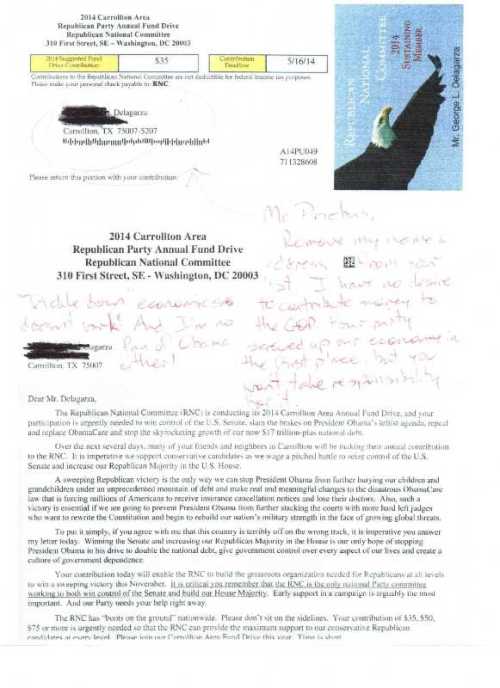
Last week I received a notice from the National Republican Party announcing a fundraiser in my city, along with a request for a donation. It was signed by the Party’s national chairman, Reince Priebus. This suburban Dallas community where I grew up is, like much of the rest of Texas, staunchly Republican. A Democrat hasn’t won a statewide race since 1994, when Garry Mauro won reelection as state treasurer; the same year Ann Richards lost her gubernatorial reelection bid to George W. Bush.
Returning home from the gym late one Saturday night a couple of years ago, I noticed a “Tea Party” sign in a neighbor’s front yard. I wanted to stop and spray-paint a swastika on their walkway, but I didn’t have any spray paint on hand. Besides, they might’ve had security cameras hidden somewhere. For years now, there’s been a billboard off Central Expressway, just north of downtown Dallas, asking: ‘Where’s the birth certificate?’ It’s a blatant reference to the ongoing idiotic questions about President Obama’s birth place. If you know how much it costs to put up one of those signs, you might also realize the same money could fund a school lunch program.
Part of the problem is that, on average, only about a third of eligible voters in Texas actually make an effort to cast a ballot. I think many of my more centrist and independent-minded fellow Texans simply feel their vote won’t make a difference and / or Republicans will win anyway, so why bother. I certainly don’t want Texas to swing to the opposite side of the political spectrum, such California, Illinois or Massachusetts; where people are regulated and taxed into oblivion and political correctness is practically a part of the state’s constitution.
I’m actually put out by our two major both political parties – Republicans AND Democrats. I feel strongly that the Republicans are bullies, and the Democrats are wimps. President Obama has capitulated too much to the bull-headed GOP and lost any credibility, from my perspective. As I see it, the U.S. is essentially leaderless right now.
Hence, my disgust when I received the mailing from Priebus. I mailed it back, but with this handwritten message:
“Mr. Priebus,
Remove my name and address from your list. I have no desire to contribute money to the GOP. Your party screwed up our economy in the first place, but you won’t take responsibility for it.”
Off to the side, I scribbled:
“Trickle down doesn’t work. And, I’m no fan of Obama either!”
I included this last bit of verbiage, so Priebus and his gang will know I’m equally disgusted. I’d hate for anyone at that level to feel so targeted.
But, you must read between the lines. Here’s what I really wanted to say:
“Take my name and address off your fucking list, you good-for-nothing, piece of shit, Neanderthal! Your party fucked up the economy big time with your stupid tax cuts, wars in Iraq and Afghanistan (wars started by a pack of fucking draft-dodgers), and total deregulation of the banking and housing industries. All of that together is what fucked up this economy – not the Affordable Care Act, which is total bat-shit, as far as I’m concerned. You fuckers have taken too much of my money in taxes already and you haven’t done a goddamned thing to help the economy, except the same stupid, fucking, trickle-down bullshit that you’ve been pushing through since that incompetent dumbass, Ronald Reagan, held office!”
But, they probably wouldn’t understand my outrage. Sorry to yell like that in front of you nice folks. Damn, though! I feel so much better!
Since the envelope is postage paid, I found a thin piece of rock in the back yard that I inserted along with the note. Might as well maximize it! I would’ve sent a flattened piece of my dog’s fecal matter, but they’re not good enough to receive even that.
Up until mid-March, I had a temporary position at a lock-box facility with a major financial institution. I won’t name the company or the staffing firm that found me the job, but I will emphasize that it was one of the worst places I’ve ever worked. I took the position as a filler job amidst my freelance writing gigs. In a way, I’m glad I did, though, because it gave me a clearer view of just how bad things are in the U.S. right now. If our elected officials could experience such drudgery, matters would change in no time.
A lock-box is an intermediary between a company and the bank that handles their accounts. You might notice a post office box listed as the mailing address on bills for telephone and water utilities. That box number simply steers the payments to a separate facility where they’re processed on behalf of the bank. It’s beneficial for the bank from a time efficiency standpoint. But, they’re also breeding grounds for fraud. The workers – many of them contract or temporary – handle countless personal checks and documents with sensitive information that can then be purloined or photocopied.
The place where I worked handles immigration applications on behalf of the U.S. Department of Homeland Security. My specific job was to analyze packets of applications and ensure they contained the proper documentation. Security procedures are tight. Every employee – even temporaries – must wear a slave tag, or what they call “badges.” The badge bears the individual’s picture; tiny image that make driver’s license photos look like glamour shots. The badges also have digital codes that would trigger doors to open. To enter the actual location where the documentation was handled, associates had to swipe their badges and then apply an index fingertip to a scanner beneath the electronic locks. For some reason, the lock always had trouble identifying my fingertip. No, I wasn’t using my middle finger – although seems more appropriate now. But, I’d often stand in front of that stupid lock pressing my finger down like a rogue political leader reaching for a nuke button.
The job was monotonous and dull. I get bored easily anyway, so it was difficult for me to stay interested. But, I noticed a number of things. Most of the associates were female and / or non-White. Yet, the bulk of the supervisors and managers were composed of the usual suspects: older White males. None of that really surprised me. Women, non-Whites, the disabled and immigrants now hold the bulk of temporary and part-time jobs in the U.S. These groups have always resided at the lower rungs of the American work force. But, the 2007 – 08 financial crisis intensified those numbers. But, gender and race only tell part of the story.
In early 1990, I had a temporary position at a lock-box facility in Dallas. Back then, as now, the bulk of the workforce was female and non-White, while most of the managers and supervisors were White males. My immediate supervisor, however, was a Panamanian-born woman who once made an employee remove 37 seconds from her time card because she said the latter had been late that much when returning from break. Her manager was an older White male who had a quirky Napoleonic complex, but whom I liked much better. He didn’t work well under pressure; something that made observing him the highlight of the day. But, that was almost a quarter-century ago. And, from a workforce standpoint, not much has changed.
When I told my parents the paltry pay rate I earned at this last job, they were shocked. It was the same amount my father had earned as a contract employee of a printing shop in the early 1990s. He had worked for the company for nearly 30 years before he got laid off in 1989; he was then, rehired as a contractor.
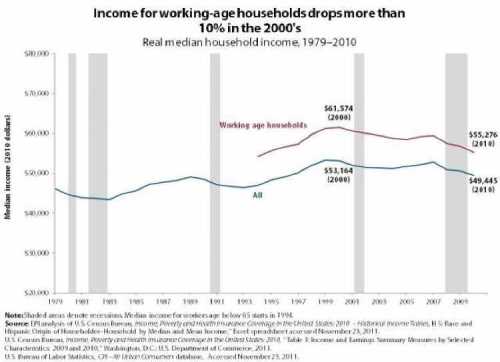
The issue of salaries and pay rates has been staring the slow economic recovery square in its ugly face. Mid-wage jobs – those averaging between $13 and $22 hourly –made up about 60% of the jobs lost during the recession. But, those same mid-wage jobs comprised about 27% of the jobs created since 2010. However, lower-paying jobs have dominated the job recovery – roughly 58%. Nearly 40%, or 1.7 million of the jobs gained during the recovery, are in three of the lowest-paying categories: food services, retail and employment services (e.g. office clerks, customer service representatives). All of this has not only decimated the American middle class, but has pushed the U.S. below Canada regarding middle class affluence.
A few other things bothered me about the facility where I worked. Because of the number of documents that arrive on a daily basis, the amount of paper is overwhelming. Should a fire break out, I thought, it could be catastrophic – and mainly because of one simple device: cell phones. People aren’t allowed to bring cell phones into the main production area. The reason is obvious: most cell phones now have camera features, and it would be easy for someone to snap a picture of classified documents. Therefore, anyone who enters the production area has to leave their cell phone in their vehicle, in a designated locker in the same building, or with security. But, along with the odd juxtaposition of desks, I also noticed fire exits weren’t clearly marked. People would be safe in the building should a tornado descend upon the property. But, if a fire erupted, I’m certain many people would head towards their lockers to grab their cell phones. Such a scenario reminds me of the 1911 Triangle Shirtwaist Factory fire in which 146 people (mostly women and immigrants) perished.
I arrived home from work one Friday to find a voice mail message on my cell phone from the staffing agency, telling me to call them immediately. The lock-box firm had pulled the job from me. The unit manager had accused me of being consistently late. His idea of “late” apparently is one or two minutes past the hour. I pointed that out to the staffing agency; emphasizing, though, that I made up the one, two or three minutes I arrived late. Moreover, I said, I’d already attained a 100% accuracy rate on the job. None of that seemed to matter. The agency was in a bind; they couldn’t refute whatever chicken-shit opinion the manager had of me.
It’s no great personal loss. I won’t exactly be seeking therapy because of it. Some things just aren’t worth the trouble. As this May Day comes to a close, it’s important to remember that people usually work too damn hard for their money. As the wealth gap in the U.S. widens, I don’t know how much longer this, or any truly democratic society, can deem itself civilized.
I knew when I turned 50 last November that I automatically qualified for membership in the AARP. But, it wasn’t until last week when I received a “Senior Information Update” mailer from some previously-unknown insurance firm that I realized I’m actually more than half past my life expectancy. The offer isn’t just for insurance. It’s for death insurance! I looked at the little rectangular piece of paper and responded the only way someone who doesn’t plan to die anytime soon would: “What the fuck?!”
As a teenager, I was a pretty good kid in that I respected my parents and other adults. But, I was a normal kid in that I often joked with my parents about their age. Then, one Christmas Eve at my grandmother’s house, I was talking with a second-cousin who was about 9 or 10. He was telling me about his new collection of video games. He then looked at me and said frankly, “Oh, I guess they didn’t have those in your day.”
No, they didn’t, I muttered quietly. And, go to hell, you little fucker!
I still thought it was funny and told both my mother and my second-cousin’s paternal grandmother (my father’s sister-in-law). My mother reacted as you might expect: “Ah-hah! Now, you know how age jokes feel!”
Okay, but kids say the strangest things. I looked at the mailer again and contemplated so many things about my life. Why did I end up an only child? Why wasn’t I born with purple eyes? Why did I develop allergies to ragweed, instead of alcohol? You know – the average, every day questions that only a Spanish / Mexican Indian / German bi-guy who likes dogs more than people and writes freaky stories about humanity’s irrelevance would ask.
But, death insurance? I haven’t even had health insurance since I got laid off from the engineering firm in October 2010! Now, I’m supposed to start planning for my death. Well, I suppose everyone should. The issue takes on slightly more significance once you reach age 40.
The father of one of my best friends died somewhat unexpectedly 10 years ago. He’d been sick for weeks, and my friend, James*, finally convinced him to make a doctor’s appointment. His father (like my father) was from that generation of macho men who didn’t go to the doctor until some body part was falling off. On the day his father was scheduled to visit the doctor, the old man decided not to go. James had taken off from work to drive him over there – and, at the last minute, his father said to hell with it. Whereupon he stepped into the front room – and collapsed. By the time paramedics got him to the hospital, he was dead. I later told James that his father probably sensed he was going to die anyway. Why waste a morning at the doctor’s office when you can drop dead in the comfort of your own home?
Neither of James’ parents had made funeral arrangements. He’d had a rough time just convincing them to compose wills. Again, they were from that generation where people just didn’t do that. But, amidst the grief of seeing their father convulsing on the floor and carried away in an ambulance, James and his family had to cobble together funeral arrangements within a matter of days. Under such circumstances, Dallas County doesn’t give families much time for planning and coordinating burials. They need that freezer space in the morgue for all the drug overdose and gunshot victims. After his father’s funeral, James managed to convince his mother to make her own funeral arrangements.
My parents took care of theirs years ago. They have their plots established at a local cemetery. But, me? I only have a will that gives everything to them, or – if they’re deceased – to be sold off with the proceeds going to the Texas SPCA. As I said, I like dogs more than people. If I could, I’d like to be buried in my white dinner jacket and entombed in my truck. But, I think I’d also like to be cremated and have my ashes embedded into a new kind of electronic device I’ll call the “I-Bod.” The “I-Bod” will be a mini-computer / Kindle-type device to be sold only to smart people who like to read and conduct actual academic-style research to help them learn and understand their world better. That means it’ll be a limited edition piece.
Here’s another thing people do more frequently when they get to that “Certain Age:” they read the obituaries. I’ve taken to glancing at them daily. A decade ago I just skipped that section, never giving it another thought. I’d only learn of someone’s death through a relative or a friend. But, that’s the way it is. For most people, our behavior changes as we age. I’ve grown more aggressive and less shy. In other words, I’ve turned into a mean old bastard! But, I still love dogs.
Remains of the West Fertilizer Plant are at the upper right.
Last Thursday, the 17th, marked a horrific first anniversary for the tiny Texas community of West, just south of Dallas / Fort Worth. On April 17, 2013, the town experienced a cataclysmic event that almost destroyed it. A fire at a fertilizer plant late in the day exploded, killing 15 people (mostly volunteer firefighters) and injuring more than 200 others. The physical impact was unbelievable. The blast registered as a 2.1-magnitude earthquake on seismographs in the region and could be felt up to 50 miles away. It carved a 10-foot crater in the ground beneath it. Windows up to 7 miles away were blown out. It obliterated two of its three schools and its one apartment complex. Several other structures were damaged so badly they had to be torn down.
As with any disaster, the psychological and emotional repercussions are immeasurable – and often irreparable. Small towns are usually like large families; yes, everybody seems to know your name and know your business. That sense of closeness frightens some people, yet it makes the town loveable.
But, amidst the trauma of recovery, West has entered into the lexicon of environmental protectionism and has become an unnecessary pawn in the battle between federal oversight and state independence. What happened in West last year is a perfect example of extreme business deregulation. It’s the result of corporate malfeasance and an entrenched conservative mindset that only companies understand what’s best for them and their communities and therefore, should be permitted to do whatever they please.
The West Fertilizer Company had supplied fertilizer and other chemicals to area farmers since its founding in 1962. Last year, just weeks before the explosion, Adair Grain bought the facility. The plant had last been inspected in 1985, when the Occupational Safety and Health Administration (OSHA) cited the plant for improper storage of anhydrous ammonia and fined it $30. In 2006, the Texas Commission on Environmental Quality (TCEQ) – the equivalent of a guard rabbit in a wolf pack – investigated complaints of ammonia smells originating from the plant and cited the owners for not having obtained proper permits for its two storage tanks containing that ubiquitous anhydrous ammonia. That same year the U.S. Environmental Protection Agency fined West Fertilizer $2,300 for a variety of problems, including failure to file a risk management plan. Just ten months before the explosion, the Pipeline and Hazardous Materials Safety Administration, an affiliate of the U.S. Department of Transportation, fined the company $5,250 for violations regarding storage of – you guessed it – anhydrous ammonia.
Since the EPA and the DOT are government agencies, they have few friends in Texas’ business world or in the state legislature. Texas’ pro-business stance is firmly carved into its culture. The state weathered the recent economic downturn better than most others and has produced more jobs and opened more businesses within the past year alone than any other state. In the months preceding the West explosion, Governor Rick Perry – still recovering from his pathetic 2012 presidential bid – dared to storm into the state of California and promote the “Lone Star State” as a more ideal place for business.
“Building a business is tough, but I hear building a business in California is next to impossible,” Perry said in a 30-second radio ad that ran in key California markets. “This is Texas Governor Rick Perry, and I have a message for California businesses. Come check out Texas. There are plenty of reasons Texas has been named the best state for doing business for eight years running. Visit texaswideopenforbusiness.com and see why our low taxes, sensible regulations and fair legal system are just the thing to get your business moving to Texas.”
He’s right to an extent. California, like Texas, is one of the world’s largest economies. Both states could probably secede (something Perry himself actually propositioned) and survive comfortably. But, California would have a tougher time. From a business perspective, it is the opposite of Texas: highly regulated and highly taxed. A close friend of mine tried to make California his home after leaving the U.S. Navy in the early 1990s, but had to leave, he told me, before he “ended up out on the streets.” A long-time acquaintance in Oakland once asked about the cost of living in Texas. Several years ago a cousin once told her mother (my aunt) that she wouldn’t mind moving to Texas if it wasn’t for the intense heat we experience during summer. She lived in upstate New York at the time and had tired of the heavy state income tax.
Perry’s efforts started paying off almost immediately. Texas commerce officials began receiving calls from California business owners, including some large companies, about details of relocating. California Lt. Gov. Gavin Newsom told a local radio station that Perry is “getting in our heads.” It’s certainly not just Perry’s charming accent; that lure of low taxes and limited regulations is too much to resist.
Then, came West.
An aerial view of the smoke plume on April 17, 2013.
Chemicals are dangerous things. There’s a reason a traditional skull-and-crossbones emblem is placed on containers holding them. After the 1995 bombing of the Oklahoma City federal building, the U.S. federal government tried to impose strict regulations on the sale and purchase of large quantities of ammonium nitrate – the key substance in the catastrophe. But, the efforts have been stymied – again by strong business interests that blame misuse and not the chemical itself. It’s similar to arguments by the National Rifle Association that further gun regulation won’t stop violent, gun-related crimes. In other words, guns don’t kill; people do. True, indeed. But, regulation addresses individuals who use said products. Again, regulation is a vile word in the business community. Among conservatives – the same ones who want to tell same-sex couples they can’t get married – regulation is tantamount to a deadly sin.
Intense deregulation has created some of the worst financial crises in U.S. history. After World War I (then called the “Great War”), a Republican-controlled U.S. Congress forced through legislation that allowed the financial industry to engage in bold new practices, such as “over-speculation.” President Woodrow Wilson seemed unable to stop it, especially after suffering a debilitating stroke in September of 1919 (a fact that remained hidden until long after his death five years later). But, while the irreverent behavior made the 1920s explosively lucrative for the nation, it ultimately led to the 1929 stock market crash and subsequently, the Great Depression.
The 1982 Garn-St. Germain Act allowed for almost complete deregulation of the savings and loans sector; they were allowed to partake in risky business practices, such as issuing credit cards and investing credit cards and investment in non-residential real estate loans. Many economic experts conclude the Act culminated in the savings and loans collapse that spilled into the early 1990s. Millions of dollars and millions of jobs were lost. At the turn of this last century, further deregulation of banking commerce, along with housing, incited the worst recessionary period since the Great Depression.
Extreme deregulation, however, can also be deadly. Beginning in the 1700s, the Industrial Revolution pushed many nations into a state of modernity they never expected. Steam engines, railroads and motorized vehicles slowly worked their way into both urban and rural areas. Such developments made life simpler for many people – and produced incredible fortunes for a handful of individuals and their families. But, it also created a cavernous divide among those at the very top who frolicked in their wealth and those who slaved (sometimes died) to create it for them. By the 1890s, the Anarchist Movement had arisen in Europe and, by 1900, had arrived in the U.S. When average workers called for better wages and safer conditions, the titans of industry literally scoffed at them.
Before then, however, his Vice-President, Garret Hobart, died in November of 1899. During his 1900 campaign, McKinley selected a curious and intriguing character as his running mate: Theodore Roosevelt. A rising star in the Republican Party at the time, Roosevelt is best remembered for his passion for land and nature conservation. But, much to the chagrin of his fellow politicians, Roosevelt also supported worker rights and safety standards in the workplace. Ironically, he got his chance to push that agenda after McKinley was assassinated in 1901 by León Czolgosz, a U.S. citizen born of Polish-Russian immigrants. Czolgosz was also an anarchist and had lost his job at a wire mill; where (according to various claims) he suffered a mental breakdown due to the horrific working conditions.
Anti-trust laws had come into place by the time Roosevelt took office. But, he brought it to new levels; thus earning him a reputation as a “trust buster.” It didn’t faze him. Long before he attained the presidency, Roosevelt had criticized the affluent in America. The continued exploitation of the public could result in violent uprisings that would, in effect, destroy the economy. He also condemned the arrogance of industry heads – the Vanderbilts, the Rockefellers, etc. – who apparently believed they were above the government. Some things don’t change, do they?
But, while American workers continued to get hurt and die on the job, the public as a whole didn’t realize how bad things were until the 1911 Triangle Shirtwaist Factory fire in New York City. In less than 20 minutes, a fire engulfed three of the building’s floors and killed 146 people – mostly immigrant women and girls. The sight of dead bodies both inside the factory and on the sidewalks outside (where several had jumped as a desperate attempt to escape the flames) was too much to bear. Cries for workplace safety reforms quickly rose up, and – just as quickly – the city and the state of New York responded with strict regulations. For the first time in U.S. history, fire codes were enacted, including requirements for designated exits and forbidding locked doors during working hours. (Locked doors were one of the primary reasons so many people died in the Triangle fire.) As usual, corporate executives complained; denouncing the new regulations as anti-business and detrimental to the country’s economic welfare. They dismissed the injuries and deaths as another cost of doing business.
The struggles for workers didn’t end there. Companies continued to find creative ways to ignore safety compliance demands. Brutal working conditions and low pay in California’s crop fields were what compelled César Chávez to lead the United Farm Workers strike in 1965; a strike that lasted five years and almost bankrupted California’s agricultural sector. The accidental deaths of two sanitation workers in a trash compactor are what led Martin Luther King, Jr., to Memphis in 1968.
Mining has always been a chief target for workplace safety regulations. In 1977, the U.S. Congress passed the Federal Mine Safety and Health Act. Admittedly, mining is an inherently dangerous profession; there are only a finite number of safety precautions that can be taken to ensure all the workers return home. But, beginning in the 1990s, mine owners pushed for relaxation of those standards; using the old conservative mantra that they stifle productivity. Under the administration of George W. Bush, they achieved much of what they demanded. Safety procedures that had been in place for years were either overturned or greatly reduced. For example, in 2001, the Bush Administration killed a proposal to test the viability of constructing conveyor belts of fire-resistant materials. Mining accidents and fatalities began to climb almost immediately, starting with the 2002 Quecreek Mine in Pennsylvania. No one died, but 9 men were trapped in the mine for 3 days.
Most recently, in 2010, 29 miners perished at the Upper Big Branch mine in West Virginia; the deadliest mining disaster in the U.S. in nearly 40 years. Some had survived the initial explosion, but suffocated to death when they became trapped. The mine’s owner, Massey Energy, had deliberately thwarted any attempts to enforce existing safety regulations, or impose new ones. In 2009, the government fined Massey $382,000 for “serious” violations of the 1977 Mine Act. Between then and the Upper Big Branch calamity, Massey received 57 additional safety infractions. None of that seemed to upset then-Massey CEO Don Blankenship. He sold his Massey stock for $21.24 million shortly afterwards and retired from Massey in December 2010. The following year he established another coal mining operation, McCoy Coal Group, in Kentucky. His arrogance and self-righteous demeanor shined brightly when he supported Mitt Romney’s 2012 presidential bid and threatened his employees that, if President Obama won another term, they’d all lose their jobs. He actually ordered them to vote for Romney, a direct violation of the 1965 Voting Rights Act.
Just two weeks after the Upper Big Branch calamity, the Deepwater Horizon oil rig in the Gulf of México exploded, killing 11 men and injuring 17 others. In the darkness, several workers were forced to hurtle themselves into the water several feet below. The rig burned for 36 hours before collapsing into the Gulf; subsequently pouring more than 200 million gallons of crude oil for nearly three months before it was capped. It was the worst oil spill in U.S. history. The sight of such a massive structure wrapped in flames was bad enough. But, flippant statements by Tony Hayward, then-CEO of BP (formerly British Petroleum), which operated the rig, once again proved the disconnected nature of corporate executives. Hayward initially deemed the spill “relatively tiny” in comparison to the “very big ocean.” Later, he bemoaned the extent of the crisis by saying he wanted “my life back.” He resigned in July of 2010, just as the spill was sealed off.
BP incurred $40 billion in fines and cleanup costs associated with the spill. But, it wasn’t the first. Just four years earlier, a BP facility had been the catalyst for a catastrophic oil spill in Alaska’s Prudhoe Bay. Some 212,000 gallons of crude oil had spilled from company pipelines on the North Slope. In May of 2011, BP paid out $25 million to settle the various claims against them.
In each case, the spills shouldn’t have come as an absolute surprise. Workers in Prudhoe Bay and on Deepwater had complained about various leaks and faulty equipment for weeks before the respective incidents. In each location, no one in authority paid much attention. But, just after some of the Deepwater employees made it to dry land, company officials started shoving papers in front of them to sign; documents that would absolve both BP and Transocean (the rig’s owner) of any liability. Fortunately, none of them fell for the trap.
In a way, I’ve seen the effects of irresponsible industrial business up close. For most of the summer of 2003, I traveled weekly to a small community in West Texas (not to be confused with the town of West) where I processed documentation for a defunct electrical firm. (Although it’s now a matter of public record, I still won’t mention any company names.) The business had built and installed electrical transformers for decades. No one ever thought much about the large trash-can-looking contraptions, until scientists realized the polychlorinated biphenyl-saturated oil used to insulate them was extremely dangerous. PCB has been linked to a host of ailments; its odorless and tasteless qualities making it virtually undetectable in the water and soil around the town where it had leaked. It was one reason why the local water bore a salty taste; a discomforting fact I learned quickly. I was even concerned about taking a shower and resorted to giving my then-year-old puppy cold bottled water I bought from a hotel vending machine. One woman with the local TCEQ office told me in confidence that her superiors in Austin had the toughest time reaching the community’s state and U.S. congressional representatives, both Republicans. “They just won’t return their calls,” she whispered.
I had to visit the site a number of times to procure documents and started to wonder if my life was in danger from just walking to and from the facility. The transformers sat untouched and rusting in a large, fenced-in area; where the sharp West Texas winds could pick up their PCB coatings and hurtle them anywhere.
A seismograph reading from Hockley, Texas, 142 miles (228 km) south-east of West, charts the temblor caused by the plant explosion.
Meanwhile, West continues recovering with the help of both state and federal money, as well as through the incredible outpouring of support from average citizens across the country; people who understand the frailties of human existence. Last year OSHA fined Adair Grain a paltry $118,300. The company had only $1 million in insurance and has not rebuilt. Two days after the disaster, Donald Adair, the company’s president, issued a formal statement of condolence. The town of West is now suing Adair.
But, even now, a year later, state officials are reticent to establish more regulations for the storage of dangerous chemicals. Texas is among a handful of states that doesn’t have a uniform fire safety code. It only requires counties with a population of at least 250,000 (and those bordering one) to have such codes. Still, a number of facilities across the state keep their highly volatile supplies of fertilizer and other chemicals housed within unstable structures, such as wooden barns and tool sheds. Adair didn’t have an automatic sprinkler in its fertilizer housing unit, but the company had installed security cameras to deter would-be methamphetamine dealers from stealing their product. The cause of the fire is still unknown, although officials believe a faulty golf cart may have sparked it. People will continue working in these places because many have no other means of support. They have only two choices: work in unsafe conditions, or go hungry and become homeless. What would you do?
A cell phone video captured the terror of the West explosion.
Tamerlan and Dzhokhar Tsarnaev had just about everything they wanted, when their family brought them here in 2002 from Dagestan. They grew up in a middle class environment in one of America’s oldest and most revered cities. Tamerlan was training to be an Olympic boxer, and Dzhokhar was an ordinary college boy. Then, something happened with them. The older brother, in particular, suddenly realized he didn’t like the American military’s treatment of Muslims overseas. Thus, he decided to take action: bomb his adopted home city. Now, he’s dead, and his brother is in federal custody after barely surviving a battle with police last year.
I understand that people don’t like U.S. foreign policy. Our attempts at colonialism and, later, with democratic influence has always led to anger and resentment. Yes, I get that. I really do. But, people who become enraged with a nation’s outrageous behavior abroad always forget one thing: it’s not the fault of the common citizen. The Iraqi government, for example, committed genocide in Kurdistan – not the average Iraqi.
Terrorists also underestimate the goodness and resilience of humanity. Did the Tsarnaev brothers really think Boston would collapse after they attacked the marathon? There are only a handful of things that can take out such a large city; earthquakes and meteors being the most likely candidates. But, two punks who turn on their neighbors? Hell, no! Hitler almost inadvertently destroyed his beloved Germany during World War II. Mussolini practically did the same with Italy. Both ended up dying alongside their mistresses; Hitler in his underground bunker, and Mussolini hanged and burned.
People die and get hurt in terrorist acts. They scream, cry and vow revenge. But, as a society, we always manage to gather ourselves together and move forward. So, all the hate and anger goes for nothing. It wrecks some lives and burns a few cars. Then – people move on with their lives. What’s it worth then? Why the desire to destroy someone and something that may have absolutely nothing to do with the hostilities?
When Europeans first began populating the Western Hemisphere, they viewed the indigenous people as little more than two-legged forms of the local wildlife. The Europeans brought their guns, diseases and self-righteous determination and subsequently tried to decimate entire masses of individuals who had occupied this region for millennia. They did wipe out large communities and deliberately killed thousands of people, often at once. But, they didn’t win. They couldn’t destroy everyone. Indian people survived.
It’s a little like the Boston bombing case. All the fury and holy indignation just didn’t succeed. It never does. That’s not the way humanity works.
On March 19, Fred Phelps, the patriarch and founder of the Westboro Baptist Church in Topeka, Kansas passed away at age 84. Goodbye and good riddance. I’m glad the old bastard is dead. It would be even better if the rest of his family could join him, but their time will come, too.
Westboro gained notoriety in the early 1990s as a rabidly anti-abortion and homophobic clan. They tested the limits of free speech with the simple act of protesting – a test that would take them to the U.S. Supreme Court. Westboro’s roots date back to 1931, when it originated as a branch of Topeka’s East Side Baptist Church. In 1955, however, Phelps broke ties with East Side and established Westboro.
As a biblical literalist, Fred Phelps held a very narrow view of the world and believed anyone who strayed from it was hell-bound. But, he wasn’t just some cantankerous loudmouth who adored media attention. He was a convicted criminal. In 1947, Phelps was a student at Bob Jones University, when he and some fellow pupils traveled to Vernal, Utah to try converting people from Mormonism. After Phelps gave a speech condemning the Mormon religion, a young man in the audience asked him a theological question. Phelps apparently didn’t know the answer and – as idiots are often wont to do – physically attacked the man. The scuffle almost incited a riot. In 1951, Phelps found himself in Pasadena, California, where he led a protest to make kissing in public a criminal felony. When a police officer told him he didn’t have permission to protest, the then-21-year-old assaulted him.
Phelps actually had a good start in life. He was a Boy Scout who earned the coveted Eagle Scout Award. He graduated from high school at age 16 and was admitted to the United State Military Academy in West Point New York. While there, however, he attended a Methodist revival meeting and decided to become a minister instead of attending West Point.
Phelps and his wife, Margie, met at the Arizona Bible Institute in 1951 and married the following year. They eventually had 13 children. Phelps went on to earn a law degree from Washburn University in 1962 and, ironically, developed a reputation as a civil rights lawyer. He even won an award from the NAACP for his work on civil rights cases. But, his career began to disintegrate in 1979, when he was disbarred in the state of Kansas for perjury. He spiraled further out of control with complaints of harassment, witness intimidation and more false testimonies, until 1987, when he was permanently forbidden from practicing law.
In 1991, WBC began its notorious and never-ending anti-gay crusade by protesting at Topeka’s Gage Park; claiming it was a hotbed of homosexual activity. Phelps and his gang seemed to cross a fragile line, however, when they began picketing at the funerals of AIDS victims around the same time. They bought into the right-wing evangelical mantra that AIDS was God’s condemnation of the homosexual lifestyle. Even those who staunchly opposed homosexuality found funeral protests a bit much. WBC harassed gay-oriented businesses, women’s clinics and other institutions they despised by repeatedly faxing – and later emailing – them obscenity-laced messages. Every time someone complained, WBC cited the First Amendment to the U.S. Constitution, which guarantees – among other things – the right to free speech.
For some free speech advocates, the WBC tactics raised troubling questions. Free speech is a critical element of a truly democratic society. The U.S. and other developed nations pride themselves on the right of their citizens to speak out; no matter how offensive the verbiage may be. The late comic Lenny Bruce pushed the bounds of free speech with racially-tinged topics and foul language during his live standup routines in the 1950s. He was arrested and fined on occasion.
In 1977, free speech took a darker turn, when a neo-Nazi group planned a march in Skokie, Illinois. Skokie wasn’t a random selection. After World War II, the Chicago suburb had become home to several survivors of Europe’s Nazi death camps. At the time, about 40,500 of the city’s estimated 70,000 residents were Jewish. To them, the sight of people proudly waving the Nazi swastika was a painful reminder of one of the 20th century’s worst periods. Led by Frank Collin, the neo-Nazi group, the National Socialist Party of America, applied for a permit to march on May 1, 1977. Concerned about the antagonism such an event would generate, the Skokie Board of Commissioners passed an ordinance requiring marchers to post a $350,000 insurance bond. NSPA sued, stating that the ordinance violated the Constitution’s First Amendment. The case made it to the Illinois Supreme Court, which upheld the Skokie bond resolution. NSPA pursued the matter to the U.S. Supreme Court, which overturned it, noting that free speech covered even hate speech.
Free speech came under review again in 1984, when Gregory Lee Johnson burned an American flag outside the Republican National Convention in Dallas. He was protesting the policies of President Ronald Reagan, which subsequently led to his arrest on charges that he violated a Texas statute preventing the desecration of venerable objects, such as the U.S. flag. Johnson sued, claiming the Texas law violated his free speech rights. The case landed at the U.S. Supreme Court in 1989, which ruled in his favor. At the time, I worked for a bank in downtown Dallas and, on my way to lunch one afternoon, encountered a group of patriotic young men who were, oddly enough, protesting the Supreme Court’s decision. They were some kind of ROTC-type group; attired in suits and banging drums to the tune of the “Star-Spangled Banner.” They were also gathering signatures for a petition to the Supreme Court, hoping somehow to get the decision reversed. I signed it, but thought about it later. Can free speech be so limited?
Fred Phelps, his family and their supporters were always on a mission. They hated everyone and protested everywhere. They believed strongly that the United States had a one-way ticket to the “Dark Side” because of its tolerance of abortion, adultery, homosexuality, non-Christian theologies and other vices. In their view, each natural- or human-made catastrophe was a sign of God’s wrath upon America. From such horrors as the terrorist attacks of September 11, 2001 to seemingly random events, like the 2003 nightclub fire in Warwick, Rhode Island, Westboro claimed God was sending an omen.
Their hatred reached a putrid climax when they began picketing at the funerals of military personnel killed in the Afghanistan and Iraq conflicts. Along with carrying their regular “God Hates Fags” signs (that’s actually the name of their web site), they also bore placards with such terms as “Thank God for I.E.D.s (improved explosive devices)” and “Thank God for Dead Soldiers.” Singing “God Damn America,” while dragging the U.S. flag on the ground, Westboro touched nerves of raw pain for the families of the dead. In 2006, Westboro made their way to Maryland to picket at the funeral of Marine Lance Corporal Matthew Snyder who had been killed in Iraq. Snyder’s father, Albert, stated he couldn’t tell what was emblazoned on the group’s placards, but learned about it from later news reports. Albert Snyder sued, claiming Westboro’s actions caused him great emotional distress. Phelps countered naturally that his church was merely exercising its free speech rights. But, a Maryland court agreed with Snyder and granted him a $10.9 million judgment against Phelps. Phelps appealed and got the decision reversed. Snyder pursued the case to the U.S. Supreme Court, which sided with Westboro.
I see one major problem with the Snyder case. The family sued for emotional distress, which is immeasurable. The case, as I saw it, centered on harassment, slander and stalking. WBC placed Matthew Snyder’s Marine Corps portrait on its web site juxtapositioned alongside various slurs like “fag” and “murderer.” They also traveled all the way to Maryland from Kansas for the sole purpose of picketing his funeral. But, the Snyder family focused on the emotional distress issue, instead of stalking and slander, which aren’t protected by free speech. Therefore, I can actually understand why the Supreme Court ruled in favor of Westboro.
“Let me put this in more common vernacular,” Shirley Phelps-Roper, one of Fred’s daughters, told a TV reporter during another picket. “He (Albert Snyder) got his feelings hurt.” She went on to explain that Westboro had no regard for the Snyder family’s “feelings.” I’m sure it’s mutual.
Six of Fred’s children, including Shirley, are lawyers. In fact, Shirley Phelps-Roper argued their case before the Supreme Court, which is highly unusual. Generally, litigants before the Court don’t present their own cases.
Four of Fred’s children, including his oldest son Nate, abandoned their family, which essentially prompted their excommunication from Westboro. I’m quite certain that didn’t hurt their feelings. When the Snyder case arose, Nate Phelps, an atheist, went public and denounced his family’s antics, calling the funeral protests “evil.” But, in a television interview, he also made a stunning accusation: his father had often beaten his mother, as well as him and his siblings. No one at Westboro validated his claims. But, that should surprise no one. Some of the most devoutly religious people are also among the most physically abusive. They use their religion to justify the violence.
I’ve always wondered if someone would put a bullet through the heads of Phelps or one his brood. People have slung rocks at them, and Phelps even got sprayed with mace during one protest at a gay rights march. WBC maintains a hefty travel account to support their activities; money that would be better spent, for example, funding education or feeding homeless people. But, just as you can’t tell people what to do with their money, you really can’t tell them how to practice free speech.
I sincerely hope Fred Phelps suffered a long and painful demise. I’m not religious – in the traditional sense – but I am spiritual and believe in an afterlife of some sort. I envision Phelps encountering the souls of all the people whose funerals he protested at or whose tragic deaths he celebrated on his voyage into the netherworld. I can see them waving with gentle smiles, as he descends into the darkness. The right to free speech is sacred to most freedom-loving people. But, it doesn’t guarantee a place on the lap of whatever god you worship.
In 2012, HSBC Bank USA N.A.agreed to a $1.256 billion settlement with the U.S. Justice Department for its failure to monitor the activities of drug cartels using the bank to launder their money. HSBC USA, which is headquartered in McLean, Virginia, and part of the international financial conglomerate known as HSBC Holdings, didn’t admit any wrongdoing (no surprise there), but agreed to the massive settlement to avoid prosecution. According to documents released by the DOJ, HSBC essentially violated the Bank Secrecy Act (BSA), the International Emergency Economic Powers Act (IEEPA) and the Trading with the Enemy Act (TWEA) by not adhering to anti-money laundering measures and by not conducting appropriate due diligence of its foreign account holders as required by U.S. banking laws. In other words, they simply looked the other way while gladly accepting customer deposits and didn’t ask any questions.
HSBC (formerly the Hong Kong and Shanghai Banking Company) traces its roots to the ambitions of a Thomas Sutherland, a Scotsman with the Peninsular and Oriental Steam Navigation Company. Realizing the need for solid banking facilities in the Orient, Sutherland founded the Hong Kong and Shanghai Banking Company in Hong Kong in March of 1865. He opened its Shanghai affiliate a month later. Within a few years, the entity grew to become the largest financial institution in Asia. In 1992, the corporation acquired London-based Midland Bank and evolved into the present-day HSBC Holdings PLC.
Law enforcement officials in the U.S. and other nations like to talk tough when discussing the multi-national drug war. In June of 1971, President Richard Nixon formally declared a “war on drugs,” a direct response to the increased usage of marijuana, LSD and other narcotics. He advocated mandatory sentencing for even minor drug possession offenses and no-knock warrants. However, in 1972, an independent commission recommended decriminalization of marijuana and allowing it for personal use. Nixon, of course, balked at the idea. But, between 1973 and 1977 eleven states decriminalized marijuana possession. In October of 1977, the Senate Judiciary Committee voted to decriminalize marijuana possession for anyone caught with no more than an ounce of the drug. President Jimmy Carter tried to focus attention on treatment instead of imprisonment. But, by the 1980s, the tide had begun to shift against such reasonable approaches. Many parents were growing concerned about the rising rates of marijuana usage among teenagers. Ronald Reagan came into office in 1981 promising to intensify the war on drugs. The number of people jailed for drug offenses skyrocketed from 50,000 in 1980 to 400,000 in 1997. Even First Lady Nancy Reagan jumped into the fray with her quaint but laughable “Just Say No” campaign.
Today, the United States spends an average of $51,000,000,000 annually to combat illegal narcotics possession, transport and sales. In 2012 alone, 1.55 million people were arrested in the U.S. for nonviolent drug charges. We have more than 2.2 million incarcerated (more than any other nation), mostly on drug charges. The U.S. – Mexican border has become highly militarized. Both people and dogs are trained to detect illegal narcotics stored away in suitcases and vehicle glove compartments. Traffic flows on border crossings between the U.S. and México has slowed dramatically in the past decade, due primarily to drug searches.
But, we’ve seen no improvement. Drug usage in the U.S. remains high. So does the violence. The crack cocaine epidemic that exploded in the 1980s has metamorphosed into a seemingly persistent state of bloodletting. By the turn of the century, the narcotics trade had migrated from such far-flung places as Bolivia and Columbia to México. In 2006, Mexican president Felipe Calderónlaunched his own war on drugs. And, that’s when things worsened. The level of violence resulting from this half-hearted venture has culminated in the deaths of at least 100,000 people and the disappearance of more than 20,000 along the U.S. – Mexican border. México already has a reputation for police corruption, but the average Mexican citizen is vulnerable to the fierceness of drug cartels. Border towns have become especially dangerous. Even people who aren’t involved in drug activities can fall victim to the violence. Ciudad Juarez, just across the Rio Grande from El Paso, Texas, is one of the most dangerous cities on Earth.
But, this all goes back to the banks. Mexican drug cartels are not only incredibly brutal; they’re also unbelievably wealthy. Joaquin “El Chapo” Guzman Loera, former head of the Sinaloa cartel who was captured recently in México, had the unique distinction of being on the United States’ “Most Wanted” list as well as one of the richest people in the world, according to Forbes. In fact, Forbes estimated that the Sinaloa cartel’s annual revenue exceeds $3 billion.
People often ask where all that money originates. But, I always wonder where it’s stored. This isn’t digital currency, as in “bitcoin.” They’re hard dollars. U.S. paper currency is rectangular-shaped and measures 2.61” wide by 6.14” long with a thickness of 0.0043”. A stack of 100 pieces of U.S. paper currency, therefore, would stand 43” (3’ x 7”) high. If you multiply that into the billions, then it becomes obvious that the money not only weighs a lot, but it takes up a great deal of room. Where would one keep, say, a million dollars in hard currency?
Enter the duplicity of the banks. Drug cartels wouldn’t be able to operate and function without seeming impunity if financial institutions actually enforced laws regarding cash deposits, which are lengthy and detailed. Banks must notify the government if they receive $10,000 or more in a single cash deposit. They must also report to the government any cash withdrawals of that amount. They have to file a Form 8300 within 15 days after such a transaction. But, the laws grow vague regarding “suspicious activity.” If a customer suddenly starts making cash withdrawals in the thousands, for example, the bank is legally obliged to report it. That, however, leaves it up to the institution.
When I worked for a major bank in Dallas, each associate was required to partake in a money laundering seminar every year. We viewed videos and slide presentations of how money is surreptitiously moved through a bank to avoid detection of criminal activity. The “know your customer” rule was hammered into us. In retrospect, I realize my colleagues and I were on the low rung of the financial totem pole. Technically, we were the first line of defense. But, do the same rules apply to the executives who actually run the company?
In 2010, Wachovia Corporation, another large U.S. banking conglomerate, agreed to pay $160 million in forfeitures and fines after officials accused it of “willfully overlooking” the suspicious nature of $420 billion in transactions between the bank and Mexican currency-exchange houses. The movement of that much money should have alerted Wachovia associate to a nefarious undercurrent. But, it didn’t. Or, maybe it did, and no one bothered to investigate further. I suspect Wachovia and other banks often know exactly what’s going on with the transfer of so much money, but deliberately ignore it. Are drug cartels that intimidating? Or, is the lure of vast cash reserves just too great of an opportunity to pass up? Perhaps, it’s both.
The fiascos involving both HSBC and Wachovia remind me of Bank of Credit and Commerce International (BCCI), an international banking organization established in Luxembourg in 1972 by a Pakistani financier, Agha Hasan Abedi, with offices in London and Karachi. Within a decade, BCCI boasted more than 400 branches in 78 countries and assets over $20 billion in assets. But, its goals were purely criminal. BCCI deliberately avoided regulatory oversight in the countries in which operated for the express purpose of enriching its executives and shareholders. But, it all came to an extraordinary end in 1991 as bank regulators in seven nations became fully aware of BCCI’s activities and began shutting down its operations. It was one of the boldest and most flagrant acts of financial malfeasance the world had ever seen. Critics joked that BCCI stood for “Bank of Crooks and Criminals International.”
Every day in America someone gets arrested for minor drug possession. These individuals aren’t the brains behind the giant drug cartels wreaking havoc on the citizenry. They’re usually people just trying to make some quick cash, or hoping to get relief from the traumas of their everyday lives. Yet, they’re the ones who get caught up in the criminal justice system and are sent off to prison. The people inciting drug-fueled violence aren’t necessarily the ones stalking dusty streets and dimly-lit back alleys. They’re the folks in business suits, lunging in corner offices.
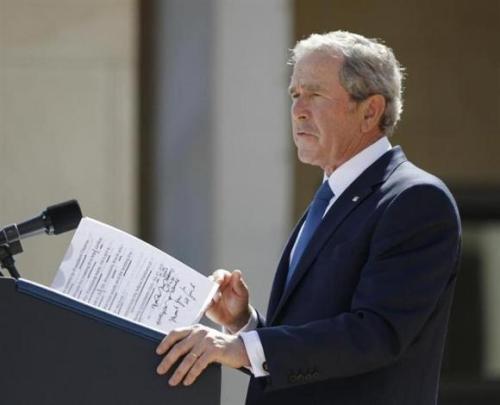
George W. Bush delivers remarks at the opening of his library in Dallas on April 25, 2013.
“I no longer feel that great sense of responsibility that I had when I was in the Oval Office. And frankly, it’s a liberating feeling.” – President George W.Bush, to a high school graduating class in Roswell, New México, May 2009.
Countless numbers of Americans, especially several military families, wish we could liberate ourselves from the dismal legacy of the Bush Administration. Unfortunately, we’re stuck with it. But, survivors of military personnel killed in the Afghanistan and Iraq Wars bear relentless pain and anguish. Anyone who enters the military has to accept the fact that they could be called to war and therefore, prepares as best they can for it. Their parents, spouses, children and other relatives try to prepare themselves, too. But, it’s still not easy losing a loved one to a foreign conflict.
Recently, Bush launched an initiative to help our military veterans transition back into civilian life as smoothly as possible. My own conversations with past veterans made me realize how difficult this can be. Through his Bush Institute, the 43rd president is imploring companies to recruit and retain military veterans, believing their tendency towards self-discipline and teamwork makes them among the best employees.
“We’ve got a problem, too many vets are unemployed,” said Bush. “There’s what we call a military-civilian divide.”
He just figured this out? It’s a noble cause, though. The unemployment rate for military veterans remains around 10% as of 2013, compared to 7% for the general population. A few times in recent years military veterans working for staffing agencies have contacted me about various technical writing positions. The moment I hear them say they were in the military, I stop the conversation and tell them how much I appreciate their service. It usually catches them off-guard. But, in turn, they appreciate just hearing someone tell them that.
However, Bush has gone further and also issued a challenge to the medical community to drop the word “disorder” from the term “post-traumatic stress disorder.” PTSD is a relatively recent term in the lexicon of psychological afflictions. It used to be called “shell shock” or “battle fatigue.” Many thought it was just a phase; almost an imaginary disorder. But, it’s real and it’s painful for its sufferers and the people closest to them.
Bush, nonetheless, believes the “disorder” word stigmatizes the affected individual and makes them sound defective, or unable to be rehabilitated; therefore, he states, they may have trouble finding work in an already-fragile job market from employers who are weary of difficult people.
Gosh, how thoughtful. It’s also hypocritical. Like his Vice-President, Dick Cheney, Bush used just about every excuse to avoid military service when his country called upon him more than four decades ago. An average high school student and occasional troublemaker, Bush managed to enter Yale University in 1964 and graduate four years later with a business degree. Upon his graduation, his draft deferment ended. The nation was mired in the depths of the Vietnam War, with public sentiment against the conflict (and the men who served there) becoming more vehement. Still, Bush managed to secure a relatively cushy spot in the Texas Air National Guard. Large numbers of young men were trying to do the same, and – according to some records – all of the spots in the Guard were taken. I guess it didn’t hurt that his father was a U.S. congressman at the time. Bush reenlisted in 1972 and was honorably discharged from the Guard two years later. Questions remain about his level of attendance and whether or not he even completed his service. His military records mysteriously vanished, and the Pentagon later claimed they were inadvertently destroyed.
I’ve always found that to be a rather convenient explanation. A friend who served in the U.S. Air Force for twenty years, including several tours of duty in Vietnam, still has his military records. All military personnel, he told me and several others more than a decade ago, are legally allowed to keep copies of them.
Dick Cheney, on the other hand, never did even that much. He garnered five military draft deferments around the same time: four educational and one because he was a new father. “I had other priorities in the 60s than military service,” Cheney said in 1989.
Words and actions always come back to haunt people. I understand that no one wants to go into battle. War is ugly and dirty; it is one of the most vile of human interactions. But, hearing Bush trying to make nice with the people he sent to war is revolting.
The Iraq War is the crux of my anger. It’s a conflict based solely on lies and innuendoes. Abusing the international support brought on by the September 11, 2001 terrorist attacks, the Bush Administration created a tenuous link between Al-Qaeda and Iraqi dictator Saddam Hussein. I believe the sole purpose was to gain access to the vast reserves of oil beneath Iraqi soil. Proof comes in the fact that Halliburton (the energy conglomerate that Cheney headed before resigning in 2000) received a slew of no-bid government contracts. For example, almost as soon as the U.S. invaded Iraq in March of 2003, the Army awarded Halliburton a no-bid contract to rebuild Iraq’s infrastructure. Boots had just hit the sand and blood was still dripping while gilded corporate executives were salivating over big payouts. While not necessarily illegal, no-bid contracts are certainly unethical and, in this case, highly suspicious.
War is fought by the grunts on the ground, but it’s waged by well-dressed power brokers in far-away skyscraper office suites whose idea of pain and agony is a paper cut. It’s pretty much been that way for the past century.
As part of his retirement from public life, Bush has taken to painting. He took up the hobby almost as soon as he departed the White House. While his works may not earn him a spot in “International Artist” magazine, they’re being prominently displayed – (where else?) – in his presidential library.
In the spring of 2005, my-then supervisor at an engineering company, a coworker and I lived and worked in northeastern Oklahoma on a special project for the government agency where our firm had a contract. We’d fly into Tulsa, rent a car and drive to the hotel in the far northeastern quadrant of the “Sooner State.” One morning, as we prepared to board a flight in Dallas, I noticed a large group of people in military fatigues gathered nearby. After a few moments of observing them, I approached the group and personally thanked each of them for their service. They all seemed genuinely surprised that I – a total stranger – would do something like that. But, it meant a lot to me that they were making such personal sacrifices. In retrospect, I wonder how many returned alive, or at least undamaged. I guess I’ll never know.
I’ll keep thinking about them, though, and I hope Bush just keeps painting. He and the other clowns in his administration have done enough damage.
The mid-term elections are upon us here in the U.S. That means – as has been the practice for the past quarter century – that candidates shout at the voters in declaring why the other person is so much worse than they are. This trend gained momentum during the 2000 presidential campaign in which then-Texas Governor George W. Bush narrowly triumphed over Vice-President Al Gore. It was the closest presidential elections in U.S. history, and Bush couldn’t have won if his campaign staff hadn’t demonized Gore and ultimately convince the Supreme Court to circumvent the electoral process and proclaim Bush the winner. Under the direction of Karl Rove, Bush’s campaign apparently had to besmirch Gore’s reputation, since Bush had no other redeeming qualities. He was a failed businessman, a one-time failed congressional candidate and a former part-time owner of the Texas Rangers. His years as Texas governor were pretty much uneventful and marked by only three notable highlights: an increase of the speed limit on Texas highways; a law legalizing the right to carry firearms; and the execution of a woman for the first time in over 130 years. That was it; that was the extent of his professional resume. If he’d tried to run on that legacy alone – and if voters had actually paid attention to it – Bush probably would have lost to Gore.
The Rove sludge machine didn’t stop with the 2000 presidential elections though. They went on to denounce the reputations of other political candidates, such as Max Cleland, a military veteran who lost three limbs in the Vietnam War. Cleland, a Democrat, had served as a U.S. senator from Georgia from 1997 – 2003. But, during the 2002 mid-term elections, his patriotism was questioned – and he subsequently lost amidst a wave of hysteria following the September 11, 2001 terrorist attacks. That a combat war veteran who nearly lost his life should have his patriotism and thereby, his credibility questioned against a president and vice-president who used just about every excuse imaginable to avoid military service during the same period is obscene and hypocritical. But, that’s how the Rove gang operated; they couldn’t run a decent campaign to highlight their candidate’s accomplishments.
The same questions of patriotism befell U.S. Senator John Kerry when he ran for the presidency in 2004. Also a military veteran who had served in Vietnam, Kerry came under attack from a group called “Swift Boat Veterans for Truth.” The group of former Vietnam War veterans was convened strictly to help Bush defeat Kerry. Financed by wealthy political donors, SBVT questioned Kerry’s credentials as a combat sailor during the Vietnam conflict and thereby insinuated that he wasn’t worthy of the Navy medals he’d received. Among their benefactors was Texas billionaire oilman T. Boone Pickens who added dirt to the mud pool by offering $1 million to anyone who could disavow the SBVT allegations. When another group of Vietnam veterans finally proved that Kerry’s military credentials were impeccable, Pickens reneged on his challenge, saying the information wasn’t verifiable; thus proving no one is too old to be a punk.
Kerry, of course, made things bad for himself with his varied verbal fumbles – not nearly as bad as Bush, though. At least Kerry knows how to pronounce the word “nuclear.” Kerry initially didn’t authorize release of his military records to the public, even though it may have helped his campaign. He finally released them in 2005.
There was a time that even I remember when a military veteran’s credibility was not something you questioned. I also recall that politicians used to debate the issues and not each other’s reputations. Things rarely got personal in high-profile political elections. When they did, whoever made the unsavory accusation or dredged up some dirt from the past was pretty much shamed into obscurity. Now, that seems to be the standard for running a campaign.
As the political season got underway here in Texas late last year, the state Republican Party quickly found itself in a curious state of division. In 2002, Republicans gained control over the Texas legislature for the first time since Reconstruction. If you listened to the state GOP, they sounded like a group of impoverished Jews who’d finally defeated the Nazis in post-World War II Europe after a century of oppression and brutality. But, the traditional Republican Party is now under attack from the “Tea Party,” a pack of extremists who formed in 2009 – conveniently – when Barack Obama took office. The “Tea Party” clan has denounced all elected Republican officials as RINOs (Republicans in Name Only). In other words, the standard GOP isn’t right-wing enough. It’s like Stalin calling Hitler a pot-smoking, tree hugger. To me, the only different is that “Tea Party” Republicans haven’t gotten their required rabies shots yet and keep forgetting to wipe their asses.
It was interesting to watch Texas Republicans try so hard to out-conservative one another. Each one (a White male) running for a statewide office lambasted his opponent as a (gasp!) Washington liberal who doesn’t support traditional (Christian) values. Ironically, they all had two things in common: they hate Obama and love the Second Amendment to the U.S. Constitution. Televised campaign ads showed many of them on hunting trips, waving guns like they were their penises. As a writer and left-of-center blogger, I have a fetish for the First Amendment, which guarantees free speech and the right to vote. But hey, I’m just kind of queer like that.
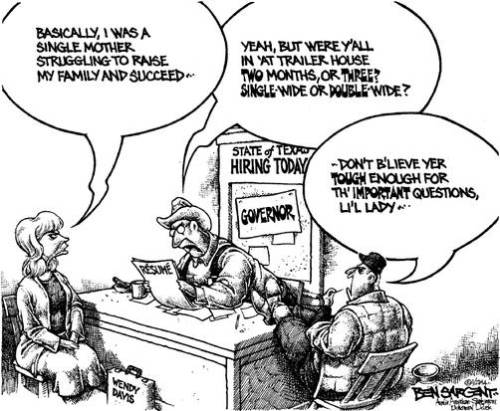
Last year I lamented how voter turnouts were lower in 2012 than in 2004 and 2008. More importantly, on average, only about a third of eligible Texas voters make a concerted effort to get to the polls. That explains why Texas appears to be a bastion of right-wing lunacy. The lone Democrat running for Texas governor, Wendy Davis, has already been labeled a one-issue candidate (because of her filibuster last year of a restrictive abortion bill), but questions arose recently about the veracity of her life story. Some were upset that she had said she was 21, not 19, when she and her husband divorced. In fact, Davis and her husband separated when she was 19; their divorce became final two years later. Do little things really mean a lot? That she lifted herself out of poverty by forging ahead with a college education apparently says nothing about her personal fortitude.
But, instead of talking bad about their opponent, why don’t candidates promote what’s good about themselves? Tell us voters what good things you’ve done for your community. Although Texas has recovered more quickly from the recent economic downturn, what ideas does each candidate have to maintain that level of productivity? The Republican candidates despise the Affordable Care Act, but what solutions do they have for ensuring that all Texans have access to health care beyond a hospital emergency room or Band-Aids from Wal-Mart?
Is it really too much to ask that these people show some level of professionalism and focus on the issues? I guess so.
“Ugliness creates bitterness,” former First Lady Claudia “Lady Bird” Johnson, a Texas native, once said. “Ugliness is an eroding force on the people of our land. We are all here to try to change that.”








 Chief Writing Wolf