Category Archives: Essays

Middle East Morass

Here we go again – more violence in the Middle East.  In case you’ve been in a coma, or preoccupied by Dancing with the Stars, Egypt is in another uproar; this time because President Mohammed Morsi has issued a mandate that grants him more political power.  This comes less than two years after Egyptian liberation activists forced Hosni Mubarak to resign, following a nearly three-decade reign.  Then, the “Arab Spring” erupted, as one country after another in the region started demanding truly democratic states; free speech, free elections, the freedom to walk down the street and not be hit by a car bomb.  But, just as things seemed to settle down – and they always just seem to settle down – Israel and Palestine have begun fighting once more.  Yawn – so what’s new?

Years ago, when I worked for a bank in downtown Dallas, I’d set my VCR to record the CBS Evening News.  I often made it home, as the VCR was recording, so I’d just lay down for a quick nap.  But, whenever news of the day’s events came to the Middle East, I’d just fast-forward the tape.  I didn’t want to hear – again – what crap was ablaze in that part of the world.  And, that part of the world is always ablaze.  If news reports of the region don’t show scattered body parts and ambulances swinging around street corners, I tend to think the end of the world has come and I didn’t check my email in time.

Just like every U.S. president since Richard Nixon has longed to end America’s dependence on foreign oil, every U.S. president since Richard Nixon has sought peace in the Middle East.  In the waning days of their respective administrations, Bill Clinton and George W. Bush became determined to draw up peace treaties.  But, Jimmy Carter came closest of any Chief Executive with the Camp David Accords.  In 1978, he succeeded in bringing Egyptian President Anwar Sadat and Israeli Prime Minister Menachem Begin together to discuss two plans of action:

(1) a framework for the conclusion of a peace treaty between Egypt and Israel and;

(2) a broader framework for achieving peace in the Middle East.

The first provided for a phased withdrawal of Israeli forces from the Sinai Peninsula and that region’s full return to Egypt within three years of the signing of a formal peace treaty between the two countries.  It also guaranteed the right of passage for Israeli ships through the Suez Canal.  The second was a more general framework (with vague terms) for Israel to gradually grant self-government and/or autonomy to the Palestinians in the Israeli-occupied West Bank and Gaza Strip and to partially withdraw its forces from those areas in preparation for negotiations on their final status of autonomy after a period of three years.  The two countries had been in an almost perpetual state of conflict since the 1956 Suez War, which had ultimately led to the 1967 “Six Day War.”  Israel invaded Egypt in May 1967, after the latter had forced the United Nations to withdraw from the Suez region.  Israel believed Egypt was about to attack them, so it engaged in what is now called a preemptive strike.

That’s how it’s been ever since.  The history of the Middle East is long and complicated, as you might expect from one of the birth places of modern humanity.  Early Egyptians built one of the most advanced and complex societies in the ancient world; they created one of the earliest forms of writing.  The ancient Israelites had lived in the area for thousands of years.  But, scores of powerful societies – from the Babylonians to the Romans to the Ottoman Empire – gradually forced them out in different waves over extended periods of time.  The British were the last; leaving in 1948, as the new Israeli state took shape.

Thus, I hate to see that entire region engulfed in a continuing state of war.  It’s one of the most culturally and archeologically significant places in the world.  I was upset, in early 2001, when the Taliban destroyed some of the oldest pre-Islamic statues in Afghanistan, including a 2,000-year-old, 165-foot-tall Buddhist masterpiece.

Since its founding as a formal nation in 1948, Israel is always fighting someone.  But, it seems they have no choice; they’re surrounded by enemies.  And, Israel is a small country, both geographically and population-wise.  Like every other nation, it has a right to exist in peace.  Its people have endured plenty of suffering, too; bounced around like trash sometimes; forced to move from one place to the next, while trying to maintain their unique
cultural identify and personal dignity.  The Nazi Holocaust of World War II compelled many Jews to flee Europe and settle in the area generally known before 1948 as Palestine.  They sought to establish their own homeland.

I actually support Israel.  They are the only true democracy in the Middle East.  They have the highest standard of living in the region and one of the highest in the world.  They also have one of the best national policies: every one of their able-bodied, able-minded citizens must serve in one branch of their military.  I feel the U.S. should adopt the same strategy, although wealthy conservatives, bleeding heart liberals and angry feminists would throw a fit.

But, I’m tired of it.  I’m tired of this Middle East mess.  I’M REALLY TIRED OF IT!  Like presidential campaigns and Thanksgiving turkeys, it’s never-ending.  And, the entire world seems to stop and pay attention when a bomb goes off or a solider is kidnapped – which I’m sure is how Israel, Palestine and all the others like it.  At the start of the 2007 – 2009 Israel – Palestine conflict, even HLN’s Nancy Grace took time out from looking for missing White females to talk with Christiane Amanpour about the fighting.  I literally did a double take.  What the hell was Nancy Grace doing involved in that shit?!

But, that proves how much attention the Middle East garners whenever things go awry – which is all the time.  It’s the same conflict – the same issues – the same level of anxiety – and the same results.  People die, and the streets are bloodied.  Israel holds up its hands, saying they had no alternative but to defend itself, and Palestine, Egypt, or whoever claims they’re fighting for their own self-preservation.  Nothing changes.  Yet, the U.S. keeps jumping in to save Israel and work towards elusive peace agreement.

I don’t know what’s going to happen next – aside from more bloodshed and name-calling – and I don’t know what can be done about it.  But, sometimes I wish the U.S. would just stay the hell out of it.  I know that won’t happen.  But, I have these wild dreams sometimes and I like to think they can actually come true, if people would just listen to me.

Image courtesy of Olle Johansson.

Leave a comment

Filed under Essays

First Thanksgivings

A depiction of the 1565 Augustine, Florida Thanksgiving.

Americans know the story.  The Mayflower Pilgrims – thankful to survive, first, a brutal voyage across the Atlantic and, second, a nasty winter sat down with a group of locals (a.k.a. Indians) and had a bountiful feast of food.  Like many American legends, it’s a mixture of truth and hyperbole.  But, as time progresses and historians research more, Americans are starting to realize they actually may have experienced more than just one “First Thanksgiving.”

Along with Thanksgiving, descendants of the Mayflower like to claim they established the first permanent European settlement in what is now the United States.  They’re wrong on both counts.  Long before the Mayflower even set sail, Spanish explorers had spread throughout much of present-day Latin America and what is now the southwestern U.S.  In 1565, Don Pedro Menendez de Aviles arrived in northeastern Florida.  He named the stretch of land near the inlet in honor of Augustine, a saint of the Roman Catholic Church; it was on Augustine’s feast day – August 28 – that Menendez de Aviles and his crew had sighted land.  Menendez de Aviles and his contingent of some 1,500 mostly military personnel encountered the Timucuan Indians who had occupied the region for millennia.  The Spaniards had brought pork, olive oil and wine, but the Timucuans helped them gather oysters and giant clams.  At some point immediately afterwards, the two groups feasted together.  The city eventually became St. Augustine, and today its residents declare they are home to the nation’s first Thanksgiving celebration.

At Texas’ westernmost point sits the city of El Paso, where humans first settled around 10,000 B.C.  In March of 1598, another Spanish explorer named Don Juan de Oñate led an expedition across the Chihuahua Desert, hoping to colonize regions north of the massive Rio Grande.  After a 50-day trek, Oñate and his entourage of roughly 500 people, including several children, arrived in the area of contemporary El Paso.  Most were barely alive.  They’d exhausted their supplies of food and water; a rain shower saving them at one point.  Once they reach the El Paso area, though, conditions and circumstances improved.  The indigenous Tigua Indians helped the Oñate group capture wild game and fish.  After several days of recuperation, Oñate ordered a feast to venerate the expedition’s survival.  On April 30, 1598, the Spaniards and the Tiguas celebrated together.

A member of the expedition wrote: “We built a great bonfire and roasted the meat and fish, and then all sat down to a repast the like of which we had never enjoyed before. . . We were happy that our trials were over; as happy as were the passengers in the Ark when they saw the dove returning with the olive branch in his beak, bringing tidings that the deluge had subsided.”

In April of 1989, the city of El Paso began honoring the Oñate celebration, laying claim to that coveted “First Thanksgiving” mantle.  But, Florida and Texas aren’t alone.

The state of Maine also stakes a claim to the “First Thanksgiving” on the basis of a service held by colonists on August 9, 1607, to give thanks for a safe voyage led by George Popham.

Connecticut may be the first state to set aside an official annual day of general thanksgiving.  Some records claim the first proclamation came on September 18, 1639.

In 1630, the Massachusetts Bay Colony observed a special day of prayer that is now often called the “First Thanksgiving.”  Even earlier in Florida, a small colony of French Huguenots living near present-day Jacksonville noted a special thanksgiving prayer.

Virginians are convinced their ancestors celebrated the first Thanksgiving when Jamestown settlers in 1610 held a religious service and a feast honoring their survival of a harsh winter.

President Abraham Lincoln may have declared the first official Thanksgiving holiday in 1863.  But, along with Connecticut, Maine, Massachusetts and Virginia, the states of New Hampshire, Rhode Island and Vermont all had annual thanksgiving observances before the 19th century.  New York joined them in 1817, and soon afterwards Illinois, Indiana, Iowa, Michigan and Wisconsin followed.

Centuries ago, our ancestors didn’t think much about the far future – not to the same degree we do now.  They were glad to survive one day at a time.  Feasts of thanksgiving – surviving a harsh winter, a summer, or a monsoon – were always reasons to celebrate.  Our predecessors understood how dependent they were upon the world’s natural elements; they never felt they could control the wind and the rain.  They were at nature’s mercy.  And, everyone should be thankful for that.

Image.

Leave a comment

Filed under Essays

Barack Obama – The Unintentional Martyr

From the moment Barack Obama declared his campaign for president in 2007, the hate mongrels came out of the sewers and began attacking him.  That happens every election cycle here in the United States.  But, this time was different.  It became particularly vicious.  The level of animosity was so intense the Secret Service granted him protection almost immediately.  It was the earliest in which the agency had ever provided security to a presidential candidate.  Technically, Hillary Clinton holds that record, but – as a former First Lady – she already had Secret Service protection.  Then, Obama won, and the hate got worst.

I think it shocked many old time politicians – especially in the Southeast – that even a half-blooded Negro could attain the highest elected office in the nation.  Yes, in most cases, it really is about race.  But, it appalled many in the old guard; the self-proclaimed protectorates of all that is sacred and holy in America who cry freedom and independence for everyone in this great land, but – deep down inside – only reserve it for a handful of select individuals.

This kind of sentiment was the genesis for the “birther” movement and ultimately the Tea Party crowd.  They didn’t like that Barack Obama’s father had been born in Kenya, a nation on Africa’s eastern flank.  But, although his mother was born and raised in Kansas, the birther clan insisted the junior Obama was born in Kenya, too; that his parents had met here in the U.S. and then – for some ungodly reason – traveled all the way back to Kenya to have their son and then, returned to the United States.  In other words, it’s part of some vast left-wing conspiracy.  Notice the birther goons didn’t highlight the fact that John McCain was born in the Panama Canal Zone, or make an issue of the fact Mitt Romney’s father was born in México.  In the minds of these people, it seems Latin America is a despicable entity on the same scale as Africa.

Many Black Americans collectively shook their heads at the fiasco.  It’s an extension of the belief that many Blacks – as well as others – always get special treatment from the federal government; that things are handed to them on a silver platter and they really haven’t had to work for it.  In other words, they’ve done something outside of the norm to achieve their success.  It’s not genuine; it’s manufactured.  They couldn’t possibly have done it on their own; they had to have help.  Whenever disenfranchised groups have succeeded in business or politics, questions often fall upon the veracity of their accomplishments.  Did they really do all that work?  They couldn’t possibly have the same degree of intellect and fortitude as White males.  It’s affirmative action gone awry.

Thus, when Obama won in 2008, many of the old guard claimed that something dubious must have occurred.  I suspect if Obama had been a full-blooded Caucasian whose father was born in Europe, we wouldn’t be having this discourse.  But, even if, say, he was a full-blooded Negro whose father had been born in Nashville or Atlanta with the surname Smith, I’m sure someone somewhere would cry foul.  Obama just can’t win that particular battle.  Bigotry is as tough as a diamond sometimes; it takes so much pressure to break it.

But, despite the unpleasant nature of it all, it’s a necessary dilemma; a requisite bad chapter for our nation to undergo as we continue our march forward.  We’ll probably encounter this same mess with the first Hispanic president (Ann Coulter’s worst nightmare), the first Native American president, the first Asian, the first female, the first Jewish, the first Muslim, the first Hindu, and the first openly gay or lesbian.  They’ll all face similar angst from the old guard who just don’t like the fact America is becoming more diverse and can’t believe that anyone aside from White heterosexual Christian males are actually able to lead the richest, most powerful country on Earth.  Never mind that White heterosexual Christian males are, in fact, a demographic minority in the U.S. and have been for some time.  So Barack Obama has become a martyr of sorts in the name of true American freedom.  He’s been crucified and demonized more than any other Chief Executive.  He’s endured more disrespect – from Donald Trump refusing to look at a copy of Obama’s birth certificate to Jan Brewer jutting a crooked finger into the president’s face and later crying that he “intimidated” her.

And, in a very sad way, it has to happen.  It’s part of our growth and maturity as a nation.  The pathways toward equality and freedom are paved with rocks, not velvet.

Leave a comment

Filed under Essays

In Defense of White Men

Okay, can we get past the race thing when it comes to elections here in the U.S.?  As a people, haven’t we risen above such petty squabbles?  Haven’t two centuries worth of civil rights taught us race and gender really aren’t qualifications for public office?  I guess not.  Well…at least not in some circles.  Here lately, White men have been getting a bum rap from left-wing academics; the self-appointed protectorates of 21st century America.  But, I’m here to say the rest of us can think for ourselves – and that White men aren’t always the enemy.

After all, I’m a mostly White guy myself.  Both my grandfathers were White, e.g. Caucasian.  My paternal was Spaniard (yes, full-blooded Spanish people are White!), while my maternal was German.  And, German is just about as White as you can get; if you get any Whiter than that, you’re not White – you’re albino.  Both my grandmothers were mixed Spaniard and Mexican Indian.  And, it’s the latter two groups who comprise the contemporary Hispanic population that had such an impact on this year’s presidential elections.  They’re the group who have been treated as recent arrivals in America, but – as a people – have actually been here long before the U.S. was born.  They’re also the ones who’ve reacted with the same level of racial virulence whenever I mention my German grandfather as the White kids reacted to my Spanish surname when I was in high school – years ago!  Yes, some Hispanics – like some Negroes – are as bigoted as a drunken Glenn Beck at a NASCAR rally.  Seriously!  Who would have thought they’d be my worst adversary?  Well, sometimes they are.  I’ve been called a “coconut,” which only bothers me because I don’t like coconut.  But, I still think it’s kind of funny when Hispanics start talking about “White people” disparagingly.  Unless they’re full-blooded Indians, they need to shove a coconut in their self-righteous mouths.

But, consider this.  White males helped to build this country and – despite all the racial angst – also helped to break down the walls of segregation.  President Harry S. Truman, for example, ended racial segregation in the U.S. military.  President John F. Kennedy jumpstarted the modern civil rights movement, and his successor, Lyndon B. Johnson, signed the 1965 Voting Rights Act into law.  Other White males have done their part to make America a better place for everyone; whether it’s hiring non-Whites for a job other Whites thought they couldn’t or shouldn’t do, or teaching some non-White kid how to read and write.  Ignore the likes of Glenn Beck and Rush Limbaugh for a while.  They’re not models for the White American male.  Most White men are decent, hard-working people who take care of their families and mind their own business.  Many of them are part of that 47% that Mitt Romney disparaged.  They don’t have houses with elevators for their cars and they can’t afford a luxury yacht.

A few of my closest friends are White males.  They’re around my age and they’re tired of being scapegoated for every transgression non-Whites have endured throughout American history.  Blacks and Hispanics don’t want to be automatically connected to the more dubious elements of our respective racial groups.  I loathe being cast alongside illegal Mexican immigrants, even though México is where my mother and both my grandmothers were born.  Most White men, therefore, don’t want to be grouped with the morons who burn crosses on people’s front lawns.  White men aren’t slipping into predominantly Black neighborhoods and shoving drugs into the hands of the community’s youth.  White men aren’t sneaking onto Indian reservations and surreptitiously exchanging sodas with beer in the convenience stores.

I often view racial discord in the same context as gender.  As a 49-year-old man, it’s not my fault women couldn’t vote until 1920, or have a legal abortion until 1973.  I wasn’t alive in 1920 and I was only 9 when Roe v. Wade became law.  How the hell am I supposed to answer for the transgressions of my male ancestors?  I can’t and I won’t!  Guilt by association is a precarious thing.  It just creates more anger.

In case you’ve forgotten, Barack Obama isn’t necessarily our first Black president; he’s actually our first biracial president.  People keep forgetting his Caucasian half.  His mother was a White-American, born and raised in the United States.  That she fell in love with and married a Negro man in the early 1960s is amazing unto itself.  So, if some White folks can’t get past Obama’s Negro side – just as some Black folks can’t get past his Caucasian side – then that’s their problem!

They all need to get over it.  If they don’t, they’ll find themselves in the same bucket as 8-track tape players and – pardon the cheap analogy – black and white TVs.  We really just need to move beyond that race thing.  It’s not helping us anymore.  It’s really not.  This is the 21st century, and the Human Genome Project has proven we’re all pretty much related on a blood level.  And, human blood is only one color.  Now, who has a problem with that?!

6 Comments

Filed under Essays

Halloween Isn’t Evil

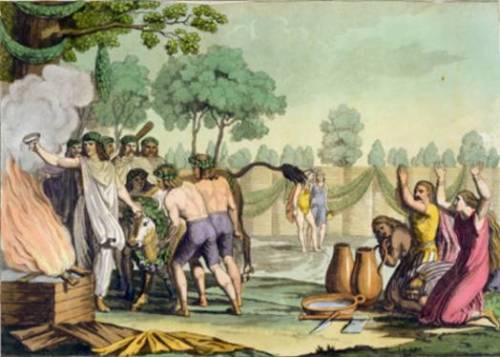
“Ancient Celts or Gauls Sacrificing a Cow,” by Vittorio Raineri, circa 1800.

Halloween is perhaps the most understood day of the year next to Valentine’s Day.  It’s riddled with misconceptions and folklore.  But, unlike Valentine’s Day, Halloween has its roots in ancient religious practices.  As you might suspect, the Roman Catholic Church has much to do with the mythology surrounding October 31; that is, the advent of Christianity.  But, Halloween also owes much of its mystery to ancient Celtic beliefs.

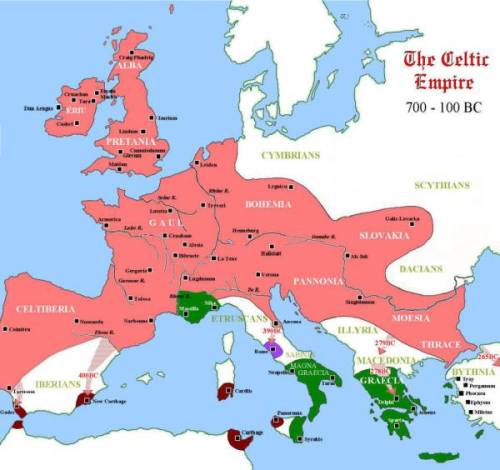
The Celts were a diverse group of tribal societies who populated most of Europe for thousands of years.  The Greeks encountered the Celts around the sixth century B.C. and called them Keltoi.  When Julius Caesar encountered the Gauls (the early peoples of present-day France) around 58 B.C., he said they called themselves Celts.  The word may have derived from the Indo-European ‘kel,’ which means ‘hidden.’  But, the term ‘Celt’ applies to any of the European peoples who spoke a Celtic language.  Greeks and Romans depicted the Celts as barbarians, but archeology has proven they were a socially and technologically advanced people.  They built complex settlements with sustainable farming practices and made significant breakthroughs in metalworking.  They essentially created the Europe that exists today.

Like every society in the ancient world, the Celts lived in accordance with the weather and the seasons.  Their calendar began on what now corresponds to November 1, which marked the start of winter.  They had to move their cattle and sheep to closer pastures and secure all animals for the cold months ahead.  They also harvested and stored their crops, again before winter’s arrival.  The Celts divided the year into four major holidays, and on what now roughly corresponds to October 31, they celebrated a festival called “Samhain,” pronounced ‘sah-ween.’  Since October 31 was technically their New Year’s Eve, the Celts believed the spirits of the dead would mingle with the living as part of the overall life cycle.  During Samhain, the Celts celebrated that the souls of all those who had died throughout the year would pass into the next world.  They feasted upon meats, fruits and vegetables and lit bonfires to help the deceased on their journeys.  Some Celts wore masks to ward off any evil spirits that tried to disrupt the celebrations or stop dead loved ones from moving onward.

Image.

Then, as Christianity began to spread across Europe, Celtic traditions came under attack.  Early Christian leaders denounced holidays like Samhain as pagan and even demonic.  While they succeeded in altering the ideological landscape of Europe, Christians didn’t completely eliminate Celtic rituals; the latter just changed their practices.  In 601 A.D., Pope Gregory I issued an edict to his missionaries concerning the beliefs and customs of the Celts.  Rather than try to obliterate Celtic rituals, Gregory instructed his missionaries to incorporate them.  If the residents of a town or village worshipped a tree, for example, the missionaries wouldn’t cut it down; instead, they would consecrate it to Christ and allow its continued worship.

But, as the Roman Catholic Church increased its power, all non-Christian beliefs and practices were declared malevolent.  The Celtic spirit world became associated with the Christian “Hell.”  Any remaining practitioners of Celtic ideology were forced into hiding and were branded as witches.

Sometime in the 4th century A.D., the Catholic Church designated November 1 as “All Saints Day.”  It honored every Christian saint, especially those who did not have a special day devoted to them.  It was meant to substitute for Samhain, to draw the devotion of the Celtic peoples, and ultimately to replace it.  That did not happen, of course, but the traditional Celtic deities diminished in status, becoming fairies or leprechauns of more recent traditions.  Once again, though, Christianity didn’t triumph completely as its esteemed leaders had hoped.

In the 9th century, the Church designated November 2 as “All Souls Day,” when the living prayed for the souls of the dead.  Christians also referred to All Souls Day as “All Hallows” – hallow means sanctified or holy.  The evening prior to the day was the time of the most intense activity, both human and supernatural.  As the centuries progressed, people continued celebrating All Hallows Eve as a time of the wandering dead, but they gradually came to associate supernatural beings with evil.  Any soul that hadn’t moved into Heaven was deemed unholy – and so was any celebration of those souls.

Celtic traditions are now most closely associated with the British Isles.  That’s mainly because the peoples of those islands – separate from the European mainland – were the last holdouts against Christianity.  Even after the time of St. Patrick, many Irish refused to convert to Catholicism, which is ironic considering that Ireland is now predominantly and staunchly Roman Catholic.

Most contemporary Halloween traditions can be traced to Samhain.  The wearing of costumes, for instance, and roaming from door to door demanding treats correlates to the Celtic belief that the souls of the dead wandered around, along with more malevolent spirits.  The Celts made offerings of food and beverages to placate all of them.  As Christianity became more entrenched in European society, people began dressing up like witches and demons and performing antics in exchange for food and beverages.  This practice is called “mumming,” from which trick-or-treating evolved.  The term ‘mumming’ is derived from either the German word ‘mumme,’ which means mask or masking, or the Greek word ‘mommo,’ which basically means a frightening mask.  Even now, in many small towns in England and Ireland, people stage ‘mumming plays.’

There is no evil in celebrations honoring the dead.  Christianity is what made that connection.  Every society across the globe honors its deceased loved ones.  It’s done out of respect and admiration.  Most Indigenous Americans, for example, conducted similar rituals, which – as early Christians tried to do with the Celts – Catholic missionaries worked to eliminate.  But, as with the Celts, some Indians merely incorporated Roman Catholic practices into their religion as a means of survival.  There were some holdouts, though, who refused to convert and often suffered the bloody consequences.  Even now, México celebrates “El Dio de los Muertos,” or “Day of the Dead,” which is a modernized version of indigenous Indian rituals that literally go back thousands of years.  People build temporary alters to honor their deceased relatives and friends, which includes offerings of food and beverages.

That’s not evil – that’s love.

BLESS, O GOD, THE DWELLING

Bless, O God, the dwelling,

And each who rests herein this night;

Bless, O God, my dear ones,

In every place wherein they sleep;

In the night that is tonight,

And every single night;

In the day that is today,

And every single day.

Celtic prayer

Leave a comment

Filed under Essays

Deliver Us from This Stupidity

Thank goodness for Hurricane Sandy!  It’s provided some respite from the ongoing presidential campaigns.  That a major tropical storm system could strike New England just before Halloween is news enough – without the inevitable destruction and loss of life.  We have eight more days until election day here in the U.S., and Sandy could provide a twisted sort of the proverbial “October surprise.”

If it’s bad enough, both President Obama and Mitt Romney may not be anywhere near Washington, D.C.  Obama could hunker down at his Chicago abode, while Romney could seek refuge in one of his many estates.  Their responses to the disaster will prove what they really think of the American people.  Obama most likely won’t stay in Chicago; he’ll want to head back to Washington to coordinate recovery efforts.  I suspect Romney will take the traditional conservative Republican stance and just let New Englanders fend for themselves.  After all, that’s been the mantra of his campaign; if you don’t have enough money in your bank account or drive a couple of Cadillacs, then you’re not worth saving.

Aside from November 7 being the birthday of one of my closest friends and former colleagues, it’ll be the first day after the elections and thus, the end of this campaign season.  I got tired of this crap – oh – I’ll say around July 1.  Political campaigns here in the U.S. are never-ending – like Thanksgiving turkey, deep space and the Harry Potter series.  They just go on and on and on.

I suppose it’s inevitable in a truly democratic society.  But, as a frequent, dedicated, tax-paying voter who’s experiencing firsthand the worst this dismal economy has to offer, I have some advice for all would-be candidates.

  • Focus on what good you’ve done for your respective communities.  In other words, run on your record, for God’s sakes!  If you don’t have much of a record, then don’t run for public office!  That’s like a high school graduate applying for an engineering position at NASA.  You don’t have to walk on water, or even build homes for the impoverished (although the latter would be more practical and appealing), but show us something positive.  What have you done for us?
  • Stop, or at least limit, the negative ads.  If you have to point out the adverse traits of your opponent instead of highlighting your positive attributes, then you don’t have much of a campaign.  Karl Rove had to do that with George W. Bush.  Bush was such a lame-ass that the only way the ignorant masses could be convinced to vote for him (other than because of their ignorance) was for the opposition to be demonized.  The 2004 presidential campaign is a perfect example.  There was nothing good about Bush’s tenure in office at that point.  He couldn’t prove that he’d completed his stint in the Texas National Guard, and no one had found the elusive “weapons of mass destruction” in Iraq.  So the Rove goblins questioned John Kerry’s military record and made him out to be indecisive; e.g. a “flip-flopper.”  It didn’t help that Kerry tried to take the high road, which was like Albert Einstein trying to explain quantum physics to Ron Jeremy.  I wasn’t too crazy about Kerry anyway, but look at the mess we ended up with as Bush left office.
  • Stop saying, ‘I promise to do .’  Instead, say something like, ‘I promise to cooperate with , or to do my best to accomplish .’  Every political candidate – especially those for the presidency – promises massive changes without realizing this not a dictatorship, or even an oligarchy.  There are 3 branches of government, and they have to work with one another.  Think We Are the World, or better yet, I Want to Teach the World to Sing.  I suppose that’s a bit much to ask from grown people with Mount Everest-size egos.  Merely promising to do your best goes a long way.  Most people are smart enough to understand that an elected official – even the President of the United States – can’t do everything alone.  I mean, William H. Taft’s wife, Helen, once answered the doorbell to the White House, and Harry Truman used to wash his own socks.  Either way people won’t be too disappointed when an elected official can’t get X, Y and Z done – which is one reason why the American people should blame the Republicans in Congress for keeping things screwed up.  They won’t work with Obama.  But, that’s a different essay.

People are always glad to see election season come to an end.  Yes, the candidates are tired, but so are we.  Our elected officials don’t seem to get it sometimes.  I’m still unemployed and have massive student debt to pay off.  I don’t care about gay marriage; don’t want to hear your definition of when life begins; don’t want too much of our tax dollars go to treat diseases in foreign countries where people should have figured out by now that having sex with a virgin doesn’t cure AIDS.  I want to see some real action in Washington – and not on the dance floor.  I want to see our elected officials handing out water bottles after Sandy hits.

Image.

Leave a comment

Filed under Essays

Cruising for Trouble

Okay, I know the title of this essay is a bad play on the name of Ted Cruz, the former Solicitor General of Texas, who hopes to replace Kay Bailey-Hutchison in the U.S. Senate this year.  He’s a Republican, of course, and since I’m not too fond of Republican politicians – especially the species creeping out of Texas – I have to criticize him.  Cruz isn’t just a Republican; he’s a “Tea Party” Republican – that wacky band of closet Nazis who emerged after our biracial president took office.  The “Tea Party” clan has grabbed the GOP by the throat and wants to send America back to the good old days of the 19th century, when only White heterosexual Christian males had power.

Cruz has been playing right into the gnarly hands of the far right; placating them with a variety of outrageous claims and blatant lies.  For example, he thinks billionaire businessman George Soros and the United Nations are conspiring to eliminate golf in the U.S.  As if that would be a bad thing.  Cruz also apparently adheres to the growing reemergence of nullification; a 19th century philosophy that states can invalidate any federal laws they don’t like.  The Affordable Health Care Act has become their favorite target.  In his first campaign ad, Cruz states, in his role as Solicitor General, he made it easier for Texas to kill an “illegal alien.”  It’s a reference to a 2008 case, Medellin vs. Texas, in which the state argued that it shouldn’t have to comply with the Vienna Convention.  The Vienna Convention is a 1969 treaty requiring countries to inform foreign nationals who are arrested that they have the right to legal counsel from their home country.  As of 2010, 112 states had signed it, including North Korea, which even honored it when it captured 2 American journalists in 2009.

Cruz has an apparent disdain for illegal immigrants – which I do, as well, to some extent.  But, from a cultural standpoint, you have to understand where this could lead.  Cruz hopes to appeal to Texas’ growing Hispanic population – most of whom are of Mexican or Central American extraction.  Most of them – despite what you may hear on FOX News – are either native born residents or legal immigrants who don’t commit crimes.  Here’s where it gets really interesting and personal.  Cruz is only half-Hispanic; his father was born and raised in Cuba where he had fought against and been tortured under the brutal regime of Fulgencio Batista.  Batista had come to power in 1933 and ruled Cuba until Fidel Castro led a successful coup in 1959.  Batista was an anti-communist ideologue, which endeared him to the U.S.  But, he revoked many personal liberties, such as the right to strike.  His secret police force allegedly killed thousands of people on the island nation.  Under his command, only a handful of families owned most of the land and therefore, held the bulk of the wealth and power.  As in most Latin American nations at the time, a wide gap existed between the wealthy and the poor; kind of like how the U.S. is becoming now.  Cruz’s father fled to the U.S. in 1957, arriving in Austin, Texas with $100.  But, Cruz was born in Calgary, Canada, that bastion of socialist anxiety right-wing extremists generally hate so much.  The “Tea Party” crowd frequently compares the Affordable Health Care Act to Canada’s universal health care policies – e.g. socialism.

Back to the Hispanic thing.  While most Hispanics trend Democratic when voting, Cuban-Americans, in particular, lean Republican.  And, as a group, Cubans seem to despise other Hispanics, mainly Mexicans and Puerto Ricans.  I don’t know why, but I’ve seen it and felt in the overall Hispanic community in Dallas.  I think it’s because Cuba is such a devoutly communist country; one of the last remaining bastions of Marxist theology in the world and the only one in the Western Hemisphere.  Therefore, when its residents flee to the United States, they are truly running for their lives.  But, no such compassion lands upon the shoulders of refugees from war-torn nations elsewhere in Latin America.  To paraphrase comedian Paul Rodriguez, ‘when Mexicans come here illegally, they take them to jail; when Cubans come here illegally, they take them to Disney World.’

Like any good Republican extremist, Cruz despises Barack Obama; believing the President is collaborating with Soros and others to turn the U.S. into a “European socialist union.”  He wants to gut both Social Security and Medicaid, feeling they have already pushed the U.S. towards that dreaded socialist state.  It doesn’t seem to matter that those programs have prevented millions of elderly and / or disabled people from slipping into poverty.  Republican vice-presidential candidate Paul Ryan feels the same way.  Neither will probably get much of the Hispanic vote and will have a tough time sweet-talking senior citizens.

Cruz is facing Democrat Paul Sadler, an attorney and member of the Texas House of Representatives.  Surprisingly, the Dallas Morning News endorsed Sadler for the U.S. Senate; amazing in that the paper has almost always recommended the Republican candidate.  That’s why I scratch my head in confusion every time some local right-winger hollers like a cow going into labor that the News has a leftist agenda.

Alas, I’m afraid Ted Cruz will win that coveted Senate seat next month.  When many Texans go to the polls, they seem to leave their brains in their vehicles, while making sure they have their guns.  It’s getting dangerous even for us moderates here in Texas.  And, the fact that a far-right fundamentalist like Ted Cruz could end up in such a powerful position doesn’t bode well for the United States as a whole.

Leave a comment

Filed under Essays

Still Bitter? Just a Little!

“Never succumb to the temptation of bitterness.” – Martin Luther King, Jr.

It’s been two years now since I lost my job at the engineering company – and I haven’t been able to land a full-time job ever since.  Each of the two contract positions I’ve found in the past fifteen months have been pulled out from beneath me.  It’s an interesting dichotomy.  I was so miserable that last year at the engineering firm it was almost a relief to be let go.  Key word – almost.  The only things I miss are the pay, the benefits and one of my favorite Mexican restaurants that’s a couple of blocks away from that building in downtown Dallas.

It’s a stab in the gut when you give your life to a company, and they reward you with a lay off.  People put up with a lot at work: bully bosses, rude coworkers, office gossip, office politics, piss-ant reviews, chicken-shit salary increases, traffic, bad weather – us working folk go through quite a bit just to earn that paycheck.  I had hoped to retire from that company, or at least work there until my writing career took off.

As tempting as it is, I won’t name the place, but you can probably find it on my Linked In page.  They were two years into a contract with a large government agency when I joined them in 2002.  They had a nice office in suburban Dallas, which was closer to home and where I’d work occasionally on other projects.  But, I spent the bulk of my time in downtown Dallas.  I’d worked for eleven years at a bank in downtown Dallas, so I was somewhat accustomed to that lifestyle.

The engineering firm had undergone the usual series of management and staff changes in the eight years I was there.  But, by 2010, when we lost the prime contract with the government agency to a small business and were kept on as sub-contractors, things were different – vastly different.  It wasn’t the same place I’d started with the week before Thanksgiving 2002.  It had gotten so bad that everyone I knew was looking for another job.  When I told a colleague not to say that too loudly, or they’d help her out the door, she casually said even our supervisor knew she was looking around.  The company had experienced a number of harassment lawsuits from disgruntled former employees.  Not all of them claimed victory, from what I understand, but it’s still a wonder no one returned with a shotgun.  Yes, people really can get that angry.  But, murder won’t just ruin your weekend; it doesn’t look good on your resume.  Mercenaries and military special forces can probably get away with it, but the average white-collar fool can’t.

My parents each have been retired for some time now, but they occasionally have bad dreams about their working lives; lives they left long ago.  Together, they put in a century’s worth of labor and came from an era where people went to work for a company and stayed there until they either retired or dropped dead.  I’d vowed never to let a job get to me like that.  Despite all the crap I endured at the bank, I never once dreamed of the place.  I don’t know why, but I guess I subconsciously realized it wasn’t worth that much of my time and energy.

Yet, for some ungodly reason, I’ve had two dreams about the engineering firm.  In the first, not long after they let me go, I found myself at their former corporate headquarters in California with the same project manager who had hired me.  A massive seaquake had struck not far from the coast, and a tsunami was approaching.  Our building sat right on the coastline, and everyone nervously went about their daily tasks, while preparing to evacuate to the upper levels once those alarms sounds.  My manager told me not to worry; that if I stayed with him, we’d be alright.  He’d lead me and the others to the building’s upper floors.  He’d been there several times in the past, but this was my first time visiting the place.  Then, I heard a distinct rumbling in the distance and realized the tsunami was on its way.  But, when the alarms sounded, my manager was nowhere to be found.  He’d disappeared.  As chaos gripped my panicked constituents, I calmly proceeded up the stairs alone – and then woke up.

In the second dream, I was getting ready for a meeting.  At the designated time, I stepped into the conference room – and found it empty.  I then began running all over the damn building looking for my colleagues.  To make matters worse, I was butt-ass naked.  Now, don’t get me wrong!  As a bona fide, red-blooded American male, I normally like being naked.  But, I didn’t care to be nude in front of the menopausal debutantes and lecherous old men who populated that government agency.  Alas, I couldn’t find my constituents and wandered into the break room – still naked – and sat down with my mug of ice water, a pen and some notebook paper.  I’d decided to start working on a new story – and then, I woke up.

Okay, I don’t want to get too esoteric about this.  They were just two stupid dreams about a company that had turned on me quicker than a rabid dog.  But, I wouldn’t blame a real dog for doing something like that.  Still, the dreams made me realize three things:

  1. Anyone in the workplace can turn on you.
  2. Don’t worry too much what other people think of you – especially the assholes at work.
  3. When disaster strikes, you’re pretty much on your own.

It’s why I’d proceeded calmly up the stairs in that first dream and why I said ‘fuck it’ in the second dream and sat down to do what I really love: creative writing.

But, am I still angry about what happened?  Well, in a word – YES!  Yea, yea – I know you’re supposed to let that shit go.  Put a period on it and move forward with your life.  But, here’s how bad I let that dump get to me.  In September 2010, I visited my dentist.  A back lower tooth had been aching for some time, and I was horrified to discover it was loose.  I’d just been there two month earlier, and everything was fine.  My dentist couldn’t understand what happened.

But, I knew what had happened.  I’d been under so much stress at work that I must have ground the crap out of it, and now there was no other remedy except to yank it out.

So, along with the paltry raise and office politics I’d had to live with that last full year, this is how my career ended with the engineering company: a loose tooth.  That’s it.  That’s what I got for busting my butt for nearly eight years.  Yes, the experience looks great on my resume.  All those technical skills make for nice business conversation pieces as I scoot in and out of companies now with a bloated grin; feeling like an ugly pitbull being shuffled from one foster home to another.

Resumes never tell the full story behind a person’s working life, but it’s just not that easy sometimes letting bad experiences go – especially at work where you dedicate so much of your life.  I think of that project manager who I’d considered a friend and mentor and now hope he has a radical prostatectomy that leaves him permanently impotent.  I guess it’s wrong to feel that way.  But, I don’t.  In fact, I really hope something like that happens to him and I hope other bad shit happens to some of those people.  Call me childish if you want, but – oh well.  In this rotten economy brought down by the wealthiest 1% and the politicians they have stuffed in their designer pockets – none of whom can relate to us average working folks – there are a lot of people who understand exactly what I’m saying.

Still bitter?  Yea, you could say that.  Still moving forward?  Oh yea!  A tsunami couldn’t stop me!

Leave a comment

Filed under Essays

Columbus Day – Whatever!

The Christopher Columbus monument in Barcelona, Spain

Today is Columbus Day in the United States where narrow-minded Americans perpetuate the myth that Christopher Columbus discovered this country.  It remains a popular fallacy despite obvious proof that the Western Hemisphere was not devoid of humans when Columbus and his fellow seafarers arrived.  As someone who is part Indian (Mexican), this is a particularly vexing situation.  But, as someone who is also Caucasian (Spaniard and German), I know I can be critical.  For one thing, historical references can’t confirm exactly where Columbus landed.  Some say present-day Hispaniola; others state Cuba.  But, it’s pretty well understood that he didn’t make it to the American mainland.

We also have to understand some other facts that slip by the history texts, which have always had a Euro-Christian slant.  Italian-Americans celebrate Columbus as one of their own.  Evidence has surfaced in recent years, however, that the intrepid explorer was not actually a humble Italian weaver, but a Polish immigrant.  Manuel Rosa, a professor at Duke University, claims that Columbus was the son of Vladislav III, an exiled king from Poland.

More importantly, though, Columbus had to seek help from Spain to finance his voyage.  In the late 15th century, Italy was not actually a country, but a collection of city-states; fractured and in constant conflict.  Apparently, no member of Italian royalty saw the value in Columbus’ grand scheme.  Thus, he turned to Spain and received approval from Queen Isabella – one of my paternal ancestors.

Another myth is that Columbus had deliberately set out to discover the Americas, or traveled as a result of some divinely inspired vision.  In reality, he wanted to find a westward route to India’s east coast and thus gain an advantage in the lucrative spice trade.  Spices were as valuable as gold and silver at the time.  Columbus believed Asia was where the Americas are and initially thought he’d arrived somewhere off the coast of China.  Then, he thought he’d actually made it to India and thus, called the Taíno peoples of the Caribbean “Indians.”

Yet another major fact that goes unreported is that Columbus was not the first European to arrive in the Western Hemisphere.  As Jared Diamond points out in his seminal book Collapse How Societies Choose to Fail or Succeed, scientists now realize that Norse Vikings arrived in North America nearly 500 years earlier.  In the 1960’s, archaeologists unearthed remnants of a village in present-day Newfoundland known as “L’Anse Aux Meadows.”  Norse literature also points to a land the Vikings called “Vinland.”  The Norse had begun their march across the North Atlantic around A.D. 800; first populating the Orkney, Shetland and Faeroe islands, then moving onto Iceland and Greenland.  There’s even some evidence that they’d made as far down North America’s eastern coastline as present-day Florida.  But, that remains to be proven.  By the time they landed in Newfoundland, however, they’d depleted much of their own energy and resources; thus any permanent settlement was unlikely.

But, here’s something even more important: people first arrived in the Americas between 15,000 and 25,000 years ago, if not sooner.  They’d branched out across the entire Western Hemisphere, even reaching the southernmost tip of South America, long before Columbus started thinking about his trip.  They built complex, intricate and highly-advanced societies – without firearms and without horses or cattle – and lived as best they could for all those millennia.

I’ve seen colorful illustrations of European men adorned in velvet and silk arriving on virgin American shores; their majestic ships moored in the distant background, carrying oversized crucifixes to which the scantily-clad Indians responded by dropping to their knees in automatic subjugation.  But, it’s just not true.  Columbus’ venture was a matter of commerce, not faith.  The concept of spreading Christianity came later, as Spaniards began settling into México and then, as the English and the French began moving westward across North America.  Some Indians allowed themselves to be converted to Christianity; more as a matter of survival, though, than some sort of mystical divine intervention.  Others, however, strongly resisted and were subsequently beaten down by White settlers who used their religiosity more as a tool of oppression than benevolence.

Investigations into the history of the Americas are ongoing, but in recent years, research has gradually proven the Siberian migration hypothesis to be true.  One study found “a unique genetic mutation” that exists only in both the indigenous peoples of Siberia and Native Americans.  Other recent data suggests that Japanese seafarers made it to South America’s Pacific coast around 3000 B.C.  Scientists have found similarities in pottery among Japan’s Jomon culture and coastal Ecuadorian Indians.  They also noticed that “the nautical capability of Chinese sea-going rafts” were identical to those of indigenous Peruvian and Ecuadorian peoples.  Moreover, archaeologists have found early specimens of the peanut – which is native to South America – in China.  That humans populated just about every corner of the Western Hemisphere is testament to overall human ingenuity and determination.  That they – we – have survived 500 years of disease, exploitation and genocide is even more impressive.

None of this is historical revisionism, as some staid elitists might claim.  The facts are now coming forward and being revealed, whether the old-timers like it or not.  It’s a mixed heritage.  I’m glad, for the most part, that Europeans made it over here.  But, what they did to the indigenous peoples cannot be underestimated or dismissed.  While nothing can be done about it now, it’s futile to ignore historical facts – even if it puts a damper on all those Columbus Day picnics and yard sales at Wal-Mart.

2 Comments

Filed under Essays

Dreams Bigger Than Ourselves

Watching the debate between President Obama and Mitt Romney the other night invoked a number of emotions in me; mainly nausea.  Obama looked half-asleep, while Romney displayed yet another side of his plastic persona.  Romney contradicted himself more times than someone with schizophrenia, and Obama simply didn’t show any backbone.  Considering that Romney announced he would take down “Sesame Street” and Obama expressed joy last week that the National Football League’s referee strike had ended peacefully, I haven’t been this disillusioned about politics since January 20, 2001, when George W. Bush first took office.

It’s come to this?  PBS and football referees are that utterly important in the overall scheme of America’s ongoing economic crisis?  Well, at least PBS serves a purpose.  But, even before the Obama – Romney debate, I pondered why America has let itself stoop to such lowly aspirations.  This is a country that built the world’s first transcontinental railroad system in the mid-1800’s and, less than a century later, constructed the world’s largest highway system.  Following World War II, this same nation created the strongest middle class the world has ever seen.  We were the first to take flight into the air and the first to place men on the moon.  We helped to develop automobiles, telephones, radio, televisions and computers.  Now, we’re talking about creationism in schools and gay marriage.  Are we serious?  How did the national dialogue become so pathetic?

A half century ago, President John F. Kennedy issued a challenge to the nation; he wanted us “to go to the moon in this decade and do the other things; not because they are easy, but because they are hard.”  And, we did just that!  Less than seven years later, Neil Armstrong became the first human to set foot on the lunar surface.

I’m somewhat of a dreamer.  In fact, I’m a big dreamer.  My quiet, sometimes introverted personality conjures up the most fantastic of stories.  But, it also envisions the seemingly impossible of events.  Thus, while some people worry what Vice President Joe Biden might say in his debate with Congressman Paul Ryan next week and others sit on the edge of their seats, wondering who will take first place on “Dancing with the Stars,” I propose the following challenges to my fellow Americans.

Energy Independent – Every American president since Richard Nixon has called for the U.S. to be completely and totally energy independent.  The oil embargoes of the 1970’s first made us realize how badly our nation is beholden to the Saudi royal family who – just a few decades earlier – were still living a nomadic lifestyle.  Our technology helped them move into the 20th century almost overnight.  Currently, though, the U.S. obtains most of its oil from Latin America, mainly Venezuela.  We actually buy more oil from Canada than from OPEC nations.  But, we’re still reliant upon foreign nations for a good chunk of our fuel.  And, we’re still too dependent upon coal and natural gas.  The fact is that those resources are finite.  They’re also dirty and dangerous to extract from the Earth.  I’d like to see the U.S. develop cleaner and safer means of energy by 2030.  Yes, that’s less than 20 years from now, but I know we can do it.  And, we need to do it.  We can’t continue to pollute our environment and put our citizens at risk just to keep the lights on in the house.

Subterranean Power and Telecommunication Lines – In August of 1992, Hurricane Andrew plowed into Florida as a borderline category 5 storm, before marching across the Gulf of México and slamming into Louisiana.  It was the most expensive natural disaster in U.S. history at the time; costing an estimated $26 billion.  For weeks afterward, residents in the impact zones lived without power.  Andrew had knocked down and / or destroyed thousands of yards of power and telecommunication lines.  In the richest, most powerful country on Earth, people found themselves struggling from day to day in a third world-style environment in the heat of summer.  Twenty years later Hurricane Isaac gently rolled over southeastern Louisiana and did virtually the same thing to all those power and telecommunication lines.  Tropical storm systems aren’t the only harbinger of disaster.  Almost every winter, people in the northeastern U.S. brace for mighty arctic hurricanes that send them back into those third world type living conditions.  The same happens after floods, tornadoes, wildfires and earthquakes.  We can never control what the planet’s natural elements will do.  Every time humans have tried to fight nature, they almost always get smacked back into reality.  But, we can mitigate the impact of these calamities by burying as many of our power and telecommunication lines underground as possible.  This is not a new idea.  Many people – from energy analysts to, yes, politicians – have pushed for this to be done on a massive scale.  But, there have been plenty of detractors.  While we already have a large number of subterranean power and telecommunication lines, opponents claim they’re not necessarily more reliable than overhead lines.  While overhead lines experience more outages and are more vulnerable to every piece of aerial debris from disoriented birds to tree branches, subterranean lines are generally more difficult to access and repair when problems with them do arise.  Another obstacle, of course, is money.  There are greater costs associated with the installation of subterranean lines, and – as you might have guessed – those costs must be passed onto consumers, either in the form of higher utility rates or increased taxes.  But, I think it’s well worth the financial burden.  Ultimately, it costs people more to go without power; food is spoiled and lives can be endangered in extreme heat or cold.  The expenses incurred with the initial installations and ongoing maintenance will more than pay for themselves in the ensuing years.

Humans on Mars – For eons, our ancestors wondered what it was like on the surface of the moon.  When the U.S. finally made it there in July of 1969, our fanciful images of otherworldly beings gave way to the bland reality of rocks and dust.  But, we made it!  We’d successfully landed humans on the surface of another celestial body and brought them back to Earth.  Almost immediately, people began contemplating a trip to Mars.  The U.S. has come close; first with the Viking I and II voyages, and most recently, with the Curiosity mission.  These have been unstaffed journeys, but they’re important.  The U.S. space program of the 1960’s helped to advance technological developments; mainly with telecommunications, such as facsimile machines and cordless phones, but also with engineering and robotics.  As with any grand adventure, however, there are detractors who look primarily (or only) at the money factor.  The Viking missions alone cost $1 billion – in 1970’s-era figures – and, as of now, the Curiosity budget has exceeded $2.5 billion.  But so far, the U.S. has spent nearly $807 trillion in Iraq and almost $572 trillion in Afghanistan.  If we can afford that kind of cash to kill people and destroy entire towns and villages, we definitely can expend a fraction of that money on a staffed trip to Mars.  I don’t believe we’re alone in this universe.  And, it’s in our nature as humans to explore and discover.  I feel we should make a concerted effort to send a craft with humans to Mars by 2030.

100% Literacy Rate – This is the most ambitious of my goals.  Literacy and education are paramount to the success of any society.  But, they’re also the most personal and the most difficult.  As of 2012, the U.S. literacy rate stands at roughly 80%.  While this means that more than three-quarters of the U.S. population can read and write to some degree, we’re still far behind such countries as Denmark, Japan and Norway where literacy rates hover close to 100%.  Why is the U.S. at a dismal 80%?  I think much of it has to do with our elected officials and their reluctance to consider education as equally important as military prowess and individual financial wealth.  Moreover, the United States boasts the largest rate of incarceration than any other nation; some 1.8 million people are imprisoned here, or about 1 of every 100 adults.  Of those individuals, roughly 70% are illiterate.  While rates vary among states, it costs roughly $23,000 per year to house one person in a prison.  However, it costs about $1,000 to educate a child each year at the elementary level and about $3,000 per year at the high school level.  College educations also vary widely among states and differ between private and public universities.  But, the average cost per year is about $15,000.  Once someone graduates from college, or even a vocational training program, however, they can enter the work force and start paying back those costs in earnings and taxes, as well as consumer spending.  Somehow, though, our political elite thinks it’s more feasible to imprison someone than to educate them.  Every year across this nation, states balance their school budgets on the backs of its most vulnerable citizens: elderly, disabled and children.  Just like with the costs of the Afghanistan and Iraq conflicts, it’s beyond me to understand why this nation always has enough money for war, but never enough for education.  I feel it’s the conservative mindset working against us.  Earlier this year former senator and Republican presidential candidate Rick Santorum denounced President Obama as a “snob” for wanting everyone in the U.S. to have a college education.  Ignoring such stupidity, though, I think it’s plausible for the U.S. to have a 100% literacy rate by 2050, if not sooner.  It’s well worth the expense, as we’ll see our prison rates decrease, while consumer spending rates increase.  Educated people generally make better decisions and think first before they act.  It’s easier to give a child and book and deal with their barrage of questions once they finish reading it than to let a kid drop out of school and deal with their bad attitude once they’re in jail.

I know naysayers will read this and scoff at my lofty ambitions; perhaps accusing me of arrogance in imposing such goals upon others.  I’m not forcing anyone to believe as I do.  But, the wealthiest nation on Earth should have much greater objectives than ensuring tax cuts for the wealthiest 1% of its citizens or constructing a wall along the southern border.  Our grand ethnic and cultural diversity will allow for it.  Our future depends on it.  It’s in our nature as humans to wonder and explore – and to dream big.

4 Comments

Filed under Essays