Category Archives: Essays

Retroacting

In light of yesterday’s massacre in Aurora, Colorado, every media talking head, politician and self-proclaimed expert on psychosis is speaking out.  Folks from CNN and MSNBC rushed to the scene yesterday morning, hoping to corral anyone who was within a mile of the theatre and ask, ‘What did you see?’  Even Nancy Grace – who normally doesn’t care unless an adult White female goes missing or turns up dead – jumped into the fray, so you know this shit is serious.

Meanwhile, idiot extremists on both sides of the gun control debate are already lining up to take – pardon the verbiage – shots at one another.  Gun control advocates say this is once again proof that firearms are too easily accessible in the U.S.  Gun rights supporters – who always seem to think the 2nd Amendment to the Constitution trumps the 1st Amendment – claim that guns don’t kill, people do.  In a way, they’re both right.  I’ll let them engage in their usual vitriolic tangos.

But, I have to wonder; are we now going to have metal detectors in movie theatres?  If we do, it’s yet another example of how the U.S. seems to behave retroactively to whatever crisis of the decade pops up.  Our elected officials and law enforcement don’t always have the foresight to cogitate ahead.  That’s what happens when they’re more concerned with election year politics and budget restraints.

Here are just a few examples of after-the-fact-responses.

In the fall of 1982, seven people in Chicago died after consuming cyanide-laced Tylenol.  The manufacturer, Johnson & Johnson, pulled every single Tylenol product off store shelves across the country and almost went bankrupt because of it.  But, they bounced back with an aggressive marketing campaign and reintroducing their products with safety seals.  Other manufacturers followed suit.  I’m old enough to remember when you could buy something and just open it up without worrying if it was a death sentence.  Now, you occasionally have to have pugilistic hands to open a bottle cap.

On April 19, 1995, Timothy McVeigh parked a moving truck outside the Alfred P. Murrah Federal Building in Oklahoma City.  A few minutes later, the truck exploded and almost completely destroyed the building; killing 168 people.  Now, you can’t just drive into a building; federal or otherwise.  You have to approach a guard post where they check your identification and confirm that you’re really supposed to be there.  You also can’t park outside any building for too long, especially in major cities, unless you want a cop or overweight security guard giving you dirty looks first, before asking what the hell you’re doing.

Law enforcement never took animal abuse seriously until psychologists made the connection between that and serial killers.  Now, anyone caught chaining a dog to a tree is threatened with jail time.

School boards always thought bullying was just kids-being-kids crap until the victims started committing suicide – or homicide.  The 1999 Columbine massacre sort of drove that message home.  So, schools started bullying intervention programs and installed metal detectors.

The best case scenario for an after-the-fact-response is September 11, 2001.  Who would have thought someone would use jet liners as weapons of mass destruction?  Actually, someone had made a concerted effort several years earlier.  In February 1974, Samuel Byck tried to hijack a Delta Airlines plane from Baltimore and crash it into the White House.  He wasn’t really a terrorist; he was a failed businessman with a seething hatred for Richard Nixon and a suicidal death wish.  He was shot to death after a brief standoff with police.  The incident received minimal press coverage because the growing Watergate mess had everyone’s attention.  And, it got lost in the historical shuffle – until 09/11.

For one thing, immigration never thought that people with expired VISAs could pose a threat.  People with past-due VISA bills always got harassed half to death by the banks however.  So, the airlines starting checking people’s identifications more closely.  Then, they started thinking that pilots should be armed and cockpit doors should be fortified with more than duct tape.  Even flight attendants started wondering if they had to start carrying nunchucks instead of extra bags of peanuts.  U.S. airlines could have taken a queue from Israel, which hasn’t experienced a hijacking since 1970.  Their airline pilots are armed and their flight attendants are trained to fight back with whatever they have.  But, over here, airline executives complained such changes wouldn’t be cost-effective, meaning they’d have to take a cut in their million-dollar paychecks.  So, the Transportation Security Agency (TSA) is content with confiscating bottles of Evian and fondling people in wheelchairs.

In December 2001, Richard Reed tried to set his shoes on fire, while aboard a flight from Paris to Miami.  Now, everyone has to take off their shoes.

In December 2009, Abdul Farouk Umar Abdulmutallab, a Nigerian-born Al-Qaeda operative, tried to set his explosive-underwear on fire on a flight from Amsterdam to Detroit.  The stuff didn’t ignite, but fellow passengers tackled him anyway, as the plane approached the airport.  People feared they’d now have to tolerate underwear checks, but the TSA amazingly drew the line at that.

So, I ask again – will theatres begin installing metal detectors beside the ticket windows?  All day Friday and into Saturday, theatres around the country employed extra security measures to ward off any copycat incidents – another uniquely American aberration.  Here’s another question – when will we stop reacting to these events and start thinking ahead to the possibility of stuff happening?  It’s not beyond the scope of reality or human intelligence.  It happens all the time in business and science – people think of what could be and what could happen.  Then, they act on it.  It’s not a crystal ball type of mentality.  It’s just being practical.

Leave a comment

Filed under Essays

Exhausted, Fatigued, Aching – and Loving It!

After my second day on the new job – my first full day of work – I’m tired beyond belief.  My head is starting to hurt from looking at the tiny screen on the laptop they gave me because they ran out of desk tops.  My hands are numbing from working on said laptop.  And, I’m happy about it.

It’s such a strange feeling though – going back to work like this.  It’s a contract job that I hope will metamorphose into a permanent position.  But, in the current business environment, hardly anyone is full-time, permanent with benefits and stock options.  Those were the glory days of – oh – circa 2000.

Still, I’m satisfied thus far.  I’m doing the type of work I’ve always wanted to do – full-time technical writing and editing.  I sit in a large cubicle all by myself.  My supervisor is on another floor, handed me a platter full of documentation to scrutinize yesterday and has pretty much left me alone since.  She’s already learned that I can be brutally honest; something I emphasized in my interview.  But, she seems to appreciate that.  The other associates have been friendly; periodically introducing themselves.  There’s a huge break room, and I park my truck in a garage.  It takes me 15 minutes to get to the office.

So yes, I’m starting to like it there.  But, I won’t push my luck, or let myself get too comfortable.  I’ve always been the cautious type anyway.  Whenever I’ve taken things for granted, I’ve gotten sideswiped.  I guess you could say I don’t trust happiness too much.

In the meantime, I’ll deal once more with crawling out of bed at 5:30 A.M.; wearing business casual attire; trying to stay awake all day; and seeing the joy in my dog’s mocha brown eyes when I return to the house.  Now, if I could keep my own eyes from reacting to these damn pollens, I’ll be happy enough have an orgasm!

Leave a comment

Filed under Essays

In Play Again

Today I return to work for the first time in almost 11 months.  It’s a strange feeling.  I’m once again entering the corporate underworld that apparently keeps spitting me back out.  But, I don’t play the lottery, and my gold bullion investment hasn’t paid off yet.  I’ve been laid off three times from major companies within the past 23 years – two banks and an engineering corporation.  I guess that’s a pretty good track record.  I don’t jump from job to job.  As creative as my mind is, I do like some semblance of order and stability.  I definitely want my fiction writing career to be as successful as my dreams think it is.  But, in the meantime, there are these awful creatures called bills and an especially evil entity known as a student loan debt.  This particular job is a contract technical writing position that should take me into the first of the year – provided the Mayan calendar doesn’t prove to be truthfully apocalyptic.  Besides, I enjoy technical writing as much as I do creative writing.  Sometimes, the boundary between the two is as clear as a fog bank.

One good thing about working in corporate America is the slew of operatic real-life stories I’ve gathered for equally juicy stories.  I’ve met some incredible people and endured some traumatic ordeals.  I wouldn’t trade it for anything.  Well, except for a lump sum payoff from that gold bullion and a million-dollar book contract.

1 Comment

Filed under Essays

Penn State’s Real Hero: Lte. Michael P. Murphy

Several people have commented on the Steve Breen cartoon about the Penn State scandal I posted on the 14th.  Many are starting to think differently about the school’s late football coach Joe Paterno who died this past January of lung cancer, after being forcibly retired.  Paterno espoused a strict code of moral integrity and personal ethics; attributes he bestowed upon his players and – vicariously – upon the Penn State student body.  But, investigations into the scandal involving former Penn State assistant football coach Jerry Sandusky reveal that Paterno and other university officials knew more about Sandusky’s pedophilic behavior and did nothing to stop it.  Their biggest concern was the school’s football program.  As with many such institutions, Penn State regarded its football program with divine reverence.  It’s an extension of how this nation feels about its professional athletes.  But, as Penn State grapples with how to survive in the aftermath of the Sandusky mess, I feel the school should remove its statue of Paterno and replace it with an alumnus named Michael P. Murphy.

Murphy grew up on Long Island, New York and graduated from Penn State in 1998 with dual degrees in political science and psychology.  He immediately joined the U.S. Navy and became a Navy SEAL, the same elite warrior force that took out Osama bin Laden last year.  But, Murphy died in Afghanistan in June of 2005; caught up in a firefight, as he and his comrades were ambushed by Al Qaeda locals.  In an operation called “Red Wings,” Murphy and his fellow SEALs entered hostile mountainous territory to search for an Al Qaeda leader.  They encountered a goat herder.  As commander of the team, Murphy suddenly had a difficult decision to make: kill the goat herder, or just let him go.  They couldn’t tell if the man was an Al Qaeda operative, or just a simple villager tending to his goats.  If he was the latter, the SEALs risked killing an innocent civilian; a fact the American press would exploit once it became known.  But, if the man was sympathetic to Al Qaeda, he could reveal the team’s presence in the region.  Murphy chose to let him go.

Hours later the group became embroiled in gun fire.  It’s likely that innocuous goat herder had turned on them.  Murphy had to dart into an open area to call for backup.  Once exposed, he suffered several fatal bullet wounds.  Two of the other SEALs also died.  Only one, Marcus Luttrell, survived and managed to escape.  A helicopter bearing 8 additional SEALs and 8 Army Night Stalkers arrived, but was shot down by a rocket-propelled grenade and crashed.  All 16 men aboard it were killed.  Eventually, the military recovered all the bodies of the dead Americans, and Luttrell made it home.

In 2007, President George W. Bush awarded Murphy the Medal of Honor.  Murphy became the first Navy SEAL since the Vietnam War to receive the medal and the first to receive it posthumously.  He was also the first MOH recipient in the modern “War on Terror.”

In 2009, Luttrell published a book detailing much of the mission, Lone Survivor.  In 2010, Gary Williams published a brief biography of Murphy, SEAL of Honor, which focused heavily on “Operation Red Wings.”  On May 7, 2011 – on what would have been Murphy’s 35th birthday – the U.S. Navy launched a destroyer vessel, the U.S.S. Michael Murphy.

I never met Michael Murphy or anyone in his family or circle of friends.  I’d never heard of him or “Operation Red Wings” until Bush awarded Murphy the Medal of Honor.  But, I’ve become fascinated with him and his accomplishments.  He’s become a personal source of inspiration.  Murphy packed more into his 29 years on Earth than most people do in a lifetime.  More importantly, he appears to have been an individual of higher moral character and integrity than any football coach or university executive.  If Murphy was willing to risk his life over a goat herder, I’m quite certain he wouldn’t have kept silent about a child molester in his midst.

Although I never attended Penn State and I’m not a football fan – I got upset in 1990 when the local NBC affiliate interrupted an episode of The Golden Girls to announce the Dallas Cowboys had fired head coach Tom Landry – I feel a statue of Murphy is more appropriate for Penn State.  It won’t erase the memories of the horrible Sandusky incident.  But, it would be better for the school to acknowledge a real hero.

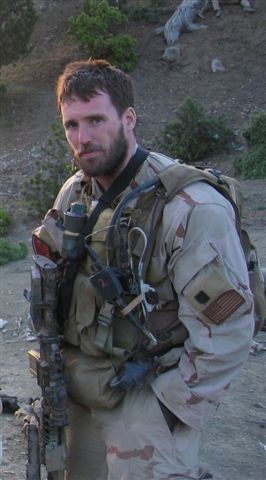
Murphy in Afghanistan, June 2005

Leave a comment

Filed under Essays

One Good Friend

How many friends do you need to make your life complete?  For me, it’s only a handful.  I’ve always had trouble making friends and therefore, I’ve never been a people person.  People usually get on my nerves – especially when they’re driving.  Earlier today, I had lunch with a good friend, Preston*, who I’ve mentioned before.  We try to meet for lunch on a Saturday whenever our schedules permit.  He’s definitely been busier than me lately.  Married with 3 kids, he and his wife have their hands full.  I’ve always envied Preston; he has a beautiful wife and 3 equally beautiful children, all living a pleasant suburban existence.  I would have liked to have that for myself, but it never happened.  I’ve told him that in past conversations, and he’s always expressed appreciation for my candor.

But, today he said something that surprised me: he envied me because of my close relationship with my parents, especially my father.  I met Preston at a tae kwon do studio around 1995.  We struck up a casual friendship, but found we had a lot in common; mainly exercise, jogging and rock n’ roll.  He’s an avid runner, though; having competed in a few marathons.  I just like to run around the block at my own pace.  That year, 1995, had been a bad one for me.  Everything in my personal and work life seemed to be going wrong.  Occasionally, in between flying fists and legs at the tae kwon do studio, I’d tell Preston what was happening.  He became one of the few friends who could relate to my dilemmas.  But, he honestly couldn’t comprehend whatever situations I encountered with my parents.  He wished he could though.

Preston’s parents had divorced when he was young.  I never exhorted him for details, but I suspect he was never close to his father.  His dad had moved to coastal Texas not long after the divorce and died several years ago.  He had perused his father’s belongings with a strange sense of detachment; occasionally surprised to find a curious bit of information about the man, or learn of a relative he never knew existed.  I don’t know the exact nature of his relationship with his mother – knowing how sensitive those subjects can be – but I gathered they weren’t too close either.  About the spring of 2003, he sent me an email with ‘Feeling kind of blue’ in the subject line.  I called him and asked what happened.  His mother had planned to visit and see her grandson for the first time.  Preston and his wife already had a daughter, and their son had just turned one.  Why Preston’s mother waited more than a year to come visit for the first time bothered me; but again, I just didn’t want to ask.  He was upset, though, because his mother had cancelled at the last minute; something else more pertinent had arisen.  From what I recall, it was nothing Earth-shattering; like a sudden illness.  It was more of a ‘I need to buy a wedding gift for a friend’ type of thing.

‘That’s more important than the grandkids?’ I asked myself.  “Don’t feel too bad,” I assured Preston.  “You get to spend time with your own family.”

His voice brightened.  “Yeah!”

On that level, I can’t relate to Preston.  I can’t imagine either of my parents passing up an opportunity to see their grandkids.  Of course, the closest they have to a grandchild is my dog.

Even though I’ve been unemployed for the better part of a year and will start a new job next week, I bought lunch for both us today.

“You’re unemployed!” he retorted.

“And, you have three kids!” I said.

Besides, I was feeling good.  I’m approaching this new job with caution, I told him, especially since it’s a contract position.  In that regard, he can certainly relate; contract work is pretty much all he’s done since about 2001, when the tech bubble burst.  Except for a brief stint at a home improvement store, he’s labored at a number of different software programming jobs; forced to jump from one place to another to keep a steady paycheck.

Like most men, we discussed work and family.  But, we also talked about religion.  Preston and his wife are devout Baptists; their two oldest kids have been to church summer camp since school ended.  Having been raised Roman Catholic, the Baptist religion had always been a distant entity; to Catholics, Baptists are the heathens of Christianity.  Another close friend calls them “heretics.”  Neither of those terms apply to Preston and his wife.  But, I emphasized that I am very spiritual.  I believe in a Great Creator and an afterlife.  I just don’t care to worship in the confines of a religious environment.  Yet, when we said a prayer over our meal, Preston expressed some concern that casual observers might “look at us funny.”

“Well, let them come over and say something,” I replied.

As we left, I reminded Preston that he’s one of the few friends I have.  A loner and an introvert, I no longer crave the attention and approval of others.  Their rules don’t apply to me.  I generally prefer the company of my dog to most people.  But, Preston’s friendship is too important to dismiss.  His thoughts and opinions rest comfortably with me.  I guess his quiet, unimposing demeanor have managed to work their way into my mind without being intrusive.  And, that’s just fine.  We men often have trouble forming friendships with other men in this society that says a man isn’t whole unless he has a woman in his life.  But, I can’t bring myself to follow those confines anymore.  One good friend, a simple Saturday lunch, and that’s all I need to make my life complete.

*Name has been changed.

Leave a comment

Filed under Essays

Grudgefest

Jason Carroll Moss apparently couldn’t let go.  Memories of high school bullying gripped him like sand grips a desert and wouldn’t just dissipate.  So, he planned to exact revenge upon his tormentors – even though it all happened more than 20 years ago.  That’s what police in San Antonio, Texas claim, when they arrested Moss July 6.  Moss supposedly threatened retaliation on the web site for John Marshall High School’s 20th high school reunion.  Moss bonded out of jail on Saturday, just hours before the reunion.  Police patrolled the area nearby, but Moss never showed up.

“I stayed away from graduation at the time because I would have started the Columbine shootings early,” Moss purportedly wrote on the reunion’s social network page.  “I was picked on and bullied by a bunch of you when I went to school and I wanted to kill everyone that hurt me.”

It probably would have been a good thing if he at least did arrive at the country club venue where the reunion was held and stood off in a corner somewhere; making other attendees feel squeamish about his presence.  I’m only saying that because I can relate to Moss’ angst.  I grew up shy and introverted and endured bullying throughout grade and high schools.  My parents, oblivious to my plight, just didn’t understand why I couldn’t make friends.  I wasn’t outgoing like they were.  I didn’t grow up mean like they did.  They came from a different environment, and it felt – back then – that we occupied two completely different universes.

My mother once told me how they worried about me every morning they dropped me off at the parochial grade school in Dallas I attended for eight miserable years.

“Well, why didn’t you just pull me the hell out of there?!” I retorted.  Even after that length of time, I remained angry.

I can still recall incidents of torment dating back to the early 1970’s.  That Moss couldn’t forget the brutal antics of his classmates isn’t so much a sign that he’s mentally unstable.  It’s proof that bullying can have an impact on people for a lifetime.

It’s only been in recent years that bullying has taken on some significance.  Like animal abuse, authorities no longer consider it cases of “kids will be kids.”  Bullying is a symptom of more serious problems within the social structure of a school, and the adults around those kids shouldn’t ignore it, much less downplay it.  Excessive harassment can lead to suicide and even murder.  In every incident where a kid shot up his own school, authorities later find out the youth had been the target of bullies.  And, since the parents and school administrators either didn’t believe him, or were too busy with their own lives, that young person felt they had only one recourse: death.  They simply wanted to end the torment and could think of no other way out.  Their young minds couldn’t fathom a peaceful solution to the crisis.

I don’t know what will become of Jason Carroll Moss now.  He may be in serious legal trouble.  Surely he was the subject of conversation that night at the reunion.  I’m certain he was mocked – just the way he was mocked twenty-plus years ago.  And, I’m certain some other self-righteous fool will begin crooning about forgiveness and just letting go.

Spare me such pathetic psychology.  You can’t just let go of the past like a cold or a bad day at work.  And, forgiveness means nothing if someone didn’t ask to be forgiven.  Did the people who bullied Moss in high school feel bad as they matured?  I don’t know.  Some bullies don’t.  Many reach adulthood and allow their tactics to metamorphose once they enter the workplace.  I’ve dealt with bully bosses and managers before.  Punks usually don’t grow up.  They develop a false sense of self-esteem and carry on with such cruel behavior as if nothing was wrong.  Eventually, though, all bullies meet their proverbial match.  They encounter someone who isn’t scared of them, or won’t just tolerate it.  They get it shoved back in their face, which usually hurts their feelings.  That’s the only consolation I have for my own memories; that many of those goons got bitch-slapped by someone who just wouldn’t take their crap.

But, until then, they leave people like Moss in their wake.  I personally don’t see him as a threat to society.  The police should just forget about it.  After all, there are real criminals that deserve more scrutiny.  If I could meet Jason Carroll Moss, I’d probably want to treat him to dinner and drinks, just to offer him some empathy; an ‘I know what it feels like’ kind of sentiment.  He deserves that much.

Leave a comment

Filed under Essays

Fiercely Savage Stereotyping

Earlier today I visited my local barbershop in suburban Dallas.  It’s literally the quintessential small-town barbershop with a candy-stripe barber’s pole out front and an ancient Coca Cola vending machine inside.  The two full-time barbers are as folksy as they are friendly; subdued and quietly professional.  But, I prefer it to an overpriced salon any day.  A television sits atop the vending machine, and the barbers frequently have it turned on to old programs.  I often wonder if they can’t get anything except TV Land.  Today I saw the end of a “Have Gun, Will Travel” episode.  That was even before my time!  I busied myself with a magazine, however, and didn’t pay attention to it.  I forgot the title of the next show that came on – although it may have been another episode of the same series – but I distinctly remember a line from one of the characters; a blonde Caucasian woman screaming something about “all Indians are savages.”  I could forgive the label, considering the time in which that show was produced; just like I could forgive Theodore Roosevelt (one of my favorite presidents) for his Eurocentric views.  He was a product of his time.  We all are.

Yesterday, however, I was cruising through my slew of emails and noticed one with the word “Comanche” in the title; a post someone had made on one of the many Linked In groups to which I belong.  He was publicizing his recently-published book about a Civil War veteran returning home in the immediate aftermath of the conflict.  What does the Comanche Indian nation have to do with that?  I have no idea.  But, the blurb stated upfront that the Comanches were “fierce and savage fighters.”  There’s that word again – “savage.”  Savage as in “noble savage,” as in A Man Called Horse savage, but not Dances with Wolves savage.  I had to look at the email date again – July 9, 2012.  If I could somehow earn a dollar every time I read about Indians who were “fierce” and “savage,” I could pay off my student loans.

“Savage,” along with “fierce,” always finds its way into characterizations of Indigenous Americans.  It’s like you can’t describe the Pacific Ocean without using the word “deep” at some point in the verbiage.  Rarely, I’ve noticed, do I see such terms as “advanced,” “agrarian,” or “intellectual” in conjunction with Native Americans.  They’re always “fierce,” “wild” and, of course, “savage.”  Even contemporary writers can’t seem to get away from those words.  It’s part of the vernacular; like a separate dictionary was composed by the Euro-Christian scribes a century ago to describe Indians when writing about them.  I reach for a 30-something-year-old thesaurus when I want to find different adjectives.  Some writers of the western genre clearly reach for that stock encyclopedia of stereotypical definitions.

In the “Old West,” Native Americans are never “people;” they’re “Indians,” or “natives.”  They’re grouped into “tribes,” instead of “nations,” or “communities.”  They still live in “tipis,” not “houses,” or any kind of stable structures.  They wear “animals skins,” not “clothes.”  They have “medicine men,” not “doctors,” or “physicians.”  They tell “stories,” but they don’t relay facts.  They worship the sun and the moon, but they don’t seem to understand their machinations.  The older ones can offer sage advice about life’s little mysteries, but overall, none of them comprehend the greater purpose of humanity.

I shouldn’t be surprised.  What can we expect from non-Indian writers?  I posted a comment to that one writer’s statement, remarking about such stereotypes.  He came back saying his book had nothing to do with Native Americans.  Huh?  Then, why the Comanche Indian correlation?  Oh, I get it!  The White Civil War soldier returning home had become as “fierce” and “savage” as an Indian because the Negro people were now free.  I guess.  It still doesn’t make sense.  It’s almost not worth the trouble even to discuss it – almost.

Believe me when I say I can forgive the stereotypes of 1950’s era television.  They didn’t know better back then.  But now?  We still have that now?  In the 21st century?  That only makes me savagely and fiercely angry!  Oh, God!  Now, I owe myself two dollars.

1 Comment

Filed under Essays

Involved

“I want to speak to your son,” the woman told my father when he opened the front door last Sunday, the 1st.  It was late in the afternoon, close to 5:00, and I had just spent the day vacuuming and dusting my parents’ home.  One of their neighbors, Lisa*, came over with her mother and youngest son in tow.  They seemed okay at first, so we didn’t know why Lisa wanted to speak with me.

But, within minutes, I understood she was terrified.  She’s either the type not to show such emotion, or manages to control herself well in public.  Through her heavy Vietnamese accent, though, she managed to relay what had just happened moments earlier.  Her ex-husband, Tran*, had arrived to pick up their 12-eyar-old daughter for a weekend visit.  The couple had been divorced for about a year.  The Roman Catholic Church had brought them over from Vietnam in the late 1980’s.  Here, they established a comfortable life and had 3 kids.  They’d lived next door to my parents for about 20 years.  I’d met them each once, but didn’t know them as well as my parents do.

Something, however, apparently went awry in that nice suburban existence.  You never know what happens behind closed doors.  Just like things always look great on paper, things can seem perfect for a family when the front lawn is nicely manicured.

There were a few times, when I first moved back here in 2007, however, that I suspected trouble brewed in that brown-brick house.  Standing in my parents’ back yard, watching my dog, I could hear a man’s voice blaring out from a closed window next door.  I only heard his voice, never anyone else’s.  I didn’t know what was going on and I didn’t want to know.  I don’t like to get involved in other people’s business.  No one really does, except the editorial boards of People and Vanity Fair magazines.

At some point, Tran moved out of the house.  She told my parents one day a couple of years ago that Tran wanted a divorce.  But, she refused to grant one, citing her Catholic faith.  My parents didn’t ask questions.  That was Lisa’s and Tran’s business; my folks didn’t want to get involved.

My dog, Wolfgang, alerted us to Lisa’s presence last Sunday.  He’d been lounging by the front door, peering out through the clear glass of the storm door, as he often likes to do.  I didn’t recognize Lisa.  I hadn’t seen her in a while.  I didn’t know the other woman was her mother and I had never seen Lisa’s youngest son.

Lisa’s daughter didn’t want to go with her father, she explained.  She retreated into her room and refused to come out.  When Lisa tried to close the front door on Tran, he damaged it and then left.  Lisa wanted me to come over and sit with her in case Tran returned.

I could just see Tran’s reaction if he did come back to the house he still owned and saw me sitting there with his ex-wife.  If he was that enraged and emotional to threaten Lisa and damage the front door, what would he do if was there?  Once, Lisa and Tran’s son told my parents that the family had gone out and, upon returning to the house, realized that they’d locked themselves out.  One of Tran’s brothers merely retrieved a gun from his vehicle and shot off the door knob.

I didn’t want to get involved.  But, I didn’t want to leave Lisa to fend for herself.  No, she’s not a child, or an animal, or a disabled person – someone truly defenseless.  But, she was obviously scared.  “No,” I told her, “you need to call the police.”

But, she was afraid even to do that; in part because of her heavy accent.  So, I stepped back into the house and called 911 myself.  I hurriedly escorted Wolfgang into my bedroom – since he’s not good with strangers – and brought Lisa, her mother and the boy inside.  Lisa’s daughter had left the house with her older brother.

The first of two police officers arrived almost immediately.  My father and I explained the situation as best we understood it.

“She was concerned the 911 operator wouldn’t understand her,” I told the fair-skinned policeman, a tall figure with a shaved head and bright blue eyes.  “They’re Vietnamese, and she –” I gestured to Lisa – “has a heavy accent.  But, their kids were born here,” I added, “here in the U.S.; in Texas.”

I felt the need to emphasize this latter fact, mainly because I don’t trust the police and don’t know how they’ll react to such circumstances.  They might think this was just an argument between a bunch of dumb gooks and leave it at that.  So, I guess if I pointed out that at least the kids were American-born, then the officer might take it somewhat seriously.

Another officer arrived soon afterwards, and thankfully, they took the case very seriously.  Tran had kicked the front inner door hard enough to impair the lock and – worst – had shoved Lisa.  When my father mentioned the gun incident to the first police officer, his expression proved he wasn’t just going to let this go.

The police remained at that house for a while.  Afterwards, Lisa returned to our house to thank us for calling the police.  “You come over here anytime you’re in trouble,” my mother told her.  “We’ll figure something out.”

As my attack schnauzer went into convulsive barking fits, I stepped outside and told Lisa, “You don’t have to put up with that.  You’re a human being and you deserve respect.  That may be Tran’s house, too, but he doesn’t have the right to terrorize you and the kids.”  I shook her tiny hand.  I didn’t want to try to embrace her.  In my culture, Hispanics consider hugs under such circumstances as a sign of respect and humanity.

I wasn’t afraid of Tran.  I just didn’t want to become mired in his family’s personal affairs.  But, the look of fear I saw deep within Lisa’s eyes told me I couldn’t just stand outside and let it go.  There seems to be a fine line between being nosy and watching out for your community.  Getting involved is sometimes necessary.

*Names have been changed.

Leave a comment

Filed under Essays

A Matter of Respect

Imagine – if you can – there are two professional sports teams, the Washington Niggers and the Houston Hebes.  And, they are meeting to play a game; football, basketball, whatever.  And, outside of the arena, large numbers of African and Jewish American citizens have gathered to protest against the teams simply because of their names.  Meanwhile, fans of both teams – many of whom may be part Black or Jewish themselves – parade into the stadium dismissing the protesters by saying things like: ‘It’s just a game.’  ‘Don’t take it so seriously.’  ‘You people are so sensitive.’

This is taking for granted, of course, that any sports team could get away with names like those in these times.  But, if you can imagine the uproar that would cause, then you can understand how Native Americans feel about the Washington Redskins football team.

The term “redskin” is as vile and demeaning as any other racial slur; one created by early English settlers to describe the native peoples, a direct reference to the latter group’s often-ruddy complexion.  Yet, the Washington Redskins insist they will not change their name and that any such attempt is just political correctness run amok.

Well, there is a stark difference between political correctness and factual correctness.  For example, it’s not politically correct to say Christopher Columbus did not discover America.  It’s factually correct.  The Western Hemisphere wasn’t virgin land, devoid of people, when Columbus arrived.  He had wanted to find a western route to India to gain an advantage in the silk and spice trades.  His own country, Italy, refused to help him; so he turned to Spain.  Spain’s Queen Isabella consented and provided him with financing, ships, and supplies.  When he made landfall, he thought he’d reached the east coast of India and thus, called the people he saw Indians.

But, if you ask the average American citizen who discovered America, Columbus’s name is almost always mentioned.  In fact, in his 1997 book The Perfect Storm, author Sebastian Junger begins one particular paragraph with the statement, “Almost as soon as the New World was discovered, Europeans were fishing it.”  And, for many years, Italian-Americans have hailed Columbus as a cultural hero who paved the way for future generations, even though Columbus wasn’t on a mission from Italy in the first place, and people didn’t begin emigrating from Italy en masse until the 1880’s.

If American history has acknowledged the presence of people here before Europeans, it has done so begrudgingly and then, viewed them as nomadic bands of Neanderthal-like beings with no true sense of community or family.  In reality, most had established large, complex societies and spent more time interacting on peaceful, social levels than they did fighting.  Yet, images of “wild Indians” or, at best, “the noble savage,” persist, both in so-called historical texts and in popular literature.

Whenever I do mention the plight of Native Americans, the most common response is, “What can be done about it now?”  Well, the simplest answer is, of course, nothing.  But, then again, nothing can ever be done about past events, can it?  But, let me take that question, ‘What can be done about it now?’, and apply it to other tragedies.

Take Pearl Harbor, for example.  Sad as it was, shouldn’t the U.S. Navy have known better than to place so many of its warships in such close proximity to one another?  Besides, what’s left of the U.S.S. Arizona is a rusting shell of a vessel that is still leaking oil.  If its hull shatters, millions of gallons of oil could pour into the ocean, creating an environmental disaster.  Shouldn’t that be a far more pressing concern than honoring a bunch of dead sailors?

What about the European holocaust of Word War II, in which over six million Jews were systematically massacred by the Nazi regime?  Notice it’s always referred to as ‘The Holocaust,’ as if no other similar genocidal event has ever occurred.  The decimation of the Western Hemisphere’s indigenous peoples was also a deliberate, concerted undertaking by Europeans, especially here in North America.  One specific example concerns Abraham Lincoln.  During the Civil War, Lincoln directed the U.S. Army to hang over a hundred Indians per day in the western states.  He then limited the number of daily hangings to twenty-eight, but only because the bodies were piling up too fast.  Yet, there are no memorials or museums in this country acknowledging those horrors.

Let me come closer in time: the 1995 bombing of the Oklahoma City federal building.  Only two men were responsible for that act, as far as we know; two devout Christians, two former soldiers with a passionate hate for the U.S. government.  Both were caught and one is now dead.  So, doesn’t that mean justice has already been served?  And, there’s no need for a memorial?  Ironically, Oklahoma is where many Native Americans were forcibly isolated at the end of the 19th century to live out their lives in despair and poverty.

Let me come even closer: the terrorist attacks of September 11, 2001, in which nearly 3,000 people lost their lives.  But, as horrific as it was, does this mean we’ll be reliving that nightmare every September 11 from now on, just like Pearl Harbor?  Shouldn’t our government have realized sooner that foreigners with expired visas could pose a security threat?  And, why have airlines only recently taken greater safety precautions?  Now a memorial is being erected on the site of the World Trade Center.  Some call it hallowed ground.  Hallowed ground!  They were office buildings, not homes or religious centers.  White settlers destroyed thousands of Native American communities across this continent, believing such destruction was necessary and righteous.

Why do we keep dredging up these awful memories?  Aren’t we supposed to let these things go and move forward with our lives?  Is that how we should remember these events?  Is that how we want future generations to look at them?  Like trite insults.

Well essentially, that’s how this nation regards the Native American experience.  If building memorials means resurrecting the past to do something about it, then it’s pointless.  Jorge Santayana, the Spanish novelist and poet, once warned of such ignorance by saying, “Those who cannot remember the past are condemned to repeat it.”

We are civilized and intelligent enough to acknowledge the injustices done to our native peoples without dismissing them or calling them names.  It’s not an issue of political correctness.  And, it’s not a case of being too sensitive.  It’s simply a matter of respect.

3 Comments

Filed under Essays

Digital Estates, Digital Heirs

In October of 2011, a friend of mine, James*, died after a nearly two year battle with cancer.  He had just turned 40 the previous May, which put everything into perspective for me.  Not long after I turned 40, I came down with the flu for the first time in my life.  To know James was to like him.  He had an infectious personality and an equally infectious grin.  Despite his cancer battles, he never relinquished hope for his future.  A few weeks before he passed away, he posted a message to Facebook simply stating that he’d just returned from another stay in the hospital and wasn’t feeling too good.  That was the last I heard from him.  I only learned of his death after I saw a message a friend of his posted to his Facebook page expressing remorse.

If you have a Facebook account, you know that you get messages about friends’ upcoming birthdays.  Whether they’re real friends – as in people you could call at 3:00 in the morning when you’re holding a knife over your wrists – is another matter.  But, I was surprised – almost angered – this past May when I received an email from Facebook advising me of James’ upcoming birthday.  Hadn’t someone thought to take down his Facebook page?  That no one had done so is what startled me; it also upset me.  I know it’s hard to let go of the ones we love, or even just like.  We have a tough time believing that they’re gone – even if they were very old and / or sick.  I had that response after my paternal grandmother died in 2001 at age 97.  I certainly felt the same when James finally succumbed to cancer; it seemed he hadn’t been getting any better.  But, as I sat in front of my computer and looked at that stupid Facebook email – ‘You have 1 friend with a birthday this week’ – I wondered who would take command of James’ property.  Did he leave a will?  Was there anything to leave?  And, to whom?  But, I’d always pondered what becomes of people’s digital property upon their demise.  Or, does digital property even exist?

That’s a question our society will have to face and ultimately answer as we grow more and more technologically advanced and interconnected.  It’s a quandary that beset an Oregon woman named Karen Williams when her son, Loren, died in a motorcycle accident at age 22 in 2005.  Williams found his Facebook password and emailed the company, asking administrators to maintain Loren’s account so she could look through his posts and comments by his friends.  But within two hours, she said, Facebook changed the password, thus blocking her efforts.

“I wanted full and unobstructed access, and they balked at that,” said Williams.  “It was heartbreaking.  I was a parent grasping at straws to get anything I could get.”

Under Facebook’s current policy, it puts a deceased person’s account in a “memorialized state.”  Certain information is removed, and privacy is restricted to friends only.  The profile and wall are left up so friends and relatives can make posts in remembrance.  Facebook will provide the estate of the deceased with a download of the account data “if prior consent is obtained from or decreed by the deceased or mandated by law.”  If a close relative asks that a profile be removed, Facebook will honor that request, too.

Keep in mind that Facebook was founded by a group of horny college boys who wanted a means of tracking the names and phone number of “hot chicks,” so it’s not exactly a repository of “Greatest Generation” stories.  But, there’s a principal inherent in that issue: digital property.  It’s a relatively new term.  Intellectual property, which is similar, doesn’t have that much more seniority.  And, as usual, the law struggles to keep up with the pace of technology.

When the Writers Guild of America (both West and East branches) went on strike in 2007, for example, one key demand focused on monetary compensation for “new media;” that is, content written for and / or distributed through emerging technologies, such as the Internet.  The movie and television studios weren’t prepared to address that particular matter and – as they always do when writers go on strike in the professional entertainment business – they had the audacity to be shocked and declare the writers’ claims unjustified.  But, apparently studio executives hadn’t learned any lessons from the 1988 WGA strike, which cost the entertainment industry millions in lost revenue in the state of California alone.

In a sense, though, the WGA battled for intellectual property rights.  But, the 2007 – 2008 strike was geared more towards that ubiquitous technology.  If a television or movie studio makes a profit from selling programs and films to I-pad users, why shouldn’t the writers who create that form of entertainment make money as well?

If I’m still alive when my parents die, their house will become mine.  It’s stipulated clearly in their last will and testament.  But, in the state of Texas – as in all states – physical property automatically goes to a surviving spouse, or a surviving child.  If my mother is still alive when my father dies, his collection of model cars would become her property.  Conversely, if my mother dies first, her jewelry would go to my father.  But, would my father’s email account go to my mother along with those model cars, should he die first?  What about all his genealogical research material?  He’s printed reams of data related to that research and carefully organized it into binders.  But, would my mother also have access to his Ancestral Quest account?  When she dies – a year later, or ten years later – those model cars consequently would become mine, since I’m their only heir.  But, would my father’s email and Ancestral Quest accounts also become mine after a year or ten years?

What if I die first?  I don’t have a formal will, but I composed a document stating that all my property, such as my books and National Geographic magazines and my own vast collection of model cars, go to my parents.  But, I included my personal computer and all of its data in that homemade will.  Would that hold up in a court of law?  If I die first and haven’t published my novel yet, can my parents submit it to a publisher and earn revenue from its sales?  I printed up a copy of it last year, simply so my parents could read it.  But, that was before I obtained the official copyright for it and made some major editing changes.  Would the digital version on this computer still be tangible?  In the past, writers have died before finishing their last work.  But, their heirs publish it anyway; sometimes with the help of a friend of that writer.

There are several entertainment figures who seem to make more money in death than they did while alive.  Elvis Presley and Michael Jackson are among the most prominent.  Usually all or most of those proceeds go to their respective heirs.  The companies that distribute the material, such as songs and movies, also make a profit.

The crux of the argument is whether or not intellectual and digital property can be placed in the same category as physical property.  Many individuals have already addressed the matter.  Microsoft has developed an entire project dedicated to the subject.  Ultimately, I feel this will find its way to the U.S. Supreme Court.

I didn’t wish James a ‘Happy Birthday’ this past May – not on Facebook.  I wished him a ‘Happy Birthday’ in my private cogitations.  I don’t need established law to help me with that.  Neither Facebook, the state of Texas, nor the U.S. Supreme Court can bring back my friend.

*Name changed.

Leave a comment

Filed under Essays