Timbuktu Under Siege

Mali---Travel---Tradition-010

The deaths of innocent civilians are always the anticipated casualties of any conflict.  But, historical artifacts are often the silent victims of war.  We’re seeing that now in the West African nation of Mali, as Al-Qaeda-backed rebels try to seize power.  Late last month, as rebel forces retreated from the city of Timbuktu, they torched two buildings that held a number of antiquitous manuscripts; some dating to the 13th century A.D.  Situated on the far southern edge of the Sahara, Timbuktu is one of the oldest, most continuously-occupied cities on the African continent.  Founded by Tuarag nomads around 1100 B.C., it rose to become a critical trading post and center of Islamic culture in the region.  Three of western Africa’s oldest mosques –Djinguereber (Djingareyber), Sankore, and Sidi Yahia – were constructed in Timbuktu in the 14th and 15th centuries A.D.  In 1988, UNESCO added Timbuktu to its “List of World Heritage Sites in Danger.”

With such an extraordinary history, you’d think even Islamic rebels would do everything to maintain Timbuktu’s dignity.  But, the hostilities racking Mali prove nothing is immune.  If warring factions don’t care about innocent people, why would they care about a batch of aged texts?

The impacted manuscripts were retained in two separate facilities: an old library and a new South African-funded research center, the Ahmad Babu Institute.  Completed in 2009 and named after a 17th century Timbuktu scholar, the latter structure utilized modern science and technology to preserve the deteriorating papers, which had been hidden in wooden trunks and boxes and found buried in caves and beneath sand.  Most of the texts were written in Arabic, while a few were composed in African languages, such as Songhai, Tamashek and Bambara.  There was even one in Hebrew.  They covered a range of topics, such as astronomy, poetry, music, medicine and women’s rights.  The oldest dated to A.D. 1204.

One long-time Ahmad Babu Institute employee, Seydou Traoré, said only a small number of the documents had been converted to digital images.   “They cover geography, history and religion,” he said.  “We had one in Turkish.  We don’t know what it said.”  The manuscripts were important, not just because of their age, but because they exploded the myth that “black Africa” had only an oral history.  Typically, the manuscripts were not numbered, Traoré said.  But, the last word of a previous page was repeated on each new one.  Scholars had painstakingly numbered several of the manuscripts under the direction of an international team of experts.

Essop Pahad, chairman of the Timbuktu manuscripts project for the South African government, said, “I’m absolutely devastated, as everybody else should be.  I can’t imagine how anybody, whatever their political or ideological leanings, could destroy some of the most precious heritage of our continent.  They could not be in their right minds.  The manuscripts gave you such a fantastic feeling of the history of this continent.  They made you proud to be African.  Especially in a context where you’re told that Africa has no history because of colonialism and all that.  Some are in private hands but the fact is these have been destroyed and it’s an absolute tragedy.”

3 Comments

Filed under Art Working

Happy Valentine’s Day!

280512_18_05_2012_heart

I hope everyone can spend this special day with the one you love – even if that means spending it with yourself!  Which is what I’m doing!  Hey, if you don’t love yourself, who else will?!

Leave a comment

Filed under News

Hold That Thought!

I’ve seen most presidential State of the Union addresses since before I was a teenager, as well as the opposing political party’s (usually pathetic) response afterwards.  But, after last night’s address, I’ve never seen a rebuttal interrupted by an otherwise innocuous bottle of water.  More than halfway into his diatribe, Sen. Marco Rubio’s throat apparently dried up and – trying to be as coy and inconspicuous as possible – he carefully reached for the water, his big bright eyes still trained on the teleprompter just a few feet away.  Personally, I would have reached for a wine cooler, or a Red Bull, but I’m just different like that.  I know Rubio will never be able to live that down.  But, it made for a good laugh.  And, I’ll always drink to that!

Leave a comment

Filed under Curiosities

An Ensler Prayer

broken-heart

As part of her “One Billion Rising” movement – which brings much-needed global attention to the issue of domestic violence – feminist activist, author and film documentarian Eve Ensler wants everyone to think about Valentine’s Day more in terms of vicious behavior than love and romanticism.  In fact, she apparently feels Valentine’s Day should focus exclusively on domestic violence, a serious and ongoing dilemma that affects countless numbers of people.  Notice I said ‘people.’  Ensler says ‘women.’  Like most liberal extremists, Ensler perpetuates the myth that domestic violence impacts only those of the female persuasion and – more importantly – declares that, by mere virtue of our gender, males are inclined to inflict it upon those females; as if it’s some instinctive behavior that must be removed like tonsils.  I’ve heard that claim for years, and it still pisses me off.

Ensler is perhaps best known for her play “The Vagina Monologues,” which she first presented in 1996 in an off-Broadway theatre.  The plot is simple: women openly and unabashedly discuss their genitalia.  Everything from childbirth to rape is mentioned, as the characters hope to remove the stigma surrounding the female physique.  It was bold and innovative and it won her a slew of awards, including an Obie.

The success and popularity of “The Vagina Monologues” led Ensler to create “V Day,” a global activist movement to halt violence against women and girls that Ensler launched on Valentine’s Day 1998.  It addresses such matters as honor killings, female circumcision and sex slavery; issues that some small-brained people wish would just go away.

I understand the severity and complexity of domestic violence.  I know millions of women every year, around the world, suffer through it.  Ensler tries to give a voice to them.  But, domestic violence isn’t so clear-cut; it doesn’t follow conveniently prescribed lines – racial, cultural, religious and not even gender.  As shocking – and politically incorrect – as it may be, men are victims of domestic violence.  So, are infants and children.  But, there are really no special laws to protect those of us who aren’t adult females.  Now, Ensler is trying to hijack Valentine’s Day and morph it into a fashionable avenue towards violent relationships.  Again, the focus is on women as victims.

As part of V Day 2013, Ensler – the daughter of a Jewish father and a Christian mother – has composed a “Man’s Prayer,” in which she invites men “whose confidence comes from the depth of my giving/who understands that vulnerability is my greatest strength/who creates space rather than dominates it/who appreciates listening more than knowing/who seeks kindness over control/who cries when the grief is too much/who refuses the slap, the gun, the choke, the insult, the punch.”  It concludes, “May I cherish, respect, and love my mother.  May the resonance of that love translate into loving all women and all living things.”

‘All living things’?

I guess that means infants, children and maybe even us men.  For the record, I’m not a ‘thing.’  Yes, I have a penis, but I’m still not a ‘thing.’  Neither is anyone else.

I’ve known more than a few victims of domestic violence.  I have a cousin on my mother’s side whose first husband broke both sides of her jaw with a heavy-duty flashlight, while she held their baby in her arms.  On my father’s side, another cousin only survived her violent first husband when her father and brother beat the crap out of him and shoved a gun in his mouth.  One of my father’s sisters-in-law used to beat her three kids with whatever instrument in the house was available – until her husband (my father’s oldest brother) stopped her.  Ah!  But, would this latter incident constitute domestic violence?  Or, just child abuse?  Who makes these definitions?

Just after one in the morning on a cold Monday in January 1999, I heard a man yelling at some females in a neighboring unit of my North Dallas apartment complex.  I could tell a young girl was among them.  Moments later, the entire group was in the parking lot just outside my bedroom window.  Initially, I mistook a popping sound for gunshots.  But, when I peered through the blinds, I realized the man had one of the women on the ground, smacking her hard.  My call to 911 wouldn’t go through.  Shirtless and barefoot, I tore out of my apartment in a pair of sweat pants and kicked the man in the face.  I think my actions startled him more than they hurt him.  I looked at the woman, as she lay contorted on the cold, wet asphalt; her face swollen and blood-smeared.  I grabbed her and forced her to her feet.  Another woman had stood just outside my door with the young girl who could have been no more than 10.  I caught a glimpse of that girl’s face; the look of absolute terror burned into my mind.  The other woman rushed forward and grabbed the first one; both stumbling back beneath the breezeway.  The man looked as if he was about to kill me.  But, just as the sound of sirens whirled in the distance, another young man arrived beside me, a pistol in his hand, pointed squarely at the thug.  But, my thoughts were about that little girl and the horrified look on her face.  Was that brute her father?  What was going through her mind?  I never saw her or the others again.  But, I wanted to tell the girl that we’re not all like the guy who bloodied that woman’s face.  Most of us men aren’t anywhere near like that.  I wanted to tell her that so badly, but I never got the chance.

Domestic violence against adult males is another one of those dirty little family secrets.  Yet, if the subject is broached, it’s met with scorn; almost mockery.  People seem to think if men are victims of violence at the hands of their female partners, then they must have done something to deserve it – the way violence against women used to be viewed.

Ensler’s sense of what’s appropriate and inappropriate bears a hypocritical twist.  An original version of “The Vagina Monologues” included a section entitled “The Little Coochie Snorcher that Could” where a 24-year-old woman imbues a 13-year-old girl with alcohol and then has sex with her.  At the section’s conclusion, the girl – now an adult – reminisces, “If it was rape, it was good rape.”  ‘Good rape’?  You’d think Ensler was a Republican.  Protests forced Ensler to remove that particular passage.

My concern is to stop violence altogether – against everyone, not just adult females.  Whenever I’ve mentioned this, people give me that ‘what-the-fuck’ dazed and confused look; as if I’d just said, ‘I’m flying to Mars next week; want to come with me?’  In other words, it’s apparently not possible – or practical – to stop all violence.  Therefore, if we must have violence, it should be against males.  For example, Ensler rants about so-called female circumcision in remote parts of the uncivilized world, but of course, ignores the reality of male circumcision in the U.S. and other developed nations.  It doesn’t seem to matter that every year in this country, between 100 and 200 infant and toddler boys die from the effects of circumcision, or from botched procedures.  It also doesn’t seem to matter that, of the estimated 3 million – 4 million children physically abused in this country every year, approximately 65% are boys.  No, such details are of no concern to Ensler; she only wants to end that violence which affects the females of the species.  So, does much of the rest of the ‘enlightened’ world.  Since I advocate stopping all forms of violence against humanity, I guess Ensler and her minions would consider me a Neanderthal.  I’ve been called worst.

Here’s another cold fact: domestic violence will never be eradicated.  Humans are imperfect and someone somewhere will feel the ungodly need to beat the person they supposedly love.  We can, however, stop hiding it like a secret lover; we can prosecute perpetrators and make victims realize it’s not their fault.  We can also stop making rash accusations against entire groups of people and – more importantly – stop categorizing violence by saying ‘x’ is worst than ‘y’ because ‘z’ is the end result.

Valentine’s Day is one thing, and domestic violence is another.  They’re not interchangeable elements.  People who inflict physical or emotional harm on others aren’t filled with romanticism or love.  They’re filled with hate – and perhaps insecurity.  Personally, I won’t be celebrating Valentine’s Day because I have no romantic interest.  But, I know plenty of men who do – married and unmarried.  And, they don’t need a self-righteous playwright to tell them violence is wrong.  Contrary to feminist theology, we men just sort of know that – instinctively.

Leave a comment

Filed under Essays

Clinton Romesha

ht_clinton_romesha_mi_130111_wblog

The term hero gets tossed around quite a bit these days, especially in the entertainment and sports mediums.  But, I’ve always thought people who wear helmets in battle should be as revered as those who wear them on a football field.  U.S. Army Sgt. Clinton Romesha definitely fits the hero definition: quiet, unimposing and truly brave.  Today President Obama awarded Romesha the prestigious Medal of Honor, the nation’s highest military award.  Romesha is only the fourth living recipient of the medal since the Vietnam War.

Romesha received the award for actions he took while wounded during a day-long firefight in Combat Outpost Keating in Afghanistan in October 2009.  More than 300 Taliban attacked Keating from all sides.  Only 53 Americans and 2 Latvians occupied Keating at the time.  A number of Afghan allies had already abandoned the site.  Romesha was wounded while trying to take out a second team of Taliban fighters.  Nonetheless, he led a group of his men to recover the bodies of downed American servicemen; moving some 100 yards with a bullet wound.

Romesha left the Army in 2011 and now works in a North Dakota oil field.  He’s married with a young son.  Watching him earlier today, as he received the medal, it was clear he was emotional; perhaps thinking of his fellow countrymen who died.  He’s small in stature and seems somewhat reserved.  But, the latter quality is what makes a genuine heroic figure.  He’s not brash and arrogant.  He’s just a simple man who accomplished an extraordinary feat.  Many of these alleged sports heroes could learn from him.  So could the rest of us.

2 Comments

Filed under News

Pope Benedict XVI Resigns

Benedict+XVI+Pope+Benedict+XVI+Delivers+Urbi+U7WKpuL7I2Kl

In a stunning announcement this morning, Pope Benedict XVI divulged that he would resign the papacy at the end of this month.  Less than eight years after he assumed the role of spiritual leader of the world’s 1.2 billion Roman Catholics, Benedict stated, in a formal announcement through the Vatican, “Strength of mind and body are necessary, strength which in the last few months has deteriorated in me to the extent that I have had to recognize my incapacity to adequately fulfill the ministry entrusted to me.”  In other words, he’s tired.

Elected upon the death of Pope John Paul II in April 2005, Benedict is only the sixth German to serve as pope and the first since the 11th century.  Born Joseph Ratzinger in Bavaria, Germany in 1927, he was drafted into Germany’s anti-aircraft force at the age of 16 and then, a year later, drafted into the regular military.  He was eventually sent home, but then drafted again, before deserting in 1945.  He was captured by American soldiers and held prisoner until after World War II in Europe ended.  He immediately began attending seminary school at the University of Munich and was ordained a priest in 1951.  At the Second Vatican Council, Ratzinger served as a chief theological expert where he was viewed as a reformer.

That contrasts with his contemporary and staunchly conservatives views about the Church and the various roles people must play in the world.  This included his harsh opposition to any form of birth control; his condemnation of condom usage in Africa to stem the spread of AIDS; and his refusal even to consider allowing women into the priesthood.  Critics also noted Benedict seemed reluctant to address the pedophile priest scandal that was bombarding the Church when he entered the papacy.  And, although Benedict declared religious freedom was a “path to peace,” he criticized Islam in a 2006 speech by reiterating the words of 14th century Byzantine Emperor Manuel II Paleologus who said, “Show me just what Muhammad brought that was new, and there you will find things only evil and inhuman, such as his command to spread by the sword the faith he preached.”  That didn’t give Muslims a warm, fuzzy feeling, but then again, Muslims – like Jews – often don’t take any form of criticism lightly.

The papacy is a lifetime appointment; therefore, popes historically have held onto their posts until death.  Benedict is the Church’s 266th pope and now becomes the first to resign in 598 years.  The last was Gregory XII who reigned from 1406 to 1415.  During his papacy, there were two anti-popes, Benedict XIII and John XXIII.  These anti-popes were the products of a division know as the “Western Schism,” which began in 1378 when the papal throne was moved from Avignon, France to Rome under Pope Gregory XI.  In order to end the hostilities, Gregory XII resigned at the Council of Constance, along with Benedict XIII.  John XXIII was deposed.  They were all replaced by Martin V in 1417.

The Western Schism is often confused with the “Eastern Schism,” which began around 1054, when philosophical differences between the eastern, Greek-speaking members of the early Christian church and the western Latin-speaking members caused relationships to disintegrate.  The Church then split, culminating in the creation of the Roman Catholic Church and the Eastern (Greek) Orthodox Church; a division that remains to this day.

Here the other popes who resigned.

Pontian ruled from A.D. 230 – 235 and was the first pope to resign.  He was allegedly forced to abdicate by St. Hippolytus, a high-ranking Church official, and exiled to a Sardinian mine.

Marcellinus ruled from 296 – 304 and either resigned or was deposed after complying with the orders of Emperor Diocletian to offer sacrifices to pagan gods.

Silverius ruled for only a year, beginning in 536, before he was forcibly removed by Empress Theodora, wife of Byzantine Emperor Justinian I, both of whom favored the Monophysites; a sect that believed in the concept of monothelitism, which stated that Jesus Christ had only one will, even though he possessed both human and divine natures.  That was considered heresy by the Church.  Silverius was exiled to the island of Palmaria where he died of starvation a few months later.

Martin I ruled from 649 – 655 and was forced to resign by Emperor Constans II, a Byzantine leader who supported monothelitism.  Years earlier Pope Theodore I had dispatched Martin to Constantinople to conduct an “ecclesiastical deposition” against Pyrrhus of Epirus, a Greek general who had attacked Rome around 279 B.C.

Benedict V was elected pope in May of 964 upon the assassination of John XII, but was deposed a month later by Emperor Otto I of Germany who replaced him with Leo VIII.

Benedict IX was only 11 years old when he assumed the papacy in 1032.  (Other sources say he was 12.)  Papacy ran in his family, as two of his uncles had been pope.  Benedict’s family used their wealth and power to garner the position for him, so in some ways, things haven’t really changed in the Catholic Church.  He resigned in 1048 upon selling the papacy to his godfather who became Pope Gregory VI; marking the first and only time the papacy has been sold.

Ironically, Gregory VI was forced to resign just a year later for the crime of simony, selling church pardons and offices.  Again, not much has changed.

Celestine V was 80 years old when he was elected pope in 1296, but held the position only 6 months before resigning.  He apparently developed a fondness for solitude as a young monk and, in 1254, founded a religious order devoted to quiet prayer and meditation; an order that was later named after him.  He evidently enjoyed that hermit lifestyle so much he decided the papacy was too much excitement for him, so he announced his resignation.  This came as a shock to the Church hierarchy, since his election had come two years after the death of Pope Nicholas IV.  Celestine was replaced by Boniface VIII.

This all makes for some fantastic historical study, but Benedict’s departure means little to me personally.  As a recovering Catholic, I see no real use for a monolithic institution that systematically oppresses more than half of the world’s population (women) and ignored the perpetual rape of thousands of helpless children.  The Roman Catholic Church is also one of the world’s wealthiest entities – which is why they can pay out millions of dollars in settlement claims and lawsuits – yet stand by as untold millions of faithful struggle daily amidst crushing poverty.  It would benefit humanity if the Catholic Church collapses in the wake of Benedict’s exit and takes every other Christian chimera with it.  Alas, that won’t happen any time soon.  Although I came to my senses and stopped bowing to Catholic ideology years ago, too many other helpless souls still retain some adherence to it.  I can only hope they see the light – and go towards it.

Leave a comment

Filed under News

Fight Like a Girl

Two Greek female gladiators, Amazonia and Achillea.

Two Greek female gladiators, Amazonia and Achillea.

For centuries, tales of female warriors known in Greek mythology as “Amazons” invoked lurid images of voluptuous, scantily-clad women parading into battle aloft white horses.  Such stories always made for more than a few good sexual fantasies and even some tawdry jokes.  Then, in 1997, archaeologists excavating in Pokrovka, Russia, near the Kazakhstan border, discovered 50 ancient burial mounds containing female skeletons – and weapons.  Among the paraphernalia, were iron swords, daggers and bronze arrowheads.  One of the skeletons in Pokrovka was that of a young girl, perhaps 13 or 14; proving that, in a world where life spans were short and sometimes fragile, people trained early to defend themselves.  As often happens in human history, legends contain some measure of truth.  And, in the region once known as Mesopotamia, female warriors weren’t mythical figures, like mermaids or fairies.  They were genuine members of their respective societies; committed, battle-hardened individuals who fought for their own freedom and that of their communities.

As controversy swirls around the new U.S. Defense Department policy to allow women into combat, I have to wonder if female warriors of the past are laughing; perhaps saying, ‘It’s about time!’  Predictably, social conservatives have reacted with horror.  Already upset that gays and lesbians are allowed to serve openly in the U.S. military, they’re now howling in greater protest at the thought of women squatting in the proverbial trenches alongside the men.  Heather MacDonald of the National Review surmised that the Pentagon has bowed to “feminism’s insatiable and narcissistic drive for absolute official equality between the sexes.”

Bryan Fischer of Renew America stated, rather chivalrously, “we want to live in a nation where we expect men to use their strength to protect the women in their world, not the other way round.”  He then added, “God simply did not design women to have the same size, upper body strength, or stamina as men.  It’s just plain stupid to ignore this biological fact of nature.”

Ryan Smith, a former Marine who now practices law, also views the matter from a physiological perspective.  “Many Marines developed dysentery from the complete lack of sanitary conditions,” he wrote in the Wall Street Journal, describing his experiences about the 2003 invasion of Iraq.  “When an uncontrollable urge hit a Marine, he would be forced to stand, as best he could, hold an MRE bag up to his rear, and defecate inches from his seated comrade’s face.”

Montana State Representative Ryan Zinke, a former Navy SEAL, told “Newsmax,” “This is not a Hollywood movie.  This has real consequences that are going to affect our sons and daughters whose lives are on the line.”  Zinke concedes that, during his lengthy military tenure, he encountered “women operatives who were very, very good.”

Elaine Donnelly, president and founder of the Center for Military Readiness, apparently speaks for all military women.  In a CNN interview she declared, “It’s the kind of a position that military women, in the majority, don’t want to have.  They don’t want to be treated exactly like men.”  In almost the same breath, however, Donnelly admits that, after more than a decade of war, “we’ve seen women do remarkable things.”

For these folks, the world as they have known it has come to an end.  They must be sad.  But, they must also be ignorant of world history, and the role women have played in national conflicts.  Many people, however, seem to view the concept of female warriors as a late 20th century anomaly; that, if women have served in a truly military fashion, it’s only been by chance or accident, or in times of absolute necessity, such as World War II.  Conservatives begrudge the overall presence of women in the military as the result of aggressive liberal ideology, social experimentation gone awry, and feminism run wild; they see it as an omen, a portent to an unstable American society; total collapse, they say, looms on the horizon.  Liberals, on the other hand, regard it as the culmination of decades of hard work and aggressive civil action; women, they declare, have finally arrived at the gates of freedom and opportunity within the military-industrial complex.

They’re all wrong.  To say that women have never held prominent positions in military history is tantamount to saying that men have never helped to raise children.  Human history isn’t so clear-cut.  People are looking at it from the prism of their contemporary opinions.

The United States alone has a long history of women in the military, starting with the American Revolutionary War.  Women, of course, served in the traditional roles of cooks and nurses, but there were a handful who jumped into the fray of battle; either by chance or disguising themselves as men.  On that front, many social conservatives are correct.  But, one has to go further back, before the U.S. came into existence, and understand the truth about “Amazonian” women.

While the “Helen of Troy” story is filled with glorious fantastical imagery, the Amazon warrior isn’t mythical.  In ancient Greece, women often trained alongside men.  They became skilled with horses, various weapons and even hand-to-hand combat.  They weren’t scantily-clad vixens on horseback; they were bruised and battered combatants who could eviscerate their enemies with a sword or an axe.

In “Warrior Queens Among the Classic Maya,” Kathryn Reese-Taylor notes that the “importance of women in Maya society is no longer in question.”  As part of one of the most scientifically and technology-advanced societies of ancient America, Mayan women held leadership positions, often ruling kingdoms of their own.  That certainly required some military knowledge and expertise, writes Reese-Taylor, and not just from a purely objective standpoint.  Archaeological evidence from the Late Classic Period (A.D. 600 – 800) proves women were prominent figures in the culture’s military.  Analyses of Mayan stone inscriptions revealed that both women and men carried the moniker of “kaloomte,” a high-ranking title in Mayan society that denoted accomplishments in political and military circles.

Mayan “Lady Snake Lord.”

Mayan “Lady Snake Lord.”

The Mayans’ counterparts, the Aztecs, also viewed women as equal to men.  In fact, as a whole, Aztec culture considered all citizens equally valuable to society; everyone, from the elite to the commoners, had to work to sustain and protect their communities.  It was, after all, a warrior culture, which ultimately led to its collapse when Europeans arrived (as the Aztecs had created so many enemies among surrounding tribes).  The Aztecs even considered childbirth to be a form of military combat, and pregnant women were viewed with the same high regard as male warriors.  Dying in childbirth was akin to dying in battle.

As Europeans began to traverse the Western Hemisphere, they were surprised – almost amused – to see that Native American women weren’t subservient to their male counterparts.  From the Iroquois in the Northeast to the Zuni Pueblo in the Southwest, women in most Native American communities held equal sway in politics and trade; they farmed and hunted with the men; and naturally, they served as warriors.  For most Native Americans, their history has been written by the Europeans; any famous Native Americans, therefore, were often closely associated with a person of European extraction.  Moreover, Europeans viewed war as a man’s duty, and any female Native American fighter became invisible.  Consequently, the identities of many American Indian women on the battlefront have been lost.  But, there are a handful of exceptions, such as Fallen Leaf, a member of the Crow Nation; Running Eagle, a Blackfoot; and Tashenamani (“Moving Robe”), a Lakota warrior who fought George Armstrong Custer in Montana in the 1876 “Battle of the Greasy Grass.”

Europeans were equally surprised at the high status of women in West Africa, especially their military prowess.  Queen Amina of Hausaland is among the most legendary.  As in Greek lore, there are some assertions Amina’s accomplishments are mere folklore.  But, there are reliable sources that substantiate her existence.  Amina’s mother, Bakwa Turunku, was another powerful queen and fierce warrior who reigned in the Hausa state of Zazzau during the late 15th century.  Bakwa Turunku is credited for establishing a new capital for Zazzau when the water supply in the former capital of Turunku was nearly depleted.  The new capital was named Zaria after her second daughter.  By the time Amina assumed power, the entire state of Zazzau had adopted the name Zaria.  Amina came to power around 1536 and helped to expand her kingdom by conquering surrounding states.

Another prominent African female ruler, Yaa Asantewaa, was the queen mother in the Edweso tribe of the Asante, or Ashanti.  As part of their continuing efforts to keep indigenous Africans under control, the British Empire removed the Ashanti king, Prempeh I, in 1896.  They installed their own ruler, a Briton, whom the Ashanti refused to recognize.  Yaa Asantewaa almost immediately began developing plans for a coup to overthrow the British.  In March of 1900, the Ashanti attacked the British fort at Kumasi; the ensuing conflict lasted over three months.  The British succeeded in regaining control and capturing Yaa Asantewaa.  They exiled her to the Seychelles where she died in 1924.  Unrepentant, she reportedly spat in the faces of the British military officials as they took her prisoner.

Yaa Asantewaa in an undated photograph wearing “batakarikese,” or ceremonial war dress.

Yaa Asantewaa in an undated photograph wearing “batakarikese,” or ceremonial war dress.

Asian history is also replete with female warriors.  Among them is Tomoe Gozen who lived in Japan in the 12th century A.D. and fought during the Genpei War.  Skilled in horse-riding, archery and with swords, she is known to have killed more than a few opponents.  Japanese women could attain the coveted role of samurai, the legendary warriors of feudal Japan.

In China, Fu Hao was the wife of Emperor Wu Ding of the Shang Dynasty; they lived around the 13th century B.C.  Hao’s battlefield exploits are inscribed on about 200 of the approximately 17,000 turtle shells unearthed in 1976 in Henan Province.  She also has the distinction of resting in her own tomb, instead of beside her husband, as was the cultural tradition in feudal China.

Xun Guan was only 13 years old when she joined her father, Xun Song, the governor of Xiangyang in Western China, in a battle to protect the state from an internal revolt led by one of Xun Song’s own officials.  Xun Guan led a group of warriors out of the city at night and successfully attacked the enemy.  Her father eventually joined the group to fortify the defense and saved the city.

Princess Pingyang is the only woman in China’s feudal history to have a military funeral.  She lived at the end of the Tang Dynasty where life had become unbearable for many local citizens.  In A.D. 617, Pingyang joined her father, Li Yuan, when he decided to overthrow the ruling government.  Officials learned of his plans and ordered Li Yuan and his family to be arrested.  He managed to escape capture, as did Pingyang and her husband, Chai Shao.  Pingyang returned to Huxian County and sold some land she owned to raised money for the planned siege.  She also recruited and trained hundreds of volunteers, finally leading her troops – known as the “Army of Lady Li” – to victory in a number of battles.  Pingyang’s forces were a major factor in crushing the remaining Sui Dynasty military.

Other Asian women such as India’s Queen Vishpala and China’s Hua Mulan, bear the same mythological aura as the Greek Amazons.  But, while those particular individuals may just be purely legendary, it’s more likely they’re composites of actual women who lived and died the warrior lifestyle.

Princess Pingyang of China’s Tang Dynasty.

Princess Pingyang of China’s Tang Dynasty.

European history has its own gallery of exceptional female warriors.  Queen Boudicca ruled the Iceni tribe of Britain during the 1st century A.D.  The Iceni had managed to retain their territory near present-day Norfolk after the Romans invaded in A.D. 55.  Following the death of her husband, King Prasutagus, died in A.D. 60, Boudicca assumed leadership of the Iceni.  But, the Roman government didn’t honor female rulers and attempted to confiscate the family’s wealth and property.  When Boudicca resisted, she was captured and flogged in public.  Her two daughters also were captured and subsequently raped.  Boudicca and her daughters recuperated and the Queen plotted retaliation.  She rallied her fellow Iceni into battle and attacked Roman officials in the new settlement of Londinium (later London).  Initially, the Romans retreated, but gathered their troops and fought back.  The battle culminated in the deaths of some 80,000 Iceni.  Although defeated, Boudicca and daughters remained defiant against the Romans and poisoned themselves rather than face subjugation.

Queen Boudicca of Celtic Britain.

Queen Boudicca of Celtic Britain.

Perhaps the most famous of all medieval female combatants, Joan of Arc, was a 17-year-old peasant girl when she joined France’s Prince Charles to battle England’s King Henry VI over control of the French crown.  English troops had invaded northern France where they found an ally in John, the Duke of Burgundy.  By 1422, Charles still hadn’t been crowned king, but he wouldn’t capitulate to British rule.  In 1428, Joan – claiming she had received visions from Roman Catholic saints ordering her to lead the French overthrowing England – traveled to Vaucouleurs to ask French military leadership for permission to support Charles’ efforts.  Military officials dismissed her, and Joan returned home.  But, she remained undeterred, insisting she could help the French achieve victory.  Apparently seeing few other options, the military finally accepted Joan into their ranks.  At the time, French royalty held a more guarded, conciliatory theory in dealing with enemies, which may have led to England’s presence in France.  Joan, however, rejected that approach, opting instead for more aggressive tactics.  She had to train French conscripts not just in tactical maneuvers but to rethink their views.  In May of 1429, Joan led her troops to attack a British fortress in Saint Loup, before marching on to another in Saint Jean le Blanc.  At yet another British stronghold at Les Tourelles in Orleans, Joan was shot through the neck, but survived and rejoined her comrades.  Her resilience inspired them to continue fighting, until the British surrendered.  With England in defense mode, Charles traveled to Reims where he was crowned King Charles VII in July 1429.

Allowing women into combat here in the U.S. invariably leads to another pertinent issue: Selective Service.  Can and should women be forced into military service via the Military Selective Service Act.  Passed by Congress in 1980, the Act requires all males in the U.S. to register for military conscription within 30 days of their 18th birthday.  If they don’t, they could be fined $10,000 and imprisoned for up to 5 years.  They also will be denied federal financial aid, such Pell Grants and Stafford Loans; federal job training; and federal employment.  Men who are only sons or only children are required to register.  Even men who are mildly physically disabled (meaning they can still leave their homes under their own power) must register for the draft.  It’s the most blatant form of sexism in the U.S. this side of the death penalty.  Feminists usually scoff at the notion that women should be required to register for Selective Service; stating that women should never be forced to do anything like that.  God forbid!  Whenever I’ve brought up the subject, some women have disparagingly responded that men should have children first; that is, get pregnant.  That, of course, is not the issue, since individual women aren’t required by law to bear children.  Men, on the other hand, have no choice but to register for Selective Service, lest they be dubbed criminals.

Women in Israel are already required to serve in the military along with men.  Israeli citizens don’t have a choice.  Surrounded by cultural and political enemies, everyone in Israel is obligated to protect their nation’s sovereignty.  I feel the U.S. should adopt a similar policy; it’s perhaps the only way to even out much of the social disparities in this nation and make our leaders think twice before jumping into war, as they did in Iraq.  But, I won’t hold my breath on that one.

Social conservatives deplore the idea of women returning home in wheelchairs or body bags, as if though we’ve made our peace with men in similar circumstances.  But, if anyone doesn’t like the idea of women being killed in battle, they shouldn’t feel comfortable with the concept of men dying like that.

I don’t know what’s going to happen next, but this issue clearly won’t be settled easily.  While conservatives scorn a nation that deliberately sends its women into war, liberals rejoice at the concept of equality.  Regardless, both sides need to understand that women have held a place in the world’s military history long before the United States and most other nations were even born.  It’s simply indisputable.  And, anyone who fights for their freedom should never be disrespected or forgotten.

F-15 Eagle American pilots at the Joint Base Elmendorf-Richardson.


F-15 Eagle American pilots at the Joint Base Elmendorf-Richardson.

3 Comments

Filed under Essays

Skull Rosary

hb_17_190_306

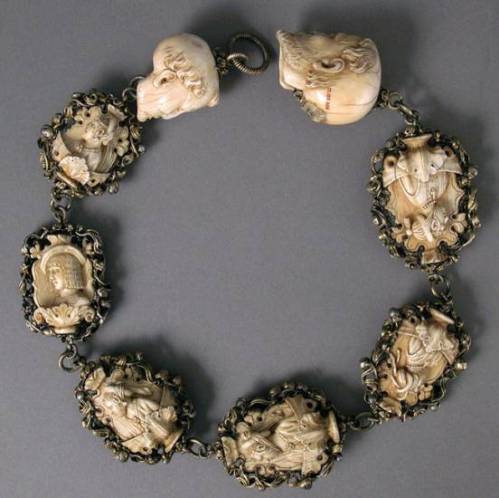
Well, it’s not really made of skulls, but this German rosary from the early 16th century certainly has a macabre air about it.  Made of ivory and set into silver, each of the eight beads represents the bust of a burgher or maiden on one side and a skeleton on the other.  Albeit lurid, the beads may hint that life is fleeting and virtuousness in the Christian faith is the only true path to salvation.  Raised Roman Catholic, I’ve seen plenty of rosaries, but none quite as compelling as this.  Leave it to my Teutonic ancestors to create shock value, even in modern times!

Courtesy of Metropolitan Museum of Art.

1 Comment

Filed under Classics

Speaking of Politics and Bowls!

Maxine 020313

Courtesy Maxine and “Crabby Road.”

Leave a comment

Filed under Curiosities

Black and White in a World of Color

Moore_Photo__2

“We are a backwards-ass state in a fast-forward world.  Texas is a land of contradictions.  We are creating some of the planet’s most advanced technology while teaching our children that archaeology proves the Bible to be factual.”

– Author and political analyst James Moore, in the Huffington Post.

It would be easy for me to pack up my stuff and run to the nearest place of common sense – say, Hawaii or New Zealand.  Politics here in Texas has taken a woefully right-wing turn, especially with the election of such extremists as Sen. Ted Cruz and the ongoing reelection of Rick Perry.  I honestly believe it’s not that Texans lose their brains when they head to the voting booth, but rather, that too many of the decent, logical ones stay home come election season.  Who can blame them?  If you look at any crop of candidates, it’s like you’ve arrived at a going-out-of-business sale just moments before the store closes.  There’s not much left.

Alas, I can’t afford to move and I certainly don’t want to leave my aging parents to the mercy of such scoundrels as Cruz and Perry.  I can only hope that, in the ensuing years, more of my moderate fellow Texans will drag themselves to the polls each election and start bouncing the extremists back under the rocks from whence they came.

2 Comments

Filed under News