

Visit the Oklahoma City National Memorial
Visit the Oklahoma City National Memorial
Filed under News

Survivalist Tip: Consider stockpiling blueberries. Blueberries are one of the few fruits indigenous to North America. There’s no evidence the ancient Mayans cultivated them, but many of the native peoples of what is now New England grew and consumed them. They often used blueberries in religious ceremonies and for medicinal purposes, especially in alleviating coughs. Science has proven they were right. With just 80 calories per cup and no fat, blueberries are rich in Vitamin C and high in fiber. This will keep your energy at peak levels and your digestive tract regulated as you struggle to survive in the immediate aftermath of the apocalypse. Blueberries are also high in manganese, which is good for bone development. That means it’ll be good for everyone in your posse. Strong bones will help you fend off zombies, politicians and other scavengers who might survive the upheaval. And, blueberries are at the top of the list in antioxidants, elements that help prevent cell damage. Blueberries are good fresh, dried, or mixed in with soups and stews. Native Americans even used them to make indigo dye. But, as you’re wrapped up in survivalist mode, don’t worry about that. You’ll have plenty of time to be fashion conscious once things settle down. In the meantime, enjoy some blueberries. They go good with chocolate, too!
Filed under Mayan Calendar Countdown
If your birthday is today, “Happy Birthday!”
Actress Barbara Hale (Perry Mason, The Oklahoman, Airport) is 90.

Actor Clive Revill (The Sea Wolf, The Empire Strikes Back, The Private Life of Sherlock Holmes) is 82.
Actor Robert Hooks (A Woman Called Moses, Heat Wave, The Execution) is 75.
Guitarist – reed player Mike Vickers (Manfred Mann) is 71.
Football Hall of Famer Pete Gogolak (first soccer-style kicker: Buffalo Bills, NY Giants) is 70.
Actress Hayley Mills (The Parent Trap, The Moon Spinners, Pollyanna) is 66.

Actress Dorothy Lyman (All My Children, Mama’s Family) is 65.
Actor James Woods (The Onion Field, Holocaust, The Way We Were) is 65.
Actor Rick Moranis (Little Giants, The Flintstones, My Blue Heaven, Parenthood) is 59.
Actor Eric Roberts (Doctor Who, The Hard Truth, Fugitive Among Us) is 56.

Actress Jane Leeves (Frasier, Throb) is 51.

TV talk show host Conan O’Brien, Late Night with Conan O’Brien, is 49.

Actress Melissa Joan Hart (Clarissa Explains It All, Twisted Desire, Sabrina the Teenage Witch) is 36.

Filed under Birthdays
1521 – Martin Luther refused to recant his writings before an assembly of the Roman Catholic Church in Worms, Germany.

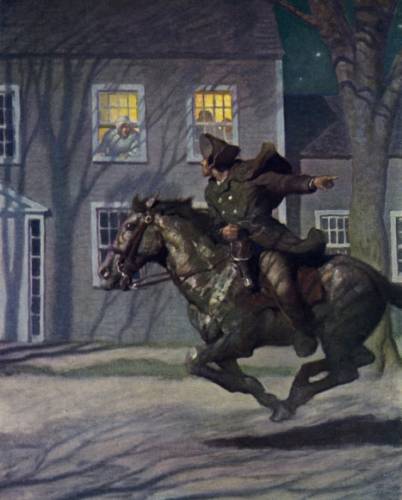
1775 – Paul Revere and William Dawes set out to warn residents of Lexington, MA, that British troops were marching out of Boston to confiscate American arsenal at Concord.
1906 – A massive earthquake, estimated to be 8.0 on the Richter scale, struck the San Francisco area at 5:12 A.M. Felt from Oregon down to Los Angeles, the temblor killed some 3,000 people and destroyed about 30,000 structures.
1910 – Walter R. Brookins made the first airplane flight at night, passing over Montgomery, AL.

1923 – Yankee Stadium opened in the Bronx, NY as the hometown team, the NY Yankees, hosted the Boston Red Sox.

1934 – The first laundromat opened in Fort Worth, TX.

1965 – Contralto Marian Anderson ended her 30-year singing career with a concert at Carnegie Hall in New York City.

Filed under History

A glacial torrent pours over a 40-foot-high ledge at Gođafoss, “waterfall of the gods,” in Iceland. After the Icelandic assembly adopted Christianity in A.D. 1000, its leader threw his pagan idols into the falls. The mossy island in the foreground, notes geographer Guđrún Gísladóttir, “is protected from sheep.” Photograph by Orsolya and Erlend Haarberg, National Geographic.
Filed under News

Fellow blogger The Templar Knight takes umbrage with a claim by Norwegian mass murderer Andres Behring Breivik that he’s part of the “Knights Templar,” the legendary religious crusaders of medieval Europe. Giving a Hitleresque salute in court the other day, Breivik admits he set off a bomb that killed 8 people and then shot 77 more to death last summer as part of his personal crusade against Norway’s Muslim population. It was the worst political attack in Europe since World War II and shattered the calm demeanor usually associated with Norwegian society.
The original “Knights Templar” first appeared in France in the 12th century. Hugues de Payens, a French nobleman, gathered 8 of his knight relatives and began what he called the “Knights of the Temple of King Solomon.” Their mission was simple but direct: protect pilgrims on their journey to visit “The Holy Places,” mainly Jerusalem. They became an elite fighting force; highly-trained, highly-motivated and well-equipped. Even their horses were trained specifically for battle and shielded by protective armor. One of the Templars’ earliest and most noteworthy battles took place in 1177. The famed Muslim military leader Saladin was attempting to invade Jerusalem from the south with a force of 26,000 soldiers. With only 500 men, the Knights Templar ambushed Saladin and forced him to retreat.
Breivik first described the Knights Templar in his 1,500-page manifesto “2083: A European Declaration of Independence,” in which he called the group “a nationalist military order and military/criminal tribunal.” He designed and modeled uniforms, badges and other insignia for the military. In his proclamation, which was distributed to about 1,000 people immediately before Breivik detonated a car bomb in Oslo, he also tried to recruit “Justiciar Knights” for the crusade. “As a Justiciar Knight you will go into history as one of the most influential individuals of your time,” Breivik wrote in “2083.”
As horrific as Breivik’s crimes are, his views are nothing new. Europe has seen a wave of anti-Muslim sentiment in recent years. A 2010 survey in the United Kingdom found that 52% of respondents believe Britain is divided sharply along religious lines. In Malmö, Sweden, in November 2010, a man was arrested in connection with a dozen unsolved shootings of immigrants, including 1 fatality. Even German Chancellor Angela Merkel told fellow Christian Democrats in October 2010 that multiculturalism “has failed, utterly failed.”
Officials haven’t determined whether Breivik acted alone, as he claims. But, this case is destined to be the subject of much attention and scrutiny in both Europe and the Muslim world.
Read the rest of The Templar Knight’s blog post here.
Filed under News

“I acknowledge the acts, but I don’t plead guilty, as I claim I was doing it in self-defense.”
– Anders Behring Breivik, responding to a judge in an Oslo courtroom on April 16. The 33-year-old Breivik is charged with killing 77 people last July at a Labor Party youth camp on the island of Utøya. Breivik also has denied being insane and has dubbed himself a contemporary “Knight Templar.”
Filed under News

Survivalist Tip: Previously, I mentioned you should stockpile bananas, as they’re a good source of nutrients. But, you also should stockpile apples. Unlike bananas, apples don’t ripen as fast and therefore, last longer. Apples have always had a bad rap, since the “Garden of Eden” scenario in the Christian Bible. But, since the Mayans existed long before the Bible, that rule doesn’t apply here. Although the crab apple is the only type of apple native to North America, there are currently 2,500 varieties grown in the United States. Europeans brought more varieties of apple trees to North America in the 17th century, but since Native Americans adapted quickly to them, that sort of makes up for the whole small pox fiasco and anything Custer did.
More importantly, apples are extremely nutritious. A single apple has about 80 calories and 5 grams of fiber. Apples are also free of fat, sodium and cholesterol. In the chaotic aftermath of the apocalypse, you’ll need a high caloric intake to search for food and fend off predators. You definitely don’t need more fat and sodium in your diet amidst the ruckus. Don’t peel an apple; about 2/3 of the fiber and lots of antioxidants are found in the skin. And, don’t worry about making apple cider and apple pies until things have settled down. You’ll have plenty of time for that later. As long as you all keep your apples in a relatively cool, dark place, they’ll be good for a while. I know there’s a bad joke in that, but I won’t go there.
Filed under Mayan Calendar Countdown


