Archaeology of Titanic

This composite image, made from sonar and more than 100,000 photos taken in 2010 from by unmanned, underwater robots, shows a small portion of the Titanic debris field.

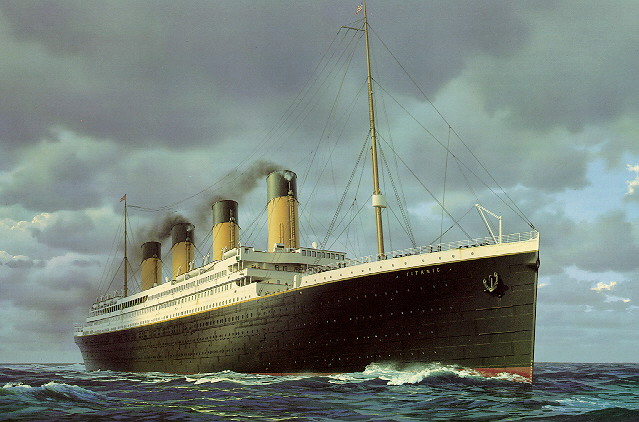
The May / June 2012 issue of Archaeology Today, a publication of the Archaeological Institute of America, marks the centennial anniversary of the Titanic’s sinking by focusing on “what it was always meant to be: an archaeological site.”  When scientists finally discovered the wreck in 1985, using an unmanned deep-sea vessel called Argo, they certainly didn’t expect to find the Titanic in pristine condition.  But, they also didn’t expect to learn that it had become a haven for marine life. 

Two miles down, with water pressurized to 6,000 pounds per square inch, the remnants of the Titanic metamorphosed into a “series of reefs in what had once been a deep-sea desert.”  Plunging to such depths had been the stuff of ambitious dreams and adventurous souls.  But, even by the 1980’s, when technology allowed those dreams to become reality, no one really knew what to expect.  Humans first visited the site in 1986, peering out the peep holes of another deep-sea submersible, Alvin.  The year after that, another vessel, Nautile, glided over the site.  Scientists were stunned to find bottles of wine, dishes, clothing, wallets and other items scattered along the ocean bottom near the wreck, where oxygen doesn’t reach.  With its robotic arm, Nautile picked up the first of 1,800 artifacts it would recover during that expedition. 

In 2010 two robotic vehicles crisscrossed the seabed, using high-resolution sonar and camera systems to create the first comprehensive map of the Titanic site.  Another robot, at the end of a fiber-optic cable, sent to the surface live, full-color, 3-D images, allowing scientists to virtually walk the decks of the ship.  This latest effort is perhaps the most significant advance since underwater archaeology began just 50 years ago.  For the first time, Titanic can be treated and explored like any other underwater site; extreme depths are no longer an obstacle. 

The first steps in expanding underwater archaeology to the depths were propelled by the Titanic disaster itself, as the first sonar systems were developed and tested after the sinking to locate and avoid icebergs.  This technology improved throughout the 20th century, moving into deeper waters, until Titanic’s discovery.  But even in 1985, the idea that Titanic could be explored, photographed and mapped like an archaeological site seemed like science fiction. 

The artifacts salvaged since 1987 represent less than 1% of what might be available.  The furor over the recovery of artifacts from Titanic has been long and arduous.  The greater concerns for archaeology are how and why the artifacts were removed, and what would become of them.  Were they being appropriately conserved, cataloged, and researched?  Would they ultimately go to auction? 

The U.S. District Court in Norfolk, Virginia has overseen the salvage company’s activities under admiralty law for two decades and has answered a number of these questions.  Rulings by the court have limited recovery to artifacts scattered outside the intact bow and stern sections.  At one stage, RMS Titanic Inc. unsuccessfully sued the U.S. Departments of State and Commerce to stop publication of the International Agreement on Titanic guidelines.  Most recently the court awarded RMS Titanic Inc. title to the 5,000 artifacts, with the stipulation that the company follow international standards for conservation, treatment and display of the collection.  Furthermore, any sale of the artifacts would be subject to review by the court, and allowed only if the collection stays together and is maintained for public display and study. 

Debate surely will continue over Titanic’s remnants, but one thing is certain: it is one of the most horrific maritime disasters in recent memory.  People have an almost macabre fascination with it.  Yet, we can’t forget the human aspect of that tragedy.  The hopes and dreams of many people aboard the vessel vanished into the cold dark waters of the North Atlantic.  The ship is their collective graveyard.  We can dredge up cutlery and even paper documents from the muddy depths.  But, we can’t bring the more than 1,500 souls who perished along with them.  They were important, too, and they should be respected.


Leave a comment

Filed under News

In Memoriam – R.M.S. Titanic

April 15, 1912 – Rest In Peace


Leave a comment

Filed under News

April 14, 2012 – 250 days Until Baktun 12


Survivalist Tip:  One thing you have to check in your vehicle is the motor oil.  No vehicle can function without it.  It’s the single most essential lubricant for the engine.  If you’re starting to get sexually excited, stop and get hold of yourself.  On second thought, get hold of something else – like the wall – and start concentrating.  This is serious!  Motor oil has 3 primary functions: 

  1. It prevents all the metal surfaces in your engine from grinding together and tearing themselves apart due to friction.  If you hear a nasty grinding sound coming from the engine, chances are your motor oil level is low.  Either that, or you were speeding through a school zone. 
  2. It suspends all the nasty by-products of engine combustion, such as acid and insect refuse. 
  3. It minimizes exposure to oxygen, which at high temperatures, can damage the engine.

Motor oil comes in 2 types: mineral and synthetic.  Mineral oil is a natural substance that comes from the Earth.  Do not confuse it with the type you use for cooking.  Synthetic – as the name implies – is concocted in a lab.  Since I place scientific labs in the same category as government agencies and utility companies, I don’t trust them and therefore, recommend you use mineral-based motor oil, specifically 10W-40.  You’ll have to change it more often, but it’s best for you and your vehicle. 

As December 21 approaches, you need to change the motor oil in your vehicle.  Regular oil changes prevent something called “Black Death.”  Usually when people think of “Black Death,” they conjure up images of medieval, rat-infested Europe.  But, in this case “Black Death” simply means sludge.  This is not the chocolate sludge delight you get at a chocolate festival.  This is the gunk that builds up in your engine when you don’t maintain it properly.  Similar gunk builds up in your intestines and refrigerator, but I don’t have time for that.  If your vehicle’s engine has developed sludge, you just need to have it flushed out completely.  Consider this an enema for the engine.  I know that sounds nasty, but I’m trying to emphasize the importance of engine maintenance. 

You don’t know how long it’ll take for things to settle down after the apocalypse.  But, if you have to travel a long distance, you can be assured your vehicle will help you reach safety.  Then, you can enjoy all the chocolate sludge in the “New Universe!”


Leave a comment

Filed under Mayan Calendar Countdown

Today’s Notable Birthdays

If your birthday is today, “Happy Birthday!”


Actress Gloria Jean (Copacabana, The Ladies Man) is 85.

Actor Bradford Dillman (Compulsion, The Bridge at Remagen, Falcon Crest) is 82.


Actor Jay Robinson (Sinatra, My Man Godfrey, The Virgin Queen, The Robe) is 82.

Actress Joan Darling (The President’s Analyst, The Two Worlds of Jenny Logan) is 77.

Singer – songwriter Loretta Lynn (Coal Miner’s Daughter, I’m a Honky-Tonk Girl, One’s on the Way, The Pill; 1st woman to earn the Country Music Association’s Entertainer of the Year award) is 77.

Actress Julie Christie (Dr. Zhivago, Petulia, Shampoo, McCabe & Mrs. Miller) is 71.


Guitarist Ritchie Blackmore (Deep Purple, Rainbow, Blackmore’s Night) is 67.

Actor John Shea (Baby M, WIOU, Backstreet Justice) is 63.


Actor Anthony Michael Hall (The Breakfast Club, Sixteen Candles, Edward Scissorhands) is 44.


Leave a comment

Filed under Birthdays

On April 14…

1865 – John Wilkes Booth, an actor and Confederate sympathizer, fatally shot President Abraham Lincoln at Ford’s Theatre in Washington, D.C.  Lincoln died at 7:22 A.M. the next day.


1894 – Thomas Alva Edison demonstrated the kinetoscope in New York City.  A viewer that held 50 feet of film – about 13 seconds worth – showed images of Annie Oakley and Buffalo Bill.  The demonstration was actually called the first peep show, as one had to peep into the device to see what was on the film.  Movies were not projected on a screen at that time.

1902 – James Cash Penney opened his first store, dry goods and clothing store named Golden Rule, in Kemmerer, WY.

1912 – The R.M.S. Titanic of the White Star Line struck an iceberg at approximately 11:40 P.M.  The great ship, on its maiden voyage, sank just under three hours later, taking 1,517 people with it.


1912 – Stunt man Frederick Rodman Law became the first man to intentionally jump from the Brooklyn Bridge in New York without intending to take his own life.  He survived the leap.


1939 – John Steinbeck published The Grapes of Wrath.


1956 – Ampex Corporation of Redwood City, CA demonstrated the first commercial magnetic tape recorder for sound and picture.  The videotape machine had a price tag of $75,000.


Leave a comment

Filed under History

Cartoon of the Day


Leave a comment

Filed under News

Pictures of the Day

A weather system dumped up to 4 feet of hail in Northwest Texas, mainly the Amarillo area, the other day.  This was an odd event, even for Amarillo, which experiences heavy snowfall every winter.


Leave a comment

Filed under News

Quote of the Day

“I have very little tolerance for people who tell me that they graduate with $200,000 of debt or even $80,000 of debt because there’s no reason for that.  We live in an opportunity society and people are forgetting that.  I remind folks all the time that the Declaration of Independence says “life, liberty, and the pursuit of happiness.”  You don’t have it dumped in your lap.”

– Rep. Virginia Foxx (R-NC), who chairs the House Subcommittee on Higher Education & Workforce Training, on G. Gordon Liddy’s radio show.  In Foxx’s 2010 financial disclosure statement, she owned two individual mortgage notes worth up to $250,000 each, from which she earned as much as $20,000 in payments.


Leave a comment

Filed under News

Why We Should Fear Amazon

Author Scott Turow apparently has a distaste for the Amazon giant and feels it’s dangerous for the world of literature.  As society develops an increasing fascination with e-books and more writers undertake self-publishing, Amazon finds itself in a prime position as a global entity.  Last month, however, the U.S. Justice Department warned Apple and 5 of the nation’s largest publishers that it planned to sue them for price fixing.  At issue is the agency model, a method of selling e-books via wholesale in which the publisher sets the retail price and the retailer takes a 30% cut.  Most print and many e-books are sold under the traditional wholesale model, in which publishers sell books at a discounted price, and the retailer can resell them for whatever price it likes.

On March 12, Scott Turow – the bestselling author of many legal thrillers and current president of the Authors Guild – posted a letter to members on the Guild’s web site.  He denounced the Justice Department’s actions as bad news for authors, “grim news for everyone who cherishes a rich literary culture,” and ominous for book consumers.

Laura Miller, a writer for Salon, interviewed Turow shortly after his letter appeared.


Miller: What are some of the Guild’s problems with Amazon?

Turow: First of all, so that I don’t get dismissed as an ingrate, I should say that Amazon has been a boon for bestselling authors.  Authors get paid on the basis of the cover price for a hardcover book.  By discounting, which is something that chain stores started and Amazon continued, they have lowered the barriers to book buying in ways that have been personally extremely beneficial to me.


Because you get paid the same amount regardless of how much the retailer charges for the book, and the discounting encourages more people to buy the book?

Exactly.  These are not personal complaints.  There are lots of things about Amazon for which they deserve credit.  They’re innovative.  There are lots of very, very happy Amazon customers.  I’m not here to dispute that Amazon has been personally good for me or to say that they haven’t been, so far, good to their customers.


So what’s the problem?

The concern is that they are getting so large and they compete so ruthlessly that there’s a lot of fear for what the world with Amazon in charge is going to look like.

The Guild’s beefs with Amazon became pronounced over the issue of the resale of new titles some years ago.  This was something that Amazon pioneered.  They would sell you a [just-released] book on Day One, buy it back from you on Day Two, and then resell it to another customer on Day Three.  This was legal, but certainly not what anybody ever intended.

Traditionally, in hardcover, that’s been basically a split of the proceeds between the author and publisher.  (An aside: That’s something we’re fighting with publishers about in the digital world.)  So Amazon decides to go into competition with the publishers by reselling the book they just bought.  The publisher gets paid nothing, and neither does the author. It’s a pure profit for Amazon.

Now, the reason you don’t see used bookstores within new bookstores is that the used books compete with the new books and the publishers supplying the new books would object.  Either you’re doing business with me or you’re competing with me.  I’m not going to sell you books so you can take some percentage of sales.

The problem of course was the Amazon had gotten so big that publishers were afraid to resist that.  It’s not the mere fact that they’re competing [with their own suppliers].  I can certainly understand that it’s good for consumers to be able to buy a book two days later at a lower price.  It’s the fact that the publishers were afraid to dismiss Amazon.


Which is what they would do with a regular retailer who was doing the same thing but had viable competitors?

Right, and of course, Amazon was undercutting authors in the process.  We tried to persuade them to just window this [delay making used copies of brand-new books available for a period of time, the way the release of the DVD of a movie is delayed until after it has played in theaters].  That didn’t work.  It was a muscle-flexing exhibition by Amazon, saying, “We’ve got so much market power, you guys can’t do what you’ve traditionally done and take your goods elsewhere.  We represent at least 30 percent of the book market.”

I don’t like losing sales, but the real problem is at the margins.  Midlist authors have been struggling to survive for decades now.  If you start eating into the publishers’ returns, then at the bottom of the food chain, those books are just not going to get published.  We have seen that happen.


Are there other examples of Amazon using its predominance?

They now control the print-on-demand market.  That’s when you buy a book and only then does a service print a copy — literally on demand.  [This is a method used by academic and small presses, as well as by authors with otherwise out-of-print books.]  Amazon bought a POD service called BookSurge.  Then they informed their customers — university presses and some other publishers who the Guild had organized to do POD for Authors Guild members — that they would not list their books on Amazon’s site unless they paid BookSurge more for their services.

I don’t know how they defend themselves on this one.  That’s another very ominous sign to the book industry and authors.


What about their history with e-books?

They deserve a lot of credit for the Kindle, for yoking e-ink with this nationwide wireless network.  It’s a great innovation.  And they said to the publishers, “It’s really important to us in introducing this platform that e-books appear at the same time as the hardcover edition.”  Publishers said, “Oh, we’ve seen your tricks before, Amazon!  Why would we ever do that?”

So Amazon says, “We’ll pay you the same amount we pay you on a hardcover.”  So publishers think that sounds fine, how can they complain about that?  They agree and are then stunned when Amazon announces that they’re going to sell every e-book at a loss, for $9.99.  That’s an average loss of $4 to $5 a book.


Why would Amazon do that?

I suppose they could argue they were doing it to sell devices and that may well have been one of their intentions.  It had the additional benefit of making it much harder for any of their competitors to enter the market.

For example: A lot of people have the habit of going into a physical store, looking at books and then turning around and buying the e-book wirelessly from Amazon.  Had it not been the case that you had to sell an e-book at a $5 loss, bookstores would have been able to say, “Sure, bring your device with you and we’ll sell you the e-book right here.”

Bookstores are pretty hard-pressed by book discounting as it is, and the idea of selling e-books at a loss made it impossible for them to enter the marketplace in competition with Amazon.


What about the proprietary format of Kindle? Didn’t that also make it hard for competing e-readers to enter the market?

You couldn’t read all those books you bought from Amazon on a competitor’s device – you can now, if you have an iPad, but you couldn’t then.


The nook is widely regarded as the better e-reader device, but if you’ve accumulated a library of Kindle titles, you can’t take them with you if you decide to switch.  [Technically, you can, but most users would find this quite challenging.]

Barnes and Noble developed the nook because they really had no choice but to compete with Amazon.  They were struggling at that point, and I personally don’t think they’d have been able to survive while losing $5 on every book.  There simply were not a lot of people jumping into that market to compete, not with the prospect of losing $5 on every book sale.  From the outside, it looks like the pricing was not just a loss leader on the devices, but a way to discourage competition.


How did Amazon’s e-book pricing affect authors?

One way that 25 percent of net became the standard royalty for e-books was because publishers said, “We all know they can’t go on selling e-books at a loss forever and sooner or later this pricing structure has got to change.”  They told authors they couldn’t agree to a different royalty because everyone knew that Amazon wouldn’t be paying them $14 to $15 per title indefinitely.


You’re implying that Amazon planned eventually to use the consumer’s habituation to $9.99 books to force publishers to charge Amazon lower wholesale prices for books.  They’ve tried to do that recently with some small presses, removing their titles from Amazon unless the presses agree to sell their books at rock-bottom wholesale prices.  And publishers would have no choice but to agree because every other competitor would also have been driven out of the market by Amazon’s predatory pricing?

Certainly, that’s what publishers assumed.  The other thing Amazon could have done once they had the market to themselves – and this is virtually inevitable – is that they would have raised prices to consumers.


That’s part of the less-known history behind anti-trust laws.  Once a large company has spent its capital to fund predatory pricing and drive its competitors out of business, there’s no reason to keep selling for cheap.  The low prices don’t last.

Right.  Look, if what they’re into is maximizing profits, then if they were to have a monopoly there’d be no rationale not to use the monopoly power to increase prices to consumers.  Now, if I were on the other side, working for Amazon, I’d say “Show me where I’ve done that.”


Presumably, they haven’t done it yet because they haven’t achieved the monopoly yet.  Historically, that’s what monopolies always do.

Correct.  That is historically what monopolies do.  There is plenty of precedent for that.  It’s only rational to fear what they’re going to do with this accumulation of power.

Again, the concern from the author’s perspective is that e-books are putting a tremendous downward pressure on the price of books in general.  That’s putting tremendous pressure on publishers to survive.  And I think a world in which online book selling is driving bookstores out of existence is a pity.


How did Amazon respond to the entrance of Apple and the agency pricing system?

Apple offered to sell books on the iPad using the agency model – which is what they use for iTunes – and the publishers one by one agreed to that.  Then they told Amazon they were going to follow this new model, and that they were going to produce the e-books themselves rather than Amazon doing so.

When the first publisher, John Sargent [of Macmillan], told them that, Amazon responded by removing the buy buttons not just from all of Macmillan Publishing’s e-books – about which you can say, yeah, there’s a legitimate dispute – but from their print books, too. Paper, physical books!  It was another demonstration of their ability to abuse their market power.  They used their market power over an item where pricing was not in dispute to punish a publisher for taking what Amazon regards as an unfavorable position in a different market.


Why should where their books are bought make a difference to authors?

New authors traditionally are nurtured by bookstore personnel, especially in independent bookstores.  These people literally hand sell books to their customers, by saying, “I’ve read this.  I think you’re going to love it.”  Not to mention the fact that a bookstore is a small cultural center in a community.  That’s definitely a loss.

Again, my concern is for the sake of literary diversity.  If the rewards to authors go down, simple economics says there will be fewer authors.  It’s not that people won’t burn with the passion to write.  The number of people wanting to be novelists is probably not going to decline – but certainly the number of people who are going to be able to make a living as authors is going to dramatically decrease.

When that decreases, the diversity of the literary culture decreases.  The store of new ideas and the richness of the discussion all decreases.


Leave a comment

Filed under News

Fantasmagorie

Fantasmagorie is a 1908 French animated film by Émile Cohl.  It is one of the earliest examples of traditional, hand-drawn animation, and considered by film historians to be the first animated cartoon.


Leave a comment

Filed under Classics