Tag Archives: conflict

Gladiating

Jacqueline Susann’s 1973 novel “Once Is Not Enough” is filled with enough drama, heartbreak, romance, intrigue and sexual indiscretions to send any family into therapy for decades.  The central character, January Wayne, returns home to New York City after being hospitalized in Switzerland for nearly three years.  That part alone rivals the best (or worst) any Mexican telenovela can deliver.  In many ways the world she left three years earlier hasn’t changed, but in most others, it’s radically different.  As is befitting a Susann story, January encounters a plethora of strange figures: one of the world’s richest women; a vile magazine editor; a hyper-masculine novelist; and a physician with salaciously ulterior motives, among other cretins.  Almost sounds like one of my old family gatherings!

To some extent “Once Is Not Enough” is a commentary on the myriad social upheavals in the U.S. at the time of its publication.  Right now, though, I wonder if many Americans have been suffering from subtle amnesia – or are just innately sadistic.

A generation ago we had a president who launched an unexpected war upon a Middle East nation that – along with a slew of heavy tax breaks for the wealthiest citizens – culminated in the worst economic downturn in almost a century.  George W. Bush used the horrors of the September 11, 2001 terrorist attacks to justify an invasion of Iraq less than two years later.  To date that fiasco has cost the U.S. an estimated USD 6 trillion.  That’s just in hard U.S. dollars.  But the cost in mental and physical health is immeasurable.

Now we’re at it again.  The Trump Administration has attacked Iran – one of the U.S.’s most loathsome enemies.  Until 1979, we had a cordial diplomatic relationship with Iranian leadership, including the late Mohammad Reza Pahlavi.  He had risen to prominence in the immediate aftermath of World War II and guided Iran into something of a progressive new era.

But Pahlavi had also instituted a repressive dictatorship and exhibited an extravagant lifestyle for him, his family and others in the small elite class.  His ardent efforts to Westernize and secularize Iran, along with depending strongly on the United States, alienated his own people and culminated in a student uprising that forced him and his family into exile.  The same uprising ambushed the U.S. embassy in Tehran in November 1979 that led to holding several Americans hostage for over a year.

It was our first battle with radical Islam and it caught the U.S. completely off-guard.  At the time the “Cold War” was still raging, and the Soviet Union remained the most serious foreign threat.  Iran wasn’t on the radar of diplomatic instability.

Recently the Trump Administration invaded Venezuela to capture its president, Nicolás Maduro, who the world has denounced as an illegitimate leader.  A global coalition of democratic states claims Maduro ascended to the Venezuelan presidency in January 2019 after a rigged election.  Somehow, the 2000 and 2016 presidential elections in the U.S. come to mind whenever I hear the term “rigged election”.

Now Trump has set his sights on two more foes: Cuba and Colombia.  Cuba has been on the American shit-list for over 60 years, and Colombia has a long history of political assassinations and drug trafficking.  Bush had used the excuse of nuclear weaponry to invade Iraq, and even critics later admitted the country was better off without its brutal leader, Saddam Hussein.  The world would be better off without many autocrats – including Trump.

But is it the duty of the U.S. to remove every such character?

We all know the adage that, when old men go to war, young men die.  Right now, though, it seems when the billionaire class goes to war, the middle and lower classes die.

And here we are again.  Once may not be enough in regards to love, sex and a good back rub.  But one war is always one too many.
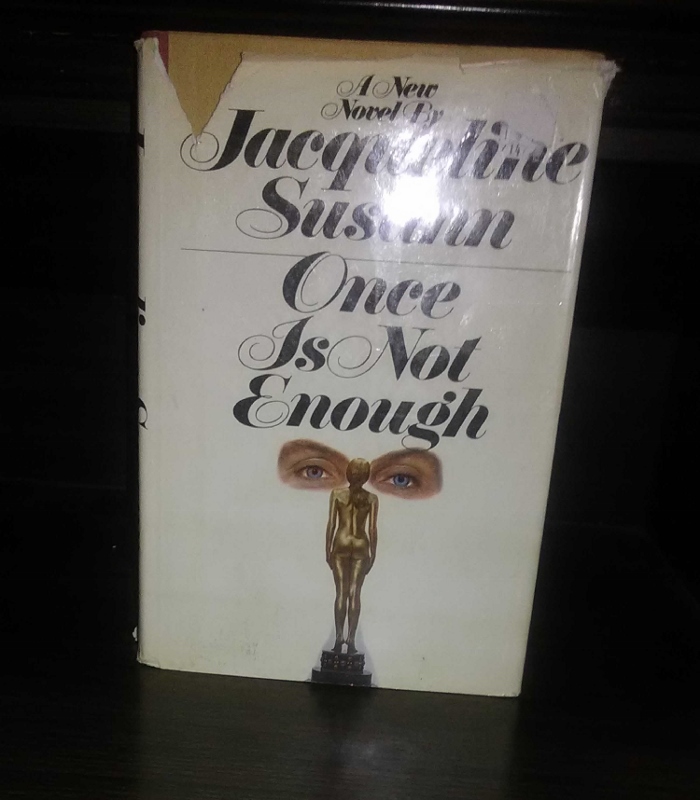
My first edition copy of “Once Is Not Enough”
5 Comments

Filed under Essays

Home Somewhat Free

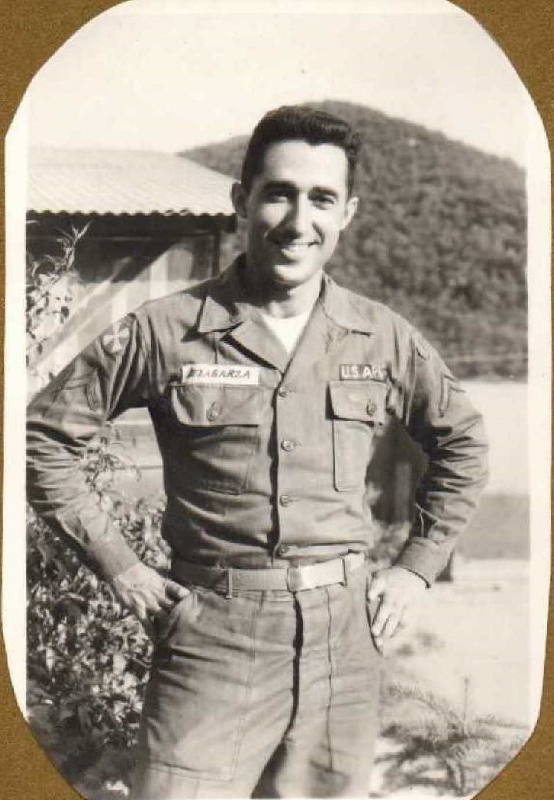
My father, George De La Garza, Sr., in South Korea in 1954

This is my father’s recollection of returning home from military service in Korea.

I had thought of joining the military when I got older.  My older brother, Jesse, did.  He was 17 and failing out of school when he enlisted in the U.S. Army in the summer of 1942.  They shipped him out to the Pacific region.  He was stationed on some remote island, when he killed his first person.  He said it was at night, and Jesse and his commanding officer were hidden in some thick foliage – looking for…whatever.  Then they spotted a Japanese solider approaching.  Jesse’s CO ordered him to kill the guy…“or I’ll kill you first and then him.”  He was still 17 and had no choice.  Jesse saw other casualties – adults and children; soldiers and civilians – in the wicked and bloody chaos of World War II’s Pacific theatre.  He caught malaria, before returning home.

Jesse received a slew of awards, including a Purple Heart by Gen. Douglas MacArthur himself.  He got an honorable discharge and quickly came back to Dallas.  One Saturday morning me and Jesse, our younger brother, and some other friends visited a local barbershop.  As sat conversing in Spanish and English, the shop’s owner approached and – in his heavy Scottish brogue – ordered us to leave.  “We don’t cut Mexicans’ hair.”

Here we all were – born and raised in the Dallas area, not causing any ruckus – and a foreign-born man tells us to leave.  At some point over the next couple of days, a massive rock found its way through the large glass window of that shop.  I swear I don’t know how that happened!

That experience kind of left me bitter about this great country and the freedom it was supposed to have.  I no longer had any desire to join the military.

Then came Korea – and I had no choice.

I had just turned 21 in January 1954, when my father drove me to the Greyhound bus station in downtown Dallas – just like he’d done with Jesse more than a decade earlier.  I had rarely been outside of Dallas and never outside of Texas.  I arrived at Fort Bliss in El Paso, a little scared and not knowing what to think.  After basic training, they put me on another bus to Los Angeles, then a train to Seattle, and finally a ship to Korea.

From what I understood later, Korea wasn’t nearly as bad as World War II, but when is there ever a pleasant war?  More importantly I understood why Jesse never wanted to talk about his own experiences.

By then the U.S. armed forces had been (forcibly) integrated, so men of all shapes, sizes and colors served together.  I developed close friendships with many of my Black comrades.  I could envision these connections lasting a lifetime.

It was only two years, but it felt like decades.  We left Korea on a ship for Seattle.  Once there we had to take a train down to Los Angeles.  I stood with my Black buddies on the platform, before we had to board.  My friends started walking away from me.

“Hey, guys, where are you going?” I asked, still innocent – naïve actually.

“We have to go to the rear of the train,” one of them called back to me.

The rear of the train – where the Negroes had to go.

Oh yeah, I told myself.  We’re back in America – the land of the free.

3 Comments

Filed under Wolf Tales

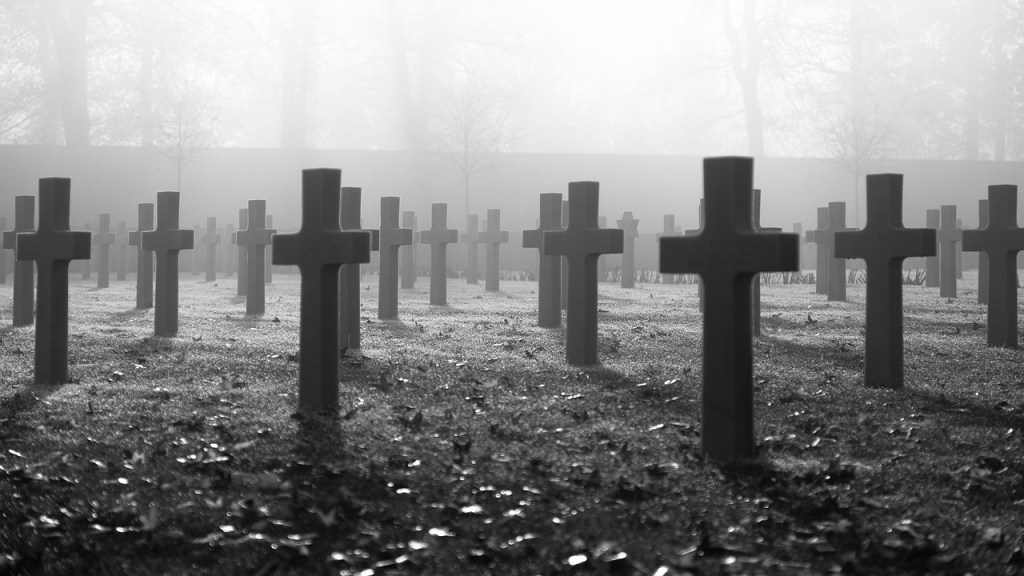
Memorial Day 2023

“This is the day we pay homage to all those who didn’t come home. This is not Veteran’s Day; it’s not a celebration; it is a day of solemn contemplation over the cost of freedom.”

Tamra Bolton

Memorial Day

Leave a comment

Filed under News

“Napalm Girl” at 50

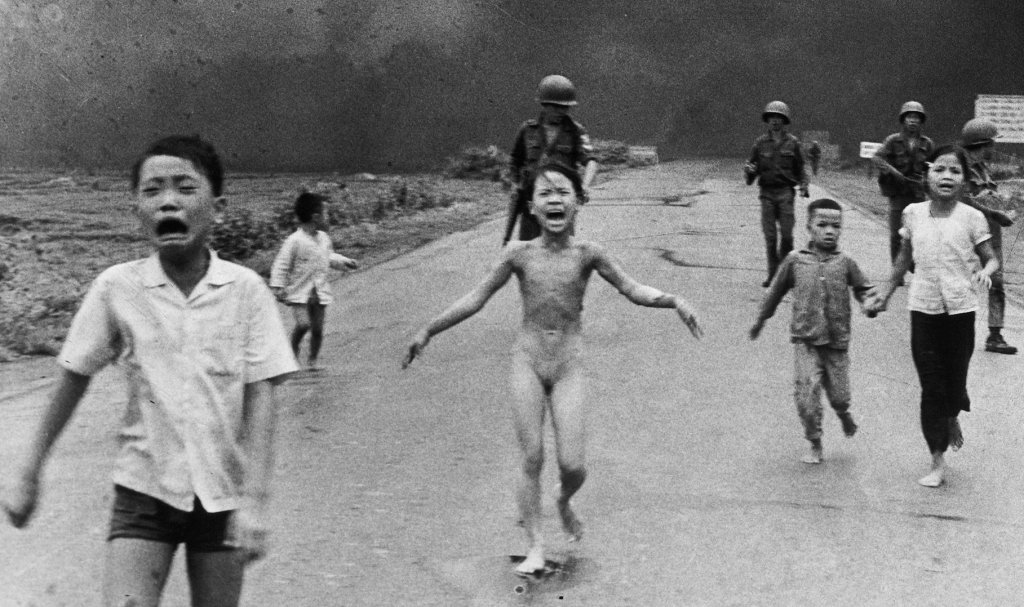
Phan Thị Kim Phúc probably didn’t think anything of the photographer who snapped a photo of her running stark naked down a dirt road.  She was in excruciating pain and – as a child – had no idea what was going on around her.  The photographer, Nick Ut, certainly had no idea of what he had captured on film.  But that one single image of people scampering down a road in Trang Bang, Vietnam on June 8, 1972, following a napalm attack, captured the true horror of war and the carnage it unleashes upon innocent civilians.

For most Americans in 1972, the Vietnam quagmire had become unbearable.  Gone was the glamor and nobility of war as instilled by World War II.  Often called the “living room” war, Vietnam brought home the reality of what happens when nations can’t agree on what’s right and decide to fight it out like wild dogs.  In some ways, things haven’t changed.

Amazingly Phúc survived the attack and now lives in Canada.  She no longer views herself as that “Napalm Girl”.  But that she did live through such an event is a true testament to the human spirit – something no chemical can destroy.

3 Comments

Filed under Classics

Gaffe of the Week – May 21, 2022

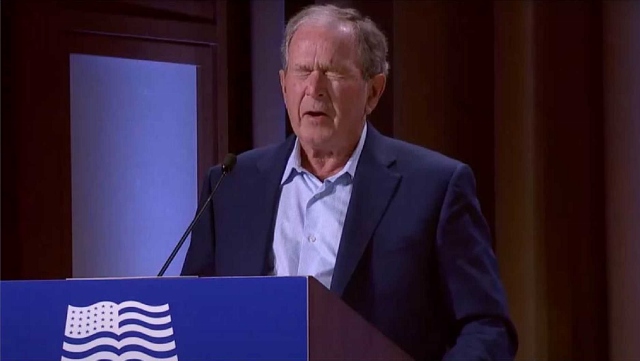
“The result is an absence of checks and balances in Russia, and the decision of one man to launch a wholly unjustified and brutal invasion of Iraq – I mean of Ukraine.”

Former President George W. Bush, in a speech criticizing Russian President Vladimir Putin

Leave a comment

Filed under News

Tweet of the Week – Match 5, 2022

Sen. Lindsey Graham

Leave a comment

Filed under News

Political Cartoon of the Week – March 5, 2022

Khalil Bendib

Leave a comment

Filed under News

Memorial Day 2021

“Ask not what your country can do for you, but what you can do for your country.”

John F. Kennedy

Memorial Day

Leave a comment

Filed under News

Political Ad of the Week – July 4, 2020

Lincoln Project

Leave a comment

Filed under News

Most Questionable Quote of the Week – July 4, 2020

“The president does read and he also consumes intelligence verbally.  This president, I’ll tell you, is the most informed person on the planet Earth when it comes to the threats that we face.”

Kayleigh McEnany, White House Press Secretary, in response to claims that Donald Trump wasn’t aware of bounties placed on U.S. troops in Afghanistan by the Russian government

Leave a comment

Filed under News