A lion pride naps on a road in Kempiana Contractual Park, South Africa, an area tourists do not see. The park has been shut down due to COVID-19 concerns.
Alfred Hitchcock’s 1963 film “The Birds” was an innovative horror film. A small, peaceful town in northern California suddenly finds itself the target of avian rage. Seemingly unprovoked and without explanation, untold numbers of birds begin assaulting the townsfolk; leading to death and destruction in the most surreal ways. Some film historians consider “The Birds” to be a call to action for the burgeoning environmental movement.
But I consider a movie that came out nine years later, “Frogs”, to be an even greater homage to environmental action. It points specifically to environmental degradation caused by irresponsible and reckless human activity. Whereas “The Birds” deals with one type of animal that suddenly goes insane, “Frogs” gathers an entire gallery of creatures that seek revenge on their human adversaries. Just about everyone likes birds. But few truly like spiders, snakes and alligators – the monsters that seem to band together in “Frogs”. Even snapping turtles and clever geckoes get into the act! And yes, frogs join in the mayhem with their ominous croaking, as if directing the chaos.
Unlike “The Birds” where both characters and audience are perplexed by the deranged airborne assaults, it becomes clear the frightening swamp creatures inhabiting “Frogs” are colluding to exact their own brand of justice. As laughable as the antics can be at times, I always find myself gleeful at the sight of upper class people, trapped on an island off the coast of Georgia on Independence Day weekend, suddenly realizing their wealth and luxurious possessions can’t save them from the brewing ecological nightmare.
It’s the same feeling I get when I see bullfighting matadors gored by the massive horned beasts they stab with spears or when a circus elephant decides to bitch slap people dancing on its back. It’s also the identical sense of euphoria I’ve been getting in recent weeks as I read of vacant cities resulting in clear skies and see pictures of wild animals strolling through urban streets because of the COVID-19 pandemic.
Today marks the 50th anniversary of Earth Day 2020, a movement begun as the realities of an industrialized society became brutally clear. A number of celebrations and gatherings had been planned for this day. The COVID-19 pandemic, however, has stifled those activities, and the revelry has been limited to virtual commemorations. But, as raucous as some festivities have been in the past – with the usual cadre of corporate scions sneering overhead – perhaps there may be no better way to celebrate Earth Day than watching the world go quiet.
Satellite photos of many locations taken before and after mandatory quarantines and lock-downs exhibit how the reduction of human and vehicular traffic has resulted in less-polluted skies. On clear days, for example, overhead views of Lake Michigan often reveal shipwrecks on the sea bottom. But recent COVID-19 restrictions have produced many more of these days.
Undoubtedly, the disease has been heartbreaking and tragic. But as Earth Day 2020 quietly sunsets, I still feel things couldn’t be more glorious with quarantining and social distancing have become common practice.
A fox wanders through a residential street near West Middlesex University Hospital in London, England on April 2, 2020. (Kirsty Wigglesworth/AP)
Jackals howl in Hayarkon Park, in the heart of Tel Aviv, Israel. (Oded Balilty/AP)
A Hindu holy man feeds monkeys at Pashupatinath Temple in Kathmandu, Nepal, the country’s most revered Hindu temple on March 31, 2020. Guards, staff and volunteers are ensuring animals and birds on the temple grounds don’t starve during the country’s lockdown, which halted temple visits and stopped the crowds that used to line up to feed the animals. (Niranjan Shrestha/AP)
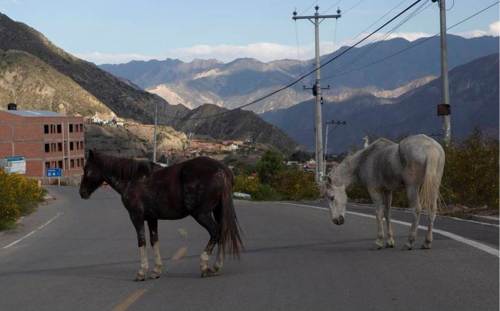
Horses in Huajchilla, Bolivia, on the outskirts of La Paz, wander a deserted highway amid government restrictions that limit residents to essential shopping in an attempt to contain the spread of the new coronavirus on April 15, 2020. (Juan Karita/AP)
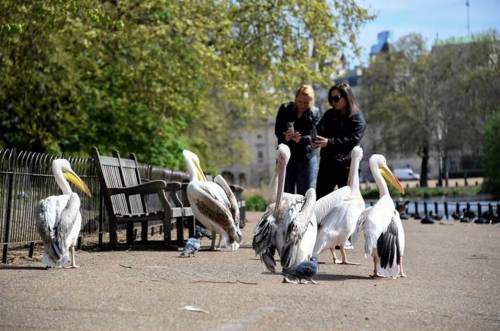
Two women take pictures of the pelicans in a deserted St James’ Park due to the Coronavirus outbreak in London, England on April 14, 2020. (Alberto Pezzali/AP)
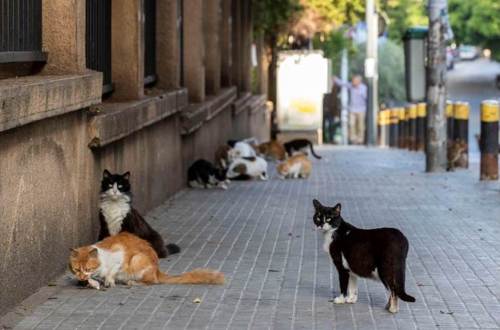
Cats eat food on a street that is almost empty before a nighttime curfew imposed by the government to help stem the spread of the coronavirus in Beirut, Lebanon on April 3, 2020. (Hassan Ammar/AP)
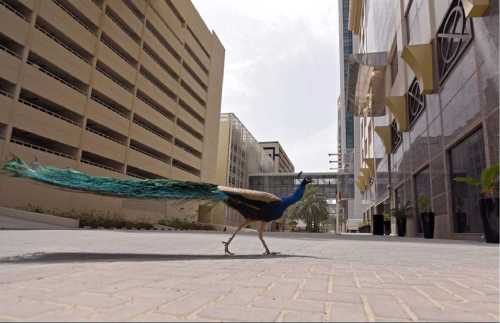
A lone peacock walks along a street in Dubai on April 1, 2020, past shops closed during the pandemic. (Karim Sahib/AFP via Getty Images)
Fallow deer from Dagnam Park in Romford, England rest and graze on the grass outside homes in the Harold Hill community on April 2, 2020. The deer are a regular sight in the area around the park, but as the roads have become quieter due to the nationwide lockdown, the deer have staked a claim on new territories in the vicinity. (León Neal/Getty Images)
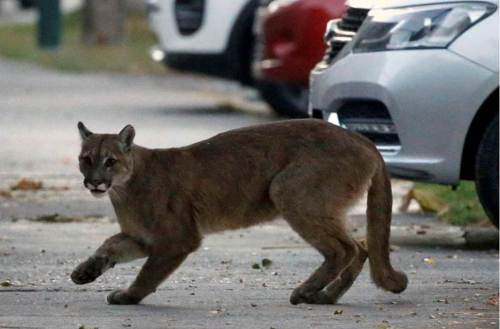
A young puma wanders the streets of Santiago, Chile shows on March 24, 2020. According to Chile’s Agricultural and Livestock Service, the animal arrived from nearby mountains in search for food as fewer people occupy the streets due to COVID-19. (Andres Pina/ATON CHILE/AFP via Getty Images)
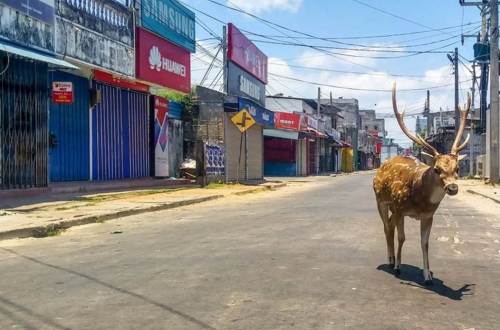
A wild deer, from a herd used to mingling with and be fed by the local population, roams a deserted street during a government-imposed nationwide lockdown, in the port city of Trincomalee, Sri Lanka on March 31, 2020. (STR/AFP Getty Images)
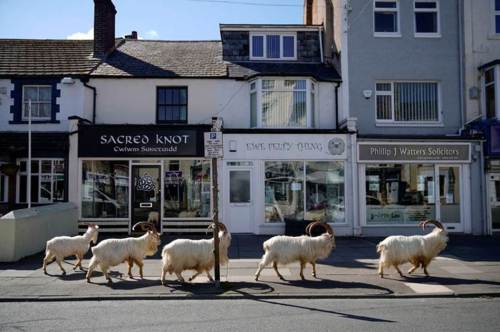
Mountain goats roam the streets of Llandudno, Wales. The goats normally live on the rocky Great Orme but are occasional visitors to the seaside town, but a local councilor told the BBC that the herd was drawn this time by the lack of people and tourists due to the COVID-19 outbreak and quarantine measures. (Christopher Furlong/Getty Images)
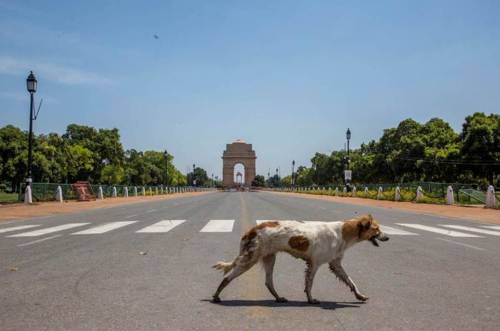
A stray dog walks in front of an empty historic India Gate as a nationwide lockdown continues over the highly contagious coronavirus (COVID-19) on March 30, 2020, in New Delhi, India. (Yawar Nazir)
Stray dogs stand on a deserted square in Pristina, Kosovo on April 1, 2020, during a government-imposed curfew from 5pm to 5am as part of preventive measures against the spread of the COVID-19. (Armend Nimani/AFP)
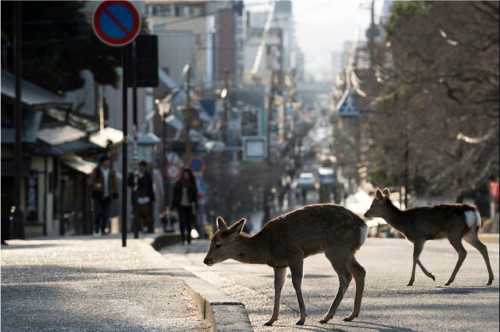
Sika deer cross a road on March 12, 2020, in Nara, Japan. Like a number of tourist hotspots around the country, Nara, a popular ancient city where free-roaming deer are an attraction for tourists, has seen a decline in visitor numbers in recent weeks amid concern over the spread of COVID-19. Some groups of deer have begun roaming in the city’s residential area due to shortage of food partially fed from tourists, according to media reports. (Tomohiro Ohsumi)
A seabird swims across clear waters by a gondola in a Venice canal on March 17, 2020, as a result of the stoppage of motorboat traffic, following Italy’s lockdown within the new coronavirus crisis. (Andrea Pattaro/AFP)
Sea turtle hatchlings scamper towards the water. (Ben Hicks)
The History Channel’s “Life After People” series examined what the world could look like if humanity disappeared. It didn’t describe what might cause a massive die-off of humans, but a variety of experts discussed how flora and fauna would slowly consume and ultimately destroy human-made creations and induce a chemical- and pollution-free world.
Hm…would that be a bad thing?














 Chief Writing Wolf