Category Archives: Classics

The First Laptop Computer

Osborne

Here’s another gem from the early days of computer technology.  In 1981, Adam Osborne, a British author and book publisher, introduced the “Osborne 1”: the world’s first portable computer.  As with most technologies, the idea of a portable computer wasn’t new in 1981.  Such nerdy luminaries as Steve Jobs and Steve Wozniak had conceived of it years earlier.  Osborne just had the good fortune of meeting a far-sighted engineer named Lee Felsenstein at the West Coast Computer Faire in March of 1980.  Osborne knew what he wanted: an affordable computer that people could carry around with them and the software to make it function.  Felsenstein had the skills and the same ambition as Osborne to turn that vision into reality.

On April 3, 1981, the Osborne Computer Corporation released the Osborne 1 – a device that cost $1,795 and weighed just under 24 pounds (10.7 kg).  With a tiny 5-inch display screen and its dependency on floppy disks, which limited its data space, the machine was somewhat impractical for most business functions – even back then.  But, after officially hitting the market three months later, OCC sold 11,000 of them within the first eight months.  Their profits soared, as did their staff – from two (Osborne and Felsenstein) to over 3,000.  Sadly, despite earning $73 million within a year after the debut of Osborne 1, OCC declared bankruptcy on September 13, 1983.

Osborne-ad

Leave a comment

Filed under Classics

No Postage Needed

I’m sure the thought of sending letters and other messages across a telephone line was as alien to people in the 1970s as a Negro winning the presidency was to many Americans in the 1990s.  Be careful what you think won’t happen because it probably will!

Since today marks the 25th anniversary of Tim Berners-Lee’s “Information Management: A Proposal,” which gave helped create what we now know as the Internet, I felt it’s appropriate to prove that the concept of electronic mail is not brand new.  In 1977, Honeywell, already a leader in engineering and infrastructure, pushed business towards the brave new world of digitalization.  At a time when phones were still tied to walls, this was unimaginable.  And, as this advertisement shows, it could also be intimidating.  It’s still amazing to realize that, in less than four decades, we’ve gone from just thinking about email to carrying computers in our pockets.

Electronic-Mail-Honeywell

1 Comment

Filed under Classics

Neon in Color

c. 1911-1913 First colour photograph of a glowing neon tube

This is the first known color photograph of a neon tube, taken around 1913.  The man is John Norman Collie, a distinguished scientist, writer, artist, photographer and mountaineer born in England in 1859.  He served as a professor of chemistry at the University College of London (UCL) from 1913 to 1928.  UCL was founded in 1826 as the first institution of higher education open to anyone, regardless of race, gender or socioeconomic background.

He was the first to climb 71 peaks around the world, and has two mountains named after him, Sgurr Thormaid (Norman’s Peak) in Scotland, and Mount Collie in Canada.  Collie was a pioneer in chemistry research.  He also was instrumental in the development of the first X-ray in 1895.  There is even some anecdotal evidence that Collie was Arthur Conan Doyle’s inspiration for the character of Sherlock Holmes.

In this picture, he’s perched next to a glowing neon gas discharge tube.

2 Comments

Filed under Classics

Deep Sea Diving in 1459

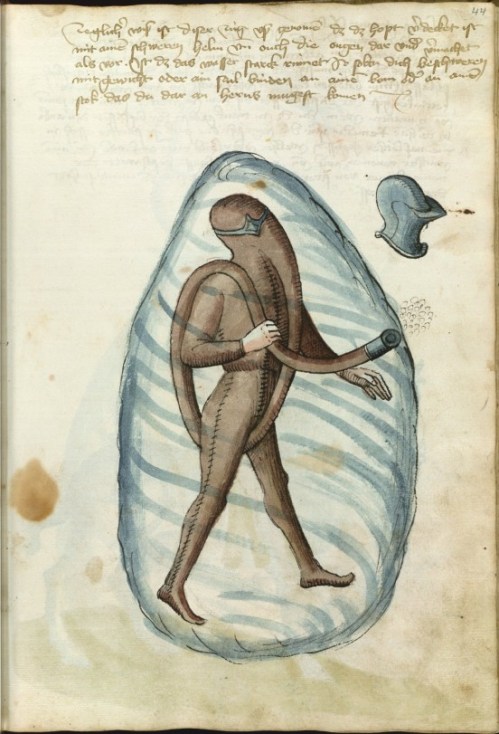
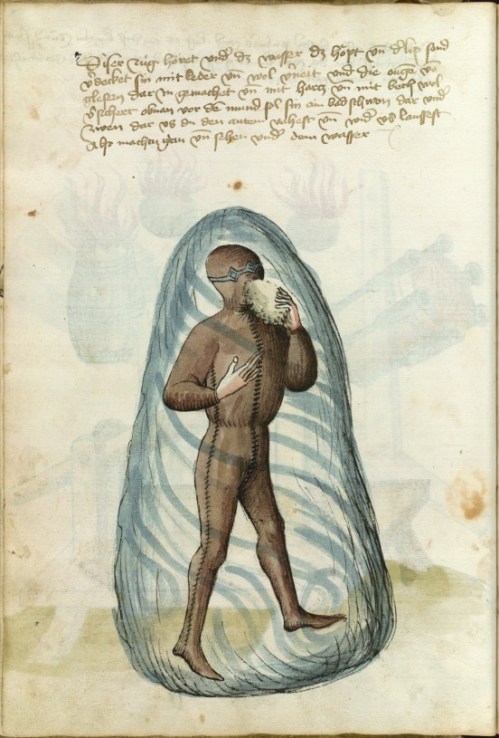
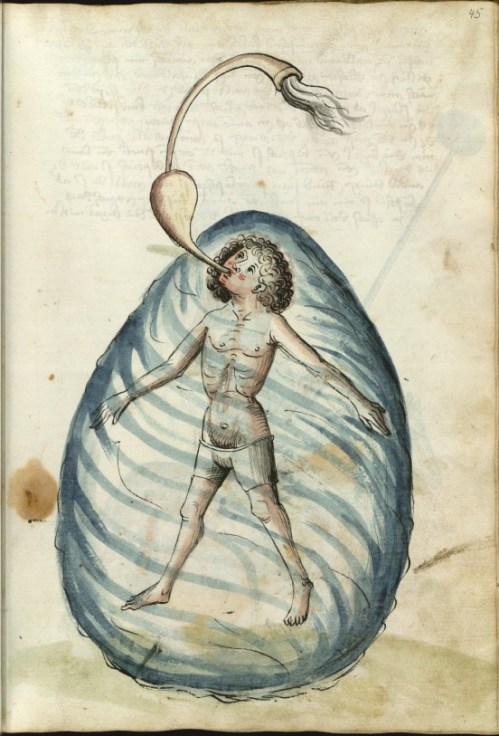
I’m always seeking to prove my belief that our ancestors were far more astute and prescient than we realize or sometimes want to admit.  Here’s another perfect example.  Hans Talhoffer was a 15th century Danish fencing master, best known for his “Fechtbuch (Fight Book”) published in 1459.  Fencing was the martial art of Renaissance Europe; a display of sportsmanship and athletic superiority.  But apparently, Talhoffer was as forward-thinking as many of his contemporaries, such as Leonardo da Vinci.  He studied a variety of disciplines: botany, chemistry, astronomy and – underwater technology.

The same year he first published “Fechtbuch,” Talhoffer apparently also dabbled in the possibility of diving with the help of a mechanical apparatus.  Most of Talhoffer’s works were kept by Count Otto Thott, a Danish prime minister who left his vast collection of rare manuscripts to the Royal Library of Denmark upon his death in 1785.  These three drawings show crudely-designed equipment that would allow for extensive submersion in water; a probability as unlikely in the 1400s as human flight.  Whether Talhoffer ever constructed and tested such devices, or what material he would have used, is unknown.  But, it demonstrates the kind of ingenuity that only ambitious dreamers possess.

Diving-Apparatus-Thott-1-552x811

Diving-Apparatus-Thott-2-552x815

Diving-Apparatus-Thott-3-552x813

Drawings courtesy Royal Library of Denmark.

5 Comments

Filed under Classics

Nativity in the Italian Renaissance

On this Christmas night, I wanted to show some colorful and detailed classic artwork from Italy’s renowned Renaissance period where advances in art, architecture, math and science helped Europe climb out of the muck of the Dark Ages.  Since the Roman Catholic Church was an integral part of the region’s daily life, it’s no surprise much of the art bore religious themes.  Here are 10 pieces of the Nativity, one of the most prominent subjects among Italian Renaissance artisans.
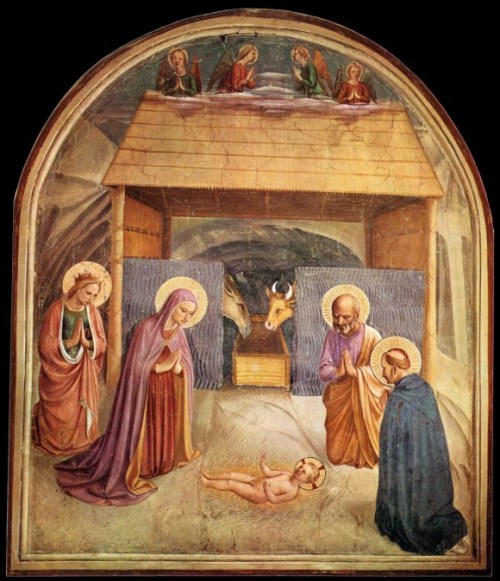
Fresco in San Marco, cell no. 5

Fresco in San Marco, cell no. 5

This is one of many frescoes in the friars’ cells in the convent of San Marco, dating to the early 1440s.  Historians disagree on the artist: Fra Angelico or Benozzo Gozzoli, with most believing the latter is responsible, based on the frescoes’ more decorative aspects and thicker applications of paint characteristic of Gozzoli.
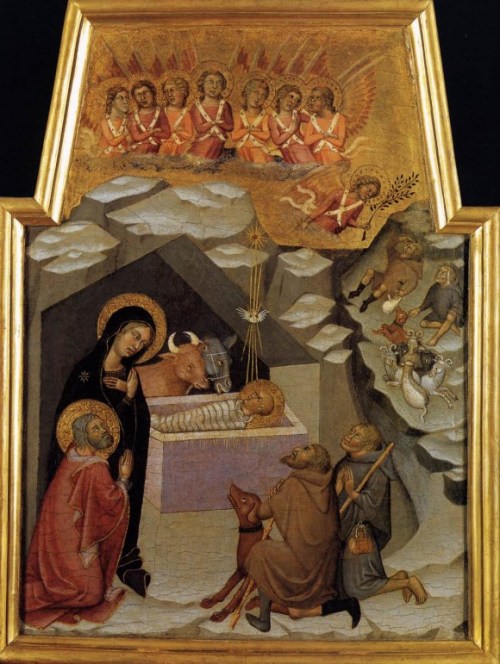
Bartolo di Fredi, “Nativity and Adoration of the Shepherds,” Vatican Museums, 1383.

Bartolo di Fredi, “Nativity and Adoration of the Shepherds,” Vatican Museums, 1383.

Bartolo di Fredi was commissioned to paint this panel by the Company of Saint Peter in 1383, for the Chapel of the Annunciation in the Church of S. Francesco in Montalcino.  The polyptych has since been broken up, and parts of it can be seen in various museums.  This piece is in the Pinacoteca Vaticana.
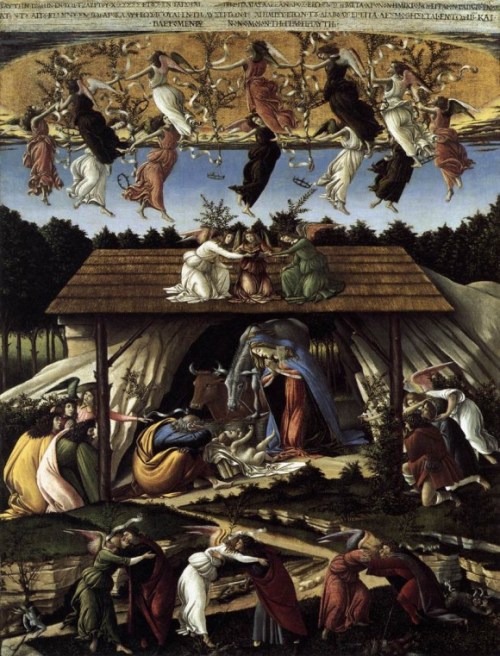
Sandro Botticelli, “The Mystical Nativity,” National Gallery of London.

Sandro Botticelli, “The Mystical Nativity,” National Gallery of London.

Sandro Botticelli
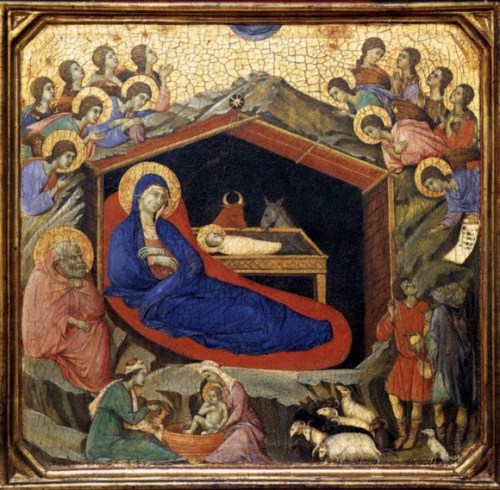
Duccio, Nativity panel, ca. 1308, National Gallery of Art – Washington, D.C.

Duccio, Nativity panel, ca. 1308, National Gallery of Art – Washington, D.C.

Duccio
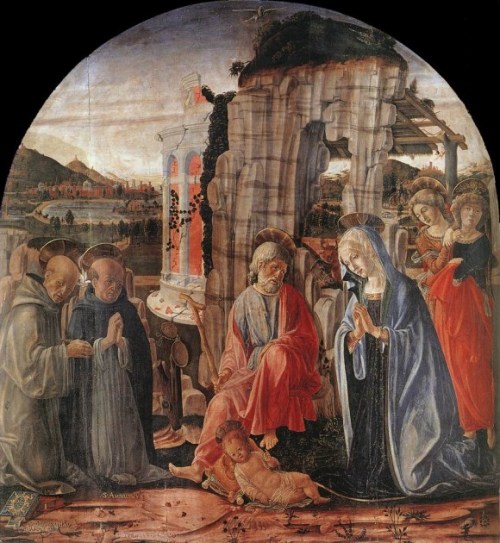
Francesco di Giorgio Martini, 1475, Pinacoteca Nazionale – Siena.

Francesco di Giorgio Martini, 1475, Pinacoteca Nazionale – Siena.

The Nativity with two angels, St. Bernard and St. Thomas of Aquino, is the only signed work of the Francesco di Giorgio Martini.
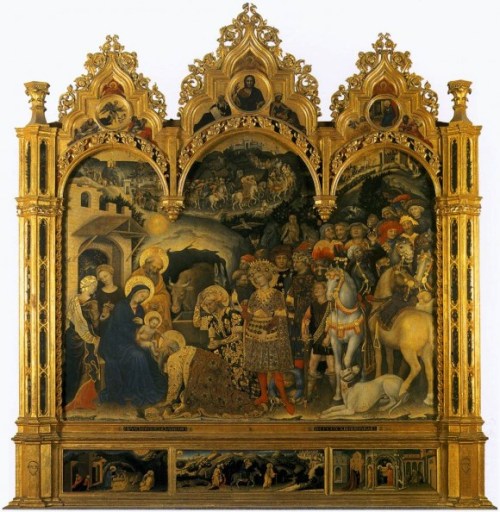
Gentile da Fabriano, “Adoration of the Magi,” 1423, Galleria degli Uffizi – Florence.

Gentile da Fabriano, “Adoration of the Magi,” 1423, Galleria degli Uffizi – Florence.

Gentile da Fabriano
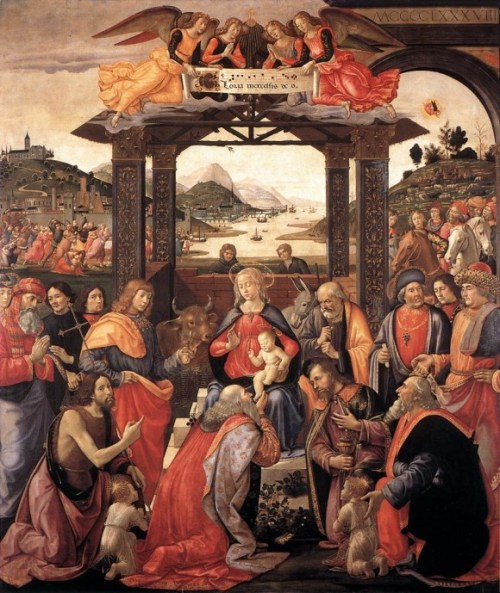
Domenico di Ghirlandaio, “Adoration of the Magi,” Ospedale degli Innocenti, 1488.

Domenico di Ghirlandaio, “Adoration of the Magi,” Ospedale degli Innocenti, 1488.

Domenico di Ghirlandaio
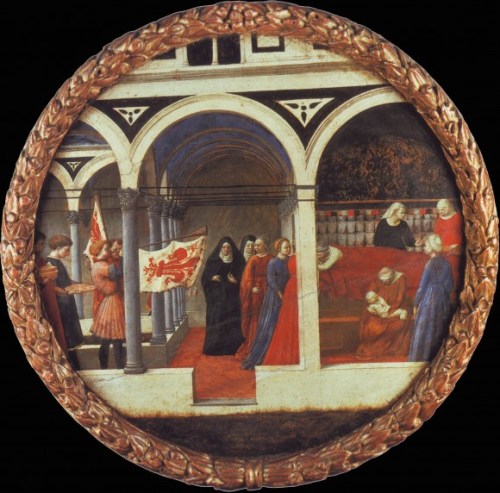
Masaccio, Birth salver depicting the nativity, with Florentine horn-blowers, ca. 1427, Staatliche Museen – Berlin.

Masaccio, Birth salver depicting the nativity, with Florentine horn-blowers, ca. 1427, Staatliche Museen – Berlin.

Birth trays like this wooden one from the first quarter of the 15th century were common objects in many medieval European households.  They were given to women often before or during pregnancy; their imagery was believed to encourage the healthy delivery of a baby boy.  Masaccio.
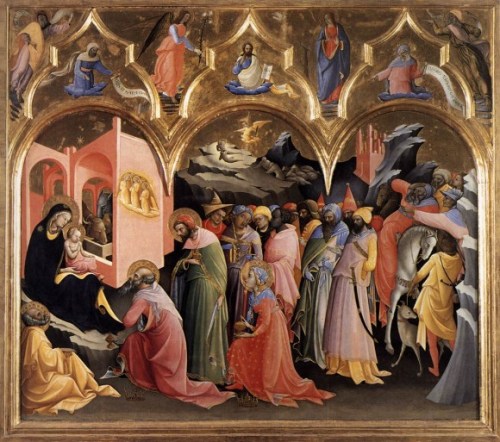
Lorenzo Monaco, “Adoration of the Magi,” 1422, Galleria degli Uffizi – Florence.

Lorenzo Monaco, “Adoration of the Magi,” 1422, Galleria degli Uffizi – Florence.

Lorenzo Monaco
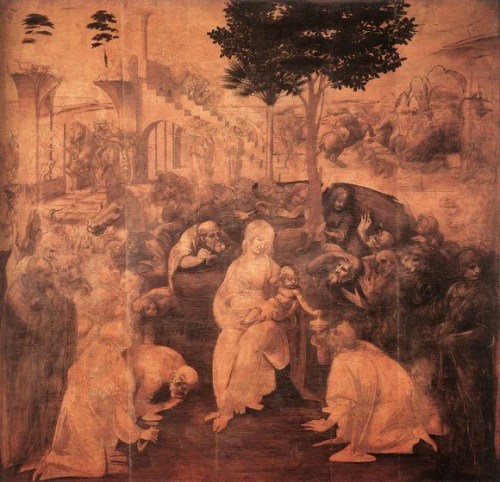
Leonardo da Vinci, (unfinished) “Adoration,” 1481, Galleria degli Uffizi – Florence.

Leonardo da Vinci, (unfinished) “Adoration,” 1481, Galleria degli Uffizi – Florence.

The master of all master artisans, Leonardo da Vinci left some work unfinished, including this panel currently on display in the Uffizi.  Da Vinci developed his own theories about creating dramatic contrasts between various figures (e.g. young and old, female and male), like the strong triangle created by the central figures.  Although uncompleted, this panel also notes Da Vinci’s technique of working on a dark panel and building up first the shadows, then the color.

All images courtesy of Tuscany Arts.

2 Comments

Filed under Classics

Monsters and Maps

Humanity has always had a love/hate relationship with the world’s oceans.  It is from the seas we were born and, for millennia, trying both to navigate and live off those waters has created dreams and nightmares.  Plowing across the oceans has been crucial to our survival, but people always wonder what lurks beneath.  Even now, with advances in deep sea diving, we know more about the surface of Earth’s moon than its oceans.

Medieval European artists were particularly adept at bringing seafarers’ worst hallucinations to life.  Everything from beautiful sirens luring sailors into a rocky demise to gigantic serpents wrapping themselves around entire ships populated ancient oceanic lore.  Here are just four colorful delights that make you wonder if these folks were genuinely frightened or if they just needed some loving after long days at sea.

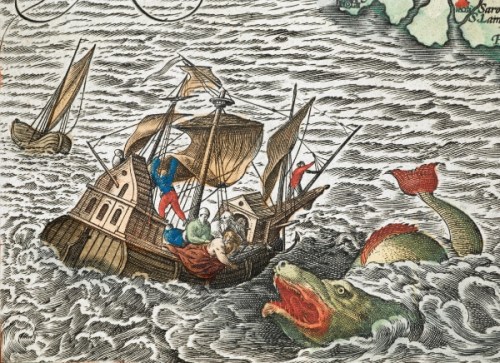
In “Theatrum orbis terrarum,” first published in 1570 by Flemish cartographer Abraham Ortelius, Jonah is cast overboard to a sea monster.

In “Theatrum orbis terrarum,” first published in 1570 by Flemish cartographer Abraham Ortelius, Jonah is cast overboard to a sea monster.


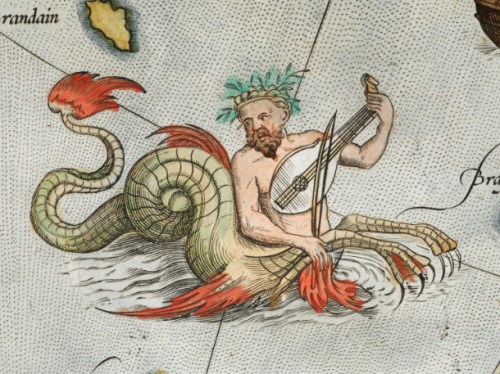
Ortelius became even more creative with this chimeric entity: an ichthyocentaur (part human, horse and fish) playing a viol on a map of Scandinavia from the 1573 edition of “Theatrum orbis terrarum.”  The sea surrounding Scandinavia showed sailing ships and the otherwise peaceful ichthyocentaur, perhaps suggesting safe passage.

Ortelius became even more creative with this chimeric entity: an ichthyocentaur (part human, horse and fish) playing a viol on a map of Scandinavia from the 1573 edition of “Theatrum orbis terrarum.” The sea surrounding Scandinavia showed sailing ships and the otherwise peaceful ichthyocentaur, perhaps suggesting safe passage.


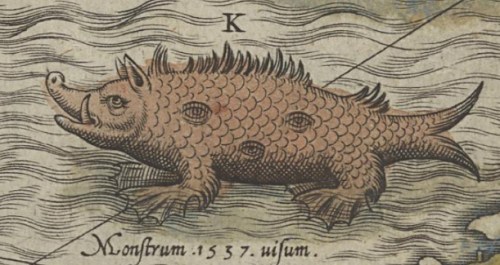
In Olaus Magnus’s “Carta Marina” from 1539, a sea pig – which was compared to heretics that distorted truth and lived like swine – dwelled in the North Sea.

In Olaus Magnus’s “Carta Marina” from 1539, a sea pig – which was compared to heretics that distorted truth and lived like swine – dwelled in the North Sea.


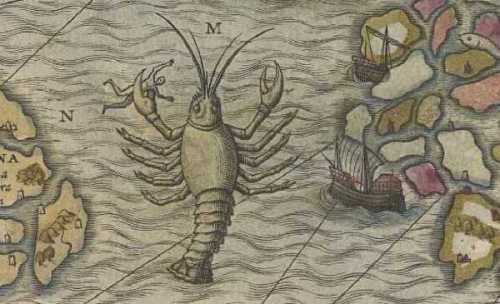
This giant lobster in Magnus’s “Carta Marina,” is described as an octopus in the accompanying text.  Polypus, which means “many-footed,” was often used to describe many different types of multi-limbed creatures, from lobster to octopi.  Such sweeping designations showed confusion about what types of creatures actually lived in the sea.

This giant lobster in Magnus’s “Carta Marina,” is described as an octopus in the accompanying text. Polypus, which means “many-footed,” was often used to describe many different types of multi-limbed creatures, from lobsters to octopi. Such sweeping designations showed confusion about what types of creatures actually lived in the sea.


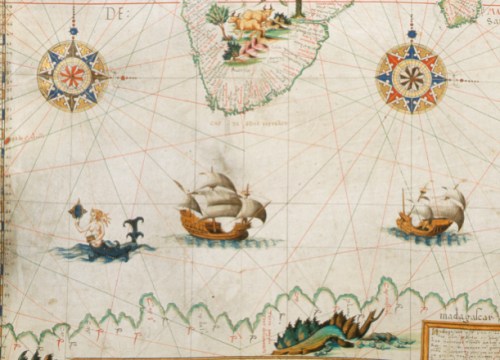
In a classic delineation, a siren admires herself in a mirror while surrounded by ships in the Southern Ocean on Pierre Descelier’s map from 1550.  Other monsters can be seen on the nearby lands.

In a classic delineation, a siren admires herself in a mirror while surrounded by ships in the Southern Ocean on a 1550 map by Pierre Descelier. Other monsters can be seen on the nearby lands.


2 Comments

Filed under Classics

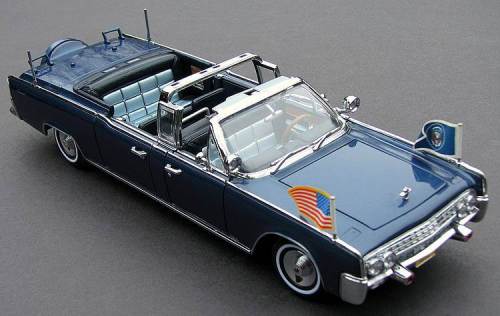
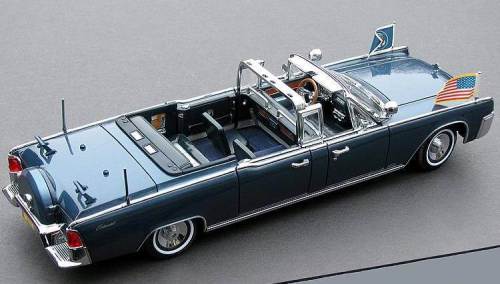
Kennedy’s Presidential Limousine – The Lincoln X-100

ym24048

I mentioned this last year, on the 49th anniversary of Kennedy’s death, but I wanted to bring it up again on this special occasion.  My car fetish knows few bounds, even though it’s limited to most anything pre-1980.  That includes the vehicle Kennedy was riding in that fateful day: a 1961 Lincoln Continental X-100.  It was a 4-door convertible, and X-100 was its Secret Service code name.

Ford Motor Company assembled the car at its Lincoln plant in Wixom, Michigan in January 1961.  Hess & Eisenhardt of Cincinnati, Ohio customized the vehicle to function as a presidential parade limousine; literally cutting it in half, reinforcing it, extending it 3½ feet in length and making numerous other modifications.  Ford Motor Company and Hess & Eisenhardt collaborated on engineering and styling.  It debuted at the White House in June 1961.  The car remained the property of the Ford Motor Company, which leased it to the Secret Service for $500 per year.

The car, equipped at the Lincoln plant, would have retailed for $7,347.  Custom built, it cost nearly $200,000.

ym24048_11

Special features on the limousine included:

  • Removable steel and transparent plastic roof panels
  • Hydraulic rear seat that could be raised 10½ ” to elevate the president
  • Massive heating and air conditioning system with auxiliary blowers and 2 control panels
  • Dark blue broadcloth lap robes with gray plush lining and hand-embroidered presidential seals in special door pockets
  • Four retractable steps for Secret Service agents
  • Two steps on rear bumper for additional agents
  • Flashing red lights, siren
  • Blue Mouton rug in rear
  • Indicator lights when door was ajar or steps out
  • Two flagstaffs, two spotlights
  • Auxiliary jump seats for extra passengers
  • Two radio telephones
  • Interior floodlights

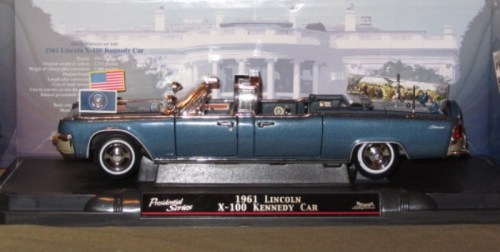
I have a replica of this car by Yat Ming, which is part of its “Presidential Limousines” collection.  Yes, it’s made in China, but I love it anyway.  And, I know owning such a thing sounds macabre, yet the vehicle is an indelible, albeit tragic, part of our nation’s history.

My replica of the 1961 Lincoln X-100.

My replica of the 1961 Lincoln X-100.

The Strange Saga of the JFK Assassination Car.”

Leave a comment

Filed under Classics

Hearts Aloft

tumblr_mhy8i4eQe81rppc0go1_500

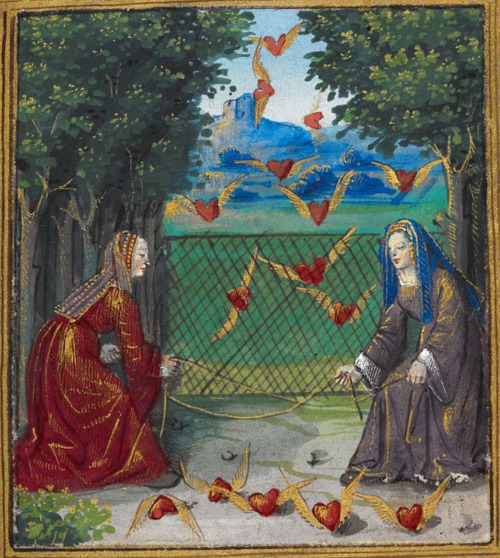
This has to be one of the most intriguing and unique works of medieval art I’ve ever encountered.  Entitled “Two women attempting to catch flying hearts,” it’s by Pierre Sala, a French Renaissance artist who also composed poetry.  This particular piece is part of his “Emblèmes et Devises d’Amour” (“Emblems and Currency of Love”) collection and dates to around 1500.  Historians believe Sala was making a dedication to his mistress Marguerite.

Sala is perhaps best known for his work “Tristan,” but I can’t find much information about him.  Still, I think this would make a great Valentine’s Day card.  The entire collection is currently housed at the British Library in London.

4 Comments

Filed under Classics

“Castle of Love” in Ivory

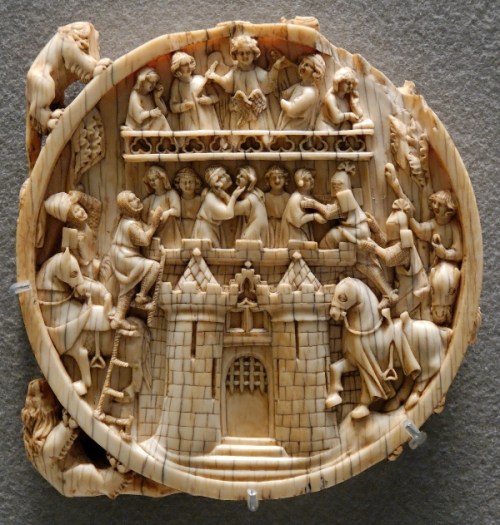
Castle_of_Love

Ivory is one of the world’s most treasured natural resources; a substance often used for everything from furniture to medicine.  While it’s illegal to purchase and import products made of pure ivory, ancient ivory artifacts hold a unique place in cultural lore.  This piece is what’s left of a French medieval mirror case, c. 1350 A.D.  Currently housed at the Louvre, the “Castle of Love” most likely refers to a medieval religious play of the same name; one of the earliest known writings in the French language.  The scene depicts a castle coming under attack by knights and a group of women defending it, as an angel overlooks the chaos.  There are some obviously romantic, if not sexual, connotations in the design; a couple of the knights making contact with some of the women.  It’s always interesting to see so much eroticism present in religious artwork; considering how badly religious leaders tried to suppress sexual desire.

2 Comments

Filed under Classics

1904 Standard Oil Octopus

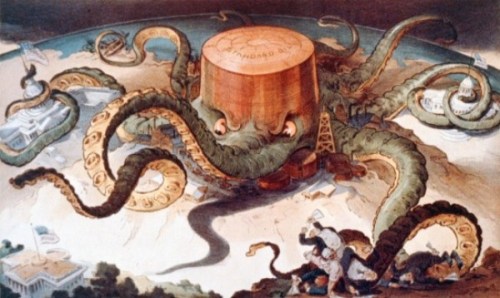
1904_The-Standard-Oil-Octopus

At the beginning of the 20th century, Standard Oil was the world’s largest corporation; it was also the first multinational corporation – until the U.S. Supreme Court dismantled it in 1911, as part of anti-monopoly wave that had commenced with the Sherman Anti-Trust Act of 1890.  Today’s Exxon-Mobil Corporation is a direct descendant.  In 1904, “Puck Magazine” published a cartoon by Udo J. Keppler (son of founder Joseph Keppler) showing a Standard Oil tanker as an octopus with a wicked gaze; its tentacles wrapped around various political establishments, such as the White House.  The message was clear: big oil had its grip on the halls of power.

Flash forward a century later and we have to ask – have things changed much?

4 Comments

Filed under Classics