Category Archives: Essays

Update: The Chief Almost Kills Himself

Nerve_Cells

Not feeling sorry for myself, I nonetheless wanted to give everyone an update on my accident.  It’s been two months now since a simple trip to a refrigerator turned into a two-day hospital visit and nerve damage.  If I could somehow turn this into a reality TV show, I think I might secure my financial future.  I mean, as a bisexual / Spanish / Mexican Indian / German / recovering Catholic / former alcoholic writer, I certainly know how to create drama.

I visited a hand specialist last Tuesday, the 13th, and she laid it out for me as clearly and honestly as possible.  The bad news is that I’m in worse shape than I thought; the good news is that it’s not as bad as it could be.  Nerve damage is rated on a scale of 1 to 6, with 6 being the worst.  I’m a borderline 3.  Normally I hate just getting halfway to something, but on this, I’m thankful.  Also, nerves regenerate at roughly one inch per month.  But on average, an injury like mine will result in permanent damage in anywhere between twelve and eighteen months, if nothing is done sooner.  Thus, with the extent of the damage I have, I won’t heal fast enough over the next ten months to salvage my hand.  She says she can repair the damage and return me to 100% functionality – or close to it – but she has to do surgery.  She only mentioned that after she’d told me everything I needed to know about nerves and how they operate, so I already feel I can trust her.  If a doctor mentions surgery within ten minutes of a conversation, I think you should get up and flee.  Any legitimate physician will explain everything in detail first and then discuss surgery.

Since I don’t have health insurance, and prostituting myself is not a viable option, I’ll have to pay for the surgery up front.  I’d mentioned previously that I had surgery scheduled at Parkland Hospital in Dallas – where I was taken after the accident.  But, they won’t treat me in part because I’m not a Dallas County resident (I live in neighboring Denton County), but also because I have no health insurance.  Usually Parkland treats the uninsured, which is why it’s not the ideal place to get medical care.  But, it’s that damn county residence thing!  Instead, Parkland referred me to Denton County’s indigent health care program.  The latter mailed me an application, which I had to fill out and snail mail back to them with reams of documentation proving that, although I’m a really nice person who uses his turn signal and loves small animals, I’m flat-ass broke.  I never thought I’d be considered a starving artist, but here I am.  Then, they’ll supposedly call me to come in for a personal review.  I couldn’t do any of that online, so hopefully, they won’t be too shocked when I pull up in my 2006 model Dodge pickup truck and not a horse and buggy.  The Affordable Care Act is supposed to kick in at the beginning of 2014, but I can’t wait until then.

I have to get this done.  Handwriting, for one thing, is difficult.  I’ve kept a hand-written journal for nearly thirty years, but I’ve switched to a digital journal last month; that is, a Word document on my computer.  I have boxes of spiral-bound notebooks dating back to November 1983; all filled with a lifetime of joy, sadness, strange thoughts and sexual proclivities.  If I ever decide to run for public office, I’d have to burn them.  Other manual tasks are challenging.  I can do just about anything with my left hand, though, except write.  Well, I supposed I could write left-handed if I really wanted, but it’ll come out looking like a rambunctious third-grader who’s gone two days without Ritalin.

I still consider myself fortunate.  I have great parents and an incredible little dog, plus a collection of friends, all of whom have been very supportive.  I’ve suspended my gym membership indefinitely, but my creativity remains active.  I still think of the man I shared the room at Parkland with; the one who had to have his lower right leg amputated because of sciatic nerve damage gone awry.  It’s ironic that we were both in there because of nerve injuries.  But, at least I didn’t lose my right arm.  And, aside from my ability to work a keyboard, I can still make some hellacious mix drinks!  I mean, what would I be worth as a writer if I couldn’t stir up my own cocktails?!
Leave a comment

Filed under Essays

Still Hurts

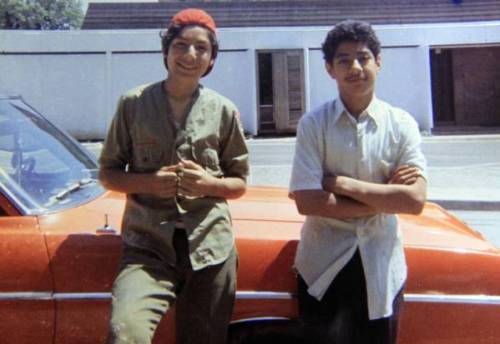
Santos Rodriguez, right, stands with his brother David next to a relative’s car just a month before Santos’ death.

Santos Rodriguez, right, stands with his brother David next to a relative’s car just a month before Santos’ death in 1973.

Today marks an ignominious scar in the history of Dallas, Texas.  It’s the 40th anniversary of the death of a 12-year-old boy by a Dallas police officer playing a game.  It began innocuously enough.  In the pre-dawn hours of July 24, 1973, Dallas police received a report that three boys were spotted fleeing a gas station where a vending machine had been burglarized of $8.  Officer Roy Arnold spotted the youths, but couldn’t catch up with them.  Yet, he thought he recognized two of them, brothers David and Santos Rodriguez.  They’d been in trouble before.  He summoned his partner, Darrell L. Cain, and the duo drove to the East Dallas home of the boys’ 80-year-old maternal grandfather, Carlos Miñez, who didn’t speak much English.

The officers immediately took custody of the boys, handcuffed them and drove them back to the scene of the crime.  The boys proclaimed their innocence, but the policemen demanded the name of the third suspect.  Cain sat in the back seat of the squad car, next to David.  He figured a way to get the boys to talk.  He pulled out his gun and emptied it of bullets, before pointing it to the back of Santos’ head.

The Rodriguez brothers had too much against them from the start.  They were a little more than a year apart in age; born to a teenage mother and an illegal immigrant father.  David, Sr., had already been deported to México, and their 29-year-old mother, Bessie, was in jail; charged with killing an abusive boyfriend a few years earlier.  All of that fed into the myth much of Dallas’ White society held of the city’s Hispanic citizens: illegal, uneducated Mexican immigrants who had too many kids too soon and bore a criminal mindset.  That was pretty much the same view of Dallas’ Black residents.  At the time, less than a quarter of Dallas citizens were non-White.  Hispanics clustered mostly in the western and eastern edges, while Blacks were relegated to the increasingly impoverished southern sector.  Both groups had tolerated disrespect and harassment from police for decades.  Then, it all came to a boil that dark summer morning.

“I bet I can get him to talk,” Cain said, emptying his gun.  Pressing the barrel of the firearm to the back of Santos’ head, he again demanded the name of the ubiquitous third burglary suspect.  He pulled the trigger, and there was a click.  Santos again feverishly denied knowing anything about the incident.  Cain pulled the trigger a second time, and a flash of light flooded the car, along with the smell of gunpowder.  He’d missed one bullet left in the chamber.

“You’re going to be alright,” a terrified David shouted to his brother, as the officers bolted from the vehicle like frightened little animals.  Blood filled the car floor.  Santos wasn’t alright.

That was it; that was the catalyst for the city’s minority populations.  The city erupted into a frenzy of protests and violence that had besieged other metropolitan areas years earlier.  I was 9 years old that summer and, albeit obsessed with my new German shepherd puppy, I stopped to look at the fiasco; my naïve and innocent mind trying to fathom what happened.

As one might expect in those days, given the city’s history, Cain wasn’t really held accountable.  He lost his job and went on trial in Austin where the case had been moved because of local publicity.  He was found guilty by an all-White jury and sentenced to 5 years in prison; he served only half.  In 1978, the U.S. Justice Department refused to prosecute Cain under federal civil rights statutes, since he’d already been tried in state court.

While Cain adamantly insisted the shooting was an accident and described himself as traumatized in a 1998 interview with the Dallas Morning News – the only time he’s spoken publicly about the tragedy – it seemed the culmination of a long series of events that had occurred for as long as anyone could remember.  Police stopping Black and Brown people on the street; forcing their way into residents’ homes in the dead of night; pulling them over for the most mundane of traffic-related transgressions.  The civil rights movements that had rattled the nation for years finally reached the streets of Dallas – avenues trembling with anger and tension.  Every forest fire needs just one tiny spark to inflame the dry brush.  We were slightly less than a decade removed from the Kennedy assassination.  And then, this happened.

It was truly a different time.  Today, Hispanics make up 42% of Dallas’ population, while Blacks comprise about 25%Roughly half of the city’s police officers are non-White, as are nearly half of police sergeants.  Dallas has a Black police chief, David O. Brown.  If juveniles are suspected of criminal behavior, a judge must approve of any interrogation.

In light of the recent George Zimmerman – Travyon Martin case, I wonder, though, how much has changed.  In general, the U.S. wasn’t consumed by the kind if violence we see now.  There were no ‘Right-to-Carry’ laws.  Police across the nation try their best to interact with the public, instead of behaving like ravenous vultures.  The Rodriguez event seemed so long ago, and of course, it really was.  But, whenever a child dies, it always hurts.  No one can ever make up for it; we can only try to move forward.

Leave a comment

Filed under Essays

No Winners Here

scales_20of_20justice

Many of us here in the U.S. have been watching the George Zimmerman murder trial closely.  I have to admit I’ve become addicted to the ongoing media coverage, but not because of any ubiquitously salacious intent.  It’s fascinating how attorneys for both sides dissect each bit of information, like butchers attacking a cow carcass.  In a way, that’s what attorneys are – butchers.

As people on all sides eagerly await the verdict, I know two things are certain: the victim, Trayvon Martin, will never come back home and no one will win.  There are never any winners in murder trials.  If anything, the concept of justice will win.  But, like beauty, that’s often an interpretation of the beholder.

I try to take in the boat loads of data slung at me regarding this case and sort through the definitive facts.  Here are the facts: the incident occurred on February 26, 2012, just after 7 P.M. local time, in the Retreat at Twin Lakes, a gated community in Sanford, Florida.  It was raining.  George Zimmerman resided at Twin Lakes.  Trayvon Martin’s father, Tracy Martin, did also.  The younger Martin was staying with his father because the teen had been suspended from school for possessing a plastic bag that tested positive for marijuana.  Martin had visited a convenience store, just blocks from his father’s home.  He was on the phone with a female friend when he became aware that someone was following him.  Zimmerman was carrying a Kel-Tec PF-9 9mm firearm.  He called the police to report that he was following someone.  Zimmerman and Martin got into a physical altercation.  Zimmerman shot Martin, and the teen died almost instantly.  Those are bulk of the facts.  Everything outside of that arena is mostly conjecture.

No one can explain why Zimmerman didn’t stop following Martin, as the police dispatcher instructed him.  No one knows exactly what words were exchanged between the two.  I do know we’ll probably see another case like this in our lifetime.

Here in the U.S. – mainly in the Southeast – issues of race and ethnicity still creep into debates about social justice and police activities.  And, to say that race doesn’t factor into this particular matter is akin to saying that Earth isn’t round.  It’s unfortunate, in this second decade of the 21st century, but that’s how it is.

Here’s another fact: no one involved in the Zimmerman – Martin case will ever be the same.  Not the families of the two principals; not even the 911 dispatcher who told Zimmerman to stay in his vehicle.  If Zimmerman is found not guilty, it will set off a firestorm of anger and protest.  If he’s found guilty of just one charge, he will most certainly be imprisoned.  Either way, no one will be satisfied.  Justice may win – but sometimes, that’s not saying much.

3 Comments

Filed under Essays

Why I’m Still Proud to Be an American

RLIT0075-usa-flag18mb

As I hear the sound of fireworks booming in the distance, not far from my suburban Dallas home, I contemplate the value and wisdom of patriotism.  Independence Day is slowly winding down here in the U.S.  If you’ve looked closely at my Gravatar photo, you can see I’m wearing a vest in the emblem of the American flag.  It’s quite clear to most that I’m proud to be a citizen of this country.  It hasn’t been easy, though, these past few years to sustain that type of joy.  But, national pride is like being in a relationship: you love the other person most of the time; other days, you just want to walk away and say to hell with it.  No one is perfect, and therefore, neither is any nation perfect.

Since the turn of the century, the U.S. has come under attack – not so much from without as from within.  The multiple terrorist attacks of September 11, 2001 changed most everyone here.  But, as the nation beamed in its refreshed vanity, I suspected some would use that as an excuse to denigrate anything that seemed remotely different and anyone who didn’t fully see their point of view.  I just didn’t know it would get this bad.

The U.S. is embroiled in the worst economic crisis in nearly eight decades; an onslaught of mismanagement brought about by uneven tax cuts, two wars and deregulation of the financial and housing industries.  As our military return home to foreclosed homes and lackluster health services, some of the wealthiest citizens hide their money in offshore bank accounts.  School districts are laying off teachers, and police are fighting crime with fewer and fewer resources.  Congressional members left Washington last weekend without acting to prevent student loan rates from doubling.

So, why the prideful feelings?  Why don that flag vest and express joy in being an American?  Because it will get better.  Despite all the angst and frustration, this country is still one of the best places to live.  Yes, it could improve in terms of education and health care.  But, that’s just the point: the potential is there.  People have scoffed at my national pride; thinking I’m a fool, a naïve dunce who should know better.  But, I’ve looked at them and asked what they’ve done to improve their own lot in life.  What, I’ve queried – looking hard at the arrogant scowls that blister their faces – have they done to make this country a better place?

Criticism without action is pointless – and stupid.  It goes back to the relationship issue.  If you really love and care for someone, you’ll tell them when you feel they’re wrong.  You’ll look them in the eyes and relay your concerns and your fears.  You know they could do better.

The U.S. is the self-proclaimed beacon of freedom and democracy.  We have the oldest national constitution one Earth.  We are a democratic nation, and a democracy requires interaction among its citizens; it demands political engagement.  After the controversial 2000 presidential elections, a friend told me he didn’t vote because he felt it didn’t count and pointed to the election results as proof.  He then admitted the real reason he didn’t vote: he didn’t want the IRS to find him, since he owed so much in student loans and credit card debt at the time.  Excuse me?

“Are you serious?” I asked him.  “You have a social security number and a driver’s license.  If the IRS wanted to find you, believe me, they’ll find you!”

Whenever I hear my fellow Americans dismiss the value of elections, I consider the tens of millions of people around the world who wished they had the luxury of choosing between the lesser of two evils.  When they lament the lack of freedom for the poor, I see other Americans stepping in to fill the void of hunger.  When they remark on this nation’s history of racist oppression, I remind them those days no longer exist; we’ve come a long way since then.

The U.S. is going through one of the toughest period in its existence.  I don’t know.  It just is.  But, I suspect it’s the result of inaction on the part of the citizenry; people like my friend who didn’t bother to vote and who had resigned their country to an uncertain fate.

Yet, when I hear the extremists say they despise America – simply because it’s not working for them in particular – I recall the words of John F. Kennedy: “Ask not what your country can do for you, but rather what you can do for your country.”

Wherever you live, in whatever nation you call home, you simply can’t expect others to do things for you.  You have to make your country work for you.  It’s an endless chore.  But, there’s no sensible alternative.

3 Comments

Filed under Essays

Yes, I’ve Used Those Words – And So Have You

rs_293x473-130627112755-634.pdeen7.ls.62713

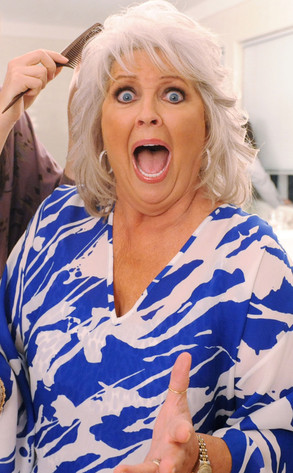
Here in the U.S., the “Society of Political Correctness” is swept up in an unending tizzy about racist comments once made – years ago – by culinary maven Paula Deen, the self-proclaimed “Queen of Southern Cooking.”  Deen, head of a multi-million dollar gastronomical empire that’s geared to maintaining high rates of obesity in the world’s richest nation, has been in relentless defensive mode since she admitted using a racial slur to describe a Black man who held her up at gunpoint in 1987.  The fiasco began – ironically – when a White former employee of one of Deen’s restaurants filed suit against Deen citing the latter had repeatedly used the term ‘nigger’ to describe Negro people.  The former employee, Lisa Jackson, claims the comments were especially hurtful because her own nieces are bi-racial with a Black father.  In a court-ordered deposition, Deen admitted she’d used the ‘n’ word more than a few times in her life.  Consequently, sponsors have been dumping her faster than bail bondsmen have dumped Lindsay Lohan.  Even Wal-Mart has pulled Deen’s merchandise!  And, how can any decent southern White woman be a bona fide redneck if Wal-Mart doesn’t stand by her?

I can’t speak for other countries, but anyone age 30 and over here in the U.S. who claims they’ve never ever, not once used a racial epithet to describe someone of a different ethnicity in the heat of anger or in the midst of an episode of temporary stupidity is either lying, mentally retarded, or has been in a coma since birth.  I’ve used all sorts of unsavory terms to describe people of different races.  Hell, I’ve even used them against my own people: Spaniards, Mexicans and Germans!

Yes, I’ve used the word ‘nigger’ before!  I’ve also spit out such hateful terms as ‘spic,’ ‘redskin,’ ‘chink,’ ‘gook,’ ‘hebe,’ ‘redneck,’ ‘White bitch,’ and ‘George W. Bush’ to describe people.  Here’s the difference: I’ve always stepped back and thought how stupid that was of me.  I should know better than that.  But occasionally, I get mad at someone – so outrageously mad – that I let loose with a barrage of insults.  We all have those weak moments; those brief periods of intellectual vacuums where we let our emotions get the best of us and nothing we say makes sense.  It’s just part of human nature; we’re an imperfect species.  We don’t always say the right thing.

That’s probably what happened to Deen that night in July of 1987 when a gun-wielding Black man threatened her while she worked as a bank teller.  Terrified because of the incident, she slipped into a nonsensical frame of mind and started rambling.  No one seems to be upset, however, that a Black man disrespected the rule of law by putting a gun to Deen’s head and robbing a bank; therefore, feeding the myth that Black men are naturally predisposed to violence.  They’re more concerned with Deen’s angry verbiage.  Does that make sense?

Here’s something else: Deen isn’t a Yale law professor; she’s essentially a glorified chef who happened to get lucky enough to turn her passion for butter- and salt-laden foods into a fortune.  I wish I could do the same with my masturbatory techniques, but I think the market is already overwhelmed by 40-something Spanish / Mexican Indian / German men playing with themselves online.

Deen has apologized profusely.  She even appeared on the “Today” show last week and tearfully told host Matt Lauer, “I is what I is.”  As a writer, that particular verbiage almost gave me an aneurism!  But, what else can she do?  Kill herself on live TV?  She’s already slowly doing that with her daily menus.  People need to give it a rest and lay off Deen.  Many folks have rallied to her defense, including some Negroes.  I’ve never been a fan of Deen, but I don’t understand why this matter has taken up so much media time.  In the state of Texas, some 45% of residents under age 17 have no health care coverage, and on the nation level, we’re building more prisons than schools.  That’s what bothers me – not the brainless rants of a 66-year-old woman who deep-fries everything that crawls out of her refrigerator.  I’m not trying to tell other people what to think or how to feel.  If some are offended by Deen, then I respect their sentiments.  She’s just not someone I’m worried about.

In the meantime, I have to set up for my next solo video shoot.  I’m determined to break into that market after all.

2 Comments

Filed under Essays

The Chief Almost Kills Himself

shards

Okay, I’m being a bit dramatic.  But, I had a serious accident the other day that resulted in significant blood loss and a 48-hour hospital stay.  You’ve heard of those freak accidents that get you either on “America’s Funniest Home Videos” or into a medical text book?  Well, that’s what happened to me.  I was carrying a gallon glass jug of iced tea to a refrigerator when I slipped on the linoleum floor, turned 180° and fell face down.  The jug shattered instantly, and a shard pierced the inner side of my upper right arm.  I thought it had impacted an artery, but it cut a vein.  I also thought I’d broken my right forearm, or wrist, but the glass nicked the ulnar nerve.  Blood flowed everywhere.  Mixing with the herbal blackberry tea, I’m sure even some ardent UFC participants would have panicked.  The jug had originally contained white wine.  I was pissed at the thought of losing all that tea.  But, if it had been wine, I would have never forgiven myself.  In this economy, you can’t afford to lose such pleasures.

The refrigerator is in the atrium of parents’ home.  They had remodeled their kitchen seven years ago and had all new appliances installed.  But, they decided to keep that old refrigerator as a backup.  It’s a good thing, since the new refrigerator turned out to be a piece of crap.  I mean, the old refrigerator is now some 30 years old and still makes ice.  The icemaker on the new one just went out a couple of weeks ago.

I felt myself getting light-headed immediately; an obvious effect from the excruciating pain and sudden blood loss.  I ordered my mother to grab some old towels from the garage and told my father to call 911.  I know it’s not nice to yell at your aging parents, but the accident was already starting to piss me off.  I consider myself very coordinated; having done gymnastics and Tae Kwon Do in the past.  This wouldn’t look good, if I aspired to be, say, a UFC fighter.  I lost consciousness a few times between the house and the hospital.

The paramedics drove me to Parkland Hospital, just north of downtown Dallas.  It’s a designated Level 4 trauma center, which means it can handle the worst of the worst that humanity has to offer.  It’s also a county hospital, so the uninsured often make their way there for treatment.  It’s a great place if you’ve been in a major car wreck, or if you’re a dumb ass who doesn’t watch where he’s walking while carrying a large glass object.  But, for basic care, it’s actually the worst place to be.  Back in 1992, I drove a sick friend to Parkland on a Saturday morning – and waited the entire day.  They had one doctor for some 200 patients.  Parkland is the hospital where President John F. Kennedy was taken after being shot.  But, in the ensuing years, it developed a dubious reputation as a lackluster and mismanaged facility.  Not surprisingly, illegal immigrants in Dallas County make good use of Parkland’s generosity.  It got so bad that, in 2006, Parkland sent México a multi-million dollar bill for services rendered.  I don’t know if México ever paid; if they did, they’d probably have to get a loan from a drug cartel.

All of that rumbled through my mind as I was wheeled into the E.R.  There must have been about 50 people waiting for me; all of whom descended upon me like I was a virgin starring in a porn film.  I would prefer that much attention for the publication of my first novel, but damned if things turn out as planned.  When a doctor asked if I was allergic to anything, I said, “Stupid people.”  He and his colleagues laughed, but I was serious – and still am.  Pollen aggravates my nasal cavities, but stupid people send me into epileptic fits.

I had just finished eating about 10 minutes before the accident, so despite my blood loss and constant regurgitations, it was a while until I went into surgery.  They had to stitch up two places on my right arm.  My father had driven to the hospital and spent about 4 hours in the waiting room; nervously anticipating my recovery and putting his bilingual skills to good use by helping as many monolingual Mexicans read the information board as possible.  He wanted to stay with me overnight.  But, I wouldn’t have it.  I ordered him out of there by 7 P.M., since he can’t drive at night, and my mother was home with no one except my cantankerous canine.  I called the house around 9:30 that night to make certain he’d made it back safely.  Funny how parent / child roles sort of reverse as the years go by.  A close family friend – a lady who used to work with my mother and who also lives nearby – brought them down to visit me Wednesday afternoon.  In part, they had to bring me a change of clothes, but I also wanted them to see me in that chic turquoise hospital gown.

Parkland finally released me Thursday afternoon.  I have tentative exploratory surgery scheduled for next Wednesday.  They’re certain they can repair this nerve.  I have no feeling in the small finger, and about half of my right arm and hand are numb.  But, while I can’t write too well, eating, typing and other activities are still manageable.  Aside from my unwillingness to be kept in such a vulnerable state, I wanted to make it home by today because it’s my dog’s 11th birthday.  I composed a piece last year for his 10th birthday.  I guess that’s more important to me than to him, but only animal lovers will understand.

I have to concede I now have a different opinion of Parkland.  It’s obviously changed.  The staff was great, even if at first, people repeatedly asked me if I ‘Habla Inglés.’  (I almost told a nurse, ‘Would you please put a sign on the door that says the patient in bed 1 speaks English?’)  And, amazingly, the food was pretty good.  More importantly, I consider myself fortunate.  The man who shared the room with me faces a much greater challenge.  He had to have his lower right leg amputated last week; an emergency that could have been avoided if his regular doctor had realized that his sciatic nerve pain was causing his leg to die.  By the time he made it to Parkland, it was too late to save anything below his knee.  But, listening to him interact with his family and the staff, you’d think he was just there for a really bad paper cut.

I’m an incredibly impatient person at times, but I’ll just have to see how things go the next few weeks.

7 Comments

Filed under Essays

Mad Women

Dzhokhar Tsarnaev has generated scores of hashtags (#FreeJahar is a favorite), Facebook pages and Tumblr blogs.  Photo courtesy FBI / April 19, 2013.

Dzhokhar Tsarnaev has generated scores of hashtags (#FreeJahar is a favorite), Facebook pages and Tumblr blogs. Photo courtesy FBI / April 19, 2013.

In 1985, when Los Angeles police finally arrested Richard Ramirez and identified him as the “Night Stalker,” countless residents celebrated.  For a year, beginning in June of 1984, Ramirez had terrorized the city; breaking into modest homes and torturing, raping and killing the occupants.  He attacked anyone – adults and children, young and old – without mercy.  His campaign prompted some unusual behavior.  Many residents of pastel-colored homes began painting them dark, while those in houses near highways began moving away; since that’s what Ramirez seemed to target.  It was similar to the reaction of David Berkowitz, New York City’s “Son of Sam,” who had terrorized the region for a year beginning in the summer of 1976.  Many young dark-haired women began donning blonde wigs, or bleaching their hair; while many men with red or orange cars began painting them darker colors, or getting rid of them altogether.  Berkowitz appeared to aim for those particular victims.

During his lengthy trial, the true nature of Ramirez’s personality and details of the carnage he incited horrified even the most jaded of criminologists.  Epileptic as a child, Ramirez began consuming drugs by his teens and then, delved into the world of Satanism.  Investigators knew early on that they were dealing with a devil worshipper, or some kind of cult fanatic.  Ramirez often left pentagrams in victims’ blood on the walls and doors of their homes.  While incarcerated he even drew a pentagram on the palm of his left hand and prominently displayed it in the courtroom.

But, during Ramirez’s four-year trial, another unsettling development arose.  Countless numbers of women and girls parked themselves outside the courthouse and openly displayed their affection for the demonic serial killer.  Holding up placards expressing their unrequited love, they insisted Ramirez was just misguided; that he didn’t have the proper upbringing; that he just never had found the right woman to care for him.  Even now, Ramirez has a fan club and a My Space page.  Ramirez remains on death row in California and has outlived some of the survivors of his rampage.  He also remains unrepentant.

Similar adoration has been bestowed upon Dzhokhar Tsarnaev; the 19-year-old Russian immigrant accused, along with his older brother, Tamerlan, of setting off two bombs near the finish line of the Boston Marathon on April 15.  Dzhokar, who survived a self-inflicted gunshot to the throat and is now in police custody, has incited a fan base of young women – “fangirls,” columnist Charlotte Allen calls them – who have come to his defense.  Attracted by his tousled brown hair and large, doe-like eyes, these girls apparently think this proverbial “bad boy” just needs some loving.

Meanwhile, men around the country, such as myself, scratch our collective heads and ask, ‘Why?’  Why do women feel their feminine wiles can turn even the most heinous of men into angelic creatures of hope and prosperity?  Men, of course, always lament they never understand women.  But, one thing none of us understands is why some women are attracted to that bodice-ripper type.  In her 1997 book, “Bad Boys: How We Love Them, How to Live with Them, When to Leave Them,” Dr. Carole Lieberman claims that women are attracted to 12 different types of destructive men.  A 2009 study by researchers at New México State University in Las Cruces identified “dark triad traits,” such as callousness, impulsive behavior and narcissism that certain outgoing men seem to possess, and which in turn, seem to attract certain women.  It’s also called “James Bond psychology.”

Peter Jonason, who led the study, said, “We would traditionally consider these dark triad traits to be adverse personality traits, and we think women would avoid these kinds of men.  But, what we show is counterintuitive – that women are attracted to these bad boys and they do pretty well in terms of sheer numbers of sexual partners.”

Because these traits appear to equate to aggressiveness and therefore success, notes Jonason, they consequently prove desirable.  He emphasizes that it doesn’t seem to matter that, in many cases, the “success” is a brief sexual conquest.

That appears to change when women are on birth control.  A recent study published in the journal “Psychoneuroendocrinology” proposes that women taking birth control pills gravitate towards men with rounder, less masculine faces, which may indicate more faithfulness and stability.  Once off birth control, women apparently return to hunting for those more masculine faces.  The study emphasizes, though, that there are several factors contributing to an individual’s attractiveness or desirability.  But, if women historically were less attracted to more dangerous men, then this analysis might imply that 20th century social and cultural changes have altered human behavior more than we ever realized.

In my own informal studies – I’m a writer who may hate people, but still finds human behavior fascinating – I’ve heard more than a few men complain about being considered “too nice.”  The adage that “nice guys finish last” bears some truth when you look at the likes of Dzhokhar Tsarnaev.  But, it’s not just a grievance from wimpy men with no money.  Even male friends and acquaintances who are incredibly successful in their professional lives complain that women often just want to be friends in the long run.

Such desires for the omnipresent “bad boy” can have deadly consequences.  In the early 1980s, one of my cousins married a man who was a drug addict.  She believed she could change him; that her gentle, loving personality could draw out the good side of him and make it stay.  Her mother felt otherwise and warned her the union was doomed.  But, she also knew her daughter was an adult who could make her own choices.  My cousin’s efforts collapsed, and she was forced to leave him.  But, she couldn’t get over it; she felt like a complete and absolute failure.  So, she sat down in the floor of her closet, stuck a pistol in her mouth and pulled the trigger.  Other women have learned that their delectable “bad boy” is truly bad, as in warped bad, evil bad, can’t change the bastard no matter how much perfume you put on bad.  Then, a few broken bones and black eyes later – if they manage to survive his “bad boy” image – they wonder what the hell happened.

After my cousin’s suicide, my father bemoaned, “Of all the decent men around, she picks a fucking drug addict.”

Fortunately, most women aren’t so stupid.  And, human nature isn’t that clear and absolute.  Relationships are complicated and frustrating.  We never know why some people we desire either want someone else, or just remain aloof and indifferent to us.  In contrast, we also don’t know why some people just won’t leave us the hell alone when we clearly say we’re not interested.  Quite often we want something – and sometimes, someone – we can’t have.  No psychologist can explain it.  It’s just one of the many mysteries of the human psyche.

Leave a comment

Filed under Essays

Pray n’ Work

FamilyPrayingHands

In his 1969 novel, “The Poseidon Adventure,” author Paul Gallico tells the harrowing tale of a luxury liner, the S.S. Poseidon, capsized by a rogue wave.  The protagonist, Rev. Dr. Frank Scott, is a no-nonsense cleric; a former Princeton University football player who found a higher calling.  Scott’s unorthodox views on religion and how it should function in the everyday lives of its believers had gotten him into trouble from his local bishop.  In particular, Scott believes people shouldn’t just pray and hope for the best when they encounter problems or crises; instead, he declares, they should do what they can to resolve the dilemma.  He proves true to his word when disaster strikes.  Initially trapped in the first-class dining room, Scott convinces a handful of fellow passengers that they need to make a concerted effort to climb up towards the ship’s bottom; rather than just wait for someone to find and rescue them.  The ship is sinking, after all, and it could be hours before any rescue personnel make their way to the overturned vessel.  They have to try, he insists – even if they all die in the process.  As the oxygen begins to run out, a few in the group perish amidst their struggles to survive.  When yet another person dies, Scott becomes angry at the God he vowed to honor.  “What is it you want – another sacrifice?!” he shouts.  “More blood?  Another life?”  Then, just before he hurtles himself into a watery pit, he screams, “Spare them!  Take me!”

Gene Hackman breathed life into Scott in the 1972 film version, which remains one of my favorite movies.  But, while many people recollect actress Shelley Winters actually swimming underwater, I think more of the Scott character.

He came to mind after deadly tornadoes struck Granbury, Texas on May 15 and Moore, Oklahoma on May 20.  In each instance, survivors often said they prayed as they sought shelter.  That’s a common reaction; one that shouldn’t be faulted in the midst of a horrifying situation, when people suddenly realize how fragile life is.  But, while thousands prayed along with them in the chaotic aftermaths, they also responded immediately.  Many went so far as to make their way out to the afflicted areas to help survivors rebuild; others have been donating to the Red Cross.  In each case, the Texas Baptist Men, founded in Lubbock, Texas in 1967, quickly began packing up food and medical supplies, water and generators – as they always do after such disasters.  Even following the 2004 Indian Ocean seaquake and tsunami, the TBM gathered together cases of bottled water and water purification systems to ship out to the affected areas.  They even engaged Muslim community leaders to emphasize that their mission was purely to help; not proselytize.  They weren’t handing out packages of dried food with Christian bibles taped to them.  But, they’re all doing something; they’re not just sitting down and praying – or telling people they prayed.

It’s easy to pray.  It takes no real effort to sit down in the privacy of your home, or walk into a stall in the restroom at work, and offer up a quick prayer for someone.  I understand that some people can do no more than that; they don’t have the means or the money to help out otherwise.  And, no one should blame them for that.  Others simply don’t care to anything else except pray.  That’s fine, too; it’s their choice.  But, prayer is cheap; they’re thoughts evolved from someone’s private cogitations.  You may have no proof that someone prayed for you, but then, they have no way of disproving.  It’s so easy, of course, to tell someone you prayed for them.  How do they know?

In September of 1993, I contracted a vicious case of hepatitis.  Because of my severe dehydration, my doctor decided to hospitalize me.  I didn’t feel I was that sick at the time – and never have felt it – but I had no energy to fight it at the time.  Besides, I’d just lost one of my best friends to AIDS the day before I went into the hospital.  I was one of the few friends who hadn’t abandoned him and had promised to be a pall bearer at his funeral.  But, on the day he was buried, I was in a hospital bed, hooked up to an IV.  While hospitalized, only two people called me: my mother’s younger sister and a woman who worked with both of them; the latter who was also a neighbor and a close family friend.  After returning home, I received one get-well card: from my assistant supervisor.

Later, as I discussed the illness with my parents, my mother told me, “A lot of prayers were said for you.”  It had an almost admonishing tone, as if I should have known that folks in the family were praying for me and had better be thankful they did.

Instead, it made me angry.  “I can’t hear a prayer!” I told them.  “I can hear a phone call.  I can read a get-well card.  But, I can’t hear or read a prayer!”

My parents were shocked by my response.  After all, they said, several members of my dad’s family had expressed concern for my well-being – and allegedly prayed.

Great, wonderful, I told them.  But, no one except my aunt and a family friend called me, I emphasized.  Not one other person in the family seemed to make an effort to contact me and ask if I was okay.  Not even when we gathered at my grandmother’s house that Christmas Eve did anyone mention it.  I left there that evening, seething with anger, and returned to my apartment alone.  Prayers – shit!  That’s easy.

What’s not easy is giving up money to somebody or a charity organization, especially when you have your own financial needs.  It’s not easy – as I did one day in the summer of 1993 – to visit a sick friend and help him take a much-needed bath.  It’s not easy to jump into your vehicle and drive to a storm-ravaged neighborhood to help people look for their missing pets.

Right now, I can’t donate much money to the victims of these recent tornadoes, or put my big truck to good use by helping them move junk.  So, yes, I do pray for them.  And, in a way, I feel bad that I can’t do more than just that.  I’ve written before that, while I don’t adhere to any religion, I am very spiritual.  I’m not certain there is a Great Creator; it’s merely a belief.

But, I do know thoughts – and sometimes words – are somewhat flippant in comparison to actually doing something.  It’s up to each individual, though, to make that move; that’s their choice.  You don’t volunteer other people’s time or money.  Regardless, yes, it’s important to pray for the less fortunate, or at least think about their ordeal and wish the best for them.  But, it’s even more important to work towards making their lives better.

American Red Cross.

Leave a comment

Filed under Essays

Class of ‘73

torn

This past Friday, May 17, marked the 40th anniversary of the start of the Watergate hearings.  The Watergate scandal was a cataclysmic event in American politics; an imbroglio that brought down a sitting president and exposed the seedy underside of government.  It also made the American public realize their worst fears about elected officials were true.

Watergate actually refers to the Watergate Hotel in Washington, D.C., a luxurious complex overlooking the Potomac River.  Here in the pre-dawn hours of June 17, 1972, Frank Wills, a night security guard happened to stumble upon a group of men breaking into the Democratic National Party’s headquarters.  Ronald Zigler, then President Richard Nixon’s press secretary, denounced it as a “third rate burglary.”  It was enough to stave off any connection to Nixon who coasted to a landslide victory over South Dakota Senator George McGovern that November.  Nixon wasn’t that popular.  His constant delays in failing to end the Vietnam War looked to be a portent to his reelection, especially considering that 1972 was the first year 18 – 20 year olds could vote.  But, McGovern – despite his staunch anti-war views – wasn’t that effective or ambitious.  He only took one state: Massachusetts.  He tried to make Watergate an issue, but no information had surfaced yet tying Nixon to the burglary.  After the scandal broke, Bay State residents started driving around with bumper stickers proclaiming, “Don’t blame me.  I’m from Massachusetts.”

Jim Lehrer, who turns 79 today, was an early player in the media obsession over the Watergate Hearings.  He and fellow journalist Robert MacNeil commenced a then-innovative programming venture by covering the hearings live during the day and then discussing them in the evening.  In the days before cable TV and the Internet, Americans received most of their news from TV and print sources.  Critics condemned the move; insisting that PBS should focus more on its original intent: cultural and educational subjects.  But, the public was hooked.  Besides, the hearings quickly proved educational, in that people learned the minutia of daily government; plus, it was definitely a cultural milestone in American history.

I was only 9 when those hearings started.  My parents would rush home after work that summer to eat dinner and drop down on the couch to watch PBS.  I was more obsessed with my new German shepherd puppy.  But, I have vague recollections of those hearings and I quickly realized how significant the entire mess was.

Watergate was a critical juncture in American history; a cumbersome and frightening crossroad on the political and legal front.  It bridged the nation’s faux gold-plated past of high-minded constitutionalists fighting for democracy and liberty with the brutal reality of government corruption and deceit.  The country had almost self-destructed under the commotion of the 1960s: the assassinations of John F. Kennedy, Martin Luther King, Jr., and Robert Kennedy; the battles of the 1968 Democratic National Convention in Chicago; and the decade’s various civil rights movements.  Its brightest point – the only event that truly united us – seemed to be the 1969 moon landing.

Then, came Watergate, and everything in America changed.  Political figures never had much of an angelic reputation, here in the U.S. or anywhere.  But, not many in the American populace ever suspected their own president would stoop to overseeing a burglary.  Nixon apparently was so determined to win reelection he would break the law to find anything nefarious about his opponent.  Nixon’s tapes, recorded in what he thought was the sanctity and privacy of the Oval Office, sealed his fate.  Americans were shocked to learn how foul-mouthed and hateful he was.  Reading the excerpts in the local newspaper – with the word ‘expletive’ carefully juxtapositioned amidst the rest of the text – my parents couldn’t believe it.

By the summer of 1974 – as more details of the Watergate affair became clear, due in part to the dogged efforts of “The Washington Post’s” Carl Bernstein and Bob Woodward – the hearings metamorphosed into impeachment proceedings.  For only the second time in our nation’s history, a sitting American president faced the possibility of forced removal from office.  In August of that year, with the jaws of the scandal enveloping him, Nixon became the first president in American history to resign.  His Vice-President, Gerald R. Ford, ascended to the Oval Office.  Ford was almost a product of chance.  Spiro Agnew had been Nixon’s vice-president.  But, as the Watergate mess unfolded, Agnew faced his own quandary; he was indicted for tax fraud while governor of Maryland.  Under threat of impeachment, Agnew resigned in October 1973; only the second time that has happened in U.S. history.  When Ford assumed the presidency, he appointed Nelson Rockefeller as his vice-president.  Another dubious first: Americans found themselves with both a president and vice-president for whom they did not vote.

Ford exacerbated the problem by pardoning Nixon a month after taking office, and – along with the burgeoning energy crises, the Vietnam disaster and Jimmy Carter’s own disastrous presidency – the entire 1970s seemed like an unmitigated failure.  The only high point was the 1976 Bicentennial celebration.

That was the death knell for American politics as the nation knew it.  Whatever shred of dignity remained in the concept of public service splattered against the fan of volatility.  Nixon’s tactics established an unsettling trend: political candidates now focus more on what’s wrong with their opponent than on their own achievements.  It reached an apex during the 2000 presidential elections when George W. Bush’s inner circle used every filthy machination they could pull out of their rectal sewers to assail the other side.  It was the only way they could get an otherwise inept and unenviable candidate into the presidency.  They had done it six years earlier, when Bush first ran for governor of Texas.  His cronies began planting rumors that incumbent Governor Ann Richards had – gasp! – homosexuals serving openly in her administration.  That was enough to send the God-fearing rednecks to the voting booth – as if that had anything to do with governing.  But, people fell for it.

And, that’s just it.  Some people keep buying into the validity of such nonsense.  They believe, for example, that the Bill Clinton sex scandal really was a threat to national security, or that Barack Obama was actually born in Kenya.  I watch every presidential debate, along with other political discourses, and wonder, ‘What do you plan to do for me?’  Texas’ newest senator, Ted Cruz, gave an impassioned defense on why Chuck Hagel shouldn’t be Secretary of Defense, but has said virtually nothing about working with the president on the economy.  If anything, Cruz seems determined not to work with President Obama on anything!

Thus, is the spawn of Watergate.  Politics has become filthy, putrid and unmerciful.  Countless numbers of qualified individuals – well-educated, well-intentioned, articulate and compassionate – won’t sacrifice their souls and the souls of their families to the evil deity known as the American political machine.  After all, who wants to jump into that mess?

Leave a comment

Filed under Essays

Weekend Night Gym Bugs

??????????????????????

I visited my local gym last night to run on the treadmill and lift some weights and I’ll probably go again tonight.  I was a little tired and sore from sitting all week, slaving over a hot computer.  But, I hadn’t been to the gym all week long and knew that some leg work would eliminate that ubiquitous sore butt syndrome.  I know how odd that sounds, considering most people either go to the gym on a weeknight or during the day on weekends.  So, I wanted to take a quick survey.

If you go to the gym late on a weekend night (e.g. after 8 P.M. Friday – Sunday), you’re:

a. Committed to building your body and maintaining optimum health.

b. Extremely lonely and, with no romantic prospects, decide to take out your    sexual frustrations on innocent dumbbells.

c. A psychopathic survivalist preparing for a zombie apocalypse.

d. A blogger trying to come up with stupid shit to write about.

e. All of the above.

Well, I don’t believe in zombies – vampires and werewolves, yes, but not zombies.  I’m such an introvert, though, that visiting the gym during the off-hours has always been one of my greatest proclivities.  I’ve had memberships at various local gyms for more than 25 years, but this gym is the first one I’ve found that’s open 24 hours.  Thus, dropping by around 9:30 or 10:00 on a Saturday night has become my weekend ritual.  I’ve been going there nearly 8 years and can’t foresee joining another gym any time soon.  The building used to be a grocery store, so the facility is huge, with plenty of equipment and plenty of room.

As you might expect, I pretty much see the same people whenever I go.  I hardly talk to any of them, but if I saw them in a crowd of people running from a pack of zombies or survivalists, I’d at least say hi.  Late on weekend nights is actually the best time for me; again, that loner part of me (which is actually 99.9% of my personality) relishes it.  And, there’s one good reason: it’s simply not crowded.  I rarely have to share a piece of equipment or try to work in with someone.  There aren’t large groups of people laughing and cavorting like it’s happy hour.  There aren’t any couples trying to prove how cute they are.  In fact, no one around at that time of night on a weekend wants to show off.  We’re all there to pump some iron and be left alone.

Yes, call us lonely, if you want, but I see us for who we truly are: dedicated individuals fighting against the rising tide of obesity and laziness in this nation.  And, when that zombie apocalypse hits, we’ll be more than ready!

Leave a comment

Filed under Essays