In Memoriam – “Charlie Hebdo” Staff

image002

“Je suis Charlie!”

This is yet another call for one of my greatest passions: free speech! I don’t care if it pisses off every Muslim, Jew, Christian and other right-wing religious morons! We need more speech, fewer guns and less religion.

Soutenir nos amis en France. La liberté d’expression pour toujours!


Frederic Boisseau

Brigadier Franck Brinsolaro

Jean Cabut

Elsa Cayat

Stephane Charbonnier

Philippe Honore

Bernard Maris

Ahmed Merabet (police officer)

Mustapha Ourrad

Michel Renaud

Bernard Verlhac

Georges Wolinski


This is the last cartoon that editor Stephane Charbonnier (a.k.a. “Charb”) published in Charlie Hebdo.

Charb

Title: “Still no attack in France.”
Terrorist: “Wait! We have until the end of January to present our greetings.”

Charlie Hebdo attacks.

2 Comments

Filed under News

Writing Lives

603cuneiform

Think about what it takes to create a writing system from scratch. Imagine the intellectual aptitude of someone who draws an image on a rock, in the sand, or anywhere and declares that it represents something – a word, an action, a single sound. What is required of somebody to actually sit down and do that?

Not long after I began walking and talking around the age of 9 months, my parents started teaching me to read. The books were those simply-worded “See Spot Run” types, but I took to them with an uncannily inborn sense of ease. Whenever my folks became engaged with some task around the tiny two-bedroom apartment where we lived, they made sure I was either asleep or sitting on the couch with one of those books. Many of those colorful little pre-school tomes were “Golden Books,” the classics of childhood literature that helped to educate the young masses. I still have scores of them stored away neatly in boxes; surely they’d be collector’s items by now.

By the age of 5 – even before entering kindergarten – I was writing stories. Although I could speak in complete sentences and use seemingly grown-up words (my parents never “baby-talked” to me), putting those thoughts into written form became my primary means of communication. I’ve been reading and writing ever since.

My precociousness wasn’t always viewed with admiration. As a first-grader at a Catholic parochial school in Dallas, me and my fellow students were required to look at our name plates before carefully copying our names onto sheets of paper. I looked at mine once and, upon the second time I had to write it, I simply did so from memory. Proud of my accomplishment, I displayed the sheet of notebook paper to the nun teaching the class.

Her reaction was harsh. “Don’t ever do that again!” she chided.

It didn’t seem to matter that – all of 6 or 7 years of age – I successfully reprinted my name after having looked at the plate once. So I sauntered back to my desk, feeling humiliated and dejected.

Bitch!

I recounted the incident to my parents that evening at dinner, and they beamed with pride. My father reassured me I did nothing wrong and told me, from that point onward, just “pretend” to look at my name plate. I followed his advice, confident in my new-found ability. I never again looked at that stupid name plate; neither did I try to impress that decrepit nun. I surmised some time later that a vow of poverty, coupled with a life of celibacy and a cardboard headdress, must have a nasty impact on a woman’s cerebral capacity.

Another incident at that same school a few years later, however, made me question everyone in the education field. A lay teacher arrived at the school in the fall of 1976 to teach English. She and I got along nicely at first. But my impulsive audacity to question certain things apparently made her head hurt, and she’d stare at me from behind those gigantic 1970s-era glasses (the kind that now would qualify as motorcycle windshields) and seethe with frustration.

Other students in the class loved when her and I got into those “fights,” as one boy described them. That teacher certainly didn’t enjoy it and used every opportunity she could scrounge up to humiliate me in front of my classmates. Then, one morning, things came to a head between us over a single word: llama.

Because it’s a Spanish-language adaptation of an Indian term for the only draft animal to evolve in the Western Hemisphere, I knew it was pronounced “yama.” In Spanish, a double “L” bears a “Y” sound. The teacher shook her head no and insisted it was pronounced “lah-mah,” with the “L” clearly enunciated. I didn’t budge. I knew I was right.

Yet our constant linguistic tennis match finally made a few of her precious brain synapses explode, and she literally yelled at me to shut up and pronounce the word the way she saw fit – with that Anglicized “L” sound.

A near-deadly pall enveloped the room like a tsunami accosting a beachfront. Everyone fell silent, and the teacher ordered me to remain after class. My heart sank, and my stomach felt hollow.

After my fellow students departed, the teacher stuck a well-manicured fingernail into my quivering face and told me never to question her authority again. “Do you understand me?” she growled.

A weak “Yes, ma’am” tumbled from my lips. That evening at dinner I recounted the entire episode to my parents. This time they didn’t offer any coy suggestions for me to remain quiet. Arriving at school the next morning, both of them promptly entered the building with me and demanded to speak with that teacher.

The principal, a feisty and intimidating nun named Jean, told them they either had to make an appointment or wait until an upcoming parent-teacher conference.

My father, who was growing increasingly disillusioned with Roman Catholicism altogether, leaned forward onto the paper-cluttered desk and said, “Jean, get her in here now, or I’ll go find her and drag her ass in here myself.”

Sister Jean’s eyes widened, and her self-righteous demeanor crumbled faster than a Ku Klux Klansman accidentally entering the Pine Ridge Indian Reservation with a suitcase full of Christian bibles. The lay teacher arrived, and, as I waited outside by the secretary’s desk, she tried to explain her side of the story. My parents had always been renegades, but they were also fair. I don’t know what all was said amongst them, but my father made it clear that she was never to yell at or humiliate me in front of the class. He and my mother also made that teacher realize my pronunciation of the word “llama” was correct. Technically, everything was settled, but she still gave me a “B” for that spring semester. It didn’t matter. I graduated from the school shortly thereafter and was more than glad to get the hell out of there.

Neither of those situations diminished my love and passion for the written word. I’ve remained an avid reader and writer. And, just like I resisted the demands of those two teachers to think and behave differently, I’ve resisted any attempts to downgrade my intellect or circumvent my literary aspirations. As we stand on the threshold of this pioneering electronic medium called blogging, I think of the countless writers and poets who simply wouldn’t give up on their dreams to describe the world as they see it, or to tell the truth as they know it. I’m a strong advocate of the First Amendment to the U.S. Constitution, which guarantees free speech. But the power of the written word transcends that.

Writers have always been at the forefront of social and political changes. Powerful elites have tried to silence us; lest the truth gets out to the otherwise loyal masses who then should dare to forget their places in a carefully-structured society – places designated by those same powerful elites. Education and literacy are the best tools against tyranny and oppression. Once someone learns how to read and write, they start to think for themselves. And, while that’s good for society as a whole; for some, it forebodes danger. It’s why, for centuries, the Catholic Church tried to keep books out of the hands of commoners, especially women. It’s why, in the aftermath of the American Civil War, some Whites tried to do the same with the freed Negro slaves.

In more recent years, a number of journalists have been murdered in México, as they covered that nation’s ongoing war against the drug cartels and linked some of that violence to government and law enforcement officials.

Of course, composing short stories for my blog or recounting skirmishes with haughty nuns and teachers doesn’t constitute a battle against repression. But, from the moment some six millennia ago, when an unknown individual in the Sumerian desert carved the emblem of a human head in conjunction with a fish to indicate eating, writing has been an essential and inescapable attribute of our existence. I observe, from the comfort of my suburban home, the battles between police and drug lords in México and wonder if any of them are aware that a form of writing arose in the central part of that country around 600 B.C. Do they even realize how significant that is, not just in México’s history, but the history of the world?

I swing my attention to the mountains of landlocked Afghanistan and question if any of the men training to attack Europe and the U.S. in the name of Islam realize their ancestors corresponded frequently about such matters as the possibility of an afterlife and how birds stay aloft. How did that area reach the 16th century and become stuck there?

I remain passionate about literature and education, even in this increasingly digital world where cell phone text messages have become the norm. I have no less than 400 books crammed into my home, placed neatly on shelves or stacked atop one another. They cover everything from art to political science. Moreover, I have scores of magazines: “National Geographic,” “International Artist,” “The Sun,” “Indian” and the “Smithsonian.” And I keep adding to my repertoire. My only hope is that I get to read them all before I die, and even then, maybe carry them with me into the afterlife.

Regardless of what happens anywhere in the world, I know we writers will win the ongoing battles against ignorance and arrogance. Whether we have to stay after class for daring to question a teacher over the pronunciation of a single word, or stand before a hostile government that only wants so much of the truth to get out into the world, writers will always win. Even if we have to die for it.

Image: Mr. Dowling.

5 Comments

Filed under Essays

Happy New Year’s 2015!

15233901584_00c454c99c_o

“The horizon leans forward,
Offering you space to place new steps of change.”
― Maya Angelou


Thank you to all my followers, visitors and fellow bloggers for another great year! It is up to us to keep the world moving.

To all who share the same passion for the written word as I do, just keep fighting and keep writing!

Image courtesy Anna Lenabem.

1 Comment

Filed under News

When Family Christmas Photos Go Bad

Family Christmas photographs are a grand tradition that stretches back almost to the invention of photography. Christmas is all about family, whether the family is comprised of blood relatives or close friends who provide that irreplaceable sensation of family. A few of my friends mailed me their usual Christmas cards bearing portraits of their own beautiful families.

Some folks like to get creative with their holiday photographs. Often they’re cute and even funny. Other times, though, you have to wonder how many spirits these people had beforehand, or if local child protective services has a case file on them. Herein are a few examples of people who should’ve just left the camera the hell alone.

badfamilyxmasphotos

badfamilyxmasphotos3

badfamilyxmasphotos6

badfamilyxmasphotos8

badfamilyxmasphotos9

badfamilyxmasphotos11

Postado no Sexta-feira.net

badfamilyxmasphotos18

badfamilyxmasphotos20

badfamilyxmasphotos21

badfamilyxmasphotos24

5 Comments

Filed under Curiosities

Happy Birthday Annie Lennox!

annie-lennox

“I think music is the most phenomenal platform for intellectual thought.”

– Annie Lennox

1 Comment

Filed under Birthdays

Happy Birthday Sissy Spacek!

sissy-headshot

“I’ve always been a people-watcher, and as an actor, later, I just mined all those little details.”

– Sissy Spacek

Leave a comment

Filed under Birthdays

Merry Christmas 2014!

gb_christmas_wreath

“Don’t let the past steal your present. This is the message of Christmas: We are never alone.”

– Taylor Caldwell

Leave a comment

Filed under News

Responding Accordingly

DonkeyInTheWell

A couple of weeks ago the Texas Democratic Party emailed questionnaires to registered voters, asking how we felt about their performance throughout this year’s political campaigns. I’m still disappointed (angry, in fact) that only about a third of eligible Texas voters made it to the polls last month. Many of these people are the same ones who’ll camp out in front of a Wal-Mart on Thanksgiving night, hoping to grab a new wide-screen TV or I-phone.

But I’m equally pissed off at the TDP for staging such lackluster attempts to win some of the state’s top positions for the first time in two decades. It’s bad enough the National Democratic Party has practically abandoned the state of Texas, leaving we moderates and independents to fend for ourselves, like pit bulls at a Michael Vick family reunion. The TDP didn’t focus on the core values for which Democrats are known, such as free speech, voting rights and worker protection. All of Texas’ Republican candidates centered their respective campaigns on two issues: expressing just how much they hate President Obama and protecting gun rights. I hate to think what would happen if a Republican garners the presidency in 2016, which is a possibility.

Below are the actual questions from the survey, along with the responses I submitted. Beneath each of those, however, I’ve added my extended replies.


What do you think we did well during the 2014 elections?

Not much.

You screwed up just about everything from the start. A Girl Scout troop has more organizational skills than the TDP.


What do you think we could have done differently?

Never start a campaign with negative attack ads. Start by emphasizing your candidate’s positive aspects; e.g. what they’ve done to improve their individual communities and what they plan to do to make things better. In this case, for example, the Democrats should have emphasized that most of the jobs created in Texas have been temporary or contract with no benefits; that the GOP isn’t concerned with income equality or protection for workers. You also needed to hit back at the Tea Party faction of the GOP, emphasizing how extremely right-wing and bigoted they are.

Wendy Davis should have emphasized that she was once a struggling single mother who managed to make it through law school with little help from the state, the federal government, a man or a pack of pea-brained evangelical Christians. Instead, her first TV and radio ads focused on what she felt Greg Abbott has done wrong during his tenure as State Attorney General. The TDP should have pointed out that people like Rick Perry and Ted Cruz are right-wing loudmouths who make Kim Jong-Un look like Mother Teresa. Call the “Tea Party” what they are: a pack of rabid neo-Nazi assholes who hate anyone who isn’t a White, heterosexual Christian. Go ahead and embrace the term “liberal” – it’s not a dirty word – and highlight the fact that liberals, progressives, etc. want to move America forward, whereas conservatives want to take it back to a time when only a handful of people had all the wealth and power.


What were your favorite moments or stories of 2014?

None.

I’ve seen Bugs Bunny cartoons with more inspirational moments.


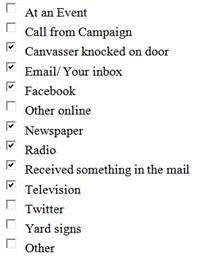
In what ways were you able to hear from Democratic candidates?

image002

I hate robo-calls. I’ve never met anyone who’s literally willing to sit there and listen to a candidate talk about how great and wonderful they are and therefore, you should vote for them. If they are, they’ve either overdosed on oxycontin or they’re having a hellacious Maalox moment.


What do you think we can do to get more Democrats to the polls?

Emphasize that voting is as much a responsibility as a right. Point out that many Americans have fought very hard to earn the right to vote and that conservative Republicans have tried to squash those rights in recent years with gerrymandering laws and voter intimidation.

Show old film footage of policemen attacking unarmed, mostly Negro citizens who were merely trying to register to vote and connect it to contemporary assaults on voting rights. The TDP should have stressed that many White conservative voters were upset that a half-blooded Negro won the presidency twice against full-blooded White men.


What do you think Democrats need to do to win in the future?

I’m not looking forward to 2016. I don’t feel there’s a single candidate at the national level who’s worth my vote.

What I said above: focus on free speech and voting rights. Don’t spend so much time worrying about who’s being tortured at Guantanamo Bay. Most of us don’t give a shit that some illiterate camel jockey can’t get a copy of the Quran, while we’re trying to find a job or pay off medical bills. And stop coddling illegal immigrants! They can’t vote anyway. And, in case you haven’t figured it out, there’s a reason they’re called “illegal immigrants.” It’s because they entered the United States illegally!


What issues are a priority for 2016 you’d like to add?

What moderates, liberals and independent thinkers have been emphasizing for the past several years: income inequality, free speech and voting rights. I’m especially tired of the Democratic Party asserting that the only way to appeal to Hispanics is to establish a comprehensive immigration policy. Immigration is NOT the only issue Hispanics are concerned about. Democrats also should have pushed President Obama to remove the individual mandate from the Affordable Care Act. Most Americans are concerned about jobs and the economy; more than they are about health care. The health care matter will take care of itself if people have solid jobs with good salaries.

You let the Texas Republican Party define you and your agenda. They kept tying all Democrats to the Washington, D.C., establishment elite. And how did you respond? With those fucking robo-calls asking folks to vote for you. Get real, people, and then get rough! Texas Democrats need to show we’re a different breed from the mainstream party. We don’t want to turn Texas into another California or Illinois where people and businesses are regulated and taxed into oblivion. Texas Democrats can show the national party the right way to do things.


I’m really dreading what will happen in the 2016 elections. Who will the Democrats select as their candidate? Hillary Clinton? Please! She’s past her prime. If she’s all the Democratic Party has, then there really is no hope for the future. And who will the Republicans choose? There’s an endless gallery of scoundrels in that bunch. The “Tea Party” clowns are pushing for Ted Cruz to run, even though, as a Canadian by birth, he isn’t truly eligible. But I’m downright frightened that we could end up with Jeb Bush in the White House. I’d rather catch Ebola while stranded in the desert with a bad case of jock itch.

1 Comment

Filed under Essays

I Hope Ted Cruz Runs for President

cruz

Texas Senator Ted Cruz splashed onto the political scene two years ago when he easily won the seat vacated by Kay Bailey Hutchison. Well-educated and highly intellectual, Cruz was a championship debater at Harvard University and, in 2003, became the youngest Solicitor General in the state of Texas; a role he served in until 2008. Unlike many first-year senators, Cruz quickly established himself as a rugged individualist by being blunt and outspoken. He held true to his base by bashing anyone and anything that didn’t fit his narrow agenda: taxes, regulation, the federal government, and, of course, President Obama. While the Republican National Party was already moving in a more staunchly conservative direction, Cruz seemed to break off his own small faction that slid even further to the right; making Hitler and Stalin look like tree-hugging liberals.

In September of 2013, Cruz incited a shutdown of the entire federal government over funding for the Affordable Care Act. He spoke on the Senate floor for 21 uninterrupted hours and was hailed as a hero by his “Tea Party” acolytes. Cruz and his Republican cohorts were unwilling to reach even a modest agreement with Democrats and Independents on funding the government; so on October 1, 2013, it essentially shut down. Approximately 850,000 workers were furloughed, and another 1.3 million were required to report for work with paycheck dates. The 16-day stalemate was the third-longest government shutdown in U.S. history and cost about $24 billion. As usual, whenever government officials skirmish, average citizens bore the brunt of the shutdown.

Now that Republicans are scheduled to take control of both houses of Congress next month, Cruz is demanding that funding for any of Obama’s programs – namely the ACA – be severed and any presidential appointments be thwarted. In other words, Cruz is pushing for nothing to get done so he can prove his point.

For all of these reasons, I sincerely hope Cruz runs for president in 2016. Not because I like and admire him. I want to see his arrogance get shoved down his throat.

Cruz is already positioning himself for a run. He’s engaged in the vital prerequisites: he’s visited the state of Iowa several times (Iowa is where the nation’s first voting primaries are held each election cycle); he’s solicited a bevy of affluent donors; and he’s expressed his unmitigated support for Israel. All he has to do is give a speech at Bob Jones University saying he doesn’t think Negro slavery was all that bad, and he’ll be good for the Republican Party’s nomination.

But I think once Cruz enters onto that stage, spouting off his vitriolic rhetoric and twisted views on American values, he’ll be shocked to learn not everyone loves him. His right-wing extremism will become apparent. Politics has a way of cutting people down to size. I sincerely feel Cruz will get diced up quicker than squid at a sushi restaurant.

A brief examination of Cruz’s voting record shows his true dimension. Among other things, he’s voted against funding for highways and transportation (three times); the “Bring Jobs Home Act”; the “Protect Women’s Health from Corporate Interference Act”; “Bank on Students Emergency Loan Refinancing Act”; the “Minimum Wage Fairness Act”; the “Protecting Access to Medicare Act”; the 2014 “Emergency Unemployment Compensation Act”; the 2013 “Employment Non-Discrimination Act”; and the 2013 “Student Loan Affordability Act.”

There is one seemingly innocuous fact about Cruz that may play into the hands of his opponents: he wasn’t born in the U.S. He was born in Canada; something from which he doesn’t shy away. Cruz’s father, Rafael Cruz, was born in Cuba and lived under the brutal dictatorship of Fulgencio Batista. In 1957, Cruz managed to escape Cuba and arrive in Texas with only 100 U.S. dollars and the clothes on his back. He had supported Fidel Castro, but now claims he didn’t know at the time that Castro was a communist. There’s a politician, if I’ve ever heard one! In the 1960s, Cruz met and married Eleanor Elizabeth Wilson. Eleanor was born in Delaware to Irish- and Italian-American parents. Rafael and Eleanor Cruz moved to Alberta, Canada where they worked in the oil industry. In 1974, the Cruz family (now including little Ted) moved back to Texas. Rafael and Eleanor divorced several years later. Why they abruptly relocated to Canada in the first place and when exactly they were married and divorced remains unclear. But doubts about Sen. Cruz’s citizenship keep surfacing.

In order to qualify to be President, the U.S. Constitution states, “No Person except a natural born Citizen, or a Citizen of the United States, at the time of the Adoption of this Constitution, shall be eligible to the Office of President; neither shall any person be eligible to that Office who shall not have attained to the Age of thirty five Years, and been fourteen Years a Resident within the United States.”

The precise definition of “natural born Citizen, or a Citizen of the United States” has confounded plenty of legal scholars and amateurs. To many of us, it simply means that you were born in one of the 50 United States, a U.S. territory, or a U.S. military base. But, if at least one of your parents was born in the U.S., then you are a U.S. citizen. My mother, for example, was born just outside of México City in 1932; yet she and her three siblings were U.S. citizens because their father was born in Michigan in 1902. Does that mean she’s qualified to run for U.S. president? I’m not certain. I don’t think she’d want the job anyway; she’d scare the crap out of too many people.

The issue of U.S. citizenship in relation to the presidency has come up before. In 1964, when Barry Goldwater garnered the Republican Party’s nomination for president, some speculated he wasn’t qualified, since he’d been born in Arizona, three years before it became a state. In 1968, when George Romney sought the Republican nomination, he didn’t avoid the fact he had been born in México in 1907. Both of his parents had been born in the U.S. and allegedly fled religious persecution by relocating to México where they and fellow Mormons set up a Mormon colony that still exists. (In reality, the Romneys wanted to maintain their polygamous lifestyle.)

The right-wing hysteria surrounding President Obama’s birthplace and birth certificate is well-documented. The self-righteous “birther” gang maintains that Obama was born in Kenya, like his father, and not in Hawaii, as the president’s birth certificate declares. Some people still don’t realize Hawaii is one of the United States. When I worked for the wire transfer division of a bank in the 1990s, we’d invariably get calls from branch offices asking if a transfer to Hawaii was domestic or international. Not much was made of the fact Senator John McCain was born in the Panama Canal Zone in 1936, when it was still a U.S. territory.

Ted Cruz tackled his own citizenship last year when he released his official Canadian birth certificate and then renounced his Canadian citizenship. I’m sure Canada was heartbroken.

Citizenship matters aside, Cruz may feel self-assured about a presidential run. Anyone who dares to tackle such an office has to be extremely self-confident and just a little bit arrogant. Cruz will find, though, that he has to appeal to a much larger base of people than the gaggle of conservative hardliners that orgasm with his every word. For one thing, he’ll have to appeal to Hispanics. That’ll be especially tough. I guess you have to understand the Hispanic identity in the U.S. Cuban-Americans don’t like to be dubbed “Hispanic” or “Latino” because that places them in the same category as Mexicans, Puerto Ricans, Guatemalans, etc. For some ungodly reason, some Cuban-Americans – Rafael Cruz among them – think they’re superior to other Spanish-surnamed peoples in the Western Hemisphere. As comedian Paul Rodriguez once noted, “When Mexicans enter the U.S. illegally, they take them to jail. When Cubans enter the U.S. illegally, they take them to Disney World.”

Ted Cruz will have no choice but to court Hispanics – and everyone else, regardless of ethnicity – if he wants to live in the White House and be considered the “Leader of the Free World.” It won’t be easy for him; not at all. He won’t be able to justify his extremist views to a broader audience. Then he’ll find himself on that sushi board. And me, personally, I think sushi is disgusting.

4 Comments

Filed under Essays

In Remembrance – Pearl Harbor

6am-sunrise-over-ocean

“Everybody knows about Pearl Harbor. The thing that really fascinated me is that through this tragedy there was this amazing American heroism.”

– Michael Bay

Pearl Harbor.

1 Comment

Filed under News