Sandy in One Year

This NOAA satellite image, taken October 30, 2012, at 10:45 A.M. EDT, shows Sandy moving westward while weakening across southern Pennsylvania.  Roughly 1,000 miles, Sandy was the largest Atlantic system on record.  Photo courtesy National Oceanic and Atmospheric Administration (NOAA).

This NOAA satellite image, taken October 30, 2012, at 10:45 A.M. EDT, shows Sandy moving westward while weakening across southern Pennsylvania. Roughly 1,000 miles, Sandy was the largest Atlantic system on record. Photo courtesy National Oceanic and Atmospheric Administration (NOAA).

Today marks the first anniversary of Hurricane Sandy’s arrival on the New England coastline.  After forming as a tropical wave in the Caribbean on October 19, 2012, Sandy quickly grew to hurricane strength and wreaked terror across 7 countries, from Jamaica to the U.S., ultimately killing 286 people.

Variously called “Superstorm” and a “Frankenstorm,” Sandy truly was a freak of nature.  As it began its march up the east coast, it sucked in other weather systems to create a hybrid of sorts; thus, its official meteorological moniker of “Post Tropical Cyclone Sandy.”  Physically, it was an immense storm: roughly 900 to 1,000 miles wide.  Although its maximum sustained winds (those winds around the eye) were about 115 miles per hour, Sandy generated snow storms along the Great Lakes region and tidal surges up to 32 feet on Lower Manhattan.  It also produced the lowest air pressure of any hurricane north of Cape Hatteras, North Carolina: 940 millibars (27.76 inches).  The previous record was 946 millibars from the infamous “Long Island Express” hurricane, a category 4 behemoth that tore up New England in September 1938.  Sandy is also only the second “S” named storm to be retired.  The first was Hurricane Stan, which struck México in October 2005.

With a $65 billion price tag and thousands of structures still sitting wrecked on various New England coastlines, Sandy reiterated what we already understood with Hurricane Katrina: the U.S. government is almost completely inept when responding to these calamities.  As politics and red-tape bureaucracy remain entrenched, the American political machine often seems more reactive than proactive.

Sadly, most major disasters will take human lives; a cost that simply can’t be measured financially.

1 Comment

Filed under News

Hearts Aloft

tumblr_mhy8i4eQe81rppc0go1_500

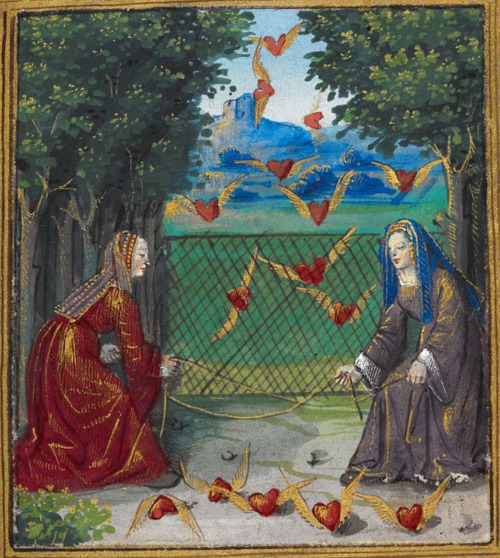
This has to be one of the most intriguing and unique works of medieval art I’ve ever encountered.  Entitled “Two women attempting to catch flying hearts,” it’s by Pierre Sala, a French Renaissance artist who also composed poetry.  This particular piece is part of his “Emblèmes et Devises d’Amour” (“Emblems and Currency of Love”) collection and dates to around 1500.  Historians believe Sala was making a dedication to his mistress Marguerite.

Sala is perhaps best known for his work “Tristan,” but I can’t find much information about him.  Still, I think this would make a great Valentine’s Day card.  The entire collection is currently housed at the British Library in London.

4 Comments

Filed under Classics

And Me?

hands-of-elderly-man-hold-006

In September of 2012, I was at my parents’ house when my father was getting ready to go have his car inspected, and my mother decided she needed to take out the trash.  I had come in following an earlier and somewhat stressful job interview.  I had brought my dog with me to the house – not the interview.  I suddenly thought that I needed to check on my mother.  I don’t know why; it just suddenly occurred to me.  Good thing, though.  As I entered the garage, my mother was returning from the recycle bin, when one of her slippers got caught on the cracked driveway.  She slammed hard onto the concrete and immediately started screaming.  I rushed to pick her up; her left arm looked broken.  With my help, she hobbled back into the house.

My father came down the hallway, horrified.  “What the hell happened?” he bellowed.  He already has a loud voice, so with any extra effort, he could wake the dead.

I quickly explained the situation, which only made him mad.

It wasn’t the first time my mother had tripped while wearing those slippers.  They were cheap, rubber footwear with a two-inch heel; what I called high-heeled slippers.  A few months earlier I was again at their house with my dog, when he indicated he needed to visit the back yard.  My father decided to take him out; my mother decided to join them.  She leapt up from the couch and tripped on those same slippers; slamming hard onto the tile floor.  In fact, she came out of them.  They literally seemed to get stuck to the floor.  She ended up with a severe bruise up the right side of her leg.  A visit to their orthopedic doctor the following week confirmed nothing was broken, or even fractured.

When she fell in the driveway, my father hurriedly called that same orthopedic doctor.  He told them to come in immediately.  I drove them to his office; the receptionist could sense my frustration, as I signed them into the log book.

“Be patient, hon,” she drawled.

My mother’s arm wasn’t broken, but her shoulder was dislocated.  The doctor and two of his assistants tried to pop it back into place, as she lay on the X-ray table, but the muscles and ligaments around it had swollen too much.  They had to admit her to the neighboring hospital and put her to sleep.  It turned out to be an all-day affair.  We left the hospital around 7 P.M.

My father tossed that pair of slippers – and another similar pair my mother had in their closet – into the trash.  Since they were made of rubber, I switched them over to the recycle bin.  I hoped they could be reincarnated as the wheels of a “Hoveround” and therefore, serve a greater purpose.

She’s not the only one who’s tripped in and around the house.  My father, an avid gardener, has fallen several times outside with no one but himself to get back up.  One afternoon he fell in the master bathroom and couldn’t get back up.  He started hollering for help.  My mother had fallen asleep on the couch and couldn’t hear him.  I had lain down in my old bedroom and – with the door closed – couldn’t hear him either.  My dog’s whining woke me up.

It’s a good thing I was there to help my parents in both those predicaments.  Many senior citizens live alone and often find themselves in compromising situations.  Several years ago I had a friend who volunteered for “Meals on Wheels.”  One afternoon he arrived at the home of a client, an elderly woman who lived alone.  Two of her neighbors were at the front door; frantic because she wasn’t responding to their knocks.  My friend wandered towards the back where he climbed the tall wooden fence – and saw the woman lying on the ground, just outside the back door.  She had stepped out the previous evening and tripped.  Unable to get up by herself, she simply remained on the ground; knowing her “Meals on Wheels” visitor would be there the next day.

As I rapidly approach 50, I’m now seeing all these incidents in a new light.  Who’s going to take care of me when I get old – if I should be that lucky?  I’m an only child.  I’ve never been married and don’t have any kids.  I’m close with a couple of cousins on my father’s side, but they have their own lives.  I don’t know if I’ll end up in this house where I grew up, or if I’ll have a home of my own.  But, if I should have the good grace of living to an old age, who could I depend on for support?  I can see dogs in my future though.  They make great companions, yet unless they can be trained to dial 911, or administer first aid, that’s about the extent of their practicality.  Still, I’d almost rather have a dog than a spouse or a partner.  I’ve never been good at romantic relationships.

It’s a serious issue facing us, as life expectancy in the U.S. and other developed nations reaches ever-increasing highs.  The current (and relentless) American obesity epidemic may put a dent in the welfare of my fellow citizens.  However, medical and scientific advances have allowed the populations of developed nations to experience greater rates of longevity, which is a good thing, of course.  People should be able to live as long as they possibly can.  But, those longer life expectancies also present some unique challenges; a fair trade-off, I presume.  It goes beyond just tolerating old folks’ stories of ‘way back when.’  Older people generally require specialized medications and treatments.  Arthritis, hearing and vision loss and immobility are among many such concerns for senior citizens.  There’s a growing industry within the medical community that targets elder care.  It’s virtually uncharted territory.

My paternal grandmother lived to age 97.  But, in the years between the death of my grandfather in 1969 and one traumatic night in the spring of 1992, she’d spent mostly alone.  She got up in the pre-dawn hours, needing to go to the bathroom, when her foot became entangled in the bedding.  She stumbled forward into the baseboard of her antique bed and fell to the floor – her right elbow cut and broken.  Despite the pain and bleeding in the pitch-black darkness, she managed to pull herself back around to the nightstand where she found the telephone cord; she yanked the phone down and called one of my aunts.  My aunt called one of her sisters, before rushing to my grandmother’s house with her husband.  Someone called the paramedics.  As my aunts and uncles stood outside, they simultaneously realized one terrifying fact: none of them had a key to the house.  One of the paramedics announced he was going to break a window, when one of my uncles remembered he had a glass-cutter in his car.  They used that to gain access to the house.  At the hospital, everyone was startled to learn something more critical than not having a key: my grandmother’s body was riddled with bumps, bruises and cuts.  She conceded that she’d fallen several times in the house and had always managed to get back up.  This time was worst, though, because of the elbow break.  The emergency room doctor looked askew at my relatives.  Elder abuse had become a hot topic in the medical community by the early 1990s, and our family became concerned that someone would look at those bumps and bruises on my grandmother and think the worst.  But, no one did.

Ultimately, my father and his six siblings decided that someone needed to be with her at all times.  My grandmother wasn’t too keen on the idea, though.  She relished her independence and privacy and didn’t want someone monitoring her every move.  But, her children ruled against her.  She was fortunate – and blessed.

A close friend of mine is caring for his elderly mother and an elderly aunt.  His aunt is in her early 90s, and his mother is fast approaching that milestone.  He works full-time, so it’s a challenge to tend to the needs of both women.  On a few occasions, he once confided to me, he literally wanted to pack up and leave Dallas for somewhere else; anywhere!  Just as long as he had no one to worry about except himself.  Alas, he couldn’t bring himself to do it.  He’s not so cold-hearted.  His older brother died a few years ago, and his younger sister has a daughter who just turned one.  His sister also has a 20-something son from a long-ago relationship who lives in the same house as his uncle, grandmother and grand-aunt.  He’s a very responsible young man who finished a hitch in the U.S. Marines three years ago and just earned an associate’s degree from a community college.  But, he also works and, at his age, I don’t think he envisions a lifetime of caring for old folks.  One day, however, he and his half-sister may face the concerns of elder care with their mother.

It’s difficult to watch my parents age.  “It’s hell getting old,” they inform me periodically.  Not until a few years ago, about the time I turned 45, did I really sit down with nothing but my most honest thoughts and contemplate life as a senior citizen.  Aside from previous bouts with alcohol addiction, I’ve tried to take care of myself both physically and mentally.  I’ve suffered from severe depression and anxiety in the past; adverse effects, I now realize, of not being able to kill people who pissed me off and get away with it.  Otherwise, I’m pretty healthy.  People who don’t know me occasionally tell me I look 30-something.  That’s a good thing.  But, surficial appearances can’t make up for a strong inner core.

In 2043, for example, I’ll be 80 – the same age as my parents are now.  Will I still have relatively good vision and the mental acuity needed to drive a vehicle?  More and more older Americans are still driving, even as their reflexes slow.  Some states are approaching the delicate issue of how to deal with the growing number of senior citizen drivers; another effect of longer life expectancies.  Will I learn from my parents’ mistakes and watch where I’m walking?  Falls are the leading cause of injury to the elderly.  It was bad enough that my mother would wear those damn rubber slippers with a two-inch base, but she also had the habit of dragging her feet.  I can understand why.  Joints become stiff with age, as cartilage behind the knees wears thin.

It would be nice for me, at age 70 or 80, to sit around the house and relish the fruits of a successful writing career.  But, at some point, I’d have to do laundry, or go to the grocery store.  If I have dogs – which I honestly intend to have – I must take them to the vet periodically.  It is possible that, in 30 years, grocery shopping will be done strictly online with customers sitting at their computers using web cameras to analyze fruits, meats and vegetables.  I wouldn’t be surprised if the U.S. Postal Service – now fighting valiantly to stay alive and relevant – will be a memory in 30 years; akin to my paternal grandfather’s early 20th century carpenter tools.  But, could there also be a vet who makes house calls?

Twenty years ago, when a good friend of mine died of AIDS, I felt lucky to reach my 30th birthday less than two months later.  Before I knew it, though, the turn of the century came – and went – a rare milestone for most humans now.  I turned 40 just weeks before I marked my first anniversary with an engineering firm – and then came down with the flu for the first time in my entire life.  Now, the first decade of the 21st century is old news.  Yes, technology changes, but so do people.

I’m not a braggart.  I don’t live for the moment, or for mounds of attention.  I’m an introvert who prefers quiet spaces most of the time; a hermit, perhaps, but one who cherishes books more than booze and dogs more than people.  If we’re fortunate, we get to live to see 70, 80, 90 and so on.  But, for me personally, what does that type of future hold?

I don’t cry out, ‘What about me?’  I’ve moved beyond wishing for the adulation of others.  But, seriously contemplating my later years, I really do have to ask, ‘What’s going to happen to me when I get old?’

3 Comments

Filed under Essays

Morass

yelling

As of 12:00 A.M. today, October 1, the United States government – for all intents and purposes – has stopped functioning.  I know it seems nothing has changed.  I mean, seriously – is there any difference?  But, the painful reality is that some 2 million government employees will not get paid and national parks have closed.  That’s the immediate effect.  It gets worse if the shutdown continues: military veterans won’t receive their benefits; the Centers for Disease Control and Prevention (CDCP) will have to halt its flu vaccination program – just as flu season approaches; some food safety operations will stop (and in a nation where behemoth butts have become the norm, that spells catastrophe); small business financing will stop; Head Start programs will start closing; disability benefits could be interrupted; funding for disease treatment through the National Institutes of Health could cease.

In the meantime, every member of both houses of Congress will receive their paychecks; their own health care won’t be adversely impacted.  Ironic, though, considering that the Affordable Care Act is the genesis of the squabble between the 2 principal political parties.  Most Republicans – especially the “Tea Party” clowns – despise the ACA, which they’ve derisively called “Obamacare.”  And, in an attempt to stop funding for the President’s signature law, the GOP is willing to risk what little integrity they have in their xenophobic bones and shut down the government.

Over the weekend, one particular “Tea Party” darling, Senator Ted Cruz, launched into a staunch tirade against the ACA.  Hoping to make a name for himself, the Canadian-born, Cuban-Italian Cruz has been campaigning for president since he took office back in January.  Representing my beloved home state of Texas, Cruz has done little else with his time and energy except commandeer the Republican Party’s vitriolic bandwagon and try to obstruct President Obama in any way possible.

Altogether congress has about a 10% approval rating.  I think ptomaine poisoning and getting stranded in the desert without water or cell phone service rank just above them.  Last year I wrote about the ongoing lack of progress from the Senate and the House of Representatives.  My wishful demand was for every elected official in Washington to get impeached, so we – the average, hard-working Americans – can elect more level-headed people to fill the apathetic void.  A million dollars in gold bullion has a greater chance of landing on my doorstep tomorrow morning.

I clearly remember the 1995 – 96 government shutdown in which a beleaguered President Bill Clinton ran head first into a recalcitrant Republican Party (led by the self-righteous Newt Gingrich) – and won.  It was a different time though.  The GOP held strong majorities in both houses of Congress; we weren’t at war; and the economy exploded into profitability for everyone shortly thereafter.  Clinton didn’t back down, thus forcing the GOP into embarrassingly humble defeat.

Today, the U.S. economy is still reeling from the worst downturn in 80 years; we have troops in Afghanistan and Iraq; and Republicans control only the House of Representatives.  Regardless, I’ve lost all respect for our elected officials.  Obama still hasn’t found any steel bars to inject into his spine, and the GOP has let itself be dominated by right-wing extremists.  I’m trying to imagine how things could get any worse.  If they do, colonizing Mars looks better all the time.

5 Comments

Filed under Essays

Last Wish

autumn-leaves

September 12th fell on a Sunday in 1993, and I was sick.  I lay in bed that night, listless and fatigued, when the phone rang at 10:12 P.M.  Curiously, I hadn’t turned on the answering machine, as I always did before going to bed.  But, I knew who lingered on the other end – even before I answered.  It was Linda*, the mother of one of my best friends, Daniel.

“He’s gone,” she whispered, her voice raspy and quivering.  She’d walked into his bedroom earlier that evening and found him with his eyes half-open.

We talked for quite a while, although I don’t remember all that was said.  But, I do recall telling her, “It’s over.  It’s finally over.”  Then, I went to sleep.  But, I wasn’t sad.  In fact, I was – not happy – but relieved.  Daniel had stopped suffering – and maybe so would his mother.

That night, though, I wondered why I was so sick.  Just allergies, I kept thinking; that’s all it was.  I’d realized years earlier how my allergies usually coincided with the Atlantic / Caribbean hurricane season, becoming most severe in August and September.  In reality, it’s the change from summer to autumn, when mountain cedar and ragweed blossom with impunity.  But, I have this obsession – almost a fetish – with tropical storm systems, so I make that odd comparison.  Yet, that year was different.  The infection seemed to have settled in my stomach, instead of my sinuses.

I’d felt fine the preceding weekend.  I’d visited Daniel and Linda that Monday, Labor Day.  I gave Daniel a much-needed bath and shave, trimmed his nails and put him back to bed.  I also vacuumed and mopped the kitchen floor.  I chatted with Linda for a while.  Her hands trembled, as she sat on a couch; as much from growing arthritis as dealing with Daniel.

“I don’t know how much longer I can go on,” she mumbled, staring at the floor.

“You’ll make it,” I said, trying to reassure her.  What else could I say?

I’d met Daniel at birthday party for a mutual friend four years earlier.  We were two completely different people, but had a few things in common: dogs, cars and rock n’ roll.  Like me, he also had been born and raised in the Dallas area.  He was the third of four children to parents who were mixed Irish and Cherokee Indian extraction.  He didn’t have a happy home life.  When his father wasn’t working, sometimes six days a week, he was drinking booze; occasionally, he’d burst into drunken rages, a stereotypical drunk-ass Irishman or Indian and lash out at anyone nearby.  Linda often bore the brunt of his attacks, until the night her oldest son lunged into his father.  For Linda, that was the proverbial last straw; the catalyst that prompted her to pack up the kids and leave.  By the time I met Daniel, his father had died.

As I’d planned, I took the day after Labor Day off from work.  I visited my gym to lift weights, worked on a short story and partook in a Tae Kwon Do class that evening.  The Tae Kwon Do session exhausted me, even though it wasn’t particularly intense.  I thought nothing of it until the next night, when I returned to the gym and left after less than an hour.  Fatigue settled over me like a ton of hot, wet blankets.

I awoke the next morning feeling awful; body aches and chills and a stomach that was churning like – well – like a hurricane.  My supervisor sent me home just after noon.  I sat near the building, waiting for the bus.  The late summer sun warmed me up, and I stopped shivering.  I felt well enough to stop by a fast food place on the way back to my apartment – and regurgitated the food that night.  I stayed home the next day, but returned to work on Friday.  I spent most of Saturday in bed; no energy, no strength.  Damn allergies, I kept telling myself.

On Sunday, I visited my parents for lunch as usual.  My father grilled steaks – their thick, juicy aromas wafting throughout the house, intermingling with the scent of the butter-saturated mashed potatoes my mother made.  But, I couldn’t eat.  I was still nauseous.  My dad suggested I visit their family doctor, if I didn’t feel better by the next day.  He even offered to pay, since my finances were strained at the time.

I had just purchased my truck six months earlier and was still paying off credit card bills for repairing my previous vehicle.  I had health insurance at work – with a $1,000 deductible.  I told them I’d be fine.  It was just those goddamned allergies.

I had been anticipating that call from Linda for months.  I knew somehow it would come at night.  She called me because I was one of the last friends Daniel had remaining; one who didn’t turn his back on him.  That’s just not my nature.  I didn’t have many friends back then and I still don’t.  But, the people I do consider friends mean a lot to me.

It’s amazing, though, the number of friends people lose when they fall on hard times – even when they become terminally ill.  Some time in the 1970s, my mother’s hair dresser became seriously ill and had to be hospitalized.  When my parents visited him, he mentioned they were among the few who’d made the effort.  All the people who were quick to accept his party invitations where mounds of food and alcohol would be served were curiously absent as he lay in a hospital bed hooked up to an IV.

I think Daniel had known he was HIV for at least two years, but he didn’t start getting sick until the spring of 1992.  By then, he was unemployed and uninsured; he could no longer afford his suburban Dallas apartment.  In May, I and another friend moved him back into his mother’s home in another Dallas suburb.  Daniel’s health deteriorated throughout that summer, but unexpectedly – almost miraculously – began rejuvenating by fall.  He gained weight and color returned to his face.  He actually looked pretty good when I spent Christmas Day with his family, including his two older siblings; younger sister, Andrea; sister-in-law; and a niece and nephew.  I took a photo of them as they gathered around a couch; one that Linda placed on her refrigerator, beside another picture of her beloved mother.

We all thought – if only for a moment – he would make it.  In less than six months, however, Daniel’s health began crumbling again.  And, one by one, his gallery of friends slipped into anonymity.

I took my father up on his offer.  After a cursory exam, the doctor stepped back into the room and asked, “Have you ever had hepatitis?”

“Hepatitis?  No.”

“Well, I think that’s what you have.”

Hepatitis!  If he had told me I was pregnant, I would have believed him sooner.  Hepatitis!  Wasn’t that an old world disease – like small pox or typhoid?  No one got that shit anymore.  But, that’s what I had – Hepatitis A, the contagious kind, and a particularly vicious strain of it, too.  The doctor hospitalized me – almost against my will.  I stayed there through the following Wednesday – the day they buried Daniel.

“Where’d you go?!” Linda cried that Wednesday night on the phone, a sense of betrayal coating her voice.

I told her what happened.

Her anguish shifted to empathy.  “Why didn’t you call me?!  I would’ve come visit you!”

“But, Daniel had just died, Linda.  And, I was in the hospital.”

“But, you’re my other son!”

I had helped Daniel pick out his burial suit in the spring of 1992.  He hadn’t bought a new suit in years.  He must have scoured through a hundred of them before he latched onto that one.  He zipped it up and stored it in the back of his closet, complete with a matching tie and a new white dress shirt.  He was proud of the ensemble; he wanted to be buried in style.

“You are going to be a pallbearer,” he asked me, “aren’t you?”

“Of course,” I said.  What a silly question.

Watching a loved one die and not being able to do anything about it is the most frustrating emotion anyone can ever experience.  I’d seen cancer consume my Aunt Mariana, my mother’s older sister, a few years earlier.  It just wouldn’t let her go, until one rainy Tuesday morning in June of 1989.  She’d already known tragedy.  Her first husband died in a freak car crash in 1968; practically leaving her to raise their six kids alone.  In January of 1983, one of her daughters took her own life.  Mariana had entered into a brief marriage with a man who – later on, as she fell ill – didn’t seem to understand she was in no mood for sex while undergoing chemotherapy.  What, I beseeched God, did she ever do to deserve all that?

I asked God the same of Daniel and Linda.  What did they ever do to bring this upon themselves?  God remained silent.  He / She always does.  But, it made me angry nonetheless, and I finally just blurted out, “Fuck you, God!,” into my darkened bedroom.

Daniel was especially close to Andrea who’d completed nursing school about two years before he passed away.  She had moved into an apartment complex across the street from him and became involved with a truck driver named Jimmy.  Jimmy was part Cherokee, too, and unfortunately, fed into the stereotype of the same drunk-ass Indian as Daniel’s father.  One night Jimmy returned to the apartment he shared with Andrea and attacked her.  She managed to call Daniel before Jimmy snatched the phone from her.  Daniel had been asleep, but donned a pair of exercise shorts, charged across the street and barreled into his sister’s apartment – where he beat Jimmy into a bloody, shriveling mess.  The police took both of them to jail, but released Daniel almost immediately.

Recollecting what his father did to his mother, Daniel was unrepentant about Jimmy.  “Now, he’s going to have to tell the guys in prison that an AIDS-infected fag beat his ass!”

In November of 1992, I happened upon the obituary for a guy I’d known in grade school.  He was 29 and had died after a “brief illness” – code words, a friend told me, for AIDS.  I revealed the true nature of Daniel’s death to only a select few people.  Even in the early 1990s, the affliction bore a terrifying stigma.   I told most everyone else – my parents, my colleagues – he’d succumbed to cancer.  I just didn’t want my folks to worry anymore about me than necessary.  My workplace, on the other hand, was populated with evangelical homophobes – the kind who preach forgiveness and compassion, but practice hate and bigotry.

Daniel always introduced me as a “true friend” to people he knew.  I was embarrassed, since I felt I was doing nothing extraordinary.  But, to Daniel, I was someone who gave my compassion and generosity, asking for nothing in return except trust and respect.  I promised him I would stay with him through the end.  And, I did – until the night he died.

For anyone who’s ever lost a relative or friend, there’s always something that triggers thoughts of that person; something relatively small and insignificant – a color, a sound…something that literally makes us stop and think about the better times we had together.  In 1992, a group called Snap! came out with a song entitled “Rhythm Is a Dancer.”  Both Daniel and I really liked that tune.  We’d visited a nightclub together in late 1992 where the deejay played it.  I don’t know what it is about that song, but it bridges a connection to Daniel and how good life was for me in the early 1990s.  So, I listen to it now, and all the feelings of  friendship and those carefree days flood my subconscious.  It’s just one of those things that transport me to ‘Way Back When.’

Daniel had two dogs when he returned to his mother’s home – a male named Alan and a female named Veronica, both Lhasa Apsos.  The male was fiercely protective of him.  The female was spoiled; Daniel had the habit of carrying her wherever they went, instead of letting her walk.  As Daniel’s health waned in the summer of 1993, he and his mother made the painful decision to turn them over to the local animal shelter.  Two years after Daniel died I seriously thought of purchasing a dog and just happened to peruse the ads of the local newspaper for animals, when I saw a blurb about an “adorable white Lhasa Apso named Alan.”  I almost fell off my easy chair.  Is it…no, it couldn’t be!  Surely, it’s not… I didn’t know what to think.  I realized, though, that I couldn’t afford a dog at the time.  I could only hope some good families adopted Alan and Veronica.

We measure the important events of our lives in the increments of time we know: one week, one year, five years, ten years.  Seven weeks after Daniel died I turned 30.  My colleagues at the bank bought me an ivy plant – which I still have – and treated me to lunch.  They also bought me a mechanical red crab emblazoned with the words ‘30 AND STILL CRABBY.’  You wind it up and it marches along the surface in the standard sideways crab walk.  I still have that crab, too, buried among my slew of possessions.  In seven weeks I’ll turn 50.  Life keeps moving, no matter who lives or dies.

I’ve always wondered why I never dreamed of Daniel.  I didn’t expect his ghostly apparition to appear before me one dark and stormy night – albeit something like that wouldn’t have frightened me.  But, I kept thinking he should at least visit me in a dream to tell me he’s alright.  Or, I hoped he would – just for my own peace.  Is he mad at me?  Did he think that I’d abandoned him at the last moment?  But then, I realized I’d never dreamed of my Aunt Mariana either.  And, we were family.  When I was a child, she’d sit me down at her dining room table and feed me.  Was she mad at me, too?

No – of course not.  I finally understood that I’ve never dreamed of them because they didn’t need me anymore; me or anyone else.  They’ve gone on to another and hopefully better life.  My job was done, as far as they’re concerned.

I did for Daniel what few people – friends or relatives – would do: I took care of him at the worst possible moments of his life.  I bathed him, I fed him, I took him shopping for that suit, I gave him all the undivided love and attention I could muster.  I even cared for his mother because her own body – racked with arthritis and emphysema – allowed her to do only so much.  Some people do good just to send a get-well card.

September 12th fell on a Sunday in 1993, and I was sick.  I couldn’t do anything about it then and I can’t do anything about it now.  I did what I could for my friend – the first friend I’ve ever had who died.  My last wish for him and everyone else who has gone before me is to know that they’re safe and happy.

I’ve finally convinced myself they are.

*All names have been changed.

6 Comments

Filed under Wolf Tales

“Castle of Love” in Ivory

Castle_of_Love

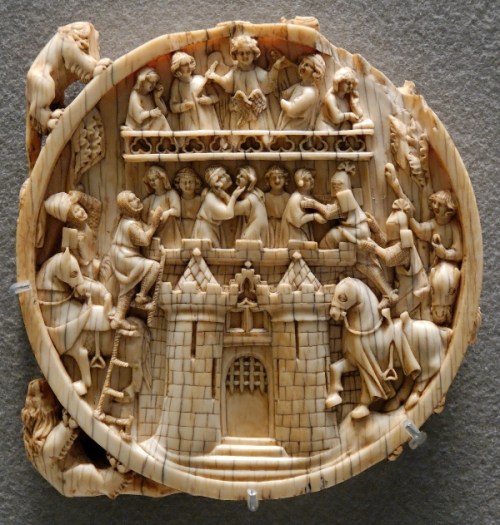
Ivory is one of the world’s most treasured natural resources; a substance often used for everything from furniture to medicine.  While it’s illegal to purchase and import products made of pure ivory, ancient ivory artifacts hold a unique place in cultural lore.  This piece is what’s left of a French medieval mirror case, c. 1350 A.D.  Currently housed at the Louvre, the “Castle of Love” most likely refers to a medieval religious play of the same name; one of the earliest known writings in the French language.  The scene depicts a castle coming under attack by knights and a group of women defending it, as an angel overlooks the chaos.  There are some obviously romantic, if not sexual, connotations in the design; a couple of the knights making contact with some of the women.  It’s always interesting to see so much eroticism present in religious artwork; considering how badly religious leaders tried to suppress sexual desire.

2 Comments

Filed under Classics

In Memoriam – September 11, 2001

remembrance-american-flag-eagle

September 11, 2001.

Image courtesy Layout Sparks.

Leave a comment

Filed under News

Old Wounds

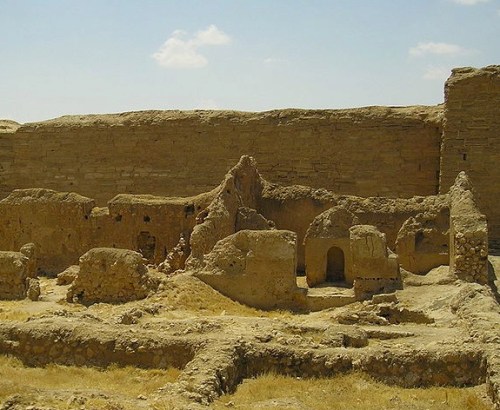
The ancient fort of Dura-Europos in Syria – possibly the site of one of the world’s first chemical attacks.

The ancient fort of Dura-Europos in Syria – possibly the site of one of the world’s first chemical attacks.

With Syria in the news lately, the specter of chemical warfare once again rears its despicable, gassy head.  If Syrian President Bashar al-Assad really did attack a select number of his own civilians with mustard gas, sarin, or another agent, it actually won’t be the first time such an event has occurred in the region.  Archaeology Magazine reports that around A.D. 256, Roman soldiers at a fort in Dura-Europos – a part of the Sasanian Empire – fell victim to a chemical attack.  There’s no written account of the battle, but recent analyses of remains unearthed in the 1920s and 1930s substantiate claims made by University of Leicester archaeologist Simon James in 2009.

Until then, scientists thought the soldiers had died when the tunnel they apparently tried to utilize to enter the fort collapsed.  Now, according to James, sulfur residue found along in a jar near several of the bodies reveals a bloodier truth.  The Sasanians had strategically placed fire pits throughout the tunnel.  As the Romans encroached, the Sasanians added sulfur crystals and bitumen to the fires.  The invaders inhaled the toxic fumes and perished alongside their armor.

Defining ancient chemical attacks is obviously difficult, if not impossible.  But, in this case, the remains of that sulfur makes it pretty clear what happened.  More importantly, it shows that while we modern folks think we’ve invented everything, history always upstages us.

1 Comment

Filed under History

Okay, Let’s Attack Syria, But…

warrior_of_ideas_196945

President Obama has placed himself into a quandary with Syria.  As the world observes what can only be deemed a human atrocity with a chemical assault upon Syrian civilians, the United States collectively contemplates intervention.  Obama won the presidency in 2008 primarily based on his opposition to the Iraq War – the illegitimate enterprise launch by the draft-dodging George W. Bush and Dick Cheney.  We now know that American oil interests used the horror of 09/11 to justify the invasion of Iraq.  Those same entities are surely behind Obama’s sudden desire to attack Syria.

It’s amazing how the U.S. government selects its battles.  President Bill Clinton says he didn’t interfere in the 1994 Rwandan massacre because he simply had no idea what had happened; a dubious claim at best.  Ronald Reagan sent covert military operatives into Central America allegedly to stamp out any communist insurgencies.  In reality, U.S. conglomerates like United Fruit wanted to maintain their lock on local commodities.

Chemical warfare is nothing new.  Technically, people have been using them for millennia; starting with poisoned arrows.  They gained prominence, however, at the start of the 20th century with a chlorine gas attack in Belgium in 1915.  Germany made good use of them during World War I.  Consequently, in 1925, an assemblage of nations banned chemical weapons with the Geneva Protocol.  But, things always look great on paper.

No one jumped when Saddam Hussein used mustard gas and sarin against Kurdish civilians in 1988; perhaps because the U.S. might have been involved.  Hussein may have used chemical weapons against the U.S. military during the 1991 Persian Gulf War.  A decade ago the U.S. accused Hussein of stockpiling uranium, which of course, prompted the invasion.  Notice how these things are cyclical?

Now Obama wants to don the mantle of international hero by ousting Bashar al-Assad.  So far, he hasn’t convinced too many in the U.S. Congress, nor has he been able to persuade our biggest ally, Great Britain.  He plans to take his case to the American public in a televised address tomorrow night.  Good luck.

But, if the U.S. does plan to attack Syria, here are two conditions I’d like to see take place first:

  • Raise taxes on the wealthiest citizens and largest corporations to fund the war.  Our engagements in Iraq and Afghanistan occurred without the benefit of significant tax revenue, which ultimately led to the current economic crisis.  Besides, all those rich folks and oil conglomerates are the one who benefited the most from the conflicts.
  • Institute the military draft for every able-bodied person ages 18 – 25.  But, this time include women and rich men.  Yes, if women want to be treated as equals to men in business and politics, that means they have to serve alongside men on the battlefield.  In the past, sons of affluent families have been able to bypass military service.  (Mitt Romney comes to mind.)  But, if those boys can expend energy racing their million-dollar speed boats or partying all night in Cancún, then they can damn well haul rucksacks across the Syrian desert.  There also should be no exceptions for conscientious objectors, such as Mormons, Amish, or Jews.

I won’t hold my breath on passage of either.  I know it’s a long shot to expect multi-millionaires to share the tax burden (not their hard-dollar wealth), or for “Millenials” to set down their I-pods and actually do something constructive.  But, what’s life worth if you can’t dream?  Ultimately, my dream is for the Syrian people to rise up and depose al-Assad all on their own.  Regardless, war is just too ugly for only a handful of people to endure.

Image courtesy Warrior of Ideas.

1 Comment

Filed under Essays

Save the Boys, Damn the Religion!

knife

Where was the outrage?

Last year the Centers for Disease Control and Prevention (CDCP) reported that, between November of 2000 and December of 2011, eleven infant boys in the New York City area developed herpes infections following orthodox Jewish circumcision rituals.  In keeping with religious tradition, every infant male born into the Jewish faith undergoes a bris, or brit milah, on the 8th day of life, during which the foreskin of his penis is removed.  The cleric, a mohel, often dabs the infant’s lips with a drop of wine supposedly to numb the pain before performing the ritual.  In the rare cases when the baby is born without a foreskin – a condition called aposthia – or if he was circumcised outside of the standard bris ceremony, the mohel performs a symbolic circumcision called a hatafat dam brit in which he pricks the head of the infant’s penis to draw a drop of blood.  All of this is done in accordance with Jewish scripture, Genesis 17:10-14 and Leviticus 12:3, which Abraham, the founder of Judaism, allegedly wrote.  Orthodox Jews, like many staunchly religious people, view their faith as an unmitigated commandment that should not be questioned.

No one knows if Abraham considered the possibility of herpes infections.  But, during some of these ultra-orthodox rituals, the mohel often performs metzitzah b’peh, or oral suction, to minimize blood loss.  In other words, he sucks on the baby’s penis, while family members and others stand around in quiet observation.  I believe, in keeping with contemporary federal law, that’s called pedophilia and – regardless of one’s religious affiliations – it’s a felonious criminal offense.

Health officials have known for years that herpes infections can be detrimental to newborns.  Because of their undeveloped immune systems, babies born to women infected with genital herpes (herpes simplex type 2) can develop fevers, seizures and / or blindness.  Death is not uncommon among these infants.  Herpes simplex type 1 usually causes blisters on the mouth, lips or eyes; otherwise known as cold sores.  Of the 11 aforementioned New York cases, 10 of the babies were hospitalized; at least 2 developed brain damage, and 2 others died.

In December of 2005, New York Mayor Michael Bloomberg – tiptoeing through the minefield of religious sensibilities – issued a letter to the local Jewish community warning of the health risks of metzitzah b’peh and politely asked rabbis to cease the practice.  Religious leaders scoffed at the notion, insisting that the ritual was perfectly safe.  As usual, they claimed religious freedom and vowed to fight any attempts to ban it.

Such cases may be rare, but I noticed no demands were made of New York’s Jewish community to stop putting their infants at risk; no threats of prosecution; no criminal charges – nothing but courteous requests to think about what they were doing.  Had those infants been girls, I realized, Bloomberg himself would have rounded up every religious leader and every parent and thrown them in jail.  But, since male circumcision has become such an insidious element of pediatric care in the U.S. and since violence against males – even infant males – is socially acceptable here, no one seemed to notice.

Religious freedom – like free speech and voting – is one of the hallmarks of American society.  It’s a critical feature of any civilized state.  But, I have to wonder how the public would react to infant females contracting genital herpes following some archaic religious ceremony.  Would the local mayor merely ask religious leaders to stop and just hope for the best?  Where, in fact, was the media outrage over the 2012 CDCP report?  Why is that people seem to think it’s okay that baby boys aren’t just being cut up in the name of religion, but dying because of it?

Male circumcision is primarily associated with Judaism, but it’s also a sacred rite among Muslims.  Unlike Jews, however, Muslims wait until their sons are older to perform the ritual – usually between the ages of 6 and 11.  But, its origins in the Islamic faith, however, are unclear.  It’s mentioned in the hadith (sayings from the profit Mohammed), but not in the Quran.  Circumcision is not considered a religious rite among Christians, even though the “Gospel of Luke” states that Jesus was circumcised on the eighth day after his birth.  Circumcision was also considered a rite of passage among some African and Indigenous Australian groups where it was viewed as a pathway to manhood for boys.
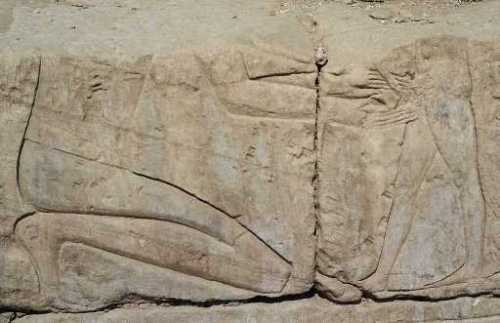
A purported circumcision from the Temple of Khonspekhrod in Luxor, Egypt, c. 1360 B.C.

A purported circumcision from the Temple of Khonspekhrod in Luxor, Egypt, c. 1360 B.C.

Male circumcision was once virtually unknown in the United States.  Early proponents were doctors who believed it would prevent male sexual deviants from committing further crimes, such as rape and pedophilia; others included homosexuality in that evil repertoire.  Circumcision was even recommended for men charged with adultery and to stop boys from masturbating.  This was during a time when physicians believed human sexuality (and its various perversions) were strictly tied to genitalia.  In 1858, for example, the European medical community urged clitoridectomies to overcome frigidity and hysteria in women.  In 1891, England’s Royal College of Surgeons published On Circumcision as Preventative of Masturbation.  Around the same time, John Harvey Kellogg, a nutritionist and self-proclaimed sexual advisor, developed his corn flakes cereal as a means to prevent children from masturbating.  Kellogg believed masturbation – then often called onanism or self-pollution – caused insanity and, if left unchecked, could be fatal.  He even suggested threading silver wire through the foreskins of young boys to prevent them from getting erections and therefore, stamp out their sexual urges.  He also came up with the idea of injecting some of his patients with yogurt enemas to cleanse their intestinal tracts.  Fortunately, neither of these latter two practices caught on with the American public.

Neither did circumcision.  That began to change, however, after World War II.  Much of it has been credited to the rapid influx of Jewish immigrants fleeing Nazi-riddled Europe.  But, a growing body of medical practitioners had already begun to urge circumcision of newborn boys as a means of preventing penile cancer later in life.  In 1932, Abraham Leo Wolbarst, [Circumcision and penile cancer. Lancet 1932; 1: 150-153], published a review of 1,103 cases of penile cancer in the U.S. and noted that none occurred among Jews.  He cited similar figures from Europe and pointed out that Muslim men who had been circumcised as pre-teen boys were less likely to develop penile cancer.  A 1935 report entitled “Epithelioma of the Penis,” published in the Journal of Urology, [Dean AL Jr. Epithelioma of the penis. J Urol 1935; 33: 252-283], seemed to confirm those findings with an analysis of a mere 120 penile cancer victims at New York’s Memorial Hospital: none were Jews.  Circumcision among adult males began to increase throughout the 1930s.
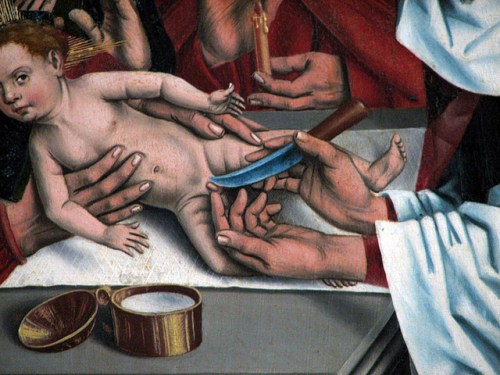
Detail of Friedrich Herlin’s 1466 depiction the circumcision of Jesus, “Twelve Apostles Altar.”

Detail of Friedrich Herlin’s 1466 depiction of the circumcision of Jesus, “Twelve Apostles Altar.”

Then, in 1946, various reports started coming out in the U.S. claiming that men returning home from World War II, especially those who’d served in North Africa, were suffering from penile cancer.  These men, some medical professionals supposedly observed, had gone for long periods without bathing and, for the uncircumcised ones, this culminated in a build-up of smegma; which in turn, developed into penile cancer.  It is true that many of those servicemen were uncircumcised and had gone without bathing for lengthy stretches.  But, they weren’t suddenly afflicted with penile cancer.  Instead, many of them were suffering from venereal diseases, mainly syphilis.  It’s quite plausible to assume many of them, happy that the relentless war had finally ended, celebrated by patronizing local brothels before returning home.  Yet, the unsubstantiated claims of a sudden outbreak of penile cancer nonetheless launched a movement and circumcisions of newborn males began occurring at a rapid pace.  By the mid-1950s, up to 90% of newborn American boys were circumcised; thus making it the most common surgical practice in the country.  By the early 1960s, some health insurance companies began reimbursing doctors for circumcisions, thus invoking a profit motive.  Some hospitals started performing circumcisions without the parents’ knowledge or consent – and then charging them for it.  In the early 1980s, the rate of newborn male circumcisions began to drop; albeit slowly, and continued dropping.  By 2010, the rate stood at roughly 40% in the U.S. – the first time it was below 50% in over half a century.

Preventing penile cancer is perhaps the top myth related to male circumcision.  As with anything, the truth often gets lost amidst the rancor of popular opinion and uncertain medical advice.  Tell a lie often enough, as the saying goes, and people start to believe it.  But, here are the facts, starting with that number one lie:

Myth:  It prevents penile cancer.

Fact:  Penile cancer is one of the rarest forms of carcinoma known to humanity.  Worldwide penile cancer accounts for about 0.2% of all cancers in men.  In the U.S., it accounts for some 0.1% of all cancers in men, or about 1 man in 100,000.  Men are actually more likely to die from a rare form of male breast cancer than penile cancer.  Even in other developed nations, such as England and Japan, where male circumcision is uncommon, penile cancer is actually more rare.

After years of intense medical analyses with various groups of men, no doctor has been able to prove conclusively that intact foreskins are linked directly to penile cancer.  Doctors do know that the number one cause of penile cancer is the human papilloma virus (HPV), which is spread through unprotected and often frequent sex.  Poor diet, obesity and nicotine consumption are other contributing factors.

Myth:  It prevents cervical cancer in men’s female partners.  This is another top reason provided for male circumcision.

Fact:  As with penile cancer, HPV is the leading cause of cervical cancer, with poor diet, obesity and nicotine consumption listed as other risk factors.  Up until the mid-1950s, cervical cancer was one of the leading causes of cancer deaths among women in the U.S.  But, physicians don’t credit the increase in male circumcisions for the decline; rather, they point to the increased prevalence of pre-cancerous screenings (Pap smears) and greater attention to women’s overall gynecological health.

Circumcising males to protect females may be politically correct, but it’s morally unethical and medically impractical.  You don’t safeguard one group of people by violating the basic human rights of another.  Even if all men are circumcised, venereal diseases can still be spread through unprotected sex.  As with the number of pregnancies and births, the rates of venereal disease infections drop when women are empowered with information.  Women in developed countries, for example, have on average 2 children; while women in developing nations have as many as 5 children.

Myth:  It minimizes the risk of venereal disease transmissions.

Fact:  The term “minimize” is often substituted for the term “prevent,” but the misunderstanding can be dangerous.  Even though most males born in the U.S. from the 1950s to the 1970s were circumcised, the rates of sexually transmitted diseases increased exponentially during that same time period.  Gonorrhea was one of the biggest culprits, with 193 reported cases per 100,000 individuals in 1950; and 442 reported cases per 100,000 individuals in 1980.  Syphilis actually experienced a dramatic decrease: 642 reported cases per 100,000 individuals in 1950; and 60 reported cases per 100,000 individuals in 1980.  The key term, of course is “reported.”  Even now, though, both those ailments remain the most commonly-transmitted venereal diseases.  (Health, United States, 2010, U.S. Health and Human Services, Trend Tables: Table 44, p. 212.)

Genital herpes exploded from an average annual 5% infection rate in the late 1960s to about 30% by 1980Chlamydia, which was rare before 1990, saw 1.4 million cases in the U.S. in 2011.  Hepatitis B has also been tenuously linked to male circumcision.  Scientists identified Hepatitis B as a separate strain in 1955 and discovered it could be sexually transmitted in 1975; the same year they identified Hepatitis C, which they initially called “non-A, non-B.”  Until the 1970s, Hepatitis B had been dubbed the “druggies’ disease” because it primarily infected intravenous drug users.  In the 1980s, Hepatitis B became linked with another growing epidemic, another consequence of the sexual revolution: AIDS.  And, that in turn, has now metamorphosed into yet another ruse for circumcision.

In recent years, some epidemiologists have claimed that circumcision minimizes the spread of HIV (human immunodeficiency virus) infections.  Much of this is based on a controlled study of 5,534 uncircumcised, HIV-positive Ugandan men, beginning in 2002.  Doctors convinced the men (all of whom identified as heterosexual) to get circumcised.  None of the physicians believed the men would be cured of HIV, but they wanted to see if the men developed higher T-cell counts once their foreskins were removed.  As often happens, things looked great on paper, but didn’t go as planned once put into action.  Many of the men – believing they’d been cured of HIV – began having unprotected sex; others disappeared from the control group, so doctors couldn’t track their activities.  Still, the doctors insisted the study showed promise; claiming that circumcision reduced a man’s risk of acquiring HIV by as much as 60%.  But, to me, the concept of a bunch of mostly White, mostly female European and American physicians urging a cluster of uneducated, basically illiterate Black men to have their penises mutilated seems as racist and sexist as it does immoral.

Myth:  It prevents urinary tract infections (UTI), especially in male children.

Fact:  The medical community can’t seem to make up its mind on this one.  On average, about 5% of girls and 2% of boys will develop a UTI.  Between 1971 and 1999, the American Academy of Pediatrics published 5 policy statements on the circumcision of boys in relation to UTIs and could find no credible evidence of a direct correlation.  In other words, circumcision didn’t prevent UTIs in boys.  In 1986, however, they still noted the procedure “has potential medical benefits.”  Then, in 1999, they reversed course and didn’t recommend it.

An analysis of 136,086 boys born at U.S. Army hospitals from 1980 to 1985 showed that 100,157 were circumcised.  Of those, 193 experienced complications related to the procedure; that apparently included UTIs.  Of the 35,929 uncircumcised infants, 88 (or .24%) developed UTIs.  It’s obvious infants develop UTIs because they can’t control their bladder and therefore, can’t clean themselves.

There is only one legitimate medical reason for circumcision: phimosis, which is the inability of the foreskin to be retracted.  The condition can lead to inflammation of the penile glans and urinary tract infections.  Occasionally, topical ointments such as hydrocortisone can relieve the tightness of the skin and subsequent inflammation.  But, more practically, removal or loosening of the foreskin is appropriate.  Still, on average, only about 1% of boys are born with or develop this condition.

Another medical reason often given for circumcision is prevention of balanitis, which is inflammation of the penile glans.  This usually occurs in uncircumcised men, but is traced to one primary cause: poor hygiene.  Severe balanitis requires more aggressive treatments, such as antibiotic pills or steroid creams.  But, it’s amazing what regular hygienic habits can accomplish.  Simple hand-washing, for example, can reduce the risk of respiratory-associated infections by up to 16% and reduce the risk of diarrheal disease-associated deaths by up to 50%.

Yet another explanation often given to justify circumcision is purely aesthetic: it allegedly makes the penis look better.  That, of course, is a personal opinion, but not enough to warrant mandatory foreskin removal.  I’ve entered into a number of debates about this one in particular; often with women who would scream if I suggested they have a surgical procedure done to meet what I think is my own definition of beauty.  Any woman who thinks the uncircumcised penis looks ugly needs to hold a mirror up to her own crotch; the female genitalia isn’t exactly a work of art either.  Human genitalia altogether isn’t built for appearance; it’s built for function.  You don’t look at it; you work with it.

Then, there’s the presence of smegma – the nasty buildup of dead skin cells beneath the foreskin.  It’s primary cause?  Once again, poor hygiene.  For most uncircumcised men, hygiene is a simple matter, like breathing – we retract the foreskin and clean ourselves.  Any uncircumcised man who doesn’t engage in this most basic of behavior has far more problems than the inability to reach for soap and water.

If circumcision truly prevented penile or cervical cancers, then perhaps we should mandate, or at least strongly recommend, that women have double mastectomies once they pass their child-bearing years to avoid breast cancer.  Despite recent medical advances and awareness, breast cancer remains the number one killer of women in the U.S.  For that matter, we should mandate adult males have prostatectomies to avoid prostate cancer, which is the third greatest cause of carcinoma-related deaths of men in the U.S.  (Lung cancer is the top killer, but I don’t think mandatory thoracotomies would be practical.)

Appendicitis is much more common than penile cancer, and since the appendix serves absolutely no purpose in the human body, appendectomies could save valuable time and money.  Tonsillitis is a common affliction in children, but doctors still don’t perform tonsillectomies as a preemptive measure.  Wisdom teeth often become impacted and necessitate removal, but again, doctors don’t seem to automatically mandate it.
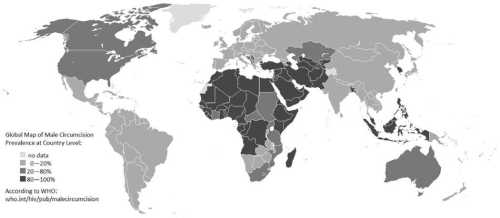
Global_Map_of_Male_Circumcision_Prevalence_at_Country_Level

Unlike so-called female circumcision, calls to ban male circumcision have been met with hostility from people who suddenly develop an affection for religious freedom.  The loudest voices have come from the Jewish community; many of whom will use any excuse to play the victim.  When a handful of Muslim groups protested that banning female circumcision violated their religious freedoms, human rights activists paid no attention.  In that regard, protecting the health and safety of infant and toddler females trumped the religious ideologies of their parents.  A number of countries rightfully passed laws outlawing the practice, including the U.S.  When it comes to males, however, that religious freedom issue abruptly rears its ugly head and suddenly takes precedence over the rights of the child.

In 1996, then Congresswoman Pat Schroeder of Colorado proposed the Female Genital Mutilation Prevention Act (FGMPA) to outlaw female circumcision in the U.S.  It didn’t seem to matter that the ritual never had been practiced here, or most anywhere in the developed world.  The FGMPA passed unanimously, and then-President Bill Clinton signed it into law.  I’d never even heard of female circumcision until the early 1990’s, when human rights advocates started complaining about the thousands of girls suffering and dying in isolated parts of Africa and Asia.  For a much longer period, however, others had been complaining about the savagery of male circumcision and the fact that boys are suffering and dying as well.  The same devout Muslims who practice female circumcision in Africa and Asia also practice male circumcision – with the same level of barbarity; no anesthesia, no sterilization and no post-operative medical care.  With each child – female or male – they just cut off part of the flesh.  But, as in the developed world, the deaths and injuries suffered by males are ignored.  It is truly a gender-bias abomination.  But, in the politically correct universe of 1990’s America, that didn’t seem to matter; thus, the FGMPA became law without question and remains law, even though female circumcision was never practiced in the U.S. or any other developed nation.

In 2011, two California cities – San Francisco and Santa Monica – proposed to ban male circumcision.  In both cases, the issue reached the state legislature where Assemblyman Mike Gatto reacted by introducing a bill that would prevent any municipality in California from outlawing the procedure.  Ultimately, supporters of the ban in both cities experienced disenfranchisement.  In San Francisco, voters defeated the measure at the ballot box in November of 2011.  In Santa Monica, those who had proposed the anti-circumcision measure merely withdrew it from consideration.

In July of 2012, the German government backed away from its sweeping proposal to ban male circumcision.  Chancellor Angela Merkel announced that Jewish and Muslim groups will be allowed to circumcise their sons in accordance with their respective religious beliefs.

The 11 cases highlighted in the 2012 CDCP report aren’t really anomalies.  Every year in the U.S., about 100 infant and toddler boys die due to botched circumcision procedures, which include complications from administration of anesthesia.  Some say the number sometimes reaches 300, but actual statistics are difficult to ascertain.  I’m quite certain if 100 to 300 infant or toddler girls were dying from botched medical procedures, the practice would have been outlawed without question, no matter whose religion was offended.  If 100 to 300 adult females died annually from a botched cosmetic procedure, it definitely would have been outlawed!

It’s shocking to think that infant male circumcision is the most common surgical practice performed in the United States, but it has been for over six decades.  Even with the rash of weight reduction surgeries and face lifts in recent years, removing the foreskins of baby boys still ranks number one among cosmetic procedures.  But, the adverse effects of those circumcisions are conveniently left out of the debate.

Almost every year for nearly three decades, a bill simply titled the “Male Genital Mutilation Bill” has been presented to the U.S. Congress.  And, every year it never comes up for discussion.  It goes back to the cloak of religious freedom, and the grip it has on society.

When people make medical decisions based on religious ideology, other people – usually infants and children – often die.  In medieval Europe, the Roman Catholic Church often punished as heretics any medical practitioner who tried to ease the difficulties of pregnancy and childbirth; the Church believed women had to suffer for the sins of “Eve.”  Even now, the Fundamentalist Church of Jesus Christ of Latter Day Saints (FLDS) forces women and girls to endure the agony of childbirth because of Eve’s alleged transgressions.  When the “Black Death” struck 14th century Europe, the Roman Catholic Church pointed to Jews as the culprits.  As we now know, of course, the “Black Death” was the bubonic plague, which is a virus transmitted by fleas that live on rats and other animals.  The lack of hygiene among medieval Europeans and the fact they often slept in the same quarters as their animals contributed to the virus’ spread.  Jews were saved mostly because they often washed their hands before preparing food and engaged in other such ghastly habits like bathing more than once a year.

Just recently, a measles outbreak in Fort Worth, Texas has been traced to an evangelical Christian church where members refused vaccinations of any kind.  When some in the congregation returned from overseas proselytizing trips infected with the highly contagious disease, leaders prescribed prayer instead of medicine.  Now, 21 people in two counties have been diagnosed with measles.

I realize it’s difficult to alter religious ardor.  People tell me Jews and Muslims should be allowed to circumcise their sons because they’ve been doing it for centuries.  Well, for centuries, slavery was considered perfectly acceptable.  Blatant racism was a factor of American life from its beginning; something that changed only in recent decades.  That, in and of itself, ties into the enslavement of the first African-Americans; their contemporary European counterparts believed slavery was mandated by the Bible.  In the 19th century, White Americans concocted the philosophy of “Manifest Destiny” to forge westward across North America, which obligated them to destroy any darkness and savagery they encountered; meaning, of course, God commanded them to kill any heathenous Indians who got in their way.

As a former Roman Catholic devotee – an altar boy at that! – I once believed in the concept of “original sin” and the story of creationism.  Then, I saw the light and divorced myself from such ludicrous ideology – a sacrilege unto itself in the Church.  The Church’s disrespectful treatment of women was the real catalyst for my departure from its ranks of the blind faithful.  Roman Catholicism – and all branches of Christianity – has always taught that women were second-class citizens; another by-product of Eve’s wickedness.  Even now, the Church forbids birth control; believing everyone should procreate whether they like it or not.  The Church naturally doesn’t feel obligated to provide financing for those procreative results.

When human rights clashes with religious freedom, religion needs to take a back seat – always and forever, no exceptions.  I don’t care about anyone’s religious affiliation – Jew, Christian, Muslim, whatever – infants have more of a right to have their bodies left intact than their parents or their communities have to practice a certain philosophy.  If all of Judaism or Islam collapse because parents won’t be able to carve up their sons’ penises, then that would be a good thing.  Religion has been a great oppressor throughout human history.  Judaism, Christianity and Islam, in particular, have been the worst offenders; more people have been maimed and murdered because of those three religions than any other human construct.  It’s still happening even now.

And again, with 11 newborn babies infected with herpes, I ask – where was the outrage?

Attorneys for the Rights of the Child

International Coalition for Genital Integrity

MGMbill.org

Jews Against Circumcision

Mothers Against Circumcision

Nurses for the Rights of the Child

8 Comments

Filed under Essays