“Fauci said that he’s concerned about states like Texas that skipped over certain things. He doesn’t know what he’s talking about. We haven’t skipped over anything.”
– Dan Patrick, Texas Lte. Governor, responding to Dr. Anthony Fauci’s testimony before a Senate committee about the U.S. response to the coronavirus outbreak.
Patrick went on to say, “The only thing I’m skipping over is listening to him. He has been wrong every time, on every issue. I don’t need his advice anymore. We’ll listen to a lot of science, we’ll listen to a lot of doctors, and [Gov. Greg Abbott (R)], myself and other state leaders will make the decision. No thank you, Dr. Fauci.”
As we often say in Texas, ‘Bless his heart.’ Translation: ‘Dumb ass!’ It’s simply impossible to protect stupid people from themselves. To non-Texans, please don’t consider Patrick typical of everyone here in the Lone Star state; the vast majority of us are considerably more intelligent than the moronic clowns who finagle their way into leadership positions.
“In defense of the Confederacy, the word ‘heritage’ is romanticized. But its literal definition is property that is or may be inherited. Even if the property you inherit is your little brother.”
Yesterday, July 3, the Washington Redskins football team made the stunning announcement that they would actually consider changing their name; at least change the “Redskins” part of it. If there’s a true case of better late than never, this is it. For decades, the nation’s Native American population and their supporters have demanded Washington remove the “Redskins” feature of their moniker. As recently as 2013, team owner Dan Snyder scoffed at the possibility of such a move. Many have expressed surprise that Snyder would be opposed to the alteration because he is of Jewish-American extraction. But I say it’s because he is Jewish-American that he remained reticent to a change. From what I’ve seen, many people of Jewish faith and ethnicity feel they are not only the “Chosen Ones” of humanity, but they are the ONLY ones who have ever suffered the horror of genocide. So much so that the term ‘holocaust’ has metamorphosed into ‘Holocaust’ as a direct reference to Nazi Germany’s attempt to obliterate the Jewish people. Snyder had spat out the usual Caucasian rhetoric of venerating Native Americans as fierce warriors with the word “redskin”.
In his formal statement, he declared, in part, “This process allows the team to take into account not only the proud tradition and history of the franchise, but also input from our alumni, the organization, sponsors, the National Football League and the local community it is proud to represent on and off the field.”
Not once did Snyder mention the derogatory nature of the word “redskin”. In the spirit of thick-skin football, I presume Snyder wouldn’t mind me recounting a couple of old Jewish jokes someone told me more than 30 years ago.
“Hear about the new German microwave oven?
Seats 500.”
Or…
“What’s a Jewish woman’s favorite sex position?
Bent over the checkbook.”
In the spirit of racial unity, I wanted to refer to one of my earliest essays, “A Matter of Respect,” in which I address this very issue. Because, like love and hope, respect never dies.
“I always have the most fun on the Fourth of July. You don’t have to exchange any gifts. You just go to the beach and watch fireworks. It’s always fun.”
“You have to love a nation that celebrates its independence every July 4, not with a parade of guns, tanks and soldiers who file by the White House in a show of strength and muscle. But with family picnics where kids throws Frisbees, the potato salad gets iffy, and flies die from happiness. You may think you have overeaten, but it is patriotism.”
We’ve heard it so many times before. History has always been written by the victors. It’s a sad reality, yet very true. It means that much of the history of Africa and the Western Hemisphere has been recounted with a decidedly European viewpoint. As someone of mixed European and Indigenous American extraction, I always felt conflicted about this disparity. While trying to find information about Native American Texans in an encyclopedia during my grade school years, for example, I noticed that references to pre-Columbian peoples were treated dismissively. It wasn’t just archaic history in standard academic circles. It was irrelevant. Even mention of the state’s Spanish colonizers – the first permanent European settlers – was dubbed “pre-history.” It seemed Texas history didn’t actually begin until the likes of Stephen F. Austin and Sam Houston arrived. And it didn’t matter that these men weren’t even born and raised in the state.
Only within the past half-century has the truth about various indigenous societies been revealed with advances in archaeological research and detailed forensic analysis. Lidar, for example, has taken the concept of neon lighting from the banal presence of liquor store signs to the jungles of Central America where long-abandoned Mayan structures remain shrouded by the foliage. As a devotee of Archeology magazine, I’m constantly amazed by discoveries of ancient settlements across the globe. Areas once thought to be occupied by nomadic hunter-gatherer types at best are revealing the ghosts of thriving population centers.
Yes, history has always been dictated and composed by those who somehow managed to overcome the locals – usually through the casualties of disease and pestilence or the sanguineous nature of war and violence. But the blood of history’s victims seeps into the ground and eventually fertilizes the crops that feed the newly-minted empires. That blood eventually metabolizes into the truth of what really happened – albeit many centuries or millennia later. Still at that point, it can no longer be ignored.
Here in the U.S. we’re now seeing statues and other emblems of the American Civil War come down by government decree. Supporters of that conflict have maintained its genesis was the battle for states’ rights, while truth-tellers insist it was a battle over slavery. They’re both correct, in some ways. It was a battle over the right of some states to keep an entire race of people enslaved. I certainly feel removal of these statues is appropriate. Those who fought for the Confederacy wanted to rip the nation in half over that slavery issue and therefore, should not be venerated as military heroes. They’re traitors.
The debate has now shifted to renaming many U.S. military bases. In my native Texas, one military base is named after John Bell Hood, a Confederate general who – like so many other Texas “heroes” – wasn’t even born and raised in the state. Hood also wasn’t an especially adept military commander; having lost a number of individual conflicts. And yet, a military base is named after this treasonous fool?
The U.S. Pentagon has expressed some willingness to rename military bases that reference those ill-fated Civil War characters. Naturally, it’s upset many White southerners who annually reenact various Civil War conflicts; not realizing how ridiculous they look in their antebellum garb. I can’t help but laugh at them. They’ve been fighting the war for over 150 years and STILL haven’t won!
In his usual brusque and toddler-esque manner, President Trump announced last month he would veto a USD 740 billion defense bill if it included an amendment that would rename many of those military bases. He declared, “These Monumental and very Powerful Bases have become part of a Great American Heritage, and a history of Winning, Victory, and Freedom.”
Remember, the Confederacy lost that war. A million reenactments won’t change that reality.
Some 30 years ago my father discovered that Spain’s Queen Isabella (who funded Christopher Columbus’ voyage) was an ancestor of his mother. According to documentation my father found, Isabella learned of the atrocities Spain’s military officials were committing against the indigenous peoples of the “New World” and ordered them to stop. That’s one reason why Latin America has a stronger connection to its native peoples than the United States and even Canada.
It should be worth noting that, while Italians celebrate Columbus as a national hero, he probably wasn’t even a native son. For centuries he was considered a Genoese sailor with grand visions of finding a westward route to India and subsequently gain an edge in the then-contentious spice trade. Contemporary research, however, has declared he was actually the son of Polish King Władysław III; often dubbed the twelve-toed king because allegedly had 6 toes on each foot. And I have to emphasize that Columbus couldn’t get Italian leaders to finance his ventures, so he turned to Spain. In the 15th century C.E., Italy was actually a conglomeration of city-states.
In one of my earliest essays on this blog, I lamented the term “redskin”; a derogatory moniker for Native Americans that has figured prominently into the names of many sports teams, from grade school to professional. Just this week the Washington Redskins football team announced what many previously considered unthinkable: they might change their name. Team owner Daniel Snyder conceded he’s bowing to pressure from its largest corporate sponsors (big money always has the loudest voice in the corporate world), as well a growing cacophony of socially-conscious voices demanding change. Snyder said the team has begun a “review” of both the name and the team’s mascot. Detractors, of course, moan this is political correctness at its worst. But, just like Civil War reenactors still haven’t won, Eurocentrics still won’t admit they didn’t obliterate North America’s indigenous populations.
Change on such a grand scale is always slow and painful. But, as with time itself, change will happen; it can’t be stopped.
We can never correct or fix what happened in the past. Nothing can ever atone for the loss of millions of people and the destruction of the societies they built. But we can acknowledge the truth that is buried. It’s not rewriting history; it’s writing the actual history that remained entombed in that bloodied soil for so long. It’s adding the needed and long-absent color to reality.
My mother told me that one day in the early 1960s, she was strolling past a row of file cabinets at the insurance company in downtown Dallas where she worked at the time, when a man who had a history of playing pranks on his coworkers suddenly leaped out and popped her bra strap. At a time when people could normally get away with such shenanigans in the workplace, my mother said she didn’t think twice once she saw the smirk on the young man’s face…and smacked him across his face, sending his glasses to the floor. She cursed at him – something that most people, especially women could NOT get away with in those days – and merely walked away. Trying to play the victim, she said he complained to his manager who subsequently called her into his office. She reiterated the entire scenario, which generally would be a true case of he-said-she-said. But she had a supporter. Another man had witnessed the incident and confirmed her version. The bra popper was merely reprimanded verbally, and my mother was forced to drop the incident.
Not until years later did she reveal that to my father who surely would have stormed into the office and cracked a few heads of the all-male management. In fact, she told me she never told my father most of the stuff that happened to her at work – the ongoing and pervasive sexual harassment she endured in the old days – because she feared his retribution upon her male colleagues. But really didn’t need to do that; she could fend for herself.
My mother, Maria Guadalupe De La Garza, passed away last Monday, June 22, at the age of 87. She had endured a lengthy battle with dementia and the effects of a stroke she suffered last January, which almost completely rendered her left side immobile. After a lengthy stay in a rehabilitation center, I had to bring her home in May; whereupon she entered home hospice care. That, in and of itself, was an ordeal.
But I knew her time was coming to an end.
My mother had a difficult start in life. Her mother, Esperanza, was seven months pregnant with her, when her parents traveled to Taxco, a town just outside of México City, to attend some kind of family gathering in December 1932. While there, Esperanza suddenly went into labor. My mother barely weighed 2 pounds at birth; she was so small they carried her home in a shoe box and used her father’s handkerchiefs for diapers. She was born on December 12, which to Latino Roman Catholics is Day of the Virgin of Guadalupe (Día de la Virgen de Guadalupe). Thus, her parents named her Guadalupe. Knowing that she had slim chance of survival – like most babies born prematurely in the 1930s – a local priest baptized her and gave her last rites in the same ceremony.
But she did survive – and fought various battles throughout her life with that inborn sense of determination and perseverance. I still believe the unique mix of German and Mexican extraction only accentuated her unbridled individualism.
Esperanza died in México City on Christmas Day 1940, just 11 months after giving birth to her only son, William. They had wanted to name him after his father, Clarence, but no one could a Spanish language version of that name. Esperanza’s mother, Felicitas Basurto, stepped in to help Clarence raise his 4 children. Felicitas had lived in the United States for a short while and worked for a U.S. Navy admiral as a governess to his 2 children. She had actually taught herself English. Felicitas returned to México in the summer of 1940, as Esperanza’s health began to fail. She was there when her daughter succumbed to an abdominal infection.
In the September of 1943, Clarence moved his children and mother-in-law to Dallas where he’d found a job working an auto plant. He wanted to return to his native Michigan, but he spotted an ad for the job in Dallas.
It was a rough transition for my mother and her 3 siblings. None of them could speak English. Many strangers thought my mother and her older sister, Margo, were Americans because of girls’ fair coloring. But their maternal grandmother helped guide them into their new lives.
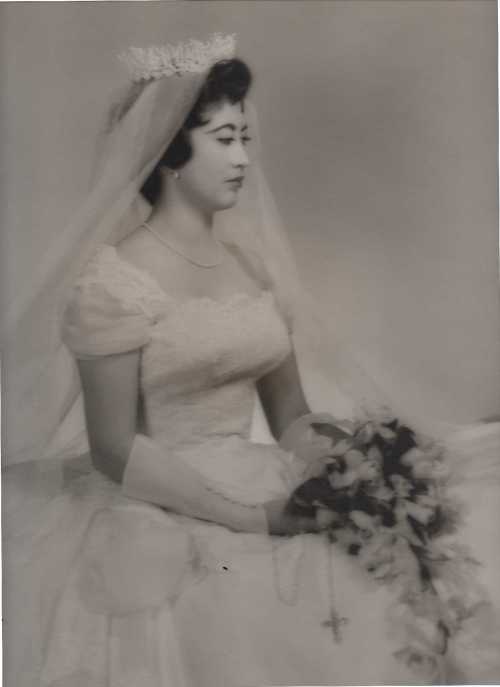
My mother met my father, George, in 1957, and they married two years later. I’m their only child.
My mother’s strong personality made her almost fearless. At some a gathering in the early 1950s, a nun got angry with my Uncle William for some unknown reason and called him a “spic”. My mother was nearby and slapped the nun across her face. That got her into trouble with the church and her father and grandmother. Shortly before my parents wed, a priest told my mother that he hoped she’d do the “godly thing” and have lots of children. My mother said she didn’t want many children, but the priest insisted; telling her it was her duty as a married woman. She then agreed – and told the old man she’d bring all those children back to him so he could help her raise them.
Her sharp criticism of some people – especially other women – was boundless. She called Paula Jones – the woman who accused Bill Clinton of exposing himself to her – a “dumb broad” because Jones apparently believed that she really was going for a job interview at his hotel room at 10:00 at night. In May of 2004, my father’s second oldest sister, Teresa, died of cancer. At the rosary, we spoke briefly with the husband of one of my cousins. He was a police officer and mentioned that he was part of the security detail for former First Lady Barbara Bush when she came to Dallas and had to carry his gun.
“Why did you need to carry your gun?” my mother inquired. “I mean, who wants a piece of that old hag?”
I burst out into laughter, as my cousin’s husband tried to keep his eyeballs from falling out of their sockets.
She called another former First Lady, Nancy Reagan, a “screaming banshee”; said she didn’t realize how fat Oprah Winfrey was until she saw her in jeans, when the talk show maven visited Dallas; and denounced Monica Lewinsky (the woman who had a sexual tryst with Bill Clinton in 1996) as a “cheap-ass whore”.
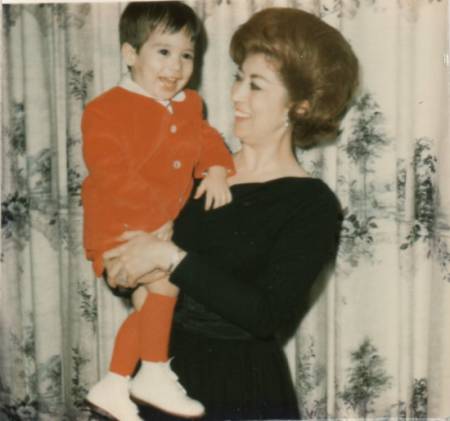
My mother and me, Christmas Eve 1965
My mother first started showing signs of dementia more than a decade ago. Recipes for the simplest things sometimes eluded her. My father and I finally got her to start seeing a neurologist in 2011. In the four years since my father died, she occasionally referred to me as her brother, William. A few times I had to call the paramedics to help me deal with her increasingly erratic behavior. Their sudden presence always managed to calm her down. I believe it’s because they were all men, and my mother was partial to men.
At the end of this past January, she suffered a mild stroke. I didn’t realize it at first, but noticed she couldn’t get up out of bed. I had her transported to a local hospital where an MRI discovered bleeding on the brain, which had already begun to heal. It had paralyzed her entire left side.
I had to make the difficult decision of admitting her to a rehabilitation center to help her recover. I found one nearby, but I developed a sense of dread the night the hospital transported her to the facility. I felt like I was abandoning her. I had promised my father many years ago that, if she should die first, I’d do everything I could take care of her. And, of course, he died first.
The rehab center turned out to be incredible. Physical therapists helped her regain mobility in her left arm and even her left leg. I brought her back home at the end of March, as the COVID-19 calamity was unfolding. I’d reports of residents at similar facilities contracting the novel coronavirus and even dying.
I contracted a health care agency to help me care for her. But, after a week, things didn’t turn out well. She became increasingly hostile and combative. She also developed a urinary tract infection, but I thought she was experiencing another stroke. After one night at the hospital, I had her readmitted to the rehab center. Unfortunately, health care in the United States is still very much an actual business. Her Medicare benefits were exhausted, and the facility had to discharge her in May. I wrote about this in an essay a few weeks ago.
After returning home again, she entered a home hospice care program with same health agency. They were quite phenomenal in helping me. I couldn’t depend too much on relatives, friends or neighbors. But her health continued to decline. I had told a long-time family friend who lives nearby – a woman who’s known my mother for close to 50 years – that I didn’t feel my mother would make it to the end of summer. Our friend was shocked, but when she came over to visit on the 18th, she realized I was probably right. My mother had grown incoherent; she didn’t seem to recognize anyone, even me; and would often lie in bed staring at the ceiling or a wall and asking for her sister, Margo. Margo had died of cancer in June 1989.
It’s incredibly frustrating and sad to watch someone who raised me descend into the depths of cognitive bewilderment. The once vibrant, strong-minded woman I’d known my entire life had reverted to a child-like state of mind. Now I know why dementia is often called “the long goodbye”. You see your loved one disintegrate before you, and there’s not a damn thing you can do about.
In the few weeks preceding her death, I often felt we weren’t alone in the house. I had prayed to my Aunt Margo to come get my mother, and I actually began to sense it was her moving about. I also began to see shadows of a small animal trotting down the hall or the sound of tiny footsteps. I realized immediately the figure was my dog, Wolfgang, who died in October 2016; just less than four months after my father. In many cultures, animals, birds, and butterflies are often seen as either an omen of death or a conduit between our world and whatever other world might exist. Both my parents absolutely loved that little dog of mine. He actually became our dog. Since I never married and had children, Wolfgang became their pseudo-grandson. I even mentioned Wolfgang as a “canine grandson” in my father’s obituary. On just a handful of occasions, though, I actually did spot Wolfgang – but only for a second or two. I needed no further reassurance that my mother’s time here was coming to a close.
There’s no easy way to say goodbye to a loved one. As a friend told me, that person can live a thousand years, but their demise is still painful. I’m at peace, though, with what happened. I’m glad I could get her back home to die. She and my father had worked very hard to get and to keep this house. We’ve been here almost 50 years. And I couldn’t let her die anywhere else.
White woman becomes hysterical after Black man says something to her. In decades past, that occasionally would have been a death sentence for the latter. Now, it’s almost news fodder. And with the advent of 21st century technology, it becomes a social media event.
According to Karlos Dillard, the woman cut him off on the road then flipped him the bird and called him “nigger” before following him with her car for four blocks. It was only after she saw he was recording her with his phone that she stopped.





 Chief Writing Wolf