It should be a quick read.
Tag Archives: Donald Trump
Small Matters
Filed under Wolf Tales
Voodoo You
“It just isn’t going to work, and it’s very interesting that the man who invented this type of what I call a voodoo economic policy is Art Laffer, a California economist.” – George H.W. Bush, Carnegie Mellon University, April 10, 1980
I’m frightened for the United States, and it’s not just because of my disdain for our faux president, Donald Trump. I’m genuinely concerned about what could happen over the next few years.
In the above quote, George H.W. Bush was referring to the plans of fellow Republican and 1980 presidential candidate Ronald Reagan for revitalizing a stagnant U.S. economy. Then, when Reagan won in most of the primaries, his camp offered Bush the vice-presidential position, and the former Texas congressman shut up about economics. In 1980, the nation was in a bad financial situation. The costs of the Vietnam War, coupled with oil embargoes from OPEC nations, had finally taken their toll. Unemployment stood at nearly 10%; the prime interest rate was 21%; inflation was 14%; home mortgage rates were 17%; and the top marginal tax rate was 70%. In the second quarter of 1980, the U.S. gross domestic product (GDP) declined by 8%. By the end of the year, the overall GDP boasted about $3 trillion (in today’s dollars).
With the help of some Democrats in both houses of the U.S. Congress, Reagan was able to generate an agreement that slashed taxes down to 50% on wages, to 48% on corporate income, and to 20% on capital gains. These measures initially jumpstarted the economy. Average citizens had more expendable income, which they poured back into the economy by purchasing many so-called big ticket items, like vehicle and electronics. By 1990, the size of the U.S. economy had grown from $3 trillion to $6 trillion, with roughly 4 million new businesses and 20 million new jobs created. Although the national debt increased from $1 trillion to $4 trillion during the same period, overall revenues doubled.
Reagan’s economic policies were in line with conservative views on taxation: if we give the “investing class” (meaning, the most affluent) generous tax breaks, they will respond by expanding their businesses or starting new ones, which in turn, will create more products and / or services and more jobs. Along with reduced business regulations (“job killers” in conservative lingo), average citizens will have more income, which of course, they will pour back into the economy. Such growth then will expand the tax base; the additional revenue will replace any money lost to the initial tax cuts.
Ask any frustrated project manager and they will tell you that everything always looks great on paper. While Reagan disciples keep championing his financial moves, the reality is that “Reaganomics” didn’t work out as planned. One thing people forget is a little thing called the Garn-St. Germain Depository Institutions Act of 1982, which rolled back financial regulations that had been established by the administration of Franklin D. Roosevelt to prevent further damage caused by the 1929 stock market crash and the ensuing Great Depression. It’s interesting that Bush’s voodoo comment was made at Carnegie Mellon University. Founded by Andrew Carnegie in 1900 as Carnegie Technical School, it merged with the Mellon Institute of Industrial Research in 1967 to become Carnegie Mellon. The Mellon Institute had been established in 1913 by brothers Andrew and Richard B. Mellon who, like Carnegie, were self-made businessmen and titans of early 20th century America. Andrew Mellon served as Secretary of the Treasury from 1921 – 1932, one of the longest tenures for this position. He created the “trickle-down” economic theory by declaring, “Give tax breaks to large corporations, so that money can trickle down to the general public, in the form of extra jobs.”
But Andrew Mellon is also known for a notoriously rotten hands-off policy with the Great Depression. The banks that failed had put themselves in such a precarious financial position, he believed, and thus, they were responsible for extricating themselves from it. It didn’t seem to matter that these bank failures took people’s money with them; therefore, amplifying the effects of the 1929 crash.
Still, President Reagan – like any good fiscal conservative – held onto these beliefs and eagerly signed the Garn-St. Germain bill. That reduced the number of regulations on financial institutions and allowed them to expand and invest more of their customers’ deposits in various ventures, particularly home mortgages. Again, that looks-great-on-paper ideology swung back around to bite everyone when the Savings & Loans Crisis erupted. Between 1986 and 1995, 1,043 out of the 3,234 savings and loan institutions in the U.S. failed; costing $160 billion overall, with taxpayers footing $132 billion of it. It was the worst series of bank collapses since the Great Depression. That led to the 1990-91 Recession, the longest and most wide-spread economic downturn since the late 1940s. I started working for a large bank in Dallas in April of 1990 and saw the S&L crisis unfold in real time.
Nonetheless, trickle-down economics saw a rebirth with George W. Bush, as his administration further deregulated the banking industry and also deregulated housing. Combined with the costs of wars in Afghanistan and Iraq, the U.S. economy almost completely collapsed at the end of 2008. The 2007-08 Recession was the worst economic downturn since the Great Depression. Unemployment reached double digits for the first time since the start of the Reagan era, as millions of citizens lost their homes and their savings. Had it not been for such programs as the Federal Deposit Insurance Corporation (the FDIC, established by Roosevelt), we surely would have plunged into another depression.
Now, with Donald Trump in office, I fear we’re headed for the same morass. On December 22, 2017, Trump signed the Tax Cuts and Jobs Act; the largest overhaul of the U.S. tax code in 30 years. Financial prognosticators have already forecast the act will raise the federal deficit by hundreds of billions of U.S. dollars over the next 10 years. The law cuts individual taxes temporarily, but cuts corporate tax rates permanently. As suspected, the most affluent citizens will benefit greatly, as they experience a significant reduction in their taxes. The rest of us lowly peons may see a tax increase after those temporary provisions expire in 2025.
You know that classic definition of insanity? Doing the same thing over and over, while expecting different results. It’s more like, well, if you keep doing stupid shit, stupid shit will keep happening!
Ignore Russia-gate for a moment and the fact Melania’s side of the First Bed is colder than a Chicago winter. This past week Trump visited the World Economic Forum (WEF) annual meeting in Davos, Switzerland. This is where the most elite members of the business world meet (conspire) with leaders of developed nations to create economic policies and decide what’s best for us peons. Kind of like evangelical Christians often meet to decide what people should see and read. They’ve set themselves up as the righteous few; the ones who supposedly understand exactly what works and what doesn’t and are divinely compelled to bestow such knowledge upon the rest of us.
Trump ran his presidential campaign on the wave of anti-Washington sentiment; appealing to average citizens about reviving a once-lost “Great America” with a variety of clever ruses: ban Muslims, build a wall along the Mexican border, etc. So many people, of course, bought into it. Like Ronald Reagan, Trump was able to tap into that sensitive nerve of everyday angst; spitting out a slew of quaint buzz words to appeal to average folks. He had said he would never take part in a WEF convention. Yet, there he was; leading a parade of those self-righteous few into another kind of revitalization: the Gilded Age.
I doubt if most Trump voters even know what Davos means and how it could impact their lives. Understand, though, that Switzerland is a place where Hollywood celebrities often went for a retreat or a little vacation – code words for cosmetic surgery; long before Phyllis Diller made it openly acceptable. That’s essentially what Donald Trump did this past week. He flew to Davos to tell the world, “America first is not America alone.”
I’m frightened for the United States.
Filed under Essays
I Sight

Over the past few months the dreaded “I” word has been floating across the nation: impeachment. As in the impeachment of President Donald Trump – which sounds pretty good – because his words and actions have put the U.S. in a precarious global position – because he really wasn’t elected to the office – because he’s an obnoxious bastard. Okay, that last one is more of a personal opinion. And, of course, we all have a right to that!
But talk of impeaching the president of the United States is like warning Americans about visiting North Korea: don’t go there. Forcibly removing the president from office was a rare topic of discussion – even among politicians – until the 1970s. But, after the Watergate left a bitterly angry taste in the mouths of the American populace, impeachment has been tossed around as often as limes at a Mexican barbecue.
Since Watergate, only one sitting U.S. president has faced a concerted attempt at impeachment: Bill Clinton. And that was only because he engaged in an eel-hunting adventure with a perky, overweight intern, which culminated in a blue dress wardrobe malfunction before anyone invented the term.
Yet, as much as I despise Trump and as little as I thought of George W. Bush, I would look at anyone who talks of impeachment with concern. Do you realize how serious that is? Do you understand exactly what it takes to oust such a person from the White House? It’s almost like a military coup; the kind that occurs in third-world nations. Think Cuba or the Philippines. Yes, that kind. It’s nowhere near as bloody and violent; we use pens and roll-call votes here, instead of guns and machetes. But it remains a complex and arduous task.
Keep in mind that, aside from Clinton, only 2 other U.S. presidents have faced impeachment: Andrew Johnson and Richard Nixon. The key term here is faced impeachment. To date, no sitting president has actually been removed from office by impeachment. The House of Representatives has the sole power of impeaching the president, while the U.S. Senate has the sole power of trying impeachments. This all occurs under rules of law established in the Constitution; therefore, no single branch of government possesses omniscient power to remove a sitting president.
The first step, obviously, is to identify what acts performed by the president qualify as “treason, bribery, or other high crimes and misdemeanors.” The House votes on articles of impeachment. If there is just one article, it requires a two-thirds majority of House members. But, if there are two or more articles of impeachment, only one of them needs to garner a majority to induce impeachment. Nixon came very close to actually being removed from office. But he resigned after the House voted in August of 1974.
Second, the proceedings move to the Senate where an actual trial is held. The Chief Justice of the Supreme Court oversees the case, as they would any other legal matter. Here, a team of lawmakers from the House serves in a prosecutorial role, while the Senate is technically the jury. The president has his or her own lawyers. Once all sides have presented their arguments, the matter is handed to the Senate. If at least two-thirds of Senators vote in favor of the articles, then the president is removed from office, and the vice-president assumes the presidency.
This isn’t punishment for being tardy. The U.S. likes to present itself as a beacon of democracy for the world; a master of political dignity and fairness. If we are compelled to remove our own national leader from office, what does that say about our voting system? What does it say about the concept of democracy altogether? Is the presidential vetting process so pathetic that we can’t identify someone with a criminal mindset beforehand?
Elizabeth Holtzman is a former U.S. congresswoman from New York. In 1974, she was on the House Judiciary Committee that voted to impeach Nixon. In a 2006 essay entitled “The Impeachment of George W. Bush,” she not only describes the arduous process of removing a sitting president from office, but also the emotional toll it took on everyone in both houses of congress at the time.
“I can still remember the sinking feeling in the pit of my stomach during those proceedings,” she wrote, “when it became clear that the President had so systematically abused the powers of the presidency and so threatened the rule of law that he had to be removed from office. As a Democrat who opposed many of President Nixon’s policies, I still found voting for his impeachment to be one of the most sobering and unpleasant tasks I ever had to undertake. None of the members of the committee took pleasure in voting for impeachment; after all, Democrat or Republican, Nixon was still our President.”
Curiously, she goes on to state, “At the time, I hoped that our committee’s work would send a strong signal to future Presidents that they had to obey the rule of law. I was wrong.”
In this regard, she was discussing the possible impeachment of George W. Bush. I can think of no other Chief Executive in modern times who exhibited such incompetence and corruptness as our 43rd president. That he got into office under dubious circumstances in the first place is enough to question the integrity of our electoral process. That he managed to remain there, despite mounting evidence of war crimes, is anathema to the grander concept of democracy. I’ve always said that, if the Democrats had at least made a concerted attempt to remove Bush from office, they wouldn’t just appear heroic in the eyes of their constituents; they also would have upheld the rule of law governing all institutions.
Remember that congressional Republicans tried to remove Bill Clinton for lying about his sexual dalliances. It was an incredibly one-sided, vindictive assault on democracy – all because the man didn’t want the world to know he’d screwed around on his wife and because right-wing extremists didn’t like him, no matter what he happened. You’re going to impeach him for THAT?! Then-House leader Newt Gingrich – who was married to his third wife with whom he’d cheated on his second wife – had led the cavalcade of self-righteous Republicans. He and his constituents paid for their hypocrisy when they lost their super-majorities in both Houses of Congress in the 1998 elections.
Watching the Trump presidency collapse around the real estate magnate-turned-reality-TV-star is almost laughable. But it’s not that funny. His behavioral quirks and fetish for name-calling are hallmarks of social ineptitude and, perhaps, mental instability. As with George W. Bush, that Trump actually made it into the White House is an insult to the core of the institution of democracy. Growing evidence shows that Russia interfered with the 2016 U.S. elections. Exactly how they did it has yet to be discovered – or revealed. But I honestly believe the Trump presidency is a fluke.
In his novel, “Shibumi,” author Trevanian (Rodney William Whitaker) relays the incredible tale of Nicholai Hel, a Shanghai-born spy of Russian – German heritage who is the world’s most accomplished assassin. After surviving the carnage of the Hiroshima bombing, Hel retreats to a lavish and isolated mountain citadel with his beautiful Eurasian mistress. But he’s coaxed back into the netherworld of international espionage by a young woman. Hel soon learns, however, that he’s being tracked by a mysterious and omnipotent global entity known simply as the “Mother Company.” The “Company” is a composite of corporate giants that installs leaders in key nations – even those in the developed world – manipulates the markets for such necessities as food and oil and incites wars whenever it deems appropriate. The conflict between Hel and the “Mother Company” becomes something akin to a board game, where millions of lives are used as toys for the benefit of a few powerful elitists.
I keep thinking we’re already dealing with that type of set-up; that Bush, Jr., was placed into office, so we could go to war in Iraq and gain access to their oil reserves, and that Trump was planted in the White House for whatever machinations the Russian government has underway.
But I still want everyone to be careful with the “I” word. It really is just a small step from undergoing the lengthy route of impeaching a president to rigging his limousine with explosives – like they do in those unstable third-world societies. Democracy is a difficult political state to establish. It’s even more difficult to maintain. It doesn’t function on its own; it simply can’t.
This mess we’re in may provide great material for standup comics. But it also presents us with an ethical dilemma. Again, I ask, do we truly understand how serious this talk of impeachment is?
Filed under Essays
Telling Donald Trump Not to Tweet Is Like…
The 45th President of the United States has achieved a previously unimaginable goal: reduce the size of the federal government. In this case, it’s the presidency, which has been downgraded to 140 characters. He has left people disoriented and unsettled; rattled and dismayed; flummoxed and constipated. Many of his most devout followers have embraced the lemming ideology of life and started following their magical penis-pied piper to the precipice of a faux utopia. And we thought George W. Bush was mentally-challenged! Well…he was. Yet Trump has taken messianic mendacity to supersonic levels. I keep thinking that someone on his staff should advise him to keep his pre-dawn twittering in the bathroom. But that would be like telling Abraham Lincoln, ‘Don’t go to the theatre! You’ll catch a cold.’ It’s virtually impossible to demand this bombastic, bull-headed businessman behave presidential.
It may be hard to imagine, but there are some logical comparisons to such a feat. But there are plenty. Therefore, telling Donald Trump NOT to Tweet is like…
- …telling the Kardashian girls not to take selfies.
- …telling Bill Clinton to honor his marriage vows.
- …telling Matthew McConaughey to keep on his shirt.
- …telling Ann Coulter to stop being such a bitch.
- …telling Justin Bieber to act like an adult.
- …telling Michael Moore to lay off the doughnuts and eclairs.
- …telling Elton John to tone down his wardrobe.
- …telling Kanye West to stop interrupting people.
- …telling Paris Hilton to get a job.
- …telling Rush Limbaugh to take a deep breath.
- …telling Caitlyn Jenner to grow a pair.
- …telling Willie Nelson to shave and get a trim.
- …telling Barbara Walters to retire once and for all.
- …telling Eminem to act White.
- …telling Pope Francis to stop wearing those designer gowns.
- …telling Bill Maher to shut the hell up.
- …telling Oprah Winfrey no one misses her.
- …telling Brittney Spears she can’t sing worth a shit.
- …telling Snoop Dogg to learn proper English.
- …telling Alec Baldwin to stop making fun of Trump.
Telling Donald Trump Not to Tweet is like… [Readers, please feel free to provide your own response]. The more fun we can have with this, the more likely Trump will get pissed off and Tweet and subsequently provide us all with more joke material. And the more we can all laugh at and ridicule our mentally-unhinged elected officials will bring us closer to that highly-coveted state of national nirvana.
Filed under Essays
No Defense Here
At some point in the late 1960s, a Mexican-American guy got arrested in Dallas for a series of robberies. The incident garnered some media attention, but was pretty much a non-event. Until someone at my father’s workplace mentioned it.
An older White man approached my father and said something to the effect that the police had arrested “your brother Rodriguez.” He knew what the old man was talking about. My father promptly reminded the man “my name isn’t Rodriguez, and that guy isn’t my brother. Now shut your ass and leave me alone!”
The old man apparently was offended at my father’s brusque language and complained to the company owner, another old White (albeit Jewish) man who said something to the effect of, ‘What did you expect?’
My father often found himself in such uncomfortable situations; where some Hispanic individual would do something stupid and / or criminal enough to get media attention, and some non-Hispanics would assume my father was guilty by association. It actually still happens. A lot. Just ask Black men when other Black men get arrested. Or Hispanic men. Or Native American men. Even in this second decade of the 21st century, in a post-civil rights America, crime still often bears a Black, Brown or Red face.
That mess stormed into the public conscious last week when Republican presidential candidate Donald Trump dismissed a 2005 conversation with an entertainment journalist as “locker room banter.” With a monster hurricane having just ripped through the Caribbean and the U.S. east coast and the Zika virus still a threat to public health, this is what the American media and much of the American public has focused on: eleven-year-old verbiage from two old men trash-talking on a bus.
The dialogue hasn’t discouraged Trump who is roaring ahead with his campaign – undoubtedly one of the most bizarre in recent memory – even as one woman after another jumps forward to proclaim they’ve fallen victim to the type of actions the business tycoon describes in that brief snippet.
There’s no getting around it: what Trump said in that piece is deplorable, and his attempt at an apology is as sincere as a 13-dollar bill. Even before then, I didn’t like him. But, aside from the rancor bubbling over this mess, it’s amazing the number of men who are also publicly proclaiming their ardent respect for women and disdain for Trump. Athletic coaches at the high school and college levels are gathering their young male acolytes to warn them that such talk about females will not be tolerated.
Personally, I don’t feel the need to refute Trump’s so-called “locker room banter.” I don’t have a guilt complex over it and I’m not hopping up and down trying to convince any female within ten feet of me that I’d never talk that way about them. And neither should any other man.
Since high school, I’ve spent time in men’s locker rooms and can say without wincing that I’ve never heard men talk like that about women. Men say all sorts of stupid shit in locker rooms, but I cannot recall anything of that sort. As a writer, I’m prone to listen in on other people’s conversations. I’ve always wanted my characters to speak and behave as normal as possible, so they’ll be more realistic. Yes, men do talk about sex in locker rooms. (And, in other Earth-shattering news, the sun rises in the east.) I’m certain women engage in similar talk, even though most won’t admit it. Men also talk about body parts. Mainly their own body parts. Usually, though, we talk about work, home, family, cars, sports, our individual exercise routines – but never something so vile as sexually assaulting or molesting women. I know some men have talked openly like that. I’ve just never heard it.
But it’s not enough to point out that most men don’t talk in such a debasing manner about women. It’s more important to realize that most men don’t act that way either. The vast majority of men don’t harass and / or sexually assault women. I know that contradicts feminist ideology, but it’s painfully true. Men are much more likely to assault other men or even themselves than they are women.
Yet, while plenty of people like Trump think their wealth and power make them better than the rest of us, there are others who latch onto the Trumps of the world in the hopes of improving their own station in life. Trump surely has no genuine respect for women overall, but a number of women swoon over men like him daily. This is one thing that upsets most average men. Women often claim they want a man who is honest and fair-minded. But, as some men view it, women really just want a man with lots of money. Even some of the most successful and well-educated women often still expect the men in their lives to earn more than them. Why? Just in case said woman decides she’s tired of working? I don’t know.
Women, on the other hand, often say their lack of opportunities in life put them in a position where they’ve had to find men who have money, or at least a job that pays above minimum wage. On average, women still earn less than men, but women are superseding men on the educational front. If you break that down from a racial viewpoint, the gaps grow even larger. Gender politics, like racial politics, is ugly, and no one wins the argument.
I’ve heard more than a few women engage in “locker room banter” – in public – in front of me and other men. I’ve endured my share of harassment from both women and men. It was never caught on video or audio. And I rarely complained out loud about it. I knew few would believe me, especially because I’m a man. Therefore, I understand how some women feel about life in the work place during years gone by – long before the term “sexual harassment” was ever created.
Former Texas Governor Ann Richards once advised young women to complete their education and not depend on a man to take care of them; “when the Prince is middle aged with a pot belly and a wandering eye, you’ll be glad you have a degree and can support yourself if you have to.” As expected, social and religious conservative across the state and the nation dumped their snarky bile on Richards; denouncing her as anti-family and anti-marriage. Richards shrugged it off, even after losing her 1994 reelection bid.
Trump is in a class all his own – and I don’t mean that in a good way. He’s harking back to those golden years gone by; when people didn’t have to be politically correct, especially White male people. But, as part of that elite and much-reviled 1%, he obviously believes his wealth and power give him license to say and do whatever he wants. Plenty of people in his social class possess such self-righteous haughtiness. Despite all his money, Trump is still little more than a loud-mouthed bum. He’s a disgrace to all men – White or not.
My paternal grandfather once said you can dress a donkey up in silk and satin, like a thoroughbred horse, but eventually it’ll start bucking and kicking like the animal it truly is. Now, I don’t mean to disrespect donkeys by comparing them to Trump. Talk about being disrespectful! But I think you get the idea.
Filed under Essays
Maids, Beauty Queens and Other Stupidities
Recently, Republican presidential candidate Donald Trump – trying desperately, yet involuntarily to retain his title as “Asshole of the Year” – defended his previous criticisms of 1996 Miss Universe Alicia Machado. The Venezuelan-born Machado apparently had gained too much weight at the height of her reign for Trump’s taste and subsequently referred to her as “Miss Piggy.” He later also dubbed her “Miss Housekeeping,” an obvious reference to her ethnic heritage. While millions of women across the U.S. (and I’m quite certain, across the globe) resent the “Miss Piggy” sleight, I focused on the “Miss Housekeeping” comment and thought, ‘Here we go again with the racial crap.’ Once more, Hispanic women are being dropped into the narrow categories of maid, housekeeper, etc. by (imagine this!) an old White male.
Trump has made racism and misogyny hallmarks of his campaign. But this latest verbal assault against Machado struck me personally and harder than his previous idiotic statements. As the son of a German-Mexican mother, I’ve heard more than a few stories of bigotry about the American workplace. But, as someone who labored in the corporate world for more than a quarter century, I know that Hispanic women fit into more than the standard housekeeper / maid job role. Regardless of race or ethnicity, women overall comprise roughly 57% of the American workforce; both full-time and part-time. It’s the first time in U.S. labor history that more women than men are working. Such a figure would have been incomprehensible a generation ago.
Not long after I was born in 1963, my father demanded that my mother stay home and raise me; thus becoming a traditional mother and housewife. He was invoking the machismo persona of the average American male. Few women worked after having a child in those days – or at least that’s what the general philosophy held. In reality a number of women entered the workforce after having children, long before it became socially acceptable. Many had no real choice. My mother may have had a choice, but she refused to bow to pre-defined roles. She had already gone against tradition by telling a Catholic priest shortly before my parents married that she didn’t plan to have a child every year, as the Holy Roman Empire dictated. It upset the priest so badly that he told her maternal grandmother, a woman who had raised her and her three siblings after their mother died in 1940. The grandmother, in turn, expressed her frustration to my mother who stood her ground. Unless the Church was willing to finance her progeny, my mother absolutely would not have a child every time my father got an erection. It’s a good thing. My mother had enough trouble with me. She had lost two pregnancies before I was born and another afterwards. Considering some of the financial troubles my parents experienced later, it’s a good thing my mother returned to work in 1965, when I was 18 months old. She retired in 2003 at age 70.
In reviewing contemporary TV shows, I believe there are about as many Hispanic characters now as there were fifty years ago; meaning they could probably all be counted on one hand. Among the most popular today is “Modern Family,” featuring Colombian-born former model Sofia Vergara. (Apparently there weren’t enough Hispanic actresses in Hollywood needing an acting job, so the show’s casting director yanked this nitwit from the gutter of foreign refuse to fill an otherwise blatantly stereotypical role.)
In 2003, NBC presented “Kingpin,” a series about (surprise!) a Mexican drug cartel family caught between the brutal worlds of narcotics trafficking and the U.S. Drug Enforcement Agency. I guess these conflicts were supposed to induce some sort of dramatic intoxication in the viewer. Entertainment insiders noted the show presented a number of Hispanic performers; folks who normally wouldn’t find much long-term work in Hollywood apart from character clichés. Those of us outside of that insulated fantasy factory – that is, those of us with a firm grip on reality – saw it for what it was: yet more Hispanics in formulaic characters. The cacophony of anger was loud enough for NBC to cancel the series after just six episodes. They claimed it was actually due to poor ratings. As far as I can tell, industry outlets such as “Entertainment Tonight” didn’t spend much time highlighting the glaring racism in the series. But I’m certain if a similar show about Blacks or Jews had come out, protests would be louder than the sound of Donald Trump dropping another wife. Hell, when “Seinfeld” went off the air in 1998, it made national news!
This past June the USA Network premiered a show titled “Queen of the South.” Such a name might make viewers assume it focuses on the antics of a cynically witty granddame-type in Georgia or South Carolina; an old gal who sips mint julips, dons “Gone with the Wind” regalia every December 20 and longs for the old days Negroes had to sit at the back of the bus. That, of course, would be more than enough to get a show bounced of the air. But “Queen of the South” revolves around a woman named Teresa who grew up poor and loveless in a Mexican slum and falls in love with (wait for it) a Mexican drug cartel leader. When he’s killed, she flees to South Texas and becomes involved with someone from her past in an attempt to avenge her boyfriend’s murder. That’s bad enough. Yet it gets worse, as Teresa realizes the narcotics lifestyle is just too good to pass up and subsequently becomes a drug czarina in her own right. It’s a quirky spin on the life and murderous legacy of Griselda Blanco, a.k.a. “The Cocaine Godmother.” In fact, Blanco’s story is currently metamorphosing into a Hollywood biopic starring Jennifer Lopez who – like the late Michael Jackson – is gradually turning Whiter as she gets older.
Once again, though, Hispanics and illegal drugs are linked. Actually Hispanics are still paired up with almost anything illegal: gang members, prostitutes, immigrants sneaking across the border and the like. If going from maids and groundskeepers to drug cartel leaders is supposed to be an improvement, I’ll stick with the maid / groundskeeper type. It’s sort of like this year’s elections: one has to choose between the lesser of two evils.
Looking through production credits for some of these shows, I’ve noticed none had Spanish surnames. It’s obvious, then, from the initial concept down to the actual filming of the program, people of Northern European extraction are in control. A good number of them are Jewish. Therefore, I dare any of them to produce a television show displaying Jews (or any-Hispanic) as crooks. Let’s see if it even gets past its debut episode.
I’m pleased to see plenty of Blacks and Asians (many of them women) in non-traditional roles; business professionals and law enforcement characters who actually speak perfect English. The same doesn’t hold true for Hispanics, or Native Americans for that matter. We’re still the drug dealers, maids, groundskeepers and / or illiterate wetbacks who comprise the much-despised “Other” group of degenerates; people who are too lazy or stupid to get a decent education and find a legitimate career. People Donald Trump wants to wall off and deport.
I don’t want to be around drug dealers or prostitutes either. But that’s simply because I don’t belong to either of those groups. Nor does anyone in my family and nor do most Hispanics.
We’re educated and career-driven. We’re concerned about national security and the economy – just like any other citizen of this country. Race and ethnicity are wedge issues that some people love to exploit. We’re fully aware of the myriad stereotypes that plague us as a group; whether it’s on television or in political discourse. We’re fully aware that Donald Trump is appealing to the traditional Republican base: older White men who watch in dismay as the world they thought only they would inherit slowly slips into the chaos of what the U.S. Constitution promised – freedom and equality for all.
Hispanic and other non-White women (or “women of color” – whatever the hell that’s supposed to mean) are double minorities in this society because of two factors: their gender and their ethnicity. Non-White women with college degrees, for example, often earn as much (or as little) as a White male with only a high school diploma.
Having grown up with a working mother – and seeing other Hispanic women struggling both to get educated and to maintain their jobs – I understand that the American entertainment machine and people like Donald Trump just can’t (or won’t) accept the truth. Old prejudicial concepts are tough to eradicate. But reality is reality. And the reality I know is that beauty queens and housemaids aren’t the only roles where Hispanic women are allowed to exist.
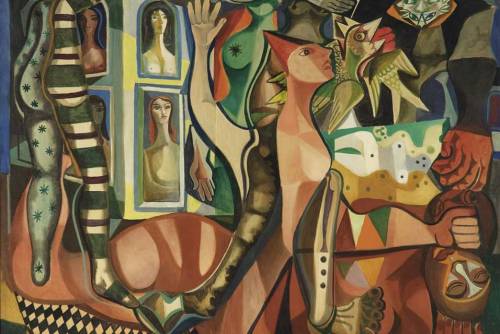
Top image “Sonhos do carnaval” (Carnival dreams, 1955), courtesy Emiliano di Cavalcanti.
Filed under Essays
Quote of the Day
“Donald, you’re beginning to sound a little ridiculous, I have to tell you.”
— CNN’s Wolf Blitzer to Donald Trump about the discredited right-wing conspiracy theory that President Obama was not born in this country.
Just a little?
Filed under News