
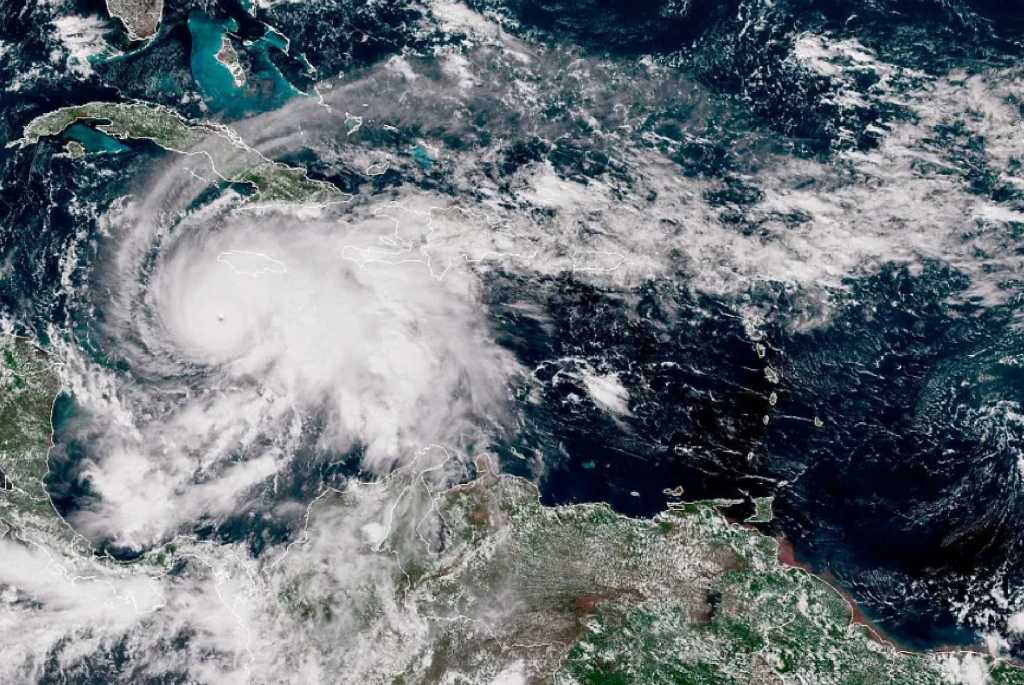
Satellite image of Melissa over Jamaica
“When I look at the cloud pattern, I will tell you as a meteorologist and professional – and a person – it is beautiful, but it is terrifying. I know what is underneath those clouds.”
Sean Sublette, a meteorologist based in Virginia
Who needs ghosts and witches for Halloween when we have massive storm systems like Hurricane Melissa? This past Tuesday, the 28th, Melissa plowed into Jamaica with 185-mph (298 kmh) winds. It’s the first known Category 5 hurricane to hit Jamaica and most powerful since Gilbert in September 1988. Gilbert held the record as the most powerful tropical storm system in recorded history, until Hurricane Patricia in the northwestern Pacific in October 2015. Patricia produced 215-mph (346-kmh) winds and a surface pressure of 872 millibars (mb). That pressure is the second lowest on record with Typhoon Tip producing 870 mb in October 1979. (Tip boasted 190-mph winds.)
These storm systems – already the most powerful tempests on Earth – are getting worse. In September 1995 Tropical Storm Opal developed in the Bay of Campeche and slammed into Florida’s west coast as a Category 4 hurricane. It was the first time since U.S. meteorologists began naming these storms in 1953 that the Atlantic-Caribbean group reached the letter ‘O’.
That year, 1995, produced a total of 21 named systems; the greatest number since the 20 total systems (albeit unnamed) in the region in 1933. All those records, however, shattered in 2005 when the Atlantic-Caribbean produced an unprecedented 28 tropical storm systems. For the first time since 1953, meteorologists had to resort to the Greek alphabet for storm names.
The 2005 Atlantic-Caribbean hurricane system was most likely foretold in March 2004, when a squall nicknamed “Catarina” developed in the southwestern Atlantic and hit Brazil as what would be considered a Category 1 hurricane. This was truly anomalous as full-fledged hurricanes rarely form in the Southern Atlantic because of cooler sea surface temperatures and strong vertical wind shear.
Tropical storm systems of any magnitude anywhere in the world are measured using the Saffir-Simpson Hurricane Wind Scale, which went into effect in 1973. The U.S. National Hurricane Center (NHC) modified the system in 2009, but it’s still the standard-bearer for measuring the most powerful weather systems on Earth.
The development of Doppler weather radar in the 1970s proved to be a great leap forward for meteorology. In September 1961 Hurricane Esther was the first tropical storm to be tracked by satellite. Previously storms were generally followed by military reconnaissance aircraft. But with Doppler scientists were able to trail various weather systems in real time and garner detailed information about a storm’s formation and movement. By the 1980s, meteorologists began theorizing that tropical storm systems – especially hurricanes – follow certain pathways in the atmosphere; depending on the time of year and location of formation. Late season hurricanes (after October 1) in the Atlantic-Caribbean, for example, tend to move eastward.
Eight years ago Hurricane Maria became one of the worst storms to rake across the Caribbean. Puerto Rico suffered the worst of the chaos, as the storm killed over 3,000 people and costing roughly USD 90-95 billion. It was the strongest storm to strike the island since the 1928 Lake Okeechobee Hurricane, which was also a Category 5 storm sporting a maximum wind speed of 160 mph (412 kmh) and a death toll in excess of 2,500 throughout the Caribbean and Florida.
Melissa’s strength is disturbing in that it is late in the Atlantic-Caribbean hurricane season. In October 1998, meteorologists were stunned when Hurricane Mitch became the first Category 5 storm to develop in the region in the month of October. Before the development of weather technology, it’s understandable that these storms would exact massive death tolls in the areas of impact. The Great Hurricane of 1780 killed an estimated 22,000 to 30,000 people throughout the Caribbean. Historians believe it may have achieved a maximum wind speed of 200 mph (322 kph).
To date, the deadliest hurricane to hit the United States (and the deadliest natural disaster) is still the 1900 Galveston Hurricane, which killed over 12,000 – at least 8,000 on Galveston alone. No one knows where specifically it formed, but scientists believe it was a Category 4 storm. They also believe it was the same storm that marched up into the central U.S., across the Arctic region and down in Siberia. If that’s accurate, the storm wasn’t just deadly – it was truly anomalous. The calamity was exacerbated by the lack of a cohesive warning system and geography. Galveston is essentially a barrier island, which are narrow strips of sand that protect the mainland from the impact of powerful storms and ocean waves. By nature they’re not designed to be developed for human habitation. In 1900, the bulk of Galveston’s land mass rose barely above 15 feet (457 cm), and many of its streets ended at the shoreline. In the ensuing decades Galveston officials have taken greater measures to develop a solid warning system and evacuation plans; a sea wall that extends across much of the island has helped, along with the planting of seagrass and palm trees. The entire island has been literally lifted up by hauling in more sand and dirt. Despite all those efforts, Galveston remains vulnerable, as evidenced by Hurricane Ike in 2008.
Technology and even the most comprehensive evacuation plans won’t save people from themselves. Development along the coastlines of the U.S. has grown exponentially within the past 50 years. In September 1999 Hurricane Floyd approached the Florida-Georgia border as a Category 4 and triggered the largest evacuation at the time – nearly 3 million people were ordered to move inland. However, Floyd bypassed the area and migrated northward in the Carolinas. Many people were upset at having to leave for a storm that missed them. I recall one man on the national news complain that all the technology should have provided a more accurate prediction. I looked at the TV screen and said, ‘Really?’ I personally believe that no one should ever be forced to flee their homes for a natural disaster. If they feel they’re brave and strong enough to withstand nature’s wrath, just leave them alone! But they also shouldn’t expect first responders to come racing to their aid. After X hour, they’re on their own.
In June 1992, the United Nations staged the “Conference on Environment and Development” in Rio de Janeiro, Brazil. Also known as the ‘Earth Summit’, political leaders, diplomats, scientists and many others convened to discuss humanity’s impact on the environment. One subject that was part of the original agenda was birth control. The premise was simple: unchecked population growth can have adverse effects on natural resources, such as clean water and air. But just as the conference was set to begin, the Roman Catholic Church in Brazil intervened and demanded that any discussion on birth control either be limited or excluded altogether. Despite some initial resistance, the conference organizers eventually conceded, and the Church got their wish. Conversations on any kind of population control were all but eradicated. Afterwards, though, the conference was declared a success.
In 1992 the global population was a little over 5.4 billion. In 2024 it stood at approximately 8.1 billion. In 1982 China reached an incredible milestone when it became the first country on Earth to attain a population of 1 billion. (Various demographic studies declared that it actually had reached that number in 1980.) Before then, China’s various efforts to control its population had catastrophic results. In 1958 the “Great Leap Forward” was an attempt to streamline food production and distribution, but it led to the starvation deaths of up to 55 million people. In 1979 the “One Child Per Family” policy was a more concerted effort to limit population growth, but it had an incredibly low acceptance rate, especially in rural areas where more children meant more hands to harvest crops and other food stuffs. Its most negative impact, however, was on gender disparities. As with many developing nations, China valued its male citizens more than females. The “One Child Per Family” stunt culminated in the deaths of thousands of infant girls and has now made China the only country with a greater population of males than females.
In May 2000 India crossed the 1 billion citizenry mark. By 2023 it had surpassed China in overall population. Lack of education and comprehensive health care always has deleterious effects on a nation’s overall welfare. Unmitigated population increases push more people into regions where they’ve never or at least rarely lived. We’re seeing that here in the U.S., as city populations grow and begin overtaking forests and even farmland.
What does this have to do with Melissa and other tropical storm systems? In terms of population and human interaction with nature, it means everything. Coastal areas continue to be popular destinations for tourists and even residents. Severe storms and rising seas are already wreaking havoc on U.S. coastlines. Since the start of 2025, a large number of beachfront homes across the country have collapsed into encroaching oceans, mostly on the Eastern seaboard.
Remember Melissa is the strongest hurricane to develop this late in the season. The first two decades of this century have seen the greatest number of Category 5 hurricanes in the Atlantic-Caribbean basin – nearly 40. Hurricane Camille remains the most powerful storm to strike anywhere in the United States. It basically set the standard and was considered a true meteorological anomaly. But that standard is changing rapidly, and Category 5 storms are becoming more common.
Once again, who needs ghosts and witches when we have real monsters coming out of the sea?
Also see: Great Bhola Cyclone





 Chief Writing Wolf