Tag Archives: World War II

Home Somewhat Free

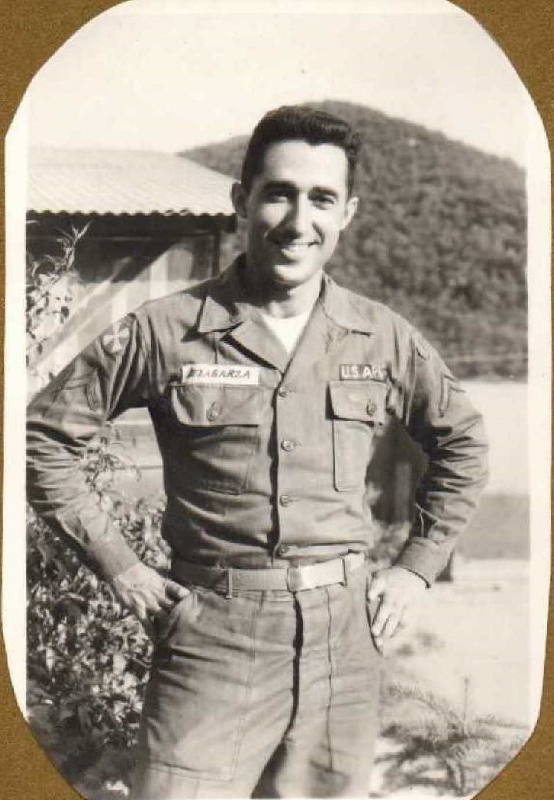
My father, George De La Garza, Sr., in South Korea in 1954

This is my father’s recollection of returning home from military service in Korea.

I had thought of joining the military when I got older.  My older brother, Jesse, did.  He was 17 and failing out of school when he enlisted in the U.S. Army in the summer of 1942.  They shipped him out to the Pacific region.  He was stationed on some remote island, when he killed his first person.  He said it was at night, and Jesse and his commanding officer were hidden in some thick foliage – looking for…whatever.  Then they spotted a Japanese solider approaching.  Jesse’s CO ordered him to kill the guy…“or I’ll kill you first and then him.”  He was still 17 and had no choice.  Jesse saw other casualties – adults and children; soldiers and civilians – in the wicked and bloody chaos of World War II’s Pacific theatre.  He caught malaria, before returning home.

Jesse received a slew of awards, including a Purple Heart by Gen. Douglas MacArthur himself.  He got an honorable discharge and quickly came back to Dallas.  One Saturday morning me and Jesse, our younger brother, and some other friends visited a local barbershop.  As sat conversing in Spanish and English, the shop’s owner approached and – in his heavy Scottish brogue – ordered us to leave.  “We don’t cut Mexicans’ hair.”

Here we all were – born and raised in the Dallas area, not causing any ruckus – and a foreign-born man tells us to leave.  At some point over the next couple of days, a massive rock found its way through the large glass window of that shop.  I swear I don’t know how that happened!

That experience kind of left me bitter about this great country and the freedom it was supposed to have.  I no longer had any desire to join the military.

Then came Korea – and I had no choice.

I had just turned 21 in January 1954, when my father drove me to the Greyhound bus station in downtown Dallas – just like he’d done with Jesse more than a decade earlier.  I had rarely been outside of Dallas and never outside of Texas.  I arrived at Fort Bliss in El Paso, a little scared and not knowing what to think.  After basic training, they put me on another bus to Los Angeles, then a train to Seattle, and finally a ship to Korea.

From what I understood later, Korea wasn’t nearly as bad as World War II, but when is there ever a pleasant war?  More importantly I understood why Jesse never wanted to talk about his own experiences.

By then the U.S. armed forces had been (forcibly) integrated, so men of all shapes, sizes and colors served together.  I developed close friendships with many of my Black comrades.  I could envision these connections lasting a lifetime.

It was only two years, but it felt like decades.  We left Korea on a ship for Seattle.  Once there we had to take a train down to Los Angeles.  I stood with my Black buddies on the platform, before we had to board.  My friends started walking away from me.

“Hey, guys, where are you going?” I asked, still innocent – naïve actually.

“We have to go to the rear of the train,” one of them called back to me.

The rear of the train – where the Negroes had to go.

Oh yeah, I told myself.  We’re back in America – the land of the free.

3 Comments

Filed under Wolf Tales

Social Living

“Social Security is the biggest Ponzi scheme of all time.”

Elon Musk, February 28, 2025

For elected officials here in the U.S., Social Security is much like a live power line: touch it and they’re done.  Social security, along with Medicare and Medicaid, is one of those sacred vessels of American life.  It’s not just beloved; it is sacrosanct.

Thus, for a foreign-born oligarch like Elon Musk to disparage it as a “scheme” has become anathemic.  As something of a pseudo-president, Musk is head of the newly created Department of Government Efficiency (DOGE), which has taken a hacksaw to a number of departments within the federal government.  The declared goal is to reduce bureaucratic weight by slashing jobs and merging together certain divisions within the system.  Nowhere in this morass of right-wing blather is a dedication to make people like Musk and their corporations to pay their share of taxes.  But that’s a different issue.

To place things in proper perspective – and put elected officials like Trump in their place – social security has too many safeguards to be considered a Ponzi scheme.  Before the Social Security Act of 1935, a large number of older Americans lived in abject poverty.  At the time it was common for families to take in older relatives.  But some people simply didn’t have that support and they were left to fend for themselves.  The concept of providing for those who simply couldn’t work or take care of themselves is nothing new.  Various societies throughout history have considered the fragilities of the human condition and sought to alleviate those difficulties.  It is simply immoral to abandon those who can’t care for themselves.  It’s also rather easy to look at those who won’t take care of their own lives and group them with the others.

The Social Security Act has been amended several times since 1935, but it differs from a Ponzi scheme in many ways.

1. Social Security is not fraudulent

A Ponzi scheme is a deliberate a fraud intent to mislead investors.

2. Social Security’s operators do not take a cut

Unlike with Ponzi schemes, Social Security is not a profit-generating gamble, and the officials who run it do not take a portion of it for themselves.

3. Social Security is operated in the open

Social Security is a transparent, government-run program with clear funding mechanisms. 

4. Social Security has built-in oversight

Unlike a Ponzi scheme, Social Security has many layers of oversight, auditing, regulation and legal and financial systems in place to ensure accuracy and transparency. 

5. Social Security offers realistic returns

The goal of Social Security is to provide basic income replacement, not to generate get-rich-quick returns.  Ponzi schemes often promise unrealistically high gains.

6. If financially stressed, Social Security can adjust funding and/or benefits

A fiscal imbalance in Social Security can be corrected, but a Ponzi scheme can’t.  Social Security beneficiaries can’t demand to be paid a balance in their account if they suspect something is wrong.  There can’t be a “bank run” on Social Security, and problems ultimately can be resolved.

It doesn’t surprise me that Trump and the Republican Party are targeting Social Security, or rather that conservative Republicans in general haven’t struck back at the president.  Social and political conservatives have always been leery about government programs designed to help people.  Before Franklin R. Roosevelt’s “New Deal” policies (designed and implemented to address the brutal impact of the Great Depression), government’s primary purpose was to enact laws and collect taxes.  The collapse of the U.S. stock market in 1929 and the subsequent financial calamities that ensued changed that mindset – at least among the more open-minded.  Social Security was just one project resulting from such forward thinking.

In 1944, Congress passed the Servicemen’s Readjustment Act (later known as the GI Bill) to assist those returning from military service during World War II.  It provided a myriad of aid and services to these individuals, such as education and housing.  Again, many conservatives denounced it as welfare.

Similar criticisms befell Lyndon Johnson’s “Great Society” some two decades later.  From this massive undertaking, we got Medicare and Medicaid.  But, as Johnson declared, the government should ensure both “liberty and abundance” for all citizens – not just those who can afford it.  And as before, critics deemed it socialized medicine.

While it’s surprising that the U.S. federal government can operate with such alleged overspending – a bloated bureaucracy – it does provide substantial safety and security to most everyone here.  The attack on Social Security is monstrous.  Trump has sworn to leave it alone, but I personally don’t trust him.

I’m fast approaching the official retirement age of 62, yet I know I won’t be able to sit back in my quiet suburban home and embark on my dream life of being a full-fledged writer.  The Social Security system is supposedly insolvent.  Raising the official retirement age (as many, including Musk, have suggested) or reducing benefits won’t repair that problem.  Funding for the Iraq War alone could have made Social Security fiscally viable for generations.  Still, the program must be handled with care.  Touching it irresponsibly is, indeed, akin to touching that live power line.

3 Comments

Filed under Essays

Dumbest Quote of the Week – August 15, 2020

“The closest thing is in 1917, they say, the great pandemic. It certainly was a terrible thing where they lost anywhere from 50 to 100 million people, probably ended the Second World War.  All the soldiers were sick.  That was a terrible situation.”

President Donald Trump, incorrectly stating that the 1918-20 Spanish Flu pandemic brought an end to World War II.

Quick world history lesson: World War I ended in November of 1918 with the signing of the Treaty of Versailles.  World War II began with Germany’s invasion of Poland in 1939 and ended with both the collapse of the Nazi regime and the bombing of Japan in 1945.

Leave a comment

Filed under News

Wait? We have.

I looked at Tom* with what he later described as a scowl.  “Are you serious?” I asked.

“Um…yeah,” was his only reply.  He then looked embarrassed – almost as if he realized he’d just said the wrong thing.  Or, in this case, just pissed me off.

It was the fall of 2002, and we’d known each other for a few years and been roommates since May.  Things weren’t turning out as well as I’d hoped.  Pooling resources is supposed to help people get through tough time.  So far, the only thing that had turned out well was the new puppy he got in August, after the death of his last dog.

I like Tom – for the most part.  You never really know someone unless you either spend the night with or move in with them.  Tom and I had never spent the night.  I do have standards!  But Tom was smart and highly-educated; something of a wild man with few bounds.

He was a little like me: a native Texan of mixed ethnicity (in his case, German and Indian) who graduated high school in 1982 and attended the University of North Texas (although I didn’t arrive there until 1984).  But he was more conservative, and our political discussions on race and gender often went sideways with his right-wing logic.

This evening’s conversation was a perfect example.  I can’t remember what set it off, but I had mentioned that the modern civil rights movement “had to occur”; that it had to take place.  He refuted that claim; calmly stating that it had been completely unnecessary; that eventually society would “come around” and realize it was only fair to give all people a chance; that folks just “needed to wait”.

Thus, my…scowl.

“Wait?”  People had already waited – more than 400 years, from the arrival of the first Europeans to the 1950s, when Martin Luther Kind launched his quiet revolution.

People had waited through the American Revolution, the U.S. Civil War, World Wars I and II, Korea and Vietnam.  People had waited through every major political and social event since the Salem Witch Trials for an equal place in American society.  People had waited through the name-calling, beatings, shootings, stabbings, lynchings and relocations.

People had waited.  Long enough.  And that’s why everything finally exploded in the 1960s.  I believe the catalyst was the assassination of John F. Kennedy.  Just a few years into the decade, the first U.S. president born in the 20th century was cut down by a delusional madman (or a cavalcade of them, depending on who you ask); thus squelching a promising future to an American that was moving irreversibly forward.  But the centennial of the Civil War – a conflict about one group of humans owning another group, not property – helped fuel the embers of dissatisfaction.  People had finally said, ‘I’ve had it.  This is it.  We’ve done everything possible to make ourselves valuable and worthy of a seat at that great American banquet table.’

And, in the midst of the mayhem, old White fools like Richard Nixon and Ronald Reagan stood around saying, ‘I don’t know why they’re so upset.  They live in a free country.’

Define free.

A high school English teacher once said all that happened in the 1960s was boiling in the 1950s.  The Korean War – the sadly “forgotten war” – was a blight in an otherwise great decade.  It was marked by the creation of the grandest economy at the time and included the seminal Brown v. Topeka Board of Education.

Tom didn’t know what to say to me after my rant.  It was more of a lecture.  I can get emotional with those sensitive issues, but I’d maintained my decorum – each of us standing there in boxer shorts chugging beers.  He was truly speechless – a rarity for him.  But alas… he had to concede I was right.  Or more, that he could see my point.

Wait…no longer.

*Name changed

Leave a comment

Filed under Essays

In Remembrance – Pearl Harbor

6am-sunrise-over-ocean

“Everybody knows about Pearl Harbor. The thing that really fascinated me is that through this tragedy there was this amazing American heroism.”

Michael Bay

Pearl Harbor.

1 Comment

Filed under News

In Remembrance – D-Day: June 6, 1944

texturez_4314

“We do not know or seek what our fate will be. We ask only this, that if die we must, that we die as men would die, without complaining, without pleading and safe in the feeling that we have done our best for what we believed was right.”

Lt. Col. Robert L. Wolverton, Commander of the 3rd Battalion of the 506th Paratroop Infantry Regiment, 101st Airborne Division.

 France_Normandy_Omaha_Beach_O_Weber_651

“War does not determine who is right – only who is left.”

Bertrand Russell


D-Day.

2 Comments

Filed under History