Category Archives: Essays

Absolutely No One!

Revelers at Trump’s “Gatsby” gala at his Mar-a-Lago estate

“Wait…why are over 40 million people on SNAP? It’s not the 1930s.  We’re not in a depression.  I have a hard time believing that many people actually need food assistance in America.”

Glenn Beck, commenting about food benefits amid the government shutdown

Nothing says classy like helping a disabled person navigating a grocery store aisle.  Nothing says trashy like one of the wealthiest people in the country throwing a lavish party while others are struggling to pay for food.

That’s the message inherent in Donald Trump’s recent Halloween bash at his Mar-a-Lago estate.  In the richest nation on Earth, the president of the United States is wallowing in his own ego and greed, as literally millions of average citizens wonder how they’re going to pay their bills and provide for their families.

As of this writing, the ongoing government shutdown has become the longest in U.S. history.  The chaos hasn’t affected me personally yet, but I remain leery and concerned.  The last shutdown in 2018 did impact the government agency for which my company does a great deal of contract work.  The present mess, though, is already upset the livelihoods of millions of people who have been furloughed from their jobs and others – such as air traffic controllers – who have been forced to work without pay. 

The latter is an obscene contradiction in that members of Congress are still getting paid.  Yes, the political elite are receiving their salaries, while doing no work.  Some federal employees are working, but not receiving their pay.  Please tell me I’m not the only one realizes how screwed up this is.

Trump’s “Gatsby” festival is not just a true indication of the President’s own arrogance and disrespect for humanity, but the growing economic disparities in the U.S.  This is a nation that boasts that someone like Jeff Bezos can grow a business from a garage operation into multi-billion dollar conglomerate; yet allows a foreign-born oligarch like Elon Musk to dictate how the U.S. government should function.

Glenn Beck’s comment regarding the Supplemental Nutrition Assistance Program (SNAP), or food benefits, is yet another hallmark of how disconnected the self-appointed elite – left or right – is with reality.  Conservative extremists like Beck are quick to condemn those who reach out for public assistance, but ignore the systems that create those needs.  Meanwhile radical liberals denounce corporations and business leaders, but don’t seem to understand personal responsibility is more than a Republican catchphrase.

I had to go on food and energy assistance a few years ago.  The COVID-19 pandemic wiped out what money I’d earned over nearly a decade of freelance and contract work.  I’d been on unemployment insurance before, but I knew I’d paid into that.  Help to buy food and pay my energy bills was a different creature.  I’m gainfully employed now, with full health benefits and a retirement plan.  I’m making a good living and satisfied with how my life is going.

But I understand completely how upset millions of Americans are with none of those things.  As the current morass continues, I wonder how this is happening.  How is the wealthiest country on Earth mired in such a serious financial crisis?  How is it that so many people – literally millions – are struggling just to live?  While Trump and his family and their minions party like the world is theirs and only theirs.

If this is such an affluent nation, absolutely no one should have to rely upon food, housing and energy assistance!  Not everyone needs to earn a six- or seven-figure salary or live in a multi-room mansion in a gated community.  Indeed, able-bodied and able-minded people should be accountable for their own actions.  But why do some people have to decide whether to pay the light bill or buy food?

Shortly after the turn of the century I joined a Dallas-area Toastmasters group.  I had met one of the co-founders, and he convinced me at least to visit.  I did and instantly felt a connection to this group of intellectuals who, like me, had something important to say.  Sadly, I became disillusioned with the group and left in the spring of 2004.  But, before I found a position with an engineering company in November 2002, that cofounder and I engaged in a rather tense discussion about economics and self-reliance.  Even though I definitely don’t consider myself conservative, that man insisted I belonged on the Republican side of things.  He was a devoted acolyte of Ronald Reagan and strongly supported then-President George W. Bush.  He was a small business owner, Jewish and openly queer.  He shocked me one time, however, when he said he didn’t really care what his fellow conservatives thought about either his ethnicity or his sexuality.  He was more concerned about the overall welfare of society.

A few months before I found that full-time job, he remarked that I “only represent a small percentage” of people across the country – in a sense mocking my lack of full employment.  Later he had commented that business owners should be allowed to discriminate against people strictly on the basis of race or gender; that anyone on the wrong end of that bigotry can just find another place to give their business. 

“Yeah,” I responded, “just like Hitler did.”

Ever see someone’s face overwhelmed with that proverbial deer-in-the-headlights expression?  His consternation was obvious enough for the blind to see.

But that, in essence, is the problem with our political leaders.  Remember they’re still earning their salaries – while doing no work.  When does the madness end?  And where’s the justice?

5 Comments

Filed under Essays

When Real Monsters Attack

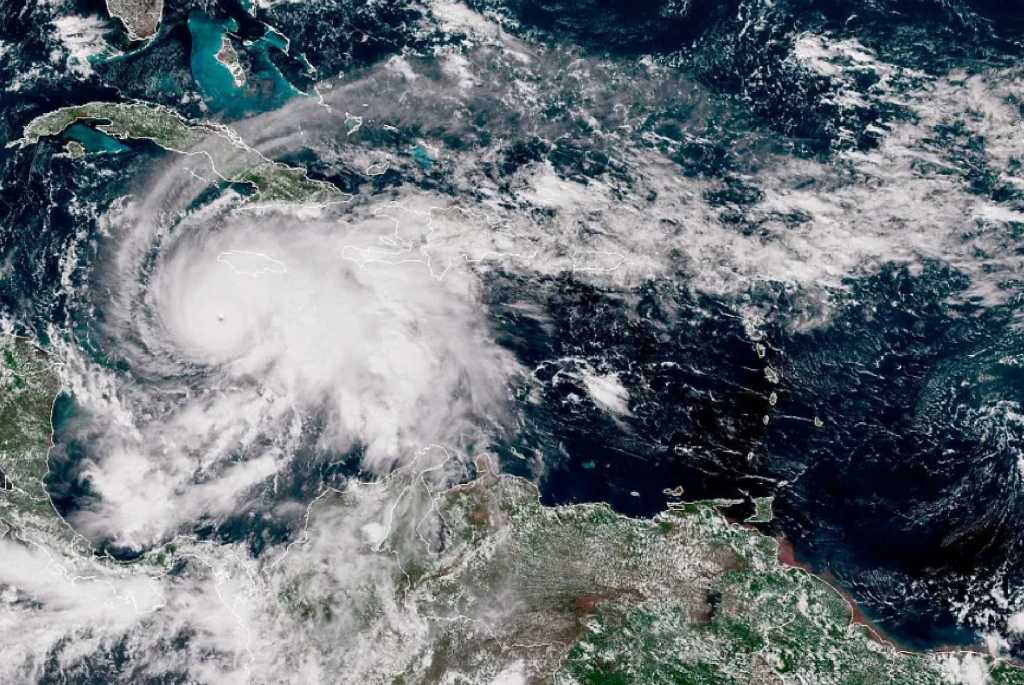
Satellite image of Melissa over Jamaica

“When I look at the cloud pattern, I will tell you as a meteorologist and professional – and a person – it is beautiful, but it is terrifying.  I know what is underneath those clouds.”

Sean Sublette, a meteorologist based in Virginia

Who needs ghosts and witches for Halloween when we have massive storm systems like Hurricane Melissa?  This past Tuesday, the 28th, Melissa plowed into Jamaica with 185-mph (298 kmh) winds.  It’s the first known Category 5 hurricane to hit Jamaica and most powerful since Gilbert in September 1988.  Gilbert held the record as the most powerful tropical storm system in recorded history, until Hurricane Patricia in the northwestern Pacific in October 2015.  Patricia produced 215-mph (346-kmh) winds and a surface pressure of 872 millibars (mb).  That pressure is the second lowest on record with Typhoon Tip producing 870 mb in October 1979.  (Tip boasted 190-mph winds.)

These storm systems – already the most powerful tempests on Earth – are getting worse.  In September 1995 Tropical Storm Opal developed in the Bay of Campeche and slammed into Florida’s west coast as a Category 4 hurricane.  It was the first time since U.S. meteorologists began naming these storms in 1953 that the Atlantic-Caribbean group reached the letter ‘O’.

That year, 1995, produced a total of 21 named systems; the greatest number since the 20 total systems (albeit unnamed) in the region in 1933.  All those records, however, shattered in 2005 when the Atlantic-Caribbean produced an unprecedented 28 tropical storm systems.  For the first time since 1953, meteorologists had to resort to the Greek alphabet for storm names.

The 2005 Atlantic-Caribbean hurricane system was most likely foretold in March 2004, when a squall nicknamed “Catarina” developed in the southwestern Atlantic and hit Brazil as what would be considered a Category 1 hurricane.  This was truly anomalous as full-fledged hurricanes rarely form in the Southern Atlantic because of cooler sea surface temperatures and strong vertical wind shear.

Tropical storm systems of any magnitude anywhere in the world are measured using the Saffir-Simpson Hurricane Wind Scale, which went into effect in 1973.  The U.S. National Hurricane Center (NHC) modified the system in 2009, but it’s still the standard-bearer for measuring the most powerful weather systems on Earth.

The development of Doppler weather radar in the 1970s proved to be a great leap forward for meteorology.  In September 1961 Hurricane Esther was the first tropical storm to be tracked by satellite.  Previously storms were generally followed by military reconnaissance aircraft.  But with Doppler scientists were able to trail various weather systems in real time and garner detailed information about a storm’s formation and movement.  By the 1980s, meteorologists began theorizing that tropical storm systems – especially hurricanes – follow certain pathways in the atmosphere; depending on the time of year and location of formation.  Late season hurricanes (after October 1) in the Atlantic-Caribbean, for example, tend to move eastward.

Eight years ago Hurricane Maria became one of the worst storms to rake across the Caribbean.  Puerto Rico suffered the worst of the chaos, as the storm killed over 3,000 people and costing roughly USD 90-95 billion.  It was the strongest storm to strike the island since the 1928 Lake Okeechobee Hurricane, which was also a Category 5 storm sporting a maximum wind speed of  160 mph (412 kmh) and a death toll in excess of 2,500 throughout the Caribbean and Florida.

Melissa’s strength is disturbing in that it is late in the Atlantic-Caribbean hurricane season.  In October 1998, meteorologists were stunned when Hurricane Mitch became the first Category 5 storm to develop in the region in the month of October.  Before the development of weather technology, it’s understandable that these storms would exact massive death tolls in the areas of impact.  The Great Hurricane of 1780 killed an estimated 22,000 to 30,000 people throughout the Caribbean.  Historians believe it may have achieved a maximum wind speed of 200 mph (322 kph).

To date, the deadliest hurricane to hit the United States (and the deadliest natural disaster) is still the 1900 Galveston Hurricane, which killed over 12,000 – at least 8,000 on Galveston alone.  No one knows where specifically it formed, but scientists believe it was a Category 4 storm.  They also believe it was the same storm that marched up into the central U.S., across the Arctic region and down in Siberia.  If that’s accurate, the storm wasn’t just deadly – it was truly anomalous.  The calamity was exacerbated by the lack of a cohesive warning system and geography.  Galveston is essentially a barrier island, which are narrow strips of sand that protect the mainland from the impact of powerful storms and ocean waves.  By nature they’re not designed to be developed for human habitation.  In 1900, the bulk of Galveston’s land mass rose barely above 15 feet (457 cm), and many of its streets ended at the shoreline.  In the ensuing decades Galveston officials have taken greater measures to develop a solid warning system and evacuation plans; a sea wall that extends across much of the island has helped, along with the planting of seagrass and palm trees.  The entire island has been literally lifted up by hauling in more sand and dirt.  Despite all those efforts, Galveston remains vulnerable, as evidenced by Hurricane Ike in 2008.

Technology and even the most comprehensive evacuation plans won’t save people from themselves.  Development along the coastlines of the U.S. has grown exponentially within the past 50 years.  In September 1999 Hurricane Floyd approached the Florida-Georgia border as a Category 4 and triggered the largest evacuation at the time – nearly 3 million people were ordered to move inland.  However, Floyd bypassed the area and migrated northward in the Carolinas.  Many people were upset at having to leave for a storm that missed them.  I recall one man on the national news complain that all the technology should have provided a more accurate prediction.  I looked at the TV screen and said, ‘Really?’  I personally believe that no one should ever be forced to flee their homes for a natural disaster.  If they feel they’re brave and strong enough to withstand nature’s wrath, just leave them alone!  But they also shouldn’t expect first responders to come racing to their aid.  After X hour, they’re on their own.

In June 1992, the United Nations staged the “Conference on Environment and Development” in Rio de Janeiro, Brazil.  Also known as the ‘Earth Summit’, political leaders, diplomats, scientists and many others convened to discuss humanity’s impact on the environment.  One subject that was part of the original agenda was birth control.  The premise was simple: unchecked population growth can have adverse effects on natural resources, such as clean water and air.  But just as the conference was set to begin, the Roman Catholic Church in Brazil intervened and demanded that any discussion on birth control either be limited or excluded altogether.  Despite some initial resistance, the conference organizers eventually conceded, and the Church got their wish.  Conversations on any kind of population control were all but eradicated.  Afterwards, though, the conference was declared a success.

In 1992 the global population was a little over 5.4 billion.  In 2024 it stood at approximately 8.1 billion.  In 1982 China reached an incredible milestone when it became the first country on Earth to attain a population of 1 billion.  (Various demographic studies declared that it actually had reached that number in 1980.)  Before then, China’s various efforts to control its population had catastrophic results.  In 1958 the “Great Leap Forward” was an attempt to streamline food production and distribution, but it led to the starvation deaths of up to 55 million people.  In 1979 the “One Child Per Family” policy was a more concerted effort to limit population growth, but it had an incredibly low acceptance rate, especially in rural areas where more children meant more hands to harvest crops and other food stuffs.  Its most negative impact, however, was on gender disparities.  As with many developing nations, China valued its male citizens more than females.  The “One Child Per Family” stunt culminated in the deaths of thousands of infant girls and has now made China the only country with a greater population of males than females.

In May 2000 India crossed the 1 billion citizenry mark.  By 2023 it had surpassed China in overall population.  Lack of education and comprehensive health care always has deleterious effects on a nation’s overall welfare.  Unmitigated population increases push more people into regions where they’ve never or at least rarely lived.  We’re seeing that here in the U.S., as city populations grow and begin overtaking forests and even farmland.

What does this have to do with Melissa and other tropical storm systems?  In terms of population and human interaction with nature, it means everything.  Coastal areas continue to be popular destinations for tourists and even residents.  Severe storms and rising seas are already wreaking havoc on U.S. coastlines.  Since the start of 2025, a large number of beachfront homes across the country have collapsed into encroaching oceans, mostly on the Eastern seaboard.

Remember Melissa is the strongest hurricane to develop this late in the season.  The first two decades of this century have seen the greatest number of Category 5 hurricanes in the Atlantic-Caribbean basin – nearly 40.  Hurricane Camille remains the most powerful storm to strike anywhere in the United States.  It basically set the standard and was considered a true meteorological anomaly.  But that standard is changing rapidly, and Category 5 storms are becoming more common.

Once again, who needs ghosts and witches when we have real monsters coming out of the sea?

Also see: Great Bhola Cyclone

Leave a comment

Filed under Essays

Okay, Bye!

Oh, what the hell!  It’s Tuesday afternoon, I have less than an hour on my work clock, and I went to bed before 7 p.m. yesterday.  Why not have some red wine!  My daily commute is about 20 feet (6.1 meters); that is, from the bed to my work laptop in a neighboring room.  That includes a necessary detour to the bathroom.  I try not to look at myself in the bathroom mirror – or any other mirror in the house.  I no longer look like a Greek/Italian/Mexican studburger who rode in on a black stallion.  I kind of look like the dirty old man parents warn their kids about.  Oh well.  I’ve had my fun.

Ever think deeply, while standing alone, and wonder if your body has suddenly decided it wants to lead a life of its own?  Well…I’ve come to the cold, brutal realization that mine has.  And I’m like, ‘Bye bitch!’  Don’t let me hold you back!

‘It’s hell getting old!’ my parents always said.  I’m starting to feel the anxiety.  I watched them struggle with the various pains of aging and could barely see myself in those same situations years from then.  I began to realize that I won’t be so fortunate to have good health as I do now.  Watching my Uncle Wes* deal with his constant physical struggles cemented that reality into my brain.  I’m about to make some modifications to both bathrooms, especially the shower stall, to help him navigate those spaces.  A few weeks ago he expressed concern for my future welfare.

“You might need this, too,” he said, referring to grab bars in the shower.  He’ll be 86 in a few months.

I have no one to care for me, if I ever get to be his age.  I never got married and had children, or just had children.  I never wanted to be a “Baby Daddy”.  I had wanted to be a husband and father.  But just tell the Great Creator your plans for the future and wait for the laughter.

I’ll be 62 in less than a month and hope to retire at age 65.  My mother retired at 70, but I’m certain I can’t make it that long.  I love my job, but I love time and solitude even more.  My ultimate goal was always to be a true writer, with no other necessary career just to help me get by.

A few years ago a close friend posted a picture on Facebook his daughter took of him after a visit to a vintage car show for his birthday.  He was kneeling beside a vehicle.  I congratulated him on making it to another year and then asked, “BTW how long did it take you to get back up from that squatting position?” with an accompanying laugh emoji.

He never answered, but that always comes to mind, whenever I try to get up from the floor after doing some basic calisthenics or squat down for some ungodly reason.  Yes, getting old his hell, but the alternative isn’t too pleasant.

Then again, I’m not “old”!  I’m vintage!  Damnit!

*Name changed

6 Comments

Filed under Essays

And the Madness Begins – Again!

Once more, political divisions have caused the U.S. Congress to shut down the government.  Sigh…again?!  Ever wonder if a long-running TV show will ever have its final season?

I’m not a federal worker, but my current role relies on the U.S. government functioning at full capacity.  Or at least at a rational level.  Then again, that may be too much to ask in the current environment.

Gosh, I hate to interrupt someone during their nap!

While literally thousands of people across the nation have found themselves on a reluctant furlough, members of Congress, along with the president and vice-president, are still getting paid.  Of course, they rarely suffer whenever such indignities befall the average peon.  Having lived in a gilded cage most of his life, Donald Trump can’t feel that kind of pain – certainly not with the support of his blind faithful.

The shutdown has entered its first full week, and – as usual – the finger-pointing has been rampant.  I’m almost afraid some of those fools will put their hands in traction!

I don’t care if any of them get hurt, though.  They’re not worth the trouble.  But Congress is as politically divided as the nation.  Trump bears a great deal of responsibility for that chaos.  He made it cool for some people to be hateful and bigoted.  Yes, he’s taking America back – back to a time when only people who looked like him held the bulk of the country’s power and money.

But the nation has been growing divided for decades now.  Technically I believe it started with the Watergate fiasco, but worsened the moment Bill Clinton first announced his run for the presidency.  It only intensified after the turn of the century.

Thousands of federal workers are now not getting paid.  That includes active duty military personnel; even those stationed overseas.  But Trump has done the right thing in that case and ordered that they continue getting paidAir traffic controllers also aren’t getting paid, but are being forced to work, as they are considered essential employees.  Many, however, are calling in sick.  They learned their lesson more than four decades ago.  In 1980 the Air Traffic Controllers Union was the only labor group in the U.S. to support Ronald Reagan’s presidential campaign.  The following year they went through on their threats to strike – demanding better pay, updated equipment and more controllers.  And then Reagan fired 11,000 of them.  Needless to say that was the last time any work union in the U.S. supported a Republican for the presidency.

Even though things look okay for me now, I’m still concerned.  The government agency my company contracts with has been the target of many public officials, especially Republicans.  Trump, however, has issued another threat.  He’s promised to terminate a number of federal associates and says that, when the government reopens, he’ll make sure they don’t get any back pay – which has always happened in the past.

Personally I think it would be great if every essential employee doesn’t show up for their job.  I mean EVERY SINGLE ONE OF THEM!  That’s not likely, however, but I’d love to see how these sanctimonious Republicans would respond.

In the meantime, average taxpaying, law-abiding citizen will continue to feel the adverse effects of this morass.  It’s a never-ending cycle of incompetence in the highest levels of the political universe.

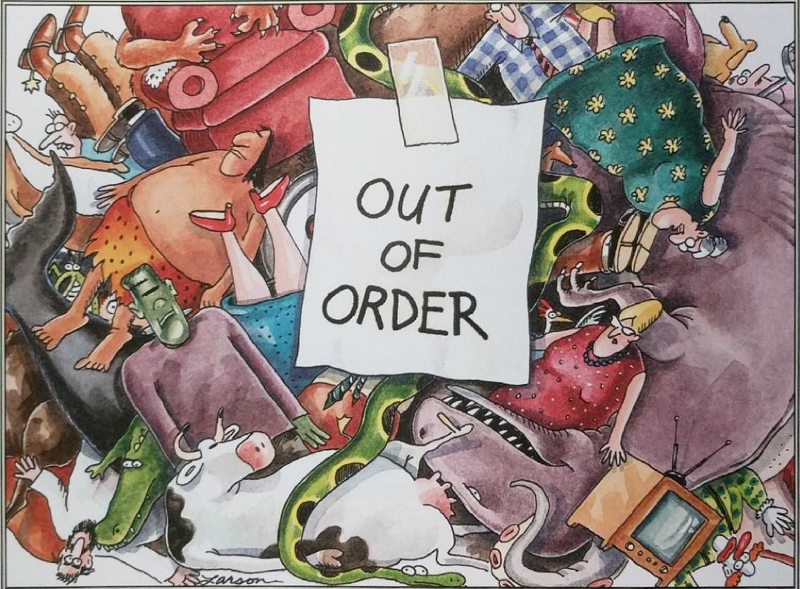
Image: Gary Larson

2 Comments

Filed under Essays

Watchittocracy

Around 1990 I met a woman who once worked for the now-defunct Braniff Airlines.  She was the aunt of a close friend, and somehow we got to discussing business practices and how things function in the corporate world.  I was already working for a major bank in Dallas.  She noted how the former president of Braniff refused to accept the reality of bad news.  Anyone who dared to step into his office and present him with less-than-stellar information about the company’s dire finances was promptly terminated.  On the day in 1982 the company filed for bankruptcy, she mentioned that employees didn’t get paid and, in some clerical settings, they literally went ballistic and destroyed many pieces of equipment and office furnishings as retribution.  I was shocked, but said I didn’t blame them.

In the summer of 2011 I landed a contract technical writing position with an IT firm in Dallas.  One of the senior technical writers had worked for Braniff as a flight attendant until they went bankrupt.  She confirmed what that other woman had told me two decades earlier.  Braniff employees didn’t receive their last paycheck and lost their patience.

You don’t have to be a business owner to understand that bad news is an inevitable burr in daily operations.  It comes with territory, but some people handle it better than others.  The same goes for comedy.  Cultural shifts can make individuals more or even less sensitive to certain aspects of their surrounding environments.

The U.S. currently has a president, however, who has no problem calling people names and making fun of them, but suddenly draws the line at people mocking him.  “You’re a horrible person” is how he often prefaces a response to someone who asks him a question he finds intolerable.  But, as I wrote in a previous essay, it appears the demonic world of American politics has become riddled with the emotionally fragile.

Last week conservative activist Charlie Kirk was shot and killed by a young man while holding an outdoor question-and-answer session at Utah Valley University.  The 31-year-old Kirk left behind a wife and two young children.  Right-wingers immediately jumped into the chaos and started pointing fingers at liberals and the entire Democratic Party. 

“Democrats own what happened today,” South Carolina Republican Nancy Mace groused to reporters the day after Kirk’s death.  “I am devastated.  My kids have called, panicking.  All the kids of conservatives are panicking.”

President Trump ordered flags flown at half-mast in honor of Kirk; something he didn’t do in the bloody aftermath of the January 6, 2021 riots on Capitol Hill.

It’s ironic, though, because Kirk once said that gun-related deaths were merely a price to pay for Americans’ right to own firearms.  “It’s worth it to have a cost of, unfortunately, some gun deaths every single year so that we can have the Second Amendment,” he stated matter-of-factly in 2023.  Now he’s being lionized as a martyr to conservative ideology.

Kirk also believed firmly in free speech, declaring that saying even “contrarian things” is acceptable.  I have to agree with that statement.  But, as the adage goes, be careful what you wish for…

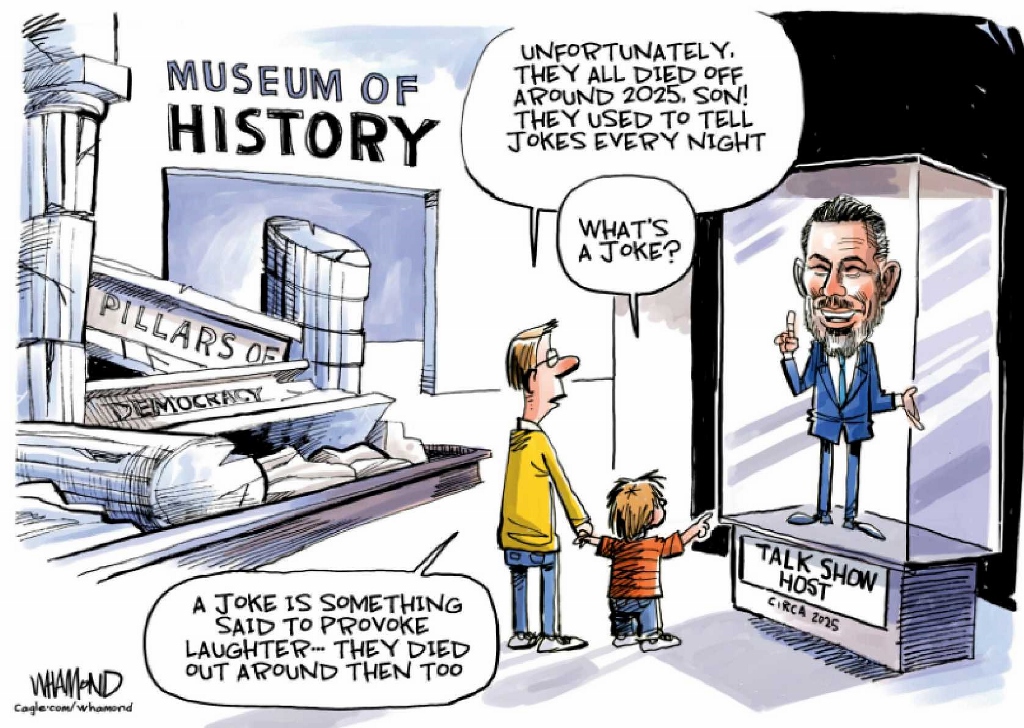
The general concept of free speech is now under attack, as it always has been with Trump and his MAGA mafia.  Recently the Federal Communications Commission ordered the ABC network to cancel or at least suspend Jimmy Kimmel’s nightly talk show, after he commented on Kirk’s murder.  Kimmel didn’t gloat over the assassination; he simply pointed out that Trump supporters are using it to enhance their own anger.

For some folks, free speech only seems to have consequences or responsibilities when someone says something they don’t like.  How free should someone be with their own words?  You can’t threaten to kill someone or you can’t call them a rapist without tangible proof.  Slander and threats of violence aren’t covered by the First Amendment to the U.S. Constitution.

Banned Books Week 2025 is coming up soon, and I recollect a news piece I saw back around 1986 – the centennial anniversary of the Statue of Liberty.  Several foreign-born and newly-minted American citizens discussed the oppression they escaped.  One woman, a Russian, noted that she was a reading a book at an outdoor café, when said she suddenly got the feeling someone was watching her.  But she remembered she was now in the United States – and she could read just about anything she wanted, even in public, without fear that someone would report her to authorities for being a traitor or disruptive; merely because of what she was reading.

Is that where we’re headed?  People need to watch what they read, as well as what they say?  Or is the First Amendment now subject to political interpretation?

Do any of us want someone else to determine what we say and read?  I’m not willing to give up that type of freedom.  No one should.

Image: Dave Whamond

6 Comments

Filed under Essays

You Won’t Have Mail!

Recently American Online (AOL) made a stunning announcement: they’re shutting down on September 30 – this year.  As in one month from now!  What had once been THE email service for many internet users has apparently run its course and – like most lifelong politicians – is no longer relevant.

Introduced in 1991, the screeching sound of AOL dial up served as the soundtrack of those early days of the cyber universe.  I definitely remember it!  AOL came with my first personal computer in March of 2000.  The “You’ve got mail” voice alert was exciting at the time. 

The influx of broadband remedied the nails-on-chalkboard tone that signaled a connection to the internet.  But, as with dial phones and 8-track tape players, AOL may have become a victim of technology.  It’s just what happens with technology and trends.

Despite my initial love for AOL, I had two major clashes with them; the second of which severed our relationship forever.  In February 2004, AOL published a piece on how Christopher Columbus allegedly used Leap Year Day of 1504 to trick the indigenous Taino people of Jamaica into providing food for him and his stranded crew.  In the comments section, someone posted a completely unrelated remark; something to the effect of “no one has suffered like the Jewish people.”

I have no idea what prompted it, except ethnocentric arrogance.  But I replied with a remark that included the term “politically correct bullshit”.   Apparently that hurt someone’s feelings, so they reported me to AOL who promptly deleted the verbiage and suspended me from commenting for a short period.  In other words, AOL did something that reeked of juvenile behavior – they put me on “probation”.

“Excuse me?”  It was bad enough I could hardly understand the customer service representative through her heavy accent.  Like several U.S. companies at the turn of the century, AOL had outsourced their technical support and customer service to India and other parts unknown.  But, when she told me about the probationary status due to my foul language, I retorted, “You don’t place me on probation!  I place you on probation!”  I was a paying customer, plus the U.S. Supreme Court had already ruled that foul language was protected speech under the First Amendment to the Constitution.  Neither truth would change their cyber mind.

Seven years later I committed another more egregious act – in the minds of AOL leadership.  I emailed a nude image of myself to a close friend in a joke message.  This time it was AOL who got their feelings hurt and literally shut down my email address.  I had to scramble to find another service and settled on Gmail.  But I kept thinking – if everyone who used foul language or sent a nude photo got banned from the internet, well…you wouldn’t have an internet!

My father – who was born in 1933 – told me that, as a kid, he thought the voices he heard from the radio were from tiny people inside the device.  Radio was a popular form of technology in the 1930s and 40s.  Then television, then computers and now…well, who knows what will come up in the future.

Goodbye to AOL.  And life continues.  Like technology itself, it always does.

2 Comments

Filed under Essays

CB Saps

The CBS television network is one of the most storied media outlets here in the U.S.  It officially launched in September of 1927 as a radio network – a major news source at the time – before transitioning in 1941 into the new medium of TV.  The assassination of President John Kennedy in 1963 led CBS to expand their weekly evening news broadcasts from 15 to 30 minutes, which remains a staple of mainstream news outlets.

In 1960 a young journalist named Dan Rather joined CBS, and in 1981, he took over the helm of the network’s nightly evening news broadcast from another legend, Walter Cronkite.  Rather had already established himself as a premier journalist.  From his live coverage of Hurricane Carla in 1961 to the chaotic 1968 Democratic National Convention in Chicago and the horrors of 9/11, Rather had few equals.  But, in the fall of 2004, he encountered his final nemesis – and perhaps one of the most unlikely: a conservative Republican political figure with a fragile ego, incumbent U.S. President George W. Bush.  After five lackluster years as Texas governor, Bush ran for president in 2000 – and won in a controversial decision handed down by the U.S. Supreme Court.  He became only the second U.S. president to follow his father into that esteemed role.  One issue that arose early in Bush’s presidential campaign was his decision to join the Texas National Guard upon graduating from Harvard in 1968.  He reenlisted four years later and then – allegedly – transferred to Alabama to work on the presidential campaign of George C. Wallace, a renowned segregationist.  Whether or not Bush completed his second stint in the National Guard has never been resolved.  He served at a time when the Vietnam War was raging and positions in any state’s national guard were highly valued for draft-age men.

The same conundrum befell Bill Clinton when he announced his candidacy for the presidency in 1991.  Conservatives were quick to denounce Clinton as a “draft dodger”, but held off criticism of Bush years later.  But when Dan Rather began his quest to determine the exact nature of Bush’s so-called military service, right-wing hound dogs quickly pounced.  How dare Rather question the integrity of their contemporary savior!  After Bush won the 2004 election (in contrast to 2000, when it was strictly an electoral college victory), the pseudo-Texan’s anger manifested quietly and nondescriptly in Rather’s termination from CBS.

The move pleased conservatives, but outraged liberals.  It mirrored a similar move by CBS against Rather’s colleagues, Connie Chung, a decade earlier.  Chung began her journalism career with CBS as a Washington, D.C., correspondent in the 1970s.  In 1993, she became only the second woman and the first Asian-American to headline a major network news broadcast, when she became Rather’s co-anchor on the CBS Evening News.  Two years later, however, her stint with the network crashed after interview with the parents of another conservative Republican with a fragile ego.

In November 1994, Republicans gained control of both Houses of the U.S. Congress for the first time since 1954.  And they didn’t just win – they won a super-majority in each chamber.  There were at least 3 factors: Clinton’s attempt at a national healthcare program, a ten-year ban on assault-style weapons and queers in the military.  All three were anathemic to American conservatives, and the new Speaker of the U.S. House of Representatives, Newt Gingrich, stood at the helm of their angst.  A Pennsylvania native and Ronald Reagan acolyte, Gingrich first arrived in the U.S. Congress in 1979.  When Bill Clinton became president, Gingrich led the loud, yet unofficial call, to slaughter the former Arkansas governor’s reputation.

In the spring of 1995, Connie Chung traveled to Georgia to interview Gingrich’s parents.  His mother, Kathleen, sitting in her kitchen, chain-smoking and speaking barely above a stage whisper, noted her son’s disdain for the Clintons – not just the President, but also First Lady Hillary.  When pressed by Chung, Kathleen Gingrich said Newt had called Hillary Clinton a “bitch”.  Chung chuckled and seemingly expressed surprise.

The interview rocketed across the news spectrum like a lightning bolt.  Newt Gingrich openly announced his rage (and refused to acknowledge whether or not he’d described Hillary Clinton as a “bitch”).  Nonetheless, he accused Chung of taking advantage of people who weren’t “media savvy”.  In response, Chung asked how “media savvy” does someone need to be when they’ve welcomed a national news figure into their home and have three cameras and several studio lights set up around them.  CBS severed Chung’s contract.

Now, some two decades later, CBS has bowed to the ego of yet another conservative Republican: President Donald Trump.  They recently announced the cancelation of the long-running “The Late Show”, which will officially end in May 2026.  Comedian Stephen Colbert has hosted the show since 2015 and has been one of Trump’s most prominent critics.  This announcement comes as a surprise, but in reality, shouldn’t be.  Previous host David Letterman frequently mocked President George W. Bush – and never shied away from his barbs.  Every political figure in the U.S. has been the subject of disdain and caricature.  Anyone who enters American politics with a thin skin normally fries in the broth of farcical verbiage.  But it sort of comes with the territory.

Yet I can’t help but notice that attacks on journalism and popular culture have come from the conservative wing.  The right-wing fringe that once openly-mocked diversity and inclusion now seems to bristle at the sound of tawdry jokes and comical jibes.  And liberals are the wimps?

Spare me the anxiety!

Personally I was the subject of extensive bullying throughout my school years and even into young adulthood.  But I survived the maelstrom and I’m still here.  In a nation that values free speech and a free press, it’s frustrating to know that journalists and comedians are ostracized for criticizing or questioning anyone – least of all political figures.  In fact it pisses me off and makes me wonder what’s next.  The U.S. currently has a president who insulted a large number of people and deliberately fomented a physical assault on our government.  Threatening physical violence and slandering someone’s reputation are actually illegal.  But, in the current, political climate, personal fragility is obviously subjective.

1 Comment

Filed under Essays

Reject

Karine Jean-Pierre, former White House Press Secretary under President Joe Biden, has shocked her peers and the political world by announcing recently that she’s abandoning the Democratic Party and declaring herself an independent.  And I’m happy to say, “Welcome!”

Born in Martinique, Jean-Pierre attended – among other colleges – the New York Institute of Technology (from where I earned my B.A. in English) and had been a registered Democrat her entire adult life – well, until now.  Like most people in the maelstrom of the American political arena, she had to conform to certain party ideology and maintain a specific persona.  After her brief stint as Biden’s Press Secretary, however, she apparently couldn’t tolerate the deception any longer.

I have to admire her candor.  She’s one of the few people in recent years to step forward and be so blatantly honest with her sentiments.  The truth always hurts, and Jean-Pierre has taken a sledgehammer to a migraine.

I didn’t vote for Hillary Clinton in 2016 because I didn’t feel she was the right leader for the nation.  I only voted for Biden in 2020 to keep Trump from winning another term, but I reverted back to the Green Party last year and voted for Jill Stein.  Trump still won, since the U.S. is not quite ready for a president with vaginal attributes – unlike many other nations in the Western Hemisphere, including our two bordering neighbors.

Jean-Pierre has notably critical of Biden’s mental and physical health – something his opponents had frequently cited from the moment he declared his candidacy.  American politics is such an ugly venture.  It’s always been nasty, but I feel it became especially toxic after the Watergate scandal.  I’ve said for years that the worst thing the Democratic Party could have done in the run-up to the 2020 elections was to stand by as Biden and Bernie Sanders announced they were seeking the U.S. presidency.

As the 2020 presidential race commenced, the Democratic Party presented the most diverse gallery of candidates of any such contest.  Then, like their Republican counterparts, they ended up with two old White men at the top.  Biden’s only saving moment was selecting Kamala Harris as his running mate.  It was an odd pairing.  Harris became the first female Vice-President in U.S. history, while Biden eventually became the nation’s first octogenarian Commander-in- Chief.

During Donald Trump’s first term, I often told people – both supporters and detractors – that I felt the U.S. was essentially leaderless.  Trump pales in comparison to many of his predecessors.  On the other hand, though, his Democratic counterparts have their own share of failures.  When the Democrat Party elected Ken Martin its new chair this past February, the news arrived with the same bravura as paint drying.  The longtime leader of the Minnesota Democratic Party, Martin hopes to lead his constituents into a future filled with greater accomplishments (wins) across the nation.

“Donald Trump, the Republican Party, this is a new DNC,” Martin told reporters after his election.  “We are not going to sit back and not take you on when you fail the American people.”

And I wish for the blind to see and the lame to walk.

*YAWN*

Wake me when something really important happens.

Like Jean-Pierre, I certainly won’t hold my breath.  The Democratic Party needs a hell of a lot more than a new chairperson.  If they’re prudent, they’ll heed Jean-Pierre’s not-so-subtle warning.

3 Comments

Filed under Essays

Words

Several years ago actress turned animal rights activist Brigitte Bardot found herself in legal trouble with French authorities.  The former screen siren openly condemned the Islamic practice of animal slaughter during the Aid al-Kabir holiday. She’d been in such a predicament before – several times.  French law doesn’t actually forbid disparaging religious ideology, but it looks down sharply upon it, as it can be considered slander or worse, a conduit to hate-obsessed violence.

It’s surprising, considering France fought hard against Nazi occupation during World War II.  One tenet of Nazism is that anyone who speaks out against the government is deemed a traitor.  But, short of slander or threats of violence, criticism of governing bodies and religion is free speech.  Imprisoning anyone, or even threatening to levy a monetary penalty for such views, runs counter to that.

All of it strikes hard for me – and other writers and artists – here in the U.S., as we witness ongoing assaults on various forms of free speech.  Book bans remain a primary source of concern.  And with Republicans in charge of the White House and both houses of Congress, the attacks continue.  Social extremists have always been opposed to any viewpoint that doesn’t conform to their standards – whether it’s coming from the left or the right.  The voices of moderates seem to get lost in the chaos.

Recently the U.S. government – under pressure from the Trump administration – compiled and presented a list of words that are forbidden on federal web sites and other documentation.  They include such terms as “biologically male”, “clean energy”, “inequality”, and “woman”.  This is real!  I have a tendency towards creating outrageous stories, but I’m not intoxicated or deranged.  Well…not yet.

Regardless, the list definitely isn’t a manifestation of liberal outrage at the most right-wing president in decades.  It’s a result of years of conservative ideology designed to put people and institutions in categories and re-enshrine bigotry and hatred into the American conscience.  The leftward shift in culture and politics in the U.S. beginning in the late 1950s eventually met the hostility of Reaganesque antipathy towards anything viewed as different or the other.  The Trump era is the culmination of it all.

Those in formerly marginalized groups who also voted for Trump and his ilk shouldn’t be surprised – but they are.  For example, Cuban-Americans voted overwhelmingly for Trump, as they often have for the Republican Party.  As Cuba has been under communist rule since 1959, those fleeing the country have been given special protection from American law.  The same luxury hasn’t been granted to people fleeing war and violence in other Latin American nations, such as El Salvador and Guatemala.  However, the Trump Administration’s efforts to reform immigration law have started to impact thousands of Cuban immigrants.  Now, Cuban-Americans have the audacity to be horrified at the betrayal.  Remember the adage: be careful what you wish for; you might just get it.

We also need to recall the words of Martin Niemöller:

“First they came for the socialists, and I did not speak out – because I was not a socialist. Then they came for the trade unionists, and I did not speak out – because I was not a trade unionist. Then they came for the Jews, and I did not speak out – because I was not a Jew. Then they came for me – and there was no one left to speak for me.”

Trump and his cronies appear to be going after anyone who doesn’t fit the narrow definition of who he is.  His hypocrisy is glaring.  He never outwardly espoused any religious fervor until he first ran for president, but now says Christian ideology should be taught in schools.  If he believes in true biblical content, then consider the Christian Bible’s 7th commandment: “Thou shalt not commit adultery.” Exodus 20:14.

There are others.

“I am a stranger and an alien residing among you; give me property among you for a burying place, so that I may bury my dead out of my sight.” Genesis 23:4

“The sinless one among you, go first. Throw the stone.” John 8:6-11

“Love the Lord your God with all your heart and with all your soul and with all your mind and with all your strength. Love your neighbor as yourself. There is no commandment greater than these.” Mark 12:30-31

I’m sure this would be too much for him to handle.  It’s too much even for some devout Christians to handle!

Whatever words someone wants to use, they shouldn’t be frightened into compliance.  Russia, Iran and North Korea do that.  No truly democratic society wants to echo such autocratic leadership.

Leave a comment

Filed under Essays

Social Living

“Social Security is the biggest Ponzi scheme of all time.”

Elon Musk, February 28, 2025

For elected officials here in the U.S., Social Security is much like a live power line: touch it and they’re done.  Social security, along with Medicare and Medicaid, is one of those sacred vessels of American life.  It’s not just beloved; it is sacrosanct.

Thus, for a foreign-born oligarch like Elon Musk to disparage it as a “scheme” has become anathemic.  As something of a pseudo-president, Musk is head of the newly created Department of Government Efficiency (DOGE), which has taken a hacksaw to a number of departments within the federal government.  The declared goal is to reduce bureaucratic weight by slashing jobs and merging together certain divisions within the system.  Nowhere in this morass of right-wing blather is a dedication to make people like Musk and their corporations to pay their share of taxes.  But that’s a different issue.

To place things in proper perspective – and put elected officials like Trump in their place – social security has too many safeguards to be considered a Ponzi scheme.  Before the Social Security Act of 1935, a large number of older Americans lived in abject poverty.  At the time it was common for families to take in older relatives.  But some people simply didn’t have that support and they were left to fend for themselves.  The concept of providing for those who simply couldn’t work or take care of themselves is nothing new.  Various societies throughout history have considered the fragilities of the human condition and sought to alleviate those difficulties.  It is simply immoral to abandon those who can’t care for themselves.  It’s also rather easy to look at those who won’t take care of their own lives and group them with the others.

The Social Security Act has been amended several times since 1935, but it differs from a Ponzi scheme in many ways.

1. Social Security is not fraudulent

A Ponzi scheme is a deliberate a fraud intent to mislead investors.

2. Social Security’s operators do not take a cut

Unlike with Ponzi schemes, Social Security is not a profit-generating gamble, and the officials who run it do not take a portion of it for themselves.

3. Social Security is operated in the open

Social Security is a transparent, government-run program with clear funding mechanisms. 

4. Social Security has built-in oversight

Unlike a Ponzi scheme, Social Security has many layers of oversight, auditing, regulation and legal and financial systems in place to ensure accuracy and transparency. 

5. Social Security offers realistic returns

The goal of Social Security is to provide basic income replacement, not to generate get-rich-quick returns.  Ponzi schemes often promise unrealistically high gains.

6. If financially stressed, Social Security can adjust funding and/or benefits

A fiscal imbalance in Social Security can be corrected, but a Ponzi scheme can’t.  Social Security beneficiaries can’t demand to be paid a balance in their account if they suspect something is wrong.  There can’t be a “bank run” on Social Security, and problems ultimately can be resolved.

It doesn’t surprise me that Trump and the Republican Party are targeting Social Security, or rather that conservative Republicans in general haven’t struck back at the president.  Social and political conservatives have always been leery about government programs designed to help people.  Before Franklin R. Roosevelt’s “New Deal” policies (designed and implemented to address the brutal impact of the Great Depression), government’s primary purpose was to enact laws and collect taxes.  The collapse of the U.S. stock market in 1929 and the subsequent financial calamities that ensued changed that mindset – at least among the more open-minded.  Social Security was just one project resulting from such forward thinking.

In 1944, Congress passed the Servicemen’s Readjustment Act (later known as the GI Bill) to assist those returning from military service during World War II.  It provided a myriad of aid and services to these individuals, such as education and housing.  Again, many conservatives denounced it as welfare.

Similar criticisms befell Lyndon Johnson’s “Great Society” some two decades later.  From this massive undertaking, we got Medicare and Medicaid.  But, as Johnson declared, the government should ensure both “liberty and abundance” for all citizens – not just those who can afford it.  And as before, critics deemed it socialized medicine.

While it’s surprising that the U.S. federal government can operate with such alleged overspending – a bloated bureaucracy – it does provide substantial safety and security to most everyone here.  The attack on Social Security is monstrous.  Trump has sworn to leave it alone, but I personally don’t trust him.

I’m fast approaching the official retirement age of 62, yet I know I won’t be able to sit back in my quiet suburban home and embark on my dream life of being a full-fledged writer.  The Social Security system is supposedly insolvent.  Raising the official retirement age (as many, including Musk, have suggested) or reducing benefits won’t repair that problem.  Funding for the Iraq War alone could have made Social Security fiscally viable for generations.  Still, the program must be handled with care.  Touching it irresponsibly is, indeed, akin to touching that live power line.

3 Comments

Filed under Essays