Category Archives: Essays

Getting Viral

“If a severe pandemic materializes, all of society could pay a heavy price for decades of failing to create a rational system of health care that works for all of us.”

Irwin Redlener

We Texans like to consider ourselves a hardy lot.  Not much scares us – not communists, Islamic terrorists, hurricanes, triple-digit temperatures, or even gingivitis.  When the 2014 Ebola scare hit Dallas, locals rumbled through their daily routines without any real concern that a fatal microbe – one with a roughly 90% death rate – lurked in the air.  Actually, it was in the bloodstream…of a handful of individuals.  Ebola, like HIV and bad attitudes, is a blood-borne pathogen and therefore, not transmittable via the air.  Thus, I thought it odd that the South by Southwest Festival (SXSW), an annual gathering of film, music and media artists in Austin, had been canceled this time because of the current, ongoing coronavirus outbreak.  I still can’t believe that Austin – a city that prides itself on being “weird” – has been humbled by a viral intruder.  But it has.  Sadly, thousands of weirdos from across the globe will not be able to descend upon the capital of one of the most conservative dominions in the United States and find kindred souls through their mutual love of art and music.  And humanity’s mutual love of going to work and to school, shopping and taking vacations also has been undermined by a wicked little microbe.

For COVID-19 – the critter formerly known as a coronavirus – the mystery continues unabated.  I haven’t seen this much hysteria over a disease since AIDS popped up nearly four decades ago.  With the death toll now exceeding 3,000 and the confirmed number of infections pushing 100,000, COVID-19 is proving to be a formidable bacterial opponent.  The flu-like virus has reached every continent except Antarctica and (as many of these things tend to do) shows no signs of slowing.  What are we bipedals on the third rock from the sun supposed to do?

A century ago the world was recovering from two cataclysms: the Great War (World War I) and the “Spanish flu”.  It seems the latter followed the former.  Millions of people displaced across Europe by the ravages of conflict – sickened and hungry – inadvertently created a cesspool of illness.  To this day, no one really knows where exactly the Spanish flu evolved (some say the Midwestern U.S. was the point of germination), what made it so lethal, or why it spread so quickly and so far.  In the ensuing decades, some virologists declared that the closest analogy is the 14th century “Black Plague”, a scourge that managed to ravage much of the known world – from Western Asia to Northern Africa to Iceland.  The “known world”, of course, being what European scholars thought existed, circa 1300 C.E.

The “Black Plague” was a Eurasian pandemic; a merciless spread of the bubonic plague across regions that hadn’t yet realized the beauty of handwashing and Kleenex.  From roughly 1347 C.E. to 1352 C.E., the ailment took approximately 20 million lives.  It impacted commerce and trade and terrified ignorant souls into comprehending the fragility of their existence.  It shaped the entire region; one of the birth places of modern humanity; a womb of agriculture and farming.

The 1918-19 Spanish flu remains the most severe pandemic in recent virological history.  Doctors in both Europe and the U.S. first identified the virus in military camps in the spring of 1918.  Within two years the virus, now identified as a strain of avian H1N1, had directly affected roughly 500 million people and killed an estimated 50 million.  And much like the 14th century “Black Death”, the “Spanish flu” retreated into the annals of medicine, once it appeared to have inflicted enough agony upon a vulnerable populace.  In a time before antibiotics, contemporaries of the “Black Death” and “Spanish flu” resorted to isolation, quarantine, prayer and general hysteria.  So what’s new?

In the century since the “Spanish flu” quagmire, the planet has experienced two similar microbial outbursts: the 1956-58 “Shanghai flu” and the 1968-70 “Hong Kong flu”.  The Shanghai menace was an H2N2 avian virus first reported in China in early 1956.  It had originated from a mutation in wild ducks and combined with a pre-existing human strain.  A vaccine was introduced in 1957, and the pandemic slowed down.  A second wave developed in 1958, however, and went on to become part of the regular wave of seasonal flu.  Overall, the “Shanghai flu” killed about 5 million people across the globe.  By 1968, the H2N2 Asian flu had disappeared from the human population and is believed to have gone extinct in the wild.

Then, in 1968, the “Hong Kong flu” arose.  Developing from an H3N2 avian virus, it first appeared in Hong Kong in July of 1968.  Within two months, the virus had spread across Asia and into Europe.  By autumn, it reached the Western Hemisphere.  As with the Spanish flu, the Hong Kong flu appears to have come to the United States along with military troops arriving home from battle.  In this case, it was the Vietnam War, which had begun to impact all of Southeastern Asia by 1968.  In total, the Hong Kong flu killed approximately 1 million people.

AIDS bears some similarities to all of the aforementioned influenzas disasters, in that it appeared unexpectedly and incited mass hysteria.  But HIV germinates within blood and blood-related elements.  Despite warnings from religious zealots and other uneducated morons, it cannot be transmitted via sneezing and coughing.

The most recent influenza-style epidemic was the 2002-03 SARS (Severe Acute Respiratory Syndrome) virus.  Officially dubbed SARS-CoV, it is thought to be an animal-borne microbe – perhaps bats, which spread to other mammals, such as wild felines.  It somehow spread to humans and was first identified in southern China in November of 2002.  It infected about 1,800 people and killed less than 300.  No known SARS cases have been documented since 2004.

The contemporary COVID-19 has sparked the usual rash of histrionics.  The sight of people clad in hazmat attire scrubbing walls and airline seats is matched only by the plethora of wary citizens navigating the streets of the world’s metropolises while wearing face masks.  Aside from the SXSW event, Chinese New Year events saw dramatic shifts in travel and attendance, and the latest installment of the James Bond franchise, “No Time to Die”, has had its worldwide premier delayed from April 10 to November 25.  Italy, which has experienced the greatest number of COVID-19 infections outside of Asia, has seen an overwhelming drop in tourism to some of its most famed landmarks.  Saudi Arabian authorities have suspended the year-round “umrah” pilgrimage to Islam’s holiest place, in a bid to stop the spread of the virus.  The usual masses of people circling the granite Kaaba at Mecca’s Grand Mosque has been reduced to a handful of brave souls.

Here in the U.S. we’ve seen a run on hand sanitizer, face masks, generators, non-perishable food items, and even hazmat suits.  People are refusing to shake hands and will touch elevator buttons and door handles only if there’s a latex glove or a paper towel between them.  I can only suspect that the same has occurred in other countries.  These precautions are not unwarranted.  In a world with a population rapidly approaching 7 billion, it’s not illogical to envision millions of people literally dropping dead on the streets.

While the epidemic seems to have slowed in Wuhan, China (the place of its birth), it continues across the planet.  We’re far from the death toll of even the Hong Kong flu.  And most of the fatalities have occurred in individuals over the age of 65 and / or in people with underlying health conditions, such as diabetes and heart disease.  This should be expected of any viral scourge.

My greatest concern, however, is that the real biological menace – the one that could wipe out literally millions, if not billions of people – has yet to emerge.  Such a pandemic would be unprecedented in human history.  And it would impact everyone, much like the 1918 Spanish flu, which affected even strong, healthy people.  The very young, the very old and the very sick are always the first victims of any airborne disease.  Epidemiologists will continue to march across the globe in search of the next viral threat, and the rest of us will continue to wonder if our time will end in the depths of elderly sleep or swaddled in the confines of plastic.

1 Comment

Filed under Essays

Still Can’t Get into the Dance!

“I checked my watch. Yep, it was 2020. We were supposed to have flying cars by now. Instead, gay Republicans can’t even get a booth at their own convention.”

Marco Roberts, secretary of the Texas Log Cabin Republicans, lamenting how the Texas Republican Party has – once again – refused to grant the Texas LCR (an openly GLBT group) a booth at this year’s state convention.

Damnit!  They paid for their tickets, but they still can’t get in through those steel doors!  They wear the red, white and blue; display their guns; mock affirmative action; and say they hate immigrants.  But, the ballroom guards just won’t let them get beyond the entrance threshold.  What’s a queer Republican have to do to get noticed in the state of Texas?

Apparently, nothing.  Once again, the Texas GOP has locked out their smidgen of homosexual brethren; refusing to acknowledge they even exist, much less grant them any speaking privileges.  As the Texas Republican Party continues along its rightward path, that’s not surprising.  Recently they rejected – yet again – the Log Cabin Republicans’ request for a booth at the state convention, denouncing the group as “perverted”.  LCR is a political organization that advocates equality for the queer community; essentially a political home for conservative gays and lesbians.  They admire Ronald Reagan and oppose the usual “liberal agenda”: big government, taxes, affirmative action, abortion, Mexicans, Muslims and Bill Clinton.  One aspect of the liberal agenda they can’t bring themselves to oppose is…well, themselves!  Homos, queers, fags, dikes…you know – perverted folks.  It’s the oddest of all symbiotic relationships.  From the national level on down, the Republican Party has not hidden its animosity towards the queer community.  They despise homosexuals more than agnostics and uppity (meaning educated) Latinos and Negroes.

Conservative queers often mirror the general conservative population: mostly White and male.  I’ve known a few conservative queers – emphasis on “few”.  Literally just one woman and a handful of men.  Queer conservatives are a little like snow leopards – rare and practically endangered.  The major difference of course is that snow leopards are stunningly beautiful and more deserving of their niche in the world.

Two queer conservatives I knew had been good friends of mine nearly 20 years ago.  One was Jewish and a native Texan; the other was Native American from Arkansas and an Army veteran with cheek bones high enough to set Jell-O shots.  Together they owned a chain of men’s clothing stores throughout Texas and were, therefore, staunchly pro-business.  They eagerly supported Republican Party ideology of low business taxes and few regulations.  They didn’t care very much about the environment and – more astonishingly – they didn’t worry how fellow conservatives viewed them.  The Jewish guy literally told me that one day!  “I don’t really care how they look at me,” he stated nonchalantly.  He and his partner were more concerned about the overall welfare of the nation; they stood alongside the party’s general message without hesitation or regret.  Their business acumen was so intense that the Jewish guy once dismissed my unemployment status around 2002 in that “you only represent about 6% of the population.”  In an interview with the “Dallas Voice” several years later, the Jewish guy openly declared his opposition to diversity in the workplace; admitting he believed businesses should have the right NOT to hire people of a certain race, ethnicity or religion simply because they didn’t like the people within that group.  I noticed he didn’t include sexuality in that group of undesirables.  I remember thinking, ‘How could someone hate themselves THAT much?’

Indeed, how could anyone with at least half a brain and some semblance of a conscious willingly accept the bigoted philosophy of others among them?  Of course, some Republicans didn’t mind if queers loiter among them; as long as they kept quiet and vocalize their support for the party’s agenda.  After all, there were some Native Americans in the ranks of the U.S. Army and Jews among the Nazi guard.  My two aforementioned friends noted change often comes from within.   But, I realized after listening to them, so does support.

Among the many items on the Texas GOP agenda, one in particular has gained national notoriety: support of “reparative therapy” for gays and lesbians.  Reparative or conversion therapy is a concerted psychological attempt to change someone’s sexuality from homosexual to heterosexual.  (There’s no such thing as reverse therapy, unless you count visiting a gay bar.)   Doctors, clerics and various others have tried to “cure” queer people of their “affliction” for centuries, usually through religious means.  But, in its present form, conversion therapy has existed since the 1960s.  Early attempts often used electroshock therapy; the same kind previously used on the mentally ill.  And, of course, queer folks have always been considered mentally ill by many in both the general population and the medical community.  Some in both camps still hold that assessment.  But, contemporary reparative therapy is generally more psychological in its approach, with a good dose of theological rigor thrown into the cocktail.

Response to the inclusion of conversion therapy has been met with the usual vitriol from gay rights groups and medical professionals.  No concrete proof exists that such methods actually succeed, even though there are plenty of people willing to testify otherwise.  If anything, the process can be deadly.  People who undergo such treatments usually don’t notice a change in their same-gender attractions and – feeling like utter failures – sometimes hurt themselves, often fatally.  I don’t think it bothers the likes of Texas Governor Greg Abbott or Senator Ted Cruz that a depressed queer kills themselves.  To them, that’s one less degenerate off the streets.

That the Texas GOP should include this mess in their agenda shouldn’t surprise anyone familiar with the party, or with the antagonism queer folks feel when confronted by them.  But, what of gay Republicans?  How exactly do they regard this mess?  Well, for starters, Log Cain Republicans has officially denounced the reparative therapy.  In that regard, they’re in line with the general queer community.

LCR’s battle with their Republican brethren in Texas is not new.  They’ve tried unsuccessfully to become part of the mainstream Republican dialogue.  In 1996, when Bob Dole ran for president on the Republican ticket, the national GOP created ruckus within its own ranks when it initially refused to accept a $1,000 donation from LCR.  Then, it changed course and asked LCR to resubmit the money, which LCR did.  But, responding to internal pressure, the GOP returned the donation.  After the very public squabble, LCR officially declared itself neutral in that year’s presidential campaign.  They damn well couldn’t support incumbent Bill Clinton.  That would – as one LCR official declared – “undermine our credibility.”  But, it still couldn’t bring itself to support Dole.  It was left holding that $1,000 check and its support, like a teenage boy left holding a pair of tickets and box of Trojans outside the prom venue.  And, it’s been that way ever since.

Change may come from within a particular group, but at what point do you finally get it that some folks within that group just won’t change?  Steven Hotze, the leader of an anti-LGBTQ religious organization and Republican kingmaker, sent emails to board members decrying the “immoral and perverted sexual proclivities” of gay people.

State Sen. Rob Hall (R) accused the group’s members of promoting “unnatural sex.”  Speaking of Log Cabin Republicans, he added, “They don’t have the basic belief in the God of the Bible that we are founded on.  I could not find anywhere on their website an expression of their faith in God like you will find on a Republican website.”

Not to be defeated or deterred, a representative from LCR tried to remake the vitriolic rhetoric by saying the number of people who spoke in support of accepting the group’s money to buy booth space was encouraging.  Relatively speaking, it was a huge win.

Yes, a win for the party at a state and even a national level.  But when will the queers in the trenches finally get it that they’re really not wanted?  When will they understand that, no matter how much they try, they still won’t be allowed into the dance hall?

Leave a comment

Filed under Essays

Morass

Ronald Reagan and Tip O’Neill conceded they didn’t get along personally.  O’Neill would go so far as to say Reagan was one of the laziest presidents he’d ever known.  It was ironic that two old Irish-Americans would have such disparate viewpoints, as they each reached the apex of their careers.  Yet, despite their differences in how government should function and what policies were best for the nation, they did try to work together.  Those differences fell into the background in March of 1981, when Reagan almost fell victim to a would-be assassin’s bullet.  O’Neill visited Reagan in the hospital and the two even read biblical passages together.

Flash forward nearly four decades and try to imagine such comingling in Washington now.  On Tuesday, Donald Trump gave his State of the Union address.  As required, he provided copies of his speech to Vice-President Mike Pence and House Speaker Nancy Pelosi.  Despite intense animosity between Trump and Pelosi, the latter extended her hand to the president – which he deliberately ignored.  After Trump concluded speaking, Pelosi ripped up her copy of the speech, explaining later that Trump had “shredded the truth,” so she saw fit to shred the speech.  Then, on Wednesday, the U.S. Senate voted to acquit Trump of both articles of impeachment the House had brought up at the end of last year.  Over these past couple of days, Trump has gloated over his acquittal; proudly displaying various newspapers announcing the trial verdict and – in a live press conference – condemned the entire fiasco; ultimately calling it “bullshit”.  Yes, he really did utter that word on live television.  Then again, it’s Donald Trump.  Nothing he says or does should surprise anyone by now.

I have NEVER seen anything like this in my lifetime.  In my own 40-plus years of studying American politics, these past four have been surreal and almost otherworldly.  Donald Trump is the stress test of all stress tests.  And I thought George W. Bush was disoriented!  Trump is one block away from full-fledged derangement!  Bush’s actions in office embarrassed me more than once.  But Trump has stained the U.S. presidency with a new level of disgrace and shame.

It’s disillusioned me to the point where I’ve begun deleting all incoming emails of a political nature – even from Democratic and Green Party candidates.  I disliked Bush, but I absolutely loathe Trump.  I don’t like to say I hate someone I don’t know personally.  However, Trump has come as close to it for me as have only a few others – animal abusers, neo-Nazis, Caitlyn Jenner.  Just to name a few.

And none of that gives me pleasure.  It’s easy to hate and demonize.  It’s harder to dismiss bad behavior, especially from our political leaders.  I’ve been watching this circus and cringe at the thought of foreign opinions.  The United States is the self-claimed beacon of democracy and national dignity.  We’re supposed to be far above these kinds of third-world antics.  Now we’ve dropped into the abyss of antagonism and mockery.  People in Somalia must be laughing.

After Bush ascended to the presidency in 2001, some outspoken liberals announced they would actually flee the country.  Even with the current political diorama, I’m not ready to update my passport.  Well…not yet.  I just don’t know when this somnambulistic nightmare will end.  But the dénouement can’t arrive soon enough.

Thanks goodness all bad things – like blind dates and ptomaine poisoning – must come to an end!

Leave a comment

Filed under Essays

Equalizing

Recently, Virginia became the 38th of the United States to ratify the Equal Rights Amendment.  It’s been a long-fought battle for proponents of dismantling all barriers to women achieving full and complete equality with males.  Earlier this month supporters became ecstatic when both chambers of the Virginia state house approved the amendment.

“We must begin to see a world without discrimination of any kind,” declared Virginia State Senator Mamie Locke.  “Equality based on sex is not just good for women, it is good for society.”

Ratification of the ERA reached a critical flashpoint in the 1970s, as more women entered the workforce and began seeking higher levels of education than at any time in U.S. history.  When Congress submitted the ERA to the states for ratification in 1972, it gave it a March 1979 deadline for 38 states to ratify it.  They didn’t make it.  In 1979, however, the U.S. Congress gave the ERA three more years to get ratified.  Again, it didn’t succeed.  By then, most judicial and legislative experts declared the amendment dead.  Even the U.S. Supreme Court, the only court to review it, acknowledged that.

Proponents remained undeterred.  The slew of legal machinations born of this ongoing effort is astounding, which is understandable.  Our education system often discusses our founding fathers, but – outside of Betsy Ross – says little about our founding mothers.  Yes, men devised and built much of the infrastructure and technology that has helped the United States become a wealthy, powerful nation.  The same is true for most other developed countries.  But women have been at the forefront of change and progress as well.  To deny their impact is essentially telling only half of the story.

Still, ERA critics state the ratification process has been unnecessarily complicated and even unconstitutional.  Others point to the 14th Amendment to the U.S. Constitution, which includes the term “equal protection of the laws,” and often refers to citizenship matters.  Supreme Court Justice Ruth Bader Ginsberg (undoubtedly the most progressive of all the Court’s judges) opined that any attempt to ratify the ERA would mean starting over again.

But, as the old saying goes, be careful what you wish for; you might just get it.  Full gender equality doesn’t just mean equal pay for equal work – which has been the crux of the argument.  It could also mean certain employment standards would have to be adjusted or eliminated.  For example, one could argue that physical fitness requirements for firefighters could be declared illegal based strictly on gender.  Some women may be able to meet those particular goals, while a number of men couldn’t.

A new argument that has arisen is that the ERA will prevent pro-life advocates and groups from protesting abortion, which is generally aimed at women.  It’s a dubious claim at best.  Perhaps some birth control methods could come under greater scrutiny.  Since birth control pills and IUD’s are consumed primarily by women, does that mean they will have to be deregulated and sold over-the-counter like condoms?  Or will condoms become available only by prescription?  That’s a disaster waiting to happen!

I personally want to see how ERA advocates react to women being compelled to abide by Selective Service.  Currently, all able-bodied, able-minded males in the U.S. are required to register for Selective Service within 30 days of their 18th birthday.  There’s no penalty for late registration, but there are a slew for non-registration.  Men who don’t register usually can’t enter college or get financial aid.  In some places, they can’t even graduate from high school, or could have their diploma rescinded.  They can’t obtain federal job training, or get jobs within the federal government.  All men who immigrate to the U.S. before their 26th birthday must register in order to garner full citizenship.  Failure to register is a felonious offense and punishable by up to 5 years in prison and a $250,000 fine.

Selective Service is the most blatant and deliberate form of gender discrimination.  The education penalties alone are violations of Title IX, an act passed by Congress in 1972 and directed towards ending gender imbalances in the education system (mainly college).  Contemporary feminists had argued that all-male schools, for example, are unconstitutional if they receive federal funding.  But, as I see it, Title IX means nothing, since Selective Service permits discrimination against males.

The Selective Service system refers, of course, to a military draft, which has not been in place in the U.S. since 1973.  While it basically means all young men must be available for compulsory military service, it actually means that group is expendable.  When the concept of women serving in combat positions in military conflicts arose, many people expressed horror at the thought of women coming home critically disabled or in body bags – as if we’ve made our peace with men returning in the same conditions.  Selective Service, therefore, makes young males cannon fodder.  Even some disabled men have to register for the draft; that is, if they can leave their dwelling under their own power.  If disabled men have to register, why shouldn’t able-bodied women be required to do the same?

How will the ERA affect family leave policies in the American workplace?  Most health insurance policies require coverage for pregnancy, and most companies allow for X amount of time off to care for a newborn.  But very few companies maintain paternity leave, and I don’t believe any insurance policies plans consider such time a medical issue.  Will pregnancy no longer be considered a unique medical condition, but rather, something chronic like diabetes?

Will the Violence Against Women Act have to be restructured to include men, or will it be eliminated altogether?  First enacted in 1994, the VAWA seeks to improve criminal justice and community responses to domestic violence, dating violence, sexual assault and stalking in the United States.  In effect, it’s also a highly sexist piece of legislation because it assumes either that only adult females are the victims of violence or that adult females are the only victims of violence who matter.  The law has been amended in recent years to include lesbian and transgender women – as if men, again, aren’t worth the trouble or should just be left to fend for themselves with laws and processes that don’t really help.

Currently in the U.S. vehicle insurance rates are slanted against males.  Most companies will lower insurance rates for females when they reach the age of 21, but only for males when they reach 25.  Men can earn lower insurance rates if they marry or have children.  Years ago women often couldn’t enter into a contractual agreement without a man as cosigner.  That’s now illegal, but will the ERA render the insurance rates’ gender disparities invalid?

Aside from forcing women into the military alongside men, one bloodcurdling fear among social conservatives is that the ERA will compel society to establish unisex public lavatories.  Early opponents seemed to focus on this in particular.  If that happens, will locker rooms fall to gender equality next?  Will doctors be forbidden from letting prospective parents know the gender of their baby after a sonogram?

As a writer, I wonder what the ERA might do to language.  It’s more common now to use the term humanity instead of mankind.  Will gender-specific pronouns fall out of favor or – worst – be outlawed?

How will the transgendered be impacted by the ERA?  Growing up there were only two genders: female and male.  Now we have such classifications as non-binary and cisgender.  Excuse me?

I know some of these issues seem almost comical, but we really have to think about what gender equality means.  I fully believe women are just as capable as men, when it comes to professional matters, such as business and law enforcement.  But men and women each possess qualities that are generally unique to our respective gender.  Neither set of attributes is superior to the other; they’re meant to work in concert with one another.  I’ve always said that, if gender and racial oppression hadn’t been in place for so long, we might have made it to the moon 200 or more years ago.  Telephones, motor vehicles and television could be ancient equipment by now.

But alas, our world hadn’t become that progressive until recently.  Still, aside from restroom signs and military deployments, gender is not always fluid and malleable.

What does gender equality mean to you?

Leave a comment

Filed under Essays

How Did We End Up Here?

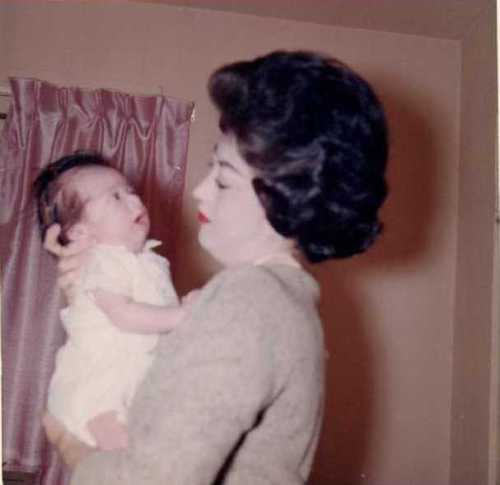
My mother with me in December 1963, a month after I was born.

I stood alone in the darkness of the den last night and wondered how it got to this point.  My mother had a mild stroke one week ago today; paralyzing her entire left side and essentially rendering her immobile.   She is now in a rehabilitation facility.  With dementia clouding her judgment and comprehension, I almost felt like I was abandoning her to a bedridden life.

Both of my parents were among the roughly 100% of the population declaring they would never end up in a nursing home.  In the months before he died, my father insisted on returning to this modest suburban home to pass away.  He did not want to be in a hospital or any other facility hooked up to machinery, barely surviving off IV drips.  I was able to grant him that wish.  Who wants to die in a hospital anyway?  I believe only a workplace is the least desirable place to expire.

But here my mother is in a place filled with elderly and disabled people.  I got a bad feeling from the moment I stepped into the building.  The representative I had spoken to on the phone earlier on Friday told me the structure was older.  Indeed, it is!  With severely off-white walls and ceiling light fixtures the color of Neosporin, the place looks like it’s witnessed every national event since the Vietnam War.  I didn’t expect the rooms to be equivalent to 5-star Bahamian resorts.  But they’re Spartan appearance is just one step above a prison cell.

Aging building features aside, I have to concede the staff seems nice – at least the ones I’ve met so far.  That, of course, is far more important than cosmetics.  The facility has a high rating from business and health associations.  I’m concerned mainly because the state of Texas has become a critical focal point in elder abuse within nursing home facilities.

I’m also worried because I’ve never been put in this situation before.  I had promised my parents I’d never let this happen – being placed in a…facility.  But how does one prepare for such an event?

Life takes such a strangely circuitous route.  When we’re born, we’re totally helpless; dependent on others to ensure our survival.  As we reach the end of our lives – hopefully many years later – we enter another stage of fragility.  The human body winds down and shows its age.  Like a building.

So how did we end up here?  It’s just what happens to many people.  My primary hope right now is that my mother can endure proper physical therapy to get her ambulatory enough to return home.  If she could walk – even with an aid – that would make a world of difference.  Besides, I’d promised my father years ago that – should he die first – I’d take care of my mother.  And I feel if I violate that oath, he’ll return to cripple my hands where I can’t tap on a keyboard to write my stories and make snarky comments on this blog.

Shortly after moving here in December of 1972, I stopped my father amidst the unpacking and asked if he’d noticed something unique: silence.  We’d moved from a garage apartment near downtown Dallas to this newly-developed area.  It had been mostly ranchland and, for years, a large pasture stretched out behind our house.  We’d often see cows grazing, along with the occasional bull.  But relocating from a heavily-trafficked urban neighborhood to here was utopian.

I kept asking myself last night – having downed plenty of vodka and orange juice – how we got to this point.  Things happen, I finally realized, and people get old and disabled.  The alternative is not too pleasant.  But this is the way it is.  And it’s not infinite.  It’s this anomaly called life.

Leave a comment

Filed under Essays

Flush Royal

The announcement of the summit alarmed everyone.  They didn’t know what to make of it.  What would happen?  So, as the key players gathered, many held their collective breath.  Others dismissed it as the usual pomp and circumstance.  Again, interested parties wondered, what would come of this?

Was it another meeting between Donald Trump and Vladimir Putin?  Had the World Court convened to mediate yet another dispute between Israel and Palestine?  Did México’s president finally agree to pay for that border wall?

No, it wasn’t anything that dramatic – except for the tabloids.  Queen Elizabeth II had summoned members of her immediate family to discuss their royal duties.  More specifically if Prince Harry and his wife, Meghan, really did plan to step back from their title-bound obligations.  And, once again, the American press focused so much of their time and energy on this sudden turn of events.

Yet, amidst the chaos, I have to make a very simple inquiry: WHO CARES?!

Seriously!  With all due respect to my British friends, acquaintances and fellow writers and bloggers, the average American citizen doesn’t give a damn what happens with the British royal family!  And I suspect many average Britons don’t care either.

But here we are – AGAIN – with several American media outlets wasting more of their – and our – time telling us what that group of entitled bluebloods are doing.  A while back they spent a great deal of time revealing that Prince Philip had decided to retire from his royal duties and remain at Buckingham Palace, the Windsor family’s primary abode; an 800-room monstrosity that dates to the 18th century.  How does one retire from duties that really aren’t a job?

My mother retired from the insurance industry at age 70.  She gets two pensions, plus social security.  She literally worked for half a century – dealing with gender and racial harassment; gossipy coworkers; rude customers; and unsavory managers.  I recall her bringing work home sometimes, just so she could get caught up – although she didn’t get overtime.  That was on top of helping my father raise me and tending to the house.  She also had to deal with migraine headaches, which often struck in the midst of meetings and conference calls.  Gosh, did Prince Philip have to deal with that shit?

Ever since Prince Charles and Lady Diana Spencer wed in 1981, the American press has held an incredible fascination with the British monarchy.  I have to concede that Diana had more class, grace and style than the entire Windsor family combined.  I’m actually glad that her sons, William and Harry, inherited both her looks and her sense of generosity.

But, if you take away all of their regal extravagance, the Windsors would qualify as little more than trailer park trash here in the U.S.  And, in all fairness, I’ve known people who lived in trailer parks and had more class than the Windsor clan.

Since the United States has such a close relationship with Great Britain – it’s from their tight grasp that we were born – I suppose it’s natural many of my fellow citizens would be enamored with British royalty.  After all, we aren’t similarly obsessed with the royal families of India, Japan, the Netherlands, or Spain.

But, as an average American whose taxes help fund the livelihood of the First Family (in this case, the Trumps, already among the wealthiest families in the world), I have to point out that it is average Britons whose tax money funds the livelihoods of the Windsor family.  While Great Britain suffered through severe economic downturns in the immediate aftermath of World War II and through subsequent national events – such as IRA bombings and coal miner strikes – money was still being sucked out of the paychecks of working people so the Windsors could move from one grand home to another and gallop across the globe.  It’s British taxpayers who finance those extravagant state dinners at Buckingham Palace where only the rich and powerful can partake of exquisite meals.

Twenty years ago Prime Minister Tony Blair made a concerted attempt to tackle child poverty in the U.K.  At the time officials estimated approximately 34% of children in Great Britain lived in households impacted by poverty.  Blair’s goal was eliminate poverty – or at least severely reduce it – within a generation.  Sadly, results have been mixed.  But at least he tried.

The U.S. president is more intent on spending billions of American dollars (tax-payer money) to build a wall along our southern border to keep all those varmint Mexicans out.  Never mind that my Indian and Spanish ancestors had dominated the region long before there was a United States or a Trump family.  That, of course, is a different history.

I suspect much of the child poverty in England could be resolved by pulling money out of the coffers of the Windsors and inserting into health and education programs specifically aimed at children and working families.  The U.S. could do something similar with taxes levied against the largest corporations and wealthiest families who already don’t pay much in taxes.  Families who – much like the Trump clan – feel they’re somehow entitled to their luxurious lifestyles; an existence for them that comes at the expense of we lowly peons who struggle with increasing costs of living on a daily basis.

I don’t know what will come of the aforementioned “royal summit” and, of course, I DON’T CARE!  Plenty of English citizens are opposed to the Windsors and to the general concept of a royal family.  We certainly know what France and Russia did to their monarchies.  I don’t wish a similar fate to befall the Windsors.  But it wouldn’t hurt them to relinquish Buckingham Palace to the city of London to be transformed into a museum.  Their plethora of jewels possibly could fund complete renovations of every single school building in the U.K.  Elizabeth and Philip could sell off the bulk of their homes, and the entire clan could settle quietly into a single multi-room estate and write books about their privileged lives as a source of income.

See!  If we average people ruled the world, there would be no war, poverty, sick and hungry children or overpriced state dinners.  And everyone would have a place at the table!

Leave a comment

Filed under Essays

About the Last Decade…

“I saw the decade in,

When it seemed the world could change,

At the blink of an eye.”

Jesus Jones – “Right Here, Right Now

I have to wonder what is it about this last decade that makes it unique.  How do we define the 2010s?  It seems to be a modern quandary.  Since the 1920s, the United States – and perhaps, much of the world – has viewed itself in terms of decades.  Every ten-year period for the past century has been defined by certain cultural and political events and movements.

The 1920s were known as the “Roaring 20s” and the “Jazz Age”.  It was a decade of extraordinary prosperity, the maturity of the film industry, jazz bands, raccoon coats, flappers, bootleggers and marathon dancers.  The 1930s were dominated by the “Great Depression”; a calamitous effect of those “Roaring 20s”.  It also became renowned for the equally disastrous “Dust Bowl”, bank robbers, the rise of fascism in Europe and many precursors to World War II.

The 1930s started as the previous decade came to an end and spilled into the 1940s, which then became known as the “War Years”; its connection to the Second World War sealed in blood and stone.  Sorrow and patriotism marked that period, but hope also rose up from the sands of despair.  American dominance across the globe began to take shape in that decade.

The 1950s saw the greatest economic expansion in modern world history, as a new “Middle Class” took control of the American experience.  The Second World War metastasized into the Cold War, as Communism began rampaging across Europe.  The Korean War was a brutal stain on this time of prosperity, which also became known for a dual sense of conformity and fear.  The various civil rights movements that would dominate the latter half of the 20th century began fomenting in the 1950s.

The 1960s were a cataclysm of generational clashes, which started with the election of John F. Kennedy.  The decade commenced as a mirror of the previous decade.  But all of the chaos that defined the 60s had begun rumbling in the 50s, like a volcanic caldera.  People who had done everything possible to secure their right to freedom and happiness exploded with anger that they had achieved little in many respects.  Their hostility shocked the staid American populace, as the decade also saw the space race take shape; political assassinations; the Vietnam War; drug and sex revolutions; and finally, a man on the moon.

The 1970s began as an extension of the 60s, but it saw an explosion of artistry in music, television, cinema and literature.  It also experienced cultural and technological innovations.  On the down side, it was scarred by the first resignation of president in U.S. history; a humiliating end to the Vietnam conflict; energy crises; and finally, an even more humiliating hostage situation with Iran.

While the 60s were often called the “We Decade” and the 70s the “Me Decade”, the 1980s became the “Gimme Decade”; a time when greed became good, hair and women’s shoulder pads grew large and overpriced meals grew small.  It spawned the “MTV Generation” and saw the VCR become ubiquitous in American households.  It also experienced the rise of one of the greatest health crises in world history, as AIDS exploded.

The 1990s remains my personal favorite.  Although it began with the “Savings & Loan” crisis and the Persian Gulf War, we underwent economic growth that eclipsed the 1950s and an explosion of technology unmatched in modern history.  The 90s saw multiculturalism and the fruits of affirmative action; DNA science; the collapse of the Soviet Union; right-wing paranoia; and Y2K.

The first two decades of the 21st century, however, seem almost indistinguishable.  The horror of 9/11; a resurgence of patriotism; U.S.-led Middle East conflicts; and the “Great Recession” defined the first ten years.  But, if we had to classify the 2010s, how would we so it?  What would we say?

I feel it’s been almost a complete reversal of two centuries of civil rights progress.  The birth of the “Tea Party” in 2010 wasn’t so much a vitriolic dissatisfaction with the tax system in the U.S. (Taxed Enough Already), but rather, the election of the nation’s first biracial president.  That seemed to upend all that was considered normal in this country; an obliteration of long-held norms.  The “Tea Party” boasted a few Asian, Black and Hispanic members; all tokens working on behalf of the Old White Male, who went from just ‘angry’ to downright ‘enraged’.  So-called “birtherism” mixed with the complete and total disrespect Republican politicians had for Barack Obama.  In response, Republican-dominated state legislatures (including my beloved Texas) became determined to dismantle decades of voting rights by limiting early voting periods and enhancing voter identification methods; all in an attempt to undermine a mythical rash of voter fraud.  In reality, they were just appalled that a Negro (a half-blooded one, but a Negro nonetheless) could make it into the highest political office in the land.  Fortunately, they’ve been stalled by various judges at almost every step.  In retaliation for the Obama years, many voters became determined to get just about any old White man into the White House.  Thus, we ended up with the cantankerously disoriented Donald Trump.  I told myself repeatedly during the disastrous George W. Bush years that I’m not ashamed to be an American.  But Trump’s tenure has made that sentiment exceptionally difficult.

As with any serious economic downturn, the “Great Recession” made America turn inwards during the last decade; with non-Whites and immigrants suffering the usual brunt of antagonism and fear.  What should have been a time of extraordinary prosperity – coming off the 1990s – mutated into lackluster economic growth in the 2000s and ardent despair in the 2010s.  Literally millions of people lost their jobs, homes and savings, as the large corporations (particularly the monstrous financial institutions) that fueled the near-total collapse got bailed out.  And – with a few high-profile exceptions – no one went to jail.  Where was my tax relief?

The trickle-down economics bullshit that forms the basis of conservative financial ideology got a steroid-type boost with the Afghanistan and Iraq wars and intense deregulation of those dreaded banks.  That furthered the expansion of wealth inequality that makes the “Gilded Age” look juvenile.  The “Gilded Age” – to anyone wary enough – created an anarchist movement that took root in the slums of Europe and Latin America before seeping into the U.S.  It came close to a rebirth with “Occupy Wall Street”, but I still believe a full-fledged revolt is possible.

I guess how we define any period in our lives is how we define ourselves.  If we like where we are in life, then times are good.  It’s always purely subjective.  As introverted as I am and as pessimistic as I may seem to some, I still hope the 2020s experience an eruption of more progressive national ideologies; such as advances in science and medicine and greater funding for education and health care, instead of war and tax breaks for a select privileged few.  Where we go from here is often dependent more on our own aspirations than on fate and acts of God.  The sun hasn’t set on hope, if we look at hope as concept ahead and not behind.

Leave a comment

Filed under Essays

One Last Angry Clarion Call

Trump looking out in anger.

“It seems clear that [Attorney General William Barr] will do or enable anything to keep Trump in office.  And Trump will do anything to stay there.  Suspension of the election, negation of the results, declaration of martial law are not simply fanciful, alarmist or crazy things to throw out there or to contemplate.  Members of Congress, governors and state legislators, leaders in civil society, lawyers, law enforcement figures and the military need to be thinking now about how they might respond.”

Norm Orenstein, Chair of American Enterprise Institute of Public Policy Research

Donald Trump has joked recently that he might not leave office after a second term, as mandated by the 22nd Amendment to the U.S. Constitution.  This particular amendment was ratified in response to the 12-year tenure of Franklin D. Roosevelt.  The original authors of the Constitution had never intended for any elected Chief Executive to hold the position as if it were a divinely-inspired monarchy.  They certainly didn’t anticipate Roosevelt, but they most likely designed the Constitution with concerns about scandalous characters like Trump.  Our 45th Chief Executive made his claim about an extended presidency last month at a conference of the conservative Israeli-American Council in Hollywood, Florida.  I’ve always found it oxymoronic – downright hypocritical, actually – that Trump bears such ardor for Israel and the Jewish people, while openly courting White supremacists.  But that’s a different subject.

The thought of Trump holding just one term in the White House was frightening enough three years ago.  That he could be elected to a second term is deeply unsettling.  That he could somehow forcibly remain in the office even one day longer makes the bloodiest horror films look like Hallmark greeting card commercials.

Yet Trump is delusional enough to believe that’s a real possibility, and he has plenty of supporters who would be comfortable with such a scenario.  Those of us who live in the real world understand this simply could not be allowed per that pesky 22nd Amendment.  Still, even some constitutional experts have surmised Trump might make such an attempt.  That would be reality TV at its worst!  Richard Nixon quietly left the White House, following an impassioned farewell speech to his staff, in August of 1974.  There were no guns blazing or hand grenades exploding.  Nixon and his family weren’t spirited out of the White House through a tunnel to avoid angry mobs of detractors.  The Nixons simply strolled onto the South Lawn, accompanied by newly-appointed President Gerald Ford and his wife, Betty, to Marine One.  The helicopter made the loudest sound of anything.  That’s how a peaceful transition of power occurs, even in the most dire and tense of situations.

With Trump, I can almost see him and his wife, Melania, scurrying through that tunnel in a setting reminiscent of Romania’s Nicolae and Elena Ceaușescu.  I honestly don’t believe it will ever come to that sanguineous of a climax.  Yet, I wouldn’t put it past the infantile Trump to grip onto the door frame of the master bedroom.

But, while Trump’s behavior can’t be taken too lightly, another aspect of the current American experience that definitely shouldn’t be dismissed is the effect Trump’s presidency has had on his faithful minions and the sentiments that put someone like him into office.  Decades of socially progressive behavior and legislation gave us Barack Obama and others like him; individuals who didn’t meet the traditional standard of those in position of power.  In other words, Obama and others weren’t White males.  Just a half century ago it was inconceivable that someone like Obama could ascend to the highest elected office in the land.  It was unimaginable that Nancy Pelosi would be the one banging the gavel in the House of Representatives.  Only a handful of visionaries thought it possible that Hilary Clinton could be a serious contender for the presidency, or that Pete Buttigieg could live openly gay AND serve in the U.S. military AND talk about having a “husband.”  People born, say, since 1990 have no idea what a vastly different world it is today than in the few years before their time.

Now, it seems the nation has digressed with Donald Trump.  Decades ago, Ronald Reagan aspired for America to return to a time before the 1960s messed up everything.  That was a simpler time for him and others just like him.  But it meant Blacks sat at the back of the bus; women sought nothing but marriage and motherhood; queers remained in the closet; and Native Americans languished as comical figures on TV screens.  The 1960s may have messed up the world for the likes of Reagan and Nixon, but it opened up the universe for everyone else.

As I marched through my junior year in high school, I began receiving phone calls from a man with the local recruiting office of the U.S. Army.  I believe I’d spoken to him at least twice, before my father happened to answer the phone one day; whereupon he politely told the man that I had plans for college and that he and my mother were determined to ensure I get there and graduated.  Just a few years later I’d openly stated I had considered joining either the Navy or the Marines.  And each time my father talked me out of it.  In retrospect, I understand why.

As a naïve high school student in the late 1940s, my father had been convinced NOT to take a drafting course and instead go for something in the blue collar arena.  “Most Spanish boys do this,” is how he quoted the female school counselor telling him.  My father liked to draw and – much like his own father – had the desire and talent for an architectural profession.  But he’d been talked out of it.  Because that was what most “Spanish boys do”.  College was for White guys.  Trade school and the military were for everyone else.

Years of struggle – working twice as hard for half as much – and assertive civil rights action had led America to the early 1980s, when I graduated from high school.  And didn’t have to join the military.  In the spring of 1983, I was sitting in a government class at a local community college, when the instructor asked, “What do we owe minorities in this country?”

Seated in the row in front of me was a young man who had graduated with me from the same high school.  I knew his name, but I didn’t know him personally.  Without missing a beat, he muttered, “Nothing.”

Only the few of us nearby heard him.  He was White, as was most everyone else seated on either side of him.  From my vantage point directly behind him, he looked angry; as if he’d been robbed of something that was rightfully his.

I finally spoke up and informed the class that “this country” owes the same thing to minorities that it does to everyone else: equality and fairness; “the right to life, liberty and the pursuit of happiness”, as prescribed in the Declaration of Independence.  I added, “Nothing more, nothing less.”

That one young man and the others nearby nodded their collective heads and looked at me, as if I’d said something unbelievably profound – which, to them, it may have been.

That level of total fairness and freedom hasn’t been easy.  But nothing so monumental as dramatic cultural changes are.  The Civil War, for example, ended more than 150 years ago.  Yet, some people in the Deep South of the United States still can’t let that go.  They still insist it was a war over states’ rights, not slavery.  They’ve been fighting that conflict all these years and they still haven’t won!

That’s a little of what Donald Trump’s presidency is all about: a bunch of old-guard folks wanting to maintain things as they were way back when.  And it’s just not going to work for them any longer.  The old White Republicans dominating the U.S. Senate disrespected Barack Obama as much as they could without making it too glaringly obvious.  They did everything they could to undermine his presidency and essentially failed at every step.  If anything, they only hurt the country and their reputations.

Social and political conservatives can’t return to an America of the 1940s and 50s any more than liberals can return to an America of the 1990s.  Memories are forever, but time marches onward.  It always has and it always will.  Trump’s presidency may be the final battle cry of the angry White male.

But we can’t go back to whenever.  Time continues.

1 Comment

Filed under Essays

10 After 20

“Nothing in life is to be feared. It is only to be understood.” – Marie Curie

Here we are!  It’s 2020 – the start of a new year and a new decade.  Forty years ago I was excited about the prospect of witnessing and understanding the birth of a new decade.  I had just turned 16 and couldn’t remember 1970.  But this was different.  A whole new decade!  As my parents and I often did, we staged a New Year’s party in 1979; inviting family, friends and neighbors.  I had taken the time to cut up strips of multi-colored paper into literally thousands of squares, which I then tossed into the air from a large brown paper bag at the stroke of midnight.

I was considerably more excited ten years later, as we welcomed the 1990s, which – even now – remains the best decade of my life.  I was a young adult by then, working for a major bank in Dallas; a small personal accomplishment that made me feel I was finally a part of society and not some frustrated observer on the outside looking into a seemingly untouchable world.  During that time I began making concerted attempts to become a published writer and even contemplated returning to college.  These latter two dreams each wouldn’t materialize for more than another decade later.

The turn of the century – and the millennium – was one of the most exciting moments I’ve ever experienced.  Like the dawn of the 1990s, it remains a high point of my life.  Twenty years ago the world looked more hopeful and inviting.  I wasn’t nearly as excited about the 2010s.  Things had grown kind of awkward for me by then.  But it’s come and gone.

So alas, we are at the threshold of the third decade of the 21st century.  Every New Year’s bears the excitement of a renewal; a chance to alter our priorities and improve our stations in life.  Yet, it’s different with the start of a new decade.  Since the early 1900s, societal changes have occurred rapidly.  For millennia, time periods were designated by century; now they’re often designated by decade.  Each ten-year interval boasts its own cultural shifts; fashion and music trends; and political dynamics.  As our life expectancy increases, so does our concept of time.

I’m approaching this decade with more caution, however.  As I tend to do, I maintain a safe distance and analyze the universe around me and wonder what more can be done to improve not just my life, but everyone’s lives.

These last two decades have seen an explosion of technological and cultural advances, both here in the United States and across the globe.  But, in many ways, things haven’t changed much.  I’ve focused my concern on how dismal our political and economic well-being have become.  The pathetic presidency of George W. Bush and the ever-increasing disorientation of the Donald Trump administration have set us back on many levels.  Unlike 20 years ago we now have the greatest wealth gap in over a century.  The first decade of the present century should have been an extraordinary time of progressive social and technological advancement.  Yes, everyone seemingly has a cell phone and a personal computer.  But so many promising visions of the future were lost to Middle East conflicts and an extreme level of corporate deregulation.  The “Great Recession” squashed hope for many people across the nation.  While many of my fellow Americans wonder if Bitcoin will make a resounding return to the financial sphere or what latest cell phone apps will be available in the coming months, I’m contemplating the grander picture.

In the 19th century, the U.S. built the world’s first transcontinental railroad system and helped create telephones and electric lighting.  At the start of the 20th century, we sent men into the air and then constructed the world’s largest highway system.  In 1962, President John F. Kennedy issued a challenge to the nation; wanting us “to go to the moon in this decade and do the other things; not because they are easy, but because they are hard.”  And, we did just that!  Just seven years later, Neil Armstrong became the first human to set foot on the lunar surface.

The 1960s and 70s saw the birth of various civil rights movements: women, non-Whites, and gays and lesbians.  That forced America to live up to its promise to be a land of equality and prosperity.  We finally began seeing the fruits of those movements in the 1990s.

Yet here stands the U.S. – still mired in Middle East conflicts and dealing with an economy that, on the surface, looks extraordinary.  But those of us struggling with medical bills and increasingly high costs of basic living aren’t exactly thrilled that the U.S. stock market is functioning wonderfully for large corporations that don’t often pay their taxes and feel they have the unquestionable right to contaminate the environment in the name of profit.

Although I’m an introvert, I remain optimistic and would like to see society achieve some grand accomplishment over the next 10 years.

Infrastructure – As of 2017, the American Society of Civil Engineers (ASCE) gave the U.S. a grade of D+ for infrastructure.  That’s an overall assessment of everything from bridges to railroads.  To say they’re falling apart is dismissively juvenile.  A grade is just a letter, but the implications are dire.  In 2007, a section of Interstate 35 through Minneapolis collapsed, killing 13 people and injuring 145.  But, nearly 13 years later, the U.S. is still spending more on military intervention in the perpetually-chaotic Middle East than making serious efforts to rebuild, or even refurbish, highways like I35.  The ASCE estimates the nation will need up to 4.5 trillion USD to repair or rebuild much of our infrastructure by 2025.  It’s one critical issue on which elected officials of all political stripes might agree.  Instead, we have a president who wants to spend even more money to build a wall along the nation’s southern border with México.  I can’t even contemplate how much that would cost.  Knowing the U.S. federal government, though, it would be much more than initial estimates.  Still, as I move around my own local area, I notice roads that have been under construction since the start of the last decade!

Subterranean Power and Telecommunication Lines – In September of 2017, Hurricane Maria rolled over Puerto Rico as a borderline category 5 storm.  With an estimated cost of 94 billion USD, it stands as one of the most expensive natural disasters in U.S. history.  And Maria didn’t even reach the American mainland.  As with most such calamities, residents in the impact zones lived without power, which includes clean water.  Like Andrew did to Florida in 1992, and Katrina to the Gulf Coast in 2005, Maria destroyed a substantial number of power and telecommunication lines across Puerto Rico.  Our government’s response?  USD 5 billion in aid and a president tossing paper towels into a raucous crowd.

Tropical storm systems aren’t our only nemesis.  Currently, the U.S. is dealing with yet another round of powerful winter weather, with strong winds flipping vehicles and blizzard conditions hampering travel.  It’s not uncommon for massive weather phenomena to impact more than 100 million people.  Last October the Dallas, Texas area experienced a rash of tornado outbreaks.  But that’s just in one city in one state.  Other areas across the country have been struck by these meteorological vortexes.  And, of course, power and telecommunication lines are among the casualties.

The same happens after floods, tornadoes, wildfires and earthquakes.  Humans can never control Earth’s natural elements.  Every time we’ve tried, those elements remind us who holds the true power.  Still, we can lessen the severity of unruly weather by burying as many of our power and telecommunication lines underground as possible.  It’s nothing new.  People have been pushing this concept for years.  And there are the usual detractors.  Although a number of power and telecommunication lines have already been interred, opponents claim they’re not always more reliable than overhead lines.  While overhead lines experience more outages, subterranean lines are generally more difficult to access and repair when problems with them do arise.  Another obstacle, of course, is funding.  There are greater costs associated with the installation of subterranean lines.  The costs would have to be passed down to consumers somehow.  But, I feel it’s all worth the financial burden.  Ultimately, it costs people more to go without power – both in actual money and lives lost.  The expenses incurred with the initial installations and ongoing maintenance will more than pay for themselves in the ensuing years.

Space – Since humans first looked up to the sky and began studying the stars, we’ve wondered what it would be like to fly and visit another celestial body.  Now, we’ve taken flight and ventured onto the moon.  The next logical step would be Mars.  Plenty of people – from Elon Musk to Mars One – are making a concerted effort to get there.  In the 1970s, the U.S. became the first nation to reach Mars with the Viking I and II voyages.  We’ve done it again recently with the Curiosity mission.  The U.S. space program was good for the country and the world, as it spurred a number of technological developments; mainly with telecommunications, but also with engineering and robotics.

Sadly, if the U.S. wants to send humans to the moon now, we couldn’t do it.  We’ve let that go.  Again, it’s the war factor – more money spent on Middle East conflicts than on things that really matter.  But I would like to see the U.S. rejuvenate its space program and begin establishing a lunar colony; thus making interplanetary travel materialize from the pages of science fiction into reality.  And, of course, we should make a concerted effort to send a craft with humans to Mars by the end of this decade.  There’s more technology in a single Smart Phone than there was in all of the Apollo 11 lunar module.  We can make this happen.

Thousands of years ago humans thought Earth was the only place in the universe that harbored any semblance of life.  We’re starting to realize that’s not true.  We exist on this third rock from the sun, but I’m certain we have never been alone.  And, even if we are (by some odd fluke of nature), what’s to say we can’t venture outward and make our world more hospitable?  If we rise above our own political and social distractions, we’ll understand we can do better than this.  We have to do better.  I can’t imagine us living in a world of such chaos and uneasiness.  Throughout this next decade, we have to move forward.  Time will.  We have to follow it.

Photo by Josh Sorenson.

Leave a comment

Filed under Essays

Trauma Nation

“Never let yourself be persuaded that any one great man, any one leader, is necessary to the salvation of America.  When America consists of one leader and 158 million followers, it will no longer be America.”

Dwight D. Eisenhower

From a political standpoint, this has not been a good week for the United States.  On Wednesday, the 18th, the U.S. House of Representatives voted to impeach President Donald Trump.  Trump now holds the dubious distinction of being only the third Chief Executive to be recommended for removal from office.  As much as I personally despise our Russian-elected president, I’d rather see him voted out of office next November than be forcibly removed.  It would be the single strongest message to Trump and his band of right-wing sycophants that their extremist ideology is of no use to the American populace.

But the impeachment process hints at a failure in our national leadership and puts the institution of voting into question.  As the oldest continually-functioning democracy in the world, the U.S. has always been a beacon of freedom; our constitution an enviable guide to how a nation should operate.  Our right to vote is a core element of our very national existence.  It’s the heart of our democratic soul.  The president of the United States is often deemed the leader of the Free World.  That other elected officials would seek to oust him from that pinnacle slashes at our democratic heart.

I’m old enough to remember Watergate.  Even people who considered themselves staunch conservatives had to concede that President Richard Nixon was as crooked and devious as his detractors made him out to be.  On the night Nixon announced his resignation, millions of Americans tuned into the live broadcast.  Afterwards there was no sense of real jubilation.  As the nation inched closer to its bicentennial, most people – including my parents – felt sad.  When Nixon left the White House, the transition of the office occurred at the tip of a pen, instead of the barrel of a gun.  After all, we didn’t live in a third-world society.  No tanks, no bombs and no bloodshed.  Still, Americans asked, how did we get to this point?

I definitely recall the Clinton impeachment fiasco.  My brain and body became flush with anger at the self-righteousness of the Republicans Party.  They had done everything to undermine Bill Clinton’s presidency – even before he won the Democratic Party’s formal nomination.  And they failed.  Their bloodthirsty overreach extended shamelessly to the president’s secretary and the mother of the woman who kept that infamous blue dress.  They paid the price for their arrogance in the November 1998 midterm elections.  They lost their super-majority in both houses of Congress.  Conversely, the Democrats gained seats; the first time the same party as the president attained positions in the House and the Senate in a midterm election since 1942.

And now, here we are – for the second time some twenty years – at the threshold of usurping the leader of the Free World.  How did we get to this point?  As I wrote in an essay two years ago, impeachment should not be taken lightly.  Neither politicians nor average citizens should become obsessed with it.  A sanguineous mindset traumatizes the national soul.

With the term “impeached” now added to the title of President, Donald Trump’s place in political history has been secured – unpleasantly and distastefully carved into the American psyche.  He cannot escape it.  Deny it, yes, as his narcissistic persona is already doing.  But – like the sky – it’s ubiquitous and unmalleable.

How painful for this nation.

Leave a comment

Filed under Essays