Tag Archives: discrimination

Draft Well

Recently President Trump signed an Executive Order that will impact military readiness in the U.S.  Beginning in December 2026 all able-bodied males in the country will be automatically registered for Selective Service (the military draft) upon turning 18.  The late former President Jimmy Carter reinstituted the Selective Service system in 1980, requiring all males born in the U.S. since 1960 to register for the draft within 30 days of their 18th birthday.  A number of lawsuits against the system in the following decades have failed to reverse the policy.

The penalties for failing to register are severe:

  • Fines up to $250,000 and/or 5 years in prison.
  • Ineligible for federal jobs and many state, local, and municipal positions.
  • Ineligible for federal student financial aid (FAFSA), including Pell Grants and federal student loans.
  • Non-citizens can be denied citizenship (naturalization).
  • Roughly 40 states and Washington, D.C., deny driver’s licenses or renewal for non-registration.
  • Ineligible for training under the federal Workforce Innovation and Opportunity Act.

Yes…a $250,000 fine and up to 5 years in prison…for failing to register to serve (unwillingly) in the military of a nation that still maintains an incredibly unequal justice system and wealth structure.  (Understand that Casey Anthony and George Zimmerman each murdered someone and got away with it.)

Again, this system only applies to men. 

Now Trump wants to make it more difficult to evade compulsory military service.  Well…he should know.  Like his Republican predecessor, George W. Bush, he did just about everything he could to avoid compulsory military service more than a half century ago.

One of my best friends, Preston*, has two 20-something sons and voted for Trump during all three of his presidential runs.  As the 2024 elections approached, he expressed concern that a Kamala Harris presidency would result in military action in Ukraine; meaning Harris would enact the military draft, and his sons could be impacted.  I was concerned about that, too, but I was more concerned that Trump would get back into office and take military action against Iran; the same way Bush invaded Iraq under the false pretense of protecting the world from an Iraqi-based nuclear war.

I was right.

Trump got into office and – under the guise of safeguarding the globe against an Iranian-inspired nuclear Armageddon, as well as defending Israel – attacked the Middle Eastern county.  Now, Preston is even more worried.

So am I.

In August of 1990, Iraq unexpectedly invaded Kuwait.  Fearful they were the next targets, the Saudi royal family fled their palaces and asked the U.S. for help.  As that year came to an end, then-President George H.W. Bush sent troops into the Saudi desert.  Ultimately Iraqi forces surrendered without much of a fight, but about 300 U.S. service personnel died in battle.  Shortly before the conflict erupted, Saudi leadership – still safely ensconced abroad – demanded that our people in uniform remove emblems of the U.S. flag from their attire.  They somehow found it offensive.  Bush bowed to the Saudi sheiks and ordered the removals.

Pull our boys out, was the first response from most U.S. citizens, including me.  It was an outrage.  If it hadn’t been for American demand for oil, the Saudis would still be living in ornate tents in the desert, picking sand fleas out of their ass.  The Bush family’s loyalty to the Saudi regime became apparent in the immediate aftermath of the September 11, 2001 terrorist attacks, when the Bush Administration allowed several Saudi nationals to leave the U.S., while other travelers remained trapped at airports and hotels.

Shortly before the Persian Gulf War began, I visited my local gym and heard one young man ask another, “Ready to go?” in reference to the conflict.

I was 27 then and thought it was a real possibility knowing our political leaders’ penchant for war.  My father – who had been drafted into the U.S. Army and sent to Korea nearly four decades earlier – was also concerned.  He became especially incensed when the Saudi royal family demanded U.S. military personnel remove the American flag emblems from their uniforms; cursing the clan in both English and Spanish.

Throughout Bill Clinton’s presidency, his right-wing adversaries condemned his lack of military experience; labeling him with that dreaded “draft-dodger” moniker.  From 1968 to 1970, he was a Rhodes Scholar at the University of Oxford where he openly protested the Vietnam War.  But a large number of American expatriates did.  When he returned to his native Arkansas, he placed his name back into the draft lottery (to maintain his “political viability”) and drew a high enough number not to be sent into the conflict.

As the 2000 presidential election arose, conservatives were eager to prop up only one man: then-Texas Governor George W. Bush.  The eldest son of the nation’s 41st President, George H.W. Bush, the younger Bush graduated from Harvard in 1968 – and found himself eligible for military conscription.  He immediately managed to secure a position in the Texas Air National Guard (at a time when such spots were sparse and difficult to obtain).  After his initial four year stint was over, he reenlisted and then somehow was able to switch to the Alabama National Guard; in part, he later said, to work on the presidential campaign of George Wallace.  That second hitch should have been completed in 1976.  But no real record exists of Bush completing his service.  And then – as things tend to occur – misfortune arrived and Bush’s military records mysteriously disintegrated in a warehouse fire.

Bush’s Vice President, Dick Cheney, also came under scrutiny for his lack of military service.  During the 2000 campaign, Cheney declared he had “other priorities” during the Vietnam fiasco; receiving a number of draft deferments – mostly educational and one because he was a new father.

The same band of right-wingers who excoriated Clinton for his lack of military service weren’t so quick to demand a full accounting from either Bush or Cheney.  Also, in 2000, then Sen. John McCain sought the GOP nomination.  Coming from a long line of U.S. Navy officers, McCain served in Vietnam and was a pilot shot down over Hanoi in 1968, captured by enemy forces and held hostage for five years.  But the Bush political machine had the audacity to question not only McCain’s military service (which was there for all to see) but also his patriotism.  The same flag and country crowd who had demonized Clinton suddenly had no qualms belittling a real American military hero.

Now we come to Trump.  Donald “bone spurs” Trump.

No one has a desire to do something unpleasant – like pay taxes or wait in line at the grocery store.  And certainly nobody wants to go to war.  War is not just ugly; it’s stupid and pointless.

One Saturday evening in the late 1970s, my parents hosted a few friends over for a casual gathering.  Among them was a longtime male friend who brought along a young woman we hadn’t met before.  She seemed pleasant enough.  At some point, during a discussion, the subject of the Vietnam War came up.  The U.S. had just fled Vietnam in an ignominious defeat a few years earlier.  All of the men in the group had served in the U.S. military.  A few of them, including my father, had been drafted.  The aforementioned young woman mentioned that a young man she had been dating about a decade earlier had failed to heed his conscription notice and – apparently feeling intensely patriotic – reported him to some authority.  She said he got drafted anyway.

I remember the brief quiet that settled over our cavernous den.

“Wow,” my father finally muttered.  “How brave of you.”

And the conversation ended.

Don’t ask someone to do something you’re not at least willing to try – which is one reason why men have no business demanding women get pregnant.

I’m genuinely worried about Preston’s sons, as well as for any other young man who may get swept up into this conflict-laden world.  But I’m concerned for the greater population.  Despite all the patriotic bravado, the 2003 Iraq War really was about gaining access to the region’s oil.

I see the same outcome with Iran.

*Name changed

3 Comments

Filed under Essays

Shifted

The U.S. Supreme Court ended its first term of 2023 last month with some stunning decisions – stunning, but not surprising.  A year ago the Court finished with its shocking reversal of the 1973 landmark Roe v. Wade, which had legalized abortion in the United States.  Ending abortion in this country had been a long-standing goal of social and religious conservatives and they finally accomplished that mission.  But this time the Court went further in their swing to the far right by ending affirmative action in college admissions and allowing religion to be used to discriminate.

In Students for Fair Admissions, Inc. v. President and Fellows of Harvard College, the Court ruled that the admissions programs used by the University of North Carolina and Harvard College violate the Constitution’s equal protection clause (the 14th Amendment), which bars racial discrimination by government entities.  The 14th Amendment has been utilized to undermine entrenched discrimination for decades.  It has manifested its power in such SCOTUS decisions as Brown v. Board of Education of Topeka and Miranda v. Arizona.  Ironically, the Students for Fair Admissions ruling reversed a 20-year-old case, Grutter v. Bollinger, which declared race as a plausible factor in college admissions policies.  Have things really changed for the better in two decades?  All of this also reminds me of the Regents of the University of California v. Bakke, in which a White man, Allan Bakke, sued the University of California Medical School at Davis for refusing to admit him; the school had reserved 16 places in each entering class for qualified ethnic minorities.  Bakke had applied twice to the school and been denied twice, despite having a high GPA and test scores.  SCOTUS ruled that, while race was a qualifying factor in college admissions, the University of California policy at the time, indeed, violated the Constitution’s 14th Amendment.

I have to admit I support their affirmative action decision.  As noble a philosophy as it was, I feel affirmative action has run its course, and – as we march further into the 21st century – it’s time we truly become a color blind society.  Actually it’s way past time.  But, as with campaign promises and many business plans, things look great on paper.  Personally I don’t feel affirmative action has helped me.  It hasn’t hurt me, but it certainly hasn’t helped me.  I never asked for special rights or considerations.  But, like I told a friend years ago, while legislation may have forced the playing field to become level, are all the players on the field playing on the level?

It’s the Creative 303 decision, however, that concerns me the most.  Last year the Supreme Court made perhaps its most controversial decision in decades with the Dobbs ruling that effectively ended the constitutional right to an abortion.  But, in the 2022 Carson v. Makin ruling, the Court chipped even further away at that cherished separation between government and religion, when it declared the state of Maine had violated the constitution when it refused to make public funding available to students attending religious schools.  In general religious institutions don’t pay taxes; therefore, they’ve traditionally been unable to access tax money at either the state or federal level.  The reasoning was practical: anyone who receives government funding should follow certain rules and regulations.  People taking unemployment insurance, for example, have to conduct a minimum number of job searches weekly; otherwise, they can’t receive that money.

In the Creative 303 case, Colorado web site designer Lorie Smith had allegedly refused to design a site for someone planning a same-sex wedding; declaring that it was an affront to her religious beliefs and therefore, violated her First Amendment rights.  It’s similar to another case from Colorado, Masterpiece Cake Shop v. Colorado Civil Rights Commission, in which Jack C. Phillips, the owner of Masterpiece, refused to bake a wedding cake for a male couple on the grounds that it violated his religious beliefs; he simply didn’t believe in same-gender unions.  The couple, Charlie Craig and David Mullins, filed suit, claiming Phillips was in violation of Colorado’s Anti-Discrimination Act.  The Supreme Court ultimately ruled in Philips’ favor, decreeing that the Colorado statute violated “the State’s duty under the First Amendment not to use hostility toward religion or a religious viewpoint as a basis for laws or regulations.”

But no sooner had the Creative 303 ruling been made than news arose that Smith may have fabricated her initial claim.  The man who supposedly asked her to design a web site for a same-gender wedding states he never worked with her.  Smith, however, cited the man – identified only as “Stewart” – in 2017 court documents and included his phone number and email address.  But “Stewart” says he didn’t even know his name had been invoked in the original lawsuit until a report with “The New Republic” contacted him.

“I was incredibly surprised given the fact that I’ve been happily married to a woman for the last 15 years,” said Stewart, who declined to give his last name for fear of harassment and threats.  He noted that he’s a designer himself and could have created his own web site if necessary.

One of Smith’s lawyers, Kristen Waggoner, insisted Stewart’s name and other information had been submitted to her client’s web site and denied the entire claim had been fabricated.  But she suggested an internet troll had made the request to Smith; adding that’s it occurred with other clients.  Ironically, the aforementioned Jack C. Phillips was also Waggoner’s client.

Regardless, I have to wonder if this revelation doesn’t render the Creative 303 ruling invalid.  Even if an internet troll had made the initial application, Smith’s attorneys should have verified every detail of the case.  That’s what lawyers are supposed to do.

Getting a matter before the U.S. Supreme Court is no small feat; they don’t take on minor traffic infractions.  That’s why so many of their decisions are monumental and can reshape society.  And thus, it’s why people are rightfully concerned about the implications of the Creative 303 edict.  If religious ideology can be the basis for discrimination, who’s to say a business owner can’t refuse to service a prospective client under such a pretense?  Technically businesses have the right to refuse service to anyone, but that’s generally happened only under the most egregious of circumstances.  A bar or nightclub, for example, can refuse to admit someone who’s visibly intoxicated.  I’ve seen signs on doors declaring “no shirt, no shoes, no service”.

Years ago another friend told me I discriminate whenever I choose one food item over another.  “That’s not discrimination,” I told him, “that’s selection.”  But he was a conservative, so I guess I understood why he couldn’t make that distinction.

Still, I certainly hope many Black, Hispanic and queer conservatives are happy with their votes for George W. Bush and Donald Trump.  Despite not winning the popular vote in their respective elections, they were able to place five justices on the U.S. Supreme Court.  That has never happened before in the history of U.S. legal jurisprudence.  All five of those individuals have now set back decades of civil rights advancements.  A truly democratic society is supposed to protect all of its citizens from bigotry and oppression.  I fear we’re doing the opposite in the United States.

2 Comments

Filed under Essays

Worst Quotes of the Week – May 15, 2021

“We’re not talking about eight-year-olds’ soccer.  We’re talking about post-puberty sports. We’re talking about girls who’ve worked their whole lives to earn a scholarship and not have to worry about being outplayed by a boy.”

Rep. Lauren Boebert, about the proposed Equality Act, which would ban discrimination based on gender and gender identity

Boebert also claimed the bill would lead to “women getting in an MMA ring and having their skulls crushed by a man,” among other things.

“Let’s be honest with the American people – it was not an insurrection, and we cannot call it that and be truthful.”

Rep. Andrew Clyde (R – GA), on the January 6 Capital Hill riots

A gun dealer in his first term in Congress, Clyde compared the riots to a “normal tourist visit”.

“It was Trump supporters who lost their lives that day, not Trump supporters who were taking the lives of others.”

Rep. Jody Hice (R-GA), presenting his version of the January 6 riots

Painting the rioters as victims, Hice noted that four of them died, including Ashli Babbitt who was fatally shot.  The other three suffered medical emergencies while part of the crowd laying siege to the Capitol.  Another victim is Capitol Hill police officer Brian Sicknick.

2 Comments

Filed under News

Photo of the Week – March 27, 2021

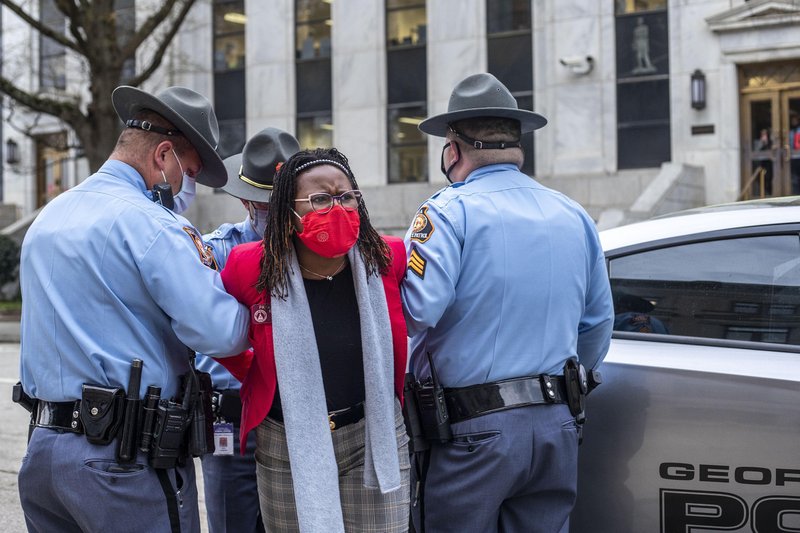
Georgia State Rep. Park Cannon (D-Atlanta) is placed into the back of a Georgia State Capitol patrol car after being arrested by Georgia State Troopers at the Georgia State Capitol Building in Atlanta, Thursday, March 25, 2021. Cannon was arrested by Capitol police after she attempted to knock on the door of the Gov. Brian Kemp office during his remarks after he signed into law a sweeping Republican-sponsored overhaul of state elections that includes new restrictions on voting by mail and greater legislative control over how elections are run.  Photo: Alyssa Pointer/Atlanta Journal-Constitution via AP

To anyone familiar with the history of race relations in the United States, the image of an African-American getting arrested by a bunch of White police officers in a Southern state over a dispute about voting rights is inescapable.

Leave a comment

Filed under News

Equalizing

Recently, Virginia became the 38th of the United States to ratify the Equal Rights Amendment.  It’s been a long-fought battle for proponents of dismantling all barriers to women achieving full and complete equality with males.  Earlier this month supporters became ecstatic when both chambers of the Virginia state house approved the amendment.

“We must begin to see a world without discrimination of any kind,” declared Virginia State Senator Mamie Locke.  “Equality based on sex is not just good for women, it is good for society.”

Ratification of the ERA reached a critical flashpoint in the 1970s, as more women entered the workforce and began seeking higher levels of education than at any time in U.S. history.  When Congress submitted the ERA to the states for ratification in 1972, it gave it a March 1979 deadline for 38 states to ratify it.  They didn’t make it.  In 1979, however, the U.S. Congress gave the ERA three more years to get ratified.  Again, it didn’t succeed.  By then, most judicial and legislative experts declared the amendment dead.  Even the U.S. Supreme Court, the only court to review it, acknowledged that.

Proponents remained undeterred.  The slew of legal machinations born of this ongoing effort is astounding, which is understandable.  Our education system often discusses our founding fathers, but – outside of Betsy Ross – says little about our founding mothers.  Yes, men devised and built much of the infrastructure and technology that has helped the United States become a wealthy, powerful nation.  The same is true for most other developed countries.  But women have been at the forefront of change and progress as well.  To deny their impact is essentially telling only half of the story.

Still, ERA critics state the ratification process has been unnecessarily complicated and even unconstitutional.  Others point to the 14th Amendment to the U.S. Constitution, which includes the term “equal protection of the laws,” and often refers to citizenship matters.  Supreme Court Justice Ruth Bader Ginsberg (undoubtedly the most progressive of all the Court’s judges) opined that any attempt to ratify the ERA would mean starting over again.

But, as the old saying goes, be careful what you wish for; you might just get it.  Full gender equality doesn’t just mean equal pay for equal work – which has been the crux of the argument.  It could also mean certain employment standards would have to be adjusted or eliminated.  For example, one could argue that physical fitness requirements for firefighters could be declared illegal based strictly on gender.  Some women may be able to meet those particular goals, while a number of men couldn’t.

A new argument that has arisen is that the ERA will prevent pro-life advocates and groups from protesting abortion, which is generally aimed at women.  It’s a dubious claim at best.  Perhaps some birth control methods could come under greater scrutiny.  Since birth control pills and IUD’s are consumed primarily by women, does that mean they will have to be deregulated and sold over-the-counter like condoms?  Or will condoms become available only by prescription?  That’s a disaster waiting to happen!

I personally want to see how ERA advocates react to women being compelled to abide by Selective Service.  Currently, all able-bodied, able-minded males in the U.S. are required to register for Selective Service within 30 days of their 18th birthday.  There’s no penalty for late registration, but there are a slew for non-registration.  Men who don’t register usually can’t enter college or get financial aid.  In some places, they can’t even graduate from high school, or could have their diploma rescinded.  They can’t obtain federal job training, or get jobs within the federal government.  All men who immigrate to the U.S. before their 26th birthday must register in order to garner full citizenship.  Failure to register is a felonious offense and punishable by up to 5 years in prison and a $250,000 fine.

Selective Service is the most blatant and deliberate form of gender discrimination.  The education penalties alone are violations of Title IX, an act passed by Congress in 1972 and directed towards ending gender imbalances in the education system (mainly college).  Contemporary feminists had argued that all-male schools, for example, are unconstitutional if they receive federal funding.  But, as I see it, Title IX means nothing, since Selective Service permits discrimination against males.

The Selective Service system refers, of course, to a military draft, which has not been in place in the U.S. since 1973.  While it basically means all young men must be available for compulsory military service, it actually means that group is expendable.  When the concept of women serving in combat positions in military conflicts arose, many people expressed horror at the thought of women coming home critically disabled or in body bags – as if we’ve made our peace with men returning in the same conditions.  Selective Service, therefore, makes young males cannon fodder.  Even some disabled men have to register for the draft; that is, if they can leave their dwelling under their own power.  If disabled men have to register, why shouldn’t able-bodied women be required to do the same?

How will the ERA affect family leave policies in the American workplace?  Most health insurance policies require coverage for pregnancy, and most companies allow for X amount of time off to care for a newborn.  But very few companies maintain paternity leave, and I don’t believe any insurance policies plans consider such time a medical issue.  Will pregnancy no longer be considered a unique medical condition, but rather, something chronic like diabetes?

Will the Violence Against Women Act have to be restructured to include men, or will it be eliminated altogether?  First enacted in 1994, the VAWA seeks to improve criminal justice and community responses to domestic violence, dating violence, sexual assault and stalking in the United States.  In effect, it’s also a highly sexist piece of legislation because it assumes either that only adult females are the victims of violence or that adult females are the only victims of violence who matter.  The law has been amended in recent years to include lesbian and transgender women – as if men, again, aren’t worth the trouble or should just be left to fend for themselves with laws and processes that don’t really help.

Currently in the U.S. vehicle insurance rates are slanted against males.  Most companies will lower insurance rates for females when they reach the age of 21, but only for males when they reach 25.  Men can earn lower insurance rates if they marry or have children.  Years ago women often couldn’t enter into a contractual agreement without a man as cosigner.  That’s now illegal, but will the ERA render the insurance rates’ gender disparities invalid?

Aside from forcing women into the military alongside men, one bloodcurdling fear among social conservatives is that the ERA will compel society to establish unisex public lavatories.  Early opponents seemed to focus on this in particular.  If that happens, will locker rooms fall to gender equality next?  Will doctors be forbidden from letting prospective parents know the gender of their baby after a sonogram?

As a writer, I wonder what the ERA might do to language.  It’s more common now to use the term humanity instead of mankind.  Will gender-specific pronouns fall out of favor or – worst – be outlawed?

How will the transgendered be impacted by the ERA?  Growing up there were only two genders: female and male.  Now we have such classifications as non-binary and cisgender.  Excuse me?

I know some of these issues seem almost comical, but we really have to think about what gender equality means.  I fully believe women are just as capable as men, when it comes to professional matters, such as business and law enforcement.  But men and women each possess qualities that are generally unique to our respective gender.  Neither set of attributes is superior to the other; they’re meant to work in concert with one another.  I’ve always said that, if gender and racial oppression hadn’t been in place for so long, we might have made it to the moon 200 or more years ago.  Telephones, motor vehicles and television could be ancient equipment by now.

But alas, our world hadn’t become that progressive until recently.  Still, aside from restroom signs and military deployments, gender is not always fluid and malleable.

What does gender equality mean to you?

Leave a comment

Filed under Essays

Best Quote of the Week – December 6, 2019

“Religious freedom is a fundamental American value, but it’s not a license to discriminate. Elected officials shouldn’t be allowed to use their religious beliefs as an excuse to pick and choose which taxpayers they would serve.  If a government official can’t treat everyone equally under the law, then it’s time for them to find another line of work.”

Dan Quinn, spokesman for the Texas Freedom Network, on the public warning Texas’ State Commission on Judicial Conduct issued to Justice of the Peace Dianne Hensley for violating ethical standards by failing to treat LGBTQ people fairly in her courtroom.

Leave a comment

Filed under News