Category Archives: Essays

Shut Up and Draw

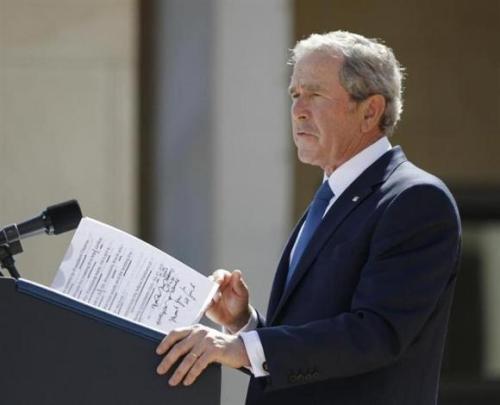
George W. Bush delivers remarks at the opening of his library in Dallas on April 25, 2013.

George W. Bush delivers remarks at the opening of his library in Dallas on April 25, 2013.

“I no longer feel that great sense of responsibility that I had when I was in the Oval Office.  And frankly, it’s a liberating feeling.” – President George W.Bush, to a high school graduating class in Roswell, New México, May 2009.

Countless numbers of Americans, especially several military families, wish we could liberate ourselves from the dismal legacy of the Bush Administration.  Unfortunately, we’re stuck with it.  But, survivors of military personnel killed in the Afghanistan and Iraq Wars bear relentless pain and anguish.  Anyone who enters the military has to accept the fact that they could be called to war and therefore, prepares as best they can for it.  Their parents, spouses, children and other relatives try to prepare themselves, too.  But, it’s still not easy losing a loved one to a foreign conflict.

Recently, Bush launched an initiative to help our military veterans transition back into civilian life as smoothly as possible.  My own conversations with past veterans made me realize how difficult this can be.  Through his Bush Institute, the 43rd president is imploring companies to recruit and retain military veterans, believing their tendency towards self-discipline and teamwork makes them among the best employees.

“We’ve got a problem, too many vets are unemployed,” said Bush.  “There’s what we call a military-civilian divide.”

He just figured this out?  It’s a noble cause, though.  The unemployment rate for military veterans remains around 10% as of 2013, compared to 7% for the general population.  A few times in recent years military veterans working for staffing agencies have contacted me about various technical writing positions.  The moment I hear them say they were in the military, I stop the conversation and tell them how much I appreciate their service.  It usually catches them off-guard.  But, in turn, they appreciate just hearing someone tell them that.

However, Bush has gone further and also issued a challenge to the medical community to drop the word “disorder” from the term “post-traumatic stress disorder.”  PTSD is a relatively recent term in the lexicon of psychological afflictions.  It used to be called “shell shock” or “battle fatigue.”  Many thought it was just a phase; almost an imaginary disorder.  But, it’s real and it’s painful for its sufferers and the people closest to them.

Bush, nonetheless, believes the “disorder” word stigmatizes the affected individual and makes them sound defective, or unable to be rehabilitated; therefore, he states, they may have trouble finding work in an already-fragile job market from employers who are weary of difficult people.

Gosh, how thoughtful.  It’s also hypocritical.  Like his Vice-President, Dick Cheney, Bush used just about every excuse to avoid military service when his country called upon him more than four decades ago.  An average high school student and occasional troublemaker, Bush managed to enter Yale University in 1964 and graduate four years later with a business degree.  Upon his graduation, his draft deferment ended.  The nation was mired in the depths of the Vietnam War, with public sentiment against the conflict (and the men who served there) becoming more vehement.  Still, Bush managed to secure a relatively cushy spot in the Texas Air National Guard.  Large numbers of young men were trying to do the same, and – according to some records – all of the spots in the Guard were taken.  I guess it didn’t hurt that his father was a U.S. congressman at the time.  Bush reenlisted in 1972 and was honorably discharged from the Guard two years later.  Questions remain about his level of attendance and whether or not he even completed his service.  His military records mysteriously vanished, and the Pentagon later claimed they were inadvertently destroyed.

I’ve always found that to be a rather convenient explanation.  A friend who served in the U.S. Air Force for twenty years, including several tours of duty in Vietnam, still has his military records.  All military personnel, he told me and several others more than a decade ago, are legally allowed to keep copies of them.

Dick Cheney, on the other hand, never did even that much.  He garnered five military draft deferments around the same time: four educational and one because he was a new father.  “I had other priorities in the 60s than military service,” Cheney said in 1989.

Words and actions always come back to haunt people.  I understand that no one wants to go into battle.  War is ugly and dirty; it is one of the most vile of human interactions.  But, hearing Bush trying to make nice with the people he sent to war is revolting.

The Iraq War is the crux of my anger.  It’s a conflict based solely on lies and innuendoes.  Abusing the international support brought on by the September 11, 2001 terrorist attacks, the Bush Administration created a tenuous link between Al-Qaeda and Iraqi dictator Saddam Hussein.  I believe the sole purpose was to gain access to the vast reserves of oil beneath Iraqi soil.  Proof comes in the fact that Halliburton (the energy conglomerate that Cheney headed before resigning in 2000) received a slew of no-bid government contracts.  For example, almost as soon as the U.S. invaded Iraq in March of 2003, the Army awarded Halliburton a no-bid contract to rebuild Iraq’s infrastructure.  Boots had just hit the sand and blood was still dripping while gilded corporate executives were salivating over big payouts.  While not necessarily illegal, no-bid contracts are certainly unethical and, in this case, highly suspicious.

War is fought by the grunts on the ground, but it’s waged by well-dressed power brokers in far-away skyscraper office suites whose idea of pain and agony is a paper cut.  It’s pretty much been that way for the past century.

As part of his retirement from public life, Bush has taken to painting.  He took up the hobby almost as soon as he departed the White House.  While his works may not earn him a spot in “International Artist” magazine, they’re being prominently displayed – (where else?) – in his presidential library.

In the spring of 2005, my-then supervisor at an engineering company, a coworker and I lived and worked in northeastern Oklahoma on a special project for the government agency where our firm had a contract.  We’d fly into Tulsa, rent a car and drive to the hotel in the far northeastern quadrant of the “Sooner State.”  One morning, as we prepared to board a flight in Dallas, I noticed a large group of people in military fatigues gathered nearby.  After a few moments of observing them, I approached the group and personally thanked each of them for their service.  They all seemed genuinely surprised that I – a total stranger – would do something like that.  But, it meant a lot to me that they were making such personal sacrifices.  In retrospect, I wonder how many returned alive, or at least undamaged.  I guess I’ll never know.

I’ll keep thinking about them, though, and I hope Bush just keeps painting.  He and the other clowns in his administration have done enough damage.

2 Comments

Filed under Essays

Mud Sliding

LittleMudVolcano

The mid-term elections are upon us here in the U.S.  That means – as has been the practice for the past quarter century – that candidates shout at the voters in declaring why the other person is so much worse than they are.  This trend gained momentum during the 2000 presidential campaign in which then-Texas Governor George W. Bush narrowly triumphed over Vice-President Al Gore.  It was the closest presidential elections in U.S. history, and Bush couldn’t have won if his campaign staff hadn’t demonized Gore and ultimately convince the Supreme Court to circumvent the electoral process and proclaim Bush the winner.  Under the direction of Karl Rove, Bush’s campaign apparently had to besmirch Gore’s reputation, since Bush had no other redeeming qualities.  He was a failed businessman, a one-time failed congressional candidate and a former part-time owner of the Texas Rangers.  His years as Texas governor were pretty much uneventful and marked by only three notable highlights: an increase of the speed limit on Texas highways; a law legalizing the right to carry firearms; and the execution of a woman for the first time in over 130 years.  That was it; that was the extent of his professional resume.  If he’d tried to run on that legacy alone – and if voters had actually paid attention to it – Bush probably would have lost to Gore.

The Rove sludge machine didn’t stop with the 2000 presidential elections though.  They went on to denounce the reputations of other political candidates, such as Max Cleland, a military veteran who lost three limbs in the Vietnam War.  Cleland, a Democrat, had served as a U.S. senator from Georgia from 1997 – 2003.  But, during the 2002 mid-term elections, his patriotism was questioned – and he subsequently lost amidst a wave of hysteria following the September 11, 2001 terrorist attacks.  That a combat war veteran who nearly lost his life should have his patriotism and thereby, his credibility questioned against a president and vice-president who used just about every excuse imaginable to avoid military service during the same period is obscene and hypocritical.  But, that’s how the Rove gang operated; they couldn’t run a decent campaign to highlight their candidate’s accomplishments.

The same questions of patriotism befell U.S. Senator John Kerry when he ran for the presidency in 2004.  Also a military veteran who had served in Vietnam, Kerry came under attack from a group called “Swift Boat Veterans for Truth.”  The group of former Vietnam War veterans was convened strictly to help Bush defeat Kerry.  Financed by wealthy political donors, SBVT questioned Kerry’s credentials as a combat sailor during the Vietnam conflict and thereby insinuated that he wasn’t worthy of the Navy medals he’d received.  Among their benefactors was Texas billionaire oilman T. Boone Pickens who added dirt to the mud pool by offering $1 million to anyone who could disavow the SBVT allegations.  When another group of Vietnam veterans finally proved that Kerry’s military credentials were impeccable, Pickens reneged on his challenge, saying the information wasn’t verifiable; thus proving no one is too old to be a punk.

Kerry, of course, made things bad for himself with his varied verbal fumbles – not nearly as bad as Bush, though.  At least Kerry knows how to pronounce the word “nuclear.”  Kerry initially didn’t authorize release of his military records to the public, even though it may have helped his campaign.  He finally released them in 2005.

There was a time that even I remember when a military veteran’s credibility was not something you questioned.  I also recall that politicians used to debate the issues and not each other’s reputations.  Things rarely got personal in high-profile political elections.  When they did, whoever made the unsavory accusation or dredged up some dirt from the past was pretty much shamed into obscurity.  Now, that seems to be the standard for running a campaign.

I still think the average American’s distaste for all things political began with the Watergate fiasco.  But, it reached its putrid zenith in the mid-1990s, when Republicans took over both houses of the U.S. Congress.  Already filled with vile against Bill Clinton, they did everything they could remove him from office; a scheme that culminated in Clinton’s 1998 impeachment over a tawdry sex affair.

As the political season got underway here in Texas late last year, the state Republican Party quickly found itself in a curious state of division.  In 2002, Republicans gained control over the Texas legislature for the first time since Reconstruction.  If you listened to the state GOP, they sounded like a group of impoverished Jews who’d finally defeated the Nazis in post-World War II Europe after a century of oppression and brutality.  But, the traditional Republican Party is now under attack from the “Tea Party,” a pack of extremists who formed in 2009 – conveniently – when Barack Obama took office.  The “Tea Party” clan has denounced all elected Republican officials as RINOs (Republicans in Name Only).  In other words, the standard GOP isn’t right-wing enough.  It’s like Stalin calling Hitler a pot-smoking, tree hugger.  To me, the only different is that “Tea Party” Republicans haven’t gotten their required rabies shots yet and keep forgetting to wipe their asses.

It was interesting to watch Texas Republicans try so hard to out-conservative one another.  Each one (a White male) running for a statewide office lambasted his opponent as a (gasp!) Washington liberal who doesn’t support traditional (Christian) values.  Ironically, they all had two things in common: they hate Obama and love the Second Amendment to the U.S. Constitution.  Televised campaign ads showed many of them on hunting trips, waving guns like they were their penises.  As a writer and left-of-center blogger, I have a fetish for the First Amendment, which guarantees free speech and the right to vote.  But hey, I’m just kind of queer like that.

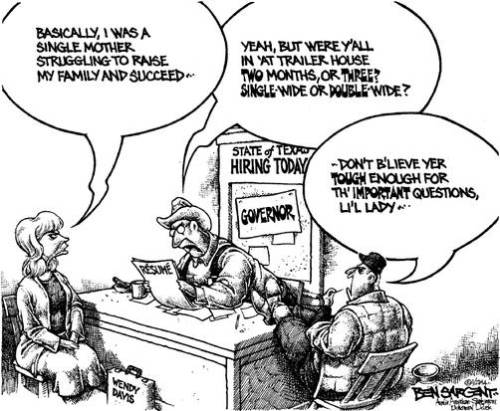
Last year I lamented how voter turnouts were lower in 2012 than in 2004 and 2008.  More importantly, on average, only about a third of eligible Texas voters make a concerted effort to get to the polls.  That explains why Texas appears to be a bastion of right-wing lunacy.  The lone Democrat running for Texas governor, Wendy Davis, has already been labeled a one-issue candidate (because of her filibuster last year of a restrictive abortion bill), but questions arose recently about the veracity of her life story.  Some were upset that she had said she was 21, not 19, when she and her husband divorced.  In fact, Davis and her husband separated when she was 19; their divorce became final two years later.  Do little things really mean a lot?  That she lifted herself out of poverty by forging ahead with a college education apparently says nothing about her personal fortitude.

Ben Sargent 012414

Image courtesy Ben Sargent.

But, instead of talking bad about their opponent, why don’t candidates promote what’s good about themselves?  Tell us voters what good things you’ve done for your community.  Although Texas has recovered more quickly from the recent economic downturn, what ideas does each candidate have to maintain that level of productivity?  The Republican candidates despise the Affordable Care Act, but what solutions do they have for ensuring that all Texans have access to health care beyond a hospital emergency room or Band-Aids from Wal-Mart?

Is it really too much to ask that these people show some level of professionalism and focus on the issues?  I guess so.

“Ugliness creates bitterness,” former First Lady Claudia “Lady Bird” Johnson, a Texas native, once said.  “Ugliness is an eroding force on the people of our land. We are all here to try to change that.”

I truly wish that would happen.

1 Comment

Filed under Essays

Downton Abyss

Crotchety Violet Crawley doing what she does best – smirking.

Crotchety Violet Crawley doing what she does best – smirking.

Since 2010, “Downton Abbey” has been one of the most popular dramas on television.  It’s enjoyed high ratings here in the U.S., which surprised its British producers.  I’ll concede that the production values are extraordinary: the period costumes and set design are as appealing as the beautiful cinematography.  I also love seeing those vintage automobiles.  My parents are modest fans of the show, but I’m not.  In fact, I actually loathe it.  The concept of upper-class Britons spending their time delivering snarky comments to one another, while haggling over what attire to don for the latest high-society ball, bears no sense of originality or purpose in my view.  But, “Downton Abbey” actually serves a greater, if unintentional purpose: it represents what is wrong in the U.S. from a cultural and economic standpoint.

In one episode, I happened to overhear the character of Violet Crawley, portrayed by the exquisite Dame Maggie Smith, lament that life in England was pathetically different than it was before the “Great War,” a.k.a. World War I.  She desperately wants to see it return to “the way it was before.”  That’s how some White conservative Americans view this nation; they want to see it return to the way it was before the 1960s, when droves of Negroes, Hispanics, Indians, women and queers dared to demand equal treatment.  It’s one thing that makes Ronald Reagan so popular among White conservatives.  The “Gipper” (a failed, divorced actor) had always believed America was just fine before c. 1963.  Reagan’s British counterpart and political soul mate, Margaret Thatcher, apparently felt the same.  Aside from their subtle distaste for equality, both enacted legislation to crush unions and subsequently impede workers’ rights.  Reagan fired more than 11,000 air traffic controllers in 1981 for going on strike to demand higher wages and better working conditions.  Thatcher systematically destroyed coal miners’ unions; coming close to bringing in the military to help put an end to their relentless strikes.  Consequently, labor never viewed either Reagan or Thatcher with much adoration.

It’s these latter antics that brought both countries back to an earlier time when large companies could do what they wished to their workers with little regard for their health or safety.  And, it’s where “Downton Abbey” plays out – during a period in which the wealthiest citizens managed to insulate themselves from “The Rest of Us” and stay above the fray of everyday life.  “Downton Abbey,” with all its vivacious costumes and sumptuous furnishings, is emblematic of the very real and extraordinary economic disparity in the U.S.  We’re still suffering the ill effects of dramatic deregulation of the banking and housing industries that the Bush Administration enacted more than a decade ago; irresponsible actions that, along with two unfunded wars and disparate tax policies, almost completely destroyed the U.S. economy by the end of 2008.  It lingers as a financial hangover for us common folks.

Still, Peter Augustine Lawler, a conservative professor of government at Berry College, celebrated the “astute nostalgia” of “Downton Abbey” in an editorial in “Intercollegiate Review,” a publication of the Intercollegiate Studies Institute.  ISI promotes limited government and free market economies – hallmarks of conservative ideology that leave no room for individual freedom, despite their claims to the contrary.

Wrote Lawler: “Everyone – aristocrat or servant – knows his place, his relational responsibilities. . . . The characters aren’t that burdened by the modern individualistic freedom of figuring out one’s place in the world. . . . Many of the customs that seem pointlessly expensive and time consuming, such as dressing for every dinner, are employment programs for worthy servants given secure, dignified places in a world where most ordinary people struggle. . . . The nobility of living in service to a lord. . . . What aristocracy offers us at its best is a proud but measured acceptance of the unchangeable relationship between privileges and responsibilities in the service of those whom we know and love.”

Notice how Lawler mentions the term “place.”  It’s a common designation the upper classes often bestow upon their lowly minions.  It’s a word many Whites in the U.S. have used in conjunction with non-Whites; what some men have often said to women.  Everyone supposedly has a “place” in the human food chain and they shouldn’t dare to undermine that structure; lest they be denounced as heretical and banished to social obscurity.  Regardless of race or ethnicity, though, Lawler coldly declares that the aristocracy of any nation should be able to preserve their right to a privileged state without impediments and damned the rest of us.  In other words, we’re supposed to accept such conditions without question; it’s just the way things are and too bad if we don’t like it.

There is no “nobility” in a life of servitude – whether to the lord of an antiquitous estate or a bully boss in a Fortune 500 company.  It’s one reason why I’m strongly opposed to illegal immigration.  Aside from the legality question, illegal immigrants are easy prey for unscrupulous employers who force them to work in the worst of conditions and sometimes fail to pay them; they then threaten the individuals with deportation if they have the audacity to demand the promised compensation.

It’s somewhat similar to what’s occurring now in the American workplace, as the economy remains fragile.  Corporate executives threaten employees with layoffs or termination if the latter won’t accept harsh working conditions, low pay and / or cuts in benefits.  I was threatened with my job at an engineering company in 2010; at the height of the “Great Recession.”  It worked, as I kept quiet and searched earnestly for another job.  So were most of my colleagues.  Everyone seemed unhappy, but could do nothing about it.  Our supervisor once mentioned in a meeting, “I wish you could see the number of applications on my desk.”  As her boss sat there nodding, we all comprehended the subtle threat.  Despite working so hard, though, four of us were laid off that fall.  My only consolation is that the supervisor and manager ended up losing their jobs, too.

The skewered viewpoint of the “Downton Abbey” gang is courtesy of principal writer Julian Fellowes, a private school graduate who holds a seat in England’s House of Lords.  Most writers compose what they know.  I’ve lived all my life to date in Texas; raised in a middle class household with two working parents in a good suburban home.  So, that’s who my characters are.  They may encounter some unusual events (since I have a fetish for the supernatural), but they’re generally working folks.  That’s my view of reality – and it’s a more accurate assessment than the world according to Fellowes.  He grew up in a golden bubble where his family obviously had privileges.  He never questioned the veracity of that lifestyle – why should anyone else?

Well I do – and I have no problems questioning it.  Violet Crawley (the name sounds as wretched as the character looks) reminds me of former First Lady Barbara Bush and conservative activist Phyllis Schlafly.  After Hurricane Katrina devastated the American Gulf Coast in August of 2005, Bush and her husband, former President George H.W. Bush, visited the Houston Astrodome where many New Orleans residents had been evacuated.  Observing the masses of people who had lost everything to floodwaters and high winds, Mrs. Bush quipped, “Everyone is so overwhelmed by the hospitality.  And so many of the people in the arena here, you know, were underprivileged anyway, so this is working very well for them.”

Schlafly came to prominence in the 1970s when she vehemently opposed the Equal Rights Amendment (ERA), which would have guaranteed complete and total equality to everyone in the U.S., regardless of gender.  Schlafly warned that women’s traditional roles were under threat from the proposed amendment: protective orders for sexual assault and alimony would be eliminated; women would no longer automatically be granted custody of their children in divorce cases; women would be drafted into the military; and unisex public restrooms would become mandatory.  With a law degree in her background, Schlafly often opened her speeches with gems like, “I’d like to thank my husband for letting me be here tonight.”

In the narrow prism through which Bush and Schlafly see the world, everyone has their proper place, and challenging it would simply disrupt the natural order of things.  Because of the near-total economic collapse, the U.S. now has the greatest wealth disparity since the 1920s.  It’s a trend that actually began years ago, but became more pronounced by the end of the previous decade.  A 2011 study by the Congressional Budget Office found that, between 1979 and 2007, after-tax income for the nation’s wealthiest 1% grew by 275%.  For the rest of the populace, it increased during the same period by an average of only 40%.  Although the “Great Recession” technically ended in 2010, unemployment remains stubbornly above 6%.  It’s been a “jobless recovery,” a term no one I know had ever heard until now.  It’s an oxymoron – how can an economy recover from a recession if so many people can’t find work?

homepage_graphic_large

In January 1952, two young men, Ernesto Guevara and Alberto Granado, launched a road trip across South America on a motorcycle.  Their purpose was purely hedonistic; their youthful vigor infused with a craving for adventure and fun.  But, as they traveled from one town to another, Guevara in particular noted the gross economic disparities between the elite European-style upper classes and the downtrodden indigenous populations.  He became disillusioned with a world he thought was just and righteous.  He turned his anger to the written word in a chronicle he dubbed “The Motorcycle Diaries: Notes on a Latin American Journey.”

“And then many things became very clear… we learned perfectly that the life of a single human being is worth millions of times more than all the property of the richest man on Earth,” wrote Guevara.  Later, the would-be medical student metamorphosed into the revolutionary Che Guevara – and would be murdered because he dared to challenge the elitist authority.

But, that happens when a country’s finances become skewered to favor the most affluent and their puppets in government.  People like Violet Crawley may feel safe and comfortable in their diamond-studded estates for a time.  But, we all die at some point – and whatever money and jewels we possess won’t go with us into that abyss of the next world.

Graph courtesy Congressional Budget Office.

4 Comments

Filed under Essays

Fags in the Shower! Fags in the Shower!

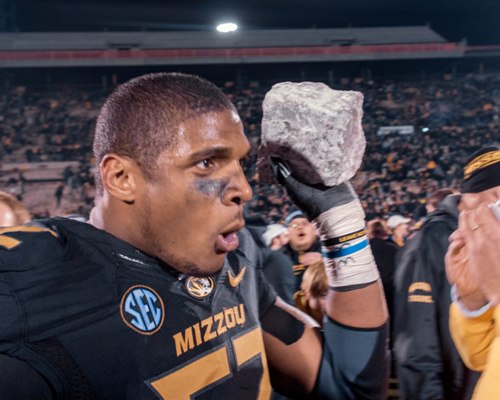
Michael Sam hopes to turn his collegiate football career into a professional one.

Michael Sam hopes to turn his collegiate football career into a professional one.

The American sports world is all riled up again – and as usual, over nothing important.  Michael Sam, a 24-year-old senior defensive lineman football player at the University of Missouri, recently announced that he’s a practicing homosexual.  Sam has garnered a number of accolades for his athletic ability, including All-American Player and Southeastern Conference Defensive Player of the Year awards.  But, his unapologetic admission to being gay has steered the conversation to a prospect more horrifying to many heterosexual men than erectile dysfunction and forgetting to order flowers on Valentine’s Day: there’ll be a damn queer in the locker room!

Professional sports in the U.S. is rife with unsavory characters and devious antics.  Like their counterparts in the entertainment world, career athletes seem to have a penchant for nefarious behavior in the public arena.  Former baseball player Darryl Strawberry had a long history of drug use, which – coupled with documented assaults on his first wife – eventually derailed his career.  Key word: eventually.  Despite his troubles, team owners and coaches kept giving him second chances.  His high batting averages appeared to gloss over the awful reality of his self-destruction.

The late Wilt Chamberlain, a legendary figure in basketball, once claimed to have slept with over 20,000 women.  His lawyer, Seymour Goldberg, declared that Chamberlain “collected women” the way some people collect stamps.  His nickname, “The Big Dipper,” came about because he often had to duck his 7’1” frame downward when he entered doorways.  But, the moniker obviously sported a more salacious definition when rumors of his romantic escapades began circulating in the media.

One of the most brutal stories of a professional athlete’s incorrigible behavior involves Rae Carruth, formerly of the Carolina Panthers.  In November of 1999, Carruth ordered a friend to murder his then-girlfriend, Cherica Adams, who was eight months pregnant.  Two years earlier Carruth had lost a paternity suit and, apparently reluctant to support yet another unwanted child, he tried convincing Adams to have an abortion.  When she refused, he allegedly planned to have her beaten up so she’d miscarry.  After that failed, he went further and set up the hit.  The two met for a date at a movie theatre.  They left in separate cars, with Adams following Carruth.  Another vehicle drove up beside Adams, and a man later identified as a friend of Carruth fired four shots.  Adams crashed and, despite her injuries, managed to dial 911 from her cell phone.  Doctors were able to save the 8-month-old male fetus.  Adams later scribbled notes for police officials describing the sequence of events and clearly implicated Carruth in the crime.  Carruth had told investigators he’d turn himself into police if Adams died.  When she finally succumbed to her injuries a month later, Carruth fled.  Fortunately, he was caught and convicted of murder in 2000, along with his three accomplices.  But, from the start, sports writers and Carruth fan were willing to give Carruth the benefit of the doubt.

In December 2012, Josh Brent, a Dallas Cowboys player, was involved in a drunk driving wreck that killed his fellow teammate and best friend, Jerry Brown.  The two had patronized a strip club and consumed large amounts of alcohol, when Brent lost control of his Mercedes.  Police officers arriving at the scene found Brent trying to pull Brown from the fiery crash.  A blood-alcohol test on Brent measured 0.18, more than twice the legal limit in Texas.  Brent’s defense attorneys tried to claim that his 320-pound frame could handle that much booze, which was roughly equal to 17 mixed drinks.  Amidst such trauma, however, Dallas Cowboys owner Jerry Jones refused to terminate Brent’s contract until after the trial.  But, the ultimate shame in this tragedy came when Judge Robert Burns announced Brent’s sentence – 180 days in jail and 10 years’ probation.

There are countless other stories of professional athletes abusing their wives or girlfriends; committing sexual assault; driving drunk; beating up friends and neighbors; and / or using illegal narcotics.  But, if you listen to the rhetoric over Michael Sam, you’d think his sexuality was as criminal as those of the aforementioned athletes.  In professional sports, it’s apparently okay for a man to beat the crap out of his wife.  In fact, many people just seem to want to shove that under the rug of illicit behavior.

But, said athlete admits that he’s gay?  Well, suddenly he’s crossed the line.  We can’t have that.  We can’t have any fags in the shower.  The same argument has been used before in the U.S. military.  It was a basis for the compromise over the pathetic “Don’t Ask, Don’t Tell” policy enacted in 1994.  Until it was repealed in 2011, more people were booted out of the military for being gay or lesbian than for being fat.

In the narrow minds of bigotry, some transgressions are inexcusable.  Homosexuality is among them.  Unless Michael Sam has forced someone into a sexually compromising position (and that’s almost always an accusation, especially towards gay men), people should focus more on his athletic abilities and his difficult upbringing than his sexual predilections.  He lost one brother to gun violence; another brother has been missing since 1998; and two more of his brothers are imprisoned.  At one point, he and his mother lived in her car.  Sam is the first member of his family to attend college.  It’s unlikely he decided to pursue a football career so he can scope out guys in the locker room.  Anyone who visits a locker room (or public restroom, for that matter) to pick up dates needs to get their ass kicked anyway.

Here’s another thing: men look at one another’s genitalia in the locker room.  Every man does; if he denies it, he’s either lying, or he’s dead.  It’s not a stare, or a gape; it’s just a casual glance to see if they measure up.  Every man is concerned about his penis size at some point in his life.  And, every woman is just as concerned about her butt and hip size during some internal squabble with her internal self.  We humans all just want to be – and look – normal.  Being gay or lesbian doesn’t cross the invisible line – but, staring does.  And, that’s just not going to happen very often.

Personally, I’m not a football fan, so I’d never heard of Michael Sam until this faux issue arose.  And, I certainly don’t plan to follow his career should be become the first openly-gay professional player in American football history.  I have more important concerns.  So should everyone else.

Local Dallas / Fort Worth sports anchor Dale Hansen tells it like it is.

5 Comments

Filed under Essays

Dr. Damary M. Bonilla-Rodriguez – Dismantling the Myth of the Hispanic Woman

Damarys-picture

The United States likes to consider itself the beacon of equality, fairness and ingenuity.  To some extent, it’s accomplished those goals.  But, if you look beneath the surface, you’ll find a number of people who have had to fight harder than most for it.  Damary M. Bonilla-Rodriguez is one of them.  I encountered Dr. Bonilla-Rodriguez through the Hispanic Professionals Networking Group (HPNG) on Linked In.  HPNG is dedicated to increasing the visibility of Hispanic business professionals.

Hispanics are the fastest-growing ethnic group in the U.S.; something that’s due, in part, to immigration.  But, many Americans ignore the fact that, as a group, Hispanics have been here longer than any other; except for Native Americans, with whom we often have a shared heritage.

Regardless, stereotypes of Hispanics persist – in both popular culture and political debates.  While all women have endured some level of oppression and discrimination, Hispanic, Black, Asian and Native American women, in particular, find themselves in the uncomfortable position of being double minorities.  This is of personal interest to me, since I’ve seen the troubles my mother and other women in my family have faced.

Even now, if you watch American TV, you’ll find limited portrayals of Hispanic women.  Colombian-born Sofia Vergara, a star on ABC’s “Modern Family,” is one of the most prominent.  But, the former model still panders to the conventional image of a Latina – complete with mangled English that (I guess) is supposed to be humorously cute.  Then, there’s Shakira, another Colombian, who gyrated her way onto the American music scene with faux blonde locks.  The only plausible Hispanic female character in American entertainment I can recall is Eva Longoria from ABC’s “Desperate Housewives.”  She spoke perfect English and wasn’t obsessed with food and sex.  Towards the end of the show’s run, another Hispanic actress, Lupe Ontiveros, appeared as Longoria’s mother-in-law.  Ontiveros, who died in 2012, once estimated that she played a maid or housekeeper-type role some 200 times in her career.

It’s against these personifications that Dr. Bonilla-Rodriguez finds herself.  I asked her recently to expand upon her career as head of the Latina Initiative Project at Girls Incorporated, a non-profit organization that seeks to empower young Hispanic women into realizing they can be more than wives and mothers or singers and actresses.

Please tell us about your background.

I was born and raised in El Barrio/Spanish Harlem NYC.  My mom died when I was 8 years old; a victim to homicide.  I am the eldest three sisters.  I was raised by my maternal grandparents because my father was in prison during my childhood and not involved in my life.  I focused on education and community activism as a means to achieve success.  I earned a Bachelor of Arts degree in Spanish and Social Work, Master of Science degree in Organizational Communication, Special Certification in Corporate Communication, and a Doctorate of Education with a focus in Executive leadership.

What prompted you to get involved with women and leadership?

I grew up in a family where the women worked hard to care for their families and provide but were not happy because they had jobs, not careers.  I did not have anyone in my extended circle that had graduated college or had a successful career.  The desire to achieve some level of success and be a person of influence, took me down the path of education and empowerment of others.  By accessing education and entering the work force, I gained an understanding the challenges faced by women, especially women of color; this knowledge ignited a personal passion to inspire women to pursue leadership roles in all aspects of their lives.

What are some of the ongoing challenges girls face in America today and how do you personally hope to address them?

America is still not a place of equity for girls and women, particularly women of color.  My passion is to inspire and empower girls and women to pursue leadership roles in all aspects of their lives because if we have a voice, we can make a difference in society.  Writing a dissertation was one way that I could contribute to society in this area.  I also deliver key note addresses and sessions for women and girls on leadership development and empowerment.

Do you believe girls can identify with women like Condoleezza Rice and Hilary Clinton, or are they too distant and exceptional to be role models?

I think any woman who is in a leadership role can be a role model.  However, seeing someone in a leadership role that “looks” like you or has a similar background, is the best way for girls and women to be inspired and believe they can be leaders and make a difference.

Aside from Rice and Clinton, what other notable women could serve as positive role models for girls?

For Latina girls and women, Justice Sonia Sotomayor has become an icon because we are proud of her accomplishment in breaking societal barriers, she “looks” like us, and an awareness has been awakened that we need more of her – more of us – in significant leadership roles at ALL levels of society.

If an average woman asks how she could be a role model to a girl or a younger woman, what would you say?

In each individual person’s life journey, they experience situations that teach them lessons; these experiences can help someone else along their path.  I believe we can all be role models to others.  I truly believe that I have stood on the shoulders of others who have paved a way for me to join a small group of Latinas with a Doctorate and that I – and all – should pave the way for others.

If a single father of a daughter asks what he could do to improve his child’s self-esteem, what would you tell him?

Single parents deserve so much credit for raising children alone because it is a hard job to raise children.  I believe that it takes many people to raise productive, hardworking people.  I would tell a single parent – mother or father – that hearing regularly how special you are, that you can change the world, that you need to believe in yourself, that your parent believes in you, and that you should access opportunities such as: education, are the foundation for improved self-esteem.  Also, helping your children access mentors and people that can teach them about access to higher education and various career options, as well as programs such as Girls Incorporated, where I work, can help empower kids and build their self-esteem so they can get far in life.

In the past few years, as the economy continues to struggle, more women than men are either returning to college, or staying in college to pursue higher levels of education.  What do you feel is the primary factor behind this trend?

Women have a nurturing nature and sharp instincts to provide and care for others.  When the pressure is on to succeed or they see closed doors, women understand the value of education in setting oneself apart from the competition.  Also, women may have entered the work force to provide financially without having the opportunity to further their education; the struggles provide the opportunity to pursue personal goals while preparing for better work opportunities and climbing the ladder of success.

I read an editorial many years ago that stated, while Black and Hispanic men often feel they’re victims of racism, their female counterparts more often feel they’re victims of sexism.  Do you feel this is true and why or why not?

While this has not been my experience, in my work with women, I have heard this come up quite a bit.  Some things I have heard are that women sometimes feel like their abilities are questioned based on how they look or dress.  Others have expressed being “sexualized” because they are a Latina which is supposed to mean they are “sexy” as opposed to smart or any other professional characteristic.  Women in society are still struggling for equity in various aspects of the workforce experience.  Women of color are struggling for the same but also to have a voice in society.  For example, women of color do not represent a significant part of the corporate/private sector in top leadership positions and corporate Boards.  There is much work to be done.

What are some of the educational and professional obstacles Latina women in the U.S. face?

According to my doctoral research study, Latinas face four critical obstacles: lack of mentors, lack of opportunities, cultural obligations, and family obligations.

Hispanics overall often have been reluctant to move far from home, since that means they’ll be separated from their families.  That’s starting to change, but do you think Hispanics generally have a stronger commitment to their families than to their professional lives?

This has been my experience – from choosing which college I would attend, to deciding if I wanted to move to another state.  The Hispanic value of family – immediate or extended family – is positive because it means you have a strong support network but also poses challenges in education and professional journeys; this is especially true for Latinas, as they have traditionally been expected to take care of everyone.  I wrote an article which was published in the Huffington Post, about “Latinas and Modern Marianismo” which touches on balancing traditional Latino values with modern Latina experiences.  Here is the link: http://www.huffingtonpost.com/damary-bonillarodriguez/latinas-and-modern-marianismo_b_4165200.html.

Do you think affirmative action is still necessary?

According to the American Civil Liberties Union (ACLU: https://www.aclu.org/racial-justice/affirmative-action) “Affirmative action is one of the most effective tools for redressing the injustices caused by our nation’s historic discrimination against people of color and women, and for leveling what has long been an uneven playing field.  A centuries-long legacy of racism and sexism has not been eradicated despite the gains made during the civil rights era.  Avenues of opportunity for those previously excluded remain far too narrow.  We need affirmative action now more than ever.”  I could not have said it better myself.

What do you hope for the general status of women in the U.S. in the next decade?

I am hopeful that as more women and women of color climb the ladder to hold highly visible and significant leadership positions across the country, doors will open so more women will have the opportunity to shine.  I am also hopeful that the in the next decade we will see a woman hold the highest political office in the country – the U.S. Presidency.

Would you like to add anything?

My doctoral research study abstract, in case anyone is interested in reading my dissertation.  Latinas face obstacles achieving proportionate representation in significant leadership roles.  This research aimed to identify characteristics unique to Latina leaders that represented shared values and beliefs of Latinas, and to understand positive factors and obstacles associated with Latina leadership in the United States.

Survey responses from three hundred thirty-five Latinas and four interviewees from across the U.S. suggested that there are forty-three characteristics an effective Latina leader should possess.  Four essential characteristics identified were: creative, good listener, optimistic/positive, and passionate.  The forty-three characteristics were categorized into five groups of similar characteristics to synthesize what study participants believed were essential characteristics of Latina leaders.  The categories were: high integrity, marianismo, new Latina, transformational leader, and visionary.  Pursuing the attributes of these five leadership categories will help Latinas who aspire to become leaders understand what it takes to be a successful Latina leader, identify their strengths and weaknesses, and enable them to create a plan of success for themselves.

Furthermore, study participants noted factors of positive influence on Latinas.  Six crucial positive influencers identified were: successful educational attainment, participating in leadership training, possessing self-confidence, having role models, religious influence, and family influence.  Study participants also noted factors which can be obstacles for Latinas.  Four critical obstacles identified were: lack of mentors, lack of opportunities, cultural obligations, and family obligations.

Literature about Latinas and Latina leadership is limited.  There is an urgent need for research about the topic(s).  This study was one step towards understanding the dynamics of Latina leadership in the U.S.  I urge Latinas to invest in themselves and become successful leaders so that together, we can make a difference in the world because this world needs Latina sazon (Latin seasoning).

9 Comments

Filed under Essays

Life Managing

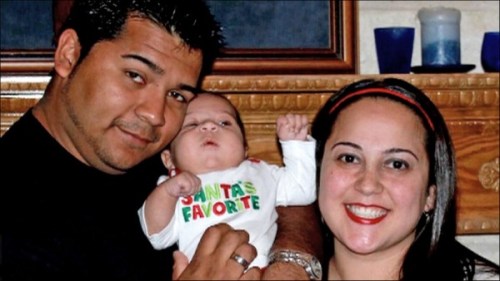
The Muñoz family in happier times.

The Muñoz family in happier times.

In June of 1997, the Southern Baptist Convention held its annual conference in Dallas, Texas.  Aside from preaching the gospel of Jesus Christ and proselytizing against the evil Bill Clinton, the organization had one other item on its agenda: boycott the Walt Disney Company because of its new policy to offer benefits to the same-sex partners of its some of its employees

The day after convention-goers officially voted on the Disney boycott, the “Dallas Morning News” placed the story on its front page – complete with a color photograph of the assemblage holding up placards; their smug, arrogant expression displaying their true contempt for the company.

In the fall of 1995, Disney had joined a growing number of companies that took the bold step of instituting non-discrimination policies for its gay and lesbian associates.  That included offering identical benefits to the same-gender partners of these employees.  Because Disney catered so much to families, the move triggered a more vociferous response from right-wing politicians and their evangelical puppet masters.  It prompted some to malign Disney as the “tragic kingdom.”

Meanwhile, buried on page 3 of the ‘Metropolitan’ section of that same “Dallas Morning News” issue was a brief story on something I found even more alarming: approximately 40% of children in Texas at the time had no health insurance.  I literally stopped when I read that.  I presumed, in my naiveté about the human condition, that all infants and children were automatically covered by some type of health insurance.  The piece – all of half a page – highlighted a family who lived in a trailer park just outside Dallas.  I can’t remember the details, but both parents worked and had two kids.  The family was just one of hundreds across the state.  I looked again at the SBC gang on the front page and wondered if they were even aware of the trailer park family; a family that could barely take care of itself, much less go on a Disney cruise with untold numbers of homosexuals allegedly lurking behind the lounge chairs.

I thought about that situation again when the bizarre case of Marlise Muñoz arose.  Last November Muñoz, a 33-year-old paramedic, suffered an apparent pulmonary embolism at her home in Haltom City, a Fort Worth suburb.  Her husband, Erick, found her on the kitchen floor after she’d gotten up in the pre-dawn hours to prepare a bottle for their toddler son.  Two days later officials at John Peter Smith hospital declared Marlise brain dead.  Her husband and parents asked that she be removed from life support.  But, the hospital refused.  Marlise was about 14 weeks pregnant at the time, and the hospital cited a little-known state law, the Texas Advance Directives Act, that forbids the cessation of life-saving measures on a pregnant woman.  Passed in 1989, “Texas Statutes – Section 166.049: Pregnant Patients” is supposedly meant to protect the lives of the unborn.  It’s an adjunct to “Texas Statutes – Section 166.046: Procedure If Not Effectuating a Directive or Treatment Decision,” which addresses life support for individuals in comatose or vegetative states.

The usual cacophony of pro-life voices raised themselves in self-righteous indignation in support of the unborn Muñoz child.  Muñoz supporters reacted by pointing to a simple fact: the woman was brain dead.  If someone’s heart stops, it can be resuscitated with electric shocks; if the lungs collapse, air can be pumped back into them; if the kidneys cease functioning, the individual can be hooked up to a dialysis machine.  But, you can’t perform CPR on a person’s brain.  Once a person’s brain dies, that’s it!  There’s no coming back.  It’s why the brain stem is the first part of the human embryo to form.

People often joke about brain death.  I point out that it’s a symptom of many politicians and entertainment celebrities.  In fact, it’s almost a requirement among reality TV stars.  But, brain death is a seriously finite condition.

Yet, pro-life activists lined up outside John Peter Smith demanding the hospital do everything it could to save the life of Marlise Muñoz’s unborn baby.  And, the hospital was trying to do just that – pumping oxygen into the dead woman’s corpse.  Her flesh was beginning to rot, however, and her body was developing both external and internal sores.  Moreover, examinations of the fetus showed its lower extremities were so badly deformed no one could determine its gender.

Erick Muñoz finally resorted to legal action against JPS.  On January 24, State District Judge R.H. Wallace concurred and ordered the hospital to let Marlise go.  “Mrs. Muñoz is dead,” he wrote.  “Defendants are ordered to pronounce Mrs. Muñoz dead and remove the ventilator and all other ‘life-sustaining’ treatment from the body.”

JPS chose not to fight the order and removed Marlise from life support on the 26th; what was left of her body died five minutes later.  As a token of love and affection, Erick named the unborn baby Nicole, his wife’s middle name.  No longer held captive to a ghoulish medical experiment, Marlise’s family can now bury her and moved forward with their lives as best as possible.  Erick still has a toddler son to raise.

This entire imbroglio comes less than a year after Texas State Senator Wendy Davis launched an 11-hour filibuster against a law that imposed heavy restrictions on abortion providers in Texas.  It was a move that garnered international attention and propelled Davis to launch a bid for the governorship.  The Muñoz case and the Texas abortion law are related, albeit tangentially, because of that pro-life label so many ideological conservatives here and around the nation like to claim.

Pro-life advocates really aren’t pro-life – that is, in the truest sense of the term – they’re pro-birth.  For some perverted reason, they want to control human reproduction.  They declare that it’s for the good of humanity; a desire to give all babies a chance at life.  I suppose, however, they really just want more bodies to work in the fields and the factories, or to go to war so oil and energy companies can earn more profits.  If pro-lifers truly are in favor of life, they wouldn’t stand idly by as literally millions of people, including infants and children, go to bed hungry in this country every night.  While the evangelical crowd thinks they’re doing society a favor by protesting the perceived horrors of homosexuality, they ignore the real tragedy of the uninsured, which has grown exponentially since 1997.  Conservative Republicans in the U.S. Congress were eager to invade Iraq in 2003, but have been slow in providing pay increases to military personnel.  We can expect that from a pack of old lawyers whose own pay and benefits are secure.

And, we can expect pro-lifers to holler in contempt that people like Judge R.H. Wallace don’t value human life.  Some are already publicly shaming Wallace and demanding his impeachment.  But, if the U.S. values human life so much, it wouldn’t boast one of the highest homicide rates among developed countries.  It wouldn’t tolerate 49 million Americans living with food insecurity (as of 2012).  Pro-life doesn’t mean a society fights like hell to allow (or force) a pregnant woman to give birth.  It means it fights for the welfare of all its citizens.  Life may begin at conception, but it doesn’t end when the umbilical cord is cut.

1 Comment

Filed under Essays

Civil Righting

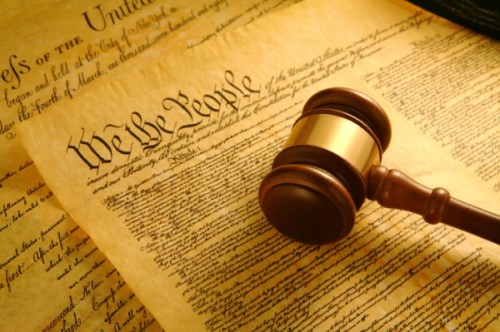
the-constitution

Back in 2002, my then-roommate, Tom,* and I got into a discussion about racial and gender equality.  I stated that all of the various civil rights movements of the 19th and 20th centuries, starting with the abolitionist movement, were necessary to instigate change and make America live up to its declaration as a truly free and inclusive nation.  Tom merely shook his head no in a condescending fashion and said, “Nah,” later adding that eventually people would have “come around” and realize discrimination was wrong.

I looked at him like the fool he was and asked him if he sincerely believed that.  He said he did.  I then recounted the story of my father’s return from Korea in the mid-1950s.  He had been drafted into the U.S. Army and sent to the front lines in the midst of the Korean War.  Among the many friends he made were a large contingent of Black soldiers.  By then, the U.S. armed forces had been forcibly integrated, so a mix of ethnic groups comprised all the various military units.  My father didn’t serve his full two-year stint, as the war ended sooner than most anyone had expected.  He and several of his fellow soldiers arrived in Seattle via ship and then boarded a train to head to their various home cities.  My father was confused when his Black team mates started walking away from.  He called out to them, asking where they were going.  One told him they were headed towards the rear caboose – where Black people had to sit.  As he watched his friends, his brothers-in-arms, saunter down the platform, my father said to himself, “Oh yea, we’re back in America – land of the free.”

Tom just sort of looked at me, not knowing what to say.  He conceded it was wrong, even then, to force Blacks to sit at the back of a bus or a train.  But, he snapped out of his brief foray into actual reasoning and reiterated that eventually White people would have realized how unfair that was.  In other words, we didn’t bus strikes or protests of any kind.  People should have just waited around, hoping for the better.

No one should have to wait for justice and fairness.  Nobody should be straddled to the rocks of oppression and brutality – hoping, praying and begging for those in positions of power and influence to see the light.  Disenfranchised groups in the U.S. had waited for centuries to be treated with dignity and respect and to be given an equal chance to succeed.

I told someone else around the same time as my conversation with Tom that the 1960s exploded with anger and rage because patience had finally run out.  They’d done everything that had been asked of them: they served in the military; they worked hard; they cleaned homes and streets; they obeyed the laws (no matter how discriminatory they were); they tried as best to keep to themselves – everything.  And, they still weren’t given a fair chance.  Blacks still had to sit at the back of the bus; women still had to change their last names when they got married and still had to have children; Indians still had to live in squalor on reservations; gays and lesbians still had to suppress their true identities.

And so, by the 1960s, everything just sort of erupted at once.  If change didn’t come through peace and hard work, then it had to be forced.  America was compelled to fulfill its proclamation as a nation of freedom and opportunity.  It no longer had a choice in the matter.  The time had come to change – whether some folks liked it or not.

It was curious to hear Tom speak of racial and gender equality and inequality.  He was a mix of German and Cherokee; from a small, nondescript community in far northeast Texas.  We discussed the plight of Indigenous Americans more than once.  He felt that Indians could have fought back against European encroachers because they also had men.  I noted that Europeans had two primary advantages: guns and horses.  Moreover, they’d adopted both gunpowder and horse-riding skills from the Chinese.  Tom wasn’t moved.  And, I told him he now had the distinction of falling into two unique groups: those who aren’t educated about a subject and those who don’t want to be educated.  That’s actually a rarity, but one that persists even now; in this second decade of the 21st century with a biracial U.S. president and a shrinking White majority.

Attitudes really are hard to change.

*Name changed.

4 Comments

Filed under Essays

Free Speaking

free-speech-hand-mouth

“I disapprove of what you say, but I will defend to the death your right to say it.”

Voltaire

On the night before the United States was set to invade Iraq in March of 2003, the Dixie Chicks, a Texas-born country music trio, took to a London stage.  Lead singer Natalie Maines suddenly blurted out, “Just so you know, we’re on the good side with y’all.  We do not want this war, this violence.  And, we’re ashamed the President of the United States is from Texas.”

The audience cheered, and Maines laughed loudly, as if she had just been joking.  But, the repercussions here at home were swift and vitriolic.  Country music radio stations quickly pulled the band’s music from their play lists; fans turned on the group and began destroying their records and CD’s; others threatened violence; someone even made a bomb threat to the band’s record company.  The group has recovered in the ensuing decade, but hasn’t really attained the same level of popularity they enjoyed before “The Incident.”  I’m not a country music fan, so I don’t follow the band.  But, I’m certainly not a fan of former President George W. Bush.  Indeed, he is an embarrassment to the state of Texas.

Maines’ 2003 pronouncement came to light again recently with the uproar over comments made by another southerner: Phil Robertson of “Duck Dynasty” fame.  Robertson’s family created an empire making and selling products for duck hunters from their Duck Commander Company in West Monroe, Louisiana, which has been in operation since 1973.  The show debuted on the A&E Network in March of 2012 and became an instant success.  The family is devoutly Christian and proudly redneck.  They seem to celebrate both, and each episode ends with the family gathered around the dinner table reciting a prayer.

Now, the show’s future is threatened after Robertson granted an interview to GQ Magazine during which he equated homosexuality with bestiality and claimed African-Americans were better off in pre-civil rights America.  It’s the homophobic part of his rant that has garnered the most attention.

“Start with homosexual behavior and just morph out from there,” Robertson told GQ.  “Bestiality, sleeping around with this woman and that woman and that woman and those men.  Don’t be deceived.  Neither the adulterers, the idolaters, the male prostitutes, the homosexual offenders, the greedy, the drunkards, the slanderers, the swindlers – they won’t inherit the kingdom of God.  Don’t deceive yourself.  It’s not right.”

After I got past the difficult concept of someone like Phil Robertson actually speaking with GQ Magazine, I just sort of yawned.  I’ve heard this crap before.  Evangelical Christians here in the U.S. have long compared homosexuality (especially male homosexuality) to bestiality and always seem to know what’s right for everyone else.  If anyone should dare criticize them, they then claim they’re merely quoting biblical scripture.  I’ve heard that crap before, too.  I’ve known plenty of people who often said, ‘Hey, don’t get mad at me.  I’m just doing what it says in the Bible,’ – not understanding how stupid they sound.  That’s almost like a man claiming he couldn’t help but sexually assault a woman because she was wearing a mini-skirt.

That Robertson assumes Black-Americans would have done well to forgo the efforts of the civil rights struggles of the last two centuries and accept their lowly place in society is equally unsurprising.  Many older White conservatives, particularly in the southeastern U.S., bristle at the thought of non-Whites achieving any kind of equality.  Robertson and his ilk remain indignant about the Civil War and continually reenact key battles in the vain hope they’ll attain victory and the Negroes and Indians will retreat into the fields where they belong.

When A&E announced “Duck Dynasty” would be suspended, many Robertson fans came to his defense.  Among them are the usual right-wing squawkers: Rush Limbaugh, Sarah Palin and Louisiana Governor Bobby Jindal.  Yet another, Ian Bayne, an Illinois Republican congressional candidate, produced the most laughable response by comparing Robertson to Rosa Parks.  “In December 1955, Rosa Parks took a stand against an unjust societal persecution of black people,” stated Bayne, “and in December 2013, Robertson took a stand against persecution of Christians. What Parks did was courageous… What Robertson did was courageous too.”

I’d love to see the look on Robertson’s face when he heard that one!  Ironically, Rosa Parks’ actions were an early cannon shot in the brewing civil rights movement.

Several Robertson defenders are denouncing the apparent hypocrisy of his critics.  “Free speech is an endangered species,” said Palin.  Perhaps it is, but then again, you have to consider who’s speaking and what they’re saying.  When Natalie Maines criticized President Bush, her detractors suddenly warned that free speech has its responsibilities, which is a polite way of saying if you don’t agree with them, then you’re dead wrong.

Indeed, free speech has its limits.  You can’t yell ‘Fire!’ in a crowded theater (a common comparison); you can’t phone in a bomb threat; and you can’t falsely accuse someone of committing a criminal act, such as…oh, bestiality.  As a writer, I know that free speech is sacrosanct; an undeniable tenet of democracy.  It’s a precious right; one born of blood and more valuable than gold or diamonds.  I’ve known people who grew up in the former Soviet Union or communist East Germany and listening to their tales of living under such oppressive regimes where dissent was regarded as a scourge makes me understand how fortunate I am to have grown up in the U.S.  I’ve seen a few episodes of “Duck Dynasty” and think it’s rather funny.  Only in America can someone make a fortune from building duck calls.  As much as I detest people like Phil Robertson, I can’t let what he says bother me too much.  If he doesn’t like gay people, then that’s his right.  No one should try to force him to march in the next gay pride parade, while holding hands with a drag queen.  If he feels Black folks had it better in America pre-1970, I feel he’s an idiot.  Ask any older Black person, especially those who grew up in the southeastern U.S., what life was like for them under Jim Crow laws, and I’m sure they’ll tell you that – aside from gatherings with family and friends – it was pretty hard and scary.  But, if Phil Robertson believes otherwise, what are you going to do?  Try to drown him in the swamp behind his mansion?

There is one unique irony about Robertson’s pathetic analogy between homosexuality and bestiality.  A hunter’s duck call is actually a ruse; the device mimics the sound of a duck’s mating wail.  In other words, the hunter masquerades as an amorous waterfowl to ensnare an unsuspecting bird into a trap.  Not that Robertson has ever sought to get busy with a duck, of course!  But, just words for thought.

Image: Albany NY a.k.a. Smalbany.

4 Comments

Filed under Essays

Thanks for This?

???????????????????????????????

In April of 2010, Sarah Palin, the former (part-time) Alaska governor and 2008 Republican Party vice-presidential nominee, told the Women of Joy conference in Louisville, Kentucky, “God truly has shed His grace on thee – on this country.  He’s blessed us, and we better not blow it.”  She was criticizing the notion of separation of church and state; a tenet essential to the establishment of the United States.  She insisted, as right-wing evangelicals do, that this is a Christian nation; founded on biblical principals.  If that’s the case, then her oldest daughter, Bristol, should be stoned to death for getting drunk, having sex out-of-wedlock and giving birth to an illegitimate child.  That Bristol went on to condemn gay marriage – even though she and her baby’s father never could set a wedding date – is typical of conservative hypocrisy.

If Palin, or anyone else in her camp, were so concerned about the application of Christian ideology, then they should look at the startling rise in both poverty and food insecurity in the U.S.  Food banks have been running low on supplies and are working (even more than ever) on shoestring budgets.  To worsen matters, President and Obama and the U.S. Congress made cuts to Supplemental Nutrition Assistance Program (SNAP).  A family of 4 could lose on average $36 monthly in food assistance.  It’s even more astounding when you consider that many of these families are not welfare brats, but among the “working poor” – a new class of individuals created almost involuntarily in the past decade.  These are the people who haven’t benefited from “trickle-down economics.”  Capitalism hasn’t functioned quite so well for them.  In the late 1990s, more people moved up out of poverty than ever before in this nation’s history.  But, thanks to the incompetence and corruption of the Bush Administration, practically all those gains have been lost.

It’s, of course, the skewered tax policies the Bush Administration instituted, beginning in 2001; a financial structure retrofitted to favor the wealthiest individuals and largest corporations.  Coupled with the wars in Afghanistan and Iraq and the almost complete deregulation of the financial and housing industries, and it shouldn’t be too surprising that the U.S. is still in the grips of the worst economic downturn in 80 years.

While conservative extremists are obsessed with injecting creationism into science curriculums in schools and stopping queers from getting married, my biggest worry is the number of people who struggle daily with food insecurity.  As much of the U.S. winds down the Thanksgiving holiday with bloated meals, hectic travel schedules and “Black Friday” shopping excursions, here are some sobering statistics, as of 2012, about the state of many kitchens across the land.

Food Insecurity and Very Low Food Security:

  • In 2012, 49.0 million Americans lived in food insecure households, 33.1 million adults and 15.9 million children.
  • In 2012, 14.5% of households (17.6 million households) were food insecure.
  • In 2012, 5.7% of households (7.0 million households) experienced very low food security.
  • In 2012, households with children reported food insecurity at a significantly higher rate than those without children, 20.0% compared to 11.9%.
  • In 2012, households that had higher rates of food insecurity than the national average included households with children (20.0%), especially households with children headed by single women (35.4%) or single men (23.6%), Black non-Hispanic households (24.6%) and Hispanic households (23.3%).
  • In 2011, 4.8 million seniors (over age 60), or 8.4% of all seniors were food insecure. [1]
  • Food insecurity exists in every county in America, ranging from a low of 2.4% in Slope County, ND to a high of 35.2% in Holmes County, MS.[2]

Overall, the U.S. sported a rate of 14.7% for households with food insecurity.  Following are the top 10 states that exhibited statistically significant higher household food insecurity rates than the U.S. national average, which is from 2000 – 2012 in this study: [3]

Mississippi                 20.9%

Arkansas                     19.7%

Texas                          18.4%

Alabama                     17.9%

North Carolina          17.0%

Georgia                       16.9%

Missouri                     16.7%

Nevada                        16.6%

Ohio                            16.1%

California                   15.6%

Use of Emergency Food Assistance and Federal Food Assistance Programs:

  • In 2012, 5.1 percent of all U.S. households (6.2 million households) accessed emergency food from a food pantry or soup kitchen one or more times. [4] 
  • In 2012, 59.4 percent of food-insecure households participated in at least one of the three major federal food assistance programs – Supplemental Nutrition Assistance Program (SNAP; formerly Food Stamp Program), The National School Lunch Program, and the Special Supplemental Nutrition Program for Women, Infants, and Children (WIC). [5] 
  • Feeding America provides emergency food assistance to an estimated 37 million low-income people annually, a 46% increase from 25 million since Hunger in America 2006.[6]
  • Among members of Feeding America, 74% of pantries, 65% of kitchens, and 54% of shelters reported that there had been an increase since 2006 in the number of clients who come to their emergency food program sites. [7]

If the U.S. and all other democratic societies are serious about strengthening themselves, they’ll spend less money on wars against foreign nations and homosexuals and more on the real threats to stability: hunger and poverty.  Otherwise, “The Hunger Games” won’t be as much a movie as a way of life.

Sources:

  1. Ziliak, J.P. & Gundersen, C. (2013.) Spotlight on Food Insecurity among Senior Americans: 2011. National Foundation to End Senior Hunger (NFESH).
  2. Gundersen, C., Waxman, E., Engelhard, E., Satoh, A., & Chawla, N. (2013). Map the Meal Gap 2013, Feeding America.
  3. Coleman-Jensen, A., Nord, M., & Singh, A. (2013). Household Food Security in the United States in 2012. USDA ERS.
  4. Ibid.
  5. Ibid.
  6. Cohen, R., J. Mabli,, F. Potter & Z. Zhao. (2010). Hunger in America 2010. Mathematica Policy Research, Feeding America.
  7. Ibid.
  8. U.S. Department of Labor.Bureau of Labor Statistics. 2012 Annual Average Unemployment Rates.

2 Comments

Filed under Essays

Now Dallas, You Can Move Forward

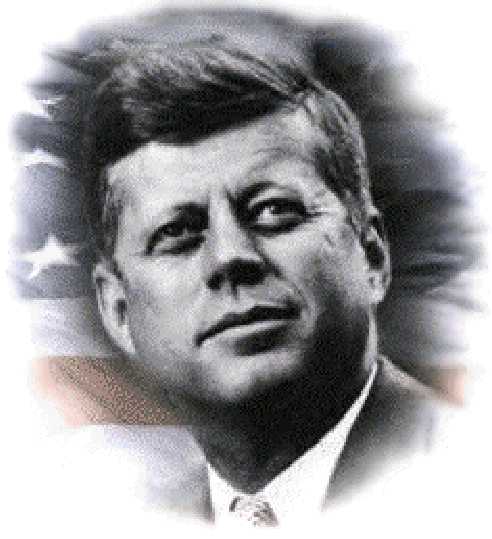
john_kennedy

For the past half century, the city of Dallas, Texas has been defined by three elements: the Dallas Cowboys, the television show “Dallas” and the assassination of the country’s 35th president, John F. Kennedy.  I’ve always admired Kennedy.  He was a true military hero who barely survived World War II.  He was witty and charming with a strong vision for America’s future.  In his inaugural address, he uttered the most inspirational words I’ve ever heard: “And so, my fellow, Americans, ask not what your country can do for you; ask what you can do for your country.”  It was a challenge for a country that – although already accustomed to them – to do more.  It’s certainly something this nation, filled with self-righteous individuals, needs today.  It’s why I vote regularly and speak out when I see injustice.  If you want your society to work for you properly, you have to be willing to do something right for it.

Several years ago, while working my first job as a package clerk at a nearby grocery store, a woman from California asked me how I felt about the city of Dallas.  It was a curious question.  But, it was her first trip to Texas, and she just wanted to know.  She mentioned that, in her native California in 1963, her fellow citizens immediately came to loathe the city of my birth and the entire state of Texas.  She saw people hurtle rocks and bottles at a couple of cars that bore Texas license plates.  Then, I told her I was only 17 days old on the day Kennedy died and that my mother had seen the presidential motorcade race by the garage apartment where we lived on its way to Parkland Hospital – though at the time, she had no idea what had just transpired.  She was nursing me and had sat down to watch “As the World Turns” – a program she’d become addicted to while on maternity leave – and just happened to hear the sirens in the distance; blaring through the open bathroom window.  Not until she returned to the front room to resume watching her show and Walter Cronkite interrupted did everything change.

The California woman – a blonde in her early 40s – froze.  The event became personal again.

It’s a good thing for a city to be associated with a great sports team.  After the horror of the Kennedy assassination, the Dallas Cowboys had the burden of transforming the city into “America’s team.”  Its image as a real estate and oil metropolis were certified in “Dallas,” one of the cheesiest programs the American entertainment community has ever produced.  Fortunately, I know the real Dallas, and I’m happy to announce it’s not that bad.  This place of nearly 2 million people is a blue enclave in a red state.  The city boasts a non-White majority population that still trends Democratic in presidential elections.  In 1995, Dallas elected Ron Kirk as mayor, the first Black to hold that office.  In 2004, Dallas County elected Lupe Valdez as its first Hispanic, female and openly gay or lesbian sheriff.  Two years later it elected Craig Watkins as its first Black district attorney.  There are two schools named after Kennedy here: Kennedy-Curry Middle School and John F. Kennedy Learning Center.  It’s a city with a diverse population and an international reach.  Yes, it boasts its share of crackpots.  Show me a city this size that doesn’t and I’ll show you a pile of rocks.

When word about Kennedy’s death spread throughout my father’s workplace, a printing company on the edge of downtown, an older man groused that Kennedy deserved to be shot because he was Catholic.  My father, then in his early 30s and unafraid to speak his mind, snapped back, “You son of a bitch!  He was our president!”

Several years ago, while working as a contractor for a government agency, my company’s liaison – a hard-right Republican who almost got teary-eyed whenever he mentioned Ronald Reagan’s name – unexpectedly commented that the Kennedy assassination was “one of the best days in this country’s history.”  The three of us standing there with him – my supervisor, a coworker and me – were literally startled.  The statement had come out of nowhere.

Even I who despised Ronald Reagan got scared when he was shot in 1981.  “No!” I announced to the man, while standing beside my supervisor.  “The day Kennedy was shot was one of the worst days this country has ever experienced!”  I reiterated how, on the day Reagan fell victim to a crazed gunman, I was glued to the television.  My mother arrived home from work and sat down to watch a local broadcast – and began to cry.  It had only been a little more than 17 years since Kennedy’s death, and the nightmare had been rejuvenated.

I stormed out of my supervisor’s office, genuinely pissed off, and returned to my desk.  The man, twice my size with an equally imposing voice, followed me and meekly apologized.

Every major metropolitan area has its extremists; its cache of lunatics who are filled with vile against anyone and anything they don’t like.  There were certainly plenty of them in Dallas in the early 1960s.  But, the nation was at the start of a cultural tumult, and such types filled a lot of cities, especially in the Deep South.  It had been a century since the start of the Civil War, and many White Southerners didn’t like the thought of Negroes gaining equality.  When Lyndon Johnson and his wife, Claudia (whom Lyndon affectionately dubbed “Lady Bird”), visited Dallas in September of 1960, they were met, in part, by a hostile crowd.  Although a native Texan and then-Senate majority leader, Johnson was vilified by some folks as duplicitous in a liberal Yankee agenda (e.g. civil rights for Negroes) by agreeing to run on the Kennedy ticket.  As the Johnsons exited a downtown theatre, a young woman lunged forward and snatched Mrs. Johnson’s white gloves from her dainty hands.  Lady Bird’s face turned as white as the gloves that ended up in a sewer.  The senator hustled his wife into a waiting car and hurtled an invective back towards the angry crowd.

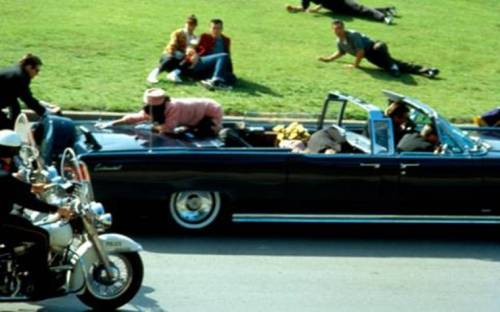
When Kennedy died, it had been 13 years since someone made a concerted attempt to assassinate a sitting U.S. president; 18 years since one had died in office; and 62 years since one had been killed.  At age 43, Kennedy was the youngest man ever elected to the U.S. presidency, the first born in the 20th century – and the last to die in office.  His death shocked the nation – and the world – into a new, more brutal reality.  Few could fathom such evil in those days.  Kennedy’s vision for a better nation held so much hope.  That a lone gunman with a Napoleonic complex could possibly destroy the beautiful stones of Camelot with three bolts of lead hadn’t entered the public conscious.

When I was a senior in high school, an English teacher told me everything that erupted in the 1960s had been brewing the previous decade; a time many still view through a delicate stained glass window.  Historians and various cultural observers now agree that Kennedy’s assassination is when the 1960s actually began.  The moment a bullet pulverized the skull of the handsome, young president and compelled his beautiful, glamorous wife to clamber onto the back of the limousine to gather the bloody fragments – like a tomboy collecting rocks – is when that stained glass window shattered.  The patriotism of the 1940s and the economic security of the 1950s collapsed into the reality of a cold, dispassionate universe.  As a whole, Americans realized the nation hadn’t lived up to its ideals of equality and freedom for all.  The Watergate scandal then seemed to confirm things aren’t always how they seem, and we needed to start questioning authority.

The exact moment when everything changed in America.

The exact moment when everything changed in America.

What’s often ignored about Kennedy’s visit to Texas is the overwhelming joy with which he and his wife, Jacqueline, were greeted.  When the couple arrived in neighboring Fort Worth late on November 21, a large, enthusiastic group had gathered in the rain to see them.  As the motorcade cruised through downtown Dallas on that bright, sunny Friday afternoon, hundreds of people lined the streets; waving and cheering.  At one point, Nellie Connally, the wife of Texas governor John Connally, turned to the president and gleefully pointed out that Dallas enjoyed the First Couple’s presence.  They did; they really did.

Several years ago someone painted a white X in the middle of Elm Street, identifying the exact spot where Kennedy was hit.  Somehow that dubious insignia withstood rain, sleet, triple-digit temperatures and Dallas drivers.  Recently, however, the city paved over it as part of a concerted infrastructure improvement plan.  But, it was also a symbolic move.  No, Dallas can’t just get over what happened here on this day five decades ago; pretending it was nothing more than a rough afternoon.  Yes, we grieve today about one of the most tragic events of the 20th century.  That’s the honorable thing to do.  But, we also need to consider Kennedy’s view of a better world – and then move forward.  We have no other choice.

aUYtZ1cxTTNkb0Ux_o_tx-wx-20120721---texas-weather-share---sunrise

John F. Kennedy Presidential Museum and Library

1 Comment

Filed under Essays