
I saw news of that new “Aging App” that can show what you’ll look like in 20 years. So I thought, what the hell, and tried it out. It came back with this shit:

Fucking technology!
I saw news of that new “Aging App” that can show what you’ll look like in 20 years. So I thought, what the hell, and tried it out. It came back with this shit:
Fucking technology!
Filed under Wolf Tales
Although I consider myself as American as apple pie, baseball and ravioli, I frequently watch foreign television networks; mainly as a matter of desire for knowledge of other cultures, but also in case I need to evade bill collector. I was channel-surfing the other night and happened upon Univision where I saw a commercial a Mexican cologne for men – “Chorizo Splash.”

Filed under Wolf Tales
Hummingbirds occupy that rare place where tenacity, beauty, grace and mysticism collaborate to create something extraordinary. Australian photographer Christian Spencer has used his camera to capture all of that in a new manner. A longtime resident of Brazil’s Itatiaia National Park for nearly two decades, Spencer has photographed many of the region’s natural wonders, including hummingbirds. Recently, he discovered a unique way to combine his love for the birds with sunlight. In a series entitled ‘Winged Prism’, Spencer photographed light filtered through the wings and tail of a black and white Jacobi hummingbird. In a Photo Shoppe world, this is truly unique and breathtaking.







Filed under Art Working

I keep having to look at the slew of calendars I have scattered throughout the house – the National Geographic, ASPCA, military veterans and one displaying houses I get every year from my real estate friend. They all assure me of the same thing: it’s 2019 – not 1919. Or 1969. Or even 1999. Nope! It’s 2019, my friends. We’re at the end of the second decade of the 21st century. Oh wait! Yes. I had to check again: 2019 – the two and the zero being the key factors here.
I have to do this because of the recent series of tirades Donald Trump has lavished upon certain members of Congress. Would somebody get the damn phone away from him?!
As if anyone should be surprised, our Dear Leader hasn’t quieted down verbal attacks against non-Whites who dare to speak their minds against him. Via his Twitter feed while safely ensconced in the White House, he created quite a stir recently, when he assailed four alphamore U.S. congresswomen, Alexandria Ocasio-Cortez, Ilhan Omar, Ayanna Pressley and Rashida Tlaib. Denouncing them as “The Squad”, he became enraged, after they criticized him for his response to the growing migrant crisis along the southern border – among other issues.
Ocasio-Cortez had already identified herself as a socialist when she won New York’s 14th Congressional District, which includes parts of the Bronx and Queens boroughs – both of which have large non-White populations. In fact, I think non-Hispanic Whites are so scarce in the Bronx they might qualify for endangered species status.
Trump didn’t hold anything back when he assailed the four congresswomen (an attribute his devotees love) that, if the lawmakers “hate our country,” they can “go back” to the “broken and crime-infested” countries “from which they came”. For the record, Ocasio-Cortez, Pressley and Tlaib were all born and raised here in the United States; thus making them, well, natural-born Americans. Omar emigrated to the U.S. with her family as a child; the clan fleeing their Somali homeland, as it sunk further into political and social chaos. But she is now an American citizen. Omar has been openly critical of Israel’s treatment of Palestinians, which garners the usual cries of anti-Semitism from all sides. But a statement about the 09/11 terrorist attacks as “some people did something” makes me think suspiciously of her. Yet, one has to look at that verbiage within the context of her entire speech. To her credit, she’s also said: “I do not blame every single white person when we have a white man who massacres children at a school, or moviegoers in a movie theatre. And I think this really horrendous narrative that says, as a Muslim, I’m supposed to explain, apologize, for the actions of someone who’s also terrorizing me, is absurd.”
Now Trump has gone after Congressman Elijah Cummings who represents Maryland’s 7th District, which includes Baltimore. Describing the majority-Black area as a “rodent-infested mess” where “no human being would want to live”, he drew widespread condemnation from Democrats and independents. I don’t know what incited that particular discourse, but it’s obvious Trump likes to play the proverbial race card when things get rough in the political arena, which is something like, oh…100% of the time. And I’ve found that, if you go for the jugular by mentioning race, ethnicity, gender or sexuality, you’ve essentially lost the debate. You’ve run out of legitimate things to say; you’ve exhausted your gallery of facts and logical points, but you want to keep arguing because you just absolutely have to have the last word.
As I’ve stated before, not everything wrong with America is the fault of White males. But again, I have to look at one of my calendars. Seriously?! We’re still dealing with this shit in 2019?! I heard that “go back” crap when I was in high school! It was a similar comment from a fellow student that propelled me into my first and only fight in high school – towards the end of my senior year. During my alphamore year a substitute teacher said my last name is un-Christian. I took that up with the school principal before I told my parents about it. I was concerned my proud father would go to the school and want to kick some old White ass.
I heard a little less racist language while in college. Key words – “a little less”. Occasionally, some idiot would throw a “you people” in my face, and I was just as quick to slur right back at them. By the 1990s, ironically, the people slinging racist vitriol at me the most were Black or other Hispanics.
So, how is it that this kind of talk has worked its way back into the mainstream? Retro may be cool in some nightclub situations, such as retro-70s. (I try to ignore “Retro 90s” nights!) But it’s not necessarily cool with a spoken language. Never mind that Trump’s “go back” comment might be illegal in a workplace setting. I’m still perplexed that we’ve gone from No-Drama-Obama to Czar Trump in a virtual blink of our collective eyes.
But, after 200 or so years of civil rights progress, it seems we’ve now started rolling backwards. To we Trump detractors, this is not news. Trump had pumped fuel into the “Birther” movement: the band of morons who questioned the birthright of President Obama. He never acknowledged he’d been wrong when he said his “researchers” had learned some odd things about Obama. Yet, he sat in the Oval Office next to Obama and called him a great man. Amazing how brave some people get when they’re behind a phone or a computer, isn’t it? It’s so different in person.
Thinking back to my high school tenure doesn’t bring back many good memories. I was so shy and introverted I often fell prey to bullies. So I try NOT to think about that period. It was so long ago anyway. Yet, that “go back” shit slammed into my conscious harder than seeing a Windows 3 screen.
My mother used to recount the number of times people had called her “half-breed” because her father was German-American and her mother was Mexican. My father told me of the day an older White woman at the printing shop where he worked said she saw “a bunch of Mexicans” working on a lawn and thought of him. He responded by saying something like, “Well, I saw a herd of cows in a field on my way to work and thought of you.”
A friend of mine once asked how is it that, in such a large city as Dallas, our fathers happened to know each other.
“All those old Mexicans knew each other!” I replied. “They were all crammed into the same neighborhoods and went to the same schools. They had to stick together. It was a matter of survival.”
She’s only a few years younger than me, and my answer seemed to surprise her. But she understood what I was saying.
In high school – and to some extent, even in college – I often felt isolated because I was one of the few Hispanic kids. But I was as much American as I was then and still am now. Some of my Spanish ancestors were here in Texas long before the Mayflower pilgrims; my Indian ancestors long before them. So I always pulled that from the depths of my mind whenever some fool threw a “go back” at me.
I suspect Donald Trump’s presidency is the final battle cry of the “Angry White Male” – the withering group of individuals who still feel they should run everything and should be allowed to say what they want. But, as a mostly White male myself, I know Trump gives all White men a bad name. I’ll never criticize people who voted for him in 2016. They had that right, and it’s not up to anyone else to decide what their selection should be. I definitely disagree with a recent essay by Pastor John Pavlovitz about Hillary Clinton’s “deplorables” comment three years ago.
But still…“go back”? I’m hearing that again? From the president of the United States? Pardon me just a moment. Yes…still 2019. Time just won’t stop or roll backwards, no matter how much we beg.
Filed under Essays
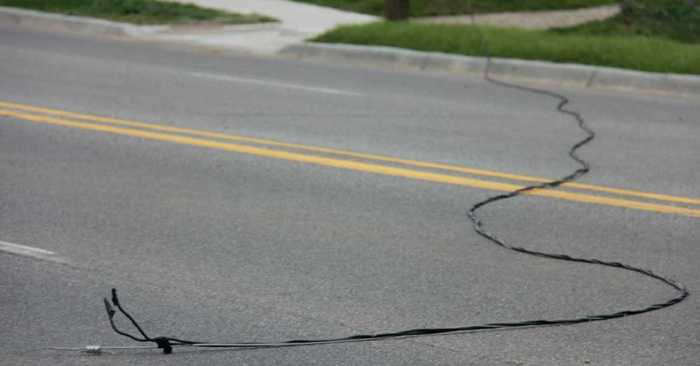
Weather-wise, Sunday, June 9, 2019, was supposed to be like Saturday, the 8th – hot and dry. But I awoke that morning to a surprisingly silver-gray sky. And I was startled around 12:30 local time, when the winds abruptly accelerated. Within minutes hot and dry became wet and windy – and destructive. Weather systems, of course, don’t always follow mortal meteorological predictions, and Sunday, June 9 is a prime example. The sudden storm surprised even the most…ahem…seasoned local weather forecasters, as it engulfed the entire Dallas / Fort Worth metropolitan area. Heavy winds shattered windows, dislodged massive trees, and – as anyone would expect – downed a multitude of power and telecommunication lines.
Literally tens of thousands of people suffered power outages for days; some not seeing it return until the following Friday. Local utility companies had to seek outside help; both clearing debris – mainly the millions of shredded tree branches – and reinstalling power lines. Many businesses remained shuttered for lack of power; thus costing millions in lost products (entire grocery stores had to be cleaned out, for example) and lost time.
One of my elderly aunts had no power for a couple of days and no landline telephone service for four days. She had her cell phone, but as a widow living alone in a small, darkened 70-plus-year-old house, she was frightened. Another aunt and uncle went without power for more than a day. My uncle is old school in that he had stocked up on candles, flash lights, batteries and bottled water – all to accompany a generator and some firearms. If it hadn’t been for that generator, everything in their refrigerator would have spoiled. That happened to literally thousands of people across the area in the days following the storm; including a friend of mine who had no power for four days. Like the aforementioned aunt, he also had a cell phone, but unlike the other two relatives, he has no generator. So he sweltered, while throwing out good food and prayed no one would sneak into his house at night. He didn’t go to work because he feared someone would do just that, while he was gone during the day.
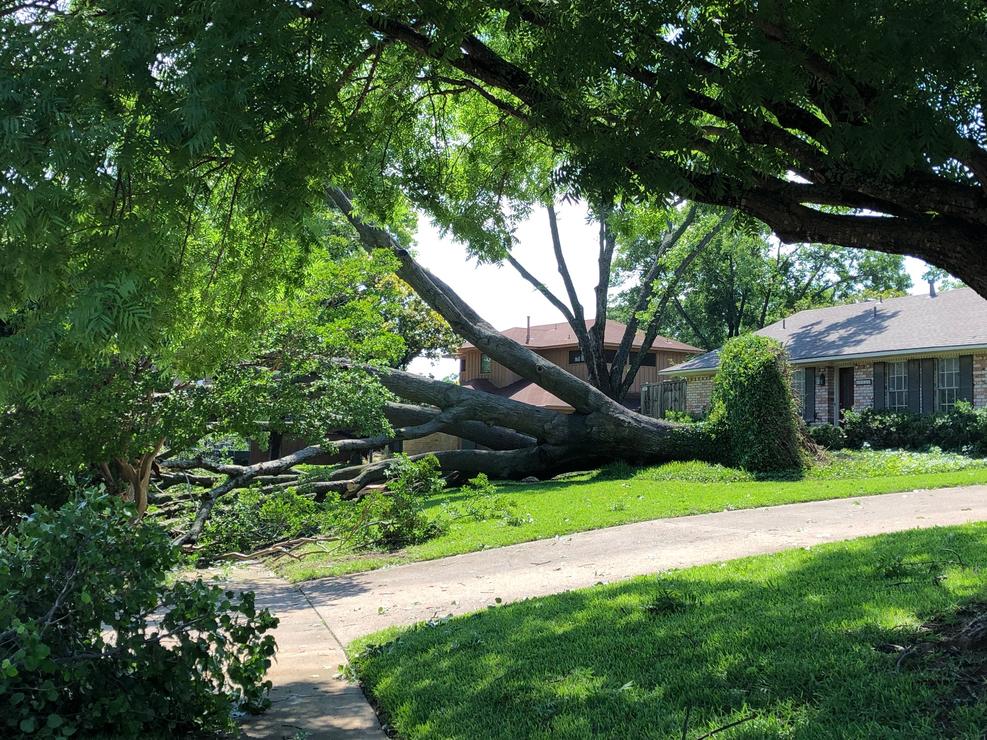
In 2018, a series of catastrophic wildfires terrorized California. The Golden State has become accustomed to annual fires, but last year proved especially brutal – and deadly. The blazes killed more than 100 people, consumed some 1.8 million acres (728,420 ha) of land, and cost roughly USD 3 billion. In at least one instance, power lines weren’t just a casualty of fire; they were the cause. The “Camp Fire” in Northern California was the worst of all the events; killing 85 people and destroying more than 13,000 structures. The town of Paradise, for example, was almost completely incinerated. It all might have been avoided, if some power lines hadn’t been live when they were toppled by high winds. Recently, California’s Pacific Gas & Electric agreed to pay $1 billion in damages to the U.S. government.
This year has already proven both deadly and costly in terms of natural disaster. Unusually heavy rains have generated massive flooding events across the country; especially, though, in the massive Mississippi River Basin and its tributaries. Records are being broken in almost every state with rainfall and high water levels. Here in Northeast Texas we’re coming to the end of one of the wettest springs since data has been gathered, starting in the 1880s. The heavy rainfall has been great for lakes and dams, but there really is something called too much of a good thing. Flooding isn’t just forcing people out of their homes. It’s also drowning farming and ranch land; flushing out sewer systems; and shutting down highways. And, as always, power and telecommunication lines are among the victims.
I’m fully aware that we mere mortals can NOT control the weather, even though we think we can. As much as we believe our latest digital and electronic machinery, coupled with a ubiquitous cybercloud, can now predict where every hurricane will make landfall and which weather system will cause flooding, we still have no means of controlling any of nature’s wrath. Yet, it’s hard for me to believe that, at the end of the second decade of the 21st century, we’re still dealing with downed power and telecommunication lines for long periods of time.
I’m not the first to speculate openly about this dilemma. A variety of individuals – from average citizens to seasoned utility experts – have proposed interring as many power lines as possible throughout the U.S. One factor, however, always rears its ugly head with each debate: money. Time and labor are also critical elements – which of course, tie back into funding. It seems rather simple on the face of it: dig as many trenches as possible and bury those lines in some kind of sturdy container. But, as the old saying declares, everything looks great on paper.
In 2011, the Public Service Commission of Wisconsin published a report, “Underground Electric Transmission Lines”, in which they state, “The estimated cost for constructing underground transmission lines ranges from 4 to 14 times more expensive than overhead lines of the same voltage and same distance. A typical new 69 kV overhead single-circuit transmission line costs approximately $285,000 per mile as opposed to $1.5 million per mile for a new 69 kV underground line (without the terminals). A new 138 kV overhead line costs approximately $390,000 per mile as opposed to $2 million per mile for underground (without the terminals).”
How would any regional or state utility firm fund such an extreme difference? There are at least three immediate solutions:
All are plausible, but raising property taxes and utility rates is never popular. If you want to see riots in the streets, starting jacking up taxes and utility rates on people; most of whom already feel they pay too much for such services. I can empathize. As much as we need power companies, it’s a proverbial love-hate relationship. Kind of like what the U.S. has with Saudi Arabia.
Since the turn of this century, technical improvements with cable technology, grounding methods, and boring techniques have made the interment of power lines more possible. That is, from a technological perspective, that goal is within reach. But, remember that everything on paper analogy!
Initial costs for such a massive undertaking would have to go to planning and organizing. We can’t just grab a back hoe and some shovels and start digging. Deciding where and when to dig will take high-level planning from the most experienced infrastructure specialists. Determining how far down to dig is another conundrum, as they have to look for, say, local water tables and even old mining shafts. That alone will take years.
Once digging begins, a slew of other factors come into play: traffic disruptions, power outages and weather. In residential areas, homeowners would have to grant permission to dig on their properties. If they don’t allow it, how would a utility company get around that? Would they invoke the concept of “eminent domain”? Or would they somehow be able to avoid that particular property? And how much would that little detour cost? In any given neighborhood, one obstinate resident could delay the entire project – which, in turn, will cost money in lost time. If local governments force the eminent domain option on someone, the situation might result in pricy litigation. In worst case scenarios, it literally could turn fatal.
Knowing the U.S. federal government – that is, knowing its inability to budget wisely – the national debt could balloon under such a massive project. Our global credit rating – which suffered greatly after the 2008 economic downturn – might, once again, be adversely impacted.
On a national security level, it could put us in a vulnerable position. The city of Dallas, for example, with a population close to 3 million and home to a regional branch of the Federal Reserve Bank, could be in the midst of a major transfer of power sources (that is, switching to the new system) when a monster tornado strikes. New York City could find itself in the same situation when another 9/11-style terrorist attack occurs. San Francisco, home to another major branch of the Federal Reserve Bank, might be in the middle of construction when a catastrophic earthquake hits; much like the 1989 Loma Prieta temblor. Chicago, the third most populous city in the U.S. and home to one of the busiest international airports in the world, as well as a major shipping port on Lake Michigan, might also be mired in a construction mess when a powerful sunstorm knocks out communication satellites. Call me a pessimist, but we have to be prepared for those dreaded worst case scenarios, while hoping for the best results.
And that’s just the planning, construction and implementation of the systems. Time capsules are a fun and delightful project for school kids. But burying something like telephone lines comes with its own set of future costs and complications.
In their 2013 report, “Underground vs. Overhead: Power Line Installation-Cost Comparison and Mitigation”, Frank Alonso and Carolyn A.E. Greenwell, transmission line engineers with Science Application International Corporation (SAIC)*, highlighted and described these issues in detail.
“Maintenance. The cost of maintenance for underground lines is difficult to assess. With so many variables and assumptions final estimates would be subjective at best. Predicting the performance of an underground line is difficult, yet the maintenance costs associated with an underground line are significant and one of the major impediments to the more extensive use of underground construction.
Major factors that impact the maintenance costs for underground transmission lines include:
Cable repairs. Underground lines are better protected against weather and other conditions that can impact overhead lines, but they are susceptible to insulation deterioration because of the loading cycles the lines undergo during their lifetimes. As time passes, the cables’ insulation weakens, which increases the potential for a line fault. If the cables are installed properly, this debilitating process can take years and might be avoided. If and when a fault occurs, however, the cost of finding its location, trenching, cable splicing, and re-embedment is sometimes five to 10 times more expensive than repairing a fault in an overhead line where the conductors are visible, readily accessible and easier to repair.
In addition, easement agreements might require a utility to compensate property owners for disruption in their property use and for property damage caused by the repairs to the underground cables.
Line outage duration. The duration of underground line outages vary widely depending on the operating voltage, site conditions, failure, material availability and experience of repair personnel. The typical repair duration of cross-linked polyethylene (XLPE), a solid dielectric type of underground cable, ranges from five to nine days. Outages are longer for lines that use other nonsolid dielectric underground cables such as high-pressure, gas-filled (HPGF) pipe-type cable, high-pressure, fluid-filled (HPFF) pipe-type cable, and self-contained, fluid-filled (SCFF)-type cable. In comparison, a fault or break in an overhead conductor usually can be located almost immediately and repaired within hours or a day or two at most.
During the extended line outages required for underground line repairs, services to customers are disrupted. The length of customer outages can be mitigated using redundant feeders, but the duration of such outages is still longer than those associated with overhead lines, and they have additional costs associated with them.
Line modifications. Overhead power lines are easily tapped, rerouted or modified to serve customers; underground lines are more difficult to modify after the cables have been installed. Such modifications to underground power lines are more expensive because of the inability to readily access lines or relocate sections of lines.”
As overwhelming as it is, I still feel it’s a worthwhile investment. It’s a long-term process and a necessity for national security and prosperity. Establishing the first telecommunication infrastructure (telegraph lines) in the 19th century was a massive undertaking, but ingenuity and determination made it happen. Those same attributes were utilized with the construction of railroads and again with the interstate highway system. We did it with the lunar and space shuttle programs. Remember, the ancient Romans built the Colosseum in the 1st century C.E., most of which remains standing. But at least they had wheels and large beasts to assist them. The Mayans and the Aztecs built massive stone temples without wheels or draft animals. The U.S., or any developed nation, surely could place thousands of miles of power and telecommunication lines underground.
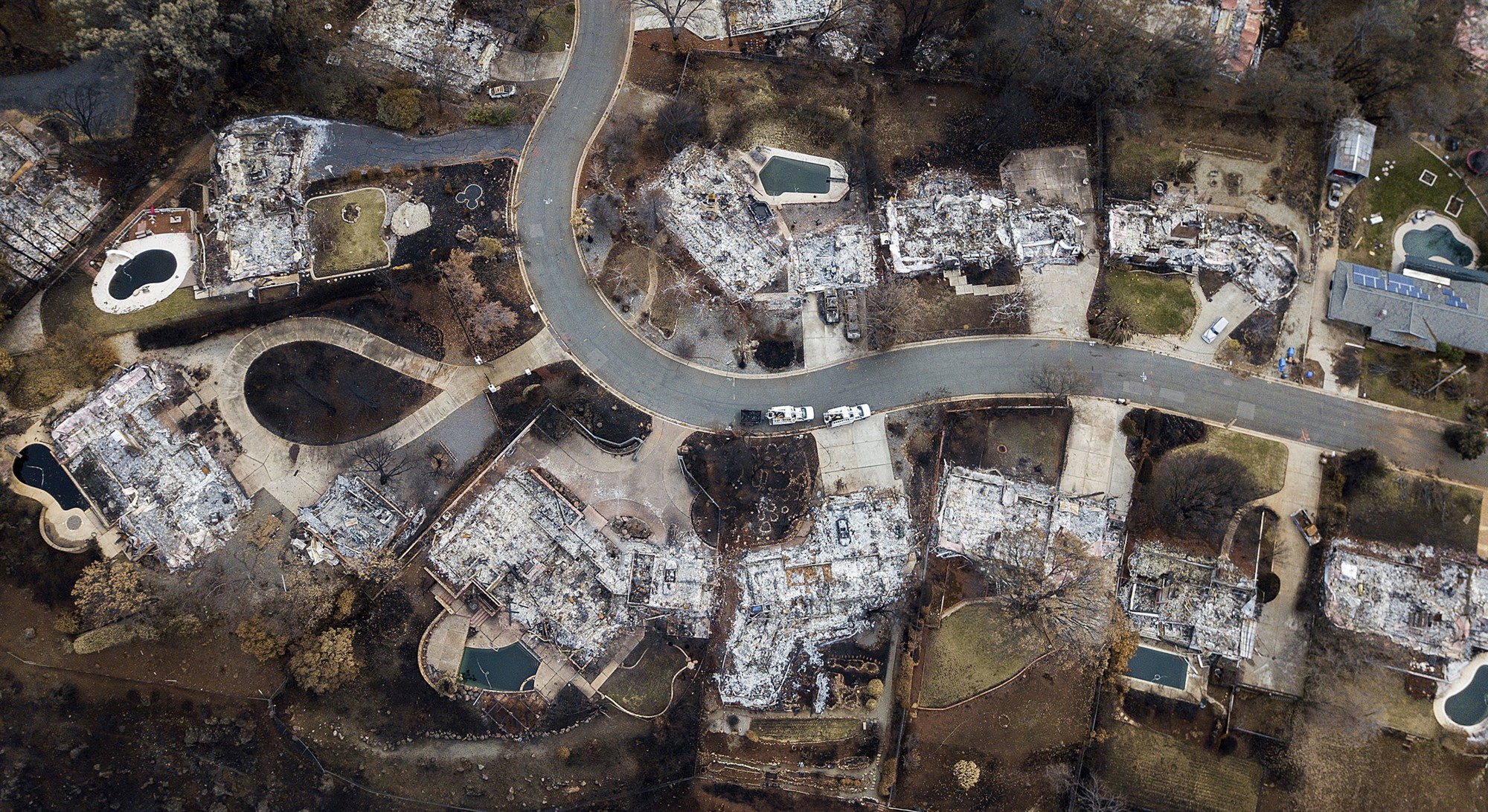
This series of photos shows the extent of the damage throughout the Dallas / Fort Worth area following the June 9 storm.
*Full disclosure: I worked at SAIC’s Dallas office from 2002 to 2010, first as a document scanner and archivist, then as a technical writer.
Filed under Essays
As a writer, I’ve often fancied myself the most popular book in the library and love it when people thumb through my pages!

Filed under Wolf Tales
While standing in a somewhat alien landscape called North Carolina (perhaps, at least to him) on May 28, 1900, Nevil Maskelyne probably thought of his artistic predecessors. The British magician knew that, just a century or so earlier, many people still thought a solar eclipse was an omen. But, for people like Maskelyne, an eclipse was the grandest trick of all – even if it was a natural phenomenon and not sleight of hand. And, in 1900, Maskelyne had a new device that he could surely add to his chest of magic: a celluloid camera.
Now, more than a century later, Maskelyne’s short film of that extraordinary celestial event has been digitally scanned and preserved in a collaboration between the Royal Astronomical Society (RAS) and the British Film Institute (BFI). Simply titled “Solar Eclipse”, it is believed to be the world’s oldest surviving astronomical film.
As a practicing magician, it’s no surprise Maskelyne realized the potential moving pictures bore, even at the dawn of the 20th century. He recognized the possibilities for both entertainment and education. His own interest in astronomy had led him to the RAS, where he became a fellow and traveled to North Carolina with an expedition to view – and record – the eclipse.
Viewing the eclipse – as people had done for millennia – was simple. But recording it with this new technology was not. The intuitive Maskelyne, however, didn’t let that deter him. Perhaps foreseeing the difficulty, he had designed a special lens attachment called a cinematograph telescope.
“He had previously taken out a patent for engineering equipment, so it’s not beyond the realms of possibility that he may have developed his own camera to capture this event,” said Bryony Dixon, BFI curator of silent film. But as the original British Astronomical Society report about the film doesn’t mention whether Maskelyne used a camera of his own invention to shoot the eclipse, “it’s something we’ll probably never know for sure.”
Despite the challenge, Maskelyne was still able to capture the exposure changes that occur throughout an eclipse.
“The diamond ring effect of the corona at totality* affects the exposure of the image,” Dixon said. “Maskelyne was able to change the exposure and camera aperture as the event occurred, tracing the gradual fading of the corona in increasing sunlight.”
After capturing the eclipse, Maskelyne screened the film for the Royal Astronomical Society at the Egyptian Hall in Piccadilly – London’s most popular magic stage at the time – as part of a larger program of magic illusionist acts.
In 2018 RAS archivists handed the film over to preservationists at the BFI, where they began the delicate process of digitalizing it. Each frame had to be meticulously and carefully copied onto 35mm film.
Although at only one minute long and in scratchy black and white, “Solar Eclipse” is yet another one of those rare treasures of early cinema; a moment that puts you back in time, more than a century ago, when the new medium of film held the promise of a new world of surprise and…well, magic. A door between the “old world” and a new century had opened.
*This refers to the “path of totality”, which is the track of the umbra (the fully shaded inner region of a shadow cast by an opaque object) on the Earth’s surface during a total eclipse.
See also: “Three Generations of Maskelyne Magicians”.
Filed under Classics

“I love magazines and film critics, so I eat it up. I’m not one of those people who says, ‘I never read anything.’ I generally read all of it.”
“I’m convinced that it’s energy and humor. The two of them combined equal charm.”
“Surely the whole point of writing your own life story is to be as honest as you possibly can, revealing everything about yourself that is most private and probably most interesting for that very reason.”
“Have some sort of private place to work in. Put up a sign to keep from being interrupted. Mine says: ‘Please, do not knock, do not say hello or goodbye, do not ask what’s for dinner, do not disturb me unless the fire or policemen have to be called.’”
“Thousands of people plan to be writers, but they never get around to it. The only way to find out if you can write is to set aside a certain period every day and try.”
“Some questions are not meant to be asked as long as the answers are right.”
“The rich are different only because people treat them as if they were.”
Filed under News
“How did the giant tarantula get to the other side of the lake?”
“It swam! How else is it supposed to get there? Levitate?”
“Hey! What’s that eight-legged monstrosity doing in the water?!”
“The front stroke, you dipshit!”
“Besides water, what do humans and spiders have in common?”
“Not a damn thing!”
“What do you say to a king-sized spider about to jump in the river?”
“Nothing, you moron! You just get the hell out of there!”
“What did the titanic tarantula say to the trout before eating it?”
“How the hell should I know?! I don’t get that close to spiders! Or fish!”
Filed under Curiosities

I recently learned something disturbing. My neighbors’ pet rooster gets off watching fried chicken commercials. And I thought, “Wow! Dark meat!”
Image by: Scheherazadenerai
Filed under Wolf Tales
 Chief Writing Wolf